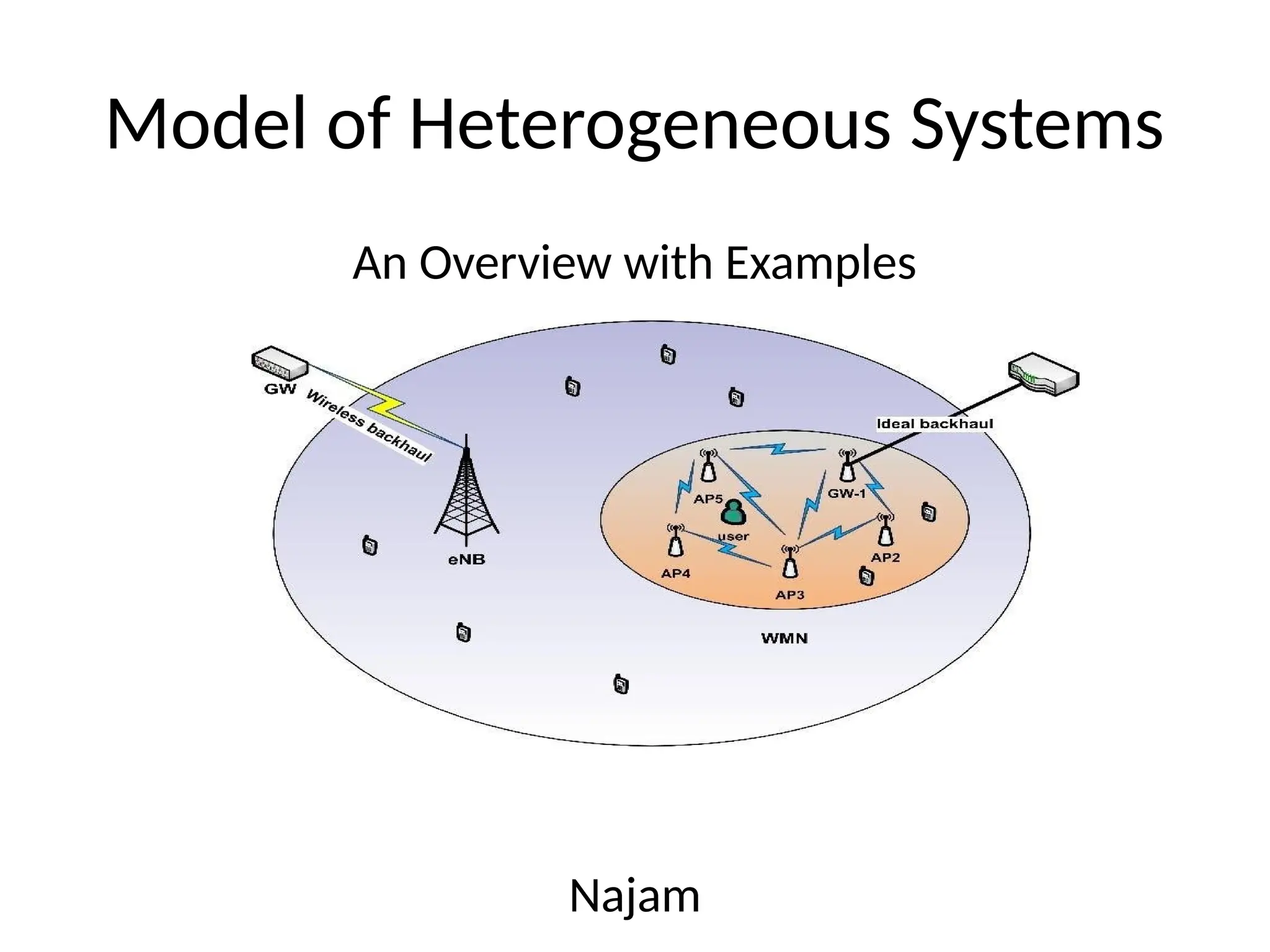
Model of Heterogeneous Systems
An Overview with Examples
Najam
Introduction
• Define heterogeneous systems.
– A heterogeneous system is a system that contains
multiple components that are different from each
other. Heterogeneous systems can be found in
computing, thermodynamics, and other fields.
• Examples:
• CPUs, GPUs, FPGAs working together.
• Key features:
• versatility, flexibility, and performance.
Importance of Heterogeneous Systems
• Why are they important in modern computing?
– Computers are vital in modern computing because
they enable efficient data processing, storage, and
communication, facilitating seamless operations across
various sectors like business, healthcare, education, and
research, ultimately driving innovation, productivity, and
global connectivity in our society.
• Examples:
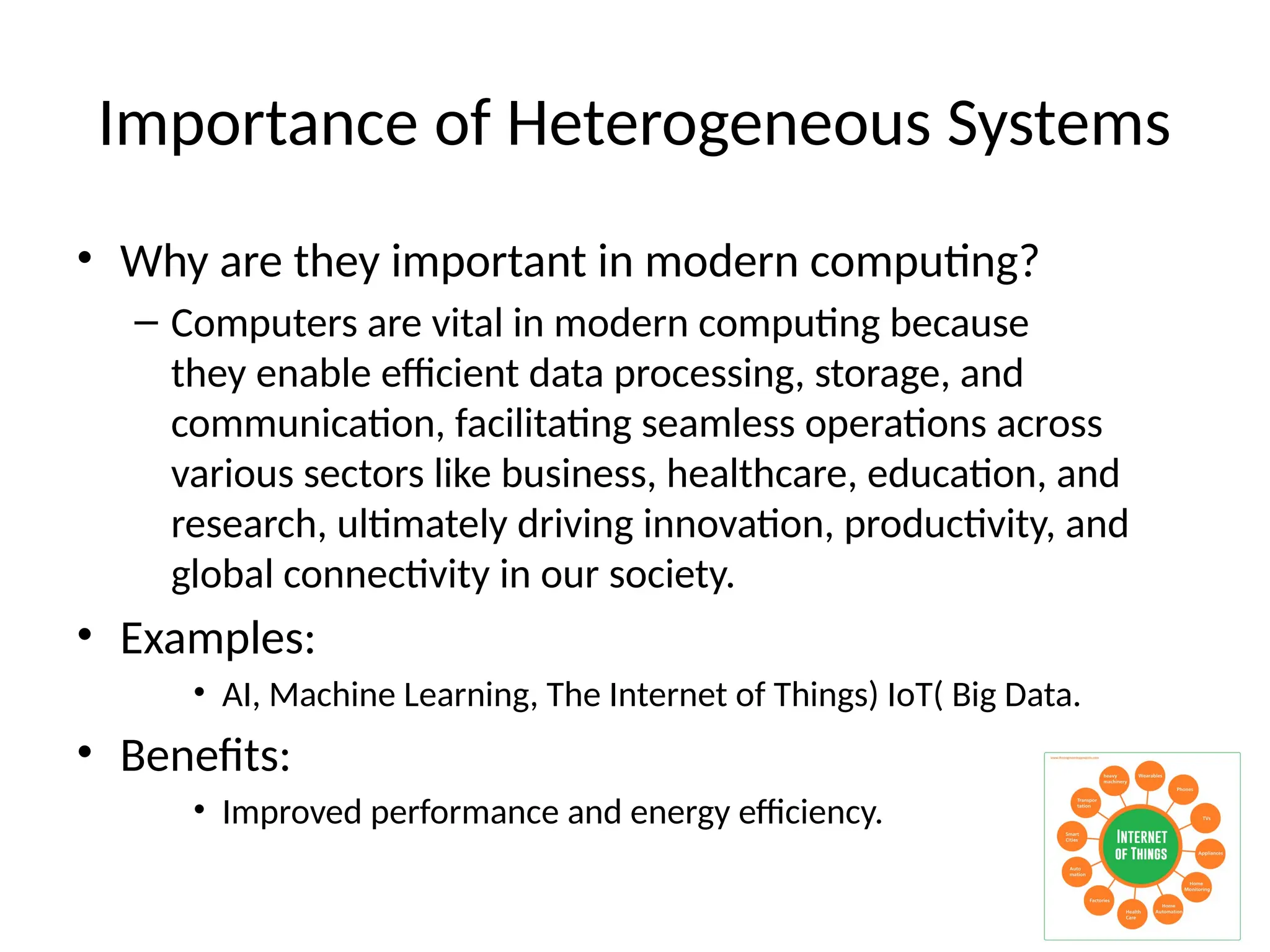
• AI, Machine Learning, The Internet of Things) IoT( Big Data.
• Benefits:
• Improved performance and energy efficiency.
Components of a Heterogeneous System
• CPU, GPU, FPGA, ASIC.
– A CPU (Central Processing Unit) is the primary processing unit in
a computer, handling general computing tasks, while a GPU
(Graphics Processing Unit) is specialized for graphics rendering,
an FPGA (Field Programmable Gate Array) is a reconfigurable
chip that can be customized for specific applications, and an
ASIC (Application-Specific Integrated Circuit) is a custom-
designed chip optimized for a single, specific task; all are types
of computer processors with varying levels of flexibility and
performance depending on their intended use.
• Communication Interfaces: Bus, Network-on-Chip.
• Examples: Nvidia CUDA, AMD ROCm.
Architecture Overview
• Shared vs. Distributed Memory.
– Shared memory and distributed memory are two
different architectures used in computer
systems. Shared memory systems are better for low-
latency communication and data sharing, while
distributed memory systems are better for scalability
and fault isolation
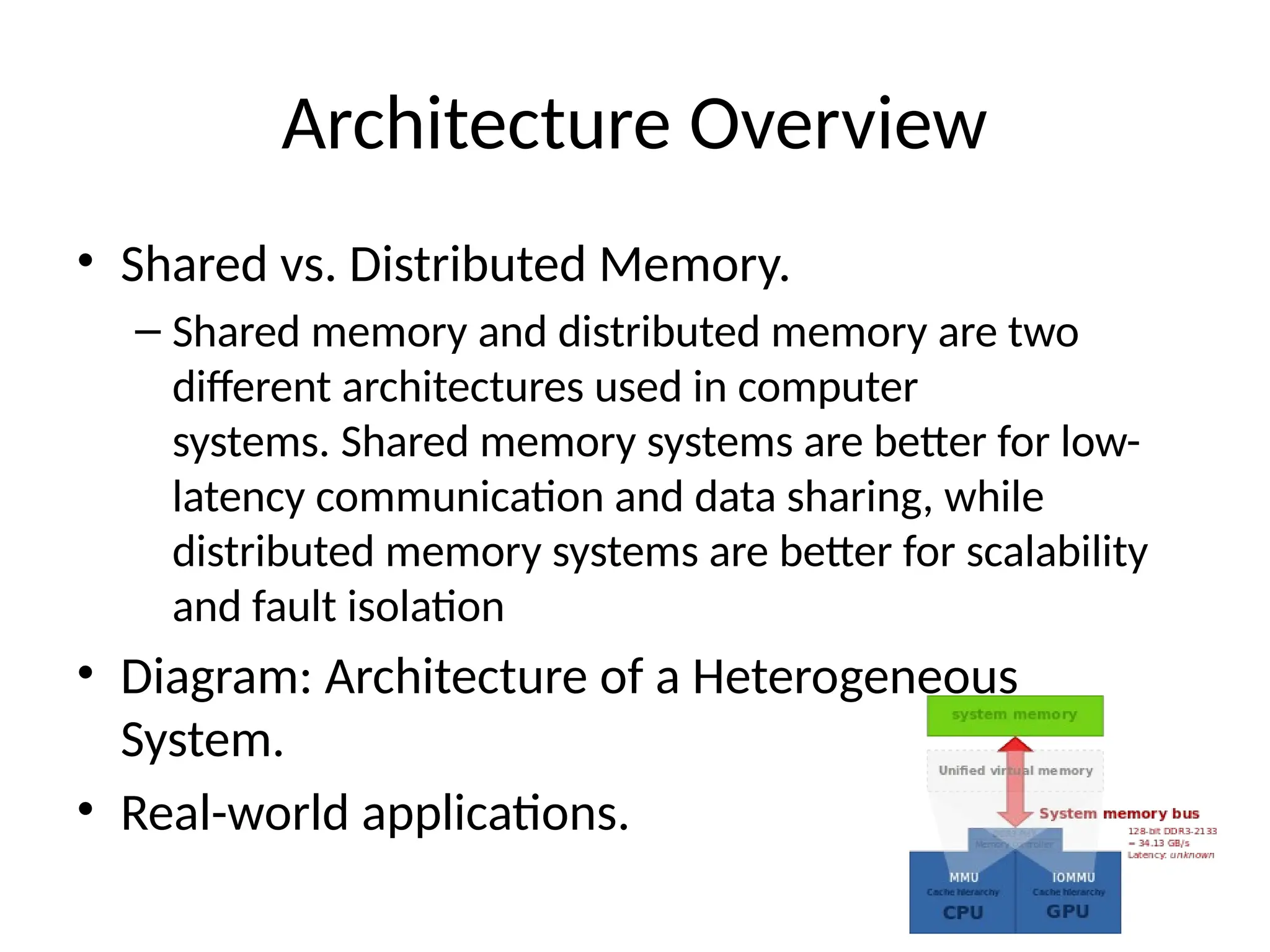
• Diagram: Architecture of a Heterogeneous
System.
• Real-world applications.
Programming Models
– A "programming model" refers to a conceptual
framework that outlines how software developers
should structure, write, and execute code to build
applications
• Examples:
• OpenCL, CUDA, and OpenMP are all programming models
for parallel computing. OpenCL is an open standard, while
CUDA is a proprietary API developed by NVIDIA. OpenMP
is a set of compiler directives and library routines.
• Use-case examples in industries.
Challenges in Heterogeneous Systems
• Compatibility issues.
• Programming complexity.
– Key challenges in heterogeneous systems
include: managing different hardware architectures and
instruction sets, ensuring data compatibility across diverse
sources, complex programming models due to varying APIs,
difficulty in load balancing across different compute units,
potential for synchronization issues, and the need for
specialized knowledge to optimize performance across
diverse components
• Examples of overcoming challenges.
Examples of Heterogeneous Systems
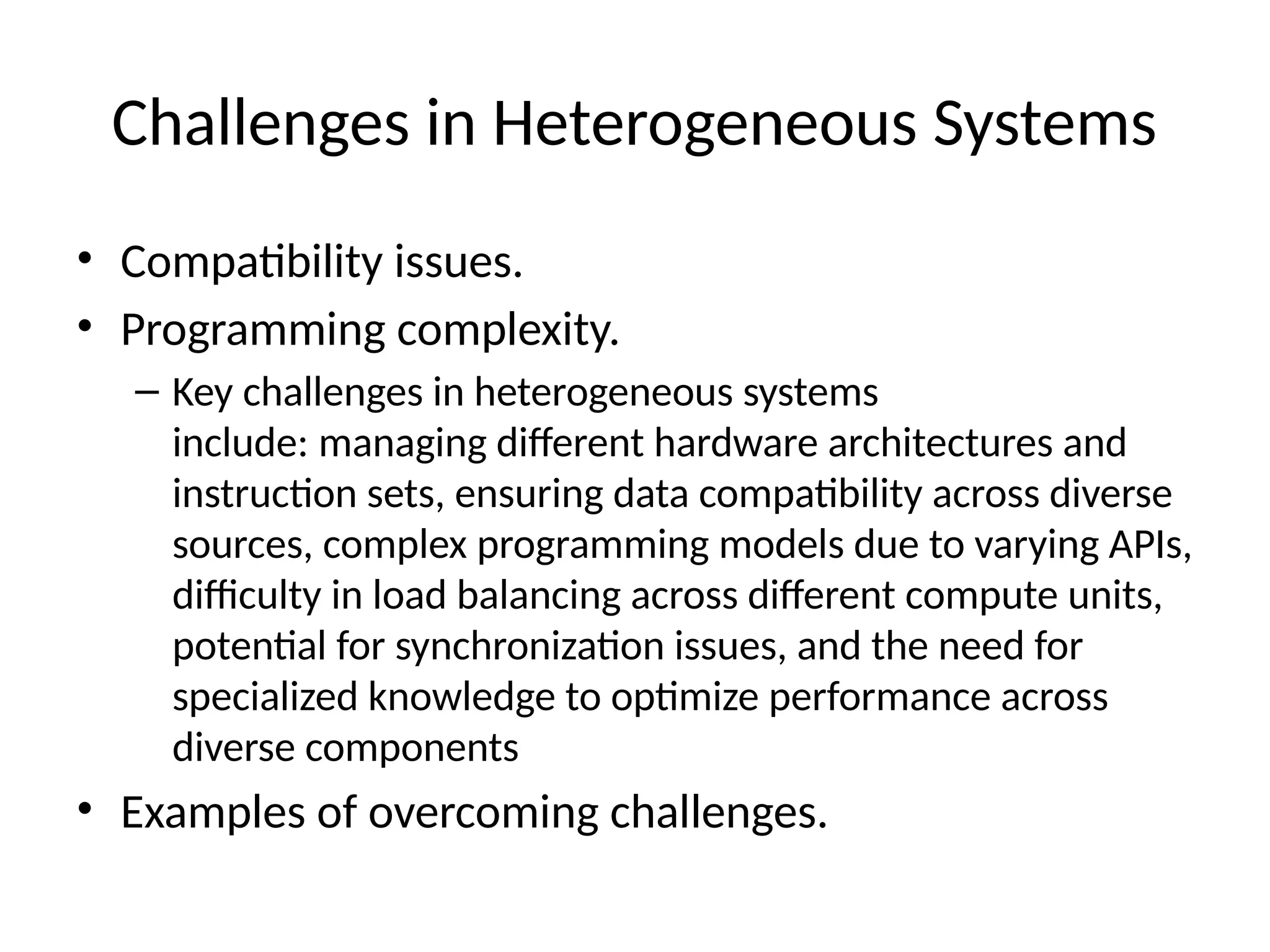
• Nvidia DGX systems.
– NVIDIA DGX systems are supercomputers that are
designed to power artificial intelligence (AI) and
machine learning. They are used by many leading
enterprises to develop AI solutions.
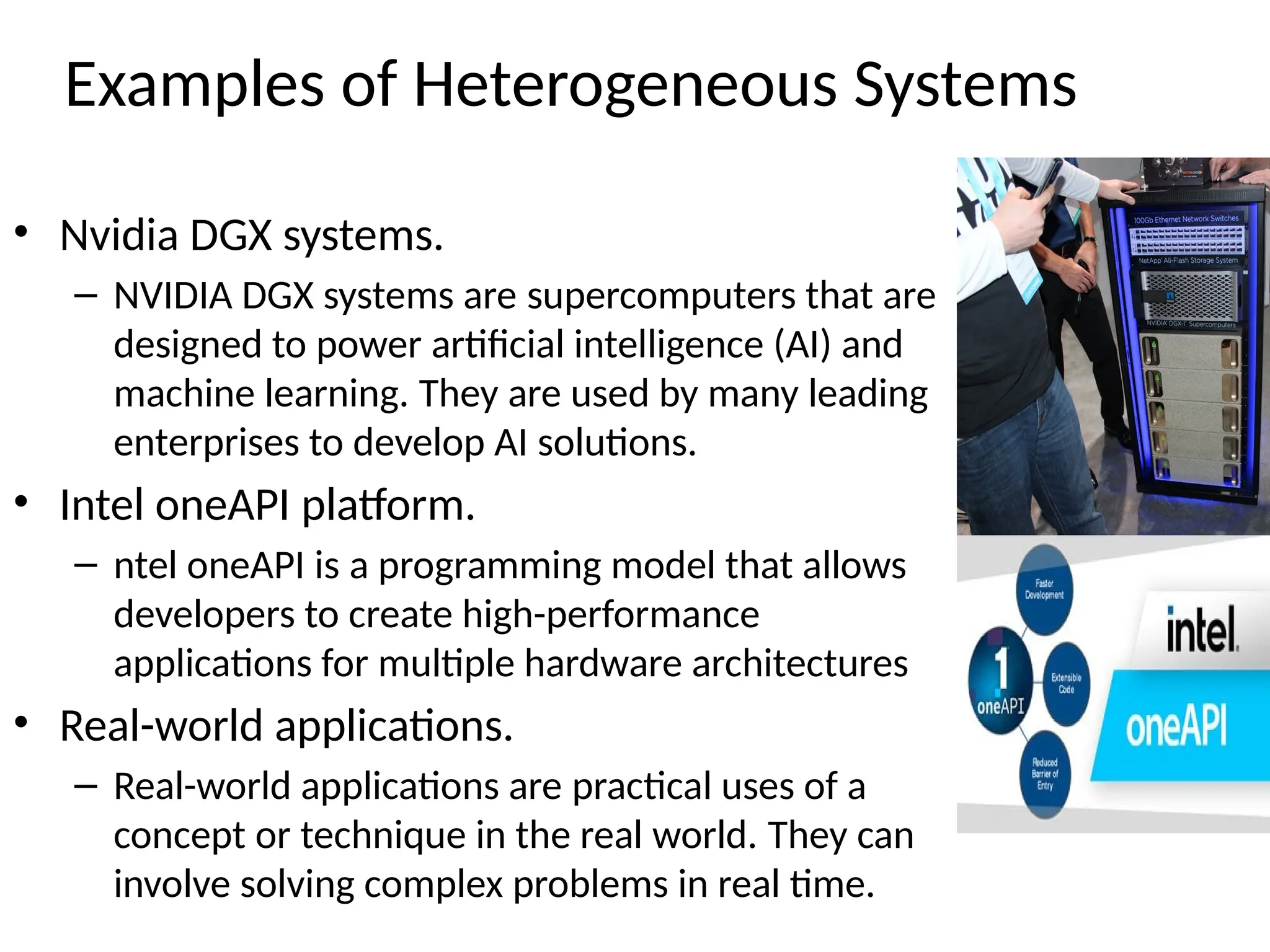
• Intel oneAPI platform.
– ntel oneAPI is a programming model that allows
developers to create high-performance
applications for multiple hardware architectures
• Real-world applications.
– Real-world applications are practical uses of a
concept or technique in the real world. They can
involve solving complex problems in real time.
Future of Heterogeneous Systems
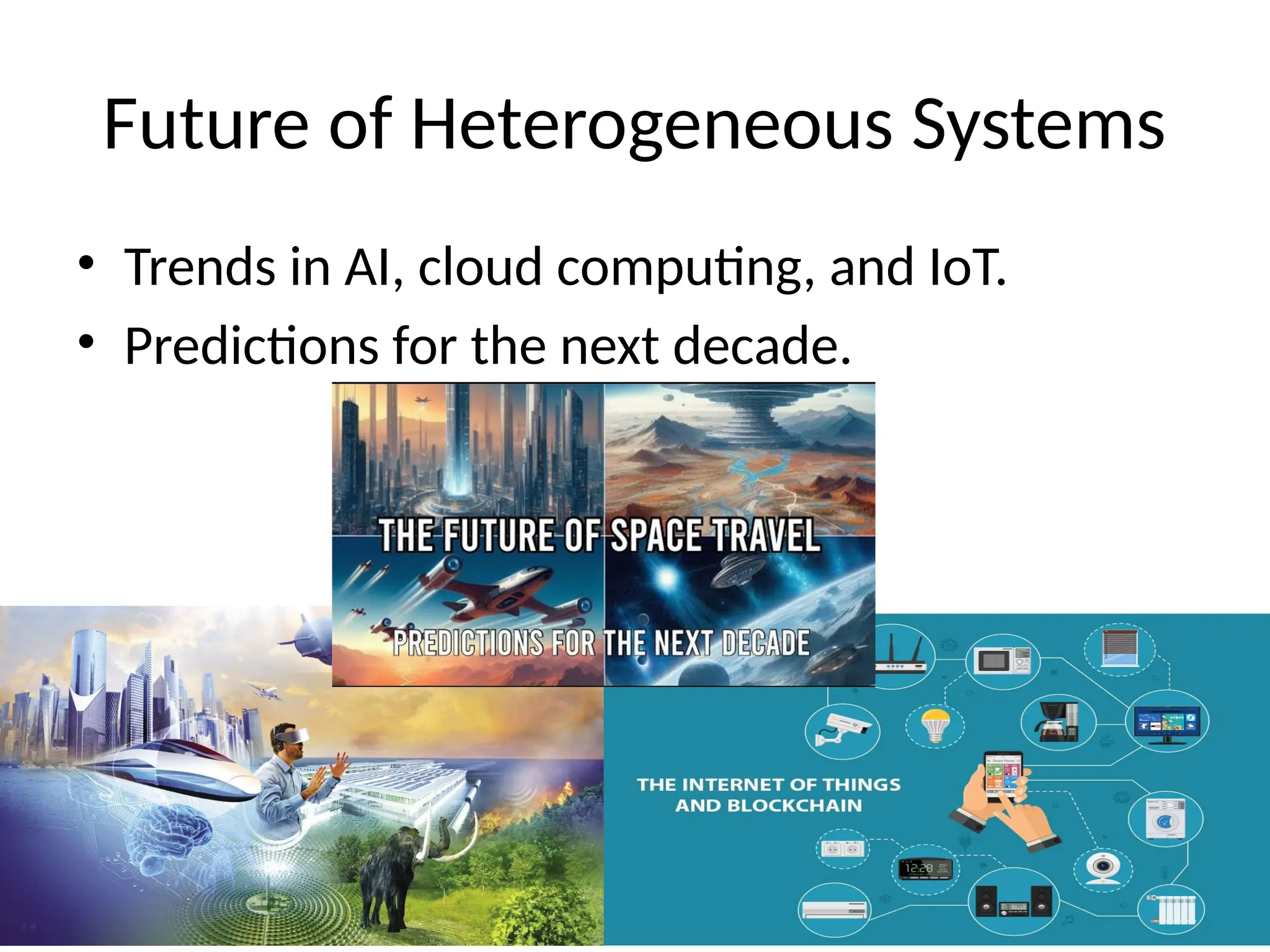
• Trends in AI, cloud computing, and IoT.
• Predictions for the next decade.
Conclusion

Model_of_Heterogeneous_System and other things

  • 1.
    Model of HeterogeneousSystems An Overview with Examples Najam
  • 2.
    Introduction • Define heterogeneoussystems. – A heterogeneous system is a system that contains multiple components that are different from each other. Heterogeneous systems can be found in computing, thermodynamics, and other fields. • Examples: • CPUs, GPUs, FPGAs working together. • Key features: • versatility, flexibility, and performance.
  • 3.
    Importance of HeterogeneousSystems • Why are they important in modern computing? – Computers are vital in modern computing because they enable efficient data processing, storage, and communication, facilitating seamless operations across various sectors like business, healthcare, education, and research, ultimately driving innovation, productivity, and global connectivity in our society. • Examples: • AI, Machine Learning, The Internet of Things) IoT( Big Data. • Benefits: • Improved performance and energy efficiency.
  • 4.
    Components of aHeterogeneous System • CPU, GPU, FPGA, ASIC. – A CPU (Central Processing Unit) is the primary processing unit in a computer, handling general computing tasks, while a GPU (Graphics Processing Unit) is specialized for graphics rendering, an FPGA (Field Programmable Gate Array) is a reconfigurable chip that can be customized for specific applications, and an ASIC (Application-Specific Integrated Circuit) is a custom- designed chip optimized for a single, specific task; all are types of computer processors with varying levels of flexibility and performance depending on their intended use. • Communication Interfaces: Bus, Network-on-Chip. • Examples: Nvidia CUDA, AMD ROCm.
  • 5.
    Architecture Overview • Sharedvs. Distributed Memory. – Shared memory and distributed memory are two different architectures used in computer systems. Shared memory systems are better for low- latency communication and data sharing, while distributed memory systems are better for scalability and fault isolation • Diagram: Architecture of a Heterogeneous System. • Real-world applications.
  • 6.
    Programming Models – A"programming model" refers to a conceptual framework that outlines how software developers should structure, write, and execute code to build applications • Examples: • OpenCL, CUDA, and OpenMP are all programming models for parallel computing. OpenCL is an open standard, while CUDA is a proprietary API developed by NVIDIA. OpenMP is a set of compiler directives and library routines. • Use-case examples in industries.
  • 7.
    Challenges in HeterogeneousSystems • Compatibility issues. • Programming complexity. – Key challenges in heterogeneous systems include: managing different hardware architectures and instruction sets, ensuring data compatibility across diverse sources, complex programming models due to varying APIs, difficulty in load balancing across different compute units, potential for synchronization issues, and the need for specialized knowledge to optimize performance across diverse components • Examples of overcoming challenges.
  • 8.
    Examples of HeterogeneousSystems • Nvidia DGX systems. – NVIDIA DGX systems are supercomputers that are designed to power artificial intelligence (AI) and machine learning. They are used by many leading enterprises to develop AI solutions. • Intel oneAPI platform. – ntel oneAPI is a programming model that allows developers to create high-performance applications for multiple hardware architectures • Real-world applications. – Real-world applications are practical uses of a concept or technique in the real world. They can involve solving complex problems in real time.
  • 9.
    Future of HeterogeneousSystems • Trends in AI, cloud computing, and IoT. • Predictions for the next decade.
  • 10.