introdu
1
2
3
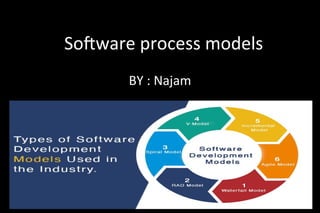
Software process models
BY : Najam
4
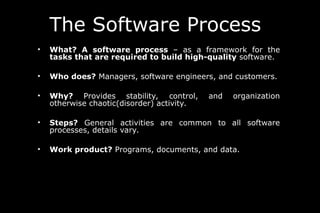
The Software Process
• What? A software process – as a framework for the
tasks that are required to build high-quality software.
• Who does? Managers, software engineers, and customers.
• Why? Provides stability, control, and organization
otherwise chaotic(disorder) activity.
• Steps? General activities are common to all software
processes, details vary.
• Work product? Programs, documents, and data.
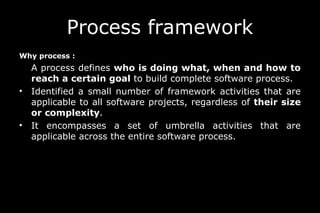
Process framework
Why process :
A process defines who is doing what, when and how to
reach a certain goal to build complete software process.
• Identified a small number of framework activities that are
applicable to all software projects, regardless of their size
or complexity.
• It encompasses a set of umbrella activities that are
applicable across the entire software process.
Generic Process Framework
Activities
• Communication:
– Heavy communication with customers, stakeholders, team
– Encompasses requirements gathering and related activities
• Planning:
– Workflow that is to follow
– Describe technical task, likely risk, resources will require,
work products to be produced and a work schedule.
• Modeling:
– Help developer and customer to understand requirements
(Analysis of requirements) & Design of software
• Construction:
– Code generation: either manual or automated or both
– Testing – to uncover error in the code.
• Deployment:
– Delivery to the customer for evaluation
– Customer provide feedback
HemalKumar Rajyaguru
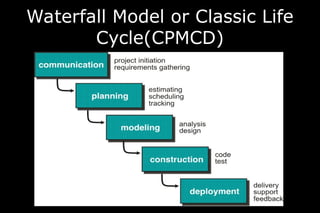
Waterfall Model or Classic Life
Cycle(CPMCD)
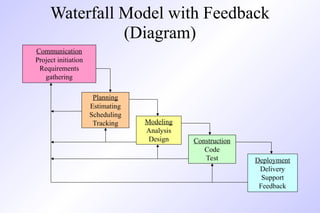
Waterfall Model with Feedback
(Diagram)
Communication
Project initiation
Requirements
gathering
Planning
Estimating
Scheduling
Tracking Modeling
Analysis
Design Construction
Code
Test Deployment
Delivery
Support
Feedback
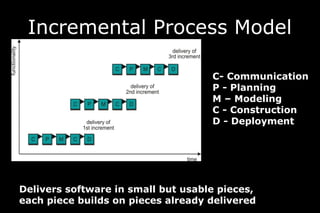
Incremental Process Model
C- Communication
P - Planning
M – Modeling
C - Construction
D - Deployment
Delivers software in small but usable pieces,
each piece builds on pieces already delivered
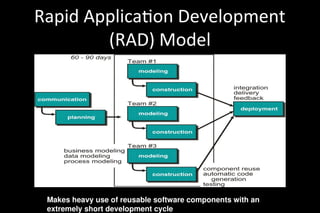
Rapid Application Development
(RAD) Model
Makes heavy use of reusable software components with an
extremely short development cycle
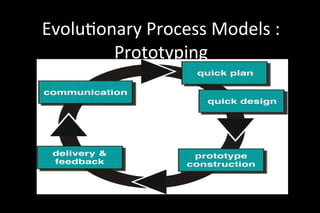
Evolutionary Process Models :
Prototyping
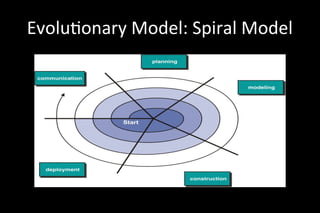
Evolutionary Model: Spiral Model
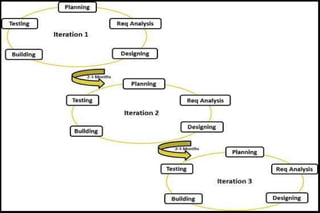
Agile Process Model
• Agile Methods break the product into small
incremental builds.
• Every iteration involves cross functional teams
working simultaneously on various areas like
planning, requirements analysis, design, coding,
unit testing, and acceptance testing.
intoductiontosoftwareengineeringpart-2-170107070959.ppt

intoductiontosoftwareengineeringpart-2-170107070959.ppt

  • 1.
  • 2.
  • 3.
  • 4.
  • 5.
    The Software Process •What? A software process – as a framework for the tasks that are required to build high-quality software. • Who does? Managers, software engineers, and customers. • Why? Provides stability, control, and organization otherwise chaotic(disorder) activity. • Steps? General activities are common to all software processes, details vary. • Work product? Programs, documents, and data.
  • 6.
    Process framework Why process: A process defines who is doing what, when and how to reach a certain goal to build complete software process. • Identified a small number of framework activities that are applicable to all software projects, regardless of their size or complexity. • It encompasses a set of umbrella activities that are applicable across the entire software process.
  • 7.
    Generic Process Framework Activities •Communication: – Heavy communication with customers, stakeholders, team – Encompasses requirements gathering and related activities • Planning: – Workflow that is to follow – Describe technical task, likely risk, resources will require, work products to be produced and a work schedule. • Modeling: – Help developer and customer to understand requirements (Analysis of requirements) & Design of software • Construction: – Code generation: either manual or automated or both – Testing – to uncover error in the code. • Deployment: – Delivery to the customer for evaluation – Customer provide feedback
  • 8.
    HemalKumar Rajyaguru Waterfall Modelor Classic Life Cycle(CPMCD)
  • 9.
    Waterfall Model withFeedback (Diagram) Communication Project initiation Requirements gathering Planning Estimating Scheduling Tracking Modeling Analysis Design Construction Code Test Deployment Delivery Support Feedback
  • 10.
    Incremental Process Model C-Communication P - Planning M – Modeling C - Construction D - Deployment Delivers software in small but usable pieces, each piece builds on pieces already delivered
  • 11.
    Rapid Application Development (RAD)Model Makes heavy use of reusable software components with an extremely short development cycle
  • 12.
  • 13.
  • 14.
    Agile Process Model •Agile Methods break the product into small incremental builds. • Every iteration involves cross functional teams working simultaneously on various areas like planning, requirements analysis, design, coding, unit testing, and acceptance testing.