A FRAMEWORK DRIVEN APPROACH TO MODEL RISK MANAGEMENT
Information, data and drawings embodied in this presentation are strictly confidential and are supplied on the understanding that
they will be held confidentially and not disclosed to third parties without the prior written consent of QuantUniversity LLC.
Sri Krishnamurthy, CFA
Founder and CEO
QuantUniversity LLC.
www.QuantUniversity.com
DATA ANALYTICS FOR FINANCIAL SERVICES, JULY 22 2014, BOSTON, MA
AGENDA
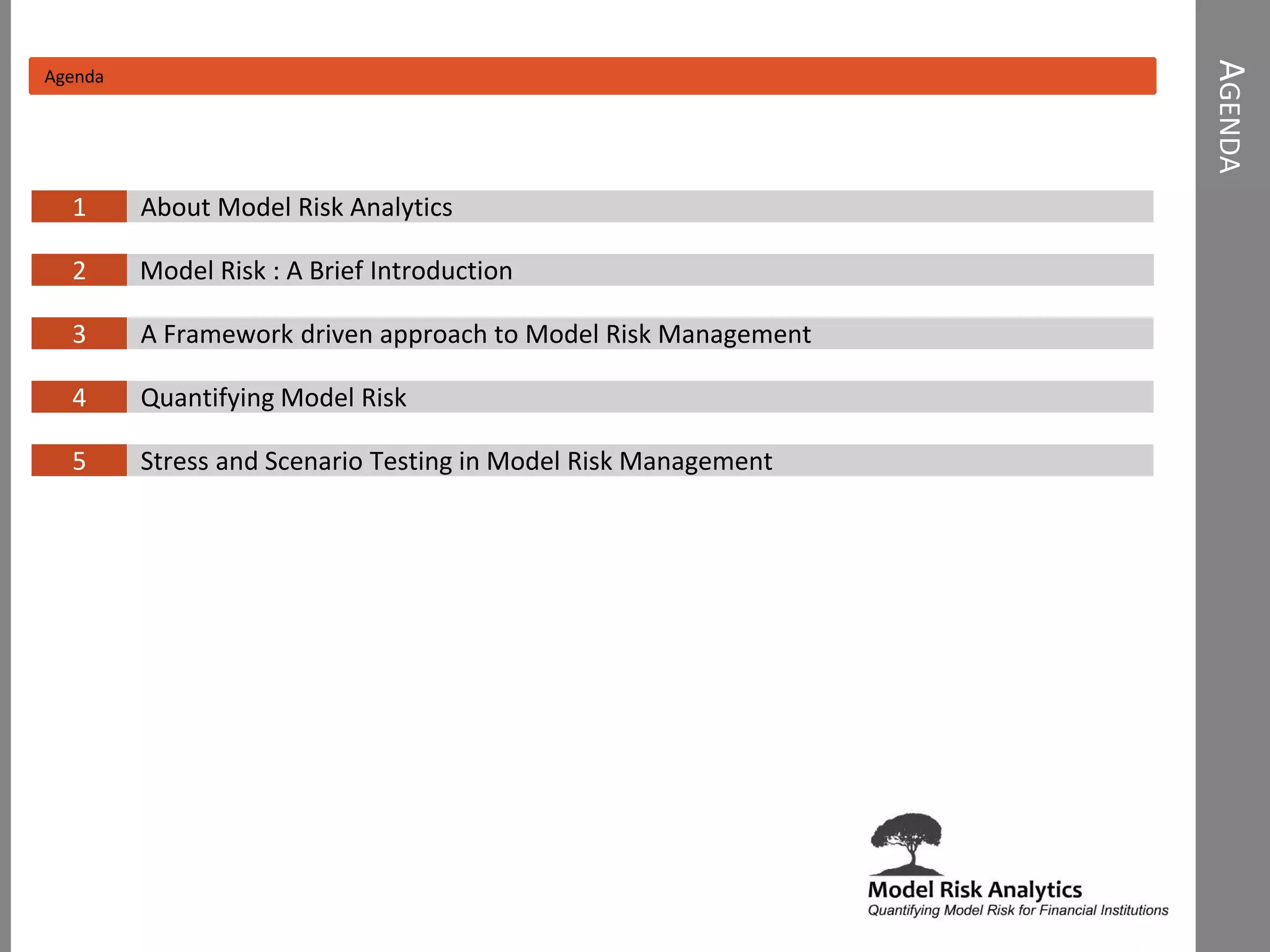
About Model Risk Analytics
Model Risk : A Brief Introduction
A Framework driven approach to Model Risk Management
Quantifying Model Risk
Stress and Scenario Testing in Model Risk Management
1
2
3
4
5
Agenda
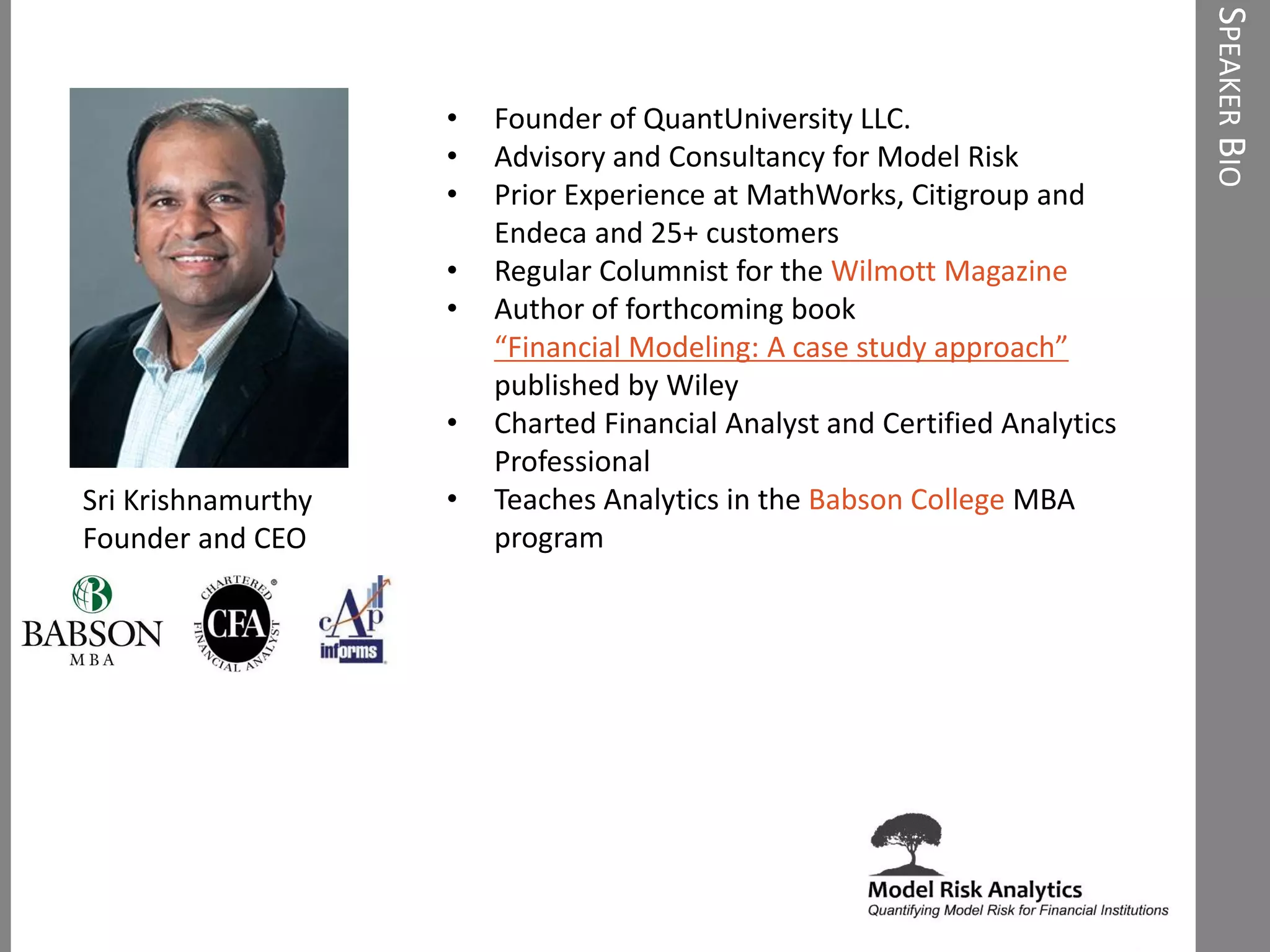
• Founder of QuantUniversity LLC.
• Advisory and Consultancy for Model Risk
• Prior Experience at MathWorks, Citigroup and
Endeca and 25+ customers
• Regular Columnist for the Wilmott Magazine
• Author of forthcoming book
“Financial Modeling: A case study approach”
published by Wiley
• Charted Financial Analyst and Certified Analytics
Professional
• Teaches Analytics in the Babson College MBA
program
Sri Krishnamurthy
Founder and CEO
SPEAKERBIO
COMPREHENSIVE MODEL RISK MANAGEMENT FOR FINANCIAL INSTITUTIONS
- ADVISORY SERVICES
- PLATFORM TO MANAGE MODEL RISK
- TRAINING AND AUDITS
OURSOLUTION
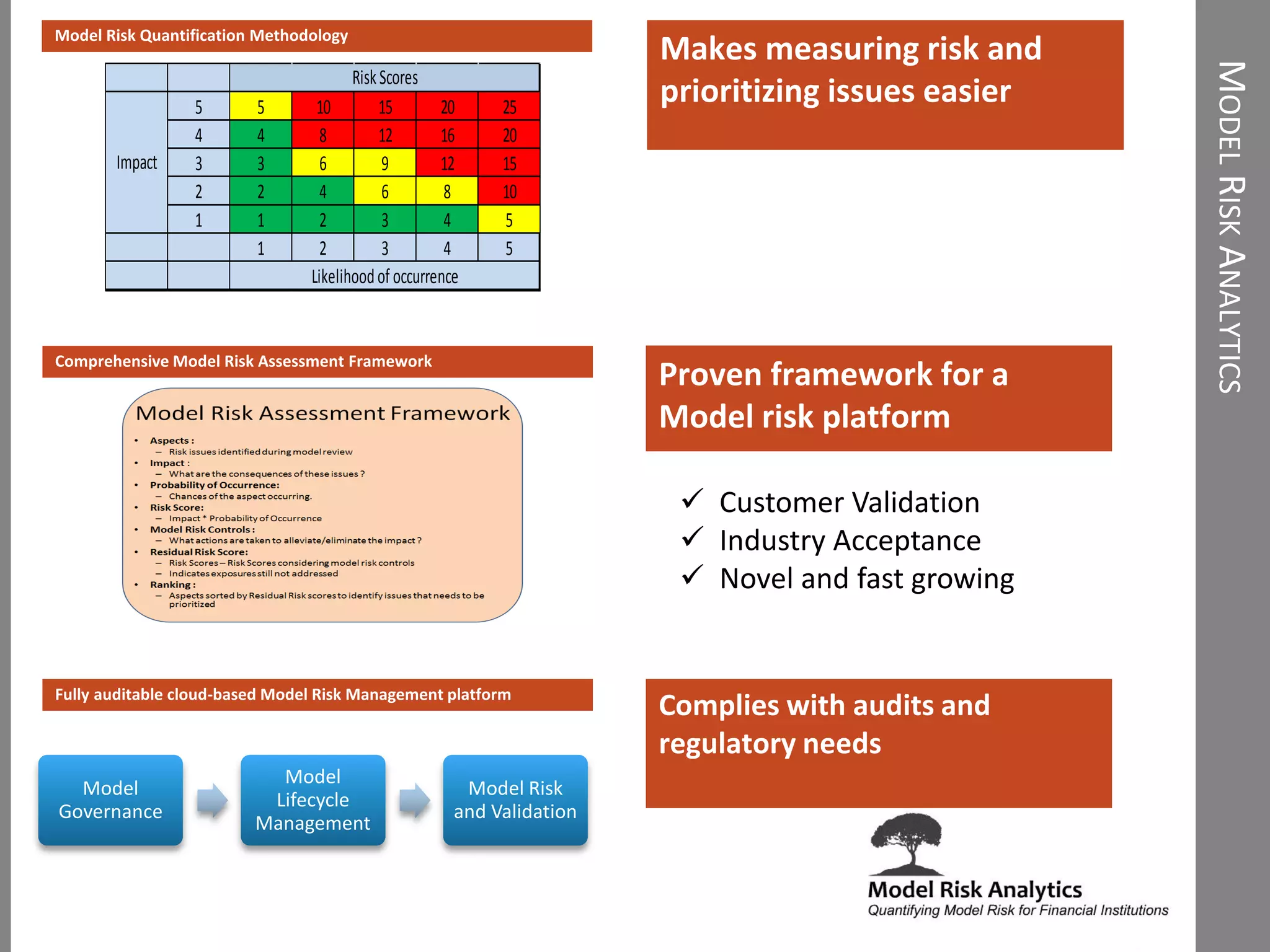
Comprehensive Model Risk Assessment Framework
Model Risk Quantification Methodology
Fully auditable cloud-based Model Risk Management platform
5 5 10 15 20 25
4 4 8 12 16 20
3 3 6 9 12 15
2 2 4 6 8 10
1 1 2 3 4 5
1 2 3 4 5
Likelihoodof occurrence
Impact
RiskScores
Model
Governance
Model
Lifecycle
Management
Model Risk
and Validation
Makes measuring risk and
prioritizing issues easier
Complies with audits and
regulatory needs
Proven framework for a
Model risk platform
MODELRISKANALYTICS
 Customer Validation
 Industry Acceptance
 Novel and fast growing
MODEL RISK – A BRIEF INTRODUCTION
MODELRISKINTHENEWS
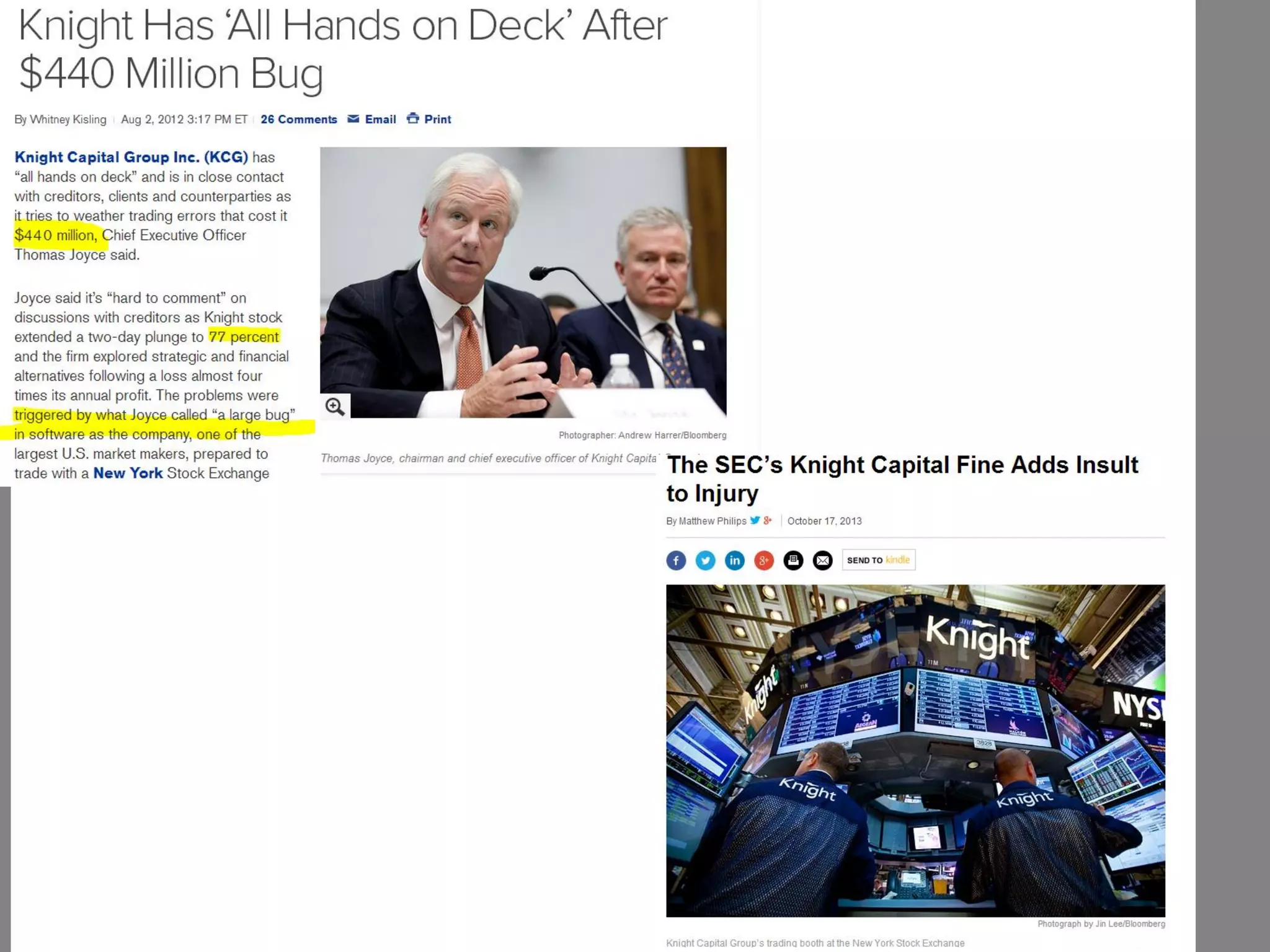
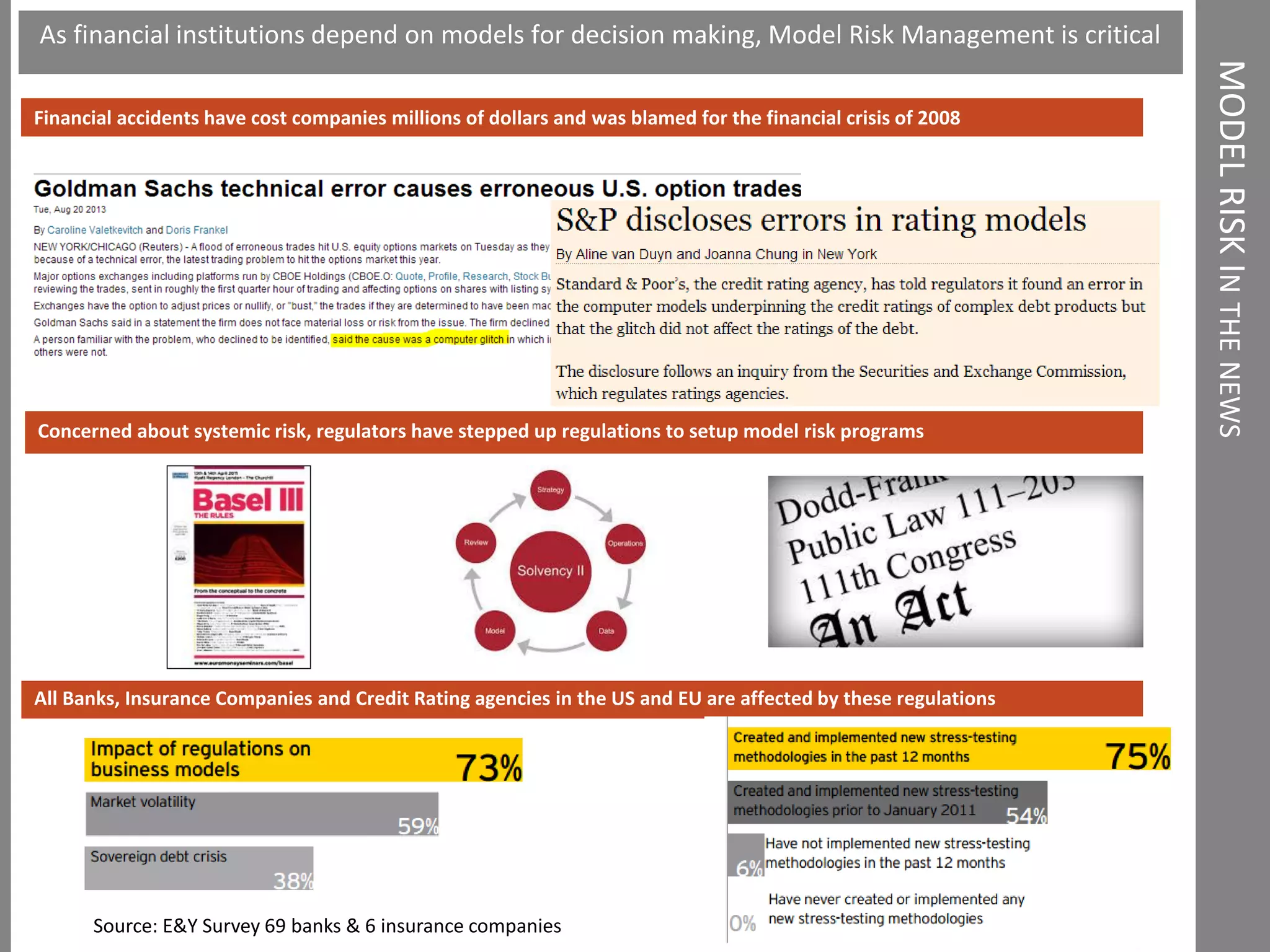
Financial accidents have cost companies millions of dollars and was blamed for the financial crisis of 2008
Concerned about systemic risk, regulators have stepped up regulations to setup model risk programs
All Banks, Insurance Companies and Credit Rating agencies in the US and EU are affected by these regulations
As financial institutions depend on models for decision making, Model Risk Management is critical
8Source: E&Y Survey 69 banks & 6 insurance companies
CHALLENGES
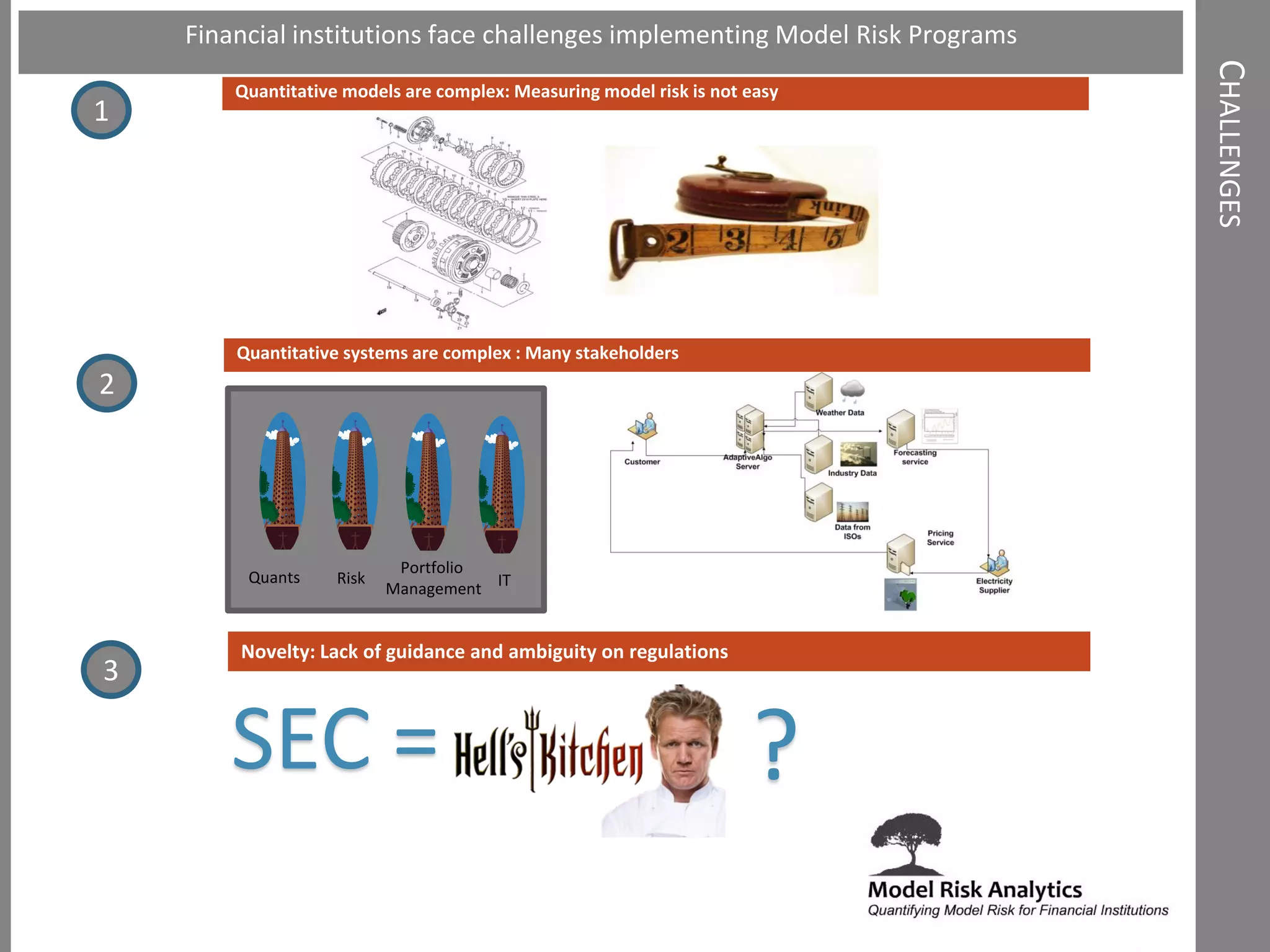
Quantitative models are complex: Measuring model risk is not easy
Quantitative systems are complex : Many stakeholders
Novelty: Lack of guidance and ambiguity on regulations
Quants Risk
Portfolio
Management IT
1
2
3
Financial institutions face challenges implementing Model Risk Programs
SEC = ?
MODELRISK
“Model refers to a quantitative method, system, or
approach that applies statistical, economic, financial,
or mathematical theories, techniques, and
assumptions to process input data into quantitative
estimates” [1]
Ref:
[1] . Supervisory Letter SR 11-7 on guidance on Model Risk
Model Risk Defined
Input
Assumptions/Data
Processing
component
Output/
Reporting
component
MODELVALIDATION
“Model risk is the potential for adverse
consequences from decisions based on incorrect or
misused model outputs and reports. “ [1]
“Model validation is the set of processes and activities
intended to verify that models are performing as
expected, in line with their design objectives and
business uses. ” [1]
Ref:
[1] . Supervisory Letter SR 11-7 on guidance on Model Risk
Model Risk and Validation Defined
A FRAMEWORK DRIVEN APPROACH TO MODEL RISK MANAGEMENT
MODELRISKMANAGEMENT
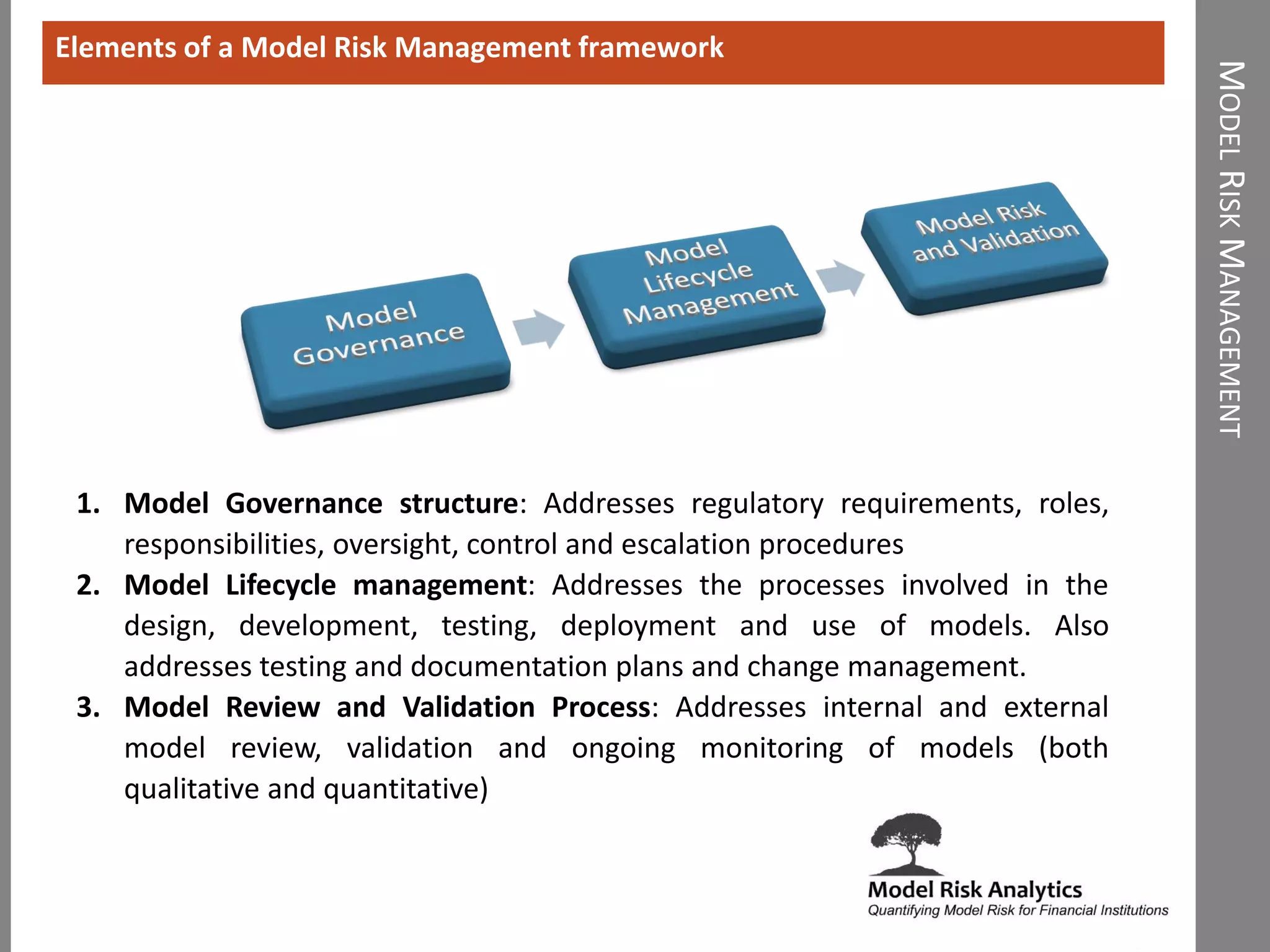
Elements of a Model Risk Management framework
1. Model Governance structure: Addresses regulatory requirements, roles,
responsibilities, oversight, control and escalation procedures
2. Model Lifecycle management: Addresses the processes involved in the
design, development, testing, deployment and use of models. Also
addresses testing and documentation plans and change management.
3. Model Review and Validation Process: Addresses internal and external
model review, validation and ongoing monitoring of models (both
qualitative and quantitative)
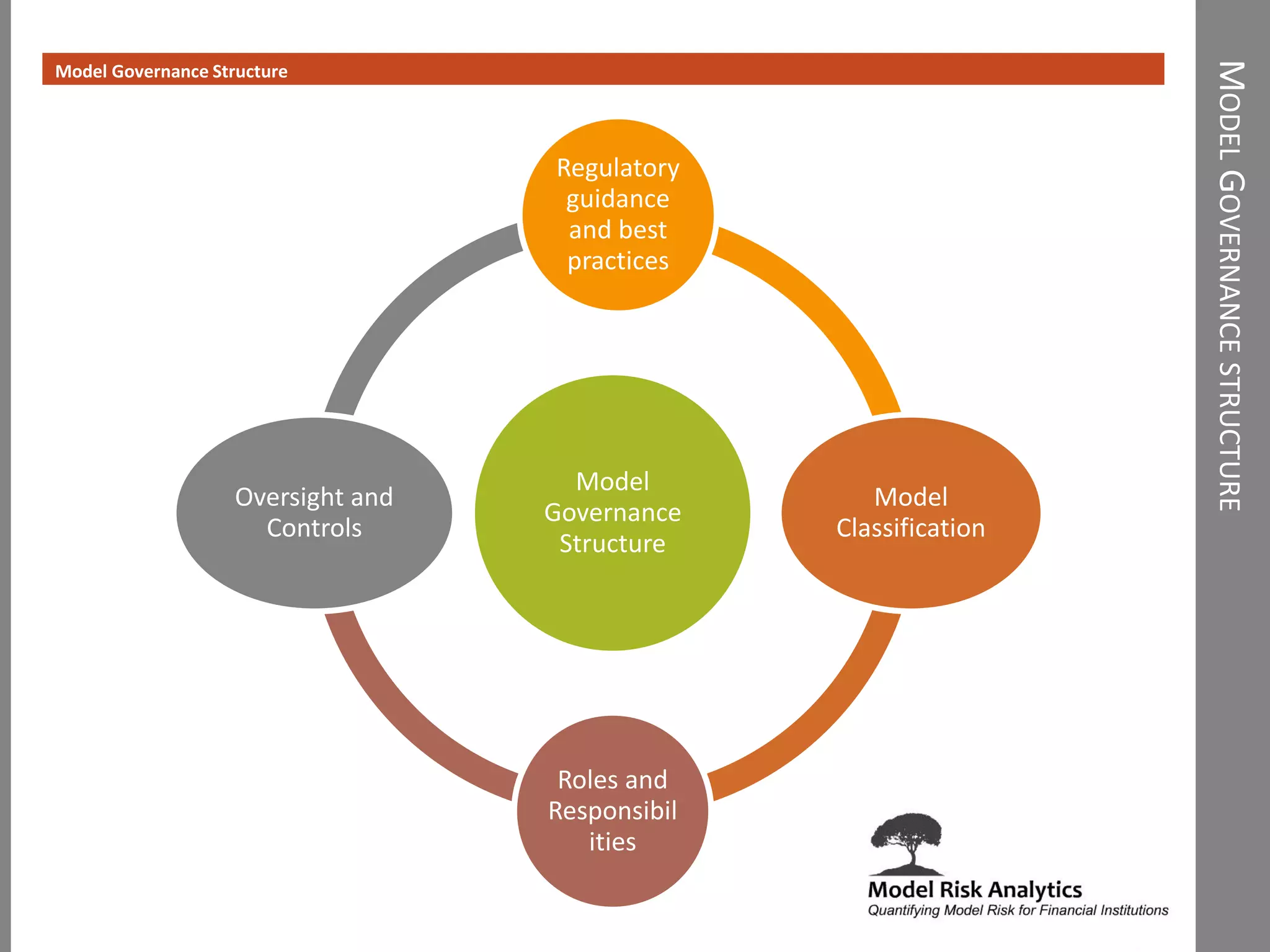
MODELGOVERNANCESTRUCTURE
Model Governance Structure
Model
Governance
Structure
Regulatory
guidance
and best
practices
Model
Classification
Roles and
Responsibil
ities
Oversight and
Controls
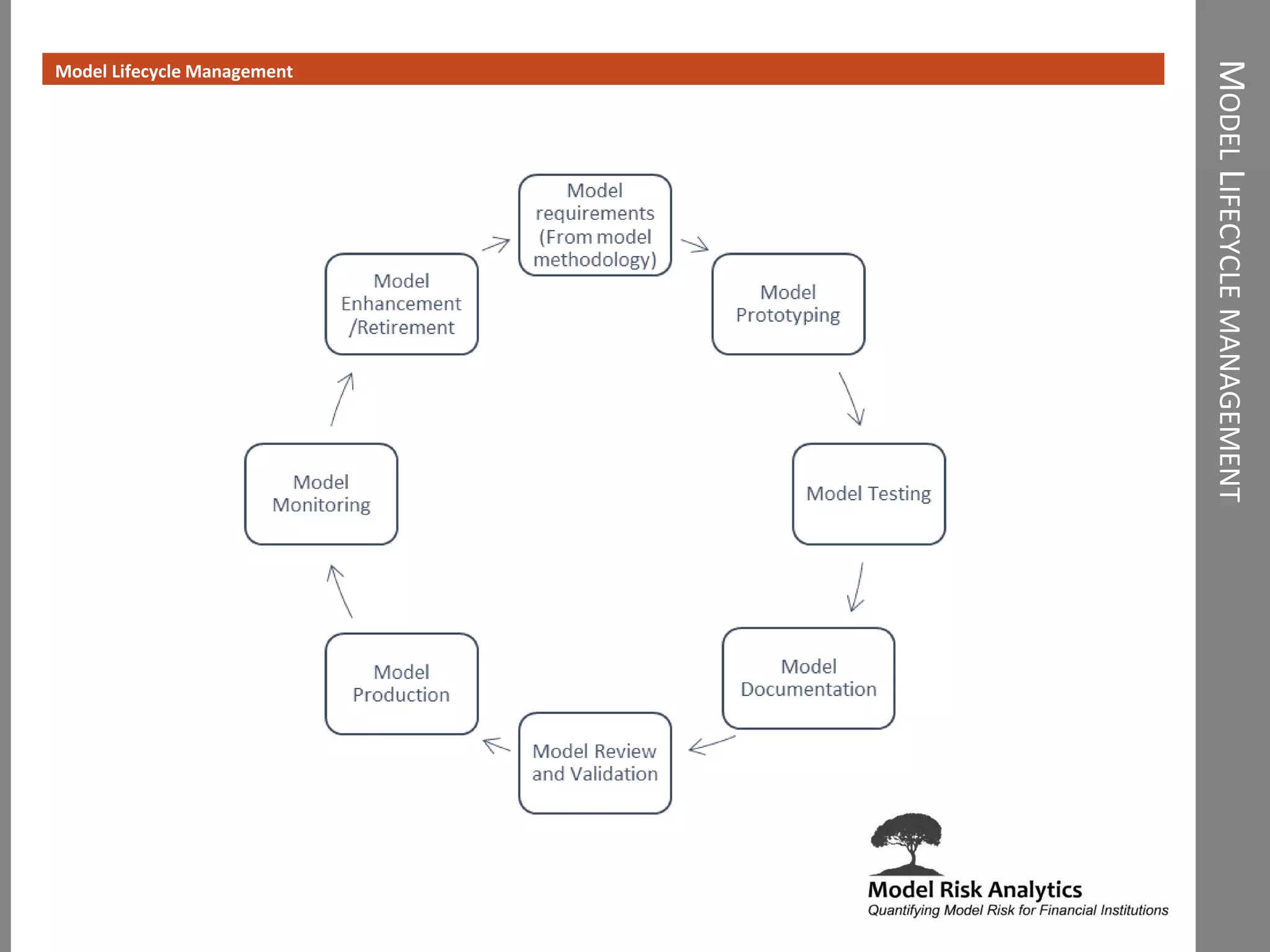
MODELLIFECYCLEMANAGEMENT
Model Lifecycle Management
MODELREVIEWANDVALIDATION
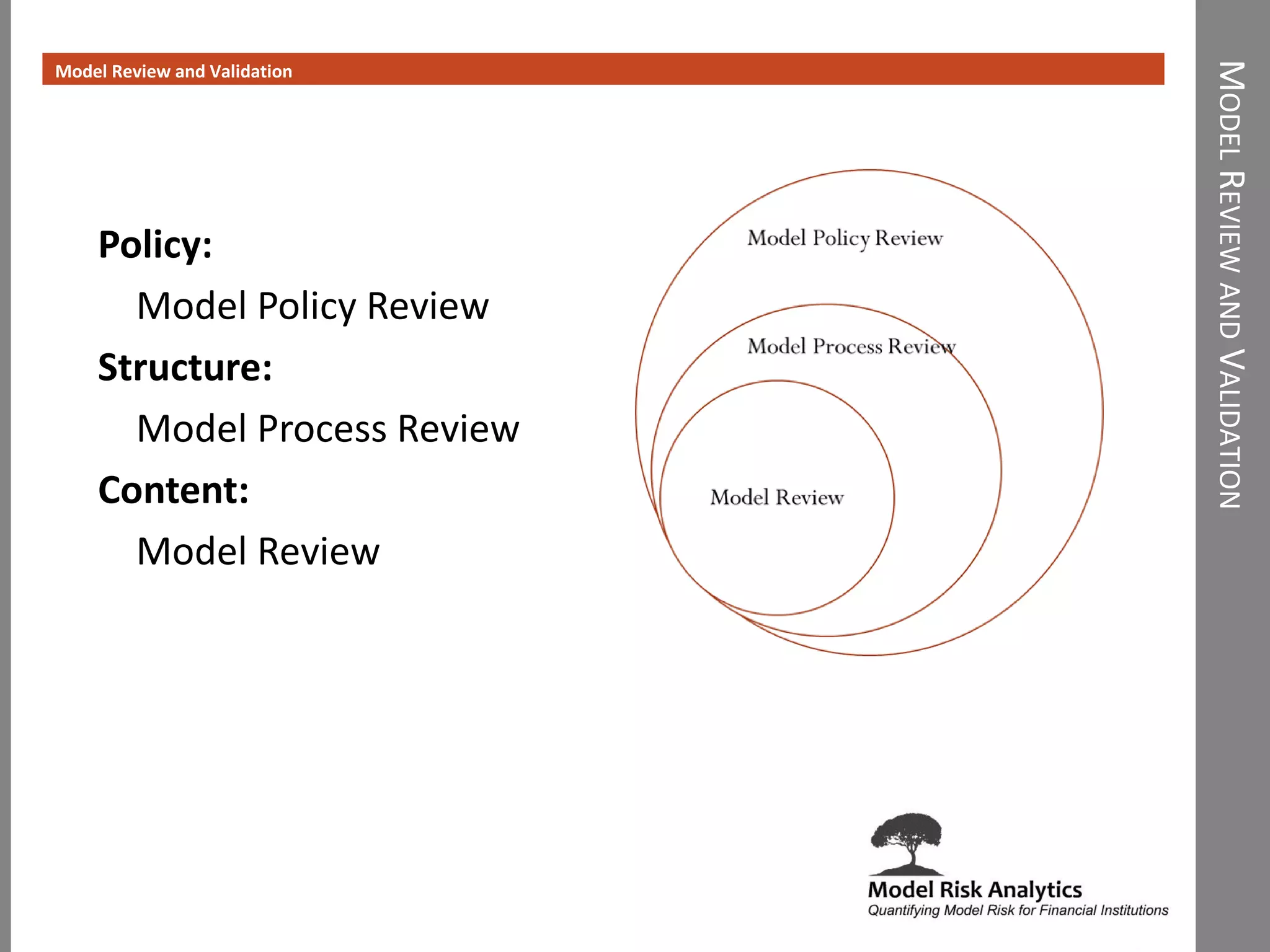
Model Review and Validation
Policy:
Model Policy Review
Structure:
Model Process Review
Content:
Model Review
LEVERAGINGTECHNOLOGYANDANALYTICSFOREFFECTIVEMODELRISKMANAGEMENT
Leveraging technology and analytics for effective Model Risk Management
1.Quantifying Model Risk:
• Classification and Measurement of Model Risk
2.Leveraging technology to scale stress and scenario
testing
QUANTIFYING MODEL RISK
CHALLENGES
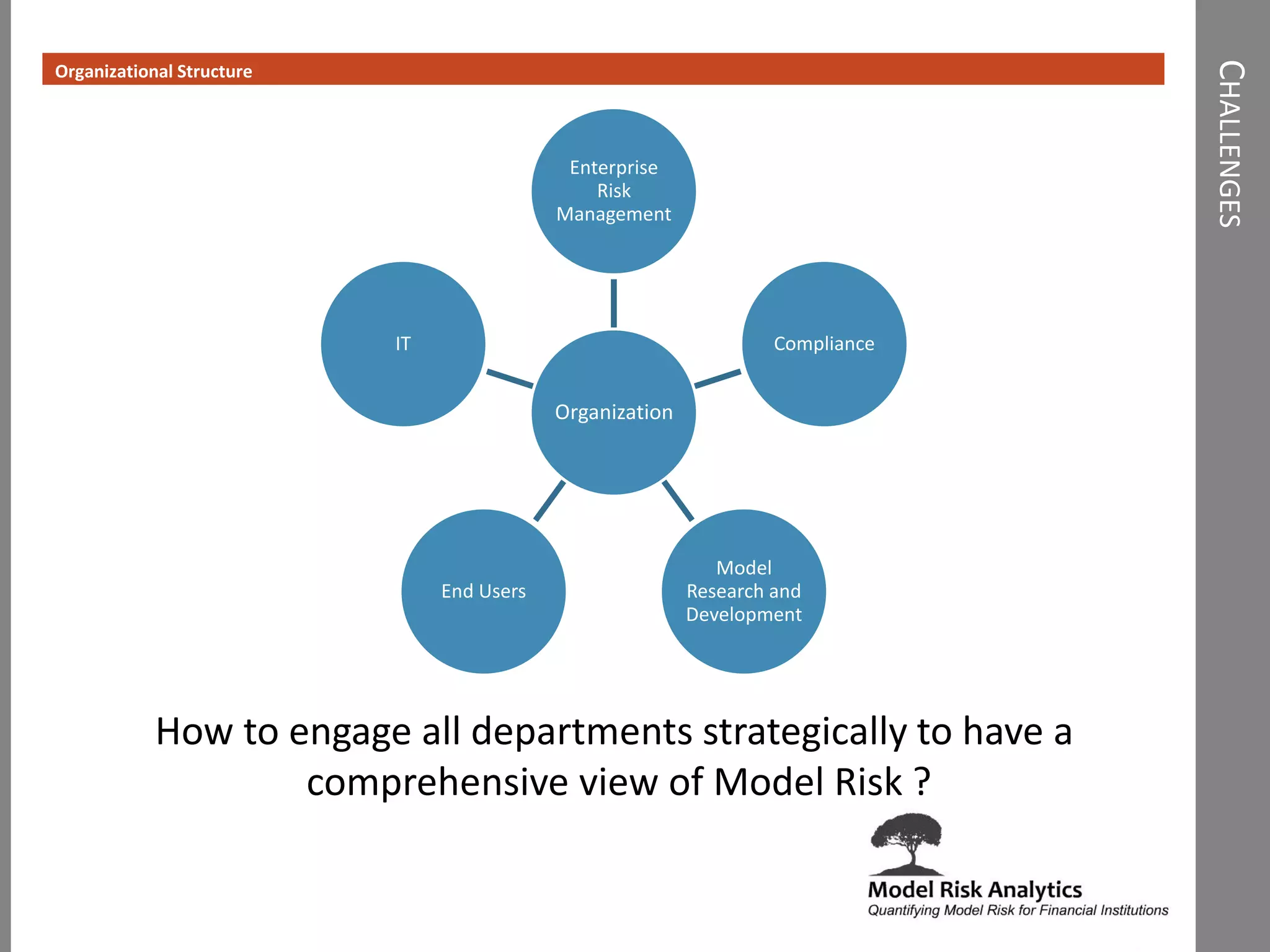
Organizational Structure
Organization
Enterprise
Risk
Management
Compliance
Model
Research and
Development
End Users
IT
How to engage all departments strategically to have a
comprehensive view of Model Risk ?
HOWTODOIT
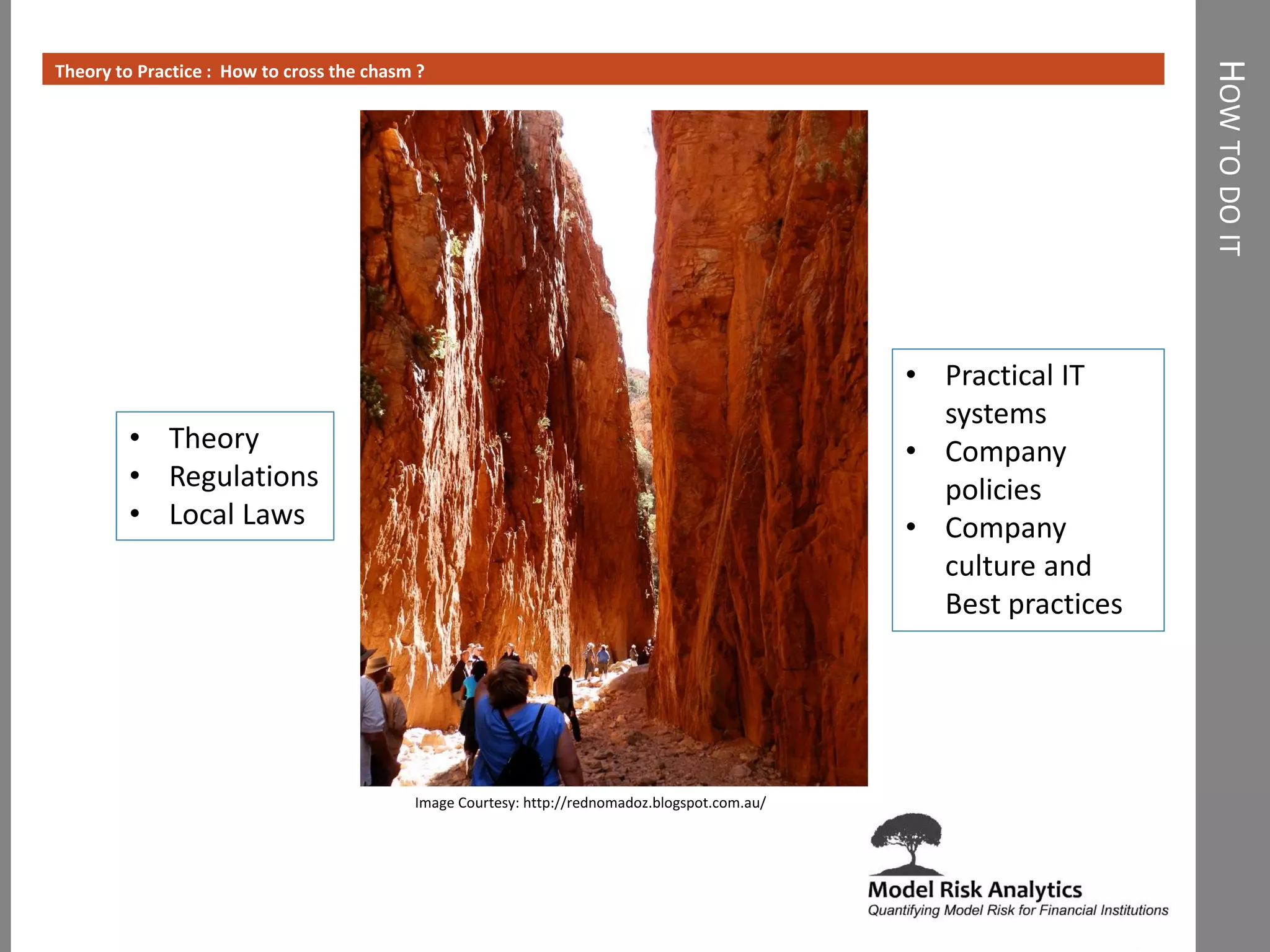
Theory to Practice : How to cross the chasm ?
Image Courtesy: http://rednomadoz.blogspot.com.au/
• Theory
• Regulations
• Local Laws
• Practical IT
systems
• Company
policies
• Company
culture and
Best practices
CLASSIFYINGMODELRISK
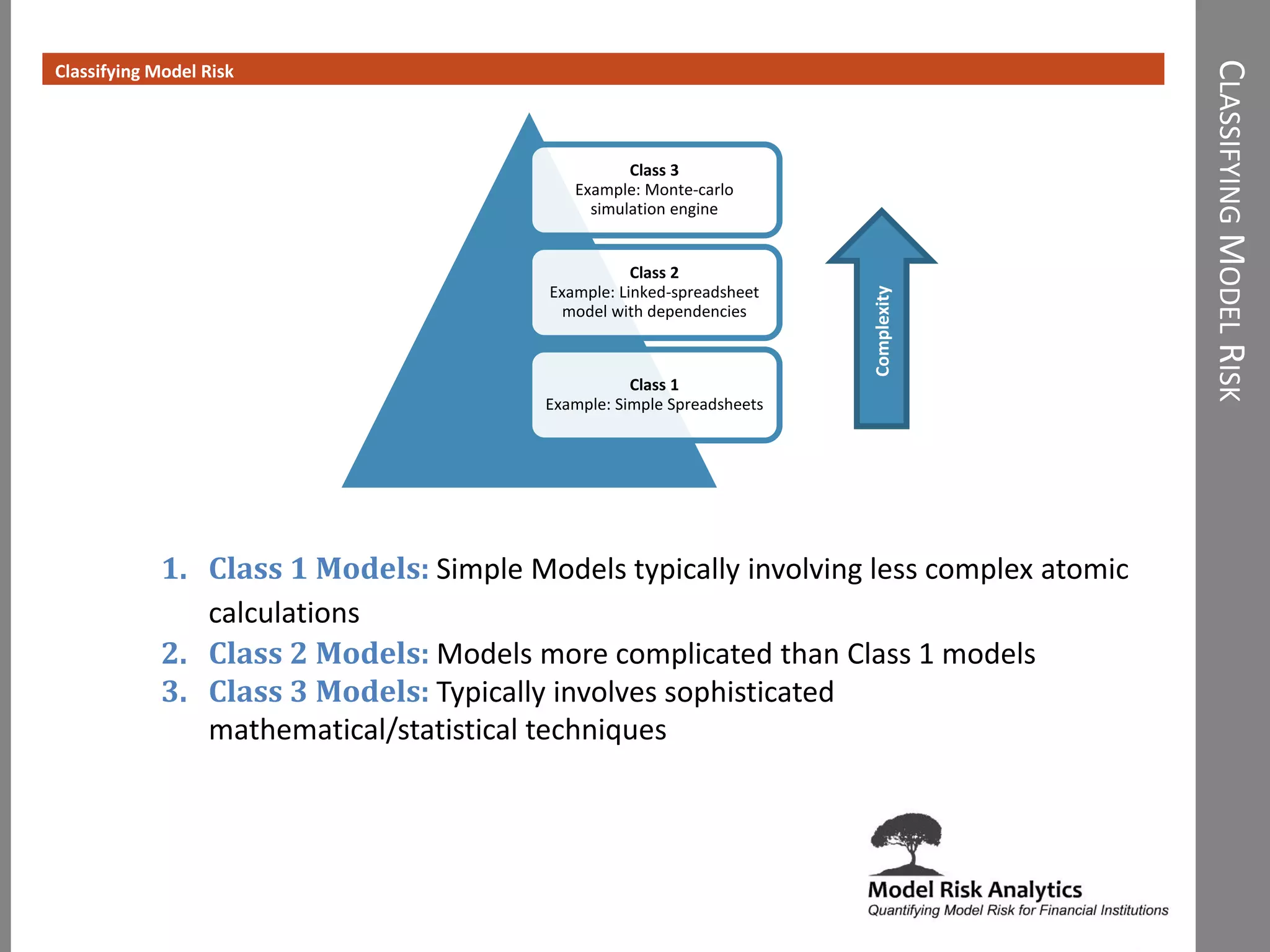
Classifying Model Risk
Class 3
Example: Monte-carlo
simulation engine
Class 2
Example: Linked-spreadsheet
model with dependencies
Class 1
Example: Simple Spreadsheets
Complexity
1. Class 1 Models: Simple Models typically involving less complex atomic
calculations
2. Class 2 Models: Models more complicated than Class 1 models
3. Class 3 Models: Typically involves sophisticated
mathematical/statistical techniques
MODELRISKASSESSMENTFRAMEWORK
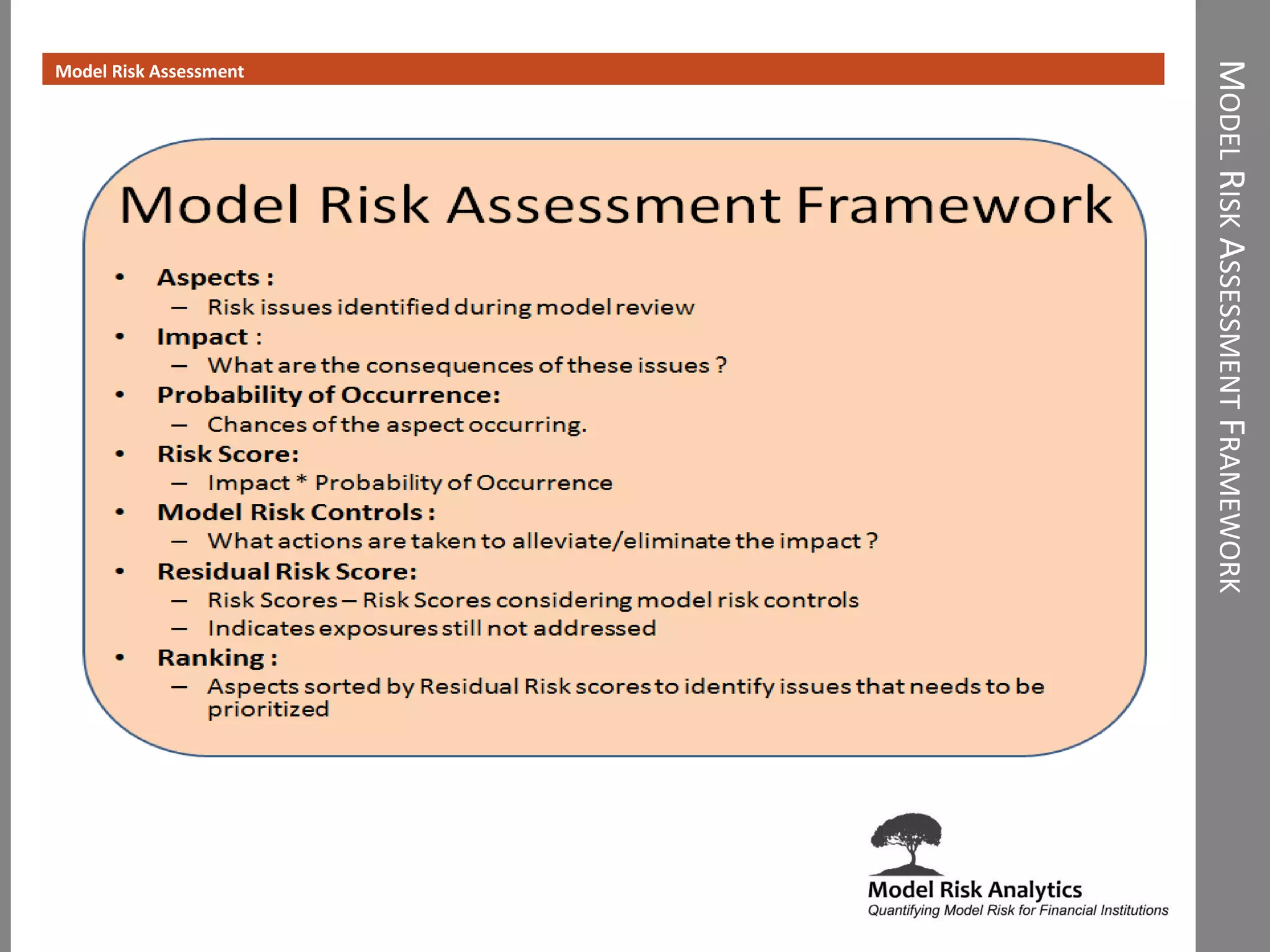
Model Risk Assessment
SCORINGGUIDELINES
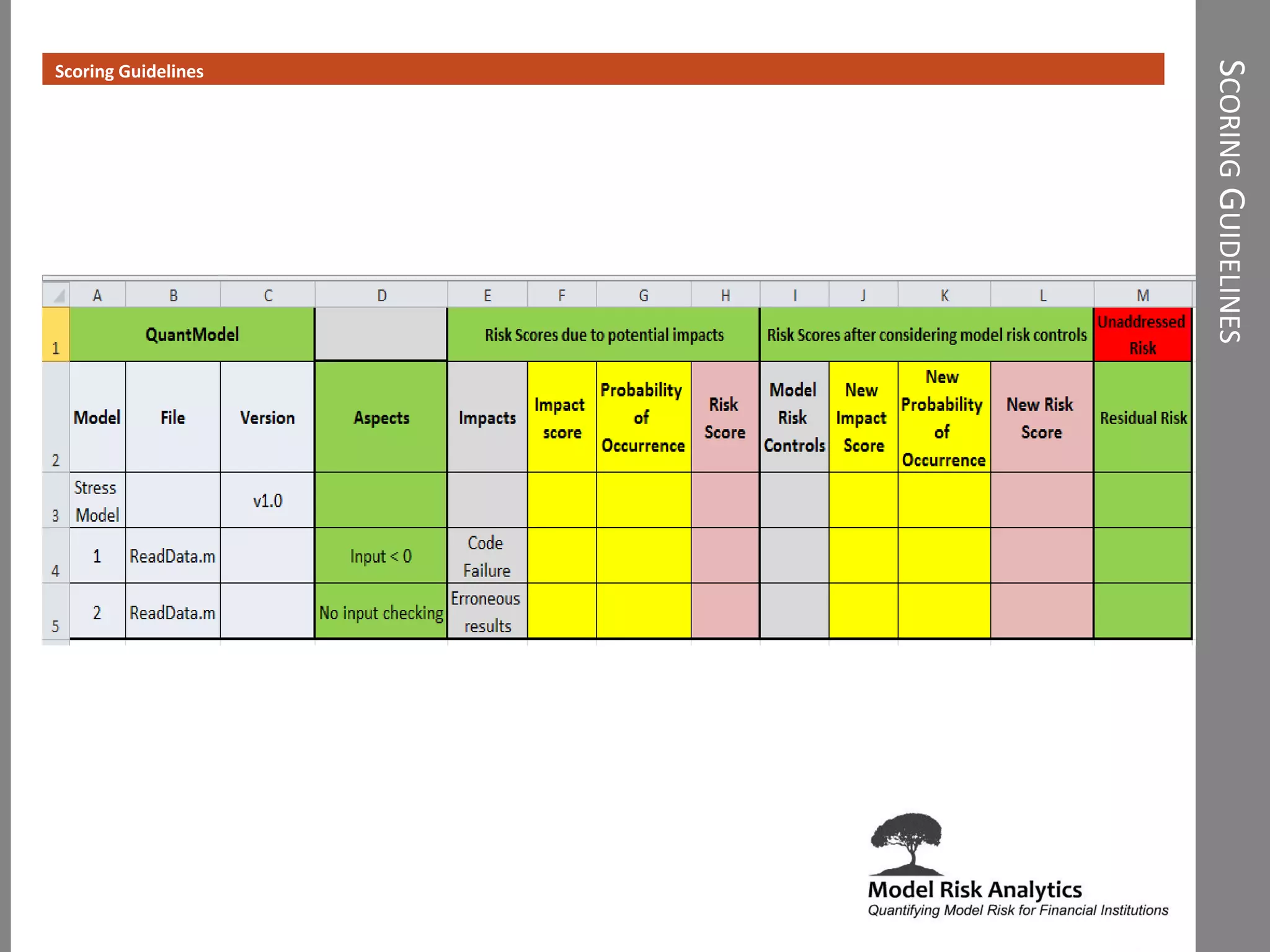
Scoring Guidelines
RISKGRADING
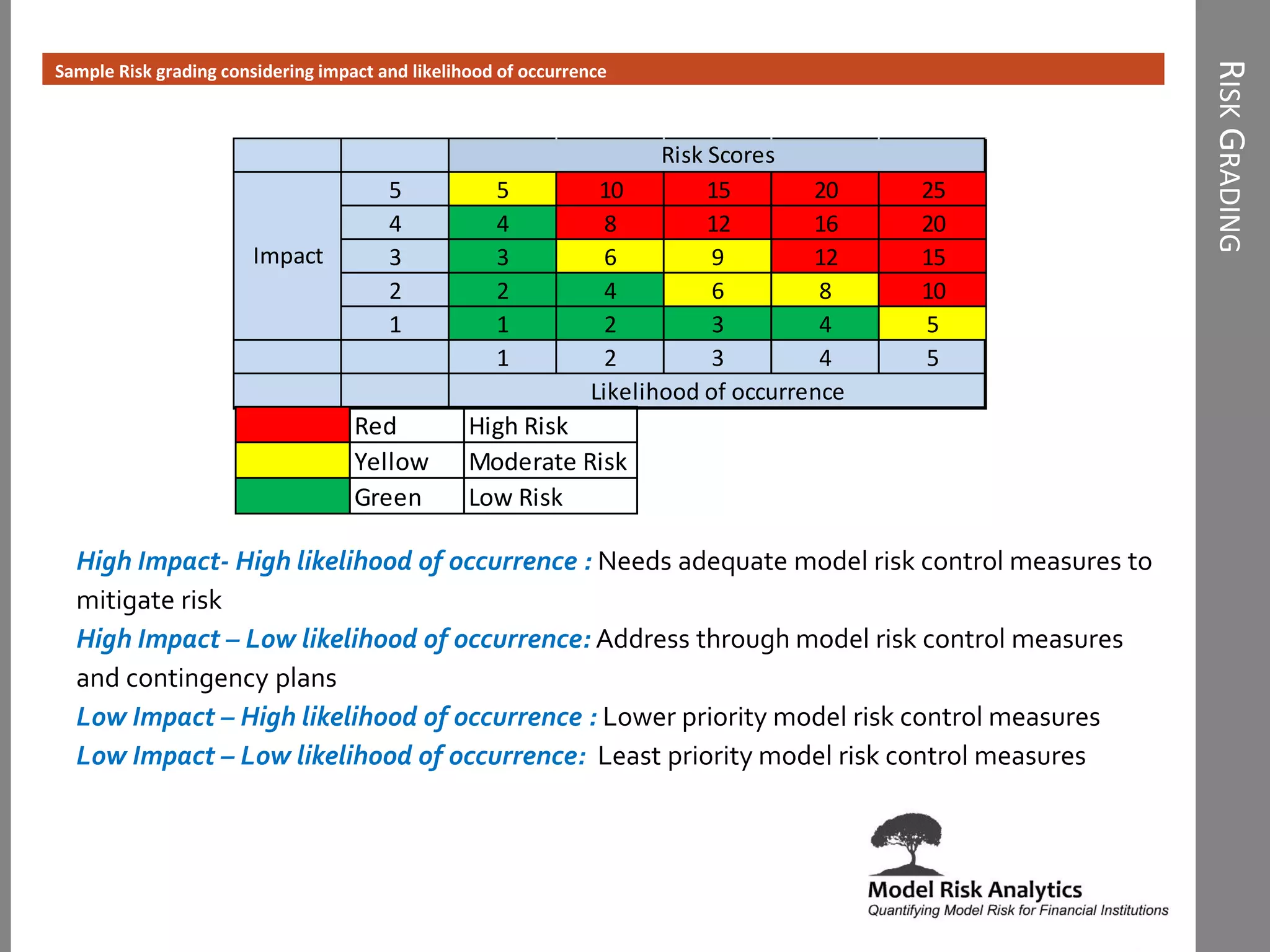
Sample Risk grading considering impact and likelihood of occurrence
5 5 10 15 20 25
4 4 8 12 16 20
3 3 6 9 12 15
2 2 4 6 8 10
1 1 2 3 4 5
1 2 3 4 5
Likelihood of occurrence
Impact
Risk Scores
Red High Risk
Yellow Moderate Risk
Green Low Risk
High Impact- High likelihood of occurrence : Needs adequate model risk control measures to
mitigate risk
High Impact – Low likelihood of occurrence: Address through model risk control measures
and contingency plans
Low Impact – High likelihood of occurrence : Lower priority model risk control measures
Low Impact – Low likelihood of occurrence: Least priority model risk control measures
LEVERAGINGMACHINELEARNING
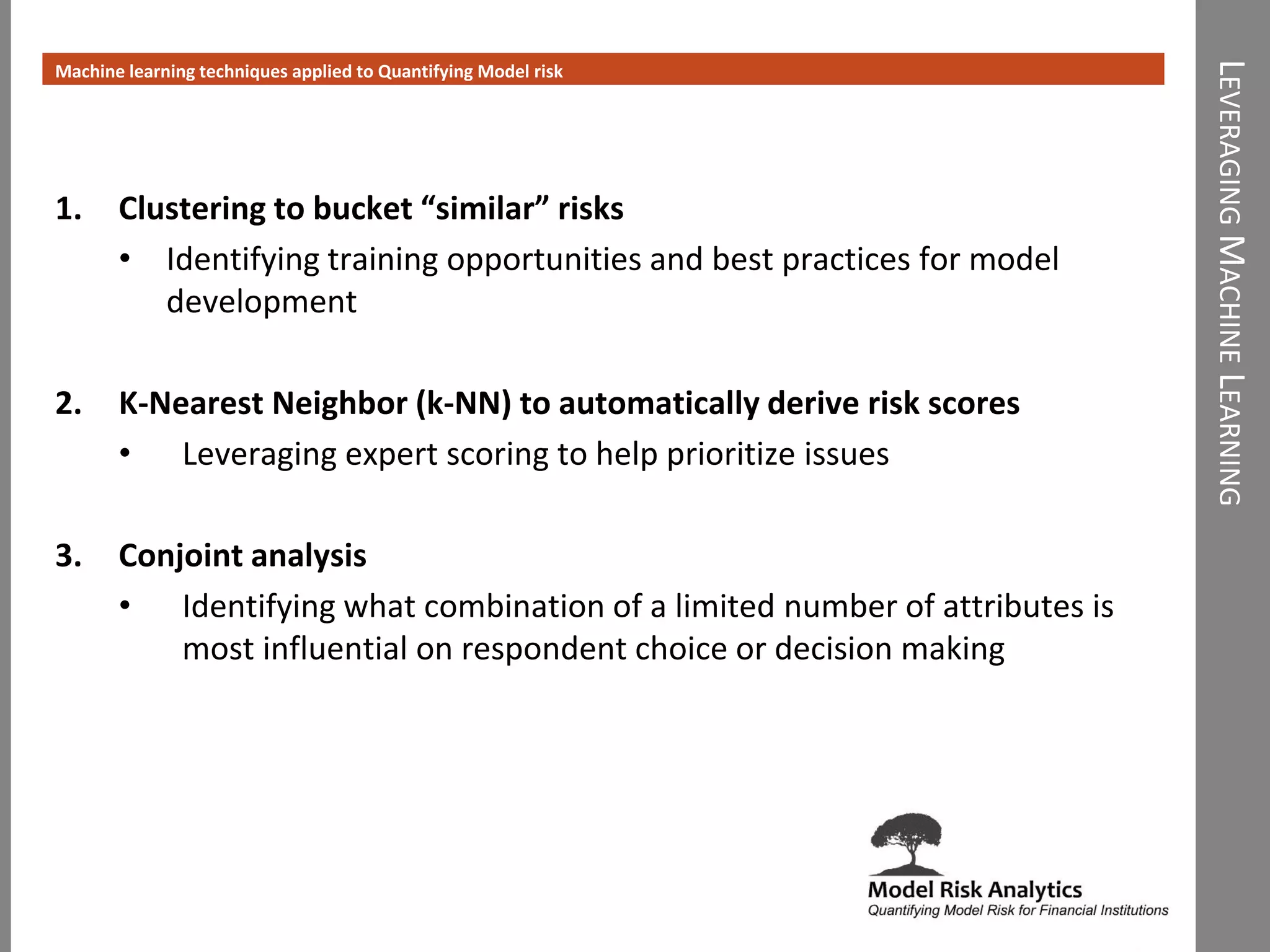
Machine learning techniques applied to Quantifying Model risk
1. Clustering to bucket “similar” risks
• Identifying training opportunities and best practices for model
development
2. K-Nearest Neighbor (k-NN) to automatically derive risk scores
• Leveraging expert scoring to help prioritize issues
3. Conjoint analysis
• Identifying what combination of a limited number of attributes is
most influential on respondent choice or decision making
STRESS TESTING AND SCENARIO TESTING TO EVALUATE MODEL
RISK
STRESSTEST&SCENARIOTEST
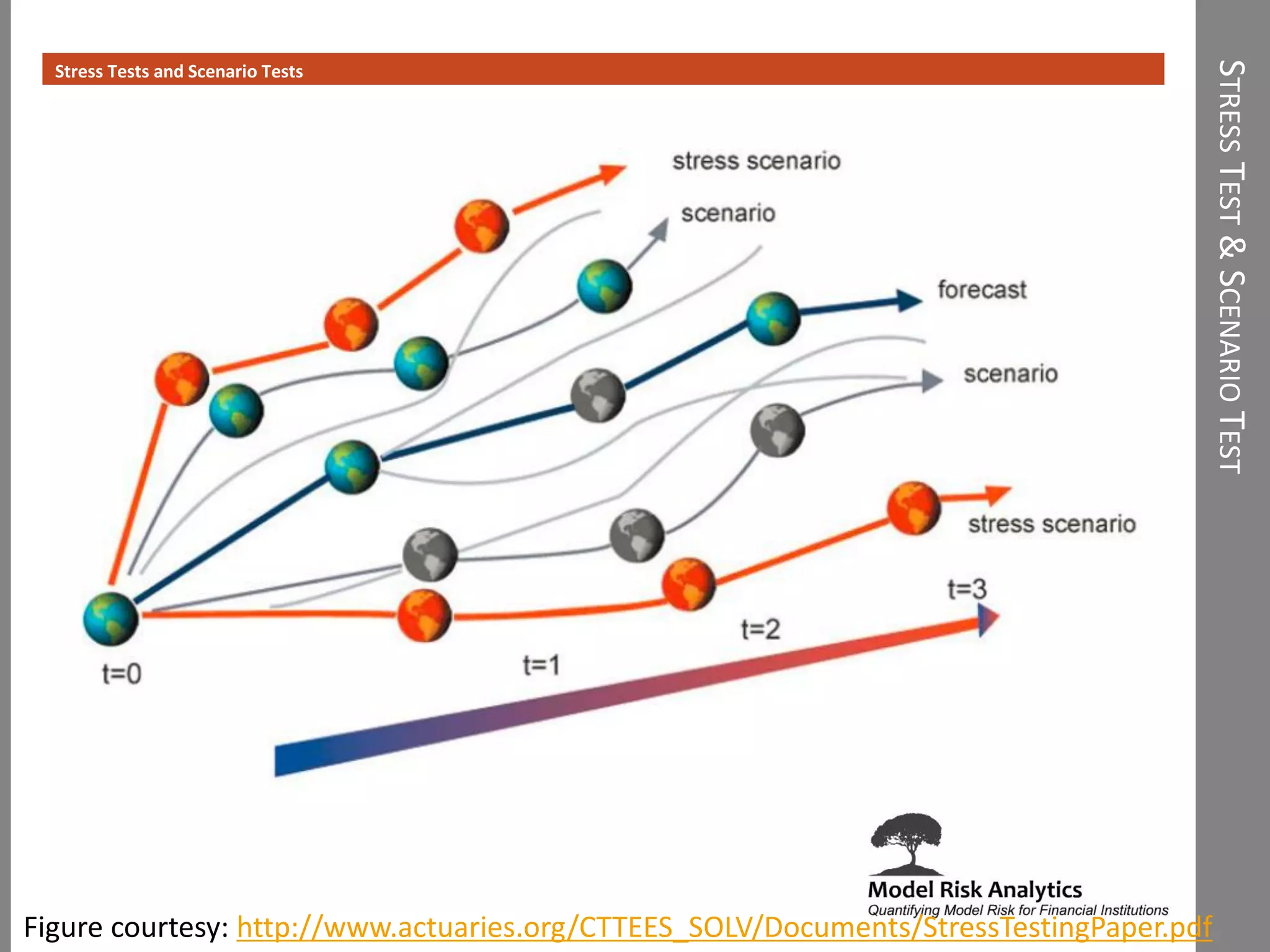
Stress Tests and Scenario Tests
Figure courtesy: http://www.actuaries.org/CTTEES_SOLV/Documents/StressTestingPaper.pdf
DEFINITIONS
Definitions
1. Scenarios :
“A scenario is a possible future environment, either at a point in
time or over a period of time.”
“Considers the impact of a combination of events“
2. Sensitivity Analysis:
“A sensitivity is the effect of a set of alternative assumptions
regarding a future environment. “
3. Stress Testing:
Analysis of the impact of single extreme events (or risk factors)
Ref: http://www.actuaries.org/CTTEES_SOLV/Documents/StressTestingPaper.pdf
CONSIDERATIONSFORMANAGINGUNCERTAINTY
Considerations for managing uncertainity
Case One: Single unknown parameter
Example : Volatility
Case Two: Two Unknown Parameters
Example : Uncertain about mean μ as well as the
standard deviation σ
Case Three: Unknown correlation(s)
Case Four: Mixing parameter and Distribution risk
Ref: Wiley: Measuring Market Risk, 2nd Edition -
Kevin Dowd
HANDLINGLARGEDIMENSIONALDATASETS
Handling large dimensional data
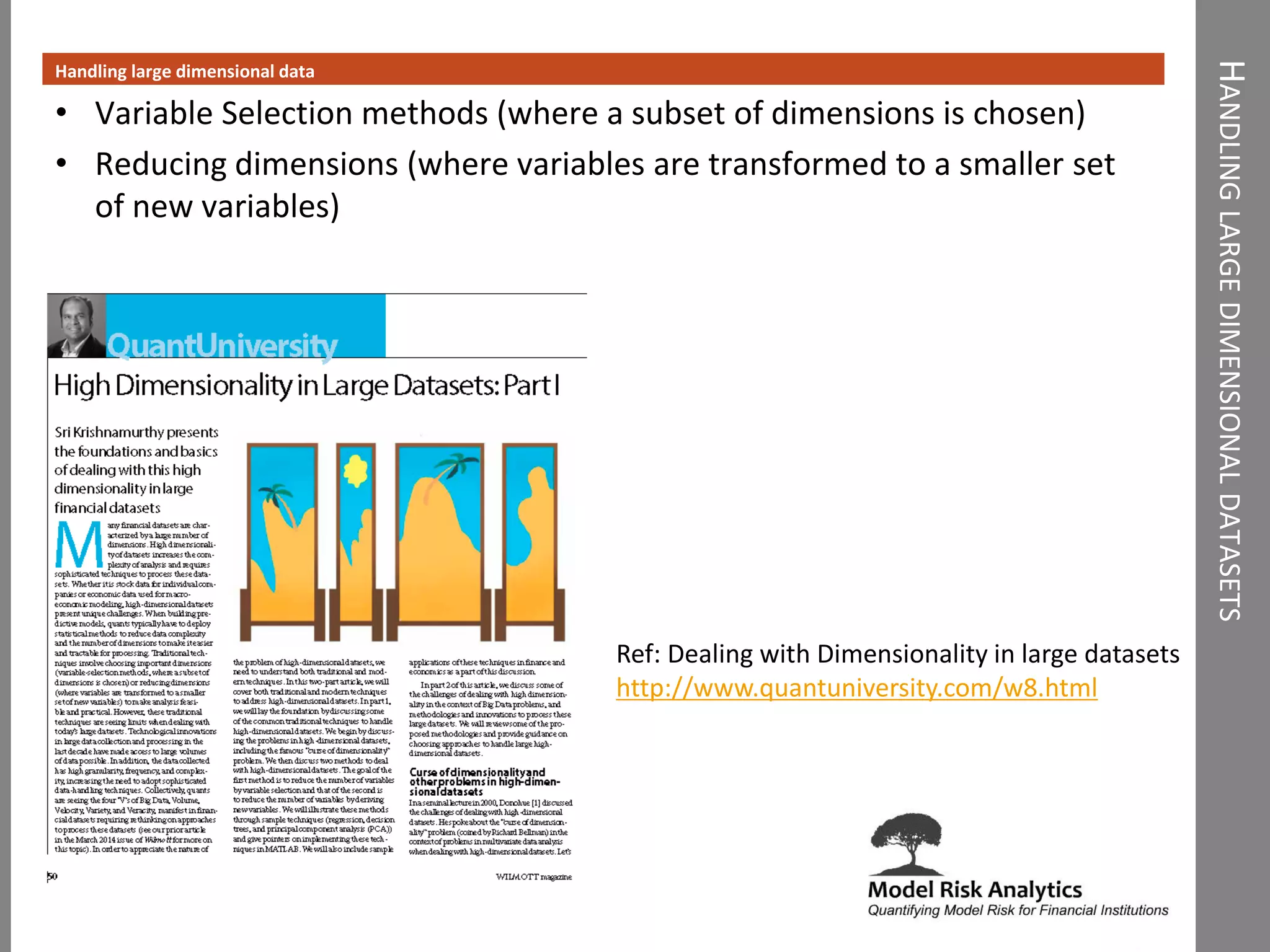
• Variable Selection methods (where a subset of dimensions is chosen)
• Reducing dimensions (where variables are transformed to a smaller set
of new variables)
Ref: Dealing with Dimensionality in large datasets
http://www.quantuniversity.com/w8.html
CHARACTERISTICSOFSTRESSANDSCENARIOTESTING
Characteristics of Stress and Scenario testing
1. Difficult to build parametric models – Simulation driven
approach necessary
2. Parameter space can explode easily
3. Tests independent of each other (Embarrassingly parallel)
4. Complete test-coverage – Useless
5. Human intervention required
6. Tests to be designed and customized for the companies
needs considering portfolios, organization structure and
regulatory obligations
Ref: http://www.actuaries.org/CTTEES_SOLV/Documents/StressTestingPaper.pdf
LEVERAGINGTECHNOLOGYTOSCALESTRESSANDSCENARIOTESTING
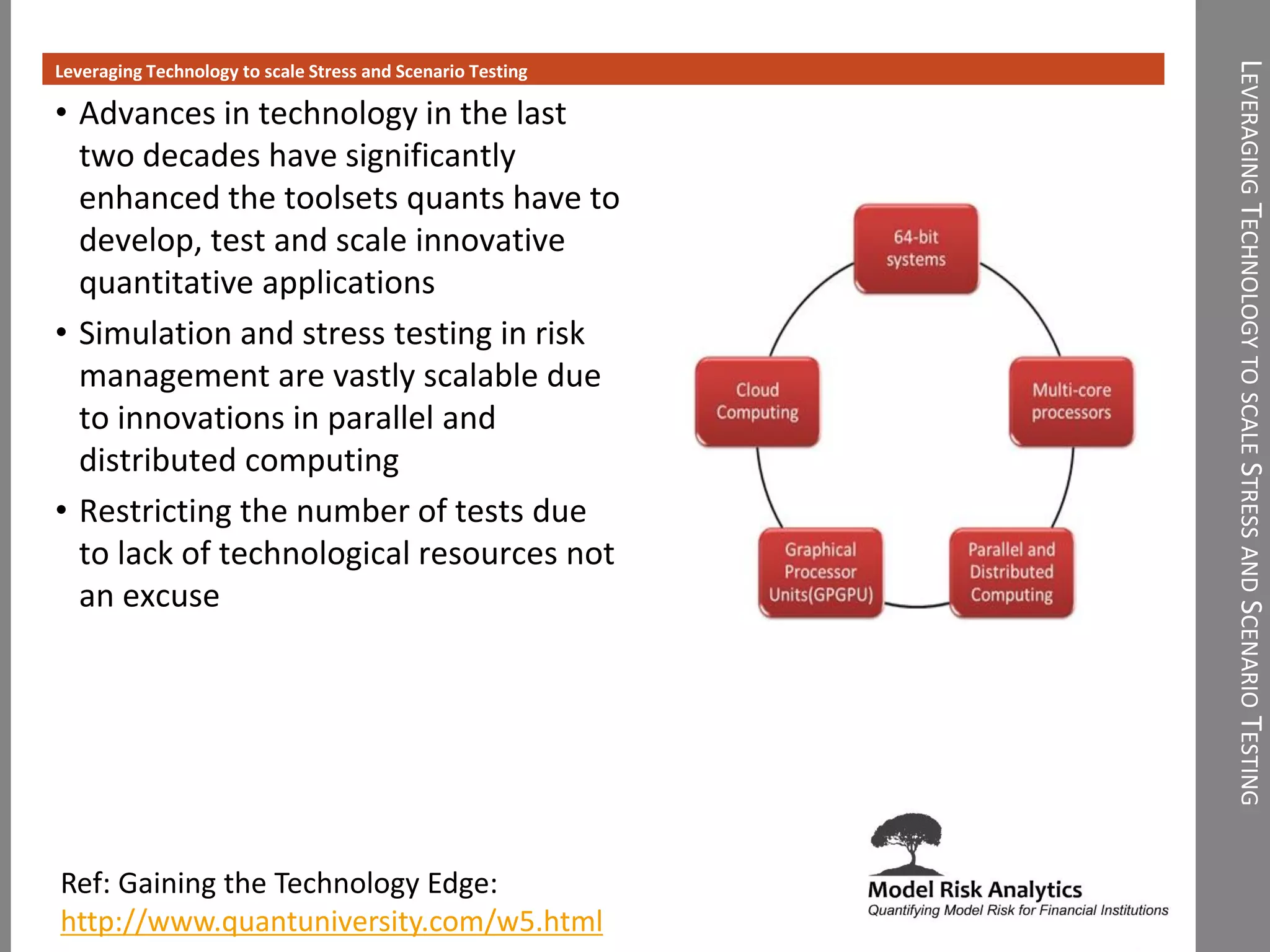
Leveraging Technology to scale Stress and Scenario Testing
• Advances in technology in the last
two decades have significantly
enhanced the toolsets quants have to
develop, test and scale innovative
quantitative applications
• Simulation and stress testing in risk
management are vastly scalable due
to innovations in parallel and
distributed computing
• Restricting the number of tests due
to lack of technological resources not
an excuse
Ref: Gaining the Technology Edge:
http://www.quantuniversity.com/w5.html
LEVERAGETECHNOLOGYTOSCALEANALYTICS
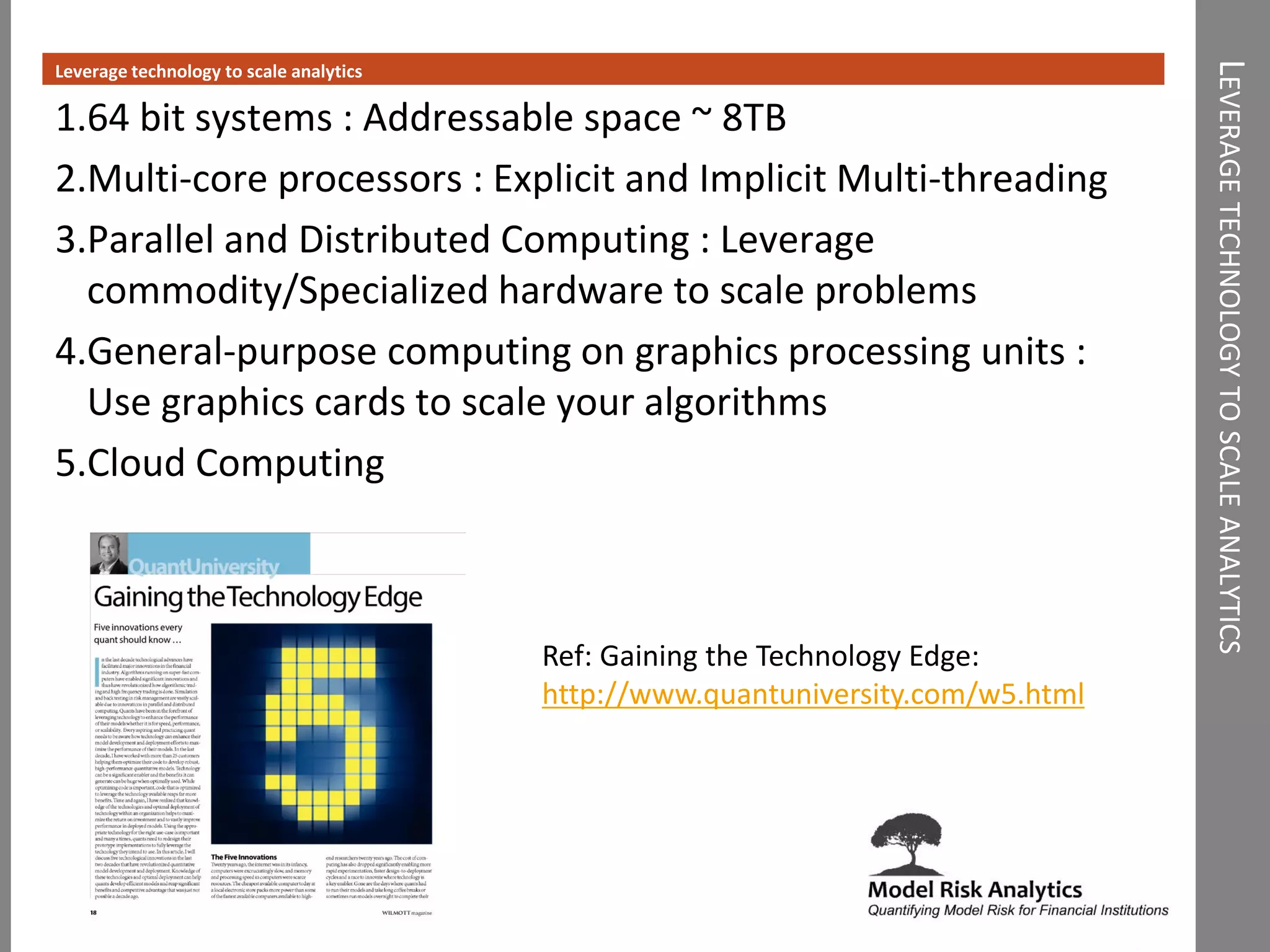
Leverage technology to scale analytics
1.64 bit systems : Addressable space ~ 8TB
2.Multi-core processors : Explicit and Implicit Multi-threading
3.Parallel and Distributed Computing : Leverage
commodity/Specialized hardware to scale problems
4.General-purpose computing on graphics processing units :
Use graphics cards to scale your algorithms
5.Cloud Computing
Ref: Gaining the Technology Edge:
http://www.quantuniversity.com/w5.html
BESTPRACTICESTOLEVERAGETECHNOLOGYFORSTRESSTESTING
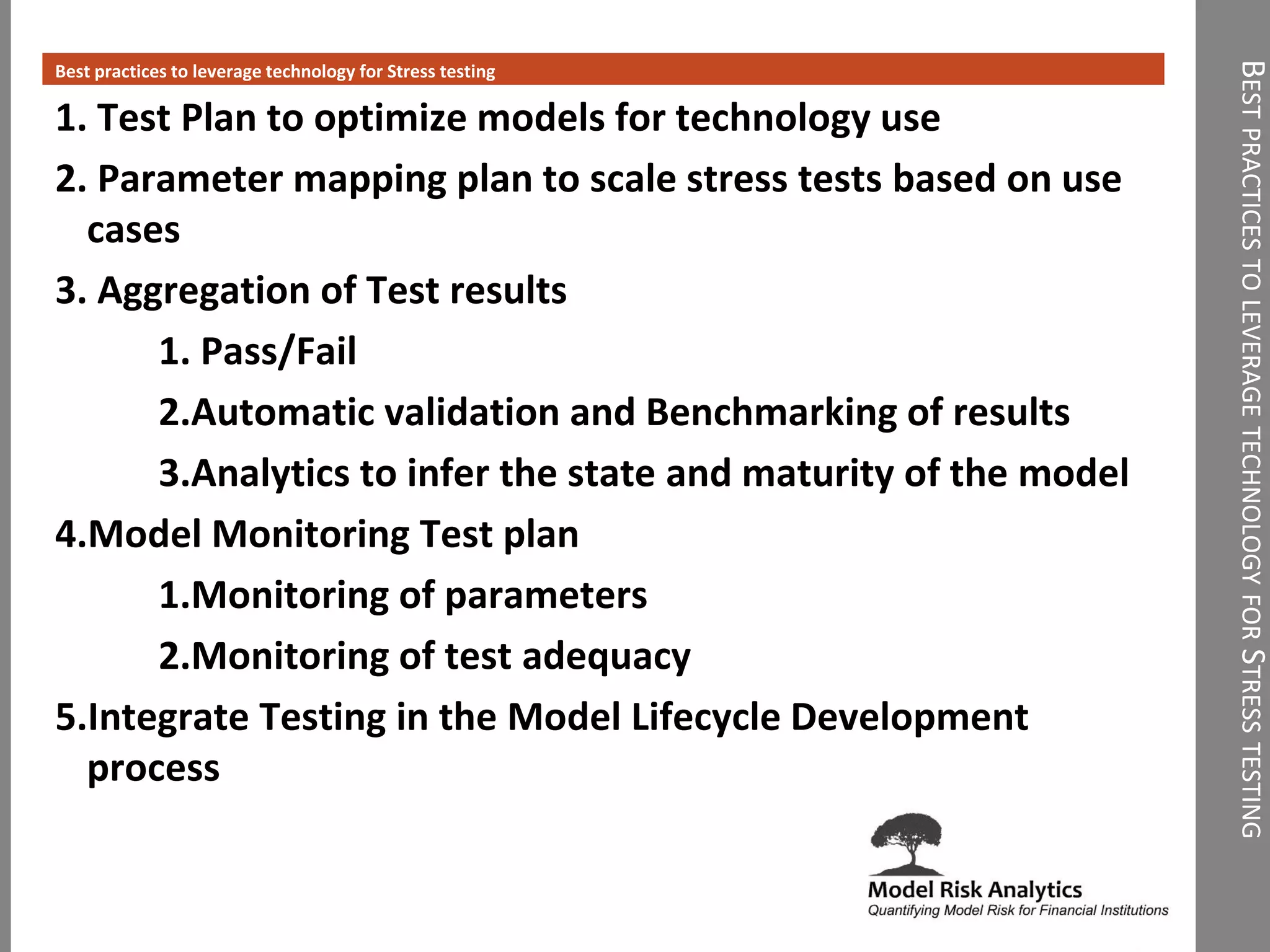
Best practices to leverage technology for Stress testing
1. Test Plan to optimize models for technology use
2. Parameter mapping plan to scale stress tests based on use
cases
3. Aggregation of Test results
1. Pass/Fail
2.Automatic validation and Benchmarking of results
3.Analytics to infer the state and maturity of the model
4.Model Monitoring Test plan
1.Monitoring of parameters
2.Monitoring of test adequacy
5.Integrate Testing in the Model Lifecycle Development
process
REFERENCES
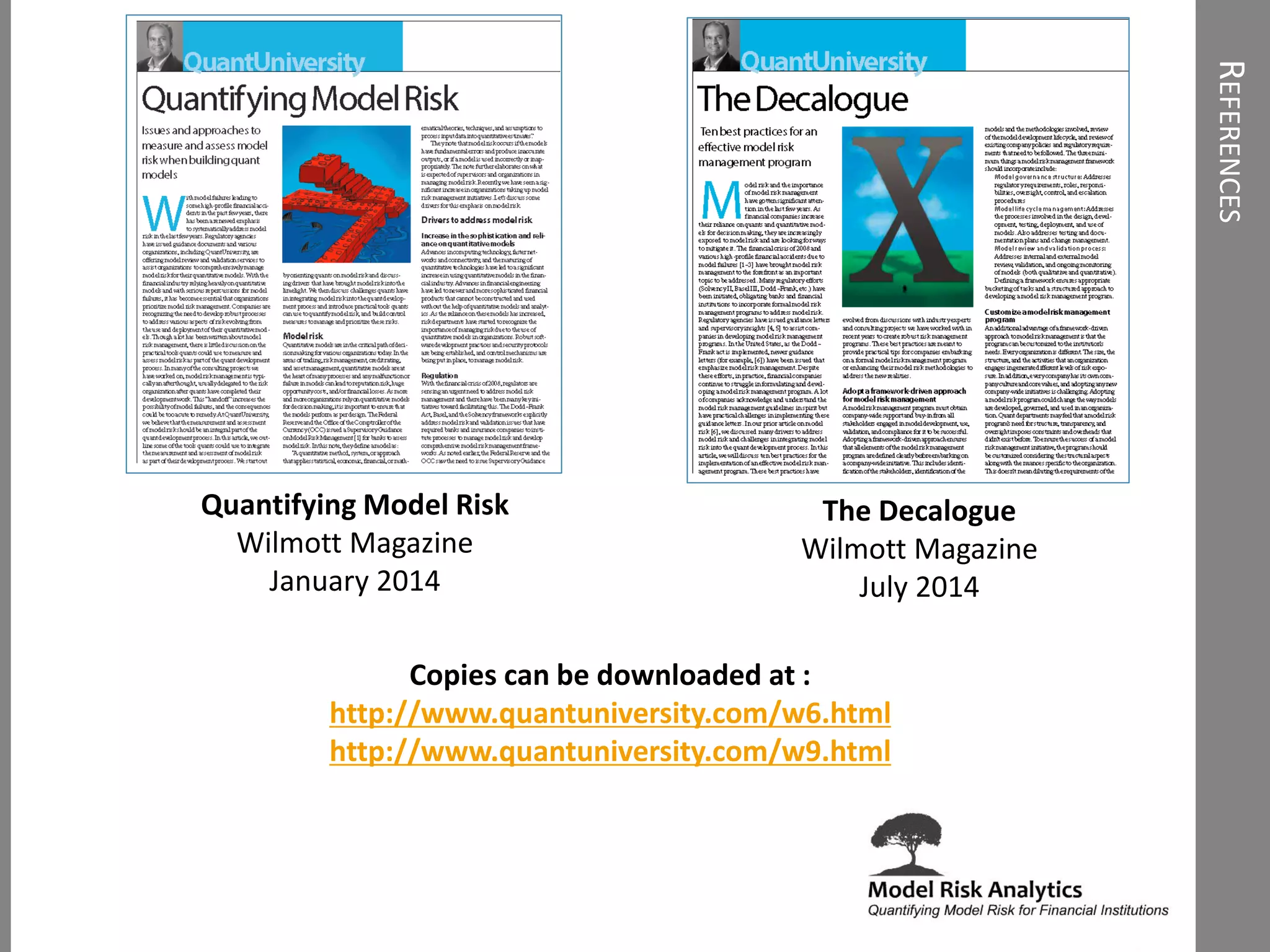
Quantifying Model Risk
Wilmott Magazine
January 2014
The Decalogue
Wilmott Magazine
July 2014
Copies can be downloaded at :
http://www.quantuniversity.com/w6.html
http://www.quantuniversity.com/w9.html
SUMMARY
Model Risk : A Brief Introduction
A Framework driven approach to Model Risk Management
Quantifying Model Risk
Stress and Scenario Testing in Model Risk Management
1
2
3
4
Summary
UPCOMINGCOURSES
Upcoming courses
1. Data Science and Analytics for Quants
2. Model Risk Management
Covers analytical techniques and Big Data methodologies in
finance.
Covers Model Risk Management framework, analytical
techniques and case studies
Register your interest at www.quantuniversity.com
Thank you!
Sri Krishnamurthy, CFA, CAP
Founder and CEO
QuantUniversity LLC.
srikrishnamurthy
www.QuantUniversity.com
Contact
Information, data and drawings embodied in this presentation are strictly a property of QuantUniversity LLC. and shall not be
distributed or used in any other publication without the prior written consent of QuantUniversity LLC.

A Framework Driven Approach to Model Risk Management (www.dataanalyticsfinancial.com)

  • 1.
    A FRAMEWORK DRIVENAPPROACH TO MODEL RISK MANAGEMENT Information, data and drawings embodied in this presentation are strictly confidential and are supplied on the understanding that they will be held confidentially and not disclosed to third parties without the prior written consent of QuantUniversity LLC. Sri Krishnamurthy, CFA Founder and CEO QuantUniversity LLC. www.QuantUniversity.com DATA ANALYTICS FOR FINANCIAL SERVICES, JULY 22 2014, BOSTON, MA
  • 2.
    AGENDA About Model RiskAnalytics Model Risk : A Brief Introduction A Framework driven approach to Model Risk Management Quantifying Model Risk Stress and Scenario Testing in Model Risk Management 1 2 3 4 5 Agenda
  • 3.
    • Founder ofQuantUniversity LLC. • Advisory and Consultancy for Model Risk • Prior Experience at MathWorks, Citigroup and Endeca and 25+ customers • Regular Columnist for the Wilmott Magazine • Author of forthcoming book “Financial Modeling: A case study approach” published by Wiley • Charted Financial Analyst and Certified Analytics Professional • Teaches Analytics in the Babson College MBA program Sri Krishnamurthy Founder and CEO SPEAKERBIO
  • 4.
    COMPREHENSIVE MODEL RISKMANAGEMENT FOR FINANCIAL INSTITUTIONS - ADVISORY SERVICES - PLATFORM TO MANAGE MODEL RISK - TRAINING AND AUDITS
  • 5.
    OURSOLUTION Comprehensive Model RiskAssessment Framework Model Risk Quantification Methodology Fully auditable cloud-based Model Risk Management platform 5 5 10 15 20 25 4 4 8 12 16 20 3 3 6 9 12 15 2 2 4 6 8 10 1 1 2 3 4 5 1 2 3 4 5 Likelihoodof occurrence Impact RiskScores Model Governance Model Lifecycle Management Model Risk and Validation Makes measuring risk and prioritizing issues easier Complies with audits and regulatory needs Proven framework for a Model risk platform MODELRISKANALYTICS  Customer Validation  Industry Acceptance  Novel and fast growing
  • 6.
    MODEL RISK –A BRIEF INTRODUCTION
  • 8.
    MODELRISKINTHENEWS Financial accidents havecost companies millions of dollars and was blamed for the financial crisis of 2008 Concerned about systemic risk, regulators have stepped up regulations to setup model risk programs All Banks, Insurance Companies and Credit Rating agencies in the US and EU are affected by these regulations As financial institutions depend on models for decision making, Model Risk Management is critical 8Source: E&Y Survey 69 banks & 6 insurance companies
  • 9.
    CHALLENGES Quantitative models arecomplex: Measuring model risk is not easy Quantitative systems are complex : Many stakeholders Novelty: Lack of guidance and ambiguity on regulations Quants Risk Portfolio Management IT 1 2 3 Financial institutions face challenges implementing Model Risk Programs SEC = ?
  • 10.
    MODELRISK “Model refers toa quantitative method, system, or approach that applies statistical, economic, financial, or mathematical theories, techniques, and assumptions to process input data into quantitative estimates” [1] Ref: [1] . Supervisory Letter SR 11-7 on guidance on Model Risk Model Risk Defined Input Assumptions/Data Processing component Output/ Reporting component
  • 11.
    MODELVALIDATION “Model risk isthe potential for adverse consequences from decisions based on incorrect or misused model outputs and reports. “ [1] “Model validation is the set of processes and activities intended to verify that models are performing as expected, in line with their design objectives and business uses. ” [1] Ref: [1] . Supervisory Letter SR 11-7 on guidance on Model Risk Model Risk and Validation Defined
  • 12.
    A FRAMEWORK DRIVENAPPROACH TO MODEL RISK MANAGEMENT
  • 13.
    MODELRISKMANAGEMENT Elements of aModel Risk Management framework 1. Model Governance structure: Addresses regulatory requirements, roles, responsibilities, oversight, control and escalation procedures 2. Model Lifecycle management: Addresses the processes involved in the design, development, testing, deployment and use of models. Also addresses testing and documentation plans and change management. 3. Model Review and Validation Process: Addresses internal and external model review, validation and ongoing monitoring of models (both qualitative and quantitative)
  • 14.
    MODELGOVERNANCESTRUCTURE Model Governance Structure Model Governance Structure Regulatory guidance andbest practices Model Classification Roles and Responsibil ities Oversight and Controls
  • 15.
  • 16.
    MODELREVIEWANDVALIDATION Model Review andValidation Policy: Model Policy Review Structure: Model Process Review Content: Model Review
  • 17.
    LEVERAGINGTECHNOLOGYANDANALYTICSFOREFFECTIVEMODELRISKMANAGEMENT Leveraging technology andanalytics for effective Model Risk Management 1.Quantifying Model Risk: • Classification and Measurement of Model Risk 2.Leveraging technology to scale stress and scenario testing
  • 18.
  • 19.
    CHALLENGES Organizational Structure Organization Enterprise Risk Management Compliance Model Research and Development EndUsers IT How to engage all departments strategically to have a comprehensive view of Model Risk ?
  • 20.
    HOWTODOIT Theory to Practice: How to cross the chasm ? Image Courtesy: http://rednomadoz.blogspot.com.au/ • Theory • Regulations • Local Laws • Practical IT systems • Company policies • Company culture and Best practices
  • 21.
    CLASSIFYINGMODELRISK Classifying Model Risk Class3 Example: Monte-carlo simulation engine Class 2 Example: Linked-spreadsheet model with dependencies Class 1 Example: Simple Spreadsheets Complexity 1. Class 1 Models: Simple Models typically involving less complex atomic calculations 2. Class 2 Models: Models more complicated than Class 1 models 3. Class 3 Models: Typically involves sophisticated mathematical/statistical techniques
  • 22.
  • 23.
  • 24.
    RISKGRADING Sample Risk gradingconsidering impact and likelihood of occurrence 5 5 10 15 20 25 4 4 8 12 16 20 3 3 6 9 12 15 2 2 4 6 8 10 1 1 2 3 4 5 1 2 3 4 5 Likelihood of occurrence Impact Risk Scores Red High Risk Yellow Moderate Risk Green Low Risk High Impact- High likelihood of occurrence : Needs adequate model risk control measures to mitigate risk High Impact – Low likelihood of occurrence: Address through model risk control measures and contingency plans Low Impact – High likelihood of occurrence : Lower priority model risk control measures Low Impact – Low likelihood of occurrence: Least priority model risk control measures
  • 25.
    LEVERAGINGMACHINELEARNING Machine learning techniquesapplied to Quantifying Model risk 1. Clustering to bucket “similar” risks • Identifying training opportunities and best practices for model development 2. K-Nearest Neighbor (k-NN) to automatically derive risk scores • Leveraging expert scoring to help prioritize issues 3. Conjoint analysis • Identifying what combination of a limited number of attributes is most influential on respondent choice or decision making
  • 26.
    STRESS TESTING ANDSCENARIO TESTING TO EVALUATE MODEL RISK
  • 27.
    STRESSTEST&SCENARIOTEST Stress Tests andScenario Tests Figure courtesy: http://www.actuaries.org/CTTEES_SOLV/Documents/StressTestingPaper.pdf
  • 28.
    DEFINITIONS Definitions 1. Scenarios : “Ascenario is a possible future environment, either at a point in time or over a period of time.” “Considers the impact of a combination of events“ 2. Sensitivity Analysis: “A sensitivity is the effect of a set of alternative assumptions regarding a future environment. “ 3. Stress Testing: Analysis of the impact of single extreme events (or risk factors) Ref: http://www.actuaries.org/CTTEES_SOLV/Documents/StressTestingPaper.pdf
  • 29.
    CONSIDERATIONSFORMANAGINGUNCERTAINTY Considerations for managinguncertainity Case One: Single unknown parameter Example : Volatility Case Two: Two Unknown Parameters Example : Uncertain about mean μ as well as the standard deviation σ Case Three: Unknown correlation(s) Case Four: Mixing parameter and Distribution risk Ref: Wiley: Measuring Market Risk, 2nd Edition - Kevin Dowd
  • 30.
    HANDLINGLARGEDIMENSIONALDATASETS Handling large dimensionaldata • Variable Selection methods (where a subset of dimensions is chosen) • Reducing dimensions (where variables are transformed to a smaller set of new variables) Ref: Dealing with Dimensionality in large datasets http://www.quantuniversity.com/w8.html
  • 31.
    CHARACTERISTICSOFSTRESSANDSCENARIOTESTING Characteristics of Stressand Scenario testing 1. Difficult to build parametric models – Simulation driven approach necessary 2. Parameter space can explode easily 3. Tests independent of each other (Embarrassingly parallel) 4. Complete test-coverage – Useless 5. Human intervention required 6. Tests to be designed and customized for the companies needs considering portfolios, organization structure and regulatory obligations Ref: http://www.actuaries.org/CTTEES_SOLV/Documents/StressTestingPaper.pdf
  • 32.
    LEVERAGINGTECHNOLOGYTOSCALESTRESSANDSCENARIOTESTING Leveraging Technology toscale Stress and Scenario Testing • Advances in technology in the last two decades have significantly enhanced the toolsets quants have to develop, test and scale innovative quantitative applications • Simulation and stress testing in risk management are vastly scalable due to innovations in parallel and distributed computing • Restricting the number of tests due to lack of technological resources not an excuse Ref: Gaining the Technology Edge: http://www.quantuniversity.com/w5.html
  • 33.
    LEVERAGETECHNOLOGYTOSCALEANALYTICS Leverage technology toscale analytics 1.64 bit systems : Addressable space ~ 8TB 2.Multi-core processors : Explicit and Implicit Multi-threading 3.Parallel and Distributed Computing : Leverage commodity/Specialized hardware to scale problems 4.General-purpose computing on graphics processing units : Use graphics cards to scale your algorithms 5.Cloud Computing Ref: Gaining the Technology Edge: http://www.quantuniversity.com/w5.html
  • 34.
    BESTPRACTICESTOLEVERAGETECHNOLOGYFORSTRESSTESTING Best practices toleverage technology for Stress testing 1. Test Plan to optimize models for technology use 2. Parameter mapping plan to scale stress tests based on use cases 3. Aggregation of Test results 1. Pass/Fail 2.Automatic validation and Benchmarking of results 3.Analytics to infer the state and maturity of the model 4.Model Monitoring Test plan 1.Monitoring of parameters 2.Monitoring of test adequacy 5.Integrate Testing in the Model Lifecycle Development process
  • 35.
    REFERENCES Quantifying Model Risk WilmottMagazine January 2014 The Decalogue Wilmott Magazine July 2014 Copies can be downloaded at : http://www.quantuniversity.com/w6.html http://www.quantuniversity.com/w9.html
  • 36.
    SUMMARY Model Risk :A Brief Introduction A Framework driven approach to Model Risk Management Quantifying Model Risk Stress and Scenario Testing in Model Risk Management 1 2 3 4 Summary
  • 37.
    UPCOMINGCOURSES Upcoming courses 1. DataScience and Analytics for Quants 2. Model Risk Management Covers analytical techniques and Big Data methodologies in finance. Covers Model Risk Management framework, analytical techniques and case studies Register your interest at www.quantuniversity.com
  • 38.
    Thank you! Sri Krishnamurthy,CFA, CAP Founder and CEO QuantUniversity LLC. srikrishnamurthy www.QuantUniversity.com Contact Information, data and drawings embodied in this presentation are strictly a property of QuantUniversity LLC. and shall not be distributed or used in any other publication without the prior written consent of QuantUniversity LLC.