Quality Improvement in Sepsis
Recognition & Treatment
By: Joseph Di Genova
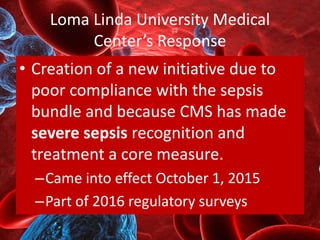
Loma Linda University Medical
Center’s Response
• Creation of a new initiative due to
poor compliance with the sepsis
bundle and because CMS has made
severe sepsis recognition and
treatment a core measure.
–Came into effect October 1, 2015
–Part of 2016 regulatory surveys
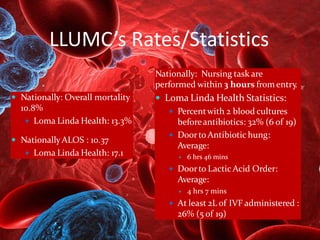
LLUMC’s Rates/Statistics
 Nationally: Overall mortality
10.8%
 Loma Linda Health: 13.3%
 NationallyALOS : 10.37
 Loma Linda Health: 17.1
Nationally: Nursing task are
performed within 3 hours from entry.
 Loma Linda Health Statistics:
 Percentwith 2 blood cultures
beforeantibiotics: 32% (6 of 19)
 DoortoAntibiotic hung:
Average:
 6 hrs 46 mins
 Doorto Lactic Acid Order:
Average:
 4 hrs 7 mins
 At least 2L of IVF administered :
26% (5 of 19)
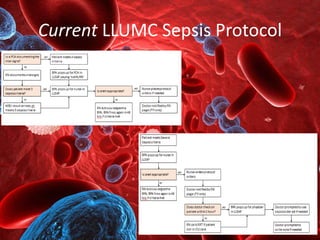
Current LLUMC Sepsis Protocol
Identifying Severe Sepsis via
Electronic Surveillance
• “The software identified 477 patients, compared
with 18 by adjudication” and was “more sensitive
but less specific than care team or administrative
data.”
• “The system can be a useful tool when implemented
appropriately but lacks specificity, largely because of
its reliance on discreet data fields.”
• The study determined the ability of a software
system to extract data from the EMR to identify
patients with severe sepsis throughout the hospital.
Reduction in Time to First Action as a Result of
Electronic Alerts for Early Sepsis Recognition
• Use of computerized medical records to create an electronic alerting
system with the potential to identify high-risk patients and initiate
interventions sooner; this creation of this alerting system with real-time
data decreased the time it took to begin sepsis workup and treatment on
patients with possible sepsis.
• “The implementation of sepsis alerts decreased time to first sepsis-related
intervention, suggesting that the alerts significantly improved timely
sepsis recognition as a whole. The alerts improved the timeliness of some,
but not all, individual sepsis-related interventions.”
• An identified negative to use of the electronic alert is what is sometimes
called “alert fatigue.” Basically, the alert fires so often (including on
patients who are found not septic) leading to possible “action by a
provider to ‘clear’ the alert without actually being followed through.”
Care of Patients in Acute and Critical Care Settings: The
impact of an electronic medical record surveillance
program on outcomes for patients with sepsis
• A study was performed to “evaluate the effects of this EMR
surveillance on sepsis, severe sepsis or septic shock outcomes
in patients admitted to a medical telemetry unit, including
length of hospital stay, patient discharge and mortality.”
• Implementation of EMR sepsis surveillance considerably
improved home discharge and reduced hospital mortality.
– “Shows promising evidence that the use of an EMR sepsis
surveillance alert could decrease the ravishing effects of
sepsis, severe sepsis and septic shock by early
identification and treatment.”
Utilizing the EMR
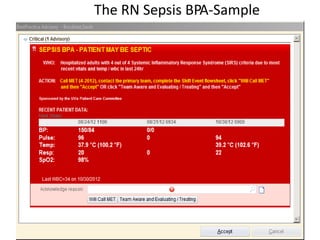
• Best Practice Advisory (BPA) Alert Pop-Up on Epic charting system
• Early identification and intervention in sepsis patients can be aided
through utilizing the Epic charting system alerts.
• Epic-‐based interventions developed to ensure the identification and
early treatment of septic patients.
• The alert will helps to:
– provide early goal directed therapy within the 1st hour
– complete the evidence-‐based Sepsis Resuscitation Bundle within 6 hours
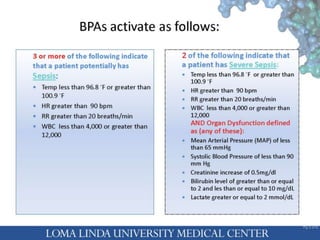
• On all adult Acute Care units, a red BPA (Best Practice Advisory) fires
when a patient meets all 4 criteria for Systemic Inflammatory
Response Syndrome (SIRS)
• Temp <= 36 or >=38.3 (in past 24 hours)
• HR > 90 (most recent)
• Respiratory rate > 20 (most recent) or PaCO2<32 (most recent in last
24 hours)
• WBC > 12k or < 4k or Bands > 10% (most recent in last 24 hours)
The RN Sepsis BPA-Sample
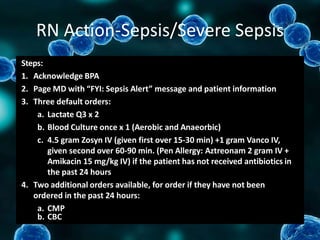
RN Action-Sepsis/Severe Sepsis
Steps:
1. Acknowledge BPA
2. Page MD with “FYI: Sepsis Alert” message and patient information
3. Three default orders:
a. Lactate Q3 x 2
b. Blood Culture once x 1 (Aerobic and Anaeorbic)
c. 4.5 gram Zosyn IV (given first over 15-30 min) +1 gram Vanco IV,
given second over 60-90 min. (Pen Allergy: Aztreonam 2 gram IV +
Amikacin 15 mg/kg IV) if the patient has not received antibiotics in
the past 24 hours
4. Two additional orders available, for order if they have not been
ordered in the past 24 hours:
a. CMP
b. CBC
MD Action-Severe Sepsis
• Physicians are expected to evaluate patients
identified as having severe sepsis within 60
minutes of receiving page alert.
• ICU:
– If no response, notify attending.
• Non-ICU:
– Activate RRT
Summary
• Problem
– Delayed sepsis recognition/treatment in other hospitals
• Solutions/Compliance
– Utilize EMR system (BPA alert) & standard protocol to
provide prompt recognition/treatment
• Improving Outcomes
– Adequately train staff and enforce/audit usage and patient
outcomes
• Maintaining Progress
– Continually review & study implementation of BPA alert
– Seek ways to critique/improve recognition of potentially
septic patients (algorithm used by EMR system)
References
Carolyn Davidson, RN, MSN – LLUMC Educator
Areas of specialty: Adult Medical and Surgical
Education, Housewide In-servicing
Karen Lawson, RN, MSN-LLUMC Educator
Unit: Surgical Neuro-Trauma ICU Clinical
References
Identifying Severe Sepsis via Electronic Surveillance.
(2015). American Journal of Medical Quality, 30(6),
559-565 7p. doi:10.1177/1062860614541291
Kurczewski, L., Sweet, M., McKnight, R., & Halbritter, K. (2015).
Reduction in Time to First Action as a Result of Electronic
Alerts for Early Sepsis Recognition. Critical Care Nursing
Quarterly, 38(2), 182. doi:10.1097/CNQ.0000000000000060
McRee L, Thanavaro J, Moore K, Goldsmith M, Pasvogel A. Care of
Patients in Acute and Critical Care Settings: The impact of an
electronic medical record surveillance program on outcomes
for patients with sepsis. Heart & Lung - The Journal Of Acute
And Critical Care [serial online]. November 1, 2014;43:546-
549. Available from: ScienceDirect, Ipswich, MA. Accessed
November 20, 2015.

Quality Improvement Sepsis Recognition & Treatment

  • 1.
    Quality Improvement inSepsis Recognition & Treatment By: Joseph Di Genova
  • 3.
    Loma Linda UniversityMedical Center’s Response • Creation of a new initiative due to poor compliance with the sepsis bundle and because CMS has made severe sepsis recognition and treatment a core measure. –Came into effect October 1, 2015 –Part of 2016 regulatory surveys
  • 4.
    LLUMC’s Rates/Statistics  Nationally:Overall mortality 10.8%  Loma Linda Health: 13.3%  NationallyALOS : 10.37  Loma Linda Health: 17.1 Nationally: Nursing task are performed within 3 hours from entry.  Loma Linda Health Statistics:  Percentwith 2 blood cultures beforeantibiotics: 32% (6 of 19)  DoortoAntibiotic hung: Average:  6 hrs 46 mins  Doorto Lactic Acid Order: Average:  4 hrs 7 mins  At least 2L of IVF administered : 26% (5 of 19)
  • 5.
  • 6.
    Identifying Severe Sepsisvia Electronic Surveillance • “The software identified 477 patients, compared with 18 by adjudication” and was “more sensitive but less specific than care team or administrative data.” • “The system can be a useful tool when implemented appropriately but lacks specificity, largely because of its reliance on discreet data fields.” • The study determined the ability of a software system to extract data from the EMR to identify patients with severe sepsis throughout the hospital.
  • 7.
    Reduction in Timeto First Action as a Result of Electronic Alerts for Early Sepsis Recognition • Use of computerized medical records to create an electronic alerting system with the potential to identify high-risk patients and initiate interventions sooner; this creation of this alerting system with real-time data decreased the time it took to begin sepsis workup and treatment on patients with possible sepsis. • “The implementation of sepsis alerts decreased time to first sepsis-related intervention, suggesting that the alerts significantly improved timely sepsis recognition as a whole. The alerts improved the timeliness of some, but not all, individual sepsis-related interventions.” • An identified negative to use of the electronic alert is what is sometimes called “alert fatigue.” Basically, the alert fires so often (including on patients who are found not septic) leading to possible “action by a provider to ‘clear’ the alert without actually being followed through.”
  • 8.
    Care of Patientsin Acute and Critical Care Settings: The impact of an electronic medical record surveillance program on outcomes for patients with sepsis • A study was performed to “evaluate the effects of this EMR surveillance on sepsis, severe sepsis or septic shock outcomes in patients admitted to a medical telemetry unit, including length of hospital stay, patient discharge and mortality.” • Implementation of EMR sepsis surveillance considerably improved home discharge and reduced hospital mortality. – “Shows promising evidence that the use of an EMR sepsis surveillance alert could decrease the ravishing effects of sepsis, severe sepsis and septic shock by early identification and treatment.”
  • 9.
    Utilizing the EMR •Best Practice Advisory (BPA) Alert Pop-Up on Epic charting system • Early identification and intervention in sepsis patients can be aided through utilizing the Epic charting system alerts. • Epic-‐based interventions developed to ensure the identification and early treatment of septic patients. • The alert will helps to: – provide early goal directed therapy within the 1st hour – complete the evidence-‐based Sepsis Resuscitation Bundle within 6 hours • On all adult Acute Care units, a red BPA (Best Practice Advisory) fires when a patient meets all 4 criteria for Systemic Inflammatory Response Syndrome (SIRS) • Temp <= 36 or >=38.3 (in past 24 hours) • HR > 90 (most recent) • Respiratory rate > 20 (most recent) or PaCO2<32 (most recent in last 24 hours) • WBC > 12k or < 4k or Bands > 10% (most recent in last 24 hours)
  • 10.
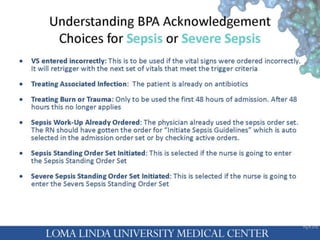
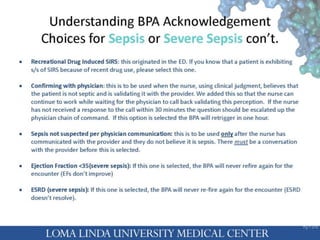
    The RN SepsisBPA-Sample
  • 14.
    RN Action-Sepsis/Severe Sepsis Steps: 1.Acknowledge BPA 2. Page MD with “FYI: Sepsis Alert” message and patient information 3. Three default orders: a. Lactate Q3 x 2 b. Blood Culture once x 1 (Aerobic and Anaeorbic) c. 4.5 gram Zosyn IV (given first over 15-30 min) +1 gram Vanco IV, given second over 60-90 min. (Pen Allergy: Aztreonam 2 gram IV + Amikacin 15 mg/kg IV) if the patient has not received antibiotics in the past 24 hours 4. Two additional orders available, for order if they have not been ordered in the past 24 hours: a. CMP b. CBC
  • 15.
    MD Action-Severe Sepsis •Physicians are expected to evaluate patients identified as having severe sepsis within 60 minutes of receiving page alert. • ICU: – If no response, notify attending. • Non-ICU: – Activate RRT
  • 16.
    Summary • Problem – Delayedsepsis recognition/treatment in other hospitals • Solutions/Compliance – Utilize EMR system (BPA alert) & standard protocol to provide prompt recognition/treatment • Improving Outcomes – Adequately train staff and enforce/audit usage and patient outcomes • Maintaining Progress – Continually review & study implementation of BPA alert – Seek ways to critique/improve recognition of potentially septic patients (algorithm used by EMR system)
  • 17.
    References Carolyn Davidson, RN,MSN – LLUMC Educator Areas of specialty: Adult Medical and Surgical Education, Housewide In-servicing Karen Lawson, RN, MSN-LLUMC Educator Unit: Surgical Neuro-Trauma ICU Clinical
  • 18.
    References Identifying Severe Sepsisvia Electronic Surveillance. (2015). American Journal of Medical Quality, 30(6), 559-565 7p. doi:10.1177/1062860614541291 Kurczewski, L., Sweet, M., McKnight, R., & Halbritter, K. (2015). Reduction in Time to First Action as a Result of Electronic Alerts for Early Sepsis Recognition. Critical Care Nursing Quarterly, 38(2), 182. doi:10.1097/CNQ.0000000000000060 McRee L, Thanavaro J, Moore K, Goldsmith M, Pasvogel A. Care of Patients in Acute and Critical Care Settings: The impact of an electronic medical record surveillance program on outcomes for patients with sepsis. Heart & Lung - The Journal Of Acute And Critical Care [serial online]. November 1, 2014;43:546- 549. Available from: ScienceDirect, Ipswich, MA. Accessed November 20, 2015.