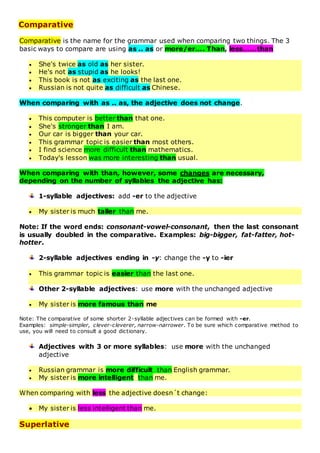
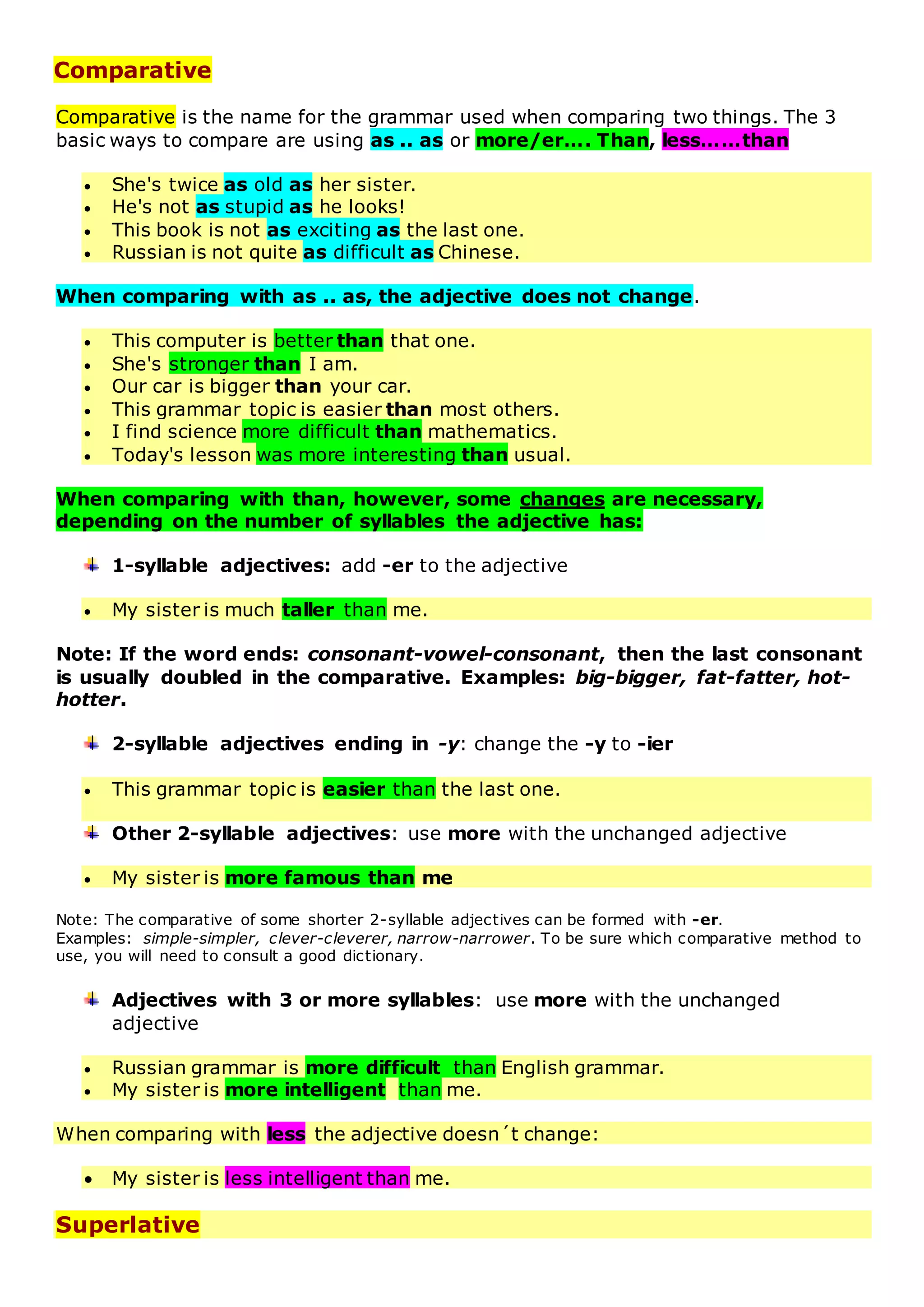
Comparative
Comparative is the name for the grammar used when comparing two things. The 3
basic ways to compare are using as .. as or more/er…. Than, less……than
 She's twice as old as her sister.
 He's not as stupid as he looks!
 This book is not as exciting as the last one.
 Russian is not quite as difficult as Chinese.
When comparing with as .. as, the adjective does not change.
 This computer is better than that one.
 She's stronger than I am.
 Our car is bigger than your car.
 This grammar topic is easier than most others.
 I find science more difficult than mathematics.
 Today's lesson was more interesting than usual.
When comparing with than, however, some changes are necessary,
depending on the number of syllables the adjective has:
1-syllable adjectives: add -er to the adjective
 My sister is much taller than me.
Note: If the word ends: consonant-vowel-consonant, then the last consonant
is usually doubled in the comparative. Examples: big-bigger, fat-fatter, hot-
hotter.
2-syllable adjectives ending in -y: change the -y to -ier
 This grammar topic is easier than the last one.
Other 2-syllable adjectives: use more with the unchanged adjective
 My sister is more famous than me
Note: The comparative of some shorter 2-syllable adjectives can be formed with -er.
Examples: simple-simpler, clever-cleverer, narrow-narrower. To be sure which comparative method to
use, you will need to consult a good dictionary.
Adjectives with 3 or more syllables: use more with the unchanged
adjective
 Russian grammar is more difficult than English grammar.
 My sister is more intelligent than me.
When comparing with less the adjective doesn´t change:
 My sister is less intelligent than me.
Superlative
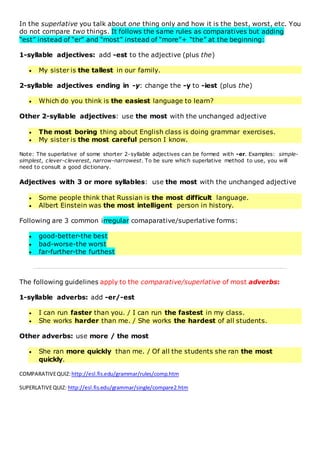
In the superlative you talk about one thing only and how it is the best, worst, etc. You
do not compare two things. It follows the same rules as comparatives but adding
“est” instead of “er” and “most” instead of “more”+ “the” at the beginning:
1-syllable adjectives: add -est to the adjective (plus the)
 My sister is the tallest in our family.
2-syllable adjectives ending in -y: change the -y to -iest (plus the)
 Which do you think is the easiest language to learn?
Other 2-syllable adjectives: use the most with the unchanged adjective
 The most boring thing about English class is doing grammar exercises.
 My sister is the most careful person I know.
Note: The superlative of some shorter 2-syllable adjectives can be formed with -er. Examples: simple-
simplest, clever-cleverest, narrow-narrowest. To be sure which superlative method to use, you will
need to consult a good dictionary.
Adjectives with 3 or more syllables: use the most with the unchanged adjective
 Some people think that Russian is the most difficult language.
 Albert Einstein was the most intelligent person in history.
Following are 3 common irregular comaparative/superlative forms:
 good-better-the best
 bad-worse-the worst
 far-further-the furthest
The following guidelines apply to the comparative/superlative of most adverbs:
1-syllable adverbs: add -er/-est
 I can run faster than you. / I can run the fastest in my class.
 She works harder than me. / She works the hardest of all students.
Other adverbs: use more / the most
 She ran more quickly than me. / Of all the students she ran the most
quickly.
COMPARATIVEQUIZ:http://esl.fis.edu/grammar/rules/comp.htm
SUPERLATIVEQUIZ: http://esl.fis.edu/grammar/single/compare2.htm

Comparative and superlative

  • 1.
    Comparative Comparative is thename for the grammar used when comparing two things. The 3 basic ways to compare are using as .. as or more/er…. Than, less……than  She's twice as old as her sister.  He's not as stupid as he looks!  This book is not as exciting as the last one.  Russian is not quite as difficult as Chinese. When comparing with as .. as, the adjective does not change.  This computer is better than that one.  She's stronger than I am.  Our car is bigger than your car.  This grammar topic is easier than most others.  I find science more difficult than mathematics.  Today's lesson was more interesting than usual. When comparing with than, however, some changes are necessary, depending on the number of syllables the adjective has: 1-syllable adjectives: add -er to the adjective  My sister is much taller than me. Note: If the word ends: consonant-vowel-consonant, then the last consonant is usually doubled in the comparative. Examples: big-bigger, fat-fatter, hot- hotter. 2-syllable adjectives ending in -y: change the -y to -ier  This grammar topic is easier than the last one. Other 2-syllable adjectives: use more with the unchanged adjective  My sister is more famous than me Note: The comparative of some shorter 2-syllable adjectives can be formed with -er. Examples: simple-simpler, clever-cleverer, narrow-narrower. To be sure which comparative method to use, you will need to consult a good dictionary. Adjectives with 3 or more syllables: use more with the unchanged adjective  Russian grammar is more difficult than English grammar.  My sister is more intelligent than me. When comparing with less the adjective doesn´t change:  My sister is less intelligent than me. Superlative
  • 2.
    In the superlativeyou talk about one thing only and how it is the best, worst, etc. You do not compare two things. It follows the same rules as comparatives but adding “est” instead of “er” and “most” instead of “more”+ “the” at the beginning: 1-syllable adjectives: add -est to the adjective (plus the)  My sister is the tallest in our family. 2-syllable adjectives ending in -y: change the -y to -iest (plus the)  Which do you think is the easiest language to learn? Other 2-syllable adjectives: use the most with the unchanged adjective  The most boring thing about English class is doing grammar exercises.  My sister is the most careful person I know. Note: The superlative of some shorter 2-syllable adjectives can be formed with -er. Examples: simple- simplest, clever-cleverest, narrow-narrowest. To be sure which superlative method to use, you will need to consult a good dictionary. Adjectives with 3 or more syllables: use the most with the unchanged adjective  Some people think that Russian is the most difficult language.  Albert Einstein was the most intelligent person in history. Following are 3 common irregular comaparative/superlative forms:  good-better-the best  bad-worse-the worst  far-further-the furthest The following guidelines apply to the comparative/superlative of most adverbs: 1-syllable adverbs: add -er/-est  I can run faster than you. / I can run the fastest in my class.  She works harder than me. / She works the hardest of all students. Other adverbs: use more / the most  She ran more quickly than me. / Of all the students she ran the most quickly. COMPARATIVEQUIZ:http://esl.fis.edu/grammar/rules/comp.htm SUPERLATIVEQUIZ: http://esl.fis.edu/grammar/single/compare2.htm