1English File Advanced Photocopiable © Oxford University Press 2015
NAME	CLASS
10  Grammar, Vocabulary, and Pronunciation   A
ENGLISH FILE
Advanced
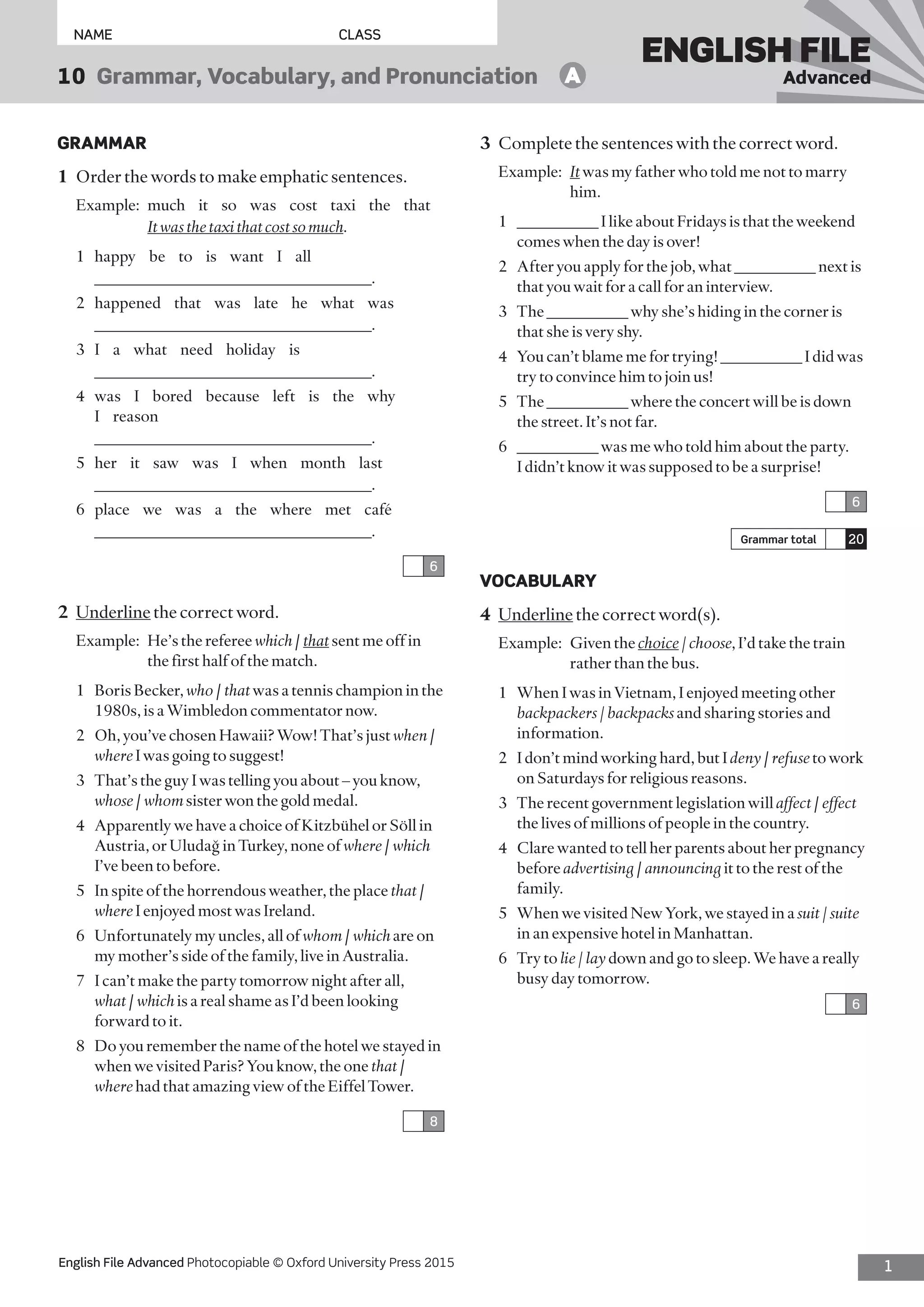
3	 Complete the sentences with the correct word.
Example:	It was my father who told me not to marry
him.
1	 __________ I like about Fridays is that the weekend
comes when the day is over!
2	 After you apply for the job, what __________ next is
that you wait for a call for an interview.
3	 The __________ why she’s hiding in the corner is
that she is very shy.
4	 You can’t blame me for trying! __________ I did was
try to convince him to join us!
5	 The __________ where the concert will be is down
the street. It’s not far.
6	 __________ was me who told him about the party.
I didn’t know it was supposed to be a surprise!
6
Grammar total 20
VOCABULARY
4	 Underline the correct word(s).
Example:	Given the choice / choose, I’d take the train
rather than the bus.
1	 When I was in Vietnam, I enjoyed meeting other
backpackers / backpacks and sharing stories and
information.
2	 I don’t mind working hard, but I deny / refuse to work
on Saturdays for religious reasons.
3	 The recent government legislation will affect / effect
the lives of millions of people in the country.
4	 Clare wanted to tell her parents about her pregnancy
before advertising / announcing it to the rest of the
family.
5	 When we visited New York, we stayed in a suit / suite
in an expensive hotel in Manhattan.
6	 Try to lie / lay down and go to sleep. We have a really
busy day tomorrow.
6
GRAMMAR
1	 Order the words to make emphatic sentences.
Example:	much  it  so  was  cost  taxi  the  that
	 It was the taxi that cost so much.
1	 happy  be  to  is  want  I  all
	__________________________________.
2	 happened  that  was  late  he  what  was
	__________________________________.
3	 I  a  what  need  holiday  is
	__________________________________.
4	 was  I  bored  because  left  is  the  why 
I  reason
	__________________________________.
5	 her  it  saw  was  I  when  month  last
	__________________________________.
6	 place  we  was  a  the  where  met  café
	__________________________________.
6
2	 Underline the correct word.
Example:	He’s the referee which / that sent me off in
the first half of the match.
1	 Boris Becker, who / that was a tennis champion in the
1980s, is a Wimbledon commentator now.
2	 Oh, you’ve chosen Hawaii? Wow! That’s just when /
where I was going to suggest!
3	 That’s the guy I was telling you about – you know,
whose / whom sister won the gold medal.
4	 Apparently we have a choice of Kitzbühel or Söll in
Austria, or Uludag˘ in Turkey, none of where / which
I’ve been to before.
5	 In spite of the horrendous weather, the place that /
where I enjoyed most was Ireland.
6	 Unfortunately my uncles, all of whom / which are on
my mother’s side of the family, live in Australia.
7	 I can’t make the party tomorrow night after all,
what / which is a real shame as I’d been looking
forward to it.
8	 Do you remember the name of the hotel we stayed in
when we visited Paris? You know, the one that /
where had that amazing view of the Eiffel Tower.
8
2English File Advanced Photocopiable © Oxford University Press 2015
NAME	CLASS
10  Grammar, Vocabulary, and Pronunciation   A
ENGLISH FILE
Advanced
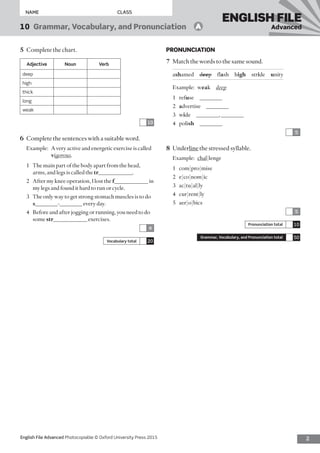
PRONUNCIATION
7	 Match the words to the same sound.
ashamed  deep flash high stride  unity
Example:	weak  deep
1	refuse ________
2	 advertise ________
3	wide  ________, ________
4	polish ________
5
8	Underline the stressed syllable.
Example:	 chal|lenge
1	com|pro|mise
2	e|co|nom|ic
3	ac|tu|al|ly
4	cur|rent|ly
5	aer|o|bics
5
Pronunciation total 10
Grammar, Vocabulary, and Pronunciation total 50
5	 Complete the chart.
Adjective Noun Verb
deep
high
thick
long
weak
10
6	 Complete the sentences with a suitable word.
Example:	A very active and energetic exercise is called
vigorous.
1	 The main part of the body apart from the head,
arms, and legs is called the tr____________.
2	 After my knee operation, I lost the f____________ in
my legs and found it hard to run or cycle.
3	 The only way to get strong stomach muscles is to do
s________-________ every day.
4	 Before and after jogging or running, you need to do
some str____________ exercises.
4
Vocabulary total 20
3English File Advanced Photocopiable © Oxford University Press 2015
NAME	CLASS
ENGLISH FILE
Advanced10  Reading and Writing   A
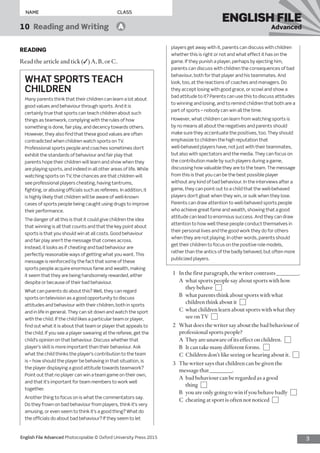
players get away with it, parents can discuss with children
whether this is right or not and what effect it has on the
game. If they punish a player, perhaps by ejecting him,
parents can discuss with children the consequences of bad
behaviour, both for that player and his teammates. And
look, too, at the reactions of coaches and managers. Do
they accept losing with good grace, or scowl and show a
bad attitude to it? Parents can use this to discuss attitudes
to winning and losing, and to remind children that both are a
part of sports – nobody can win all the time.
However, what children can learn from watching sports is
by no means all about the negatives and parents should
make sure they accentuate the positives, too. They should
emphasize to children the high reputation that
well-behaved players have, not just with their teammates,
but also with spectators and the media. They can focus on
the contribution made by such players during a game,
discussing how valuable they are to the team. The message
from this is that you can be the best possible player
without any kind of bad behaviour. In the interviews after a
game, they can point out to a child that the well-behaved
players don’t gloat when they win, or sulk when they lose.
Parents can draw attention to well-behaved sports people
who achieve great fame and wealth, showing that a good
attitude can lead to enormous success. And they can draw
attention to how well these people conduct themselves in
their personal lives and the good work they do for others
when they are not playing. In other words, parents should
get their children to focus on the positive role models,
rather than the antics of the badly behaved, but often more
publicized players.
1	 Inthefirstparagraph,thewritercontrasts________.
	 A	what sports people say about sports with how
they behave 
	 B	what parents think about sports with what
children think about it 
	 C	what children learn about sports with what they
see on TV 
2	 What does the writer say about the bad behaviour of
professional sports people?
	 A	 They are unaware of its effect on children. 
	 B	 It can take many different forms. 
	 C	 Children don’t like seeing or hearing about it. 
3	 The writer says that children can be given the
message that ________.
	 A	bad behaviour can be regarded as a good
thing 
	 B	 you are only going to win if you behave badly 
	 C	 cheating at sport is often not noticed 
READING
Read the article and tick (✓) A, B, or C.
WHAT SPORTS TEACH
CHILDREN
Many parents think that their children can learn a lot about
good values and behaviour through sports. And it is
certainly true that sports can teach children about such
things as teamwork, complying with the rules of how
something is done, fair play, and decency towards others.
However, they also find that these good values are often
contradicted when children watch sports on TV.
Professional sports people and coaches sometimes don’t
exhibit the standards of behaviour and fair play that
parents hope their children will learn and show when they
are playing sports, and indeed in all other areas of life. While
watching sports on TV, the chances are that children will
see professional players cheating, having tantrums,
fighting, or abusing officials such as referees. In addition, it
is highly likely that children will be aware of well-known
cases of sports people being caught using drugs to improve
their performance.
The danger of all this is that it could give children the idea
that winning is all that counts and that the key point about
sports is that you should win at all costs. Good behaviour
and fair play aren’t the message that comes across.
Instead, it looks as if cheating and bad behaviour are
perfectly reasonable ways of getting what you want. This
message is reinforced by the fact that some of these
sports people acquire enormous fame and wealth, making
it seem that they are being handsomely rewarded, either
despite or because of their bad behaviour.
What can parents do about this? Well, they can regard
sports on television as a good opportunity to discuss
attitudes and behaviour with their children, both in sports
and in life in general. They can sit down and watch the sport
with the child. If the child likes a particular team or player,
find out what it is about that team or player that appeals to
the child. If you see a player swearing at the referee, get the
child’s opinion on that behaviour. Discuss whether that
player’s skill is more important than their behaviour. Ask
what the child thinks the player’s contribution to the team
is – how should the player be behaving in that situation, is
the player displaying a good attitude towards teamwork?
Point out that no player can win a team game on their own,
and that it’s important for team members to work well
together.
Another thing to focus on is what the commentators say.
Do they frown on bad behaviour from players, think it’s very
amusing, or even seem to think it’s a good thing? What do
the officials do about bad behaviour? If they seem to let
4English File Advanced Photocopiable © Oxford University Press 2015
NAME	CLASS
ENGLISH FILE
Advanced10  Reading and Writing   A
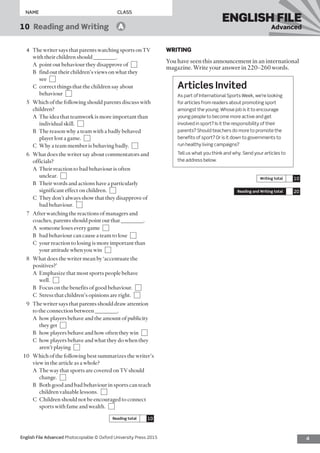
WRITING
You have seen this announcement in an international
magazine. Write your answer in 220–260 words.
Articles Invited
As part of International Sports Week, we’re looking
for articles from readers about promoting sport
amongst the young. Whose job is it to encourage
young people to become more active and get
involved in sport? Is it the responsibility of their
parents? Should teachers do more to promote the
benefits of sport? Or is it down to governments to
run healthy living campaigns?
Tell us what you think and why. Send your articles to
the address below.
Writing total 10
Reading and Writing total 20
4	 The writer says that parents watching sports on TV
with their children should ________.
	 A	 point out behaviour they disapprove of 
	 B	find out their children’s views on what they
see 
	 C	correct things that the children say about
behaviour 
5	 Which of the following should parents discuss with
children?
	 A	The idea that teamwork is more important than
individual skill. 
	 B	The reason why a team with a badly behaved
player lost a game. 
	 C	 Why a team member is behaving badly. 
6	 What does the writer say about commentators and
officials?
	 A	Their reaction to bad behaviour is often
unclear. 
	 B	Their words and actions have a particularly
significant effect on children. 
	 C	They don’t always show that they disapprove of
bad behaviour. 
7	 After watching the reactions of managers and
coaches, parents should point out that ________.
	 A	 someone loses every game 
	 B	 bad behaviour can cause a team to lose 
	 C	your reaction to losing is more important than
your attitude when you win 
8	 What does the writer mean by ‘accentuate the
positives?’
	 A	Emphasize that most sports people behave
well. 
	 B	 Focus on the benefits of good behaviour. 
	 C	 Stress that children’s opinions are right. 
9	 The writer says that parents should draw attention
to the connection between ________.
	 A	how players behave and the amount of publicity
they get 
	 B	 how players behave and how often they win 
	 C	how players behave and what they do when they
aren’t playing 
10	 Which of the following best summarizes the writer’s
view in the article as a whole?
	 A	The way that sports are covered on TV should
change. 
	 B	Both good and bad behaviour in sports can teach
children valuable lessons. 
	 C	Children should not be encouraged to connect
sports with fame and wealth. 
Reading total 10
5English File Advanced Photocopiable © Oxford University Press 2015
NAME	CLASS
ENGLISH FILE
Advanced10  Listening and Speaking   A
LISTENING
1	 Listen to a talk about Ellis Island near New York,
a place where many immigrants went when they
arrived in the USA. Complete the sentences using
no more than three words.
1	 Immigrants were received and processed at the
__________ on Ellis Island.
2	 First and second class passengers were inspected
__________ and then went straight into the USA.
3	 Steerage and third class passengers were inspected
by doctors so quickly that doctors called these
inspections ‘__________’.
4	 The legal inspection of steerage and third class
passengers was based on a document containing
__________.
5	 Just __________ of the people arriving at Ellis Island
were not allowed to enter the USA.
5
2	 Listen to five people talking about sports. Match
the speakers (1–5) to the opinions (A–H).
Speaker 1 
Speaker 2 
Speaker 3 
Speaker 4 
Speaker 5 
A	 desire to be a professional athlete one day
B	 scepticism of one activity’s classification as exercise
C	 desire for a child to be a professional athlete
D	 concern about what children learn from sports
E	 concern about the use of foul language in sports
F	 concern about the use of steroids and other drugs in
sports
G	 hatred of professional sports and the athletes who
play them
H	 hatred of having to participate in sports
5
Listening total 10
SPEAKING
1	 Ask your partner these questions.
1	 What do you think is a good reason to leave one’s
country for another one?
2	 What do you like most about professional sports?
3	 Which sports are the most popular in your country?
4	 Which sport would you most like to be good at?
5	 If you went to live in another country, what would
you miss most?
2	 Now answer your partner’s questions.
3	 Now talk about one of these statements, saying if
you agree or disagree. Give reasons.
1	 ‘I could never go and live in another country.’
2	 ‘Money has a bad effect on sports.’
3	 ‘Immigrants bring many benefits to the countries
they go to.’
4	 Now listen to your partner. Do you agree with
him / her?
Speaking total 20
Listening and Speaking total 30

Ef3e adv filetest_10a

  • 1.
    1English File AdvancedPhotocopiable © Oxford University Press 2015 NAME CLASS 10  Grammar, Vocabulary, and Pronunciation   A ENGLISH FILE Advanced 3 Complete the sentences with the correct word. Example: It was my father who told me not to marry him. 1 __________ I like about Fridays is that the weekend comes when the day is over! 2 After you apply for the job, what __________ next is that you wait for a call for an interview. 3 The __________ why she’s hiding in the corner is that she is very shy. 4 You can’t blame me for trying! __________ I did was try to convince him to join us! 5 The __________ where the concert will be is down the street. It’s not far. 6 __________ was me who told him about the party. I didn’t know it was supposed to be a surprise! 6 Grammar total 20 VOCABULARY 4 Underline the correct word(s). Example: Given the choice / choose, I’d take the train rather than the bus. 1 When I was in Vietnam, I enjoyed meeting other backpackers / backpacks and sharing stories and information. 2 I don’t mind working hard, but I deny / refuse to work on Saturdays for religious reasons. 3 The recent government legislation will affect / effect the lives of millions of people in the country. 4 Clare wanted to tell her parents about her pregnancy before advertising / announcing it to the rest of the family. 5 When we visited New York, we stayed in a suit / suite in an expensive hotel in Manhattan. 6 Try to lie / lay down and go to sleep. We have a really busy day tomorrow. 6 GRAMMAR 1 Order the words to make emphatic sentences. Example: much  it  so  was  cost  taxi  the  that It was the taxi that cost so much. 1 happy  be  to  is  want  I  all __________________________________. 2 happened  that  was  late  he  what  was __________________________________. 3 I  a  what  need  holiday  is __________________________________. 4 was  I  bored  because  left  is  the  why  I  reason __________________________________. 5 her  it  saw  was  I  when  month  last __________________________________. 6 place  we  was  a  the  where  met  café __________________________________. 6 2 Underline the correct word. Example: He’s the referee which / that sent me off in the first half of the match. 1 Boris Becker, who / that was a tennis champion in the 1980s, is a Wimbledon commentator now. 2 Oh, you’ve chosen Hawaii? Wow! That’s just when / where I was going to suggest! 3 That’s the guy I was telling you about – you know, whose / whom sister won the gold medal. 4 Apparently we have a choice of Kitzbühel or Söll in Austria, or Uludag˘ in Turkey, none of where / which I’ve been to before. 5 In spite of the horrendous weather, the place that / where I enjoyed most was Ireland. 6 Unfortunately my uncles, all of whom / which are on my mother’s side of the family, live in Australia. 7 I can’t make the party tomorrow night after all, what / which is a real shame as I’d been looking forward to it. 8 Do you remember the name of the hotel we stayed in when we visited Paris? You know, the one that / where had that amazing view of the Eiffel Tower. 8
  • 2.
    2English File AdvancedPhotocopiable © Oxford University Press 2015 NAME CLASS 10  Grammar, Vocabulary, and Pronunciation   A ENGLISH FILE Advanced PRONUNCIATION 7 Match the words to the same sound. ashamed  deep flash high stride  unity Example: weak  deep 1 refuse ________ 2 advertise ________ 3 wide  ________, ________ 4 polish ________ 5 8 Underline the stressed syllable. Example: chal|lenge 1 com|pro|mise 2 e|co|nom|ic 3 ac|tu|al|ly 4 cur|rent|ly 5 aer|o|bics 5 Pronunciation total 10 Grammar, Vocabulary, and Pronunciation total 50 5 Complete the chart. Adjective Noun Verb deep high thick long weak 10 6 Complete the sentences with a suitable word. Example: A very active and energetic exercise is called vigorous. 1 The main part of the body apart from the head, arms, and legs is called the tr____________. 2 After my knee operation, I lost the f____________ in my legs and found it hard to run or cycle. 3 The only way to get strong stomach muscles is to do s________-________ every day. 4 Before and after jogging or running, you need to do some str____________ exercises. 4 Vocabulary total 20
  • 3.
    3English File AdvancedPhotocopiable © Oxford University Press 2015 NAME CLASS ENGLISH FILE Advanced10  Reading and Writing   A players get away with it, parents can discuss with children whether this is right or not and what effect it has on the game. If they punish a player, perhaps by ejecting him, parents can discuss with children the consequences of bad behaviour, both for that player and his teammates. And look, too, at the reactions of coaches and managers. Do they accept losing with good grace, or scowl and show a bad attitude to it? Parents can use this to discuss attitudes to winning and losing, and to remind children that both are a part of sports – nobody can win all the time. However, what children can learn from watching sports is by no means all about the negatives and parents should make sure they accentuate the positives, too. They should emphasize to children the high reputation that well-behaved players have, not just with their teammates, but also with spectators and the media. They can focus on the contribution made by such players during a game, discussing how valuable they are to the team. The message from this is that you can be the best possible player without any kind of bad behaviour. In the interviews after a game, they can point out to a child that the well-behaved players don’t gloat when they win, or sulk when they lose. Parents can draw attention to well-behaved sports people who achieve great fame and wealth, showing that a good attitude can lead to enormous success. And they can draw attention to how well these people conduct themselves in their personal lives and the good work they do for others when they are not playing. In other words, parents should get their children to focus on the positive role models, rather than the antics of the badly behaved, but often more publicized players. 1 Inthefirstparagraph,thewritercontrasts________. A what sports people say about sports with how they behave  B what parents think about sports with what children think about it  C what children learn about sports with what they see on TV  2 What does the writer say about the bad behaviour of professional sports people? A They are unaware of its effect on children.  B It can take many different forms.  C Children don’t like seeing or hearing about it.  3 The writer says that children can be given the message that ________. A bad behaviour can be regarded as a good thing  B you are only going to win if you behave badly  C cheating at sport is often not noticed  READING Read the article and tick (✓) A, B, or C. WHAT SPORTS TEACH CHILDREN Many parents think that their children can learn a lot about good values and behaviour through sports. And it is certainly true that sports can teach children about such things as teamwork, complying with the rules of how something is done, fair play, and decency towards others. However, they also find that these good values are often contradicted when children watch sports on TV. Professional sports people and coaches sometimes don’t exhibit the standards of behaviour and fair play that parents hope their children will learn and show when they are playing sports, and indeed in all other areas of life. While watching sports on TV, the chances are that children will see professional players cheating, having tantrums, fighting, or abusing officials such as referees. In addition, it is highly likely that children will be aware of well-known cases of sports people being caught using drugs to improve their performance. The danger of all this is that it could give children the idea that winning is all that counts and that the key point about sports is that you should win at all costs. Good behaviour and fair play aren’t the message that comes across. Instead, it looks as if cheating and bad behaviour are perfectly reasonable ways of getting what you want. This message is reinforced by the fact that some of these sports people acquire enormous fame and wealth, making it seem that they are being handsomely rewarded, either despite or because of their bad behaviour. What can parents do about this? Well, they can regard sports on television as a good opportunity to discuss attitudes and behaviour with their children, both in sports and in life in general. They can sit down and watch the sport with the child. If the child likes a particular team or player, find out what it is about that team or player that appeals to the child. If you see a player swearing at the referee, get the child’s opinion on that behaviour. Discuss whether that player’s skill is more important than their behaviour. Ask what the child thinks the player’s contribution to the team is – how should the player be behaving in that situation, is the player displaying a good attitude towards teamwork? Point out that no player can win a team game on their own, and that it’s important for team members to work well together. Another thing to focus on is what the commentators say. Do they frown on bad behaviour from players, think it’s very amusing, or even seem to think it’s a good thing? What do the officials do about bad behaviour? If they seem to let
  • 4.
    4English File AdvancedPhotocopiable © Oxford University Press 2015 NAME CLASS ENGLISH FILE Advanced10  Reading and Writing   A WRITING You have seen this announcement in an international magazine. Write your answer in 220–260 words. Articles Invited As part of International Sports Week, we’re looking for articles from readers about promoting sport amongst the young. Whose job is it to encourage young people to become more active and get involved in sport? Is it the responsibility of their parents? Should teachers do more to promote the benefits of sport? Or is it down to governments to run healthy living campaigns? Tell us what you think and why. Send your articles to the address below. Writing total 10 Reading and Writing total 20 4 The writer says that parents watching sports on TV with their children should ________. A point out behaviour they disapprove of  B find out their children’s views on what they see  C correct things that the children say about behaviour  5 Which of the following should parents discuss with children? A The idea that teamwork is more important than individual skill.  B The reason why a team with a badly behaved player lost a game.  C Why a team member is behaving badly.  6 What does the writer say about commentators and officials? A Their reaction to bad behaviour is often unclear.  B Their words and actions have a particularly significant effect on children.  C They don’t always show that they disapprove of bad behaviour.  7 After watching the reactions of managers and coaches, parents should point out that ________. A someone loses every game  B bad behaviour can cause a team to lose  C your reaction to losing is more important than your attitude when you win  8 What does the writer mean by ‘accentuate the positives?’ A Emphasize that most sports people behave well.  B Focus on the benefits of good behaviour.  C Stress that children’s opinions are right.  9 The writer says that parents should draw attention to the connection between ________. A how players behave and the amount of publicity they get  B how players behave and how often they win  C how players behave and what they do when they aren’t playing  10 Which of the following best summarizes the writer’s view in the article as a whole? A The way that sports are covered on TV should change.  B Both good and bad behaviour in sports can teach children valuable lessons.  C Children should not be encouraged to connect sports with fame and wealth.  Reading total 10
  • 5.
    5English File AdvancedPhotocopiable © Oxford University Press 2015 NAME CLASS ENGLISH FILE Advanced10  Listening and Speaking   A LISTENING 1 Listen to a talk about Ellis Island near New York, a place where many immigrants went when they arrived in the USA. Complete the sentences using no more than three words. 1 Immigrants were received and processed at the __________ on Ellis Island. 2 First and second class passengers were inspected __________ and then went straight into the USA. 3 Steerage and third class passengers were inspected by doctors so quickly that doctors called these inspections ‘__________’. 4 The legal inspection of steerage and third class passengers was based on a document containing __________. 5 Just __________ of the people arriving at Ellis Island were not allowed to enter the USA. 5 2 Listen to five people talking about sports. Match the speakers (1–5) to the opinions (A–H). Speaker 1  Speaker 2  Speaker 3  Speaker 4  Speaker 5  A desire to be a professional athlete one day B scepticism of one activity’s classification as exercise C desire for a child to be a professional athlete D concern about what children learn from sports E concern about the use of foul language in sports F concern about the use of steroids and other drugs in sports G hatred of professional sports and the athletes who play them H hatred of having to participate in sports 5 Listening total 10 SPEAKING 1 Ask your partner these questions. 1 What do you think is a good reason to leave one’s country for another one? 2 What do you like most about professional sports? 3 Which sports are the most popular in your country? 4 Which sport would you most like to be good at? 5 If you went to live in another country, what would you miss most? 2 Now answer your partner’s questions. 3 Now talk about one of these statements, saying if you agree or disagree. Give reasons. 1 ‘I could never go and live in another country.’ 2 ‘Money has a bad effect on sports.’ 3 ‘Immigrants bring many benefits to the countries they go to.’ 4 Now listen to your partner. Do you agree with him / her? Speaking total 20 Listening and Speaking total 30