MODALS
MODALS
are auxiliary or helping verbs. They
may be used in expressing
permission, obligation and
prohibition.
SENTENCES
• I believe I can fly.
• Khodhy must call the police after the
incident.
• Janine will prepare for her exams.
• Bernadette doesn’t have to secure a permit
for her to go out of her house.
1. PERMISSION
is an act of giving consent or
authorization.
In stating permission, modals to be
used include can, could and may.
PERMISSION
a. Can is used to ask for
and give permission.
EXAMPLE
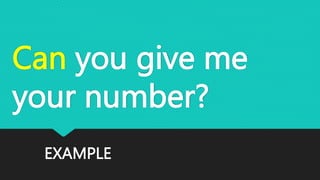
Can you give me
your number?
EXAMPLE
Can you help me
with this?
EXAMPLE
I can do it if you
want me to.
PERMISSION
b. Could is also used as a more
polite and more formal modal in
asking permission (which may not
be given).
EXAMPLE
I could possibly ask my
mom to cook it for us.
EXAMPLE
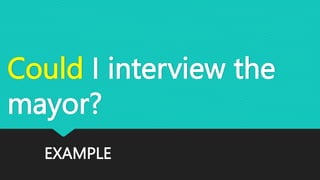
Could I interview the
mayor?
EXAMPLE
Could you lend me
your book?
PERMISSION
c. May is the most polite and
formal modal used in asking and
giving
permission.
EXAMPLE
Medical practitioners affected by
COVID-19 may now claim
their financial support from the
government.
EXAMPLE
Teachers may now distribute
the modules to the learners.
EXAMPLE
May I borrow your
book, please?
2. PROHIBITION
is the act of disallowing or
prohibiting someone in
performing or
doing something.
PROHIBITION
a. Can’t is used in dealing with
something against rules, laws and
signs. This is used when the speaker is
not the one who sets the rules.
EXAMPLE
You can’t go out during the
community quarantine.
(Quarantine Policy)
EXAMPLE
The company can’t apply for
motion for reconsideration.
(Legal Proceeding)
EXAMPLE
You can’t buy any alcoholic
beverages due to liquor ban.
(Liquor Ban Policy
PROHIBITION
b. Must Not/Mustn’t is used in dealing
with something that is not permitted.
In this context, it is the speaker who
sets the rules.
EXAMPLE
You must not turn off your
camera during online class.
(Teacher-students)
EXAMPLE
Mustn’t you eat the fruits
inside the fridge? (Mother to
child)
EXAMPLE
Salome must not tell my
secrets to her friends. (Boss
to a colleague)
3. OBLIGATION
expresses commitment
or duty.
OBLIGATION
a. Has/Have to is used when
obligation comes not from the
speaker. The obligation is set by
an authority, rule or law.
EXAMPLE
I have to be in the airport
before the flight
departure.
EXAMPLE
She has to submit her
report on time.
EXAMPLE
The company has to pay
retrenchment benefits to its
employees.
OBLIGATION
b. Must is used when
expressing obligation comes
from the speaker or from an
authority.
EXAMPLE
I must call my husband now.
EXAMPLE
We must finish the
report on time.
EXAMPLE
I must stay away from
them.
4. NO OBLIGATION
expresses the absence of
commitment or duty as
one may do it or not.
NO OBLIGATION
Don’t (doesn’t) have to is
used to express no
obligation.
EXAMPLE
She doesn’t have to attend
the funeral if she is not
feeling well.
EXAMPLE
You don’t have to come to
my office in person. You may
submit it online.
EXAMPLE
The employees don’t have to
come this morning as the
activity will start in the
afternoon.
MODALS
QUIZ
QUIZ
1. It is used to ask for
and give permission.
QUIZ
2. It is the most polite and
formal modal used in asking
and giving
permission.
QUIZ
3. It is used in dealing with
something that is not permitted.
In this context, it is the speaker
who sets the rules.
QUIZ
4. It is used when
expressing obligation
comes from the speaker or
from an authority.
QUIZ
5. It is used to express
no obligation.

MODALS
ASSIGNMENT
ASSIGNMENT
Write 5 sentences using modals.

5 -Permission
5 -Prohibition
5 -Obligation
5 -No Obligation

LESSON 1 ENGLISH MODALS TYPES AND FUNCTIONS.pptx