Subjunctive/Nominative Form
Cansu SÜER
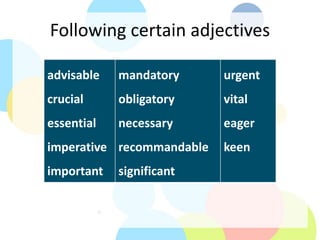
Following certain adjectives
advisable
crucial
essential
imperative
important
mandatory
obligatory
necessary
recommandable
significant
urgent
vital
eager
keen
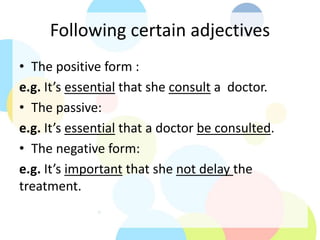
Following certain adjectives
• The positive form :
e.g. It’s essential that she consult a doctor.
• The passive:
e.g. It’s essential that a doctor be consulted.
• The negative form:
e.g. It’s important that she not delay the
treatment.
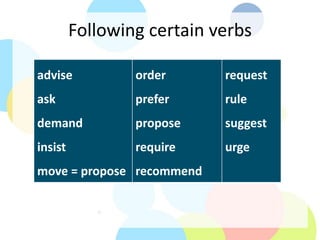
Following certain verbs
advise
ask
demand
insist
move = propose
order
prefer
propose
require
recommend
request
rule
suggest
urge
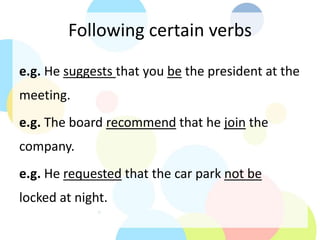
Following certain verbs
e.g. He suggests that you be the president at the
meeting.
e.g. The board recommend that he join the
company.
e.g. He requested that the car park not be
locked at night.
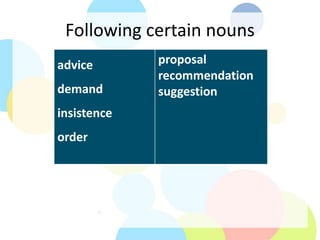
Following certain nouns
advice
demand
insistence
order
proposal
recommendation
suggestion
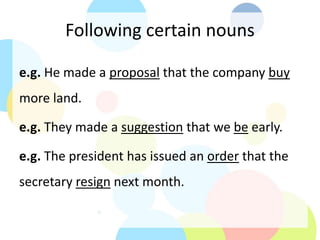
Following certain nouns
e.g. He made a proposal that the company buy
more land.
e.g. They made a suggestion that we be early.
e.g. The president has issued an order that the
secretary resign next month.
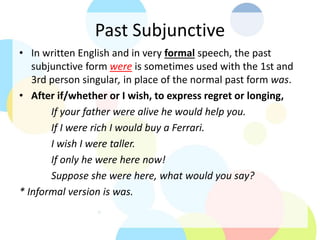
Past Subjunctive
• In written English and in very formal speech, the past
subjunctive form were is sometimes used with the 1st and
3rd person singular, in place of the normal past form was.
• After if/whether or I wish, to express regret or longing,
If your father were alive he would help you.
If I were rich I would buy a Ferrari.
I wish I were taller.
If only he were here now!
Suppose she were here, what would you say?
* Informal version is was.
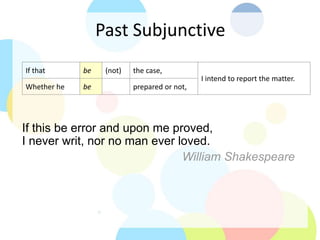
Past Subjunctive
If this be error and upon me proved,
I never writ, nor no man ever loved.
William Shakespeare
If that be (not) the case,
I intend to report the matter.
Whether he be prepared or not,
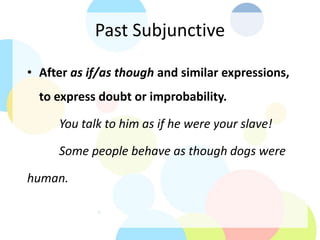
Past Subjunctive
• After as if/as though and similar expressions,
to express doubt or improbability.
You talk to him as if he were your slave!
Some people behave as though dogs were
human.
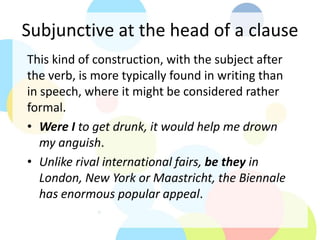
Subjunctive at the head of a clause
This kind of construction, with the subject after
the verb, is more typically found in writing than
in speech, where it might be considered rather
formal.
• Were I to get drunk, it would help me drown
my anguish.
• Unlike rival international fairs, be they in
London, New York or Maastricht, the Biennale
has enormous popular appeal.
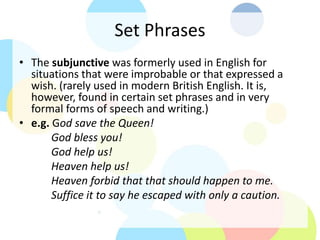
Set Phrases
• The subjunctive was formerly used in English for
situations that were improbable or that expressed a
wish. (rarely used in modern British English. It is,
however, found in certain set phrases and in very
formal forms of speech and writing.)
• e.g. God save the Queen!
God bless you!
God help us!
Heaven help us!
Heaven forbid that that should happen to me.
Suffice it to say he escaped with only a caution.
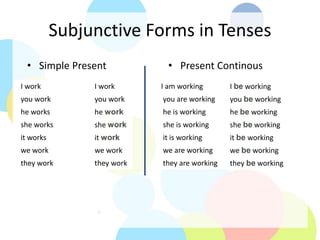
Subjunctive Forms in Tenses
• Simple Present • Present Continous
I work I work
you work you work
he works he work
she works she work
it works it work
we work we work
they work they work
I am working I be working
you are working you be working
he is working he be working
she is working she be working
it is working it be working
we are working we be working
they are working they be working
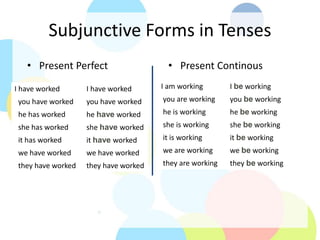
Subjunctive Forms in Tenses
• Present Perfect • Present Continous
I am working I be working
you are working you be working
he is working he be working
she is working she be working
it is working it be working
we are working we be working
they are working they be working
I have worked I have worked
you have worked you have worked
he has worked he have worked
she has worked she have worked
it has worked it have worked
we have worked we have worked
they have worked they have worked
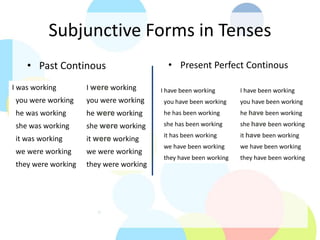
Subjunctive Forms in Tenses
• Past Continous • Present Perfect Continous
I was working I were working
you were working you were working
he was working he were working
she was working she were working
it was working it were working
we were working we were working
they were working they were working
I have been working I have been working
you have been working you have been working
he has been working he have been working
she has been working she have been working
it has been working it have been working
we have been working we have been working
they have been working they have been working
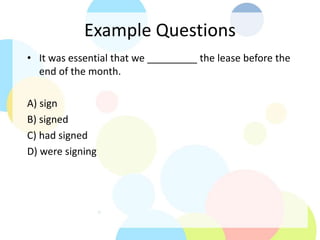
Example Questions
• It was essential that we _________ the lease before the
end of the month.
A) sign
B) signed
C) had signed
D) were signing
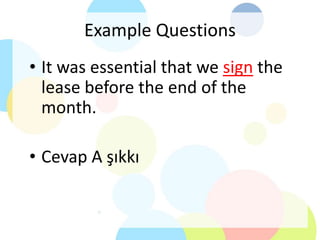
Example Questions
• It was essential that we sign the
lease before the end of the
month.
• Cevap A şıkkı
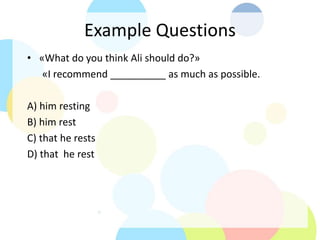
Example Questions
• «What do you think Ali should do?»
«I recommend __________ as much as possible.
A) him resting
B) him rest
C) that he rests
D) that he rest
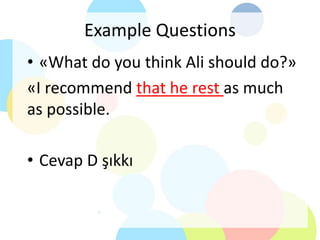
Example Questions
• «What do you think Ali should do?»
«I recommend that he rest as much
as possible.
• Cevap D şıkkı
Example Questions
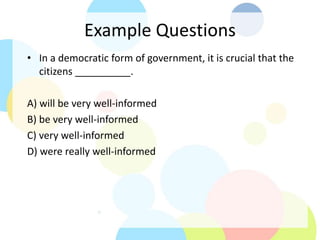
• In a democratic form of government, it is crucial that the
citizens __________.
A) will be very well-informed
B) be very well-informed
C) very well-informed
D) were really well-informed
Example Questions
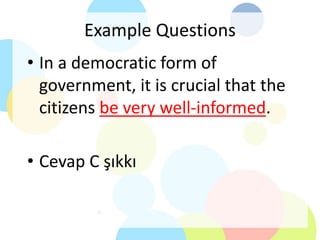
• In a democratic form of
government, it is crucial that the
citizens be very well-informed.
• Cevap C şıkkı
Example Questions
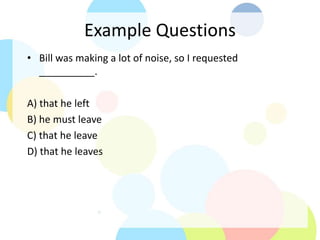
• Bill was making a lot of noise, so I requested
__________.
A) that he left
B) he must leave
C) that he leave
D) that he leaves
Example Questions
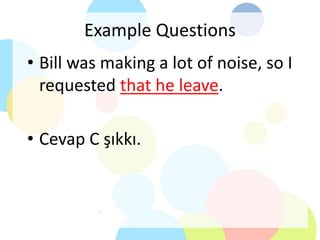
• Bill was making a lot of noise, so I
requested that he leave.
• Cevap C şıkkı.

Subjunctive nominative

  • 1.
  • 2.
  • 3.
    Following certain adjectives •The positive form : e.g. It’s essential that she consult a doctor. • The passive: e.g. It’s essential that a doctor be consulted. • The negative form: e.g. It’s important that she not delay the treatment.
  • 4.
    Following certain verbs advise ask demand insist move= propose order prefer propose require recommend request rule suggest urge
  • 5.
    Following certain verbs e.g.He suggests that you be the president at the meeting. e.g. The board recommend that he join the company. e.g. He requested that the car park not be locked at night.
  • 6.
  • 7.
    Following certain nouns e.g.He made a proposal that the company buy more land. e.g. They made a suggestion that we be early. e.g. The president has issued an order that the secretary resign next month.
  • 8.
    Past Subjunctive • Inwritten English and in very formal speech, the past subjunctive form were is sometimes used with the 1st and 3rd person singular, in place of the normal past form was. • After if/whether or I wish, to express regret or longing, If your father were alive he would help you. If I were rich I would buy a Ferrari. I wish I were taller. If only he were here now! Suppose she were here, what would you say? * Informal version is was.
  • 9.
    Past Subjunctive If thisbe error and upon me proved, I never writ, nor no man ever loved. William Shakespeare If that be (not) the case, I intend to report the matter. Whether he be prepared or not,
  • 10.
    Past Subjunctive • Afteras if/as though and similar expressions, to express doubt or improbability. You talk to him as if he were your slave! Some people behave as though dogs were human.
  • 11.
    Subjunctive at thehead of a clause This kind of construction, with the subject after the verb, is more typically found in writing than in speech, where it might be considered rather formal. • Were I to get drunk, it would help me drown my anguish. • Unlike rival international fairs, be they in London, New York or Maastricht, the Biennale has enormous popular appeal.
  • 12.
    Set Phrases • Thesubjunctive was formerly used in English for situations that were improbable or that expressed a wish. (rarely used in modern British English. It is, however, found in certain set phrases and in very formal forms of speech and writing.) • e.g. God save the Queen! God bless you! God help us! Heaven help us! Heaven forbid that that should happen to me. Suffice it to say he escaped with only a caution.
  • 13.
    Subjunctive Forms inTenses • Simple Present • Present Continous I work I work you work you work he works he work she works she work it works it work we work we work they work they work I am working I be working you are working you be working he is working he be working she is working she be working it is working it be working we are working we be working they are working they be working
  • 14.
    Subjunctive Forms inTenses • Present Perfect • Present Continous I am working I be working you are working you be working he is working he be working she is working she be working it is working it be working we are working we be working they are working they be working I have worked I have worked you have worked you have worked he has worked he have worked she has worked she have worked it has worked it have worked we have worked we have worked they have worked they have worked
  • 15.
    Subjunctive Forms inTenses • Past Continous • Present Perfect Continous I was working I were working you were working you were working he was working he were working she was working she were working it was working it were working we were working we were working they were working they were working I have been working I have been working you have been working you have been working he has been working he have been working she has been working she have been working it has been working it have been working we have been working we have been working they have been working they have been working
  • 16.
    Example Questions • Itwas essential that we _________ the lease before the end of the month. A) sign B) signed C) had signed D) were signing
  • 17.
    Example Questions • Itwas essential that we sign the lease before the end of the month. • Cevap A şıkkı
  • 18.
    Example Questions • «Whatdo you think Ali should do?» «I recommend __________ as much as possible. A) him resting B) him rest C) that he rests D) that he rest
  • 19.
    Example Questions • «Whatdo you think Ali should do?» «I recommend that he rest as much as possible. • Cevap D şıkkı
  • 20.
    Example Questions • Ina democratic form of government, it is crucial that the citizens __________. A) will be very well-informed B) be very well-informed C) very well-informed D) were really well-informed
  • 21.
    Example Questions • Ina democratic form of government, it is crucial that the citizens be very well-informed. • Cevap C şıkkı
  • 22.
    Example Questions • Billwas making a lot of noise, so I requested __________. A) that he left B) he must leave C) that he leave D) that he leaves
  • 23.
    Example Questions • Billwas making a lot of noise, so I requested that he leave. • Cevap C şıkkı.