English Modal Verbs ?
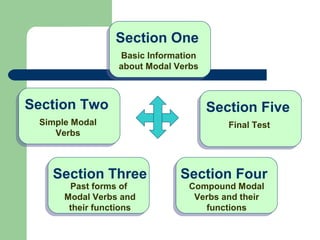
Section Four
Compound Modal
Verbs and their
functions
Section Two
Simple Modal
Verbs
Section Three
Past forms of
Modal Verbs and
their functions
Section One
Basic Information
about Modal Verbs
Section Five
Final Test
What are Modal Verbs ?
 Modal verbs are special verbs which
behave very differently from normal
verbs. Here are some important
differences:
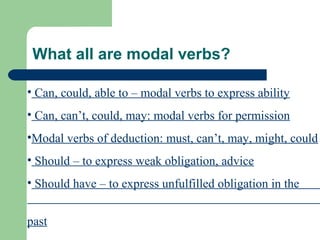
What all are modal verbs?
• Can, could, able to – modal verbs to express ability
• Can, can’t, could, may: modal verbs for permission
•Modal verbs of deduction: must, can’t, may, might, could
• Should – to express weak obligation, advice
• Should have – to express unfulfilled obligation in the
past
1. Modal verbs do not take "-s" in the
third person.
 EXAMPLES:
He can speak Russian.
She should go now.
My wife may join us for the dinner.
3. Many modal verbs cannot be used in
the past tenses or the future tenses.
 EXAMPLES:
He will can go with us. NOT CORRECT
She musted study very hard. NOT CORRECT
It mayed show yesterday. NOT CORRECT
1
2
3
Which sentence has a modal verb?
 Now we should not argue on this topic ,lets change
the topic.
 Can you tell me about Indore . I am new here
 We may visit our grandpa, we have not seen him since Chr
Please choose the correct sentence
 He cans climb the rocks.
 He can climb the rocks.
 He canned climb the rocks.
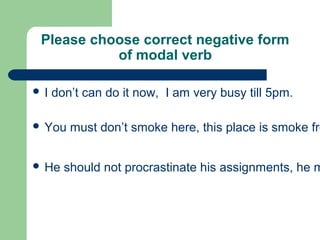
Please choose correct negative form
of modal verb
 I don’t can do it now, I am very busy till 5pm.
 You must don’t smoke here, this place is smoke fre
 He should not procrastinate his assignments, he m
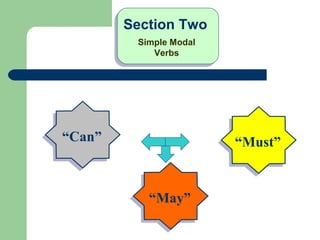
Section Two
Simple Modal
Verbs
“Can”
“May”
“Must”
1. to express general ability
2. to express possibility / impossibility
3. to ask a permission (informal)
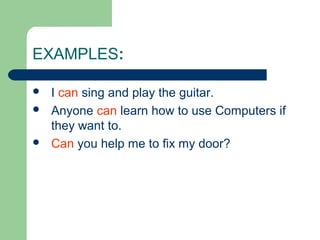
EXAMPLES:
 I can sing and play the guitar.
 Anyone can learn how to use Computers if
they want to.
 Can you help me to fix my door?
1. to express possibility
2. to ask or to give a permission (formal)
3. to make requests
EXAMPLES:
 He may come late today.
 You may use my Computer now.
 May I make a phone call?
1. to express certainty
2. to express necessity
3. to make a strong recommendation
EXAMPLES:
 You must be tired now, you have worked all
day long.
 I must have a visa to go to Canada.
 CEP 811 is a very interesting class, you must
take it too.
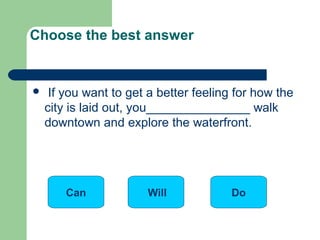
 If you want to get a better feeling for how the
city is laid out, you_______________ walk
downtown and explore the waterfront.
Choose the best answer
Will DoCan
 Today is cloudy, it ________________ rain.
Choose the best answer
May CanDoes
Choose the best answer
 Ted's flight from Uzbekistan took more than
11 hours. He ________________ be
exhausted after such a long flight.
May MustCan
“Could”
“Would” “Should”
“Might”
Section Three
Past forms of
Modal Verbs and
their functions
1. to express general ability in the past, because it is
the past form of the “Can”
2. to express possible future actions similar to “May
and Might” in meaning
3. to make a request or ask something
4. to express unreal or impossible actions
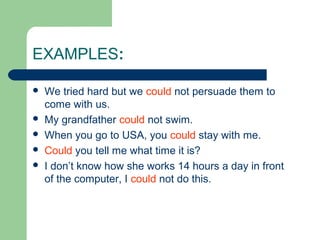
EXAMPLES:
 We tried hard but we could not persuade them to
come with us.
 My grandfather could not swim.
 When you go to USA, you could stay with me.
 Could you tell me what time it is?
 I don’t know how she works 14 hours a day in front
of the computer, I could not do this.
1. to express future in the past because it is the past
form of “Will”
2. to express unreal action in the present
3. to ask someone to do something (formal),
(structure: If + you + would+ verb)
EXAMPLES:
 He told me that he would come and fix this computer
yesterday.
 I would be very frightened if someone pointed a gun
at me.
 If we did not go to their party next week, she would
be very upset.
 I’d be very grateful if you would come and help me to
complete my work.
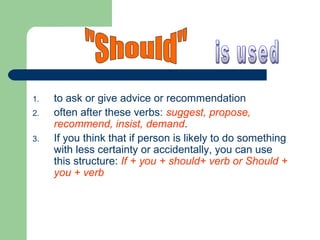
1. to ask or give advice or recommendation
2. often after these verbs: suggest, propose,
recommend, insist, demand.
3. If you think that if person is likely to do something
with less certainty or accidentally, you can use
this structure: If + you + should+ verb or Should +
you + verb
EXAMPLES:
 I think you should stop smoking, drinking and messing
around, instead you should do sometime useful.
 They insisted that we should have dinner with them.
 He recommended that I should apologize to her for
what I said.
 If you should see Tom this evening, could you tell him
to call me? or Should you see Tom…..
 Don’t worry if I should be late tonight.
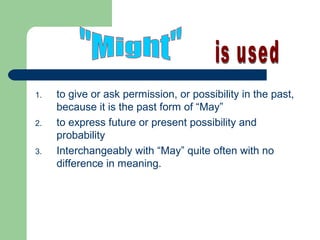
1. to give or ask permission, or possibility in the past,
because it is the past form of “May”
2. to express future or present possibility and
probability
3. Interchangeably with “May” quite often with no
difference in meaning.
EXAMPLES:
 She told that he might come in and use her stove.
 He might be having lunch now.
 It might rain tomorrow.
 There may/might not be a meeting tonight, because
the director is ill.
 I may/might go to Italy this summer.
 Your brother was ill, therefore he _____ go
out for a walk.
# 1. Choose the correct modal verb
Can’t Mustn’t Couldn’t
 Mr. Gupta said if she wasn’t busy at 10
o'clock, she ____ come to see her.
# 1. Choose the correct verb
May CanWould Must
 This house ____ look better if they painted it
and cut the grass and planted flowers.
# 2. Choose the correct modal verb
May Can WouldMust
 The Sheriff demands that all the
eyewitnesses _____ be questioned
immediately.
# 2.Choose the correct modal verb
WouldShouldMust Could
 He said that I ____ play any CD from your
collection while you were gone.
# 1. Choose the correct modal verb
May Should Must Might
For more Information about Modal
verbs please meet me in class 8th
a

Modal verbs

  • 1.
  • 2.
    Section Four Compound Modal Verbsand their functions Section Two Simple Modal Verbs Section Three Past forms of Modal Verbs and their functions Section One Basic Information about Modal Verbs Section Five Final Test
  • 3.
    What are ModalVerbs ?  Modal verbs are special verbs which behave very differently from normal verbs. Here are some important differences:
  • 4.
    What all aremodal verbs? • Can, could, able to – modal verbs to express ability • Can, can’t, could, may: modal verbs for permission •Modal verbs of deduction: must, can’t, may, might, could • Should – to express weak obligation, advice • Should have – to express unfulfilled obligation in the past
  • 5.
    1. Modal verbsdo not take "-s" in the third person.  EXAMPLES: He can speak Russian. She should go now. My wife may join us for the dinner.
  • 6.
    3. Many modalverbs cannot be used in the past tenses or the future tenses.  EXAMPLES: He will can go with us. NOT CORRECT She musted study very hard. NOT CORRECT It mayed show yesterday. NOT CORRECT
  • 7.
  • 8.
    Which sentence hasa modal verb?  Now we should not argue on this topic ,lets change the topic.  Can you tell me about Indore . I am new here  We may visit our grandpa, we have not seen him since Chr
  • 9.
    Please choose thecorrect sentence  He cans climb the rocks.  He can climb the rocks.  He canned climb the rocks.
  • 10.
    Please choose correctnegative form of modal verb  I don’t can do it now, I am very busy till 5pm.  You must don’t smoke here, this place is smoke fre  He should not procrastinate his assignments, he m
  • 11.
  • 12.
    1. to expressgeneral ability 2. to express possibility / impossibility 3. to ask a permission (informal)
  • 13.
    EXAMPLES:  I cansing and play the guitar.  Anyone can learn how to use Computers if they want to.  Can you help me to fix my door?
  • 14.
    1. to expresspossibility 2. to ask or to give a permission (formal) 3. to make requests
  • 15.
    EXAMPLES:  He maycome late today.  You may use my Computer now.  May I make a phone call?
  • 16.
    1. to expresscertainty 2. to express necessity 3. to make a strong recommendation
  • 17.
    EXAMPLES:  You mustbe tired now, you have worked all day long.  I must have a visa to go to Canada.  CEP 811 is a very interesting class, you must take it too.
  • 18.
     If youwant to get a better feeling for how the city is laid out, you_______________ walk downtown and explore the waterfront. Choose the best answer Will DoCan
  • 19.
     Today iscloudy, it ________________ rain. Choose the best answer May CanDoes
  • 20.
    Choose the bestanswer  Ted's flight from Uzbekistan took more than 11 hours. He ________________ be exhausted after such a long flight. May MustCan
  • 21.
  • 22.
    1. to expressgeneral ability in the past, because it is the past form of the “Can” 2. to express possible future actions similar to “May and Might” in meaning 3. to make a request or ask something 4. to express unreal or impossible actions
  • 23.
    EXAMPLES:  We triedhard but we could not persuade them to come with us.  My grandfather could not swim.  When you go to USA, you could stay with me.  Could you tell me what time it is?  I don’t know how she works 14 hours a day in front of the computer, I could not do this.
  • 24.
    1. to expressfuture in the past because it is the past form of “Will” 2. to express unreal action in the present 3. to ask someone to do something (formal), (structure: If + you + would+ verb)
  • 25.
    EXAMPLES:  He toldme that he would come and fix this computer yesterday.  I would be very frightened if someone pointed a gun at me.  If we did not go to their party next week, she would be very upset.  I’d be very grateful if you would come and help me to complete my work.
  • 26.
    1. to askor give advice or recommendation 2. often after these verbs: suggest, propose, recommend, insist, demand. 3. If you think that if person is likely to do something with less certainty or accidentally, you can use this structure: If + you + should+ verb or Should + you + verb
  • 27.
    EXAMPLES:  I thinkyou should stop smoking, drinking and messing around, instead you should do sometime useful.  They insisted that we should have dinner with them.  He recommended that I should apologize to her for what I said.  If you should see Tom this evening, could you tell him to call me? or Should you see Tom…..  Don’t worry if I should be late tonight.
  • 28.
    1. to giveor ask permission, or possibility in the past, because it is the past form of “May” 2. to express future or present possibility and probability 3. Interchangeably with “May” quite often with no difference in meaning.
  • 29.
    EXAMPLES:  She toldthat he might come in and use her stove.  He might be having lunch now.  It might rain tomorrow.  There may/might not be a meeting tonight, because the director is ill.  I may/might go to Italy this summer.
  • 30.
     Your brotherwas ill, therefore he _____ go out for a walk. # 1. Choose the correct modal verb Can’t Mustn’t Couldn’t
  • 31.
     Mr. Guptasaid if she wasn’t busy at 10 o'clock, she ____ come to see her. # 1. Choose the correct verb May CanWould Must
  • 32.
     This house____ look better if they painted it and cut the grass and planted flowers. # 2. Choose the correct modal verb May Can WouldMust
  • 33.
     The Sheriffdemands that all the eyewitnesses _____ be questioned immediately. # 2.Choose the correct modal verb WouldShouldMust Could
  • 34.
     He saidthat I ____ play any CD from your collection while you were gone. # 1. Choose the correct modal verb May Should Must Might
  • 35.
    For more Informationabout Modal verbs please meet me in class 8th a

Editor's Notes

  • #4 I am giving a general information about modal verbs here.
  • #12 Three basic modal verbs in English.
  • #13 Rules and examples.
  • #15 Rules and examples.
  • #17 Rules and examples.
  • #19 Multiple choice test.
  • #20 Multiple choice test.
  • #21 Multiple choice test.
  • #36 Here I give website link for more information about English Modal verbs.