Reading Poetry and Identifying 
Theme: 
Robert Frost’s “A Time to Talk” 
Grade 4: Module 1A: Unit 1: Lesson 7 
R. Medina
Learning Target 
 I can determine the theme of a poem. (RL.4.2) 
 I can explain the structural elements of a poem. 
(RL.4.5) 
 I can engage effectively in a range of 
collaborative discussions. (SL.4.1) 
 I can plan a symbol for my wampum belt.
“A Time to Talk” 
 “A Time to Talk” by Robert Frost 
 talk about how this poem looks different 
from the previous texts. 
 What makes this a poem? 
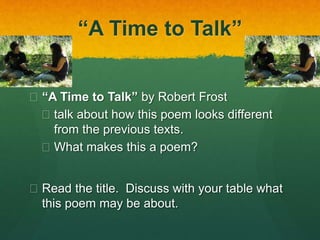
 Read the title. Discuss with your table what 
this poem may be about.
“A Time to Talk” 
 Reading poetry aloud often helps us to gain 
better understanding of the poem. Also, 
poems usually need to be read multiple 
times to figure out what the poet is saying. 
Sometimes even adults will read a poem ten 
times when trying to figure out its meaning! 
 Follow along as I read the poem aloud once.
“A Time to Talk” 
 Did you notice my reading? Did you notice I stopped at the 
periods and paused at the commas?” Rhythm Rhyme? 
Images? Speed at which I read? 
 The structure of poems will vary, but the punctuation will 
always tell you how you should read them. Let’s read the 
poem aloud again. How many sentences are in the poem? 
How do you know? 
 Read the poem silently and circle any words that are 
unfamiliar. Many of the words can be figured out using 
context. If it is an outdated word and does not have a clear 
definition, the important thing is that not understanding the 
word does not get in the way of comprehending the entire 
poem.
What is this poem about? 
 Distribute Guiding Questions 
 Work in fours. You will now read the poem to 
deconstruct it, or figure out its meaning. Read the 
poem aloud multiple times as you answer the 
questions. 
 If you do not know a meaning of a word, remember - 
sometimes the definition is not necessary in order 
to get the gist of the poem.
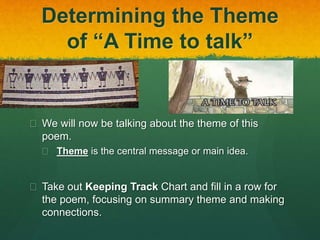
Determining the Theme 
of “A Time to talk” 
 We will now be talking about the theme of this 
poem. 
 Theme is the central message or main idea. 
 Take out Keeping Track Chart and fill in a row for 
the poem, focusing on summary theme and making 
connections.
Closing 
 How would you explain the structure of this poem? 
How does this poem connect to the other texts you 
have read? 
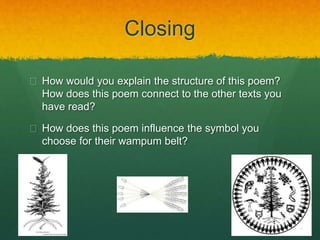
 How does this poem influence the symbol you 
choose for their wampum belt?

Ela mod1 lssn7

  • 1.
    Reading Poetry andIdentifying Theme: Robert Frost’s “A Time to Talk” Grade 4: Module 1A: Unit 1: Lesson 7 R. Medina
  • 2.
    Learning Target I can determine the theme of a poem. (RL.4.2)  I can explain the structural elements of a poem. (RL.4.5)  I can engage effectively in a range of collaborative discussions. (SL.4.1)  I can plan a symbol for my wampum belt.
  • 3.
    “A Time toTalk”  “A Time to Talk” by Robert Frost  talk about how this poem looks different from the previous texts.  What makes this a poem?  Read the title. Discuss with your table what this poem may be about.
  • 4.
    “A Time toTalk”  Reading poetry aloud often helps us to gain better understanding of the poem. Also, poems usually need to be read multiple times to figure out what the poet is saying. Sometimes even adults will read a poem ten times when trying to figure out its meaning!  Follow along as I read the poem aloud once.
  • 5.
    “A Time toTalk”  Did you notice my reading? Did you notice I stopped at the periods and paused at the commas?” Rhythm Rhyme? Images? Speed at which I read?  The structure of poems will vary, but the punctuation will always tell you how you should read them. Let’s read the poem aloud again. How many sentences are in the poem? How do you know?  Read the poem silently and circle any words that are unfamiliar. Many of the words can be figured out using context. If it is an outdated word and does not have a clear definition, the important thing is that not understanding the word does not get in the way of comprehending the entire poem.
  • 6.
    What is thispoem about?  Distribute Guiding Questions  Work in fours. You will now read the poem to deconstruct it, or figure out its meaning. Read the poem aloud multiple times as you answer the questions.  If you do not know a meaning of a word, remember - sometimes the definition is not necessary in order to get the gist of the poem.
  • 7.
    Determining the Theme of “A Time to talk”  We will now be talking about the theme of this poem.  Theme is the central message or main idea.  Take out Keeping Track Chart and fill in a row for the poem, focusing on summary theme and making connections.
  • 8.
    Closing  Howwould you explain the structure of this poem? How does this poem connect to the other texts you have read?  How does this poem influence the symbol you choose for their wampum belt?

Editor's Notes

  • #4 Call on student volunteers to share differences they find with the rest of the class. Students should notice that punctuation is different. If not, call their attention to the fact that each line is not necessarily a sentence. Inform students that poets do this for different reasons, but the important thing to remember is that when we read the poem, we should read it using the punctuation marks the poet includes. This means pausing at commas and stopping at periods, even if they are in the middle of a line. Additional differences that they may notice (or you can point out) : the poem is visually set up differently than regular sentences there is some rhyme it has a title
  • #8 Call on student volunteers to share their ideas for theme as well as any evidence they have to support that theme. Listen for: There is always time for friends. Friends should always make time to talk to each other. Communication is important to friendship. Read the poem once again, stopping at the end of each sentence to “remind yourself” of what is going on – or in some cases stopping at the end of each piece of punctuation and asking students to call out the summary. Put it all together here