EMPLOY OUR FIRST APPRENTICE
Action Plan Template
for our SME
This programme has been funded with
support from the European Commission
This is Module 4
VISIT www.apprenticeshipalliances.eu
for more resources
The Marketing Mix
This plan template is designed as a go-to
resource to guide our company as we take on
our first apprentice.
Why ?
The development of skills is at the centre of our
progression and growth.
Apprenticeships are a wonderful mechanism to
help SMEs across all sectors to harness fresh
talent.
How to benefit from this Action Plan Template……
Please use this template to create your SME plan to take on your first apprentice. This plan will assist you to
clarify the role for your first apprentice and take you through the steps involved in taking them on. By involving
other personnel in the Plan, you will get buy in to the process. The completed plan will convince you and others
(e.g. training partners) that you have prepared for this new development in your SME and will derive maximum
benefit from taking on your first apprentice, building your skills as an apprentice employer and hopefully taking
on many more apprenticeships in the future.
How to use this Action Plan Template……
 Follow the format provided but replace key text with your own details.
 Complete each exercise within this word document and delete any areas not relevant to you.
 Follow the links to our training content to learn more about each subject area.
"The European Commission support for the production of this publication does not constitute an endorsement of the
contents which reflects the views only of the authors, and the Commission cannot be held responsible for any use which
Contents
1 Apprenticeship Preparation..............................................................................................5
1.1 What you need to know..............................................................................................5
1.2 Staff Gap Analysis........................................................................................................5
How Apprenticeships can help us fill our staffing gaps:....................................................6
1.3 Working with our chosen Training Organisation ........................................................6
1.4 Recruiting and Hiring our First Apprentice .................................................................7
1. Writing the person/job specification.............................................................................7
2. Advertising the Apprenticeship Vacancy .......................................................................8
3. Inviting Applications.......................................................................................................8
4. Shortlisting our Potential Apprentices...........................................................................8
5. Interview Process...........................................................................................................9
On the day - How to start the Interview:...........................................................................9
Here are some sample interview questions that we will use:...........................................9
6. Selecting the Successful Candidate..............................................................................10
7. Creating the Apprenticeship Agreement – see next section on contracts and
agreements. .....................................................................................................................10
1.5 Contracts and Agreements........................................................................................10
2 Roles and Responsibilities...............................................................................................11
2.1 Apprentice.................................................................................................................11
2.2 Training Organisation................................................................................................11
2.3 Our Role as Apprentice Employer.............................................................................11
2.4 Apprentice Supervisor/Mentor.................................................................................12
2.5 Role of Other Staff.....................................................................................................12
3 Getting Started................................................................................................................13
3.1 Apprenticeship Introduction for Company Staff.......................................................13
3.2 Induction - Welcoming our Apprentice.....................................................................13
4 Apprenticeships in Action...............................................................................................14
4.1 Supporting our Apprentice in The Workplace ..........................................................14
4.2 On the Job Training ...................................................................................................14
4.3 Assessing Competence..............................................................................................14
5 Evaluating Success...........................................................................................................16
5.1 After the Apprenticeship...........................................................................................16
6 Action Checklist to take on our first apprentice ....................................................... 17
7 Further Apprenticeship Recruitment in our SME...................................................... 18
1 Apprenticeship Preparation
1.1 What you need to know
Apprenticeships are an excellent way to introduce new thinking and fresh abilities into our
business and inspire our existing staff to start learning again. Apprenticeship has its roots in
the skilled trades and most people think of occupations like plumbers, carpenters, and
electricians when it comes to apprenticeship. However, apprenticeship opportunities are
available in many fields. Some notes on how apprenticeships work:
 Apprenticeships offer entry-level experience in a career
 Apprenticeships includes a mix of on-the-job training and work experience, and
formal, classroom-based learning
 Most of the apprenticeship training is done with us the employer. We will assign the
apprentice with a mentor who will help them to learn job-specific skills in the
workplace.
 Apprentices employed by us have the same rights as any other employee. They
receive an agreed wage, including paid study time.
 On successful completion of their apprenticeship programme, the apprentice will
receive a formal qualification and will hopefully remain with us a valuable member
of our team.
Visit Module 1 The Untapped Potential of Apprenticeships for SMEs for key learning
<insert weblink>
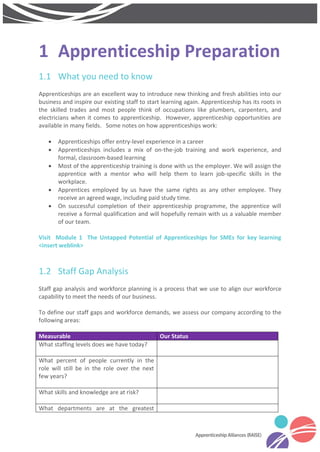
1.2 Staff Gap Analysis
Staff gap analysis and workforce planning is a process that we use to align our workforce
capability to meet the needs of our business.
To define our staff gaps and workforce demands, we assess our company according to the
following areas:
Measurable Our Status
What staffing levels does we have today?
What percent of people currently in the
role will still be in the role over the next
few years?
What skills and knowledge are at risk?
What departments are at the greatest
resource risk and how do they contribute to
delivering planned growth?
What production risk do we have?
How Apprenticeships can help us fill our staffing gaps:
Apprenticeships offer a multitude of benefits to SME’s and are particularly effective when:
 The position requires multiple or unique skills which complicates the ability to find
an individual that meet the needs.
 There is a disconnect between the skill sets of the unemployed and the types of jobs
available.
 There is a need for focus on addressing long-term needs.
 Limited talent in the external market is projected to continue in the future.
Visit Module 2 Workforce Planning (section 2) for key learning <insert weblink>
1.3 Working with our chosen Training Organisation
Most employers use an external training organisation to provide the Apprenticeship
training. There are typically two main types of training organisations – colleges of further
education and independent training providers, which can be in the private or voluntary
sector. Training organisations who deliver Apprenticeships leading to nationally recognised
qualifications usually receive government funding.
The academic institution that we select to work with will depend on the type of skill we are
looking to build, proximity to our location and their overall track record relative to
supporting similar programs.
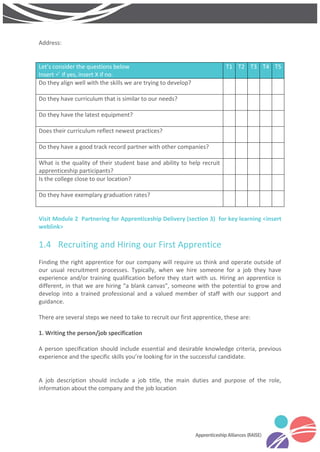
The table below is designed to help us determine who the most suitable training
organisation for us to work with:
Training Organisation 1:
Address:
Training Organisation 2:
Address:
Training Organisation 3:
Address:
Training Organisation 4:
Address:
Training Organisation 5:
Address:
Let’s consider the questions below
Insert  if yes, insert X if no.
T1 T2 T3 T4 T5
Do they align well with the skills we are trying to develop?
Do they have curriculum that is similar to our needs?
Do they have the latest equipment?
Does their curriculum reflect newest practices?
Do they have a good track record partner with other companies?
What is the quality of their student base and ability to help recruit
apprenticeship participants?
Is the college close to our location?
Do they have exemplary graduation rates?
Visit Module 2 Partnering for Apprenticeship Delivery (section 3) for key learning <insert
weblink>
1.4 Recruiting and Hiring our First Apprentice
Finding the right apprentice for our company will require us think and operate outside of
our usual recruitment processes. Typically, when we hire someone for a job they have
experience and/or training qualification before they start with us. Hiring an apprentice is
different, in that we are hiring “a blank canvas”, someone with the potential to grow and
develop into a trained professional and a valued member of staff with our support and
guidance.
There are several steps we need to take to recruit our first apprentice, these are:
1. Writing the person/job specification
A person specification should include essential and desirable knowledge criteria, previous
experience and the specific skills you’re looking for in the successful candidate.
A job description should include a job title, the main duties and purpose of the role,
information about the company and the job location
2. Advertising the Apprenticeship Vacancy
We will be employing a number of approaches to advertise our apprenticeship vacancy,
these include:
 word of mouth
 training organisation listings
 social media
 local press
 advertising on national apprenticeship vacancies website
 job/career/recruitment websites
Visit Module 2 Attracting Apprenticeships – Key Messages to Communicate (section 2)
for key learning <insert weblink>
3. Inviting Applications
On receipt of expressions of interest, we will follow up with prospective apprentice
candidates for more information. They type of information, we will be requesting is:
– Education History
– Subject/Qualification(s)
– Work Experience/History
– About You
– What are your strengths?
– What personal skills would you like to improve?
– Is there anything we can do to help you at interview?
– What are your hobbies, interests or achievements?
4. Shortlisting our Potential Apprentices
Shortlisting is the process of selecting the candidates that we will undergo with potential
apprentices we wish to take forward to the next stage whether this is formal interview,
group assessment or any other method.
Shortlist of suitable candidates will be created by more than one person to help to avoid
possible bias. Compiling our shortlist, we will look at matching the job description and
person specification to the apprentice applications. The starting point will be eliminating
those who do not have the basic requirements for the job.
Once we have our shortlist, we will liaise with our training organisation to notify the
shortlisted candidates by telephone, e-mail or letter. At this stage, we will inform the
candidate of the following:
– Where and when the interview will be taking place
– Any additional information we would like them to bring along
– Details of any practical test we might like them to do
– The name and job titles of the interview panel members.
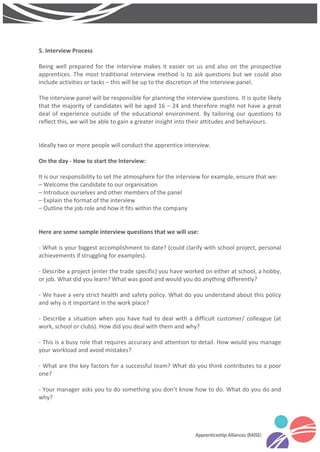
5. Interview Process
Being well prepared for the interview makes it easier on us and also on the prospective
apprentices. The most traditional interview method is to ask questions but we could also
include activities or tasks – this will be up to the discretion of the interview panel.
The interview panel will be responsible for planning the interview questions. It is quite likely
that the majority of candidates will be aged 16 – 24 and therefore might not have a great
deal of experience outside of the educational environment. By tailoring our questions to
reflect this, we will be able to gain a greater insight into their attitudes and behaviours.
Ideally two or more people will conduct the apprentice interview.
On the day - How to start the Interview:
It is our responsibility to set the atmosphere for the interview for example, ensure that we:
– Welcome the candidate to our organisation
– Introduce ourselves and other members of the panel
– Explain the format of the interview
– Outline the job role and how it fits within the company
Here are some sample interview questions that we will use:
- What is your biggest accomplishment to date? (could clarify with school project, personal
achievements if struggling for examples).
- Describe a project (enter the trade specific) you have worked on either at school, a hobby,
or job. What did you learn? What was good and would you do anything differently?
- We have a very strict health and safety policy. What do you understand about this policy
and why is it important in the work place?
- Describe a situation when you have had to deal with a difficult customer/ colleague (at
work, school or clubs). How did you deal with them and why?
- This is a busy role that requires accuracy and attention to detail. How would you manage
your workload and avoid mistakes?
- What are the key factors for a successful team? What do you think contributes to a poor
one?
- Your manager asks you to do something you don’t know how to do. What do you do and
why?
- A customer complains about something you don’t see is a problem. What do you do and
why?
On the day – Closing the Interview:
Once all the questions and/or practical tests have been completed, the panel will explain
the next stages in the recruitment process also giving the candidate an idea of the
timescales involved. The apprentice candidate will then be given some time to ask any
questions that they might have. Lastly, the panel will thank the candidate for attending.
Note: the panel must ensure they write up accurate notes as soon as possible after the
interview, to record what has been said and their notes on the candidate’s strengths,
weaknesses etc.
6. Selecting the Successful Candidate
Once you have selected a candidate, a phone call to notify them of their success is good
practice, followed by an official ‘offer letter’ offering them the position. You will also need
to notify your training organisation as they may take on the role of notifying any
unsuccessful candidates.
7. Creating the Apprenticeship Agreement – see next section on contracts and
agreements.
1.5 Contracts and Agreements
Apprentices are issued a Contract of Employment which includes working hours (normally
for a minimum of 30 hours). As a guide, the minimum Apprenticeship contract is 30 hours a
week with a minimum of 4 hours paid time devoted to education either at college or as
work based learning.
As well as a contract of employment, an Apprenticeship Agreement is put in place for all
apprentices. This is a legally required written agreement between us the employer, the
apprentice learner and training organisation. The Apprenticeship Agreement contains the
conditions of employment and training of the apprentice.
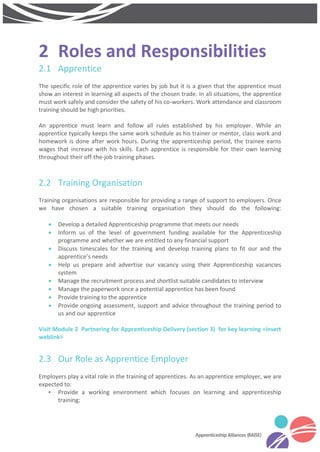
2 Roles and Responsibilities
2.1 Apprentice
The specific role of the apprentice varies by job but it is a given that the apprentice must
show an interest in learning all aspects of the chosen trade. In all situations, the apprentice
must work safely and consider the safety of his co-workers. Work attendance and classroom
training should be high priorities.
An apprentice must learn and follow all rules established by his employer. While an
apprentice typically keeps the same work schedule as his trainer or mentor, class work and
homework is done after work hours. During the apprenticeship period, the trainee earns
wages that increase with his skills. Each apprentice is responsible for their own learning
throughout their off-the-job training phases.
2.2 Training Organisation
Training organisations are responsible for providing a range of support to employers. Once
we have chosen a suitable training organisation they should do the following:
 Develop a detailed Apprenticeship programme that meets our needs
 Inform us of the level of government funding available for the Apprenticeship
programme and whether we are entitled to any financial support
 Discuss timescales for the training and develop training plans to fit our and the
apprentice’s needs
 Help us prepare and advertise our vacancy using their Apprenticeship vacancies
system
 Manage the recruitment process and shortlist suitable candidates to interview
 Manage the paperwork once a potential apprentice has been found
 Provide training to the apprentice
 Provide ongoing assessment, support and advice throughout the training period to
us and our apprentice
Visit Module 2 Partnering for Apprenticeship Delivery (section 3) for key learning <insert
weblink>
2.3 Our Role as Apprentice Employer
Employers play a vital role in the training of apprentices. As an apprentice employer, we are
expected to:
• Provide a working environment which focuses on learning and apprenticeship
training;
• Provide a safe working environment which complies with health and safety
regulations;
• Direct and guide student learning through on-site supervision by a qualified
individual;
• Assess the progress of the student and work with education providers to progress
the students career paths.
2.4 Apprentice Supervisor/Mentor
Workplace supervisors play a central role in the success of apprenticeship programmes. The
supervisor is the person who is responsible for training the apprentice at the worksite in the
day-today working environment and the employer apprentice administration.
The mentor supervises roughly 90 percent of the apprentice’s training at the work site, and
will spend more time with the apprentice during the early stages of the apprenticeship. As
the apprentice gains more skills, the mentor spends less time with hands-on training, but
continues to monitor the apprentice’s work.
An Effective Apprentice Supervisor:
 provides a safe and supportive workplace
 manages risks in relation to safety and production while training
 integrates learning tasks into work activities based on the Training Plan
 communicates with the education provider on a regular basis to ensure effective
training delivery and assessment practices, and to review progress
 advises the education provider that the trainee/apprentice has achieved
competency in specific units of competency
Another key role of the mentor is to keep the apprentice informed of safety issues and
make him aware of co-worker expectations. The mentor must also keep co-workers
informed of the apprentices competences and work capabilities as the training progresses.
Visit Module 3 Assigning an Apprentice Trainer/Suprvisor (section 1) for key learning
<insert weblink>
2.5 Role of Other Staff
Once the apprenticeship started, all company staff will be expected to provide support and
guidance to the apprentice on an on-going basis. To ensure all staff are fully up to speed on
the Apprenticeship programme, the role of the apprentice and of the apprentice supervisor
etc. an apprenticeship introduction presentation will be given to all staff.
3 Getting Started
3.1 Apprenticeship Introduction for Company Staff
Taking on our first apprentice is a new challenge for everyone at the company. In order to
help us make this a success, we will provide an Introduction to Apprenticeships Information
Session for all staff. The aim of this session will be to train all departments at our
organisation in how the Apprenticeship programme works. While some may already be
familiar with the programme, it is important that we do not assume all colleagues already
understand it.
We are conscious that all staff need to feel up to speed and fully understand how the
apprenticeship programme works in order to be able to provide the required support to our
first apprentice.
3.2 Induction - Welcoming our Apprentice
Induction training will help our new apprentice to settle down quickly in their new work
environment and will help them get to know the role they have to play in building and
growing our company.
Our Induction training aims gives our apprentices a sense of belonging. It will comprise of:
1. A company introduction presentation – this will help our apprentice get to know a little
more about our company (template below will be used as a starting point)
Company Profile
Presentation Template.pptx
2. An apprenticeship introduction presentation – this will help our apprentice get to know
more about our vision for our new apprenticeship programme in the company (template
below will be used as a starting point)
Apprenticeship
Induction Presentation Template.pptx
3. Tour of the company, health and safety protocols, work spaces etc.
4 Apprenticeships in Action
4.1 Supporting our Apprentice in The Workplace
Once they’ve settled in and feel like a comfortable member of the team, we will tailor our
management style to account for their inexperience.
We will:
 keep our apprentice motivated and engaged by keeping management positive.
 adopt a conversational approach rather than an instructive one. We will ask them for
their opinion and value what they have to offer.
 ensure the goals we set are achievable and sustainable. Setting unrealistic goals will
make our apprentice feel inadequate and unmotivated.
 provide regular feedback. If they’ve done a good job, or faltered in any areas, we will
keep them on the right path with focused training.
4.2 On the Job Training
This part of the apprenticeship training is with us the employer. In this part of the training,
the apprentice gets practical training and experience of doing the job. In addition to the
skills and knowledge gained, with our help and support, the apprentice will develop
competence, confidence, and the ability to perform to industrial standards.
An important part of the on the job training, is ensuring that the apprentice has developed
the ability and competency to perform specified tasks to pre-set standards. As a result,
assessing their work is an important aspect of our roles as the employer.
Visit Module 3 Peer Learning (section 3) for key learning <insert weblink>
4.3 Assessing Competence
Competence is a key word regularly associated with apprenticeship training. The term
'competent' refers to a person's ability to perform to the standard of performance expected
in employment.
Competency encompasses:
 performance of individual tasks (task skills);
 management of a number of different tasks within the job (task management skills);
 responding to irregularities and breakdowns in routine work (contingency
management skills);
 dealing with the responsibilities and expectations of the work environment
(occupational environment skills);
 applying skills and knowledge to new situations and environments (transferability
skills).
Assessment of competence requires a combination of performance evidence and
knowledge evidence gathered over time and preferably from different sources, using a
variety of methods and in various contexts. What this means is that we need to meeting
performance requirements on one occasion does not necessarily imply competence.
To this end, we will use the following one-page apprentice evaluation form to track the
apprentices competence and skills development on a weekly basis.
One Page Apprentice
Evaulation Form.docx
Visit Module 3 Cultivate a Culture of Learning (section 2) for key learning and resources
<insert weblink>
5 Evaluating Success
5.1 After the Apprenticeship
As this is our first time engaging in an apprenticeship programme, it is important that we
carefully evaluate its success. What are we evaluating for:
1. To validate apprenticeship training as a business tool
Training is one of many actions that an organisation can take to improve its performance
and profitability. We need to try determine if this apprenticeship has benefited our business
and if so how.
2. To justify the costs incurred
Our SME is no different from others and runs on a tight budget. Taking on an apprentice has
direct and indirect costs, we need to determine the return on investment of these costs.
3. To help improve the design of apprenticeship
Training programmes should be continuously improved to provide better value and
increased benefits for an organisation, the learner and all those involved. We will evaluate
our apprenticeship in terms of design and make notes/recommendations for improvement
as we go.
4. To help in selecting future training/employee recruitment methods
These days there are many alternative approaches available to training and recruiting staff/
In terms of training this includes a variety of classroom, on-job and self-study methods.
Evaluating as we go, will help us to make rational decisions about the methods to employ.
6 Action Checklist to take on
our first apprentice
TO BE COMPLETED
7 Further Apprenticeship
Recruitment in our SME
TO BE COMPLETED

Mod 4 employ our first apprentice

  • 1.
    EMPLOY OUR FIRSTAPPRENTICE Action Plan Template for our SME This programme has been funded with support from the European Commission This is Module 4 VISIT www.apprenticeshipalliances.eu for more resources
  • 2.
    The Marketing Mix Thisplan template is designed as a go-to resource to guide our company as we take on our first apprentice. Why ? The development of skills is at the centre of our progression and growth. Apprenticeships are a wonderful mechanism to help SMEs across all sectors to harness fresh talent. How to benefit from this Action Plan Template…… Please use this template to create your SME plan to take on your first apprentice. This plan will assist you to clarify the role for your first apprentice and take you through the steps involved in taking them on. By involving other personnel in the Plan, you will get buy in to the process. The completed plan will convince you and others (e.g. training partners) that you have prepared for this new development in your SME and will derive maximum benefit from taking on your first apprentice, building your skills as an apprentice employer and hopefully taking on many more apprenticeships in the future. How to use this Action Plan Template……  Follow the format provided but replace key text with your own details.  Complete each exercise within this word document and delete any areas not relevant to you.  Follow the links to our training content to learn more about each subject area. "The European Commission support for the production of this publication does not constitute an endorsement of the contents which reflects the views only of the authors, and the Commission cannot be held responsible for any use which
  • 3.
    Contents 1 Apprenticeship Preparation..............................................................................................5 1.1What you need to know..............................................................................................5 1.2 Staff Gap Analysis........................................................................................................5 How Apprenticeships can help us fill our staffing gaps:....................................................6 1.3 Working with our chosen Training Organisation ........................................................6 1.4 Recruiting and Hiring our First Apprentice .................................................................7 1. Writing the person/job specification.............................................................................7 2. Advertising the Apprenticeship Vacancy .......................................................................8 3. Inviting Applications.......................................................................................................8 4. Shortlisting our Potential Apprentices...........................................................................8 5. Interview Process...........................................................................................................9 On the day - How to start the Interview:...........................................................................9 Here are some sample interview questions that we will use:...........................................9 6. Selecting the Successful Candidate..............................................................................10 7. Creating the Apprenticeship Agreement – see next section on contracts and agreements. .....................................................................................................................10 1.5 Contracts and Agreements........................................................................................10 2 Roles and Responsibilities...............................................................................................11 2.1 Apprentice.................................................................................................................11 2.2 Training Organisation................................................................................................11 2.3 Our Role as Apprentice Employer.............................................................................11 2.4 Apprentice Supervisor/Mentor.................................................................................12 2.5 Role of Other Staff.....................................................................................................12 3 Getting Started................................................................................................................13 3.1 Apprenticeship Introduction for Company Staff.......................................................13 3.2 Induction - Welcoming our Apprentice.....................................................................13 4 Apprenticeships in Action...............................................................................................14 4.1 Supporting our Apprentice in The Workplace ..........................................................14 4.2 On the Job Training ...................................................................................................14 4.3 Assessing Competence..............................................................................................14
  • 4.
    5 Evaluating Success...........................................................................................................16 5.1After the Apprenticeship...........................................................................................16 6 Action Checklist to take on our first apprentice ....................................................... 17 7 Further Apprenticeship Recruitment in our SME...................................................... 18
  • 5.
    1 Apprenticeship Preparation 1.1What you need to know Apprenticeships are an excellent way to introduce new thinking and fresh abilities into our business and inspire our existing staff to start learning again. Apprenticeship has its roots in the skilled trades and most people think of occupations like plumbers, carpenters, and electricians when it comes to apprenticeship. However, apprenticeship opportunities are available in many fields. Some notes on how apprenticeships work:  Apprenticeships offer entry-level experience in a career  Apprenticeships includes a mix of on-the-job training and work experience, and formal, classroom-based learning  Most of the apprenticeship training is done with us the employer. We will assign the apprentice with a mentor who will help them to learn job-specific skills in the workplace.  Apprentices employed by us have the same rights as any other employee. They receive an agreed wage, including paid study time.  On successful completion of their apprenticeship programme, the apprentice will receive a formal qualification and will hopefully remain with us a valuable member of our team. Visit Module 1 The Untapped Potential of Apprenticeships for SMEs for key learning <insert weblink> 1.2 Staff Gap Analysis Staff gap analysis and workforce planning is a process that we use to align our workforce capability to meet the needs of our business. To define our staff gaps and workforce demands, we assess our company according to the following areas: Measurable Our Status What staffing levels does we have today? What percent of people currently in the role will still be in the role over the next few years? What skills and knowledge are at risk? What departments are at the greatest
  • 6.
    resource risk andhow do they contribute to delivering planned growth? What production risk do we have? How Apprenticeships can help us fill our staffing gaps: Apprenticeships offer a multitude of benefits to SME’s and are particularly effective when:  The position requires multiple or unique skills which complicates the ability to find an individual that meet the needs.  There is a disconnect between the skill sets of the unemployed and the types of jobs available.  There is a need for focus on addressing long-term needs.  Limited talent in the external market is projected to continue in the future. Visit Module 2 Workforce Planning (section 2) for key learning <insert weblink> 1.3 Working with our chosen Training Organisation Most employers use an external training organisation to provide the Apprenticeship training. There are typically two main types of training organisations – colleges of further education and independent training providers, which can be in the private or voluntary sector. Training organisations who deliver Apprenticeships leading to nationally recognised qualifications usually receive government funding. The academic institution that we select to work with will depend on the type of skill we are looking to build, proximity to our location and their overall track record relative to supporting similar programs. The table below is designed to help us determine who the most suitable training organisation for us to work with: Training Organisation 1: Address: Training Organisation 2: Address: Training Organisation 3: Address: Training Organisation 4: Address: Training Organisation 5:
  • 7.
    Address: Let’s consider thequestions below Insert  if yes, insert X if no. T1 T2 T3 T4 T5 Do they align well with the skills we are trying to develop? Do they have curriculum that is similar to our needs? Do they have the latest equipment? Does their curriculum reflect newest practices? Do they have a good track record partner with other companies? What is the quality of their student base and ability to help recruit apprenticeship participants? Is the college close to our location? Do they have exemplary graduation rates? Visit Module 2 Partnering for Apprenticeship Delivery (section 3) for key learning <insert weblink> 1.4 Recruiting and Hiring our First Apprentice Finding the right apprentice for our company will require us think and operate outside of our usual recruitment processes. Typically, when we hire someone for a job they have experience and/or training qualification before they start with us. Hiring an apprentice is different, in that we are hiring “a blank canvas”, someone with the potential to grow and develop into a trained professional and a valued member of staff with our support and guidance. There are several steps we need to take to recruit our first apprentice, these are: 1. Writing the person/job specification A person specification should include essential and desirable knowledge criteria, previous experience and the specific skills you’re looking for in the successful candidate. A job description should include a job title, the main duties and purpose of the role, information about the company and the job location
  • 8.
    2. Advertising theApprenticeship Vacancy We will be employing a number of approaches to advertise our apprenticeship vacancy, these include:  word of mouth  training organisation listings  social media  local press  advertising on national apprenticeship vacancies website  job/career/recruitment websites Visit Module 2 Attracting Apprenticeships – Key Messages to Communicate (section 2) for key learning <insert weblink> 3. Inviting Applications On receipt of expressions of interest, we will follow up with prospective apprentice candidates for more information. They type of information, we will be requesting is: – Education History – Subject/Qualification(s) – Work Experience/History – About You – What are your strengths? – What personal skills would you like to improve? – Is there anything we can do to help you at interview? – What are your hobbies, interests or achievements? 4. Shortlisting our Potential Apprentices Shortlisting is the process of selecting the candidates that we will undergo with potential apprentices we wish to take forward to the next stage whether this is formal interview, group assessment or any other method. Shortlist of suitable candidates will be created by more than one person to help to avoid possible bias. Compiling our shortlist, we will look at matching the job description and person specification to the apprentice applications. The starting point will be eliminating those who do not have the basic requirements for the job. Once we have our shortlist, we will liaise with our training organisation to notify the shortlisted candidates by telephone, e-mail or letter. At this stage, we will inform the candidate of the following: – Where and when the interview will be taking place – Any additional information we would like them to bring along – Details of any practical test we might like them to do – The name and job titles of the interview panel members.
  • 9.
    5. Interview Process Beingwell prepared for the interview makes it easier on us and also on the prospective apprentices. The most traditional interview method is to ask questions but we could also include activities or tasks – this will be up to the discretion of the interview panel. The interview panel will be responsible for planning the interview questions. It is quite likely that the majority of candidates will be aged 16 – 24 and therefore might not have a great deal of experience outside of the educational environment. By tailoring our questions to reflect this, we will be able to gain a greater insight into their attitudes and behaviours. Ideally two or more people will conduct the apprentice interview. On the day - How to start the Interview: It is our responsibility to set the atmosphere for the interview for example, ensure that we: – Welcome the candidate to our organisation – Introduce ourselves and other members of the panel – Explain the format of the interview – Outline the job role and how it fits within the company Here are some sample interview questions that we will use: - What is your biggest accomplishment to date? (could clarify with school project, personal achievements if struggling for examples). - Describe a project (enter the trade specific) you have worked on either at school, a hobby, or job. What did you learn? What was good and would you do anything differently? - We have a very strict health and safety policy. What do you understand about this policy and why is it important in the work place? - Describe a situation when you have had to deal with a difficult customer/ colleague (at work, school or clubs). How did you deal with them and why? - This is a busy role that requires accuracy and attention to detail. How would you manage your workload and avoid mistakes? - What are the key factors for a successful team? What do you think contributes to a poor one? - Your manager asks you to do something you don’t know how to do. What do you do and why?
  • 10.
    - A customercomplains about something you don’t see is a problem. What do you do and why? On the day – Closing the Interview: Once all the questions and/or practical tests have been completed, the panel will explain the next stages in the recruitment process also giving the candidate an idea of the timescales involved. The apprentice candidate will then be given some time to ask any questions that they might have. Lastly, the panel will thank the candidate for attending. Note: the panel must ensure they write up accurate notes as soon as possible after the interview, to record what has been said and their notes on the candidate’s strengths, weaknesses etc. 6. Selecting the Successful Candidate Once you have selected a candidate, a phone call to notify them of their success is good practice, followed by an official ‘offer letter’ offering them the position. You will also need to notify your training organisation as they may take on the role of notifying any unsuccessful candidates. 7. Creating the Apprenticeship Agreement – see next section on contracts and agreements. 1.5 Contracts and Agreements Apprentices are issued a Contract of Employment which includes working hours (normally for a minimum of 30 hours). As a guide, the minimum Apprenticeship contract is 30 hours a week with a minimum of 4 hours paid time devoted to education either at college or as work based learning. As well as a contract of employment, an Apprenticeship Agreement is put in place for all apprentices. This is a legally required written agreement between us the employer, the apprentice learner and training organisation. The Apprenticeship Agreement contains the conditions of employment and training of the apprentice.
  • 11.
    2 Roles andResponsibilities 2.1 Apprentice The specific role of the apprentice varies by job but it is a given that the apprentice must show an interest in learning all aspects of the chosen trade. In all situations, the apprentice must work safely and consider the safety of his co-workers. Work attendance and classroom training should be high priorities. An apprentice must learn and follow all rules established by his employer. While an apprentice typically keeps the same work schedule as his trainer or mentor, class work and homework is done after work hours. During the apprenticeship period, the trainee earns wages that increase with his skills. Each apprentice is responsible for their own learning throughout their off-the-job training phases. 2.2 Training Organisation Training organisations are responsible for providing a range of support to employers. Once we have chosen a suitable training organisation they should do the following:  Develop a detailed Apprenticeship programme that meets our needs  Inform us of the level of government funding available for the Apprenticeship programme and whether we are entitled to any financial support  Discuss timescales for the training and develop training plans to fit our and the apprentice’s needs  Help us prepare and advertise our vacancy using their Apprenticeship vacancies system  Manage the recruitment process and shortlist suitable candidates to interview  Manage the paperwork once a potential apprentice has been found  Provide training to the apprentice  Provide ongoing assessment, support and advice throughout the training period to us and our apprentice Visit Module 2 Partnering for Apprenticeship Delivery (section 3) for key learning <insert weblink> 2.3 Our Role as Apprentice Employer Employers play a vital role in the training of apprentices. As an apprentice employer, we are expected to: • Provide a working environment which focuses on learning and apprenticeship training;
  • 12.
    • Provide asafe working environment which complies with health and safety regulations; • Direct and guide student learning through on-site supervision by a qualified individual; • Assess the progress of the student and work with education providers to progress the students career paths. 2.4 Apprentice Supervisor/Mentor Workplace supervisors play a central role in the success of apprenticeship programmes. The supervisor is the person who is responsible for training the apprentice at the worksite in the day-today working environment and the employer apprentice administration. The mentor supervises roughly 90 percent of the apprentice’s training at the work site, and will spend more time with the apprentice during the early stages of the apprenticeship. As the apprentice gains more skills, the mentor spends less time with hands-on training, but continues to monitor the apprentice’s work. An Effective Apprentice Supervisor:  provides a safe and supportive workplace  manages risks in relation to safety and production while training  integrates learning tasks into work activities based on the Training Plan  communicates with the education provider on a regular basis to ensure effective training delivery and assessment practices, and to review progress  advises the education provider that the trainee/apprentice has achieved competency in specific units of competency Another key role of the mentor is to keep the apprentice informed of safety issues and make him aware of co-worker expectations. The mentor must also keep co-workers informed of the apprentices competences and work capabilities as the training progresses. Visit Module 3 Assigning an Apprentice Trainer/Suprvisor (section 1) for key learning <insert weblink> 2.5 Role of Other Staff Once the apprenticeship started, all company staff will be expected to provide support and guidance to the apprentice on an on-going basis. To ensure all staff are fully up to speed on the Apprenticeship programme, the role of the apprentice and of the apprentice supervisor etc. an apprenticeship introduction presentation will be given to all staff.
  • 13.
    3 Getting Started 3.1Apprenticeship Introduction for Company Staff Taking on our first apprentice is a new challenge for everyone at the company. In order to help us make this a success, we will provide an Introduction to Apprenticeships Information Session for all staff. The aim of this session will be to train all departments at our organisation in how the Apprenticeship programme works. While some may already be familiar with the programme, it is important that we do not assume all colleagues already understand it. We are conscious that all staff need to feel up to speed and fully understand how the apprenticeship programme works in order to be able to provide the required support to our first apprentice. 3.2 Induction - Welcoming our Apprentice Induction training will help our new apprentice to settle down quickly in their new work environment and will help them get to know the role they have to play in building and growing our company. Our Induction training aims gives our apprentices a sense of belonging. It will comprise of: 1. A company introduction presentation – this will help our apprentice get to know a little more about our company (template below will be used as a starting point) Company Profile Presentation Template.pptx 2. An apprenticeship introduction presentation – this will help our apprentice get to know more about our vision for our new apprenticeship programme in the company (template below will be used as a starting point) Apprenticeship Induction Presentation Template.pptx 3. Tour of the company, health and safety protocols, work spaces etc.
  • 14.
    4 Apprenticeships inAction 4.1 Supporting our Apprentice in The Workplace Once they’ve settled in and feel like a comfortable member of the team, we will tailor our management style to account for their inexperience. We will:  keep our apprentice motivated and engaged by keeping management positive.  adopt a conversational approach rather than an instructive one. We will ask them for their opinion and value what they have to offer.  ensure the goals we set are achievable and sustainable. Setting unrealistic goals will make our apprentice feel inadequate and unmotivated.  provide regular feedback. If they’ve done a good job, or faltered in any areas, we will keep them on the right path with focused training. 4.2 On the Job Training This part of the apprenticeship training is with us the employer. In this part of the training, the apprentice gets practical training and experience of doing the job. In addition to the skills and knowledge gained, with our help and support, the apprentice will develop competence, confidence, and the ability to perform to industrial standards. An important part of the on the job training, is ensuring that the apprentice has developed the ability and competency to perform specified tasks to pre-set standards. As a result, assessing their work is an important aspect of our roles as the employer. Visit Module 3 Peer Learning (section 3) for key learning <insert weblink> 4.3 Assessing Competence Competence is a key word regularly associated with apprenticeship training. The term 'competent' refers to a person's ability to perform to the standard of performance expected in employment. Competency encompasses:  performance of individual tasks (task skills);  management of a number of different tasks within the job (task management skills);
  • 15.
     responding toirregularities and breakdowns in routine work (contingency management skills);  dealing with the responsibilities and expectations of the work environment (occupational environment skills);  applying skills and knowledge to new situations and environments (transferability skills). Assessment of competence requires a combination of performance evidence and knowledge evidence gathered over time and preferably from different sources, using a variety of methods and in various contexts. What this means is that we need to meeting performance requirements on one occasion does not necessarily imply competence. To this end, we will use the following one-page apprentice evaluation form to track the apprentices competence and skills development on a weekly basis. One Page Apprentice Evaulation Form.docx Visit Module 3 Cultivate a Culture of Learning (section 2) for key learning and resources <insert weblink>
  • 16.
    5 Evaluating Success 5.1After the Apprenticeship As this is our first time engaging in an apprenticeship programme, it is important that we carefully evaluate its success. What are we evaluating for: 1. To validate apprenticeship training as a business tool Training is one of many actions that an organisation can take to improve its performance and profitability. We need to try determine if this apprenticeship has benefited our business and if so how. 2. To justify the costs incurred Our SME is no different from others and runs on a tight budget. Taking on an apprentice has direct and indirect costs, we need to determine the return on investment of these costs. 3. To help improve the design of apprenticeship Training programmes should be continuously improved to provide better value and increased benefits for an organisation, the learner and all those involved. We will evaluate our apprenticeship in terms of design and make notes/recommendations for improvement as we go. 4. To help in selecting future training/employee recruitment methods These days there are many alternative approaches available to training and recruiting staff/ In terms of training this includes a variety of classroom, on-job and self-study methods. Evaluating as we go, will help us to make rational decisions about the methods to employ.
  • 17.
    6 Action Checklistto take on our first apprentice TO BE COMPLETED
  • 18.
    7 Further Apprenticeship Recruitmentin our SME TO BE COMPLETED