Tick Mobility
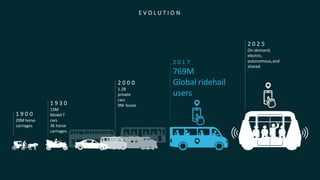
1 9 0 0
20M horse
carriages
1 9 3 0
15M
ModelT
cars
3K horse
carriages
2 0 0 0
1.2B
private
cars
9M buses
2 0 2 5
On-demand,
electric,
autonomous,and
shared
2 0 1 7
769M
Global ridehail
users
E V O L U T I O N
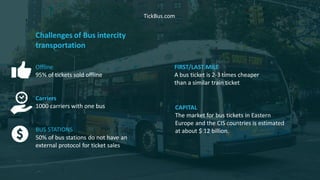
TickBus.com
Challenges of Bus intercity
transportation
Offline
95% of tickets sold offline
Carriers
1000 carriers with one bus
BUS STATIONS
50% of bus stations do not have an
external protocol for ticket sales
FIRST/LAST MILE
A bus ticket is 2-3 times cheaper
than a similar train ticket
CAPITAL
The market for bus tickets in Eastern
Europe and the CIS countries is estimated
at about $ 12 billion.
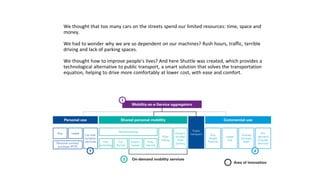
We thought that too many cars on the streets spend our limited resources: time, space and
money.
We had to wonder why we are so dependent on our machines? Rush hours, traffic, terrible
driving and lack of parking spaces.
We thought how to improve people's lives? And here Shuttle was created, which provides a
technological alternative to public transport, a smart solution that solves the transportation
equation, helping to drive more comfortably at lower cost, with ease and comfort.
5 MASSIVE X presentation to DesignTuts team
→ MaaS offers stakeholders a significant opportunity
to change travel behavior and introduce new
innovative business models, such as dynamic and
subscription pricing for multi-mode tariff systems.
→ Shuttle, which by providing a technological
alternative to public transport, is a smart solution that
solves the transportation equation, helping to drive
more comfortably at lower cost, with ease and
comfort.
→ By the end of 2022, more than 40 billion transport
tickets will be purchased through mobile and online
funds.
Demand for consumer
mobility as a service as an
alternative to ownership
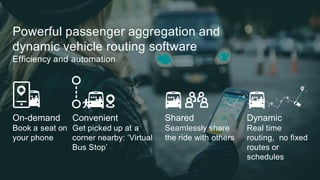
corner nearby: ‘Virtual
Bus Stop’
On-demand Convenient
Book a seat on Get picked up at a
your phone
Powerful passenger aggregation and
dynamic vehicle routing software
Efficiency and automation
Shared
Seamlessly share
the ride with others
Dynamic
Real time
routing, no fixed
routes or
schedules
7 MASSIVE X presentation to DesignTuts team
→ Passengers traveling through MaaS will save, on
average, 37% of the base travel time, calculated at 67
minutes per day for drivers and 61 minutes per day in
all modes.
→ For business, if we assume that all the time has
been saved and has been used for the purposes of
business activity, as a result of which world business
productivity would increase by 2.2 trillion.
→ Travel time is projected to decrease on average to
52 minutes per day.
→ It is estimated that 33% of the free time used to
improve business performance on a global scale will
bring an additional $ 733 billion exclusively from
MaaS..
Saving time for
passengers using MaaS
will certainly benefit the
business.
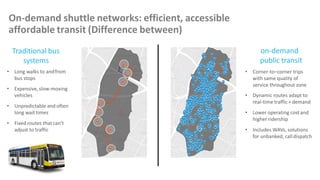
On-demand shuttle networks: efficient, accessible
affordable transit (Difference between)
Traditional bus
systems
• Long walks to andfrom
bus stops
• Expensive,slow-moving
vehicles
• Unpredictable and often
long wait times
• Fixed routes thatcan’t
adjust to traffic
on-demand
public transit
• Corner-to–corner trips
with same quality of
service throughout zone
• Dynamic routes adapt to
real-time traffic + demand
• Lower operating costand
higher ridership
• Includes WAVs, solutions
for unbanked, calldispatch
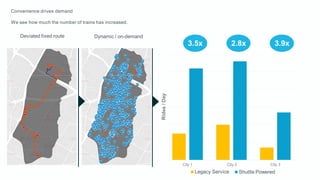
Convenience drives demand
We see how much the number of trains has increased.
3.5x 2.8x 3.9x
Deviated fixed route Dynamic / on-demand
City 1 City 3Rides/Day City 2
Legacy Service Shuttle Powered
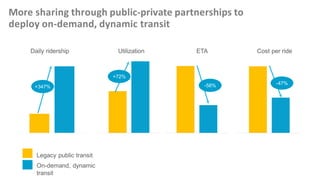
More sharing through public-private partnerships to
deploy on-demand, dynamic transit
Rides / Day Utilization ETA (1) Est. Cost / Ride
Daily ridership
Legacy public transit
On-demand, dynamic
transit
Utilization ETA Cost per ride
+347%
+72%
-58% -47%
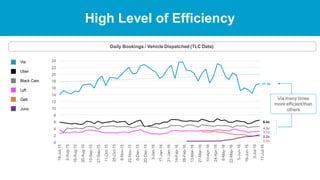
High Level of Efficiency
17.3x
Black Cars
Uber
Lyft
Via
Gett
6.4x
4.5x
3.1x
2.2x
2.0x
Juno
Daily Bookings / Vehicle Dispatched (TLC Data)
24
22
20
18
16
14
12
10
8
6
4
2
0
19-Jul-15
2-Aug-15
16-Aug-15
30-Aug-15
13-Sep-15
27-Sep-15
11-Oct-15
25-Oct-15
8-Nov-15
22-Nov-15
6-Dec-15
20-Dec-15
3-Jan-16
17-Jan-16
31-Jan-16
14-Feb-16
28-Feb-16
13-Mar-16
27-Mar-16
10-Apr-16
24-Apr-16
8-May-16
22-May-16
5-Jun-16
19-Jun-16
3-Jul-16
17-Jul-16
Via many times
more efficientthan
others
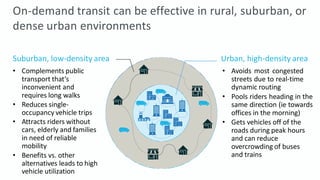
On-demand transit can be effective in rural, suburban, or
dense urban environments
Suburban, low-density area Urban, high-density area
• Complements public
transport that’s
inconvenient and
requires long walks
• Reduces single-
occupancy vehicle trips
• Attracts riders without
cars, elderly and families
in need of reliable
mobility
• Benefits vs. other
alternatives leads to high
vehicle utilization
• Avoids most congested
streets due to real-time
dynamic routing
• Pools riders heading in the
same direction (ie towards
offices in the morning)
• Gets vehicles off of the
roads during peak hours
and can reduce
overcrowding of buses
and trains
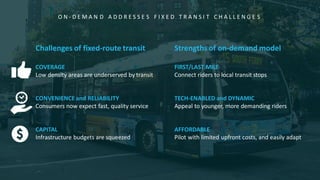
O N - D E M A N D A D D R E S S E S F I X E D T R A N S I T C H A L L E N G E S
Challenges of fixed-route transit
COVERAGE
Low density areas are underserved by transit
CONVENIENCE and RELIABILITY
Consumers now expect fast, quality service
CAPITAL
Infrastructure budgets are squeezed
Strengths of on-demand model
FIRST/LAST MILE
Connect riders to local transit stops
TECH-ENABLED and DYNAMIC
Appeal to younger, more demanding riders
AFFORDABLE
Pilot with limited upfront costs, and easily adapt
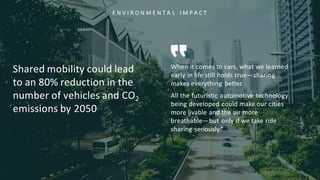
Shared mobility could lead
to an 80% reduction in the
number of vehicles and CO2
emissions by 2050
E N V I R O N M E N T A L I M P A C T
When it comes to cars, what we learned
early in life still holds true—sharing
makes everything better.
All the futuristic automotive technology
being developed could make our cities
more livable and the air more
breathable—but only if we take ride
sharing seriously.”
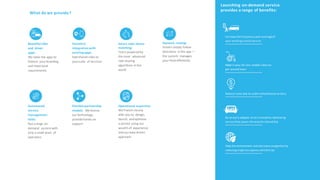
Launching on-demand service
provides a range of benefits:
Increase the frequency and coverageof
your existing transit service
Make it easy for less mobile ridersto
get around town
Reduce costs due to underutilized buses ortaxis
Be an early adopter of an innovativeridesharing
service that paves the wayfor shared AVs
Help the environment and decrease congestion by
reducing singleoccupancy vehicletrips
What do we provide?
Beautifulrider
and driver
apps:
We tailor the apps to
feature your branding
and meet local
requirements
Seamless
integration with
existing apps:
Add shared rides to
yoursuite of services
Smart rider-driver
matching:
Tickis powered by
the most advanced
ride-sharing
algorithms in the
world
Dynamic routing:
Drivers simply follow
directions in the app —
the system manages
your fleetefficiently
Flexible partnership
models: We license
our technology,
provide hands-on
support
Operational expertise:
We’ll work closely
with you to design,
launch, andoptimize
a service using our
wealth of experience
and ourdata-driven
approach
Automated
service
management
tools:
Run a large on-
demand systemwith
only a small team of
operators
A
C
B
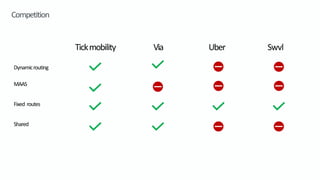
Competition
Tickmobility Via Uber Swvl
Dynamicrouting
MAAS
Fixed routes
Shared
11 MASSIVE X presentation to DesignTutsteam
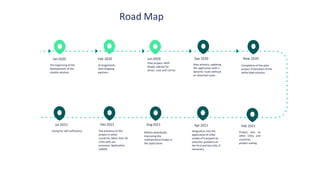
The beginning of the
development of the
shuttle solution
Road Map
Million downloads,
improving the
mathematical model in
the application
Integration into the
application of other
modes of transport to
solve the problems of
the firstand last mile, if
necessary
Jan2020 Feb 2020
Arrangements
with shipping
partners
Jun2020
Pilot project. MVP
Ready cabinet for
driver, user and carrier.
Sep 2020
Data analysis, updating
the application with a
dynamic route without
an attached route.
.
Now 2020
Completion of the pilot
project,finalization of the
white label solution
Jul 2022
Going for self-sufficiency
Dec 2021
The presence of the
project in other
countries.More than 50
cities with our
presence. Application
update
Aug2021 Apr 2021 Feb 2021
Project exit to
other cities and
countries,
project scaling
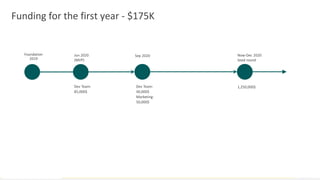
Funding for the first year - $175K
Foundation
2019
Sep 2020 Now-Dec 2020
Seed round
Jun 2020
(MVP)
Dev Team:
85,000$
Dev Team:
40,000$
Marketing:
50,000$
1,250,000$
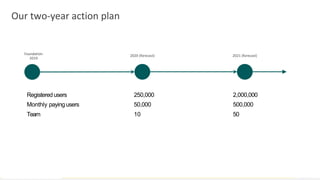
Our two-year action plan
Foundation
2019
2020 (forecast) 2021 (forecast)
Registeredusers 250,000 2,000,000
Monthly paying users 50,000 500,000
Team 10 50
To make shared-use mobility everyone’s preferred
mode by moving beyond the fixed-route bus
O U R M I S S I O N
Tick Mobility
Christian Shpilka
tick@tickfind.com
+38 (050) 309-30-92

Tick mobility

  • 1.
  • 2.
    1 9 00 20M horse carriages 1 9 3 0 15M ModelT cars 3K horse carriages 2 0 0 0 1.2B private cars 9M buses 2 0 2 5 On-demand, electric, autonomous,and shared 2 0 1 7 769M Global ridehail users E V O L U T I O N
  • 3.
    TickBus.com Challenges of Busintercity transportation Offline 95% of tickets sold offline Carriers 1000 carriers with one bus BUS STATIONS 50% of bus stations do not have an external protocol for ticket sales FIRST/LAST MILE A bus ticket is 2-3 times cheaper than a similar train ticket CAPITAL The market for bus tickets in Eastern Europe and the CIS countries is estimated at about $ 12 billion.
  • 4.
    We thought thattoo many cars on the streets spend our limited resources: time, space and money. We had to wonder why we are so dependent on our machines? Rush hours, traffic, terrible driving and lack of parking spaces. We thought how to improve people's lives? And here Shuttle was created, which provides a technological alternative to public transport, a smart solution that solves the transportation equation, helping to drive more comfortably at lower cost, with ease and comfort.
  • 5.
    5 MASSIVE Xpresentation to DesignTuts team → MaaS offers stakeholders a significant opportunity to change travel behavior and introduce new innovative business models, such as dynamic and subscription pricing for multi-mode tariff systems. → Shuttle, which by providing a technological alternative to public transport, is a smart solution that solves the transportation equation, helping to drive more comfortably at lower cost, with ease and comfort. → By the end of 2022, more than 40 billion transport tickets will be purchased through mobile and online funds. Demand for consumer mobility as a service as an alternative to ownership
  • 6.
    corner nearby: ‘Virtual BusStop’ On-demand Convenient Book a seat on Get picked up at a your phone Powerful passenger aggregation and dynamic vehicle routing software Efficiency and automation Shared Seamlessly share the ride with others Dynamic Real time routing, no fixed routes or schedules
  • 7.
    7 MASSIVE Xpresentation to DesignTuts team → Passengers traveling through MaaS will save, on average, 37% of the base travel time, calculated at 67 minutes per day for drivers and 61 minutes per day in all modes. → For business, if we assume that all the time has been saved and has been used for the purposes of business activity, as a result of which world business productivity would increase by 2.2 trillion. → Travel time is projected to decrease on average to 52 minutes per day. → It is estimated that 33% of the free time used to improve business performance on a global scale will bring an additional $ 733 billion exclusively from MaaS.. Saving time for passengers using MaaS will certainly benefit the business.
  • 8.
    On-demand shuttle networks:efficient, accessible affordable transit (Difference between) Traditional bus systems • Long walks to andfrom bus stops • Expensive,slow-moving vehicles • Unpredictable and often long wait times • Fixed routes thatcan’t adjust to traffic on-demand public transit • Corner-to–corner trips with same quality of service throughout zone • Dynamic routes adapt to real-time traffic + demand • Lower operating costand higher ridership • Includes WAVs, solutions for unbanked, calldispatch
  • 9.
    Convenience drives demand Wesee how much the number of trains has increased. 3.5x 2.8x 3.9x Deviated fixed route Dynamic / on-demand City 1 City 3Rides/Day City 2 Legacy Service Shuttle Powered
  • 10.
    More sharing throughpublic-private partnerships to deploy on-demand, dynamic transit Rides / Day Utilization ETA (1) Est. Cost / Ride Daily ridership Legacy public transit On-demand, dynamic transit Utilization ETA Cost per ride +347% +72% -58% -47%
  • 11.
    High Level ofEfficiency 17.3x Black Cars Uber Lyft Via Gett 6.4x 4.5x 3.1x 2.2x 2.0x Juno Daily Bookings / Vehicle Dispatched (TLC Data) 24 22 20 18 16 14 12 10 8 6 4 2 0 19-Jul-15 2-Aug-15 16-Aug-15 30-Aug-15 13-Sep-15 27-Sep-15 11-Oct-15 25-Oct-15 8-Nov-15 22-Nov-15 6-Dec-15 20-Dec-15 3-Jan-16 17-Jan-16 31-Jan-16 14-Feb-16 28-Feb-16 13-Mar-16 27-Mar-16 10-Apr-16 24-Apr-16 8-May-16 22-May-16 5-Jun-16 19-Jun-16 3-Jul-16 17-Jul-16 Via many times more efficientthan others
  • 12.
    On-demand transit canbe effective in rural, suburban, or dense urban environments Suburban, low-density area Urban, high-density area • Complements public transport that’s inconvenient and requires long walks • Reduces single- occupancy vehicle trips • Attracts riders without cars, elderly and families in need of reliable mobility • Benefits vs. other alternatives leads to high vehicle utilization • Avoids most congested streets due to real-time dynamic routing • Pools riders heading in the same direction (ie towards offices in the morning) • Gets vehicles off of the roads during peak hours and can reduce overcrowding of buses and trains
  • 13.
    O N -D E M A N D A D D R E S S E S F I X E D T R A N S I T C H A L L E N G E S Challenges of fixed-route transit COVERAGE Low density areas are underserved by transit CONVENIENCE and RELIABILITY Consumers now expect fast, quality service CAPITAL Infrastructure budgets are squeezed Strengths of on-demand model FIRST/LAST MILE Connect riders to local transit stops TECH-ENABLED and DYNAMIC Appeal to younger, more demanding riders AFFORDABLE Pilot with limited upfront costs, and easily adapt
  • 14.
    Shared mobility couldlead to an 80% reduction in the number of vehicles and CO2 emissions by 2050 E N V I R O N M E N T A L I M P A C T When it comes to cars, what we learned early in life still holds true—sharing makes everything better. All the futuristic automotive technology being developed could make our cities more livable and the air more breathable—but only if we take ride sharing seriously.”
  • 15.
    Launching on-demand service providesa range of benefits: Increase the frequency and coverageof your existing transit service Make it easy for less mobile ridersto get around town Reduce costs due to underutilized buses ortaxis Be an early adopter of an innovativeridesharing service that paves the wayfor shared AVs Help the environment and decrease congestion by reducing singleoccupancy vehicletrips What do we provide? Beautifulrider and driver apps: We tailor the apps to feature your branding and meet local requirements Seamless integration with existing apps: Add shared rides to yoursuite of services Smart rider-driver matching: Tickis powered by the most advanced ride-sharing algorithms in the world Dynamic routing: Drivers simply follow directions in the app — the system manages your fleetefficiently Flexible partnership models: We license our technology, provide hands-on support Operational expertise: We’ll work closely with you to design, launch, andoptimize a service using our wealth of experience and ourdata-driven approach Automated service management tools: Run a large on- demand systemwith only a small team of operators A C B
  • 16.
    Competition Tickmobility Via UberSwvl Dynamicrouting MAAS Fixed routes Shared
  • 17.
    11 MASSIVE Xpresentation to DesignTutsteam The beginning of the development of the shuttle solution Road Map Million downloads, improving the mathematical model in the application Integration into the application of other modes of transport to solve the problems of the firstand last mile, if necessary Jan2020 Feb 2020 Arrangements with shipping partners Jun2020 Pilot project. MVP Ready cabinet for driver, user and carrier. Sep 2020 Data analysis, updating the application with a dynamic route without an attached route. . Now 2020 Completion of the pilot project,finalization of the white label solution Jul 2022 Going for self-sufficiency Dec 2021 The presence of the project in other countries.More than 50 cities with our presence. Application update Aug2021 Apr 2021 Feb 2021 Project exit to other cities and countries, project scaling
  • 18.
    Funding for thefirst year - $175K Foundation 2019 Sep 2020 Now-Dec 2020 Seed round Jun 2020 (MVP) Dev Team: 85,000$ Dev Team: 40,000$ Marketing: 50,000$ 1,250,000$
  • 19.
    Our two-year actionplan Foundation 2019 2020 (forecast) 2021 (forecast) Registeredusers 250,000 2,000,000 Monthly paying users 50,000 500,000 Team 10 50
  • 20.
    To make shared-usemobility everyone’s preferred mode by moving beyond the fixed-route bus O U R M I S S I O N
  • 21.