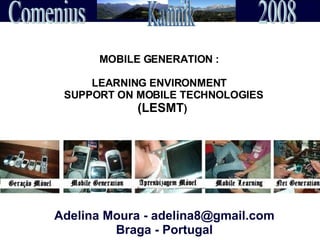
Adelina Moura - adelina8@gmail.com Braga - Portugal MOBILE GENERATION :  LEARNING ENVIRONMENT    SUPPORT ON MOBILE TECHNOLOGIES (LESMT ) Kamnik
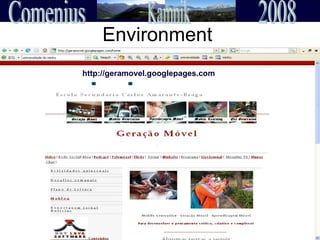
Environment http://geramovel.googlepages.com
Goals   Studying the implications of mobile technologies (Mobile Phone and Tablet PC) in the process of teaching and learning;  Analyze whether mobile technologies will help to change students’ attitudes with respect to the school and learning.
Methodology  Quasi-experimental study two groups an experimental group (15 students) a control group (16 students)  from Vocational education
Mobile Devices   Cell Phone Tablet PC Sponsor Portuguese Ministry of Education
Environment Description Curriculum Learning Autonomous and Collaborative Learning Background   classroom outside the classroom
Curriculum Learning Modules (Portuguese Literature ) Grammar Based in the use of mobile technology  and  Web 2.0 concept Blog, Wiki, Website creation, Podcast,  …
Autonomous and Collaborative Learning Fortnightly activities (General Culture)  Weekly Challenges (Skills Research)  Video in the Portuguese class (Discussion)  Art and the Bible every day (Different styles of painting)  Social Network (Learning Communities)  Forum (collaborative learning with a Lisbon’ class)  Podcasts (The Portuguese literature in audio) Cell phones Services used  Communication, video, audio, photo, SMS, the Internet, e-mail
Fortnightly activities
 
Web 2.0 Tools Ning (Social Network) Podomatic (Podcast) YouTube (Video)  M-Flickr (Photos) Animoto (slides and video)  Gmail (e-mail and synchronic conversation ) Gmail Mobile (e-mail) Google Pages Creator (Website Creation) Docs & Spreadsheets (Wiki and Spreadsheet) Blogger (Blog) Bravenet (Chat) Mogulus (Television)
Conclusions The adoption of this new paradigm, will contribute to rethink education and coping with demands of society nowadays;  The mobile technologies give students the opportunity to choose when and where they want to learn;  They respond to the workers’ and learners’ mobility needs;  This environment will allow open discussion of this new paradigm.
Future Continue to assess the implications of mobile technologies in individual and collaborative learning and students’ attitude towards the school; Consecution of this environment goals.
Tools for use with mobile devices Podcast:  Robobraille Textamerica - Mobile blog.  www.textamerica.com /   Xanco - Mobile phlog & vlog.  www.xanco.com/   Mflickr -  http://m.flickr.com/
The text-to-speech translation email account: tale@robobraille.org: Danish  britspeech@robobraille.org: British English usspeech@robobraille.org: American English audio@robobraille.org: Italian  textoparavoz@robobraille.org: Portuguese potspeech@robobraille.org: Greek parlefrancais@robobraille.org:  French  aistis2@robobraille.org: Lithuanian
Thanks for your attention ! Comments ! [email_address]

Mobile learning

  • 1.
    Adelina Moura -adelina8@gmail.com Braga - Portugal MOBILE GENERATION : LEARNING ENVIRONMENT   SUPPORT ON MOBILE TECHNOLOGIES (LESMT ) Kamnik
  • 2.
  • 3.
    Goals Studying the implications of mobile technologies (Mobile Phone and Tablet PC) in the process of teaching and learning; Analyze whether mobile technologies will help to change students’ attitudes with respect to the school and learning.
  • 4.
    Methodology Quasi-experimentalstudy two groups an experimental group (15 students) a control group (16 students) from Vocational education
  • 5.
    Mobile Devices Cell Phone Tablet PC Sponsor Portuguese Ministry of Education
  • 6.
    Environment Description CurriculumLearning Autonomous and Collaborative Learning Background classroom outside the classroom
  • 7.
    Curriculum Learning Modules(Portuguese Literature ) Grammar Based in the use of mobile technology and Web 2.0 concept Blog, Wiki, Website creation, Podcast, …
  • 8.
    Autonomous and CollaborativeLearning Fortnightly activities (General Culture) Weekly Challenges (Skills Research) Video in the Portuguese class (Discussion) Art and the Bible every day (Different styles of painting) Social Network (Learning Communities) Forum (collaborative learning with a Lisbon’ class) Podcasts (The Portuguese literature in audio) Cell phones Services used Communication, video, audio, photo, SMS, the Internet, e-mail
  • 9.
  • 10.
  • 11.
    Web 2.0 ToolsNing (Social Network) Podomatic (Podcast) YouTube (Video) M-Flickr (Photos) Animoto (slides and video) Gmail (e-mail and synchronic conversation ) Gmail Mobile (e-mail) Google Pages Creator (Website Creation) Docs & Spreadsheets (Wiki and Spreadsheet) Blogger (Blog) Bravenet (Chat) Mogulus (Television)
  • 12.
    Conclusions The adoptionof this new paradigm, will contribute to rethink education and coping with demands of society nowadays; The mobile technologies give students the opportunity to choose when and where they want to learn; They respond to the workers’ and learners’ mobility needs; This environment will allow open discussion of this new paradigm.
  • 13.
    Future Continue toassess the implications of mobile technologies in individual and collaborative learning and students’ attitude towards the school; Consecution of this environment goals.
  • 14.
    Tools for usewith mobile devices Podcast: Robobraille Textamerica - Mobile blog. www.textamerica.com / Xanco - Mobile phlog & vlog. www.xanco.com/ Mflickr - http://m.flickr.com/
  • 15.
    The text-to-speech translationemail account: tale@robobraille.org: Danish britspeech@robobraille.org: British English usspeech@robobraille.org: American English audio@robobraille.org: Italian textoparavoz@robobraille.org: Portuguese potspeech@robobraille.org: Greek parlefrancais@robobraille.org: French aistis2@robobraille.org: Lithuanian
  • 16.
    Thanks for yourattention ! Comments ! [email_address]