University of Minho, Braga, Portugal – adelina8@gmail.com
Mobile phone appropriation and
pedagogical mediation by students
in educational contexts
MoLeNET Mobile Learning Conference 2009
1st December, London
Adelina Moura & Ana Amélia Carvalho
University of Minho, Braga, Portugal – adelina8@gmail.com
• Analysis of the students' mobile phone
appropriation as learning tools
• Assessment of how the mobile phone
mediates learning
• Studying the mobile technology
implications in learning: creating learning
strategies and monitoring within and
outside the classroom.
Goals
University of Minho, Braga, Portugal – adelina8@gmail.com
Methodology
A qualitative research methodology with
multiple cases, involving a range of data
collection techniques (questionnaires,
interviews, focus group, observations, and
diaries).
University of Minho, Braga, Portugal – adelina8@gmail.com
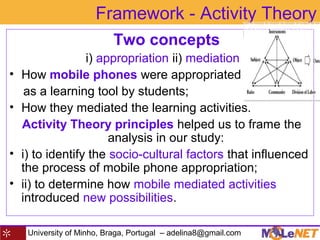
Framework - Activity Theory
Two concepts
i) appropriation ii) mediation
• How mobile phones were appropriated
as a learning tool by students;
• How they mediated the learning activities.
Activity Theory principles helped us to frame the
analysis in our study:
• i) to identify the socio-cultural factors that influenced
the process of mobile phone appropriation;
• ii) to determine how mobile mediated activities
introduced new possibilities.
University of Minho, Braga, Portugal – adelina8@gmail.com
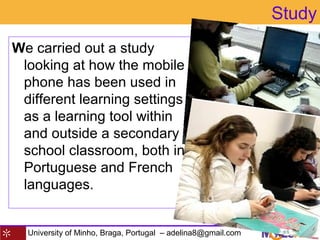
Study
We carried out a study
looking at how the mobile
phone has been used in
different learning settings
as a learning tool within
and outside a secondary
school classroom, both in
Portuguese and French
languages.
University of Minho, Braga, Portugal – adelina8@gmail.com
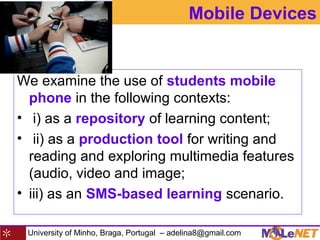
Mobile Devices
We examine the use of students mobile
phone in the following contexts:
• i) as a repository of learning content;
• ii) as a production tool for writing and
reading and exploring multimedia features
(audio, video and image;
• iii) as an SMS-based learning scenario.
University of Minho, Braga, Portugal – adelina8@gmail.com
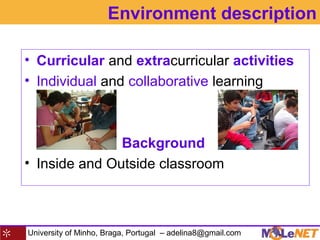
Environment description
• Curricular and extracurricular activities
• Individual and collaborative learning
Background
• Inside and Outside classroom
University of Minho, Braga, Portugal – adelina8@gmail.com
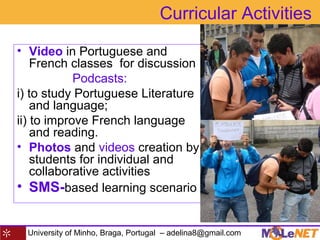
Curricular Activities
• Video in Portuguese and
French classes for discussion
Podcasts:
i) to study Portuguese Literature
and language;
ii) to improve French language
and reading.
• Photos and videos creation by
students for individual and
collaborative activities
• SMS-based learning scenario
University of Minho, Braga, Portugal – adelina8@gmail.com
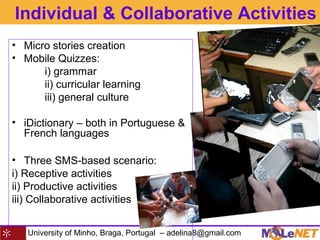
Individual & Collaborative Activities
• Micro stories creation
• Mobile Quizzes:
i) grammar
ii) curricular learning
iii) general culture
• iDictionary – both in Portuguese &
French languages
• Three SMS-based scenario:
i) Receptive activities
ii) Productive activities
iii) Collaborative activities
University of Minho, Braga, Portugal – adelina8@gmail.com
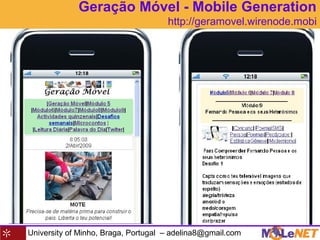
Geração Móvel - Mobile Generation
http://geramovel.wirenode.mobi
University of Minho, Braga, Portugal – adelina8@gmail.com
Findings
Outcomes showed that:
i) Students' competences (writing and reading) in
French language had benefited from mobile
phone use (podcasts);
ii) Students' engagement in learning Portuguese
and French languages was enhanced (SMS-
based learning):
iii) We noted an increase in students' motivation in
both individual and collaborative learning.
University of Minho, Braga, Portugal – adelina8@gmail.com
Thank you for your presence!
Comments?
Adelina Moura

Mobile phone appropriation and pedagogical mediation by students in educational contexts

  • 1.
    University of Minho,Braga, Portugal – adelina8@gmail.com Mobile phone appropriation and pedagogical mediation by students in educational contexts MoLeNET Mobile Learning Conference 2009 1st December, London Adelina Moura & Ana Amélia Carvalho
  • 2.
    University of Minho,Braga, Portugal – adelina8@gmail.com • Analysis of the students' mobile phone appropriation as learning tools • Assessment of how the mobile phone mediates learning • Studying the mobile technology implications in learning: creating learning strategies and monitoring within and outside the classroom. Goals
  • 3.
    University of Minho,Braga, Portugal – adelina8@gmail.com Methodology A qualitative research methodology with multiple cases, involving a range of data collection techniques (questionnaires, interviews, focus group, observations, and diaries).
  • 4.
    University of Minho,Braga, Portugal – adelina8@gmail.com Framework - Activity Theory Two concepts i) appropriation ii) mediation • How mobile phones were appropriated as a learning tool by students; • How they mediated the learning activities. Activity Theory principles helped us to frame the analysis in our study: • i) to identify the socio-cultural factors that influenced the process of mobile phone appropriation; • ii) to determine how mobile mediated activities introduced new possibilities.
  • 5.
    University of Minho,Braga, Portugal – adelina8@gmail.com Study We carried out a study looking at how the mobile phone has been used in different learning settings as a learning tool within and outside a secondary school classroom, both in Portuguese and French languages.
  • 6.
    University of Minho,Braga, Portugal – adelina8@gmail.com Mobile Devices We examine the use of students mobile phone in the following contexts: • i) as a repository of learning content; • ii) as a production tool for writing and reading and exploring multimedia features (audio, video and image; • iii) as an SMS-based learning scenario.
  • 7.
    University of Minho,Braga, Portugal – adelina8@gmail.com Environment description • Curricular and extracurricular activities • Individual and collaborative learning Background • Inside and Outside classroom
  • 8.
    University of Minho,Braga, Portugal – adelina8@gmail.com Curricular Activities • Video in Portuguese and French classes for discussion Podcasts: i) to study Portuguese Literature and language; ii) to improve French language and reading. • Photos and videos creation by students for individual and collaborative activities • SMS-based learning scenario
  • 9.
    University of Minho,Braga, Portugal – adelina8@gmail.com Individual & Collaborative Activities • Micro stories creation • Mobile Quizzes: i) grammar ii) curricular learning iii) general culture • iDictionary – both in Portuguese & French languages • Three SMS-based scenario: i) Receptive activities ii) Productive activities iii) Collaborative activities
  • 10.
    University of Minho,Braga, Portugal – adelina8@gmail.com Geração Móvel - Mobile Generation http://geramovel.wirenode.mobi
  • 11.
    University of Minho,Braga, Portugal – adelina8@gmail.com Findings Outcomes showed that: i) Students' competences (writing and reading) in French language had benefited from mobile phone use (podcasts); ii) Students' engagement in learning Portuguese and French languages was enhanced (SMS- based learning): iii) We noted an increase in students' motivation in both individual and collaborative learning.
  • 12.
    University of Minho,Braga, Portugal – adelina8@gmail.com Thank you for your presence! Comments? Adelina Moura