Mobile Computing
     - Aneesh Zutshi
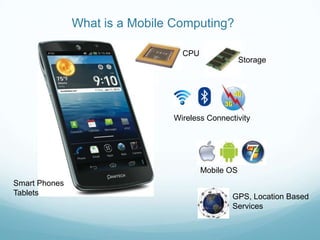
What is a Mobile Computing?

                                 CPU
                                                   Storage


                               Wireless Connectivity


                                       Mobile OS
Smart Phones
Tablets                                        GPS, Location Based
                                               Services
Operating Systems


Programmed in           Programmed in
C, C++, Objective-C     C, C++, Java
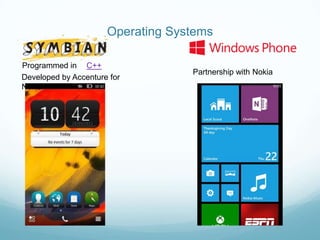
Operating Systems

Programmed in C++
                                   Partnership with Nokia
Developed by Accenture for
Nokia
App Market

All operating systems provide open platforms for the
development of applications. These are openly sold through
App Markets set up by each of the major operating system
providers. Typically 30% of the transaction value is charged as
commission.
Considerations for Mobile Apps
 Mobility – Using GPS, weather, traffic updates
 Data Storage
 Memory
 Energy
 Screen Size
 Input Methods – least button use
 Transfer Rates
 Simple, easy to use designs
 Message Latency
 Bandwidth Usage
 Wireless Security
Types of Mobile Applications

 Browser Based
   Through mobile’s web browser
   Coded with the use of a markup language (eg. Html)
 Native Applications
   Own runtime environment for execution
   Directly interacts with the OS
   Highly interactive applications
Types of Mobile Apps
 As mobile devices are being carried by a large number
  of users throughout the day, mobile apps can deliver a
  variety of services that PC based softwares can’t, thus
  providing immense economic opportunities for
  developers.
   Mobile Gaming
   Mobile Banking
   Document Reading, writing, presentation
   Noting Accounts
   Social Networking
   Mobile News
   Location Based Services
Spotify

- Listen to Radio and Unlimited Music on
  your Mobile Device
- Search and Download unlimited Mp3 on
  your mobile device
- Open Application platform for application
  developers


 Cost: € 7 per month for mobile, free for desktops
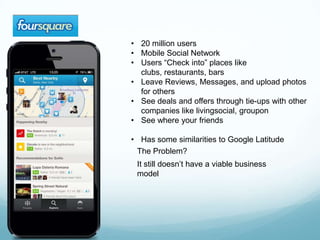
• 20 million users
• Mobile Social Network
• Users “Check into” places like
  clubs, restaurants, bars
• Leave Reviews, Messages, and upload photos
  for others
• See deals and offers through tie-ups with other
  companies like livingsocial, groupon
• See where your friends

• Has some similarities to Google Latitude
 The Problem?
 It still doesn’t have a viable business
 model
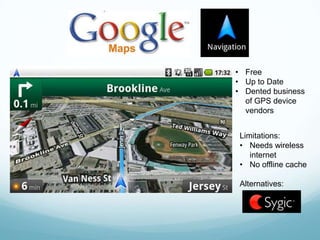
• Free
• Up to Date
• Dented business
  of GPS device
  vendors


 Limitations:
 • Needs wireless
    internet
 • No offline cache

 Alternatives:
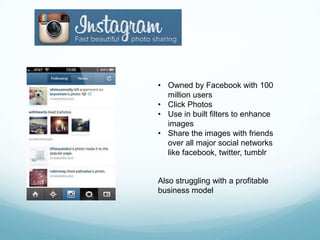
• Owned by Facebook with 100
  million users
• Click Photos
• Use in built filters to enhance
  images
• Share the images with friends
  over all major social networks
  like facebook, twitter, tumblr


Also struggling with a profitable
business model
• Special equipment in partner stores detects mobiles with the app
  installed
• Users get rewards, offers, deals, just by
     • Walking into affiliated stores
     • Scanning product barcodes
     • Purchasing products
• It earns commission for each time a customer performs any of the
  above actions.
• A social network revolving around sports and TV serials
• Users check into their favourite serials, and can share and chat with
  others watching the same serials.
• They receive gift vouchers, virtual stickers, points and discounts.
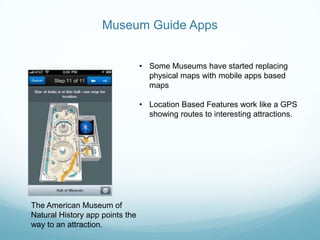
Museum Guide Apps


                                 • Some Museums have started replacing
                                   physical maps with mobile apps based
                                   maps

                                 • Location Based Features work like a GPS
                                   showing routes to interesting attractions.


The American Museum of
Natural History app points the
way to an attraction.
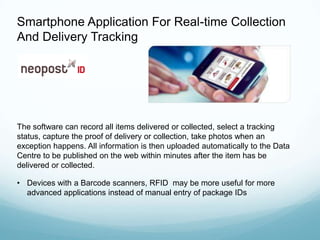
Smartphone Application For Real-time Collection
And Delivery Tracking


The software can record all items delivered or collected, select a tracking
status, capture the proof of delivery or collection, take photos when an
exception happens. All information is then uploaded automatically to the Data
Centre to be published on the web within minutes after the item has be
delivered or collected.

• Devices with a Barcode scanners, RFID may be more useful for more
  advanced applications instead of manual entry of package IDs
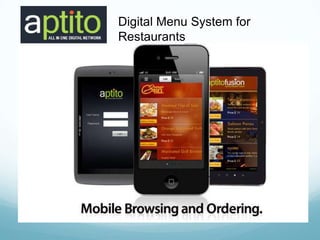
Digital Menu System for
Restaurants

Mobile computing fct

  • 1.
    Mobile Computing - Aneesh Zutshi
  • 2.
    What is aMobile Computing? CPU Storage Wireless Connectivity Mobile OS Smart Phones Tablets GPS, Location Based Services
  • 3.
    Operating Systems Programmed in Programmed in C, C++, Objective-C C, C++, Java
  • 4.
    Operating Systems Programmed inC++ Partnership with Nokia Developed by Accenture for Nokia
  • 5.
    App Market All operatingsystems provide open platforms for the development of applications. These are openly sold through App Markets set up by each of the major operating system providers. Typically 30% of the transaction value is charged as commission.
  • 6.
    Considerations for MobileApps  Mobility – Using GPS, weather, traffic updates  Data Storage  Memory  Energy  Screen Size  Input Methods – least button use  Transfer Rates  Simple, easy to use designs  Message Latency  Bandwidth Usage  Wireless Security
  • 7.
    Types of MobileApplications  Browser Based  Through mobile’s web browser  Coded with the use of a markup language (eg. Html)  Native Applications  Own runtime environment for execution  Directly interacts with the OS  Highly interactive applications
  • 8.
    Types of MobileApps  As mobile devices are being carried by a large number of users throughout the day, mobile apps can deliver a variety of services that PC based softwares can’t, thus providing immense economic opportunities for developers.  Mobile Gaming  Mobile Banking  Document Reading, writing, presentation  Noting Accounts  Social Networking  Mobile News  Location Based Services
  • 9.
    Spotify - Listen toRadio and Unlimited Music on your Mobile Device - Search and Download unlimited Mp3 on your mobile device - Open Application platform for application developers Cost: € 7 per month for mobile, free for desktops
  • 10.
    • 20 millionusers • Mobile Social Network • Users “Check into” places like clubs, restaurants, bars • Leave Reviews, Messages, and upload photos for others • See deals and offers through tie-ups with other companies like livingsocial, groupon • See where your friends • Has some similarities to Google Latitude The Problem? It still doesn’t have a viable business model
  • 11.
    • Free • Upto Date • Dented business of GPS device vendors Limitations: • Needs wireless internet • No offline cache Alternatives:
  • 12.
    • Owned byFacebook with 100 million users • Click Photos • Use in built filters to enhance images • Share the images with friends over all major social networks like facebook, twitter, tumblr Also struggling with a profitable business model
  • 13.
    • Special equipmentin partner stores detects mobiles with the app installed • Users get rewards, offers, deals, just by • Walking into affiliated stores • Scanning product barcodes • Purchasing products • It earns commission for each time a customer performs any of the above actions.
  • 14.
    • A socialnetwork revolving around sports and TV serials • Users check into their favourite serials, and can share and chat with others watching the same serials. • They receive gift vouchers, virtual stickers, points and discounts.
  • 15.
    Museum Guide Apps • Some Museums have started replacing physical maps with mobile apps based maps • Location Based Features work like a GPS showing routes to interesting attractions. The American Museum of Natural History app points the way to an attraction.
  • 16.
    Smartphone Application ForReal-time Collection And Delivery Tracking The software can record all items delivered or collected, select a tracking status, capture the proof of delivery or collection, take photos when an exception happens. All information is then uploaded automatically to the Data Centre to be published on the web within minutes after the item has be delivered or collected. • Devices with a Barcode scanners, RFID may be more useful for more advanced applications instead of manual entry of package IDs
  • 17.
    Digital Menu Systemfor Restaurants