Technological strategies
           &
     Monetization
           Ivano Malavolta
      ivano.malavolta@univaq.it
  http://www.di.univaq.it/malavolta
Roadmap

• Native vs Web vs Hybrid Apps
• Monetization Strategies
Mobile Web

  Mobile web seems to be the only long-term
                                  long-
  commercially viable content platform for mobile
  devices

Reasons:
• Fragmentation
• The web
• Distribution Control
• Consumer expectations
• Web Ubiquity
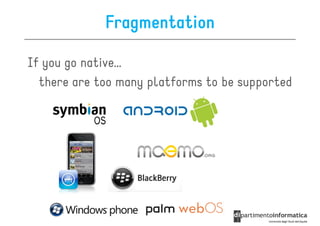
Fragmentation

If you go native…
  there are too many platforms to be supported
The Web
the only medium for information and services that lasts
  from over 15 years

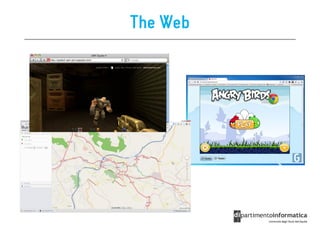
The web is an advanced technology
• webGL
• Local storage management
• Positioning & mapping
• Physical engines
• Real-time data
• Push
• …
The Web
Distribution Control

         Before..
         Before..
        Operators

            Now
Device and Platform makers

         Future
       Developers
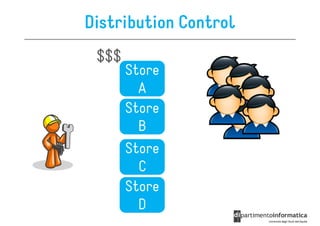
Distribution Control
 $$$
       Store
         A
       Store
         B
       Store
         C
       Store
         D
Consumer expectations
Users expect things to just work

  they don’t care about what platform they have

  they simply expect that your app will be available
  for their device

so…

                       CROSS-
        YOU HAVE TO BE CROSS-PLATFORM
Web Ubiquity

The web is the only platform that
• works across devices
• apps share the same set of standards
• the same app can work also on a desktop
Web Ubiquity

The mobile web is also

•   The easiest platform to learn
•   The cheapest to produce
•   The most standardized
•   The easiest to distribute
Native vs Web vs Hybrid Apps

  There are no golden rules here…

  It depends on a lot of factors, such as
  • Which type of app are you creating?
  • When do you need it?
  • What are your skills
                   skills?


http://bit.ly/GWOaP1
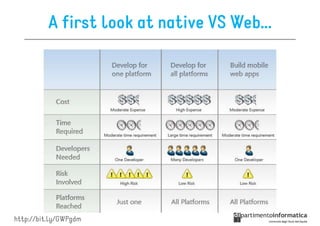
A first look at native VS Web…


http://bit.ly/GWPgdm
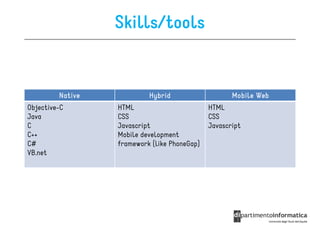
Skills/tools


         Native            Hybrid                    Mobile Web
Objective-C       HTML                        HTML
Java              CSS                         CSS
C                 Javascript                  Javascript
C++               Mobile development
C#                framework (like PhoneGap)
VB.net
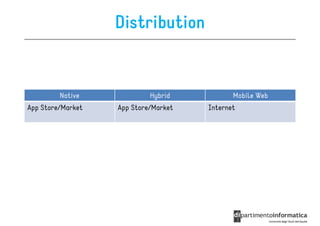
Distribution


         Native             Hybrid           Mobile Web
App Store/Market   App Store/Market   Internet
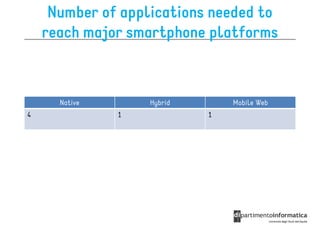
Number of applications needed to
    reach major smartphone platforms


      Native       Hybrid       Mobile Web
4              1            1
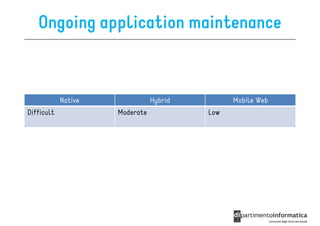
Ongoing application maintenance


            Native              Hybrid         Mobile Web
Difficult            Moderate            Low
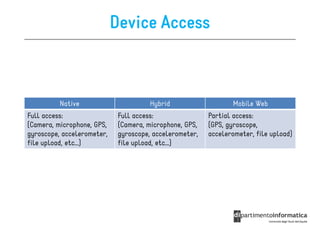
Device Access


          Native                       Hybrid                   Mobile Web
Full access:                 Full access:                Partial access:
(Camera, microphone, GPS,    (Camera, microphone, GPS,   (GPS, gyroscope,
gyroscope, accelerometer,    gyroscope, accelerometer,   accelerometer, file upload)
file upload, etc…)           file upload, etc…)
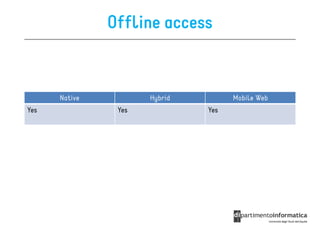
Offline access


      Native          Hybrid         Mobile Web
Yes             Yes            Yes
Native App
PRO
Lets you create apps with rich user interfaces
  and/or heavy graphics

CONS
• Development Time
• Development Cost
• Ongoing Maintenance
• No portability (apps cannot be used on other
  platforms)
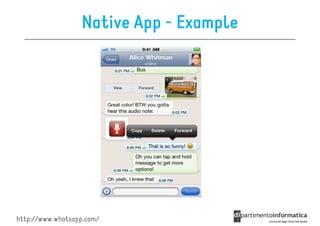
Native App - Example


http://www.whatsapp.com/
Mobile Web App
PRO
Offers fast development, simple maintenance, and
  full application portability

One mobile web app works on any platform

CONS
• Can’t handle heavy graphics
• Can’t access camera or microphone
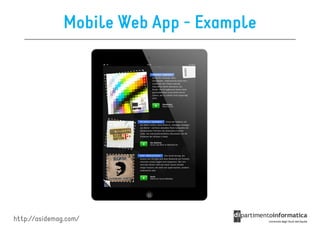
Mobile Web App - Example


http://asidemag.com/
Hybrid App

PRO
Combines the development speed of mobile web
  apps with the device access and app store
  distribution of native apps

CONS
• Can’t handle heavy graphics.
• Requires familiarity with a mobile framework
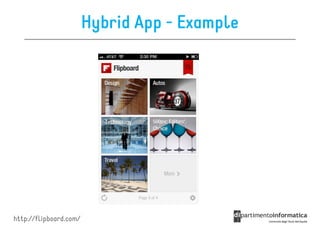
Hybrid App - Example


http://flipboard.com/
Roadmap

• Native vs Web vs Hybrid Apps
• Monetization Strategies
Mobile Business Models

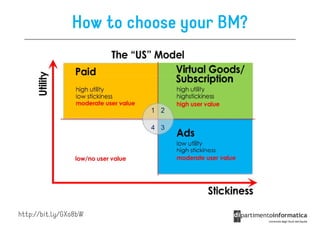
There are 4 main ways to make money with apps:
1. Paid
2. Ad-supported
3. Freemium (virtual goods)
4. Subscriptions
Paid Apps
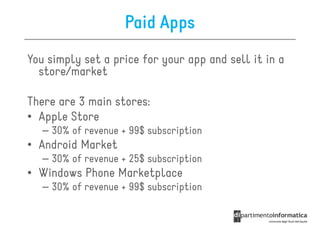
You simply set a price for your app and sell it in a
  store/market

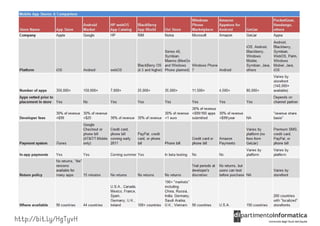
There are 3 main stores:
• Apple Store
   – 30% of revenue + 99$ subscription
• Android Market
   – 30% of revenue + 25$ subscription
• Windows Phone Marketplace
   – 30% of revenue + 99$ subscription
http://bit.ly/HgTyvH
Price Definition
The key is finding a balance between functionality and
  what users will find reasonable

If users are not satisfied, then they will make bad
  reviews
A bad review keeps potential users away

Experiment with different price ranges

TIP:
TIP paid apps are downloaded far less, but may be
  perceived as being of higher quality
Price Ranges
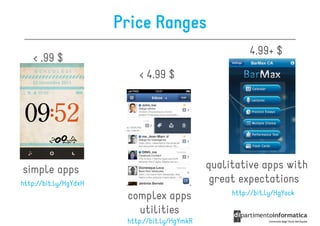
                                                         4.99+ $
   < .99 $
                           < 4.99 $


simple apps                                    qualitative apps with
http://bit.ly/HgYdxH                            great expectations
                                                    http://bit.ly/HgYock
                        complex apps
                          utilities
                        http://bit.ly/HgYmkR
Ideal Workflow
1.       Analyze competitors and their apps price
2.       Set an initial price (high)
     –     Remember, new apps get more visibility
3.    Experiment with price ranges to find the right
     balance

TIP:
TIP people love free and on sale stuff

Putting your app “on sale for a limited time” helps a lot in
   getting visibility within the store and in dedicated
   blogs
Ads
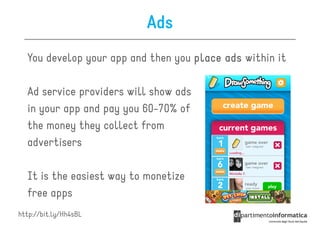
  You develop your app and then you place ads within it

  Ad service providers will show ads
  in your app and pay you 60-70% of
  the money they collect from
  advertisers

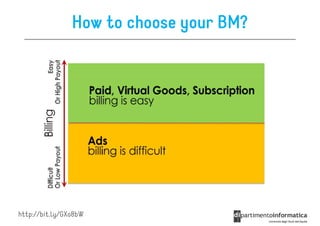
  It is the easiest way to monetize
  free apps
http://bit.ly/Hh4sBL
Ads workflow

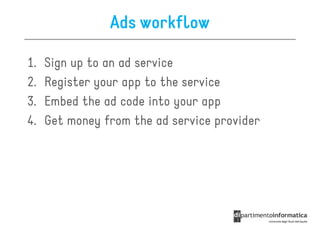
1.   Sign up to an ad service
2.   Register your app to the service
3.   Embed the ad code into your app
4.   Get money from the ad service provider
Ad services

  There are hundreds of Ad services providers, like:
  • AdMob
  • Apple iAds
  • TapJoy
  • Mobclix
  • InMobi
  • …

  There are also mobile ads aggregators, like Inneractive
http://inner-active.com/
Freemium (Virtual Goods)

You distribute a free copy of the application
but there are some paid “premium” services
  that you offer in addition to the basic free
  service

You can also provide a discriminatory free:
  consumers get it free, businesses pay
Virtual goods

Premium services may be anything:
• calling credits for Skype
• virtual items in games
• “ego services” in social networks
  – like badges, virtual objects, etc.
• new levels
• extra features
Implementation

You may realize it by:
• Proposing two version of the same app:
   – the lite version, usually free
   – the full version, paid app with a complete set of features

• Single app with in-app purchases for additional
                  in-
  goods
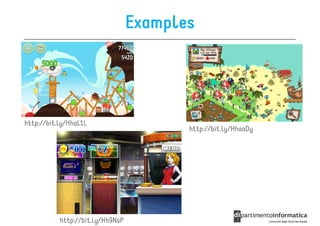
Examples


http://bit.ly/Hhal1L
                                         http://bit.ly/HhaaDy


           http://bit.ly/Hh9NsP
Subscriptions
 Users subscribe to a service and pay a regular fee
  to continue accessing the service

Existing subscribers can input their username and
  password in the same way as on the website

Those who want to subscribe can via your website
Subscriptions

The revenue is sustainable and can auto-renew just as
  other Web-based subscriptions

However, it requires users to leave the app and visit
  the publisher's website to subscribe
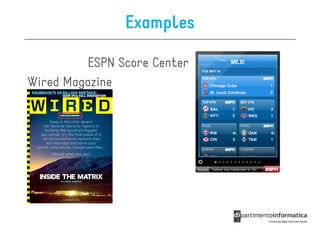
Examples

         ESPN Score Center
Wired Magazine
How to choose your BM?


http://bit.ly/GXo8bW
How to choose your BM?


http://bit.ly/GXo8bW
If everything else fails…


         Build apps for someone else!

That is, help companies who don’t have the
  expertise to build mobile applications and
  develop apps for them
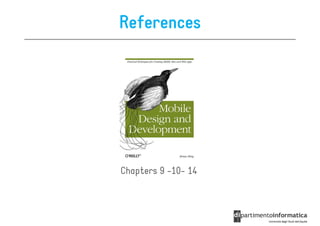
References


Chapters 9 -10- 14

Technological Strategies & Monetization

  • 1.
    Technological strategies & Monetization Ivano Malavolta ivano.malavolta@univaq.it http://www.di.univaq.it/malavolta
  • 2.
    Roadmap • Native vsWeb vs Hybrid Apps • Monetization Strategies
  • 3.
    Mobile Web Mobile web seems to be the only long-term long- commercially viable content platform for mobile devices Reasons: • Fragmentation • The web • Distribution Control • Consumer expectations • Web Ubiquity
  • 4.
    Fragmentation If you gonative… there are too many platforms to be supported
  • 5.
    The Web the onlymedium for information and services that lasts from over 15 years The web is an advanced technology • webGL • Local storage management • Positioning & mapping • Physical engines • Real-time data • Push • …
  • 6.
  • 7.
    Distribution Control Before.. Before.. Operators Now Device and Platform makers Future Developers
  • 8.
    Distribution Control $$$ Store A Store B Store C Store D
  • 9.
    Consumer expectations Users expectthings to just work they don’t care about what platform they have they simply expect that your app will be available for their device so… CROSS- YOU HAVE TO BE CROSS-PLATFORM
  • 10.
    Web Ubiquity The webis the only platform that • works across devices • apps share the same set of standards • the same app can work also on a desktop
  • 11.
    Web Ubiquity The mobileweb is also • The easiest platform to learn • The cheapest to produce • The most standardized • The easiest to distribute
  • 12.
    Native vs Webvs Hybrid Apps There are no golden rules here… It depends on a lot of factors, such as • Which type of app are you creating? • When do you need it? • What are your skills skills? http://bit.ly/GWOaP1
  • 13.
    A first lookat native VS Web… http://bit.ly/GWPgdm
  • 14.
    Skills/tools Native Hybrid Mobile Web Objective-C HTML HTML Java CSS CSS C Javascript Javascript C++ Mobile development C# framework (like PhoneGap) VB.net
  • 15.
    Distribution Native Hybrid Mobile Web App Store/Market App Store/Market Internet
  • 16.
    Number of applicationsneeded to reach major smartphone platforms Native Hybrid Mobile Web 4 1 1
  • 17.
    Ongoing application maintenance Native Hybrid Mobile Web Difficult Moderate Low
  • 18.
    Device Access Native Hybrid Mobile Web Full access: Full access: Partial access: (Camera, microphone, GPS, (Camera, microphone, GPS, (GPS, gyroscope, gyroscope, accelerometer, gyroscope, accelerometer, accelerometer, file upload) file upload, etc…) file upload, etc…)
  • 19.
    Offline access Native Hybrid Mobile Web Yes Yes Yes
  • 20.
    Native App PRO Lets youcreate apps with rich user interfaces and/or heavy graphics CONS • Development Time • Development Cost • Ongoing Maintenance • No portability (apps cannot be used on other platforms)
  • 21.
    Native App -Example http://www.whatsapp.com/
  • 22.
    Mobile Web App PRO Offersfast development, simple maintenance, and full application portability One mobile web app works on any platform CONS • Can’t handle heavy graphics • Can’t access camera or microphone
  • 23.
    Mobile Web App- Example http://asidemag.com/
  • 24.
    Hybrid App PRO Combines thedevelopment speed of mobile web apps with the device access and app store distribution of native apps CONS • Can’t handle heavy graphics. • Requires familiarity with a mobile framework
  • 25.
    Hybrid App -Example http://flipboard.com/
  • 26.
    Roadmap • Native vsWeb vs Hybrid Apps • Monetization Strategies
  • 27.
    Mobile Business Models Thereare 4 main ways to make money with apps: 1. Paid 2. Ad-supported 3. Freemium (virtual goods) 4. Subscriptions
  • 28.
    Paid Apps You simplyset a price for your app and sell it in a store/market There are 3 main stores: • Apple Store – 30% of revenue + 99$ subscription • Android Market – 30% of revenue + 25$ subscription • Windows Phone Marketplace – 30% of revenue + 99$ subscription
  • 29.
  • 30.
    Price Definition The keyis finding a balance between functionality and what users will find reasonable If users are not satisfied, then they will make bad reviews A bad review keeps potential users away Experiment with different price ranges TIP: TIP paid apps are downloaded far less, but may be perceived as being of higher quality
  • 31.
    Price Ranges 4.99+ $ < .99 $ < 4.99 $ simple apps qualitative apps with http://bit.ly/HgYdxH great expectations http://bit.ly/HgYock complex apps utilities http://bit.ly/HgYmkR
  • 32.
    Ideal Workflow 1. Analyze competitors and their apps price 2. Set an initial price (high) – Remember, new apps get more visibility 3. Experiment with price ranges to find the right balance TIP: TIP people love free and on sale stuff Putting your app “on sale for a limited time” helps a lot in getting visibility within the store and in dedicated blogs
  • 33.
    Ads Youdevelop your app and then you place ads within it Ad service providers will show ads in your app and pay you 60-70% of the money they collect from advertisers It is the easiest way to monetize free apps http://bit.ly/Hh4sBL
  • 34.
    Ads workflow 1. Sign up to an ad service 2. Register your app to the service 3. Embed the ad code into your app 4. Get money from the ad service provider
  • 35.
    Ad services There are hundreds of Ad services providers, like: • AdMob • Apple iAds • TapJoy • Mobclix • InMobi • … There are also mobile ads aggregators, like Inneractive http://inner-active.com/
  • 36.
    Freemium (Virtual Goods) Youdistribute a free copy of the application but there are some paid “premium” services that you offer in addition to the basic free service You can also provide a discriminatory free: consumers get it free, businesses pay
  • 37.
    Virtual goods Premium servicesmay be anything: • calling credits for Skype • virtual items in games • “ego services” in social networks – like badges, virtual objects, etc. • new levels • extra features
  • 38.
    Implementation You may realizeit by: • Proposing two version of the same app: – the lite version, usually free – the full version, paid app with a complete set of features • Single app with in-app purchases for additional in- goods
  • 39.
    Examples http://bit.ly/Hhal1L http://bit.ly/HhaaDy http://bit.ly/Hh9NsP
  • 40.
    Subscriptions Users subscribeto a service and pay a regular fee to continue accessing the service Existing subscribers can input their username and password in the same way as on the website Those who want to subscribe can via your website
  • 41.
    Subscriptions The revenue issustainable and can auto-renew just as other Web-based subscriptions However, it requires users to leave the app and visit the publisher's website to subscribe
  • 42.
    Examples ESPN Score Center Wired Magazine
  • 43.
    How to chooseyour BM? http://bit.ly/GXo8bW
  • 44.
    How to chooseyour BM? http://bit.ly/GXo8bW
  • 45.
    If everything elsefails… Build apps for someone else! That is, help companies who don’t have the expertise to build mobile applications and develop apps for them
  • 46.