The 5G Technology.
Presented by: ABDUL SAMI ABBASI
What is Wireless
Communication?
• In 1895, Guglielmo Marconi succeeded in receiving
Morse code on a radio wave transmitted by a
spark-gap transmitter with a receiver 2.4 km away.
This experiment demonstrated the basic concept
and framework of wireless communication today.
• In 1981, the first analog cellular system, “Nordic
Mobile Telephone (NMT)”, was introduced and this
was soon followed by the Advanced Mobile Phone
Service (AMPS) in North America in 1983. In 1988,
the first digital cellular system “Global System for
Mobile (GSM)” was introduced into Europe
• The G in these labels simply stands for ‘generation’.
Significance of Wireless
Communication.
There are many advantages of Wireless
Communication given as:
• Cost effectiveness
• Flexibility
• Convenience
• Speed
• Accessibility
• Constant connectivity
Evolution of Mobile
Networks:
• First Generation(1G) Technology
• 1G technology provided analogue cellular service, and it was developed
early 1980s. It allowed users to make mobile phone calls, sending and
receiving a signal via radio frequencies. It also allowed for two-way
communication.
• Features of 1g Technology
•
• The main feature of 1G technology was the ability to make calls from
location. Because of this, it has become popular for both personal and
use.
• Furthermore, it offered a great deal of convenience for people who
needed to stay connected on the go.
• The transmission speeds of 1G technology were quite low, usually
at 9.6 kbps. This meant that data usage was limited, and it wasn’t
more complex applications.
Second Generation(2G) Technology
• 2G, or the Second Generation of wireless
technology, was a revolutionary leap forward
compared to 1G. It was introduced in the early
1990s and allowed data transfer speeds up to 64
Kbit/s. 2G also enabled the first digital mobile
phones and text messaging. 2G allowed users to
make voice calls and send text messages, but it
was limited to those two features.
Features of 2g Technology
• 2G technology was based on GSM (Global System for Mobile
Communications) which allowed for digital encryption of communications.
• 2G also made it possible for phone networks to track the exact location of
a user and allowed roaming between different networks.
• 2G also allowed for the development of mobile internet and mobile
commerce.
• 2G technology was instrumental in the development of the modern mobile
phone and although it has been largely replaced by 3G and 4G
technologies, it is still used in some parts of the world.
• Many people still find the 2G network more reliable than the more modern
networks
Third
Generation(3G) Technology
• Third Generation (3G) technology is an improved
version of wireless communication technology
which was released in the late 1990s. This
technology provided significant enhancements over
the 2G systems, such as increased data
transmission speeds and improved multimedia
capabilities. With the introduction of 3G technology,
the main focus is on data speeds, allowing users to
access the Internet, stream multimedia, and make
video calls.
Features of 3g Technology
•
• The main features of 3G technology are that it allows users to
access high-speed data services, such as streaming audio
and video and making video calls.
• It also offers improved coverage, allowing users to stay
connected in areas where 2G service may be poor.
• In addition, 3G technology allows for higher data transfer
speeds, making it ideal for accessing the Internet,
downloading large files, and streaming multimedia content.
• Finally, 3G technology is more energy efficient than 2G
systems, allowing for longer battery life.
Fourth Generation(4G)
Technology
•
Fourth Generation (4G) was designed to
provide higher data rates and increased
bandwidth to users. It is the successor to
3G and is a huge leap forward in terms of
speed and capability. 4G technology offers
much faster data speeds than 3G, providing
users with speeds up to 100 Mbps. This
means downloading a movie file will take
just seconds.
Features of 4g Technology
• 4G offers a much more reliable signal and connection when
compared to previous generations.
• Its improved signal strength and data transfer speeds allow
users to enjoy faster browsing and streaming experiences.
• Moreover, 4G technology allows for a better quality of voice
calls, as it uses a different type of voice codec to compress
audio signals.
• In addition, 4G networks are better equipped to handle data-
intensive activities like gaming, streaming videos, and sending
large documents. It also supports a variety of services,
including Location-Based services (LBS), Mobile TV, and VoIP.
Fifth Generation(5G) Technology
• 5G technology is the latest generation of
wireless technology and is currently being
rolled out. It is capable of handling data
transmissions of up to 10Gb/s, which is 100
times faster than 4G technology. This
technology will enable users to access the
internet more quickly, stream videos in
ultra-high definition, and access virtual and
augmented reality applications.
Features of 5G Technology:
Up to 10Gbps data rate - > 10
to 100x speed improvement
over 4G and 4.5G networks
1-millisecond latency
1000x bandwidth per unit
area
Up to 100x number of
connected devices per unit
area (compared with 4G LTE)
99.999% availability 100% coverage
90% reduction in network
energy usage
Up to 10-year battery life for
low-power IoT device
Specification requirements:
What makes 5G so fast:
According
According to communication
principles, the shorter the
frequency, the larger the
bandwidth.
Using
Using shorter
frequencies (millimeter waves
between 30GHz and 300GHz)
for 5G networks is why 5G can
be faster. This high-band 5G
spectrum provides the expected
boost in speed and capacity, low
latency, and quality.
What is 5G low latency
5G technology offers an
extremely low latency rate, the delay
between the sending and
receiving information. From 200
milliseconds for 4G, we go down to 1
millisecond(1 ms) with 5G.
Just think about it.
A millisecond is 1/1000 of a second.
The average reaction time for
humans to a visual stimulus is 250 ms
or 1/4 of a second. People are
capped at around 190-200 ms with
proper training.
Imagine now that your car
could react 250 times faster than
you.
Imagine it could also respond to
hundreds of incoming information
and communicate its reactions to
other vehicles and road signals within
milliseconds.
At 60 mph (100km/h), the reaction
distance is about 33 yards (30
meters) before you pull on the
brakes. With a 1ms reaction time, the
car would only have rolled more than
one inch (less than 3 centimeters).
5G and the
previous mobile
generations at
a glance.
• 1G, the first generation of telecom networks
(1979), let us talk to each other and be mobile
• 2G digital networks (1991) let us send messages
and travel (with roaming services)
• 3G (1998) brought a better mobile internet
experience (with limited success)
• 3.5G brought a truly mobile internet experience,
unleashing the mobile app ecosystem
• 4G (2008) networks brought all-IP services (Voice
and Data), a fast broadband internet experience,
with unified network architectures and protocols
• 4G LTE , starting in 2009, doubled data
speeds. While LTE boasts extensive network
coverage, 5G is still in the initial phases of being
rolled out.
• 5G networks (2019) expand broadband wireless
services beyond mobile internet to IoT and critical
communications segments
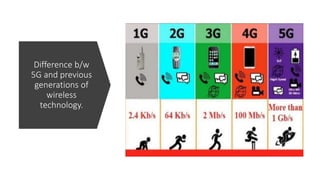
Difference b/w
5G and previous
generation's of
wireless
technology.
Difference b/w
5G and previous
generations of
wireless
technology.
Graphical
Reprenstation:
Conclusion:
• As we traverse the timeline of wireless communication
technologies, from the humble beginnings of 1G to the
revolutionary era of 5G, one undeniable truth emerges—our
ability to connect and communicate has undergone a
remarkable metamorphosis. Each generation, marked by
speed, efficiency, and innovation, has propelled us into an
age where the once unimaginable is now an integral part of
our daily lives. From the simplicity of voice calls to the
complexity of augmented reality and autonomous vehicles,
wireless communication has not only transformed the way we
interact but has become the backbone of our interconnected
world. As we stand at the cusp of a new era, let's celebrate
the strides made, acknowledge the challenges faced, and
eagerly anticipate the boundless possibilities that the future
holds for wireless communication technologies.

The 5G Technology Presentation.pptx

  • 1.
    The 5G Technology. Presentedby: ABDUL SAMI ABBASI
  • 2.
    What is Wireless Communication? •In 1895, Guglielmo Marconi succeeded in receiving Morse code on a radio wave transmitted by a spark-gap transmitter with a receiver 2.4 km away. This experiment demonstrated the basic concept and framework of wireless communication today. • In 1981, the first analog cellular system, “Nordic Mobile Telephone (NMT)”, was introduced and this was soon followed by the Advanced Mobile Phone Service (AMPS) in North America in 1983. In 1988, the first digital cellular system “Global System for Mobile (GSM)” was introduced into Europe • The G in these labels simply stands for ‘generation’.
  • 3.
    Significance of Wireless Communication. Thereare many advantages of Wireless Communication given as: • Cost effectiveness • Flexibility • Convenience • Speed • Accessibility • Constant connectivity
  • 4.
    Evolution of Mobile Networks: •First Generation(1G) Technology • 1G technology provided analogue cellular service, and it was developed early 1980s. It allowed users to make mobile phone calls, sending and receiving a signal via radio frequencies. It also allowed for two-way communication. • Features of 1g Technology • • The main feature of 1G technology was the ability to make calls from location. Because of this, it has become popular for both personal and use. • Furthermore, it offered a great deal of convenience for people who needed to stay connected on the go. • The transmission speeds of 1G technology were quite low, usually at 9.6 kbps. This meant that data usage was limited, and it wasn’t more complex applications.
  • 5.
    Second Generation(2G) Technology •2G, or the Second Generation of wireless technology, was a revolutionary leap forward compared to 1G. It was introduced in the early 1990s and allowed data transfer speeds up to 64 Kbit/s. 2G also enabled the first digital mobile phones and text messaging. 2G allowed users to make voice calls and send text messages, but it was limited to those two features.
  • 6.
    Features of 2gTechnology • 2G technology was based on GSM (Global System for Mobile Communications) which allowed for digital encryption of communications. • 2G also made it possible for phone networks to track the exact location of a user and allowed roaming between different networks. • 2G also allowed for the development of mobile internet and mobile commerce. • 2G technology was instrumental in the development of the modern mobile phone and although it has been largely replaced by 3G and 4G technologies, it is still used in some parts of the world. • Many people still find the 2G network more reliable than the more modern networks
  • 7.
    Third Generation(3G) Technology • ThirdGeneration (3G) technology is an improved version of wireless communication technology which was released in the late 1990s. This technology provided significant enhancements over the 2G systems, such as increased data transmission speeds and improved multimedia capabilities. With the introduction of 3G technology, the main focus is on data speeds, allowing users to access the Internet, stream multimedia, and make video calls.
  • 8.
    Features of 3gTechnology • • The main features of 3G technology are that it allows users to access high-speed data services, such as streaming audio and video and making video calls. • It also offers improved coverage, allowing users to stay connected in areas where 2G service may be poor. • In addition, 3G technology allows for higher data transfer speeds, making it ideal for accessing the Internet, downloading large files, and streaming multimedia content. • Finally, 3G technology is more energy efficient than 2G systems, allowing for longer battery life.
  • 9.
    Fourth Generation(4G) Technology • Fourth Generation(4G) was designed to provide higher data rates and increased bandwidth to users. It is the successor to 3G and is a huge leap forward in terms of speed and capability. 4G technology offers much faster data speeds than 3G, providing users with speeds up to 100 Mbps. This means downloading a movie file will take just seconds.
  • 10.
    Features of 4gTechnology • 4G offers a much more reliable signal and connection when compared to previous generations. • Its improved signal strength and data transfer speeds allow users to enjoy faster browsing and streaming experiences. • Moreover, 4G technology allows for a better quality of voice calls, as it uses a different type of voice codec to compress audio signals. • In addition, 4G networks are better equipped to handle data- intensive activities like gaming, streaming videos, and sending large documents. It also supports a variety of services, including Location-Based services (LBS), Mobile TV, and VoIP.
  • 11.
    Fifth Generation(5G) Technology •5G technology is the latest generation of wireless technology and is currently being rolled out. It is capable of handling data transmissions of up to 10Gb/s, which is 100 times faster than 4G technology. This technology will enable users to access the internet more quickly, stream videos in ultra-high definition, and access virtual and augmented reality applications.
  • 12.
    Features of 5GTechnology: Up to 10Gbps data rate - > 10 to 100x speed improvement over 4G and 4.5G networks 1-millisecond latency 1000x bandwidth per unit area Up to 100x number of connected devices per unit area (compared with 4G LTE) 99.999% availability 100% coverage 90% reduction in network energy usage Up to 10-year battery life for low-power IoT device
  • 13.
  • 14.
    What makes 5Gso fast: According According to communication principles, the shorter the frequency, the larger the bandwidth. Using Using shorter frequencies (millimeter waves between 30GHz and 300GHz) for 5G networks is why 5G can be faster. This high-band 5G spectrum provides the expected boost in speed and capacity, low latency, and quality.
  • 15.
    What is 5Glow latency 5G technology offers an extremely low latency rate, the delay between the sending and receiving information. From 200 milliseconds for 4G, we go down to 1 millisecond(1 ms) with 5G. Just think about it. A millisecond is 1/1000 of a second. The average reaction time for humans to a visual stimulus is 250 ms or 1/4 of a second. People are capped at around 190-200 ms with proper training. Imagine now that your car could react 250 times faster than you. Imagine it could also respond to hundreds of incoming information and communicate its reactions to other vehicles and road signals within milliseconds. At 60 mph (100km/h), the reaction distance is about 33 yards (30 meters) before you pull on the brakes. With a 1ms reaction time, the car would only have rolled more than one inch (less than 3 centimeters).
  • 16.
    5G and the previousmobile generations at a glance. • 1G, the first generation of telecom networks (1979), let us talk to each other and be mobile • 2G digital networks (1991) let us send messages and travel (with roaming services) • 3G (1998) brought a better mobile internet experience (with limited success) • 3.5G brought a truly mobile internet experience, unleashing the mobile app ecosystem • 4G (2008) networks brought all-IP services (Voice and Data), a fast broadband internet experience, with unified network architectures and protocols • 4G LTE , starting in 2009, doubled data speeds. While LTE boasts extensive network coverage, 5G is still in the initial phases of being rolled out. • 5G networks (2019) expand broadband wireless services beyond mobile internet to IoT and critical communications segments
  • 17.
    Difference b/w 5G andprevious generation's of wireless technology.
  • 18.
    Difference b/w 5G andprevious generations of wireless technology.
  • 19.
  • 20.
    Conclusion: • As wetraverse the timeline of wireless communication technologies, from the humble beginnings of 1G to the revolutionary era of 5G, one undeniable truth emerges—our ability to connect and communicate has undergone a remarkable metamorphosis. Each generation, marked by speed, efficiency, and innovation, has propelled us into an age where the once unimaginable is now an integral part of our daily lives. From the simplicity of voice calls to the complexity of augmented reality and autonomous vehicles, wireless communication has not only transformed the way we interact but has become the backbone of our interconnected world. As we stand at the cusp of a new era, let's celebrate the strides made, acknowledge the challenges faced, and eagerly anticipate the boundless possibilities that the future holds for wireless communication technologies.