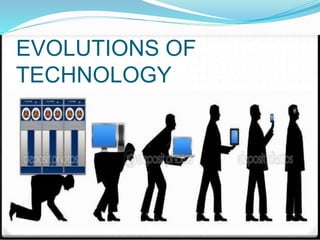
EVOLUTIONS OF
TECHNOLOGY
1G TECHNOLOGY
Developed in 1980s & completed in
early 1990s.
Based on analog system.
Speed up to 2.4 kbps.
 AMPS (Advance Mobile Phone
System) was launched by the US & it
was the 1G mobile system.
 Allows user to make voice calls in 1
DRAWBACKS IN 1G TECHNOLOGY
Poor Voice Quality
Poor Battery Life
Large Phone Size
No Security
Limited Capacity
Poor Handoff Reliability
2G TECHNOLOGY
 Developed in late 1980s & completed in
late 1990s
 Based on digital system
 Speed up to 64 kbps
 Services such are digital voice & SMS
with more clarity
 2G are the handsets we are using today,
with 2.5G having more capabilities
DRAWBACKS IN 2G TECHNOLOGY
 2G requires strong digital signals to help mobile
phones work. If there is no network coverage in
any specific area , digital signals would weak.
 These systems are unable to handle complex data
such as Videos.
3G TECHNOLOGY
 Developed between late 1990s & early
2000s until present day
 Transmission speed from 125 kbps to 2
Mbps
 Superior voice quality
 Good clarity in video conference
 E-mail, information surfing, on-line
shopping/ banking, games
DRAWBACKS IN3GTECHNOLOGY
 Expensive fees for 3G Licenses
Services
 It was challenge to build the
infrastructure for 3G
 High Bandwidth Requirement
 Expensive 3G Phones.
 Large Cell Phones
4G TECHNOLOGY
Developed in 2010
 Faster & more reliable
 Speed up to 100 Mbps
 High performance
DRAWBACKSIN4G TECHNOLOGY
 Battery uses is more
 Hard to implement
 Need complicated hardware
 Expensive equipment required to implement
next generation network.
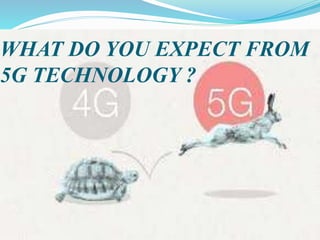
WHAT DO YOU EXPECT FROM
5G TECHNOLOGY ?
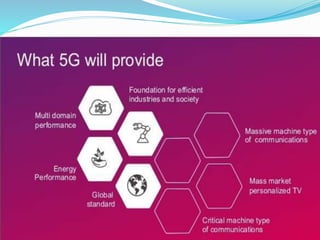
5G
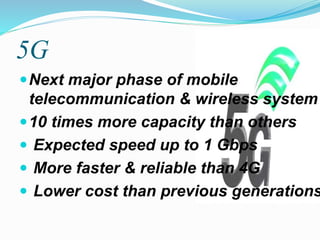
Next major phase of mobile
telecommunication & wireless system
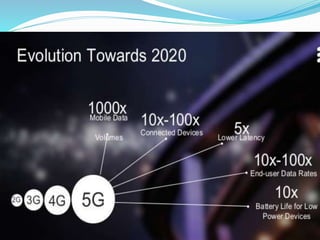
10 times more capacity than others
 Expected speed up to 1 Gbps
 More faster & reliable than 4G
 Lower cost than previous generations
;
SPECIFICATIONS
 High and sharp resolution
 Huge amount of distribution data
 Carrier division of gateway with
matchless supreme stability with no
delay.
FEATURES
 The advanced billing interfaces of 5G technology more
attractive and effective.
 Subscriber supervision tools for fast action.
 The high quality services of 5g technology based on
policy to avoid error.
 Large broadcasting of data .
BENEFITS
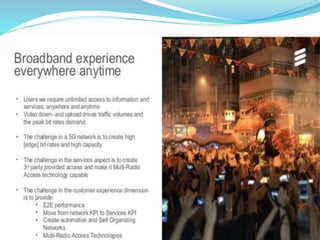
 High speed
 High capacity
 Low cost per bit.
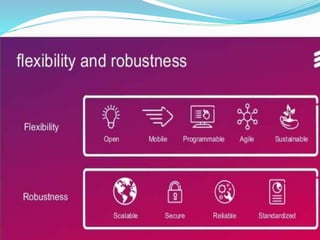
 Global access
 Service portability
 Scalable mobile services.
CONCLUSION
 Today’s wired society is going wireless.
 5g technology is going to give tough
competition to computers and laptops.
 It will be available in the market 2020 at
affordable cost with more reliability
than previous mobiles.
 5G - a promising generation of wireless
communication that will change
people’s lives.
G.Venkata Suswara

5G MOBILE TECHNOLOGY AND EVOLUTION OF MOBILE TECHNOLOGY

  • 3.
  • 4.
    1G TECHNOLOGY Developed in1980s & completed in early 1990s. Based on analog system. Speed up to 2.4 kbps.  AMPS (Advance Mobile Phone System) was launched by the US & it was the 1G mobile system.  Allows user to make voice calls in 1
  • 5.
    DRAWBACKS IN 1GTECHNOLOGY Poor Voice Quality Poor Battery Life Large Phone Size No Security Limited Capacity Poor Handoff Reliability
  • 6.
    2G TECHNOLOGY  Developedin late 1980s & completed in late 1990s  Based on digital system  Speed up to 64 kbps  Services such are digital voice & SMS with more clarity  2G are the handsets we are using today, with 2.5G having more capabilities
  • 7.
    DRAWBACKS IN 2GTECHNOLOGY  2G requires strong digital signals to help mobile phones work. If there is no network coverage in any specific area , digital signals would weak.  These systems are unable to handle complex data such as Videos.
  • 8.
    3G TECHNOLOGY  Developedbetween late 1990s & early 2000s until present day  Transmission speed from 125 kbps to 2 Mbps  Superior voice quality  Good clarity in video conference  E-mail, information surfing, on-line shopping/ banking, games
  • 9.
    DRAWBACKS IN3GTECHNOLOGY  Expensivefees for 3G Licenses Services  It was challenge to build the infrastructure for 3G  High Bandwidth Requirement  Expensive 3G Phones.  Large Cell Phones
  • 10.
    4G TECHNOLOGY Developed in2010  Faster & more reliable  Speed up to 100 Mbps  High performance
  • 11.
    DRAWBACKSIN4G TECHNOLOGY  Batteryuses is more  Hard to implement  Need complicated hardware  Expensive equipment required to implement next generation network.
  • 12.
    WHAT DO YOUEXPECT FROM 5G TECHNOLOGY ?
  • 13.
    5G Next major phaseof mobile telecommunication & wireless system 10 times more capacity than others  Expected speed up to 1 Gbps  More faster & reliable than 4G  Lower cost than previous generations
  • 18.
  • 22.
    SPECIFICATIONS  High andsharp resolution  Huge amount of distribution data  Carrier division of gateway with matchless supreme stability with no delay.
  • 23.
    FEATURES  The advancedbilling interfaces of 5G technology more attractive and effective.  Subscriber supervision tools for fast action.  The high quality services of 5g technology based on policy to avoid error.  Large broadcasting of data .
  • 24.
    BENEFITS  High speed High capacity  Low cost per bit.  Global access  Service portability  Scalable mobile services.
  • 25.
    CONCLUSION  Today’s wiredsociety is going wireless.  5g technology is going to give tough competition to computers and laptops.  It will be available in the market 2020 at affordable cost with more reliability than previous mobiles.  5G - a promising generation of wireless communication that will change people’s lives.
  • 26.