



a tour of INNOVATION
introducing
EARTHQUAKE
ENGINEERING
What are we talking about?
We have features for every step of the way
Earthquake
Engineering
Our model
and ideology
Earthquake
Resistance
EARTHQUAKE ENGINEERING
Design, organize, and construct
Earthquake engineering is the scientific field
concerned with protecting society, the natural and
the man-made environment from earthquakes by
limiting the seismic risk to socio-economically
acceptable levels.
Getting Started
ObjectivesofEarthquake
Engineering
The main objectives of Earthquake
Engineering are:
I. To see, the potential consequences of strong
Earthquakes on urban areas and civil
infrastructure.
II. Design, construct and maintain structures to
perform at Earthquake exposure up to the
expectations and in compliance with building
codes.
III.To create Earthquake-resistant buildings for
almost all soil types present around us.
IV.To directly connect technology with the safety of
construction.
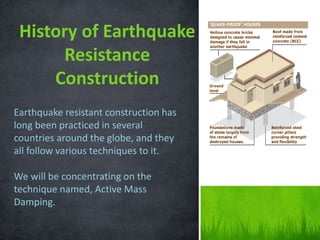
History of Earthquake
Resistance
Construction
Earthquake resistant construction has
long been practiced in several
countries around the globe, and they
all follow various techniques to it.
We will be concentrating on the
technique named, Active Mass
Damping.
ACTIVE MASS DAMPING
Computations of mass required to sway a building with respect to the earth movement.
It’s not just about the CONSTRUCTION but strengthening
THE BASE.
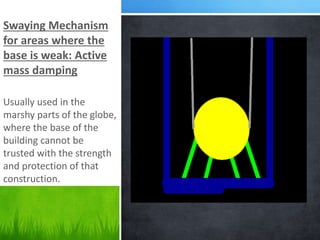
Swaying Mechanism
for areas where the
base is weak: Active
mass damping
Usually used in the
marshy parts of the globe,
where the base of the
building cannot be
trusted with the strength
and protection of that
construction.
How Active Mass Damping works?
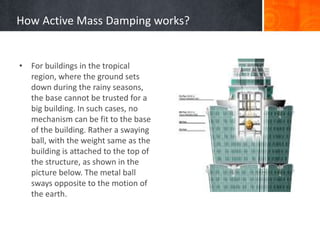
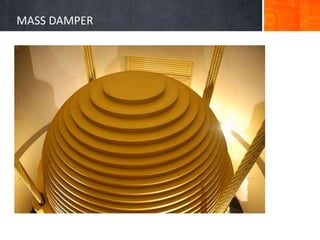
• For buildings in the tropical
region, where the ground sets
down during the rainy seasons,
the base cannot be trusted for a
big building. In such cases, no
mechanism can be fit to the base
of the building. Rather a swaying
ball, with the weight same as the
building is attached to the top of
the structure, as shown in the
picture below. The metal ball
sways opposite to the motion of
the earth.
MASS DAMPER
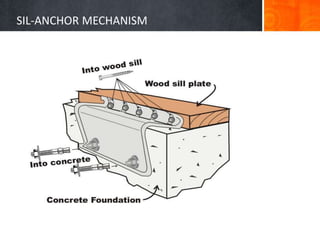
Sill-anchoring Technique
• Sill anchoring is initiated by construction of a wooden
base was a building which is provided the correct shock
resistance by tightening the wooden sill with bolts.
They are a part of active shock control devices which
physically move the base to keep up with the sudden
changes due to seismic forces.
• This method of anchoring sill plates does keep the
boards attached to the foundation during an
earthquake, but it fails to help the structure as a whole
absorb and withstand the forces of seismic shock.
SIL-ANCHOR MECHANISM
What about the resistance systems
we’re yet to mention?
They are same too.
Seismic Loading
• Seismic loading means application of an
earthquake-generated excitation on a
structure (or geo-structure). It happens at
contact surfaces of a structure either with the
ground, with adjacent structures, or
with gravity waves from tsunami.
Vibration control and Classifications
• Seismic vibration control is a set of technical means
aimed to mitigate seismic impacts in building and non-
building structures. All seismic vibration control devices
may be classified as passive, active or hybrid where:
• passive control devices have no feedback capability
between them, structural elements and the ground;
• active control devices incorporate real-time recording
instrumentation on the ground integrated with
earthquake input processing equipment
and actuators within the structure;
• hybrid control devices have combined features of active
and passive control systems.
Prevention from severe Earthquakes
Building elevation control is a valuable source
of vibration control of seismic loading. Pyramid-
shaped skyscrapers continue to attract the
attention of architects and engineers because such
structures promise a better stability against
earthquakes and winds. The elevation configuration
can prevent buildings' resonant amplifications
because a properly configured building disperses
the sheer wave energy between a wide range of
frequencies.
Bridge between concepts
and the model
Broadcast and compress for seamless delivery
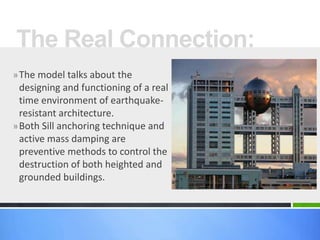
»The model talks about the
designing and functioning of a real
time environment of earthquake-
resistant architecture.
»Both Sill anchoring technique and
active mass damping are
preventive methods to control the
destruction of both heighted and
grounded buildings.
The Real Connection:
?
But wait…
There’s More!
We will conclude with suggestions and techniques to estimate the earthquake loss!
Loss Estimation
• You can always develop to your best when you
know what you have lost. People learn from their
losses and plan a better future.
• Earthquake loss estimation is usually defined as
a Damage Ratio (DR) which is a ratio of the
earthquake damage repair cost to the total
value of a building. Probable Maximum
Loss (PML) is a common term used for
earthquake loss estimation, but it lacks a precise
definition.
THANK YOU!
WISHES AND REGARDS!

Mobile Architecture

  • 1.
    a tour ofINNOVATION introducing EARTHQUAKE ENGINEERING
  • 2.
    What are wetalking about? We have features for every step of the way Earthquake Engineering Our model and ideology Earthquake Resistance
  • 3.
  • 4.
    Earthquake engineering isthe scientific field concerned with protecting society, the natural and the man-made environment from earthquakes by limiting the seismic risk to socio-economically acceptable levels. Getting Started
  • 5.
    ObjectivesofEarthquake Engineering The main objectivesof Earthquake Engineering are: I. To see, the potential consequences of strong Earthquakes on urban areas and civil infrastructure. II. Design, construct and maintain structures to perform at Earthquake exposure up to the expectations and in compliance with building codes. III.To create Earthquake-resistant buildings for almost all soil types present around us. IV.To directly connect technology with the safety of construction.
  • 6.
    History of Earthquake Resistance Construction Earthquakeresistant construction has long been practiced in several countries around the globe, and they all follow various techniques to it. We will be concentrating on the technique named, Active Mass Damping.
  • 7.
    ACTIVE MASS DAMPING Computationsof mass required to sway a building with respect to the earth movement.
  • 8.
    It’s not justabout the CONSTRUCTION but strengthening THE BASE.
  • 9.
    Swaying Mechanism for areaswhere the base is weak: Active mass damping Usually used in the marshy parts of the globe, where the base of the building cannot be trusted with the strength and protection of that construction.
  • 10.
    How Active MassDamping works? • For buildings in the tropical region, where the ground sets down during the rainy seasons, the base cannot be trusted for a big building. In such cases, no mechanism can be fit to the base of the building. Rather a swaying ball, with the weight same as the building is attached to the top of the structure, as shown in the picture below. The metal ball sways opposite to the motion of the earth.
  • 11.
  • 12.
    Sill-anchoring Technique • Sillanchoring is initiated by construction of a wooden base was a building which is provided the correct shock resistance by tightening the wooden sill with bolts. They are a part of active shock control devices which physically move the base to keep up with the sudden changes due to seismic forces. • This method of anchoring sill plates does keep the boards attached to the foundation during an earthquake, but it fails to help the structure as a whole absorb and withstand the forces of seismic shock.
  • 13.
  • 14.
    What about theresistance systems we’re yet to mention? They are same too.
  • 15.
    Seismic Loading • Seismicloading means application of an earthquake-generated excitation on a structure (or geo-structure). It happens at contact surfaces of a structure either with the ground, with adjacent structures, or with gravity waves from tsunami.
  • 16.
    Vibration control andClassifications • Seismic vibration control is a set of technical means aimed to mitigate seismic impacts in building and non- building structures. All seismic vibration control devices may be classified as passive, active or hybrid where: • passive control devices have no feedback capability between them, structural elements and the ground; • active control devices incorporate real-time recording instrumentation on the ground integrated with earthquake input processing equipment and actuators within the structure; • hybrid control devices have combined features of active and passive control systems.
  • 17.
    Prevention from severeEarthquakes Building elevation control is a valuable source of vibration control of seismic loading. Pyramid- shaped skyscrapers continue to attract the attention of architects and engineers because such structures promise a better stability against earthquakes and winds. The elevation configuration can prevent buildings' resonant amplifications because a properly configured building disperses the sheer wave energy between a wide range of frequencies.
  • 18.
    Bridge between concepts andthe model Broadcast and compress for seamless delivery
  • 19.
    »The model talksabout the designing and functioning of a real time environment of earthquake- resistant architecture. »Both Sill anchoring technique and active mass damping are preventive methods to control the destruction of both heighted and grounded buildings. The Real Connection:
  • 20.
    ? But wait… There’s More! Wewill conclude with suggestions and techniques to estimate the earthquake loss!
  • 21.
    Loss Estimation • Youcan always develop to your best when you know what you have lost. People learn from their losses and plan a better future. • Earthquake loss estimation is usually defined as a Damage Ratio (DR) which is a ratio of the earthquake damage repair cost to the total value of a building. Probable Maximum Loss (PML) is a common term used for earthquake loss estimation, but it lacks a precise definition.
  • 22.

Editor's Notes

  • #2 This presentation demonstrates the new capabilities of PowerPoint and it is best viewed in Slide Show. These slides are designed to give you great ideas for the presentations you’ll create in PowerPoint 2010! For more sample templates, click the File tab, and then on the New tab, click Sample Templates.