SEISMIC RETROFITTING OF BUILDINGS
Today, many countries are the victims of severe earthquakes resulting in the
loss of lives of human being, animals, destruction of buildings, and many more.
So, it is high time for the civil engineers to take this issue as a serious matter and
they must think of some alternatives of saving human lives as well as wildlife.
WHAT IS SEISMIC RETROFITTING?
Seismic, by the word itself means something relating to earthquakes or
vibrations of the earth and its crust. It happens due to some disturbances below the
earth’s crust which cannot be seen.
Seismic retrofitting is the modification of existing structures to make them
more resistant to seismic activity, ground motion or soil failure due to earthquakes.
There are several techniques which have come forward nowadays by which an
existing structure can be modified and make it less prone to earthquakes.
It is important to keep in mind that there is no such thing to make a structure
fully earthquake proof but seismic performance can be greatly enhanced through
proper initial design or subsequent modifications.
Common seismic retrofitting techniques fall into several categories:
1. Base Isolators.
2. Supplementary dampers.
3. Tuned mass dampers.
4. Slosh tank.
5. Active control system.
WHAT IS THE NEED FOR SEISMIC RETROFITTING OF BUILDINGS?
The need for seismic retrofitting in existing buildings can arise due to the
following reasons:
 Buildings not designed according to the codes of practice.
 Deterioration of strength of the buildings.
 Not considering the safety of buildings while construction.
UNIQUENESS:-
The impact of earthquake is sudden with little or no warning to make
preparations against damages and collapse of structures. The common seismic
retrofitting techniques have evolved very fast and have changed the belief of
people that buildings can be made earthquake proof with proper modifications and
thereby saving human lives. Seismic retrofit strategies have been developed in the
past few decades following the introduction of new seismic provisions and the
availability of advanced materials like fiber reinforced polymers, fiber reinforced
concrete and high strength steel.
AIMS AND OBJECTIVES:-
1. Public safety: The goal is to protect human life, ensuring that the structure
will not collapse upon its occupants or passerby.
2. Structure survivability: The goal is that the structure, while remaining safe
may require extensive repair but not replacement.
3. Structure functionality: Primary structure undamaged and the structure is
undiminished in utility for its primary application.
4. Structure unaffected: A high level of retrofit is preferred for historic
structures of cultural significance.
BASE ISOLATORS:-
Base isolation is one of the most powerful means of protecting a structure
against earthquake forces. It is meant to enable a building to survive a potentially
devastating seismic impact through proper initial design or subsequent
modifications.
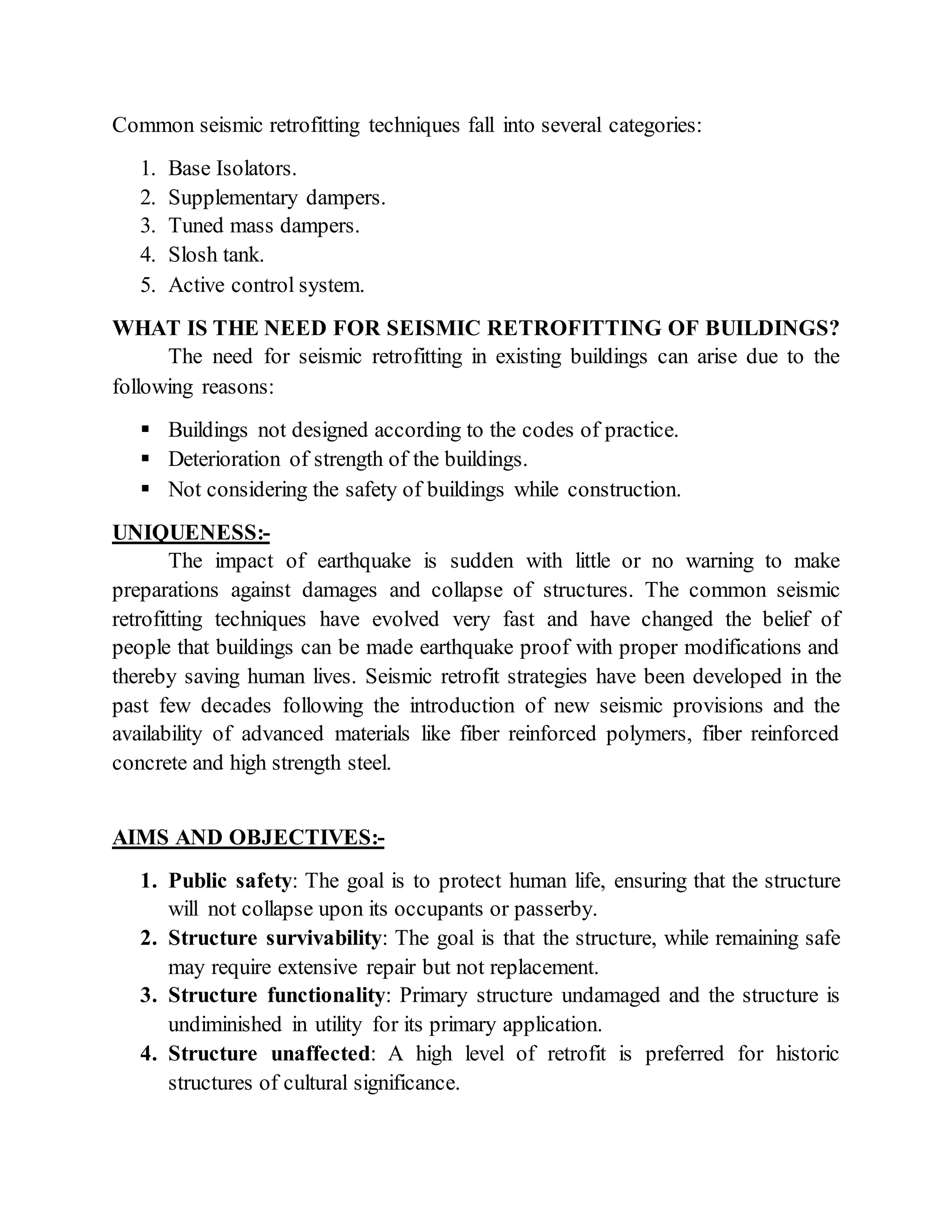
Tomb of Cyrus is said to be the oldest base-isolated structure in the world.
Base Isolation system consists of the following:
1. Isolation units 2. Isolation components
Isolation units:- They consist of shear or sliding units. They are intended to
provide the decoupling effect to a building. The first evidence of architects using
the principle of base isolation for earthquake protection was discovered in
Pasargadae, a city in Iran in 6th century BC.
Isolation components:- These are the connections between isolation units and
their parts having no decoupling effect of their own.
How do base isolators work?
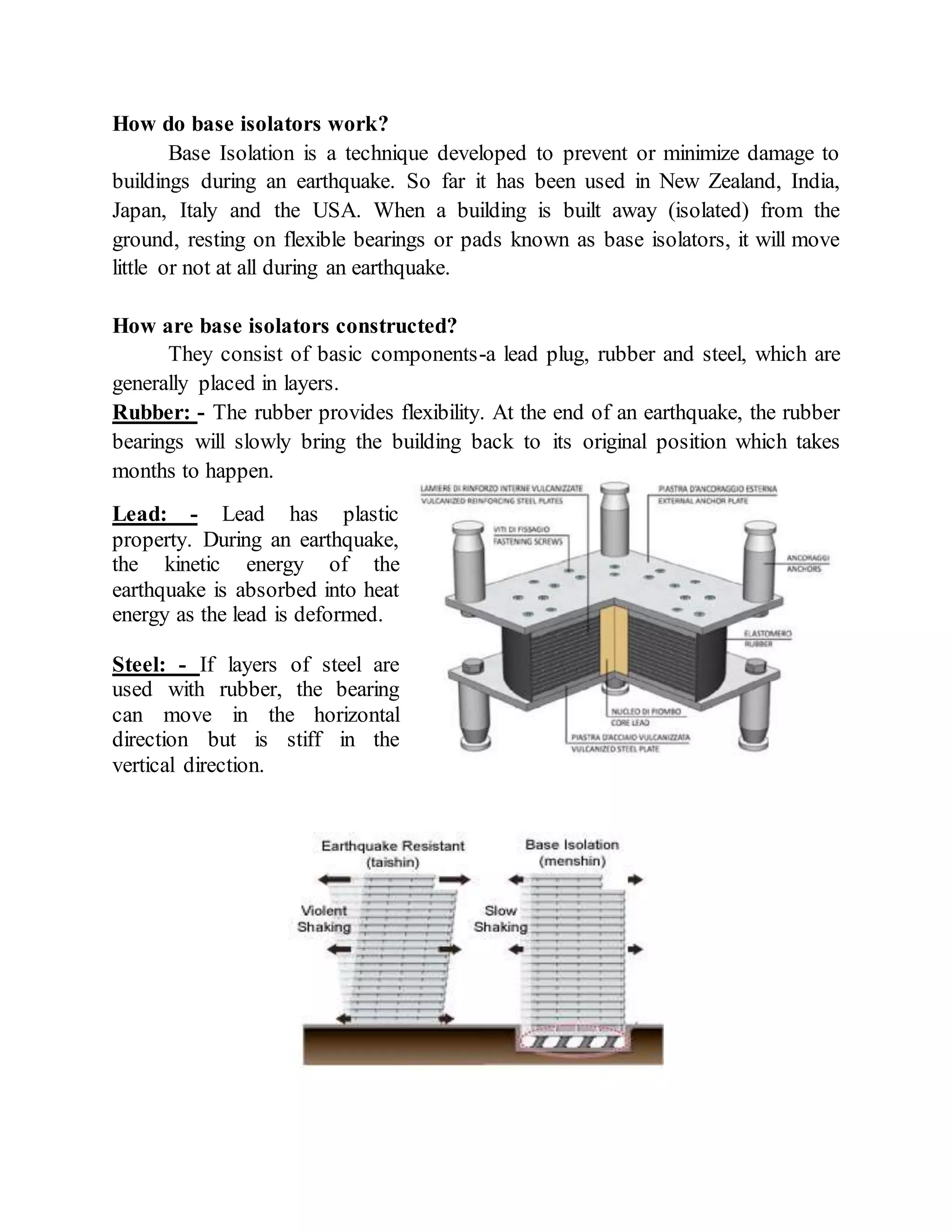
Base Isolation is a technique developed to prevent or minimize damage to
buildings during an earthquake. So far it has been used in New Zealand, India,
Japan, Italy and the USA. When a building is built away (isolated) from the
ground, resting on flexible bearings or pads known as base isolators, it will move
little or not at all during an earthquake.
How are base isolators constructed?
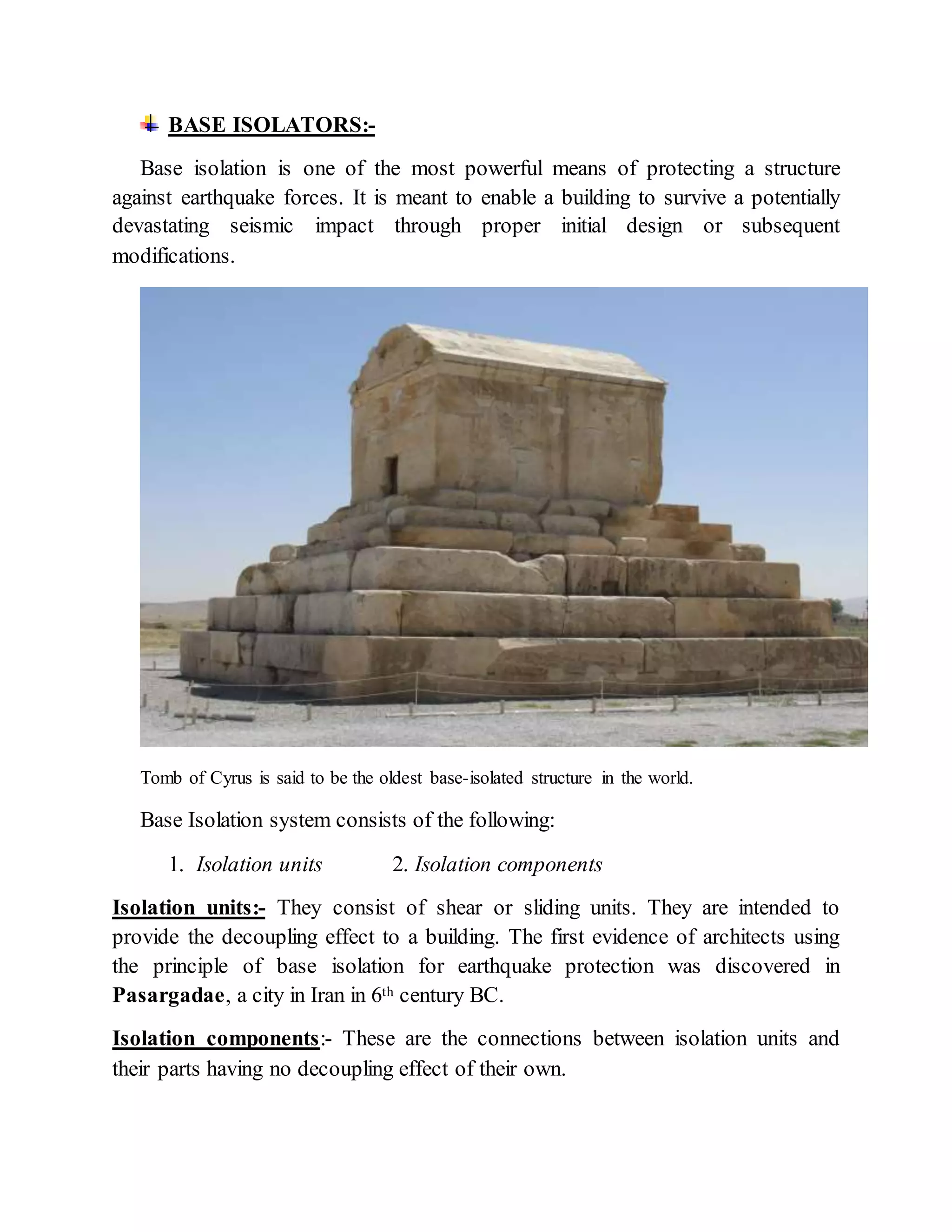
They consist of basic components-a lead plug, rubber and steel, which are
generally placed in layers.
Rubber: - The rubber provides flexibility. At the end of an earthquake, the rubber
bearings will slowly bring the building back to its original position which takes
months to happen.
Lead: - Lead has plastic
property. During an earthquake,
the kinetic energy of the
earthquake is absorbed into heat
energy as the lead is deformed.
Steel: - If layers of steel are
used with rubber, the bearing
can move in the horizontal
direction but is stiff in the
vertical direction.
SUPPLEMENTARYDAMPERS:-
A Supplementary Damping System (SDS) is essentially an energy dissipation
system that is incorporated into the design of a structure to absorb vibration
energy, thereby reducing motion.
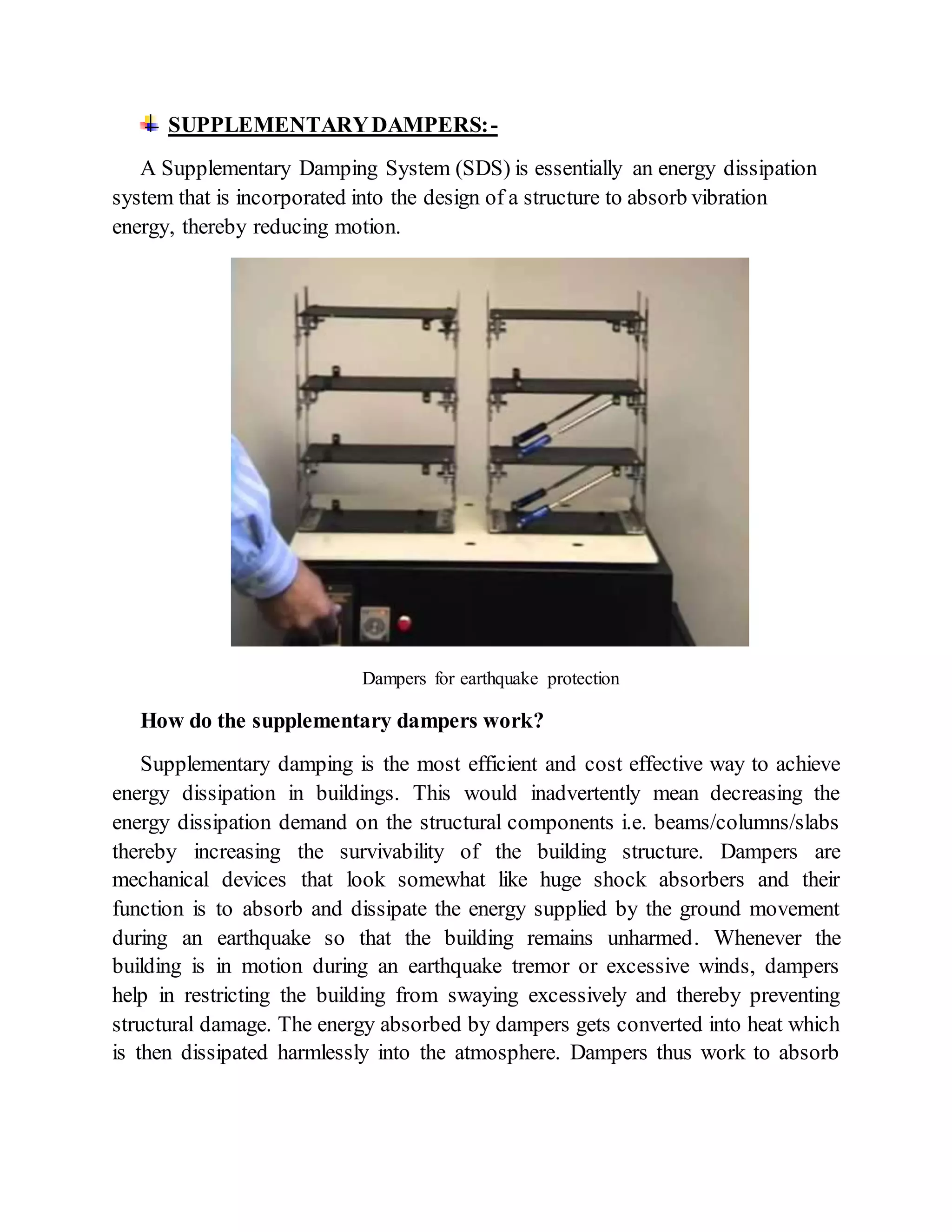
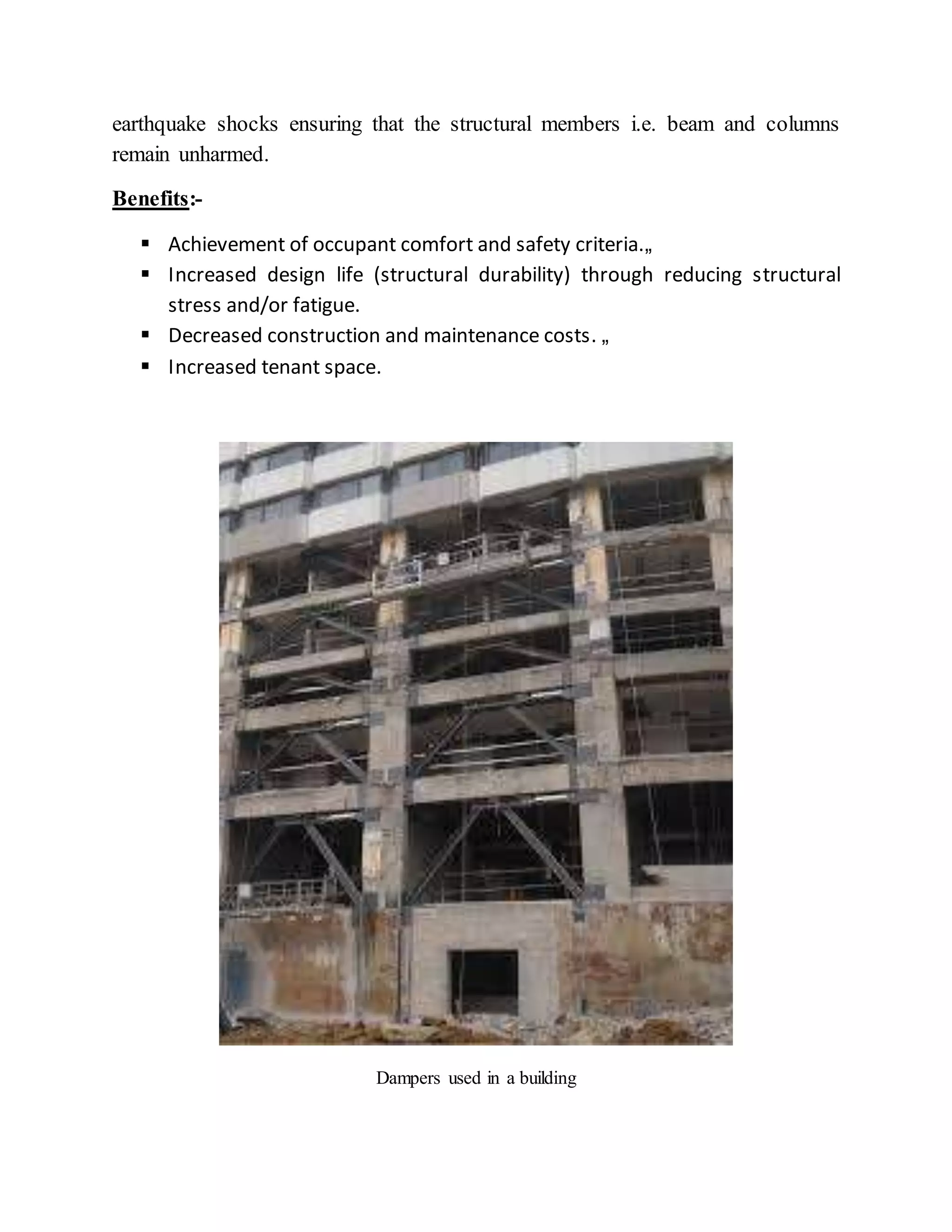
Dampers for earthquake protection
How do the supplementary dampers work?
Supplementary damping is the most efficient and cost effective way to achieve
energy dissipation in buildings. This would inadvertently mean decreasing the
energy dissipation demand on the structural components i.e. beams/columns/slabs
thereby increasing the survivability of the building structure. Dampers are
mechanical devices that look somewhat like huge shock absorbers and their
function is to absorb and dissipate the energy supplied by the ground movement
during an earthquake so that the building remains unharmed. Whenever the
building is in motion during an earthquake tremor or excessive winds, dampers
help in restricting the building from swaying excessively and thereby preventing
structural damage. The energy absorbed by dampers gets converted into heat which
is then dissipated harmlessly into the atmosphere. Dampers thus work to absorb
earthquake shocks ensuring that the structural members i.e. beam and columns
remain unharmed.
Benefits:-
 Achievement of occupant comfort and safety criteria.„
 Increased design life (structural durability) through reducing structural
stress and/or fatigue.
 Decreased construction and maintenance costs. „
 Increased tenant space.
Dampers used in a building
TUNED MASS DAMPERS: -
A tuned mass damper, also known as
a harmonic absorber is a device mounted
in structures to reduce the amplitude of
mechanical vibrations. Their application
can prevent discomfort, damage or
outright structural failure. They are
frequently used in power transmission,
automobiles and buildings.
How do tuned mass dampers work?
Tuned mass dampers stabilize against violent motion caused by harmonic
vibration. It reduces the vibration of a system with a comparatively lightweight
component so that the worst-case vibrations are less intense. Practical systems are
tuned to either move the main mode away from a troubling excitation frequency or
to add damping to a resonance that is difficult to damp directly.
Location of Taipei101’s largest tuned mass damper
SLOSH TANK: -
In fluid dynamics, slosh refers to the movement of liquid inside another object
undergoing motion.
Nowadays, one of the biggest challenges that engineering faces is to reduce
structure motion due to external loadings especially in high rise buildings. Slosh
tank is one of the inventions that can be installed in different locations and levels
into a structure, in order to increase dampening (energy absorbing mechanism) and
decrease vibrations. It can either be installed on the top floor of a structure or in
some certain floors or even at each floor of a building.
Rectangular slosh tank
Sensors
Control Actuators
Excitation Structure Response
ACTIVE CONTROL SYSTEM: -
The use of active control systems and some combinations of active and passive
systems, so called hybrid systems, as a means of structural protection against
seismic loads has received considerable attention in recent years. Active/hybrid
control systems are force delivery devices integrated with real-time processing
evaluators/controllers and sensors within the structure. They act simultaneously
with the hazardous excitation to provide enhanced structural behavior for improved
service and safety.
An active structural control system consists of the following:
a) Sensors located about the structure to measure either external excitations, or
structural response variables, or both.
b) Devices to process the measured information and to compute necessary
control force needed based on a given control algorithm.
c) Actuators, usually powered by external sources, to produce the required
forces.
Structure with Active Control
Controller Sensors
LIST OF IS CODES REQUIRED FOR SEISMIC RETROFITTING:
 IS 4326:1993 – Earthquake resistant design
 IS 13827:1993 – Earthquake resistance of earthen buildings
 IS 13828:1993 – Earthquake resistance of low strength masonry buildings
 IS 13920:1993 – Ductile detailing of reinforced concrete structures
 IS 13935 – Seismic strengthening of buildings
 IS 1893 – Earthquake resistant design of structures
Submitted by – SUKANTA PAUL
Registration ID – EXS230151
Email ID – sukantapaul92@gmail.com
College – JIS College of Engineering
Stream – Civil (4th year)

Seismic retrofitting of buildings

  • 1.
    SEISMIC RETROFITTING OFBUILDINGS Today, many countries are the victims of severe earthquakes resulting in the loss of lives of human being, animals, destruction of buildings, and many more. So, it is high time for the civil engineers to take this issue as a serious matter and they must think of some alternatives of saving human lives as well as wildlife. WHAT IS SEISMIC RETROFITTING? Seismic, by the word itself means something relating to earthquakes or vibrations of the earth and its crust. It happens due to some disturbances below the earth’s crust which cannot be seen. Seismic retrofitting is the modification of existing structures to make them more resistant to seismic activity, ground motion or soil failure due to earthquakes. There are several techniques which have come forward nowadays by which an existing structure can be modified and make it less prone to earthquakes. It is important to keep in mind that there is no such thing to make a structure fully earthquake proof but seismic performance can be greatly enhanced through proper initial design or subsequent modifications.
  • 2.
    Common seismic retrofittingtechniques fall into several categories: 1. Base Isolators. 2. Supplementary dampers. 3. Tuned mass dampers. 4. Slosh tank. 5. Active control system. WHAT IS THE NEED FOR SEISMIC RETROFITTING OF BUILDINGS? The need for seismic retrofitting in existing buildings can arise due to the following reasons:  Buildings not designed according to the codes of practice.  Deterioration of strength of the buildings.  Not considering the safety of buildings while construction. UNIQUENESS:- The impact of earthquake is sudden with little or no warning to make preparations against damages and collapse of structures. The common seismic retrofitting techniques have evolved very fast and have changed the belief of people that buildings can be made earthquake proof with proper modifications and thereby saving human lives. Seismic retrofit strategies have been developed in the past few decades following the introduction of new seismic provisions and the availability of advanced materials like fiber reinforced polymers, fiber reinforced concrete and high strength steel. AIMS AND OBJECTIVES:- 1. Public safety: The goal is to protect human life, ensuring that the structure will not collapse upon its occupants or passerby. 2. Structure survivability: The goal is that the structure, while remaining safe may require extensive repair but not replacement. 3. Structure functionality: Primary structure undamaged and the structure is undiminished in utility for its primary application. 4. Structure unaffected: A high level of retrofit is preferred for historic structures of cultural significance.
  • 3.
    BASE ISOLATORS:- Base isolationis one of the most powerful means of protecting a structure against earthquake forces. It is meant to enable a building to survive a potentially devastating seismic impact through proper initial design or subsequent modifications. Tomb of Cyrus is said to be the oldest base-isolated structure in the world. Base Isolation system consists of the following: 1. Isolation units 2. Isolation components Isolation units:- They consist of shear or sliding units. They are intended to provide the decoupling effect to a building. The first evidence of architects using the principle of base isolation for earthquake protection was discovered in Pasargadae, a city in Iran in 6th century BC. Isolation components:- These are the connections between isolation units and their parts having no decoupling effect of their own.
  • 4.
    How do baseisolators work? Base Isolation is a technique developed to prevent or minimize damage to buildings during an earthquake. So far it has been used in New Zealand, India, Japan, Italy and the USA. When a building is built away (isolated) from the ground, resting on flexible bearings or pads known as base isolators, it will move little or not at all during an earthquake. How are base isolators constructed? They consist of basic components-a lead plug, rubber and steel, which are generally placed in layers. Rubber: - The rubber provides flexibility. At the end of an earthquake, the rubber bearings will slowly bring the building back to its original position which takes months to happen. Lead: - Lead has plastic property. During an earthquake, the kinetic energy of the earthquake is absorbed into heat energy as the lead is deformed. Steel: - If layers of steel are used with rubber, the bearing can move in the horizontal direction but is stiff in the vertical direction.
  • 5.
    SUPPLEMENTARYDAMPERS:- A Supplementary DampingSystem (SDS) is essentially an energy dissipation system that is incorporated into the design of a structure to absorb vibration energy, thereby reducing motion. Dampers for earthquake protection How do the supplementary dampers work? Supplementary damping is the most efficient and cost effective way to achieve energy dissipation in buildings. This would inadvertently mean decreasing the energy dissipation demand on the structural components i.e. beams/columns/slabs thereby increasing the survivability of the building structure. Dampers are mechanical devices that look somewhat like huge shock absorbers and their function is to absorb and dissipate the energy supplied by the ground movement during an earthquake so that the building remains unharmed. Whenever the building is in motion during an earthquake tremor or excessive winds, dampers help in restricting the building from swaying excessively and thereby preventing structural damage. The energy absorbed by dampers gets converted into heat which is then dissipated harmlessly into the atmosphere. Dampers thus work to absorb
  • 6.
    earthquake shocks ensuringthat the structural members i.e. beam and columns remain unharmed. Benefits:-  Achievement of occupant comfort and safety criteria.„  Increased design life (structural durability) through reducing structural stress and/or fatigue.  Decreased construction and maintenance costs. „  Increased tenant space. Dampers used in a building
  • 7.
    TUNED MASS DAMPERS:- A tuned mass damper, also known as a harmonic absorber is a device mounted in structures to reduce the amplitude of mechanical vibrations. Their application can prevent discomfort, damage or outright structural failure. They are frequently used in power transmission, automobiles and buildings. How do tuned mass dampers work? Tuned mass dampers stabilize against violent motion caused by harmonic vibration. It reduces the vibration of a system with a comparatively lightweight component so that the worst-case vibrations are less intense. Practical systems are tuned to either move the main mode away from a troubling excitation frequency or to add damping to a resonance that is difficult to damp directly. Location of Taipei101’s largest tuned mass damper
  • 8.
    SLOSH TANK: - Influid dynamics, slosh refers to the movement of liquid inside another object undergoing motion. Nowadays, one of the biggest challenges that engineering faces is to reduce structure motion due to external loadings especially in high rise buildings. Slosh tank is one of the inventions that can be installed in different locations and levels into a structure, in order to increase dampening (energy absorbing mechanism) and decrease vibrations. It can either be installed on the top floor of a structure or in some certain floors or even at each floor of a building. Rectangular slosh tank
  • 9.
    Sensors Control Actuators Excitation StructureResponse ACTIVE CONTROL SYSTEM: - The use of active control systems and some combinations of active and passive systems, so called hybrid systems, as a means of structural protection against seismic loads has received considerable attention in recent years. Active/hybrid control systems are force delivery devices integrated with real-time processing evaluators/controllers and sensors within the structure. They act simultaneously with the hazardous excitation to provide enhanced structural behavior for improved service and safety. An active structural control system consists of the following: a) Sensors located about the structure to measure either external excitations, or structural response variables, or both. b) Devices to process the measured information and to compute necessary control force needed based on a given control algorithm. c) Actuators, usually powered by external sources, to produce the required forces. Structure with Active Control Controller Sensors
  • 10.
    LIST OF ISCODES REQUIRED FOR SEISMIC RETROFITTING:  IS 4326:1993 – Earthquake resistant design  IS 13827:1993 – Earthquake resistance of earthen buildings  IS 13828:1993 – Earthquake resistance of low strength masonry buildings  IS 13920:1993 – Ductile detailing of reinforced concrete structures  IS 13935 – Seismic strengthening of buildings  IS 1893 – Earthquake resistant design of structures Submitted by – SUKANTA PAUL Registration ID – EXS230151 Email ID – sukantapaul92@gmail.com College – JIS College of Engineering Stream – Civil (4th year)