Oil Sample Analysis
Condition Monitoring & Predictive
Maintenance
Presented by [Your Name]
Objective of Oil Sample Analysis
• • Monitor equipment health
• • Detect early wear and contamination
• • Optimize oil change intervals
• • Prevent unplanned breakdowns
Why Oil Analysis is Important
• • Oil is the lifeblood of rotating and hydraulic
equipment.
• • Breakdown in oil quality can indicate:
• - Component wear
• - Contamination (dust, water, fuel, coolant)
• - Oxidation and degradation
• • Prevents costly failures
Types of Oil Tests
• • Viscosity – Measures oil thickness
• • TAN/TBN – Acid/Base levels in oil
• • Spectrometric Analysis – Detects wear
metals
• • Water Content – Checks for contamination
• • Particle Count (ISO) – Cleanliness of oil
• • FTIR – Oxidation, nitration, soot
Sampling Procedure
• • Collect oil when equipment is hot and
running
• • Use clean, dry bottles
• • Avoid external contamination
• • Label sample properly (Equipment ID, Date,
Hours)
Key Parameters Analyzed
• • Iron, Copper, Chromium: Wear metals
(gears, bearings)
• • Silicon: Dirt contamination
• • Soot: Incomplete combustion
• • Water / Glycol: Coolant leakage
• • Fuel Dilution: Poor combustion or injector
leak
Example Oil Report Snapshot
• [Insert image or table of sample report]
Interpreting Results
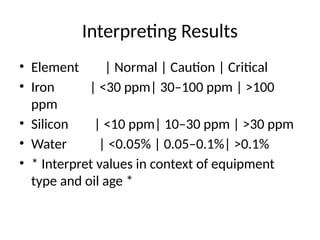
• Element | Normal | Caution | Critical
• Iron | <30 ppm| 30–100 ppm | >100
ppm
• Silicon | <10 ppm| 10–30 ppm | >30 ppm
• Water | <0.05% | 0.05–0.1%| >0.1%
• * Interpret values in context of equipment
type and oil age *
Case Study / Real Example
• • Real case where oil analysis detected early
damage
• • Action taken
• • Downtime saved / Cost prevented
Benefits of Regular Oil Sampling
• ✅ Improved Equipment Reliability
• ✅ Early Fault Detection
• ✅ Reduced Maintenance Cost
• ✅ Extended Oil Drain Intervals
• ✅ Safer Operations
Challenges in Oil Analysis
• • Improper sampling
• • Delayed testing/reporting
• • Ignoring early warnings
• • Lack of training on report interpretation
Conclusion & Recommendations
• • Integrate oil analysis with preventive
maintenance
• • Train staff on sampling and reading reports
• • Take timely action based on reports
• • Keep historical data for trend analysis
Q&A
• Any questions or observations?
Machines Used for Oil Sampling &
Analysis
• 1. **Vacuum Oil Sampling Pump** – For
extracting oil samples cleanly from
equipment.
• 2. **Spectrometer (ICP or RDE)** – Detects
metal wear particles in oil (Iron, Copper,
Chromium, etc.).
• 3. **Viscometer** – Measures oil viscosity at
different temperatures.
• 4. **FTIR Analyzer** – Analyzes chemical
degradation (oxidation, nitration, soot).

Oil_Sample_Analysis_Presentation for mines.pptx

  • 1.
    Oil Sample Analysis ConditionMonitoring & Predictive Maintenance Presented by [Your Name]
  • 2.
    Objective of OilSample Analysis • • Monitor equipment health • • Detect early wear and contamination • • Optimize oil change intervals • • Prevent unplanned breakdowns
  • 3.
    Why Oil Analysisis Important • • Oil is the lifeblood of rotating and hydraulic equipment. • • Breakdown in oil quality can indicate: • - Component wear • - Contamination (dust, water, fuel, coolant) • - Oxidation and degradation • • Prevents costly failures
  • 4.
    Types of OilTests • • Viscosity – Measures oil thickness • • TAN/TBN – Acid/Base levels in oil • • Spectrometric Analysis – Detects wear metals • • Water Content – Checks for contamination • • Particle Count (ISO) – Cleanliness of oil • • FTIR – Oxidation, nitration, soot
  • 5.
    Sampling Procedure • •Collect oil when equipment is hot and running • • Use clean, dry bottles • • Avoid external contamination • • Label sample properly (Equipment ID, Date, Hours)
  • 6.
    Key Parameters Analyzed •• Iron, Copper, Chromium: Wear metals (gears, bearings) • • Silicon: Dirt contamination • • Soot: Incomplete combustion • • Water / Glycol: Coolant leakage • • Fuel Dilution: Poor combustion or injector leak
  • 7.
    Example Oil ReportSnapshot • [Insert image or table of sample report]
  • 8.
    Interpreting Results • Element| Normal | Caution | Critical • Iron | <30 ppm| 30–100 ppm | >100 ppm • Silicon | <10 ppm| 10–30 ppm | >30 ppm • Water | <0.05% | 0.05–0.1%| >0.1% • * Interpret values in context of equipment type and oil age *
  • 9.
    Case Study /Real Example • • Real case where oil analysis detected early damage • • Action taken • • Downtime saved / Cost prevented
  • 10.
    Benefits of RegularOil Sampling • ✅ Improved Equipment Reliability • ✅ Early Fault Detection • ✅ Reduced Maintenance Cost • ✅ Extended Oil Drain Intervals • ✅ Safer Operations
  • 11.
    Challenges in OilAnalysis • • Improper sampling • • Delayed testing/reporting • • Ignoring early warnings • • Lack of training on report interpretation
  • 12.
    Conclusion & Recommendations •• Integrate oil analysis with preventive maintenance • • Train staff on sampling and reading reports • • Take timely action based on reports • • Keep historical data for trend analysis
  • 13.
    Q&A • Any questionsor observations?
  • 14.
    Machines Used forOil Sampling & Analysis • 1. **Vacuum Oil Sampling Pump** – For extracting oil samples cleanly from equipment. • 2. **Spectrometer (ICP or RDE)** – Detects metal wear particles in oil (Iron, Copper, Chromium, etc.). • 3. **Viscometer** – Measures oil viscosity at different temperatures. • 4. **FTIR Analyzer** – Analyzes chemical degradation (oxidation, nitration, soot).