10
Components of Lubrication Reliability
A How -To training guide for Maintenance & Reliability Professionals
Lubrication Reliability INTRODUCTION
 Company : Lubretec bvba
 Goal : World Class Maintenance
 Strategy : Lubrication Excellence
 Implement : Lubrication Reliability program
 Tools : Lubrication Best Practices & Equipment
Lubrication Reliability INTRODUCTION
 Company : Lubretec bvba - Belgium
• Origin Enluse bv – Holland 2002
– Enluse Import FluidDefense
– Experience : Lubrication, Reliability, Bearing Technology
– Solultion Provider
• Lubretec = End user division, one stop shop
• Custom & application centered approach
– Food industry
– Power Generation
– Offshore, Oil & Gas
– Chemical industry
• Full Lubrication Reliability product line
– Tools & Equipment
– Services
– Custom & Partner solutions
BEST
Practice
Lubrication Reliability : INTRODUCTION
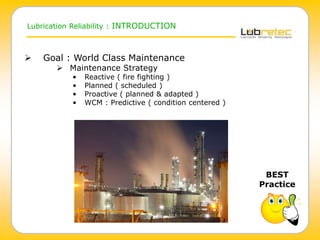
 Goal : World Class Maintenance
 Maintenance Strategy
• Reactive ( fire fighting )
• Planned ( scheduled )
• Proactive ( planned & adapted )
• WCM : Predictive ( condition centered )
BEST
Practice
Lubrication Reliability : INTRODUCTION
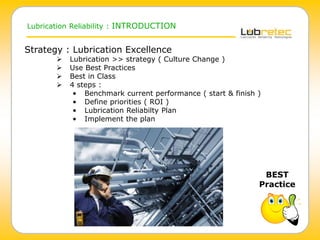
Strategy : Lubrication Excellence
 Lubrication >> strategy ( Culture Change )
 Use Best Practices
 Best in Class
 4 steps :
• Benchmark current performance ( start & finish )
• Define priorities ( ROI )
• Lubrication Reliabilty Plan
• Implement the plan
BEST
Practice
Lubrication Reliability : INTRODUCTION
Implement : Lubrication Reliability program
 Learn 10 components
 Set up the program
 Invest
 Equipment modifications
 PROCESS versus PROJECT
 Continous improvement
 Tools : Lubrication Best Practices & Equipment
 Tools
 Products
 Knowledge
 Consultancy
BEST
Practice
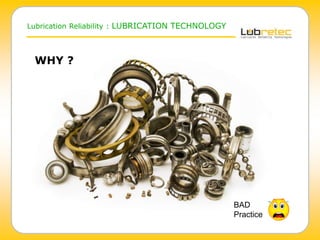
WHY ?
BAD
Practice
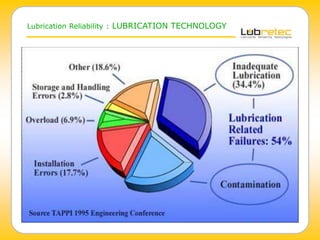
Lubrication Reliability : LUBRICATION TECHNOLOGY
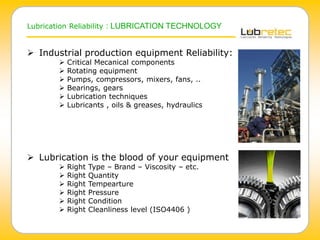
 Industrial production equipment Reliability:
 Critical Mecanical components
 Rotating equipment
 Pumps, compressors, mixers, fans, ..
 Bearings, gears
 Lubrication techniques
 Lubricants , oils & greases, hydraulics
 Lubrication is the blood of your equipment
 Right Type – Brand – Viscosity – etc.
 Right Quantity
 Right Tempearture
 Right Pressure
 Right Condition
 Right Cleanliness level (ISO4406 )
Lubrication Reliability : LUBRICATION TECHNOLOGY
Lubricant
 Reduction metal-metal friction
 Reduction surface wear
 Increase component life
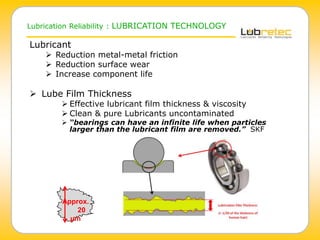
 Lube Film Thickness
 Effective lubricant film thickness & viscosity
 Clean & pure Lubricants uncontaminated
 “bearings can have an infinite life when particles
larger than the lubricant film are removed.” SKF
Approx.
20
µm
Lubrication Reliability : LUBRICATION TECHNOLOGY
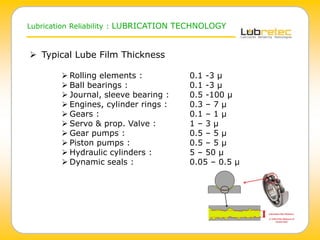
 Typical Lube Film Thickness
 Rolling elements : 0.1 -3 µ
 Ball bearings : 0.1 -3 µ
 Journal, sleeve bearing : 0.5 -100 µ
 Engines, cylinder rings : 0.3 – 7 µ
 Gears : 0.1 – 1 µ
 Servo & prop. Valve : 1 – 3 µ
 Gear pumps : 0.5 – 5 µ
 Piston pumps : 0.5 – 5 µ
 Hydraulic cylinders : 5 – 50 µ
 Dynamic seals : 0.05 – 0.5 µ
0 10 20 30 40 50
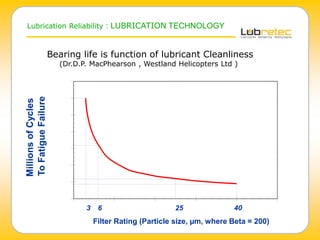
Filter Rating (Particle size, µm, where Beta = 200)
0
2
4
6
8
10
12
14
Millions
of
Cycles
To
Fatigue
Failure
6 25
3 40
1
6.6
3.6
1.3
Bearing life is function of lubricant Cleanliness
(Dr.D.P. MacPhearson , Westland Helicopters Ltd )
Lubrication Reliability : LUBRICATION TECHNOLOGY
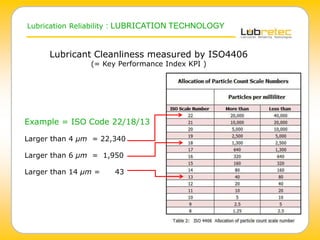
Lubricant Cleanliness measured by ISO4406
(= Key Performance Index KPI )
Lubrication Reliability : LUBRICATION TECHNOLOGY
Example = ISO Code 22/18/13
Larger than 4 µm = 22,340
Larger than 6 µm = 1,950
Larger than 14 µm = 43
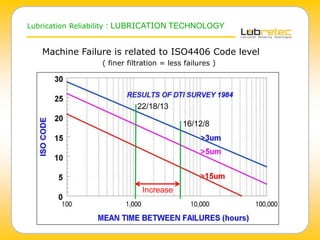
Machine Failure is related to ISO4406 Code level
( finer filtration = less failures )
Lubrication Reliability : LUBRICATION TECHNOLOGY
22/18/13
16/12/8
Increase
Lubrication Reliability : LUBRICATION TECHNOLOGY
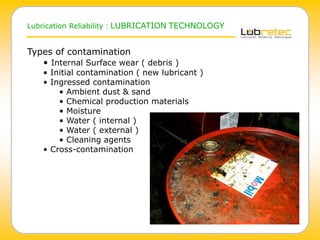
Types of contamination
• Internal Surface wear ( debris )
• Initial contamination ( new lubricant )
• Ingressed contamination
• Ambient dust & sand
• Chemical production materials
• Moisture
• Water ( internal )
• Water ( external )
• Cleaning agents
• Cross-contamination
Lubrication Reliability : LUBRICATION TECHNOLOGY
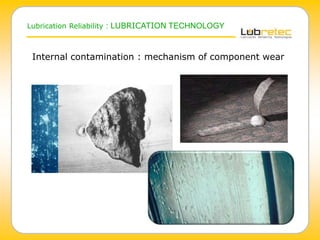
Internal contamination : mechanism of component wear
Lubrication Reliability : LUBRICATION TECHNOLOGY
Is new oil clean enough ?
• 4 % of new oils have levels outside specification!
• New lubricants travel long way :
From blending machine to storage reservoirs
 to truck-tanks ( or drums )
 to customer storage
 to transfer equipment
 to machine
Lubrication Reliability : LUBRICATION TECHNOLOGY
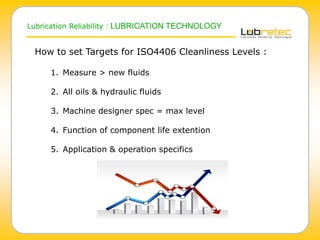
How to set Targets for ISO4406 Cleanliness Levels :
1. Measure > new fluids
2. All oils & hydraulic fluids
3. Machine designer spec = max level
4. Function of component life extention
5. Application & operation specifics
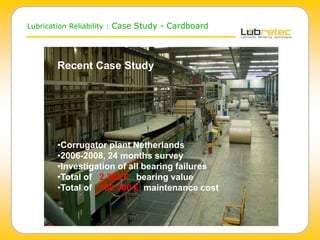
Lubrication Reliability : Case Study - Cardboard
•Corrugator plant Netherlands
•2006-2008, 24 months survey
•Investigation of all bearing failures
•Total of 2.300 € bearing value
•Total of 150.000 € maintenance cost
Recent Case Study
Lubrication Reliability : Case Study - Cardboard
Recent Case Study findings
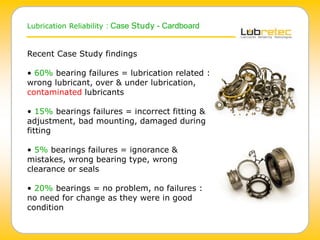
• 60% bearing failures = lubrication related :
wrong lubricant, over & under lubrication,
contaminated lubricants
• 15% bearings failures = incorrect fitting &
adjustment, bad mounting, damaged during
fitting
• 5% bearings failures = ignorance &
mistakes, wrong bearing type, wrong
clearance or seals
• 20% bearings = no problem, no failures :
no need for change as they were in good
condition
Lubrication Reliability : Case Study – Container Hub
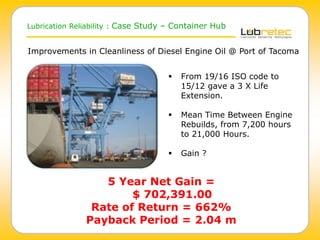
Improvements in Cleanliness of Diesel Engine Oil @ Port of Tacoma
 From 19/16 ISO code to
15/12 gave a 3 X Life
Extension.
 Mean Time Between Engine
Rebuilds, from 7,200 hours
to 21,000 Hours.
 Gain ?
5 Year Net Gain =
$ 702,391.00
Rate of Return = 662%
Payback Period = 2.04 m
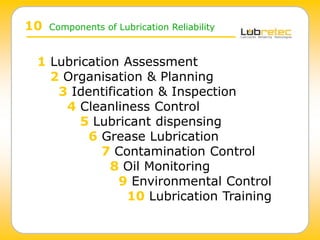
1 Lubrication Assessment
2 Organisation & Planning
3 Identification & Inspection
4 Cleanliness Control
5 Lubricant dispensing
6 Grease Lubrication
7 Contamination Control
8 Oil Monitoring
9 Environmental Control
10 Lubrication Training
10 Components of Lubrication Reliability
• Where are we now ?
• What do we do wrong ?
• What do we need to improve ?
1: Assessment & Benchmarking
Best Practice Solution : LubeAssess™
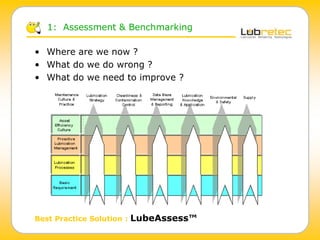
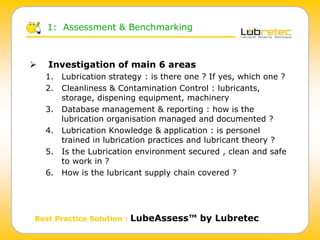
 Investigation of main 6 areas
1. Lubrication strategy : is there one ? If yes, which one ?
2. Cleanliness & Contamination Control : lubricants,
storage, dispening equipment, machinery
3. Database management & reporting : how is the
lubrication organisation managed and documented ?
4. Lubrication Knowledge & application : is personel
trained in lubrication practices and lubricant theory ?
5. Is the Lubrication environment secured , clean and safe
to work in ?
6. How is the lubricant supply chain covered ?
1: Assessment & Benchmarking
Best Practice Solution : LubeAssess™ by Lubretec
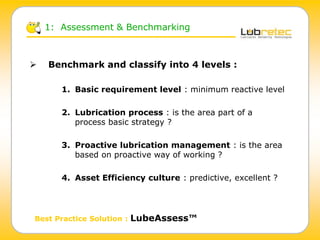
 Benchmark and classify into 4 levels :
1. Basic requirement level : minimum reactive level
2. Lubrication process : is the area part of a
process basic strategy ?
3. Proactive lubrication management : is the area
based on proactive way of working ?
4. Asset Efficiency culture : predictive, excellent ?
1: Assessment & Benchmarking
Best Practice Solution : LubeAssess™
2: Organisation & Planning
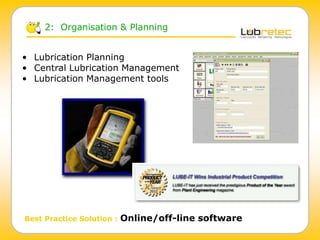
• Lubrication Planning
• Central Lubrication Management
• Lubrication Management tools
Best Practice Solution : Online/off-line software
2: Organisation & Planning
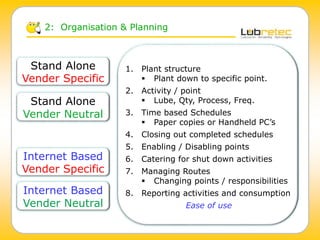
Stand Alone
Vender Specific
Internet Based
Vender Neutral
Internet Based
Vender Specific
Stand Alone
Vender Neutral
1. Plant structure
 Plant down to specific point.
2. Activity / point
 Lube, Qty, Process, Freq.
3. Time based Schedules
 Paper copies or Handheld PC’s
4. Closing out completed schedules
5. Enabling / Disabling points
6. Catering for shut down activities
7. Managing Routes
 Changing points / responsibilities
8. Reporting activities and consumption
Ease of use
3: Identification & Inspection
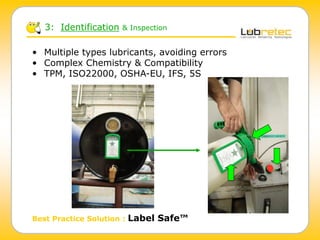
• Multiple types lubricants, avoiding errors
• Complex Chemistry & Compatibility
• TPM, ISO22000, OSHA-EU, IFS, 5S
Best Practice Solution : Label Safe™
3: Identification & Inspection
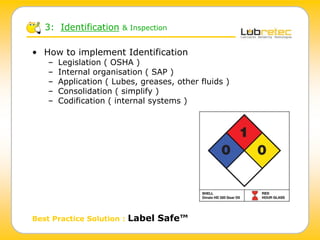
• How to implement Identification
– Legislation ( OSHA )
– Internal organisation ( SAP )
– Application ( Lubes, greases, other fluids )
– Consolidation ( simplify )
– Codification ( internal systems )
Best Practice Solution : Label Safe™
3: Identification & Inspection
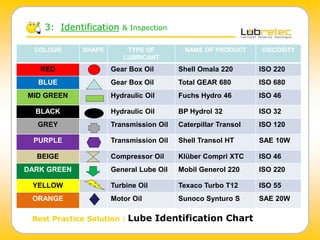
Best Practice Solution : Lube Identification Chart
COLOUR SHAPE TYPE OF
LUBRICANT
NAME OF PRODUCT VISCOSITY
RED Gear Box Oil Shell Omala 220 ISO 220
BLUE Gear Box Oil Total GEAR 680 ISO 680
MID GREEN Hydraulic Oil Fuchs Hydro 46 ISO 46
BLACK Hydraulic Oil BP Hydrol 32 ISO 32
GREY Transmission Oil Caterpillar Transol ISO 120
PURPLE Transmission Oil Shell Transol HT SAE 10W
BEIGE Compressor Oil Klüber Compri XTC ISO 46
DARK GREEN General Lube Oil Mobil Generol 220 ISO 220
YELLOW Turbine Oil Texaco Turbo T12 ISO 55
ORANGE Motor Oil Sunoco Synturo S SAE 20W
3: Identification & Inspection
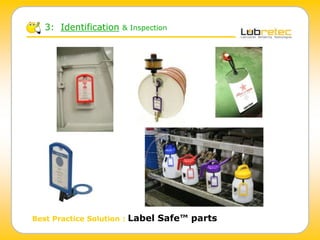
Best Practice Solution : Label Safe™ parts
3: Identification & Inspection
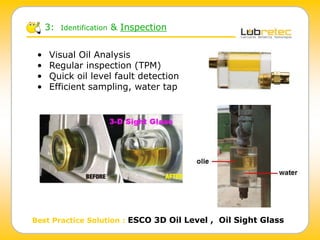
Best Practice Solution : ESCO 3D Oil Level , Oil Sight Glass
• Visual Oil Analysis
• Regular inspection (TPM)
• Quick oil level fault detection
• Efficient sampling, water tap
3: Identification & Inspection
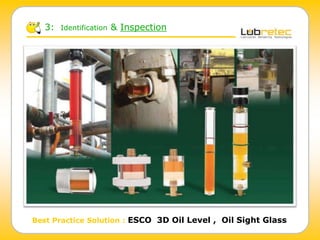
Best Practice Solution : ESCO 3D Oil Level , Oil Sight Glass
4: Cleanliness Control
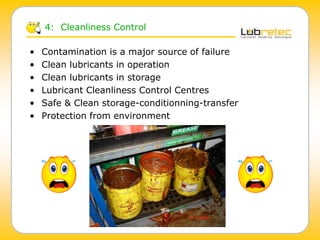
• Contamination is a major source of failure
• Clean lubricants in operation
• Clean lubricants in storage
• Lubricant Cleanliness Control Centres
• Safe & Clean storage-conditionning-transfer
• Protection from environment
4: Cleanliness Control
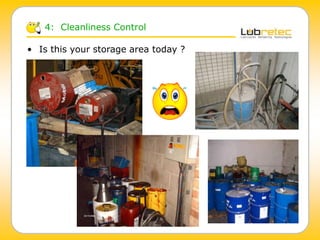
• Is this your storage area today ?
4: Cleanliness Control Basic Protection
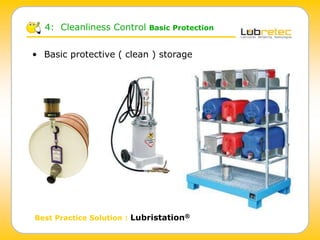
• Basic protective ( clean ) storage
Best Practice Solution : Lubristation®
4: Cleanliness Control Individual Storage
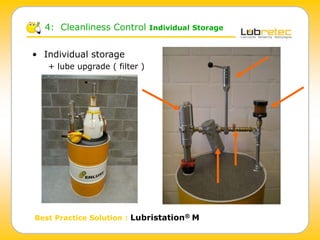
• Individual storage
+ lube upgrade ( filter )
Best Practice Solution : Lubristation® M
4: Cleanliness Control Individual Storage
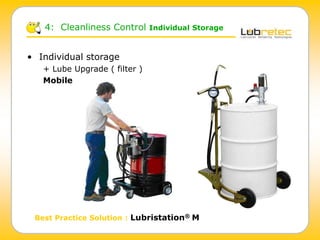
Best Practice Solution : Lubristation® M
• Individual storage
+ Lube Upgrade ( filter )
Mobile
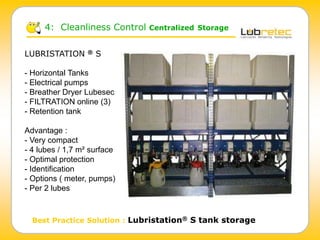
4: Cleanliness Control Centralized Storage
Best Practice Solution : Lubristation® S tank storage
LUBRISTATION ® S
- Horizontal Tanks
- Electrical pumps
- Breather Dryer Lubesec
- FILTRATION online (3)
- Retention tank
Advantage :
- Very compact
- 4 lubes / 1,7 m² surface
- Optimal protection
- Identification
- Options ( meter, pumps)
- Per 2 lubes
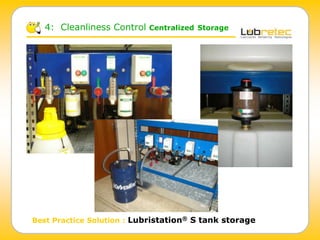
4: Cleanliness Control Centralized Storage
Best Practice Solution : Lubristation® S tank storage
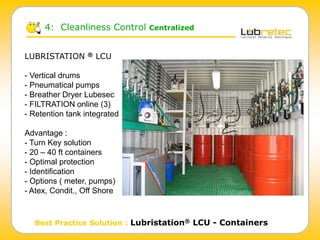
4: Cleanliness Control Centralized
Best Practice Solution : Lubristation® LCU - Containers
LUBRISTATION ® LCU
- Vertical drums
- Pneumatical pumps
- Breather Dryer Lubesec
- FILTRATION online (3)
- Retention tank integrated
Advantage :
- Turn Key solution
- 20 – 40 ft containers
- Optimal protection
- Identification
- Options ( meter, pumps)
- Atex, Condit., Off Shore
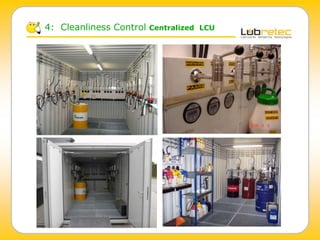
4: Cleanliness Control Centralized LCU
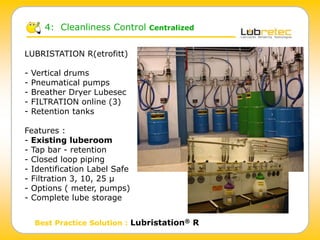
4: Cleanliness Control Centralized
Best Practice Solution : Lubristation® R
LUBRISTATION R(etrofitt)
- Vertical drums
- Pneumatical pumps
- Breather Dryer Lubesec
- FILTRATION online (3)
- Retention tanks
Features :
- Existing luberoom
- Tap bar - retention
- Closed loop piping
- Identification Label Safe
- Filtration 3, 10, 25 µ
- Options ( meter, pumps)
- Complete lube storage
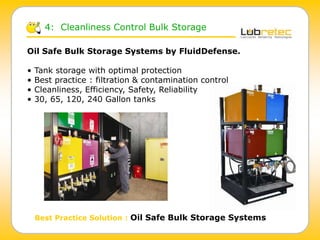
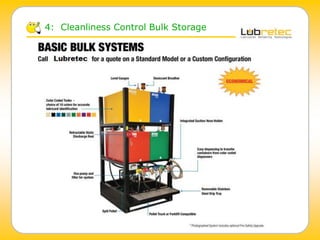
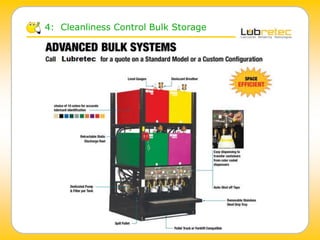
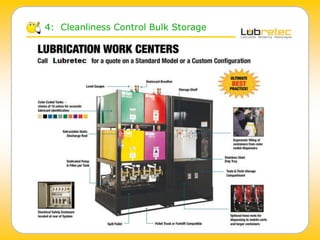
4: Cleanliness Control Bulk Storage
Best Practice Solution : Oil Safe Bulk Storage Systems
Oil Safe Bulk Storage Systems by FluidDefense.
• Tank storage with optimal protection
• Best practice : filtration & contamination control
• Cleanliness, Efficiency, Safety, Reliability
• 30, 65, 120, 240 Gallon tanks
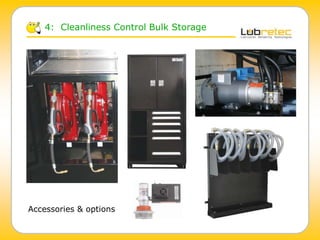
4: Cleanliness Control Bulk Storage
Accessories & options
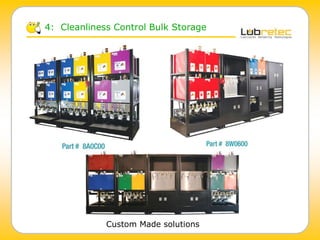
4: Cleanliness Control Bulk Storage
Custom Made solutions
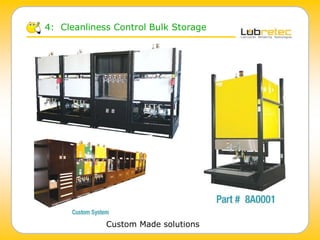
4: Cleanliness Control Bulk Storage
Custom Made solutions
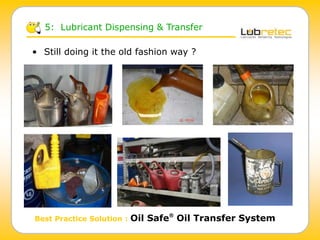
• Still doing it the old fashion way ?
Best Practice Solution : Oil Safe®
Oil Transfer System
5: Lubricant Dispensing & Transfer
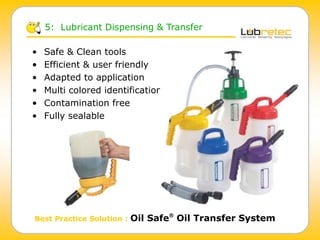
• Safe & Clean tools
• Efficient & user friendly
• Adapted to application
• Multi colored identification
• Contamination free
• Fully sealable
Best Practice Solution : Oil Safe®
Oil Transfer System
5: Lubricant Dispensing & Transfer
Best Practice Solution : Oil Safe®
Drums
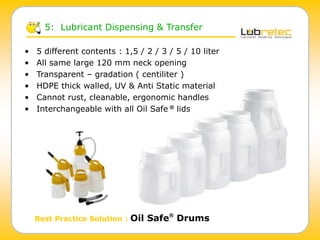
• 5 different contents : 1,5 / 2 / 3 / 5 / 10 liter
• All same large 120 mm neck opening
• Transparent – gradation ( centiliter )
• HDPE thick walled, UV & Anti Static material
• Cannot rust, cleanable, ergonomic handles
• Interchangeable with all Oil Safe ® lids
5: Lubricant Dispensing & Transfer
Best Practice Solution : Oil Safe®
Lids & pumps
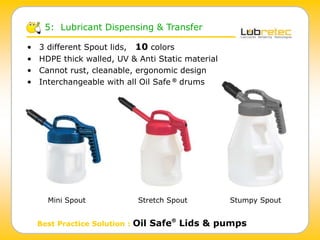
• 3 different Spout lids, 10 colors
• HDPE thick walled, UV & Anti Static material
• Cannot rust, cleanable, ergonomic design
• Interchangeable with all Oil Safe ® drums
Mini Spout Stretch Spout Stumpy Spout
5: Lubricant Dispensing & Transfer
Best Practice Solution : Oil Safe®
Lids & pumps
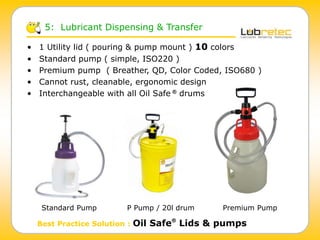
Standard Pump P Pump / 20l drum Premium Pump
• 1 Utility lid ( pouring & pump mount ) 10 colors
• Standard pump ( simple, ISO220 )
• Premium pump ( Breather, QD, Color Coded, ISO680 )
• Cannot rust, cleanable, ergonomic design
• Interchangeable with all Oil Safe ® drums
5: Lubricant Dispensing & Transfer
Best Practice Solution : Oil Safe®
Lids & pumps
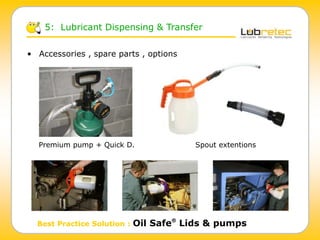
Premium pump + Quick D. Spout extentions
• Accessories , spare parts , options
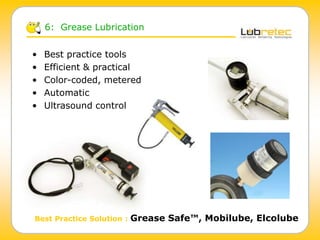
• Best practice tools
• Efficient & practical
• Color-coded, metered
• Automatic
• Ultrasound control
6: Grease Lubrication
Best Practice Solution : Grease Safe™, Mobilube, Elcolube
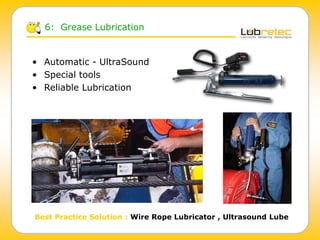
• Automatic - UltraSound
• Special tools
• Reliable Lubrication
6: Grease Lubrication
Best Practice Solution : Wire Rope Lubricator , Ultrasound Lube
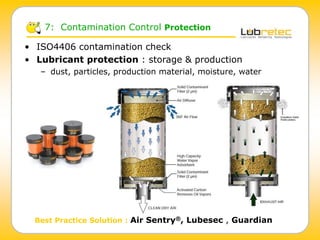
• ISO4406 contamination check
• Lubricant protection : storage & production
– dust, particles, production material, moisture, water
Best Practice Solution : Air Sentry®, Lubesec , Guardian
7: Contamination Control Protection
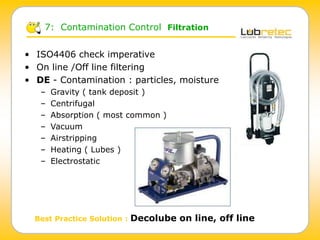
• ISO4406 check imperative
• On line /Off line filtering
• DE - Contamination : particles, moisture
– Gravity ( tank deposit )
– Centrifugal
– Absorption ( most common )
– Vacuum
– Airstripping
– Heating ( Lubes )
– Electrostatic
Best Practice Solution : Decolube on line, off line
7: Contamination Control Filtration
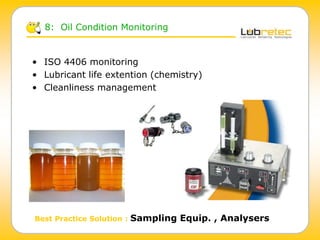
• ISO 4406 monitoring
• Lubricant life extention (chemistry)
• Cleanliness management
Best Practice Solution : Sampling Equip. , Analysers
8: Oil Condition Monitoring
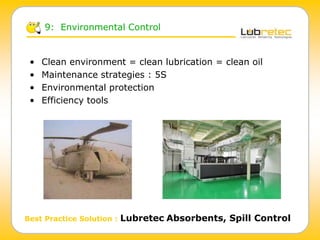
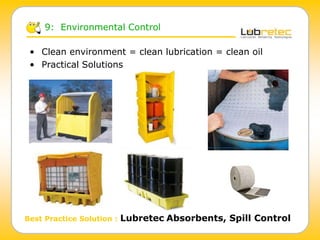
• Clean environment = clean lubrication = clean oil
• Maintenance strategies : 5S
• Environmental protection
• Efficiency tools
Best Practice Solution : Lubretec Absorbents, Spill Control
9: Environmental Control
• Clean environment = clean lubrication = clean oil
• Practical Solutions
9: Environmental Control
Best Practice Solution : Lubretec Absorbents, Spill Control
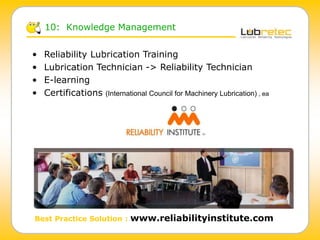
• Reliability Lubrication Training
• Lubrication Technician -> Reliability Technician
• E-learning
• Certifications (International Council for Machinery Lubrication) , ea
10: Knowledge Management
Best Practice Solution : www.reliabilityinstitute.com
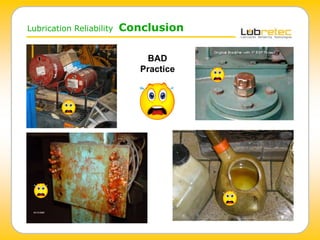
BAD
Practice
Lubrication Reliability Conclusion
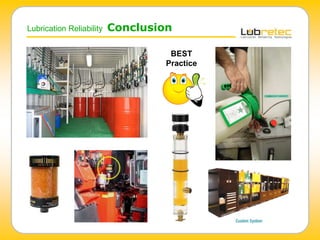
BEST
Practice
Lubrication Reliability : Check List
 Consolidation of packaging ( centralized storage )
 Unique type of packaging ( 200 l )
 Larger type
 Consolidation of lubricant types ( less is more )
 Reception control
 Type check & date
 Damaged packaging
 ISO4406 contamination level
 Proper identification
 Color coding ( refer to dispensing, avoiding mistakes )
 Type – brand – internal order code
 Viscosity
 Application
 Date of reception & of first use
Lubrication Reliability : Check List
 Pre-filtering of new oil to required ISO4406 level
 While transfer to new storage tanks
 Kidney loop on drum or tank
 Correct filter rate in function of application
 Storage in proper environment
 Clean dedicated lube room, not outside
 Constant temperature & humidity
 Organized, safe & efficient
 Away from dirt causing production environment
 Use of proper absorbents ( no pellets, no sawdust )
 Use of regulatory spill-retention equipment
Lubrication Reliability : Check List
 Storage in proper recipients
 Lube supplier drums, containers ( horizontal/vertical )
 New plastic tanks - containers ( rust free, translucent )
 New steel coated tanks ( with oil level )
 New SS tanks ( oil level )
 Protection
 Protect lubes from humidity & dirt with breather-dryers
 Fully closed containers/tanks, pump-tank connection.
 Protect grease nipples, quick disconnects with caps & plugs.
 Transfer and dispensing
 Closed loop tank-dispensing equipment preferred
 Use of fully sealable dispensing equipment ( chain of
cleanliness )
 Filtering during transfer and dispensing
Lubrication Reliability : Check List
 Continuous Lubrication Inspection
 Oil Levels on machines ( min-max level )
 Water separation sight glass inspection and tap
 Oil quality on machines ( Oil analysis )
 Lubricant and/or grease leakage
 Storage inspection ( open drums, dirty connectors, lost
protect caps )
 Grease level in automatic lubricators
 Blocked grease lines
 Filter Saturation indicators
 Filter content inspection, pictures, samples (FMEA )
 Breather-dryer inspection for saturation
Lubrication Reliability Questions
Lubrication Reliability contact & Info
10
Components of Lubrication Reliability
THANK YOU !
Lubretec bvba
Toon Van Grunderbeeck
toonvg@lubretec.com
+32 476 23 83 78
www.lubretec.com

10251287.ppt

  • 1.
    10 Components of LubricationReliability A How -To training guide for Maintenance & Reliability Professionals
  • 2.
    Lubrication Reliability INTRODUCTION Company : Lubretec bvba  Goal : World Class Maintenance  Strategy : Lubrication Excellence  Implement : Lubrication Reliability program  Tools : Lubrication Best Practices & Equipment
  • 3.
    Lubrication Reliability INTRODUCTION Company : Lubretec bvba - Belgium • Origin Enluse bv – Holland 2002 – Enluse Import FluidDefense – Experience : Lubrication, Reliability, Bearing Technology – Solultion Provider • Lubretec = End user division, one stop shop • Custom & application centered approach – Food industry – Power Generation – Offshore, Oil & Gas – Chemical industry • Full Lubrication Reliability product line – Tools & Equipment – Services – Custom & Partner solutions BEST Practice
  • 4.
    Lubrication Reliability :INTRODUCTION  Goal : World Class Maintenance  Maintenance Strategy • Reactive ( fire fighting ) • Planned ( scheduled ) • Proactive ( planned & adapted ) • WCM : Predictive ( condition centered ) BEST Practice
  • 5.
    Lubrication Reliability :INTRODUCTION Strategy : Lubrication Excellence  Lubrication >> strategy ( Culture Change )  Use Best Practices  Best in Class  4 steps : • Benchmark current performance ( start & finish ) • Define priorities ( ROI ) • Lubrication Reliabilty Plan • Implement the plan BEST Practice
  • 6.
    Lubrication Reliability :INTRODUCTION Implement : Lubrication Reliability program  Learn 10 components  Set up the program  Invest  Equipment modifications  PROCESS versus PROJECT  Continous improvement  Tools : Lubrication Best Practices & Equipment  Tools  Products  Knowledge  Consultancy BEST Practice
  • 7.
  • 8.
    Lubrication Reliability :LUBRICATION TECHNOLOGY  Industrial production equipment Reliability:  Critical Mecanical components  Rotating equipment  Pumps, compressors, mixers, fans, ..  Bearings, gears  Lubrication techniques  Lubricants , oils & greases, hydraulics  Lubrication is the blood of your equipment  Right Type – Brand – Viscosity – etc.  Right Quantity  Right Tempearture  Right Pressure  Right Condition  Right Cleanliness level (ISO4406 )
  • 9.
    Lubrication Reliability :LUBRICATION TECHNOLOGY
  • 10.
    Lubrication Reliability :LUBRICATION TECHNOLOGY Lubricant  Reduction metal-metal friction  Reduction surface wear  Increase component life  Lube Film Thickness  Effective lubricant film thickness & viscosity  Clean & pure Lubricants uncontaminated  “bearings can have an infinite life when particles larger than the lubricant film are removed.” SKF Approx. 20 µm
  • 11.
    Lubrication Reliability :LUBRICATION TECHNOLOGY  Typical Lube Film Thickness  Rolling elements : 0.1 -3 µ  Ball bearings : 0.1 -3 µ  Journal, sleeve bearing : 0.5 -100 µ  Engines, cylinder rings : 0.3 – 7 µ  Gears : 0.1 – 1 µ  Servo & prop. Valve : 1 – 3 µ  Gear pumps : 0.5 – 5 µ  Piston pumps : 0.5 – 5 µ  Hydraulic cylinders : 5 – 50 µ  Dynamic seals : 0.05 – 0.5 µ
  • 12.
    0 10 2030 40 50 Filter Rating (Particle size, µm, where Beta = 200) 0 2 4 6 8 10 12 14 Millions of Cycles To Fatigue Failure 6 25 3 40 1 6.6 3.6 1.3 Bearing life is function of lubricant Cleanliness (Dr.D.P. MacPhearson , Westland Helicopters Ltd ) Lubrication Reliability : LUBRICATION TECHNOLOGY
  • 13.
    Lubricant Cleanliness measuredby ISO4406 (= Key Performance Index KPI ) Lubrication Reliability : LUBRICATION TECHNOLOGY Example = ISO Code 22/18/13 Larger than 4 µm = 22,340 Larger than 6 µm = 1,950 Larger than 14 µm = 43
  • 14.
    Machine Failure isrelated to ISO4406 Code level ( finer filtration = less failures ) Lubrication Reliability : LUBRICATION TECHNOLOGY 22/18/13 16/12/8 Increase
  • 15.
    Lubrication Reliability :LUBRICATION TECHNOLOGY Types of contamination • Internal Surface wear ( debris ) • Initial contamination ( new lubricant ) • Ingressed contamination • Ambient dust & sand • Chemical production materials • Moisture • Water ( internal ) • Water ( external ) • Cleaning agents • Cross-contamination
  • 16.
    Lubrication Reliability :LUBRICATION TECHNOLOGY Internal contamination : mechanism of component wear
  • 17.
    Lubrication Reliability :LUBRICATION TECHNOLOGY Is new oil clean enough ? • 4 % of new oils have levels outside specification! • New lubricants travel long way : From blending machine to storage reservoirs  to truck-tanks ( or drums )  to customer storage  to transfer equipment  to machine
  • 18.
    Lubrication Reliability :LUBRICATION TECHNOLOGY How to set Targets for ISO4406 Cleanliness Levels : 1. Measure > new fluids 2. All oils & hydraulic fluids 3. Machine designer spec = max level 4. Function of component life extention 5. Application & operation specifics
  • 19.
    Lubrication Reliability :Case Study - Cardboard •Corrugator plant Netherlands •2006-2008, 24 months survey •Investigation of all bearing failures •Total of 2.300 € bearing value •Total of 150.000 € maintenance cost Recent Case Study
  • 20.
    Lubrication Reliability :Case Study - Cardboard Recent Case Study findings • 60% bearing failures = lubrication related : wrong lubricant, over & under lubrication, contaminated lubricants • 15% bearings failures = incorrect fitting & adjustment, bad mounting, damaged during fitting • 5% bearings failures = ignorance & mistakes, wrong bearing type, wrong clearance or seals • 20% bearings = no problem, no failures : no need for change as they were in good condition
  • 21.
    Lubrication Reliability :Case Study – Container Hub Improvements in Cleanliness of Diesel Engine Oil @ Port of Tacoma  From 19/16 ISO code to 15/12 gave a 3 X Life Extension.  Mean Time Between Engine Rebuilds, from 7,200 hours to 21,000 Hours.  Gain ? 5 Year Net Gain = $ 702,391.00 Rate of Return = 662% Payback Period = 2.04 m
  • 22.
    1 Lubrication Assessment 2Organisation & Planning 3 Identification & Inspection 4 Cleanliness Control 5 Lubricant dispensing 6 Grease Lubrication 7 Contamination Control 8 Oil Monitoring 9 Environmental Control 10 Lubrication Training 10 Components of Lubrication Reliability
  • 23.
    • Where arewe now ? • What do we do wrong ? • What do we need to improve ? 1: Assessment & Benchmarking Best Practice Solution : LubeAssess™
  • 24.
     Investigation ofmain 6 areas 1. Lubrication strategy : is there one ? If yes, which one ? 2. Cleanliness & Contamination Control : lubricants, storage, dispening equipment, machinery 3. Database management & reporting : how is the lubrication organisation managed and documented ? 4. Lubrication Knowledge & application : is personel trained in lubrication practices and lubricant theory ? 5. Is the Lubrication environment secured , clean and safe to work in ? 6. How is the lubricant supply chain covered ? 1: Assessment & Benchmarking Best Practice Solution : LubeAssess™ by Lubretec
  • 25.
     Benchmark andclassify into 4 levels : 1. Basic requirement level : minimum reactive level 2. Lubrication process : is the area part of a process basic strategy ? 3. Proactive lubrication management : is the area based on proactive way of working ? 4. Asset Efficiency culture : predictive, excellent ? 1: Assessment & Benchmarking Best Practice Solution : LubeAssess™
  • 26.
    2: Organisation &Planning • Lubrication Planning • Central Lubrication Management • Lubrication Management tools Best Practice Solution : Online/off-line software
  • 27.
    2: Organisation &Planning Stand Alone Vender Specific Internet Based Vender Neutral Internet Based Vender Specific Stand Alone Vender Neutral 1. Plant structure  Plant down to specific point. 2. Activity / point  Lube, Qty, Process, Freq. 3. Time based Schedules  Paper copies or Handheld PC’s 4. Closing out completed schedules 5. Enabling / Disabling points 6. Catering for shut down activities 7. Managing Routes  Changing points / responsibilities 8. Reporting activities and consumption Ease of use
  • 28.
    3: Identification &Inspection • Multiple types lubricants, avoiding errors • Complex Chemistry & Compatibility • TPM, ISO22000, OSHA-EU, IFS, 5S Best Practice Solution : Label Safe™
  • 29.
    3: Identification &Inspection • How to implement Identification – Legislation ( OSHA ) – Internal organisation ( SAP ) – Application ( Lubes, greases, other fluids ) – Consolidation ( simplify ) – Codification ( internal systems ) Best Practice Solution : Label Safe™
  • 30.
    3: Identification &Inspection Best Practice Solution : Lube Identification Chart COLOUR SHAPE TYPE OF LUBRICANT NAME OF PRODUCT VISCOSITY RED Gear Box Oil Shell Omala 220 ISO 220 BLUE Gear Box Oil Total GEAR 680 ISO 680 MID GREEN Hydraulic Oil Fuchs Hydro 46 ISO 46 BLACK Hydraulic Oil BP Hydrol 32 ISO 32 GREY Transmission Oil Caterpillar Transol ISO 120 PURPLE Transmission Oil Shell Transol HT SAE 10W BEIGE Compressor Oil Klüber Compri XTC ISO 46 DARK GREEN General Lube Oil Mobil Generol 220 ISO 220 YELLOW Turbine Oil Texaco Turbo T12 ISO 55 ORANGE Motor Oil Sunoco Synturo S SAE 20W
  • 31.
    3: Identification &Inspection Best Practice Solution : Label Safe™ parts
  • 32.
    3: Identification &Inspection Best Practice Solution : ESCO 3D Oil Level , Oil Sight Glass • Visual Oil Analysis • Regular inspection (TPM) • Quick oil level fault detection • Efficient sampling, water tap
  • 33.
    3: Identification &Inspection Best Practice Solution : ESCO 3D Oil Level , Oil Sight Glass
  • 34.
    4: Cleanliness Control •Contamination is a major source of failure • Clean lubricants in operation • Clean lubricants in storage • Lubricant Cleanliness Control Centres • Safe & Clean storage-conditionning-transfer • Protection from environment
  • 35.
    4: Cleanliness Control •Is this your storage area today ?
  • 36.
    4: Cleanliness ControlBasic Protection • Basic protective ( clean ) storage Best Practice Solution : Lubristation®
  • 37.
    4: Cleanliness ControlIndividual Storage • Individual storage + lube upgrade ( filter ) Best Practice Solution : Lubristation® M
  • 38.
    4: Cleanliness ControlIndividual Storage Best Practice Solution : Lubristation® M • Individual storage + Lube Upgrade ( filter ) Mobile
  • 39.
    4: Cleanliness ControlCentralized Storage Best Practice Solution : Lubristation® S tank storage LUBRISTATION ® S - Horizontal Tanks - Electrical pumps - Breather Dryer Lubesec - FILTRATION online (3) - Retention tank Advantage : - Very compact - 4 lubes / 1,7 m² surface - Optimal protection - Identification - Options ( meter, pumps) - Per 2 lubes
  • 40.
    4: Cleanliness ControlCentralized Storage Best Practice Solution : Lubristation® S tank storage
  • 41.
    4: Cleanliness ControlCentralized Best Practice Solution : Lubristation® LCU - Containers LUBRISTATION ® LCU - Vertical drums - Pneumatical pumps - Breather Dryer Lubesec - FILTRATION online (3) - Retention tank integrated Advantage : - Turn Key solution - 20 – 40 ft containers - Optimal protection - Identification - Options ( meter, pumps) - Atex, Condit., Off Shore
  • 42.
    4: Cleanliness ControlCentralized LCU
  • 43.
    4: Cleanliness ControlCentralized Best Practice Solution : Lubristation® R LUBRISTATION R(etrofitt) - Vertical drums - Pneumatical pumps - Breather Dryer Lubesec - FILTRATION online (3) - Retention tanks Features : - Existing luberoom - Tap bar - retention - Closed loop piping - Identification Label Safe - Filtration 3, 10, 25 µ - Options ( meter, pumps) - Complete lube storage
  • 44.
    4: Cleanliness ControlBulk Storage Best Practice Solution : Oil Safe Bulk Storage Systems Oil Safe Bulk Storage Systems by FluidDefense. • Tank storage with optimal protection • Best practice : filtration & contamination control • Cleanliness, Efficiency, Safety, Reliability • 30, 65, 120, 240 Gallon tanks
  • 45.
  • 46.
  • 47.
  • 48.
    4: Cleanliness ControlBulk Storage Accessories & options
  • 49.
    4: Cleanliness ControlBulk Storage Custom Made solutions
  • 50.
    4: Cleanliness ControlBulk Storage Custom Made solutions
  • 51.
    • Still doingit the old fashion way ? Best Practice Solution : Oil Safe® Oil Transfer System 5: Lubricant Dispensing & Transfer
  • 52.
    • Safe &Clean tools • Efficient & user friendly • Adapted to application • Multi colored identification • Contamination free • Fully sealable Best Practice Solution : Oil Safe® Oil Transfer System 5: Lubricant Dispensing & Transfer
  • 53.
    5: Lubricant Dispensing& Transfer Best Practice Solution : Oil Safe® Drums • 5 different contents : 1,5 / 2 / 3 / 5 / 10 liter • All same large 120 mm neck opening • Transparent – gradation ( centiliter ) • HDPE thick walled, UV & Anti Static material • Cannot rust, cleanable, ergonomic handles • Interchangeable with all Oil Safe ® lids
  • 54.
    5: Lubricant Dispensing& Transfer Best Practice Solution : Oil Safe® Lids & pumps • 3 different Spout lids, 10 colors • HDPE thick walled, UV & Anti Static material • Cannot rust, cleanable, ergonomic design • Interchangeable with all Oil Safe ® drums Mini Spout Stretch Spout Stumpy Spout
  • 55.
    5: Lubricant Dispensing& Transfer Best Practice Solution : Oil Safe® Lids & pumps Standard Pump P Pump / 20l drum Premium Pump • 1 Utility lid ( pouring & pump mount ) 10 colors • Standard pump ( simple, ISO220 ) • Premium pump ( Breather, QD, Color Coded, ISO680 ) • Cannot rust, cleanable, ergonomic design • Interchangeable with all Oil Safe ® drums
  • 56.
    5: Lubricant Dispensing& Transfer Best Practice Solution : Oil Safe® Lids & pumps Premium pump + Quick D. Spout extentions • Accessories , spare parts , options
  • 57.
    • Best practicetools • Efficient & practical • Color-coded, metered • Automatic • Ultrasound control 6: Grease Lubrication Best Practice Solution : Grease Safe™, Mobilube, Elcolube
  • 58.
    • Automatic -UltraSound • Special tools • Reliable Lubrication 6: Grease Lubrication Best Practice Solution : Wire Rope Lubricator , Ultrasound Lube
  • 59.
    • ISO4406 contaminationcheck • Lubricant protection : storage & production – dust, particles, production material, moisture, water Best Practice Solution : Air Sentry®, Lubesec , Guardian 7: Contamination Control Protection
  • 60.
    • ISO4406 checkimperative • On line /Off line filtering • DE - Contamination : particles, moisture – Gravity ( tank deposit ) – Centrifugal – Absorption ( most common ) – Vacuum – Airstripping – Heating ( Lubes ) – Electrostatic Best Practice Solution : Decolube on line, off line 7: Contamination Control Filtration
  • 61.
    • ISO 4406monitoring • Lubricant life extention (chemistry) • Cleanliness management Best Practice Solution : Sampling Equip. , Analysers 8: Oil Condition Monitoring
  • 62.
    • Clean environment= clean lubrication = clean oil • Maintenance strategies : 5S • Environmental protection • Efficiency tools Best Practice Solution : Lubretec Absorbents, Spill Control 9: Environmental Control
  • 63.
    • Clean environment= clean lubrication = clean oil • Practical Solutions 9: Environmental Control Best Practice Solution : Lubretec Absorbents, Spill Control
  • 64.
    • Reliability LubricationTraining • Lubrication Technician -> Reliability Technician • E-learning • Certifications (International Council for Machinery Lubrication) , ea 10: Knowledge Management Best Practice Solution : www.reliabilityinstitute.com
  • 65.
  • 66.
  • 67.
    Lubrication Reliability :Check List  Consolidation of packaging ( centralized storage )  Unique type of packaging ( 200 l )  Larger type  Consolidation of lubricant types ( less is more )  Reception control  Type check & date  Damaged packaging  ISO4406 contamination level  Proper identification  Color coding ( refer to dispensing, avoiding mistakes )  Type – brand – internal order code  Viscosity  Application  Date of reception & of first use
  • 68.
    Lubrication Reliability :Check List  Pre-filtering of new oil to required ISO4406 level  While transfer to new storage tanks  Kidney loop on drum or tank  Correct filter rate in function of application  Storage in proper environment  Clean dedicated lube room, not outside  Constant temperature & humidity  Organized, safe & efficient  Away from dirt causing production environment  Use of proper absorbents ( no pellets, no sawdust )  Use of regulatory spill-retention equipment
  • 69.
    Lubrication Reliability :Check List  Storage in proper recipients  Lube supplier drums, containers ( horizontal/vertical )  New plastic tanks - containers ( rust free, translucent )  New steel coated tanks ( with oil level )  New SS tanks ( oil level )  Protection  Protect lubes from humidity & dirt with breather-dryers  Fully closed containers/tanks, pump-tank connection.  Protect grease nipples, quick disconnects with caps & plugs.  Transfer and dispensing  Closed loop tank-dispensing equipment preferred  Use of fully sealable dispensing equipment ( chain of cleanliness )  Filtering during transfer and dispensing
  • 70.
    Lubrication Reliability :Check List  Continuous Lubrication Inspection  Oil Levels on machines ( min-max level )  Water separation sight glass inspection and tap  Oil quality on machines ( Oil analysis )  Lubricant and/or grease leakage  Storage inspection ( open drums, dirty connectors, lost protect caps )  Grease level in automatic lubricators  Blocked grease lines  Filter Saturation indicators  Filter content inspection, pictures, samples (FMEA )  Breather-dryer inspection for saturation
  • 71.
  • 72.
    Lubrication Reliability contact& Info 10 Components of Lubrication Reliability THANK YOU ! Lubretec bvba Toon Van Grunderbeeck toonvg@lubretec.com +32 476 23 83 78 www.lubretec.com