Harsimranjot, Dr. S.B.L. Tripathi, Hardeep Singh Saini / International Journal of Engineering
          Research and Applications (IJERA) ISSN: 2248-9622 www.ijera.com
                   Vol. 2, Issue 5, September- October 2012, pp.2159-2162
                           Analysis of Efficient FDDI Network
          Harsimranjot1, Dr. S.B.L. Tripathi2 and Hardeep Singh Saini3
          *Research Scholar (ECE), Singhania University, Jhunjhunu, Rajasthan-333515, INDIA.
**Head of Physics & Electronics Department, Podar Govt. College, Nawalgarh. Jhunjhunu, Rajasthan, INDIA,
     ***Associate Professor(ECE), Indo Global College of Engineering, Mohali,Punjab-140109,INDIA


ABSTRACT
        Fiber Distributed Data Interface (FDDI)            and more reliable computer and data communication
provides a 100 Mbit/s optical standard for data            networks. Wavelength division multiplexing
transmission in a local area network and can               (WDM) is a very promising technology to meet the
support thousands of users. FDDI can be                    ever increasing demands of high capacity and
implemented as a higher speed version of a token           bandwidth.
ring and is designed to work over fiber. In this                     Fiber optic communications cables would
Paper we have analyzed the performance of the              provide the most reasonable solution for use in such
FDDI systems depending on the various                      a network. Whether using radio, copper or fiber, any
parameters. Also, the efficiency of the FDDI               fixed network has one inherent drawback over a
network can be increased by the analytical model           wireless network: it is prohibitively expensive to run
proposed and by controlling the ring latency and           a separate fiber from the central controller to each
by minimizing it. We have also analyzed the                node in the field in the “star topology”
performance of FDDI network depending upon                 configuration. Another drawback of the star
the response time. The response time can be                topology is that any cable break will isolate a field
improved by decreasing the transition delay and            node from the central controller. To avoid the
propagation delay. The performance of FDDI                 drawbacks of the star topology, a linear bus
network has also been optimized depending on               topology may be use. In this configuration,
the data reliability. Also the Data reliability of the     information from the master node is transmitted to
FDDI network can also be increased.                        the remote node closest to the master node, and
                                                           from there it is retransmitted downstream to the next
Key Words:Data Reliability,FDDI Network,                   remote node further down the line until the end of
Efficiency, Response Time, Ring Latency;                   the chain is reached. Data from the remote nodes is
                                                           transmitted back upstream to the master node in a
I. INTRODUCTION                                            similar fashion. However, there are also problems
          Telecommunications        is     always      a   associated with the linear bus; if power is lost at one
fascinating, fast paced industry that affects every        of the intermediate nodes downstream, nodes can no
aspect of our lives including simple voice telephone       longer communicate with the master. Similarly if a
calls, access to the Internet, high speed data             cable break occurs somewhere in the middle of the
communications, satellite communications, surfing          bus, the downstream nodes can no longer
the World Wide Web, fax transmissions, video               communicate with the master. Adding a battery
conferencing and cable TV. The basic elements of           backup to each node has solved the loss-of-power
Telecommunication systems are: a transmitter that          problem, but this is expensive and requires
takes information and converts it to a signal.A            maintenance. Other important solution of this
transmission medium, also called the "physical             problem is Fiber Distributed Data Interface.
channel" carries the signal. A receiver takes the                    FDDI was considered an attractive campus
signal from the channel and converts it back into          backbone technology in the early to mid-1990s since
usable information. Telecommunication systems are          existing Ethernet networks only offered 10 Mbit/s
of two types; Simplex and Duplex Systems.                  transfer speeds and Token Ring networks only
          The rapid growth of Internet traffic has         offered 4 Mbit/s or 16 Mbit/s speeds. Thus it was
been the driving force for faster and more reliable        the preferred choice of that era for a high-speed
data communication networks. Networking is a very          backbone, but FDDI has since been effectively
promising technology to meet these ever increasing         obsolesced by fast Ethernet which offered the same
demands. Broadly speaking a computer network is            100 Mbit/s speeds, but at a much lower cost and,
an interconnected collection of interdependent             since 1998, by Gigabit Ethernet due to its speed, and
computers that aid communication in numerous               even lower cost, and ubiquity.
ways. Apart from providing a good communication                      Fiber Distributed Data Networks (FDDI)
medium, cost effectiveness and sharing of available        are designed to have two data transmission paths
resources (programs and data) are some of the              which provide redundancy when one of the two
advantages of networking. This rapid growth of             paths becomes unusable. FDDI can be implemented
internet traffic has been the driving force for faster     as a higher speed version of a token ring and is


                                                                                                 2159 | P a g e
Harsimranjot, Dr. S.B.L. Tripathi, Hardeep Singh Saini / International Journal of Engineering
          Research and Applications (IJERA) ISSN: 2248-9622 www.ijera.com
                   Vol. 2, Issue 5, September- October 2012, pp.2159-2162
designed to work over fiber. This standard is also       protocol. In particular he quantify frame error rate,
designed primarily for peer-to-peer communications       token loss rate and undetected error rate. Several
but can certainly be used for the polled traffic         characteristics of the 32 bit frame check sequence
modem. The underlying principle of the token ring        polynomial, which is also used in IEEE 802 LAN
is that access to the communications ring is limited     protocols, were also discussed. It was shown that
to one modem at a time: A single modem transmits         every noise event results in two code bit errors,
its message around the ring. Then, once the message      which in turn may result in up to four data bits
travels completely around the ring, the modem            errors. The FCP can detect up to two noise events.
removes the data from the ring and passes control        He justified the enhancements by quantifying their
(the token) to the next modem in line. This method       effect.
promises to be an effective method of distributing                 SaurabNog and David Kotz [5], suggested
data over the fiber.                                     that Communication is a very important factor
                                                         affecting distributed applications. Getting a close
II.LITERATURESURVEY                                      handle on network performance (both bandwidth
          There are number of researchers working        and latency) is thus crucial to understanding overall
on the FDDI. The detailed literature review of the       application performance. They benchmarked some
FDDI is covered in this section. The Terra Link          of the metrics of network performance using two
laser communication (laser-com) system was               sets of experiments, namely roundtrip and data hose.
developed by Isaac I. Kim et. al. [1] as a cost-         The tests were designed to measure a combination
effective, high bandwidth, wireless alternative to       of network latency, bandwidth, and contention.
fiber optic transmission. The advantages of laser        They have repeated the tests for two protocols
com over fiber optic cabling were primarily              (TCP/IP and MPI) and three networks (100 Mbit
economic. They proposed that however, free-space         FDDI (Fiber Distributed Data Interface), 100 Mbit
laser com is subject to atmospheric effects, such as     Fast Ethernet, and 10 Mbit Ethernet). The
attenuation and scintillation, which can reduce link     performance results provided interesting insights
availability and may introduce burst errors not seen     into the behavior of these networks under different
in fiber transmission. The Terra Link transceivers       load conditions and the software overheads
use large receives apertures and multiple transmit       associated with an MPI implementation (MPICH).
beams to reduce the effects of scintillation. By
designing the laser com link with sufficient margin      III.
                                                            PERFORMANCE ANALYSIS OF FDDI
for atmospheric attenuation and scintillation, a bit     ON       THE     BASIS       OF
error rate (BER) of 1029 or better can be achieved.      THROUGHPUT/EFFICIENCY
Since they designed the Terra Link transceivers to                 A simple model to compute the access
be eye-safe at the transmit aperture, each system is     delay and efficiency of the FDDI analytically will
range-limited. Link power budgets for the Terra          now be described. These metrics are meaningful
Link systems were presented and link margin data         only under heavy load and, therefore, it is assumed
were shown that quantitatively describe how the          that there are n active stations and that each one has
effective laser link range varies in different weather   enough frames to keep the FDDI fully loaded. It is
conditions.                                              given that for an FDDI network with a ring latency
          Pek-HooiSohet. al. [2] investigated that       of D and a TTRT value of T, the efficiency and
how evolutions of complex technologies and               maximum access delay can be given by equation (i)
networks of innovators affect the development of         and (ii).
emerging innovations. Building upon the theories of      First consider a ring with three active stations.
technological evolution and socio-organizational         Assume that all stations are idle until 𝑡 = 𝐷 when
dynamics, they developed propositions to examine         the three active stations suddenly get a large
the stability and change of networks punctuated by       (infinite) burst of frames to transmit.
successive technological changes. They argued that       Thus, for a ring with three active stations, the
incumbents who are early advocates of standards in       efficiency and access delay are:
complex technological environments are more likely
to survive via alliances. Based on 150 firms and 319                     3 𝑇−𝐷
                                                         Efficiency; 𝜂 = 3𝑇+𝐷
alliances in the US data communications industry
from 1985 to 1996, they found support for their          Maximum access delay;         𝑀𝐴𝐷 = 3 − 1 𝑇 + 2𝐷
propositions and the characteristics of central-
periphery structure best describe the patterns of
industry networks.                                       The above equation can be generalized to n active
          William R. Hawe, Richard Graham and            stations by replacing 3 by n.
Peter C. Hayden [3] covered the overview of the
                                                                          𝑛 𝑇−𝐷
FDDI and suggested some of the research actions.         Efficiency; 𝜂 =                              (i)
                                                                         𝑛𝑇 +𝐷
Raj Jain [4] analyzed the impact of various design       Maximum access delay;
decisions on the error detection capability of the        𝑀𝐴𝐷 = 𝑛 − 1 𝑇 + 2𝐷                          (ii)


                                                                                              2160 | P a g e
Harsimranjot, Dr. S.B.L. Tripathi, Hardeep Singh Saini / International Journal of Engineering
          Research and Applications (IJERA) ISSN: 2248-9622 www.ijera.com
                   Vol. 2, Issue 5, September- October 2012, pp.2159-2162

         Equations (i) and (ii) constitute the
analytical model; these equations can be used to
compute the Maximum access delay and Efficiency
of FDDI systems.

IV. RESULT AND DISCUSSION
          In this section we will cover the results for
the performance analysis of the FDDI on the basis
of efficiency. We have fixed the number of stations
to 100 and analyzed the performance of the FDDI.
The results shown in figure 4.1 to figure 4.6 depict
the performance analysis of FDDI network on the
basis of efficiency. The value of T was fixed to 4ms
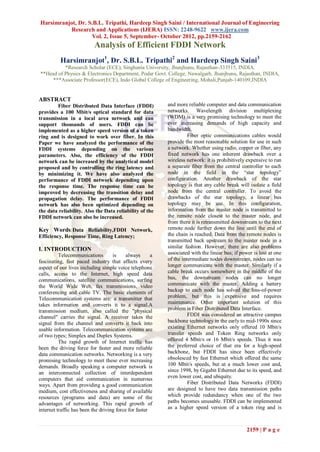
and the latency was taken as 2ms. Figure 4.1 shows
the relationship between efficiency and the number
of stations, the relationship between maximum
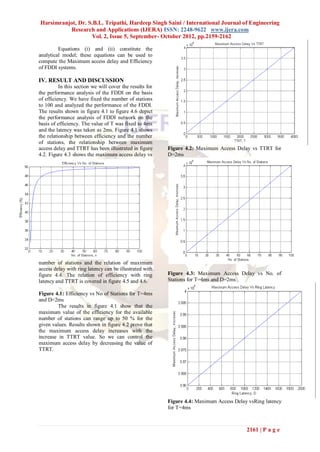
access delay and TTRT has been illustrated in figure      Figure 4.2: Maximum Access Delay vs TTRT for
4.2. Figure 4.3 shows the maximum access delay vs         D=2ms


number of stations and the relation of maximum
access delay with ring latency can be illustrated with
figure 4.4. The relation of efficiency with ring          Figure 4.3: Maximum Access Delay vs No. of
latency and TTRT is covered in figure 4.5 and 4.6.        Stations for T=4ms and D=2ms

Figure 4.1: Efficiency vs No of Stations for T=4ms
and D=2ms
         The results in figure 4.1 show that the
maximum value of the efficiency for the available
number of stations can range up to 50 % for the
given values. Results shown in figure 4.2 prove that
the maximum access delay increases with the
increase in TTRT value. So we can control the
maximum access delay by decreasing the value of
TTRT.


                                                          Figure 4.4: Maximum Access Delay vsRing latency
                                                          for T=4ms


                                                                                          2161 | P a g e
Harsimranjot, Dr. S.B.L. Tripathi, Hardeep Singh Saini / International Journal of Engineering
          Research and Applications (IJERA) ISSN: 2248-9622 www.ijera.com
                   Vol. 2, Issue 5, September- October 2012, pp.2159-2162

                                                         V.CONCLUSION
                                                                   In this paper, we covered the results for the
                                                         performance analysis of the FDDI on the basis of
                                                         efficiency. It is concluded that the maximum access
                                                         delay increases with the increase in TTRT value. So
                                                         we can control the maximum access delay by
                                                         decreasing the value of TTRT. Also, the Maximum
                                                         Access delay increases directly with the increase in
                                                         number of stations and ring latency. Results showed
                                                         that that the efficiency of FDDI networks decreases
                                                         with the ring latency and increases with the TTRT
                                                         value.

                                                         REFERENCES
                                                           [1]    Isaac I. Kim, Ron Stieger, Joseph A.
                                                                  Koontz, Carter Moursund, Micah Barclay,
                                                                  PrasannaAdhikari, John Schuster and Eric
                                                                  Korevaar, “Wireless optical transmission of
                                                                  fast ethernet, FDDI, ATM, and ESCON
                                                                  protocol data using the Terra-Link laser
                                                                  communication system”, Opt. Eng. 37(12)
                                                                  3143–3155. 1998.
Figure 4.5: Efficiency Vs Ring Latency for T=4ms           [2]    Pek-HooiSoha, Edward B. Roberts,
                                                                  “Networks of innovators: a longitudinal
                                                                  perspective”, Research Policy 32, 1569–
                                                                  1588, 2003.
                                                           [3]    William R. Hawe, Richard Graham and
                                                                  Peter C. Hayden, “Fiber Distributed Data
                                                                  Interface Overview,” Digital Technical
                                                                  Journal,Vol. 3 No. 2 Spring 1991
                                                           [4]    Raj Jain, “Error Characteristics of Fiber
                                                                  Distributed Data Interface (FDDI),” IEEE
                                                                  Transactions on Communications, Vol. 38,
                                                                  No. 8, August 1990.
                                                           [5]    SaurabNog and David Kotz, “A
                                                                  Performance Comparison of TCP/IP and
                                                                  MPI on FDDI, Fast Ethernet, and
                                                                  Ethernet,” Dartmouth Technical Report
                                                                  PCS-TR95-273, Revised January 8, 1996.


Figure 4.6: Efficiency vs TTRT for T=4ms and
D=2ms
         It is clear from the results shown in figure
4.3 and figure 4.4 that the Maximum Access delay
increases directly with the increase in number of
stations and ring latency. Whereas, it is clear from
the results shown in figure 4.5 that the efficiency of
FDDI networks decreases with the ring latency and
increases with the TTRT value.


                                                                                               2162 | P a g e

Mn2521592162

  • 1.
    Harsimranjot, Dr. S.B.L.Tripathi, Hardeep Singh Saini / International Journal of Engineering Research and Applications (IJERA) ISSN: 2248-9622 www.ijera.com Vol. 2, Issue 5, September- October 2012, pp.2159-2162 Analysis of Efficient FDDI Network Harsimranjot1, Dr. S.B.L. Tripathi2 and Hardeep Singh Saini3 *Research Scholar (ECE), Singhania University, Jhunjhunu, Rajasthan-333515, INDIA. **Head of Physics & Electronics Department, Podar Govt. College, Nawalgarh. Jhunjhunu, Rajasthan, INDIA, ***Associate Professor(ECE), Indo Global College of Engineering, Mohali,Punjab-140109,INDIA ABSTRACT Fiber Distributed Data Interface (FDDI) and more reliable computer and data communication provides a 100 Mbit/s optical standard for data networks. Wavelength division multiplexing transmission in a local area network and can (WDM) is a very promising technology to meet the support thousands of users. FDDI can be ever increasing demands of high capacity and implemented as a higher speed version of a token bandwidth. ring and is designed to work over fiber. In this Fiber optic communications cables would Paper we have analyzed the performance of the provide the most reasonable solution for use in such FDDI systems depending on the various a network. Whether using radio, copper or fiber, any parameters. Also, the efficiency of the FDDI fixed network has one inherent drawback over a network can be increased by the analytical model wireless network: it is prohibitively expensive to run proposed and by controlling the ring latency and a separate fiber from the central controller to each by minimizing it. We have also analyzed the node in the field in the “star topology” performance of FDDI network depending upon configuration. Another drawback of the star the response time. The response time can be topology is that any cable break will isolate a field improved by decreasing the transition delay and node from the central controller. To avoid the propagation delay. The performance of FDDI drawbacks of the star topology, a linear bus network has also been optimized depending on topology may be use. In this configuration, the data reliability. Also the Data reliability of the information from the master node is transmitted to FDDI network can also be increased. the remote node closest to the master node, and from there it is retransmitted downstream to the next Key Words:Data Reliability,FDDI Network, remote node further down the line until the end of Efficiency, Response Time, Ring Latency; the chain is reached. Data from the remote nodes is transmitted back upstream to the master node in a I. INTRODUCTION similar fashion. However, there are also problems Telecommunications is always a associated with the linear bus; if power is lost at one fascinating, fast paced industry that affects every of the intermediate nodes downstream, nodes can no aspect of our lives including simple voice telephone longer communicate with the master. Similarly if a calls, access to the Internet, high speed data cable break occurs somewhere in the middle of the communications, satellite communications, surfing bus, the downstream nodes can no longer the World Wide Web, fax transmissions, video communicate with the master. Adding a battery conferencing and cable TV. The basic elements of backup to each node has solved the loss-of-power Telecommunication systems are: a transmitter that problem, but this is expensive and requires takes information and converts it to a signal.A maintenance. Other important solution of this transmission medium, also called the "physical problem is Fiber Distributed Data Interface. channel" carries the signal. A receiver takes the FDDI was considered an attractive campus signal from the channel and converts it back into backbone technology in the early to mid-1990s since usable information. Telecommunication systems are existing Ethernet networks only offered 10 Mbit/s of two types; Simplex and Duplex Systems. transfer speeds and Token Ring networks only The rapid growth of Internet traffic has offered 4 Mbit/s or 16 Mbit/s speeds. Thus it was been the driving force for faster and more reliable the preferred choice of that era for a high-speed data communication networks. Networking is a very backbone, but FDDI has since been effectively promising technology to meet these ever increasing obsolesced by fast Ethernet which offered the same demands. Broadly speaking a computer network is 100 Mbit/s speeds, but at a much lower cost and, an interconnected collection of interdependent since 1998, by Gigabit Ethernet due to its speed, and computers that aid communication in numerous even lower cost, and ubiquity. ways. Apart from providing a good communication Fiber Distributed Data Networks (FDDI) medium, cost effectiveness and sharing of available are designed to have two data transmission paths resources (programs and data) are some of the which provide redundancy when one of the two advantages of networking. This rapid growth of paths becomes unusable. FDDI can be implemented internet traffic has been the driving force for faster as a higher speed version of a token ring and is 2159 | P a g e
  • 2.
    Harsimranjot, Dr. S.B.L.Tripathi, Hardeep Singh Saini / International Journal of Engineering Research and Applications (IJERA) ISSN: 2248-9622 www.ijera.com Vol. 2, Issue 5, September- October 2012, pp.2159-2162 designed to work over fiber. This standard is also protocol. In particular he quantify frame error rate, designed primarily for peer-to-peer communications token loss rate and undetected error rate. Several but can certainly be used for the polled traffic characteristics of the 32 bit frame check sequence modem. The underlying principle of the token ring polynomial, which is also used in IEEE 802 LAN is that access to the communications ring is limited protocols, were also discussed. It was shown that to one modem at a time: A single modem transmits every noise event results in two code bit errors, its message around the ring. Then, once the message which in turn may result in up to four data bits travels completely around the ring, the modem errors. The FCP can detect up to two noise events. removes the data from the ring and passes control He justified the enhancements by quantifying their (the token) to the next modem in line. This method effect. promises to be an effective method of distributing SaurabNog and David Kotz [5], suggested data over the fiber. that Communication is a very important factor affecting distributed applications. Getting a close II.LITERATURESURVEY handle on network performance (both bandwidth There are number of researchers working and latency) is thus crucial to understanding overall on the FDDI. The detailed literature review of the application performance. They benchmarked some FDDI is covered in this section. The Terra Link of the metrics of network performance using two laser communication (laser-com) system was sets of experiments, namely roundtrip and data hose. developed by Isaac I. Kim et. al. [1] as a cost- The tests were designed to measure a combination effective, high bandwidth, wireless alternative to of network latency, bandwidth, and contention. fiber optic transmission. The advantages of laser They have repeated the tests for two protocols com over fiber optic cabling were primarily (TCP/IP and MPI) and three networks (100 Mbit economic. They proposed that however, free-space FDDI (Fiber Distributed Data Interface), 100 Mbit laser com is subject to atmospheric effects, such as Fast Ethernet, and 10 Mbit Ethernet). The attenuation and scintillation, which can reduce link performance results provided interesting insights availability and may introduce burst errors not seen into the behavior of these networks under different in fiber transmission. The Terra Link transceivers load conditions and the software overheads use large receives apertures and multiple transmit associated with an MPI implementation (MPICH). beams to reduce the effects of scintillation. By designing the laser com link with sufficient margin III. PERFORMANCE ANALYSIS OF FDDI for atmospheric attenuation and scintillation, a bit ON THE BASIS OF error rate (BER) of 1029 or better can be achieved. THROUGHPUT/EFFICIENCY Since they designed the Terra Link transceivers to A simple model to compute the access be eye-safe at the transmit aperture, each system is delay and efficiency of the FDDI analytically will range-limited. Link power budgets for the Terra now be described. These metrics are meaningful Link systems were presented and link margin data only under heavy load and, therefore, it is assumed were shown that quantitatively describe how the that there are n active stations and that each one has effective laser link range varies in different weather enough frames to keep the FDDI fully loaded. It is conditions. given that for an FDDI network with a ring latency Pek-HooiSohet. al. [2] investigated that of D and a TTRT value of T, the efficiency and how evolutions of complex technologies and maximum access delay can be given by equation (i) networks of innovators affect the development of and (ii). emerging innovations. Building upon the theories of First consider a ring with three active stations. technological evolution and socio-organizational Assume that all stations are idle until 𝑡 = 𝐷 when dynamics, they developed propositions to examine the three active stations suddenly get a large the stability and change of networks punctuated by (infinite) burst of frames to transmit. successive technological changes. They argued that Thus, for a ring with three active stations, the incumbents who are early advocates of standards in efficiency and access delay are: complex technological environments are more likely to survive via alliances. Based on 150 firms and 319 3 𝑇−𝐷 Efficiency; 𝜂 = 3𝑇+𝐷 alliances in the US data communications industry from 1985 to 1996, they found support for their Maximum access delay; 𝑀𝐴𝐷 = 3 − 1 𝑇 + 2𝐷 propositions and the characteristics of central- periphery structure best describe the patterns of industry networks. The above equation can be generalized to n active William R. Hawe, Richard Graham and stations by replacing 3 by n. Peter C. Hayden [3] covered the overview of the 𝑛 𝑇−𝐷 FDDI and suggested some of the research actions. Efficiency; 𝜂 = (i) 𝑛𝑇 +𝐷 Raj Jain [4] analyzed the impact of various design Maximum access delay; decisions on the error detection capability of the 𝑀𝐴𝐷 = 𝑛 − 1 𝑇 + 2𝐷 (ii) 2160 | P a g e
  • 3.
    Harsimranjot, Dr. S.B.L.Tripathi, Hardeep Singh Saini / International Journal of Engineering Research and Applications (IJERA) ISSN: 2248-9622 www.ijera.com Vol. 2, Issue 5, September- October 2012, pp.2159-2162 Equations (i) and (ii) constitute the analytical model; these equations can be used to compute the Maximum access delay and Efficiency of FDDI systems. IV. RESULT AND DISCUSSION In this section we will cover the results for the performance analysis of the FDDI on the basis of efficiency. We have fixed the number of stations to 100 and analyzed the performance of the FDDI. The results shown in figure 4.1 to figure 4.6 depict the performance analysis of FDDI network on the basis of efficiency. The value of T was fixed to 4ms and the latency was taken as 2ms. Figure 4.1 shows the relationship between efficiency and the number of stations, the relationship between maximum access delay and TTRT has been illustrated in figure Figure 4.2: Maximum Access Delay vs TTRT for 4.2. Figure 4.3 shows the maximum access delay vs D=2ms number of stations and the relation of maximum access delay with ring latency can be illustrated with figure 4.4. The relation of efficiency with ring Figure 4.3: Maximum Access Delay vs No. of latency and TTRT is covered in figure 4.5 and 4.6. Stations for T=4ms and D=2ms Figure 4.1: Efficiency vs No of Stations for T=4ms and D=2ms The results in figure 4.1 show that the maximum value of the efficiency for the available number of stations can range up to 50 % for the given values. Results shown in figure 4.2 prove that the maximum access delay increases with the increase in TTRT value. So we can control the maximum access delay by decreasing the value of TTRT. Figure 4.4: Maximum Access Delay vsRing latency for T=4ms 2161 | P a g e
  • 4.
    Harsimranjot, Dr. S.B.L.Tripathi, Hardeep Singh Saini / International Journal of Engineering Research and Applications (IJERA) ISSN: 2248-9622 www.ijera.com Vol. 2, Issue 5, September- October 2012, pp.2159-2162 V.CONCLUSION In this paper, we covered the results for the performance analysis of the FDDI on the basis of efficiency. It is concluded that the maximum access delay increases with the increase in TTRT value. So we can control the maximum access delay by decreasing the value of TTRT. Also, the Maximum Access delay increases directly with the increase in number of stations and ring latency. Results showed that that the efficiency of FDDI networks decreases with the ring latency and increases with the TTRT value. REFERENCES [1] Isaac I. Kim, Ron Stieger, Joseph A. Koontz, Carter Moursund, Micah Barclay, PrasannaAdhikari, John Schuster and Eric Korevaar, “Wireless optical transmission of fast ethernet, FDDI, ATM, and ESCON protocol data using the Terra-Link laser communication system”, Opt. Eng. 37(12) 3143–3155. 1998. Figure 4.5: Efficiency Vs Ring Latency for T=4ms [2] Pek-HooiSoha, Edward B. Roberts, “Networks of innovators: a longitudinal perspective”, Research Policy 32, 1569– 1588, 2003. [3] William R. Hawe, Richard Graham and Peter C. Hayden, “Fiber Distributed Data Interface Overview,” Digital Technical Journal,Vol. 3 No. 2 Spring 1991 [4] Raj Jain, “Error Characteristics of Fiber Distributed Data Interface (FDDI),” IEEE Transactions on Communications, Vol. 38, No. 8, August 1990. [5] SaurabNog and David Kotz, “A Performance Comparison of TCP/IP and MPI on FDDI, Fast Ethernet, and Ethernet,” Dartmouth Technical Report PCS-TR95-273, Revised January 8, 1996. Figure 4.6: Efficiency vs TTRT for T=4ms and D=2ms It is clear from the results shown in figure 4.3 and figure 4.4 that the Maximum Access delay increases directly with the increase in number of stations and ring latency. Whereas, it is clear from the results shown in figure 4.5 that the efficiency of FDDI networks decreases with the ring latency and increases with the TTRT value. 2162 | P a g e