CDN and SDN Support and Player Interaction for HTTP
Adaptive Video Streaming
ACM MMSys 2021 Doctoral Symposium
September 30th
, 2021
Reza Farahani
reza.farahani@aau.at | https://athena.itec.aau.at/
2
Agenda
● Introduction
● Research Questions
● State of the art
● Publications and future work
Introduction
3
● Video traffic has become the dominant traffic over the
Internet.
● It is expected to reach more than 82% of all Internet traffic by
2022 [1].
● HTTP adaptive streaming (HAS) has been considered as the
de-facto video delivery technology over the Internet.
Introduction-Video Streaming
4
[1] Cisco. Global - 2021 Forecast Highlights. https://www.cisco.com/c/dam/m/en_us/solutions/service-provider/vni-forecast-highlights/pdf/Global_2021_Forecast_Highlights.pddf
● The adaptation process can be performed with different schemes:
○ Pure client-based:
■ The decision based on the local parameters, e.g.,
● buffer status
● estimated available bandwidth
■ Insufficient information about the network
● It can lead to a suboptimal adaptation decision
○ Network-assisted:
■ The decision is performed via a centralized network component with a global
view of the entire network topology.
■ can be more beneficial for the users’ QoE
● Fundamental paradigms of modern networks, i.e., SDN, NFV, edge computing have
been used in modern network-assisted frameworks
Introduction- Network-assisted video streaming
5
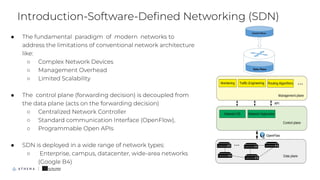
● The fundamental paradigm of modern networks to
address the limitations of conventional network architecture
like:
○ Complex Network Devices
○ Management Overhead
○ Limited Scalability
● The control plane (forwarding decision) is decoupled from
the data plane (acts on the forwarding decision)
○ Centralized Network Controller
○ Standard communication Interface (OpenFlow),
○ Programmable Open APIs
● SDN is deployed in a wide range of network types:
○ Enterprise, campus, datacenter, wide-area networks
(Google B4)
Introduction-Software-Defined Networking (SDN)
6
Research Questions
7
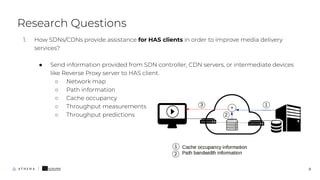
1. How SDNs/CDNs provide assistance for HAS clients in order to improve media delivery
services?
● Send information provided from SDN controller, CDN servers, or intermediate devices
like Reverse Proxy server to HAS client.
○ Network map
○ Path information
○ Cache occupancy
○ Throughput measurements
○ Throughput predictions
Research Questions
8
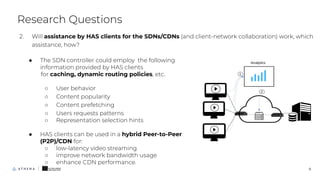
● The SDN controller could employ the following
information provided by HAS clients
for caching, dynamic routing policies, etc.
○ User behavior
○ Content popularity
○ Content prefetching
○ Users requests patterns
○ Representation selection hints
● HAS clients can be used in a hybrid Peer-to-Peer
(P2P)/CDN for:
○ low-latency video streaming
○ improve network bandwidth usage
○ enhance CDN performance.
○
Research Questions
9
2. Will assistance by HAS clients for the SDNs/CDNs (and client-network collaboration) work, which
assistance, how?
3. What is the utility of the proposed assistance and collaboration service?
● QoE parameters:
○ Average quality bitrate, Number of quality switches, Rebuffering, etc.
● CDN utilization:
○ Cache hit rates, Bandwidth/Storage consumption, Server load
● QoS parameters:
○ Delay, Throughput, etc
● Network utilization:
○ Backhaul and transit bandwidth
● SDN controller’s load
○ Messages to/from the controller
● Content providers’ costs
○ Bitrate ladder
4. How can the utility be thoroughly evaluated, both in theoretical and synthetic settings
and in practice?
● Simulation, emulation, and testbed experiments
Research Questions
10
State of the art
11
State of the art
12
● The IETF Working Group ALTO (Application-Layer Traffic Optimization) develops standards:
○ Allow applications to obtain network information(network map and the path costs), for
○ Optimizing server/CDN
○ surrogate selection
○ traffic delivery
● Akamai has a product called NetSession Interface:
○ Support peer-assisted delivery
○ Client-CDN cooperation
○ Software should install on the client device
● Network assistance for HAS clients for “traditional” network architectures.[1]
○ Asynchronous network-to-client and network-to-network communication without any delay
● Network assistance for HAS clients, by utilizing SDN capabilities[2]
● Network assistance for HAS clients through the combined SDN and CDN considerations[3]
[1]E. Thomas, M. O. van Deventer, T. Stockhammer, A. C. Begen, J. Famaey, “Enhancing MPEG DASH Performance via Server and Network Assistance,” SMPTE Motion Imaging Journal, vol. 126, issue 1, Jan.-Feb. 2017.
[2]A. Bentaleb, A. C. Begen, S. Harous, R. Zimmermann, “SDNHAS: An SDN-Enabled Architecture to Optimize QoE in HTTP Adaptive Streaming,” in IEEE Transactions on Multimedia, vol. 19, no. 10, pp. 2136-2151, Oct. 2017.
[3]D. Bhat, A. Rizk, M. Zink, R. Steinmetz, “Network Assisted Content Distribution for Adaptive Bitrate Video Streaming,” In Proceedings of the 8th ACM Multimedia Systems Conference (MMSys '17), pp. 62-75, June 2017
13
Publications and ongoing work
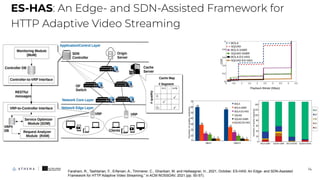
ES-HAS: An Edge- and SDN-Assisted Framework for
HTTP Adaptive Video Streaming
14
Farahani, R., Tashtarian, F., Erfanian, A., Timmerer, C., Ghanbari, M. and Hellwagner, H., 2021, October. ES-HAS: An Edge- and SDN-Assisted
Framework for HTTP Adaptive Video Streaming,” in ACM NOSSDAV, 2021.(pp. 50-57).
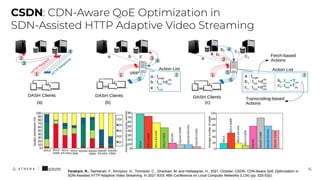
CSDN: CDN-Aware QoE Optimization in
SDN-Assisted HTTP Adaptive Video Streaming
15
Farahani, R., Tashtarian, F., Amirpour, H., Timmerer, C., Ghanbari, M. and Hellwagner, H., 2021, October. CSDN: CDN-Aware QoE Optimization in
SDN-Assisted HTTP Adaptive Video Streaming. In 2021 IEEE 46th Conference on Local Computer Networks (LCN) (pp. 525-532).
● Devise Network-assisted systems for HAS clients that uses edge collaboration
technique
● Devise a Hybrid P2P/CDN system to provide low latency live video streaming service
● Deploy a network-assisted HAS system to improve users’ QoE by optimizing the set of
video representations
Ongoing and future Work
All rights reserved. ©2020 16
Thank you for your attention
reza.farahani@aau.at | https://athena.itec.aau.at/
All rights reserved. ©2020
17

MMSys'21 DS- RezaFarahani.pdf

  • 1.
    CDN and SDNSupport and Player Interaction for HTTP Adaptive Video Streaming ACM MMSys 2021 Doctoral Symposium September 30th , 2021 Reza Farahani reza.farahani@aau.at | https://athena.itec.aau.at/
  • 2.
    2 Agenda ● Introduction ● ResearchQuestions ● State of the art ● Publications and future work
  • 3.
  • 4.
    ● Video traffichas become the dominant traffic over the Internet. ● It is expected to reach more than 82% of all Internet traffic by 2022 [1]. ● HTTP adaptive streaming (HAS) has been considered as the de-facto video delivery technology over the Internet. Introduction-Video Streaming 4 [1] Cisco. Global - 2021 Forecast Highlights. https://www.cisco.com/c/dam/m/en_us/solutions/service-provider/vni-forecast-highlights/pdf/Global_2021_Forecast_Highlights.pddf
  • 5.
    ● The adaptationprocess can be performed with different schemes: ○ Pure client-based: ■ The decision based on the local parameters, e.g., ● buffer status ● estimated available bandwidth ■ Insufficient information about the network ● It can lead to a suboptimal adaptation decision ○ Network-assisted: ■ The decision is performed via a centralized network component with a global view of the entire network topology. ■ can be more beneficial for the users’ QoE ● Fundamental paradigms of modern networks, i.e., SDN, NFV, edge computing have been used in modern network-assisted frameworks Introduction- Network-assisted video streaming 5
  • 6.
    ● The fundamentalparadigm of modern networks to address the limitations of conventional network architecture like: ○ Complex Network Devices ○ Management Overhead ○ Limited Scalability ● The control plane (forwarding decision) is decoupled from the data plane (acts on the forwarding decision) ○ Centralized Network Controller ○ Standard communication Interface (OpenFlow), ○ Programmable Open APIs ● SDN is deployed in a wide range of network types: ○ Enterprise, campus, datacenter, wide-area networks (Google B4) Introduction-Software-Defined Networking (SDN) 6
  • 7.
  • 8.
    1. How SDNs/CDNsprovide assistance for HAS clients in order to improve media delivery services? ● Send information provided from SDN controller, CDN servers, or intermediate devices like Reverse Proxy server to HAS client. ○ Network map ○ Path information ○ Cache occupancy ○ Throughput measurements ○ Throughput predictions Research Questions 8
  • 9.
    ● The SDNcontroller could employ the following information provided by HAS clients for caching, dynamic routing policies, etc. ○ User behavior ○ Content popularity ○ Content prefetching ○ Users requests patterns ○ Representation selection hints ● HAS clients can be used in a hybrid Peer-to-Peer (P2P)/CDN for: ○ low-latency video streaming ○ improve network bandwidth usage ○ enhance CDN performance. ○ Research Questions 9 2. Will assistance by HAS clients for the SDNs/CDNs (and client-network collaboration) work, which assistance, how?
  • 10.
    3. What isthe utility of the proposed assistance and collaboration service? ● QoE parameters: ○ Average quality bitrate, Number of quality switches, Rebuffering, etc. ● CDN utilization: ○ Cache hit rates, Bandwidth/Storage consumption, Server load ● QoS parameters: ○ Delay, Throughput, etc ● Network utilization: ○ Backhaul and transit bandwidth ● SDN controller’s load ○ Messages to/from the controller ● Content providers’ costs ○ Bitrate ladder 4. How can the utility be thoroughly evaluated, both in theoretical and synthetic settings and in practice? ● Simulation, emulation, and testbed experiments Research Questions 10
  • 11.
  • 12.
    State of theart 12 ● The IETF Working Group ALTO (Application-Layer Traffic Optimization) develops standards: ○ Allow applications to obtain network information(network map and the path costs), for ○ Optimizing server/CDN ○ surrogate selection ○ traffic delivery ● Akamai has a product called NetSession Interface: ○ Support peer-assisted delivery ○ Client-CDN cooperation ○ Software should install on the client device ● Network assistance for HAS clients for “traditional” network architectures.[1] ○ Asynchronous network-to-client and network-to-network communication without any delay ● Network assistance for HAS clients, by utilizing SDN capabilities[2] ● Network assistance for HAS clients through the combined SDN and CDN considerations[3] [1]E. Thomas, M. O. van Deventer, T. Stockhammer, A. C. Begen, J. Famaey, “Enhancing MPEG DASH Performance via Server and Network Assistance,” SMPTE Motion Imaging Journal, vol. 126, issue 1, Jan.-Feb. 2017. [2]A. Bentaleb, A. C. Begen, S. Harous, R. Zimmermann, “SDNHAS: An SDN-Enabled Architecture to Optimize QoE in HTTP Adaptive Streaming,” in IEEE Transactions on Multimedia, vol. 19, no. 10, pp. 2136-2151, Oct. 2017. [3]D. Bhat, A. Rizk, M. Zink, R. Steinmetz, “Network Assisted Content Distribution for Adaptive Bitrate Video Streaming,” In Proceedings of the 8th ACM Multimedia Systems Conference (MMSys '17), pp. 62-75, June 2017
  • 13.
  • 14.
    ES-HAS: An Edge-and SDN-Assisted Framework for HTTP Adaptive Video Streaming 14 Farahani, R., Tashtarian, F., Erfanian, A., Timmerer, C., Ghanbari, M. and Hellwagner, H., 2021, October. ES-HAS: An Edge- and SDN-Assisted Framework for HTTP Adaptive Video Streaming,” in ACM NOSSDAV, 2021.(pp. 50-57).
  • 15.
    CSDN: CDN-Aware QoEOptimization in SDN-Assisted HTTP Adaptive Video Streaming 15 Farahani, R., Tashtarian, F., Amirpour, H., Timmerer, C., Ghanbari, M. and Hellwagner, H., 2021, October. CSDN: CDN-Aware QoE Optimization in SDN-Assisted HTTP Adaptive Video Streaming. In 2021 IEEE 46th Conference on Local Computer Networks (LCN) (pp. 525-532).
  • 16.
    ● Devise Network-assistedsystems for HAS clients that uses edge collaboration technique ● Devise a Hybrid P2P/CDN system to provide low latency live video streaming service ● Deploy a network-assisted HAS system to improve users’ QoE by optimizing the set of video representations Ongoing and future Work All rights reserved. ©2020 16
  • 17.
    Thank you foryour attention reza.farahani@aau.at | https://athena.itec.aau.at/ All rights reserved. ©2020 17