All rights reserved. ©2020
QoE- and Energy-aware Content Consumption for
HTTP Adaptive Streaming
ACM MMSys ’23 - Doctoral Symposium
June 8th
, 2023 - Vancouver, Canada
Daniele Lorenzi
1
All rights reserved. ©2020
● Introduction
● Research Questions
● Existing Results
● Publications and Ongoing Work
● Schedule & Work Plan
● Q&A
Agenda
All rights reserved. ©2020
2
Introduction
All rights reserved. ©2020
3
All rights reserved. ©2020
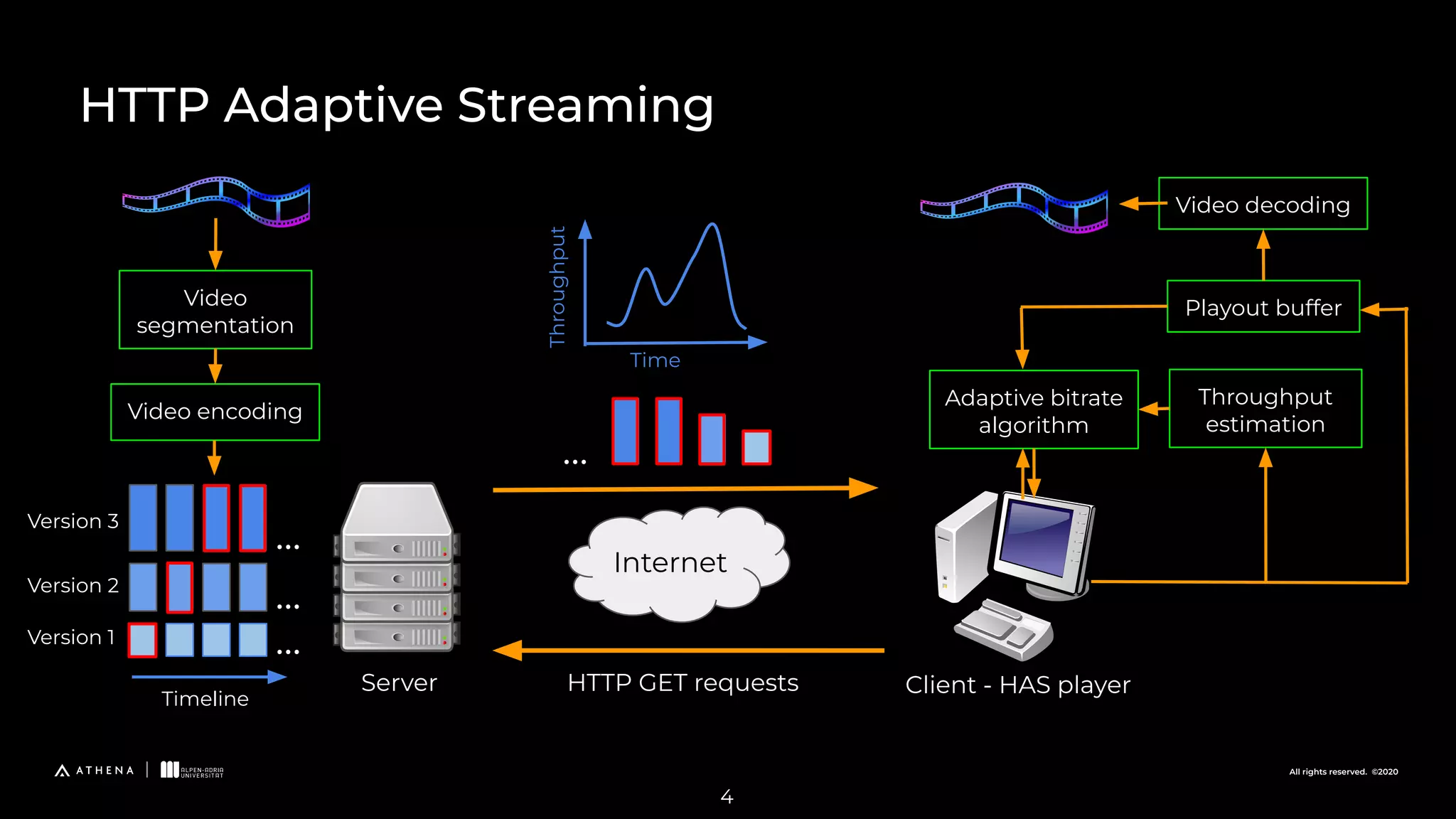
HTTP Adaptive Streaming
4
Video
segmentation
Video encoding
...
...
...
Server Client - HAS player
Adaptive bitrate
algorithm
Throughput
estimation
Playout buffer
Video decoding
...
HTTP GET requests
Version 3
Version 2
Version 1
Internet
Throughput
Time
Timeline
All rights reserved. ©2020
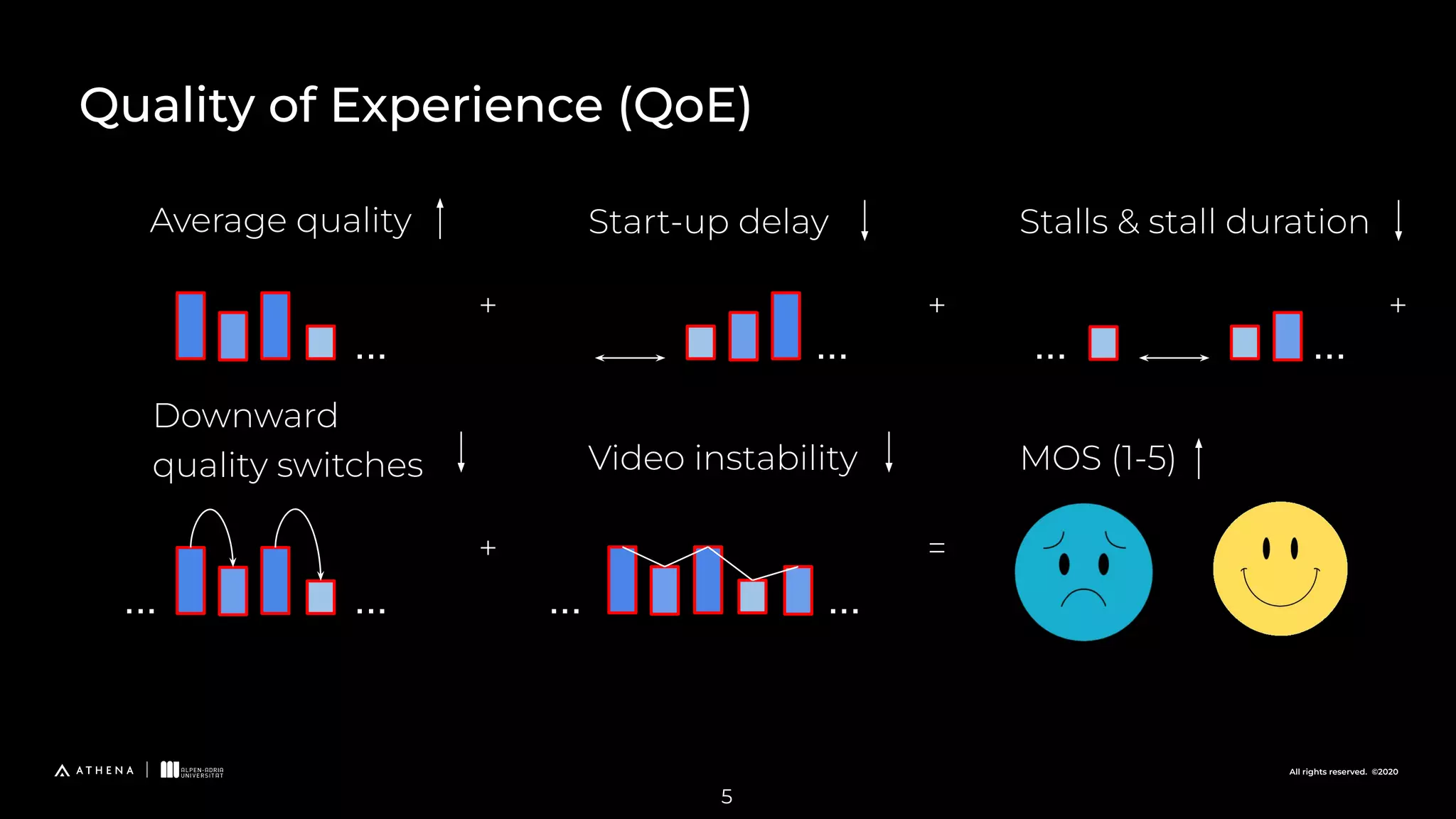
Quality of Experience (QoE)
5
Average quality Start-up delay Stalls & stall duration
Downward
quality switches Video instability
...
...
... ...
...
... ...
...
+ + +
+ =
MOS (1-5)
Research Questions
All rights reserved. ©2020
6
All rights reserved. ©2020
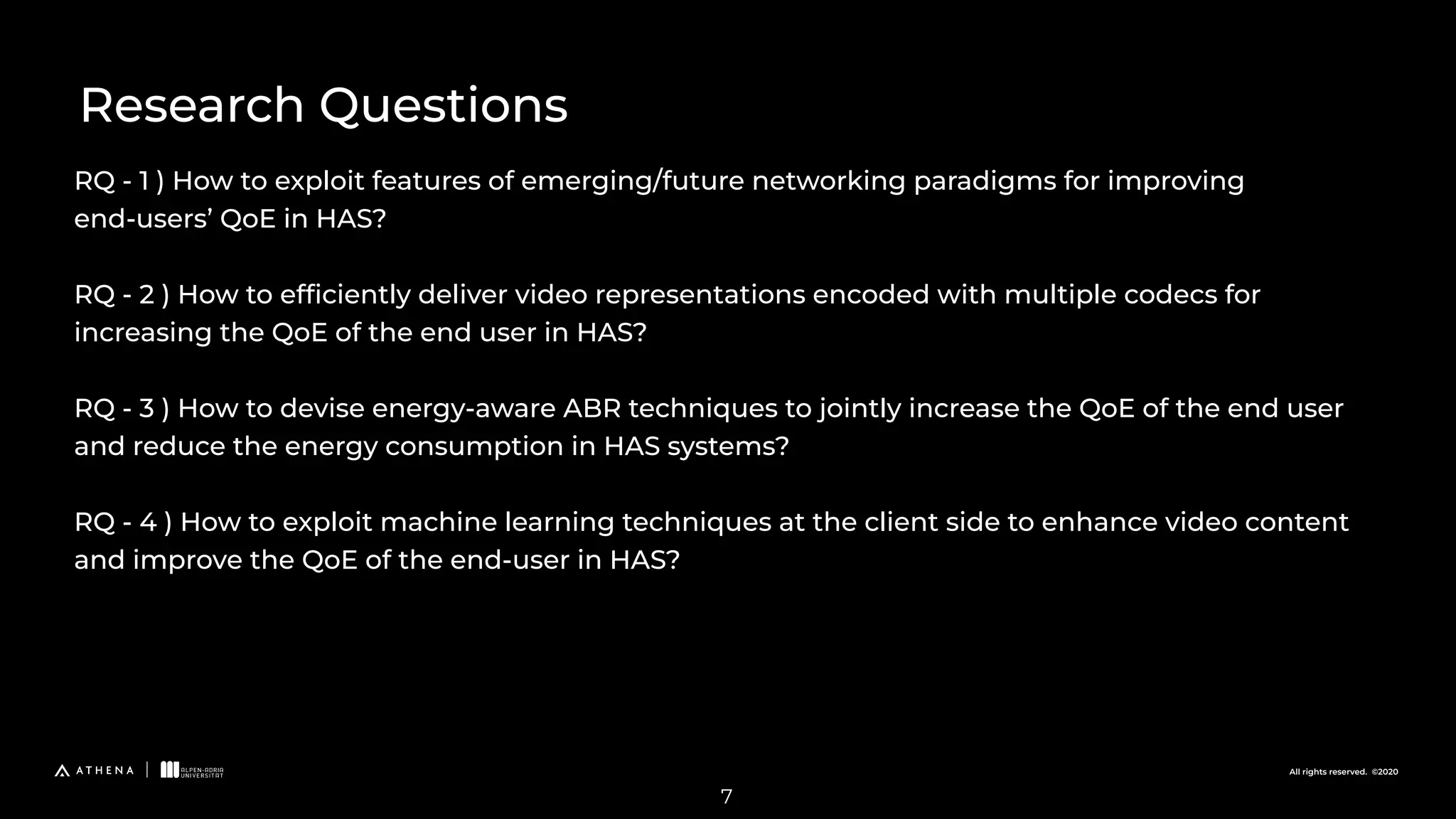
RQ - 1 ) How to exploit features of emerging/future networking paradigms for improving
end-users’ QoE in HAS?
RQ - 2 ) How to efficiently deliver video representations encoded with multiple codecs for
increasing the QoE of the end user in HAS?
RQ - 3 ) How to devise energy-aware ABR techniques to jointly increase the QoE of the end user
and reduce the energy consumption in HAS systems?
RQ - 4 ) How to exploit machine learning techniques at the client side to enhance video content
and improve the QoE of the end-user in HAS?
Research Questions
7
All rights reserved. ©2020
RQ - 1 ) How to exploit features of emerging/future networking paradigms for improving end-users’
QoE in HAS?
Related Work in Literature
1
M. Nguyen, et. al. (2020) “H2BR: An HTTP/2-based Retransmission Technique to Improve the QoE of Adaptive Video Streaming”. In Proceedings of the 25th Packet Video Workshop.
1–7.
2
Perna, Gianluca et. al. (2022). “A first look at HTTP/3 adoption and performance”. Computer Communications 187, 115–124.
8
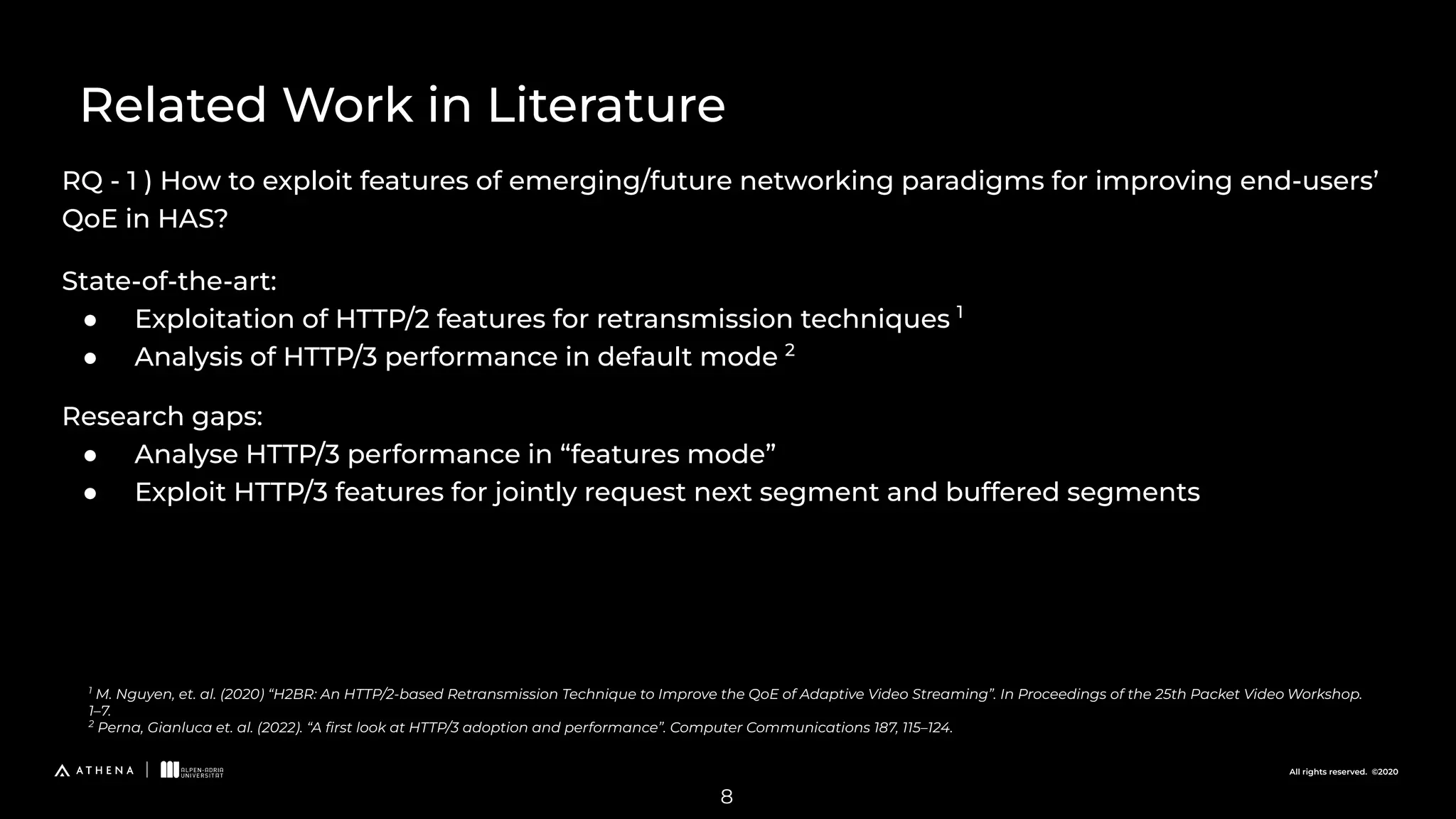
State-of-the-art:
● Exploitation of HTTP/2 features for retransmission techniques 1
● Analysis of HTTP/3 performance in default mode 2
Research gaps:
● Analyse HTTP/3 performance in “features mode”
● Exploit HTTP/3 features for jointly request next segment and buffered segments
All rights reserved. ©2020
RQ - 2 ) How to efficiently deliver video representations encoded with multiple codecs for increasing
the QoE of the end user in HAS?
Related Work in Literature
3
Zabrovskiy, Anatoliy, et. al. (2018) “A Practical Evaluation of Video Codecs for Large-Scale HTTP Adaptive Streaming Services.” In 2018 25th IEEE International Conference on Image
Processing (ICIP). 998–1002.
4
Reznik, Yuriy A., et. al. (2019) “Optimal Multi-Codec Adaptive Bitrate Streaming”. In 2019 IEEE International Conference on Multimedia Expo Workshops (ICMEW). 348–353.
9
State-of-the-art:
● Comparison of video codecs’ performances on different contents 3
● Creation of multi-codec bitrate ladders based on network conditions and content complexity 4
Research gaps:
● Deliver video segments with different codecs over time based on segments metadata
● Analyse relationship between video quality and segment size for multiple codecs and
sequences
All rights reserved. ©2020
RQ - 3 ) How to devise energy-aware ABR techniques to jointly increase the QoE of the end user and
reduce the energy consumption in HAS systems?
Related Work in Literature
5
Varghese, Benoy, et. al. (2017) “e-DASH: Modelling an energy-aware DASH player”. In IEEE 18th International Symposium on A World of Wireless, Mobile and Multimedia Networks
(WoWMoM). 1–9.
6
M. Uitto, et. al. (2018) “Towards Energy-Efficient Adaptive Mpeg-Dash Streaming Using Hevc”. In IEEE International Conference on Multimedia Expo Workshops (ICMEW), pp. 1–6.
10
State-of-the-art:
● Energy-aware ABR decision based on bitrate and video brightness 5
● Encode and deliver HEVC segments 6
Research gaps:
● Consider additional video metadata (content complexity, video quality, resolution, codec)
● Analyse effectiveness of video relighting techniques to reduce display brightness impact on
energy consumption
All rights reserved. ©2020
RQ - 4 ) How to exploit machine learning techniques at the client side to enhance video content and
improve the QoE of the end-user in HAS?
Related Work in Literature
7
Robin Rombach et al. “High-Resolution Image Synthesis with Latent Diffusion Models”. In: Proceedings of the IEEE Conference on Computer Vision and Pattern Recognition
(CVPR). 2022.
8
Minh Nguyen, and Ekrem Çetinkaya, et. al. (2022) “Super-Resolution Based Bitrate Adaptation for HTTP Adaptive Streaming for Mobile Devices”. In Proceedings of the 1st
Mile-High Video Conference (Denver, Colorado) (MHV ’22). Association for Computing Machinery, New York, NY, USA, 70–76.
11
State-of-the-art:
● Latent diffusion models for T2I synthesis, in-paint modification, and super-resolution 7
● Fast super-resolution in HAS for mobile devices 8
Research gaps:
● ML-based video frame interpolation techniques for HAS
● Reduce execution time of latent diffusion models for super-resolution on the client
Existing Results
All rights reserved. ©2020
12
All rights reserved. ©2020
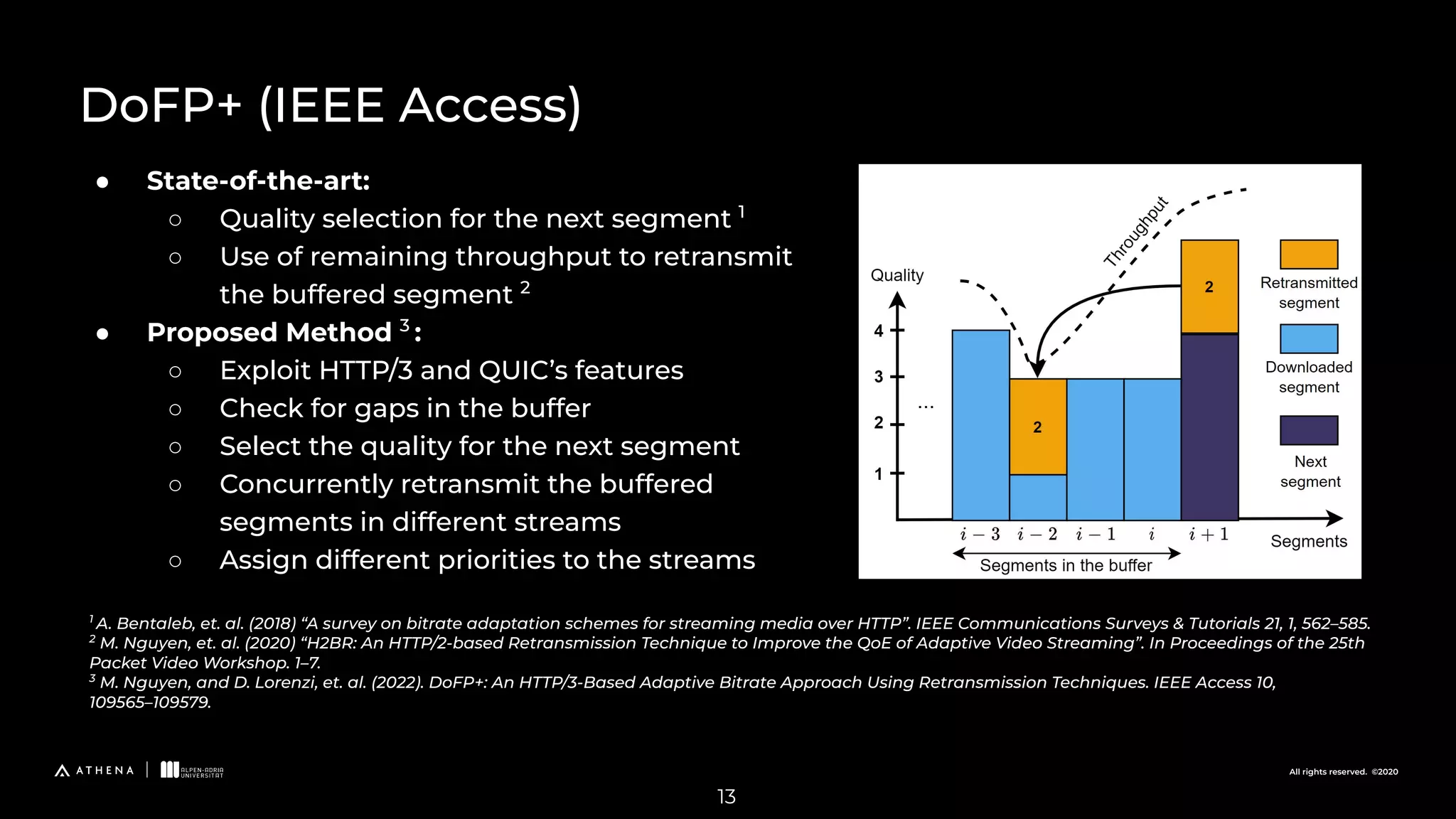
● State-of-the-art:
○ Quality selection for the next segment 1
○ Use of remaining throughput to retransmit
the buffered segment 2
● Proposed Method 3
:
○ Exploit HTTP/3 and QUIC’s features
○ Check for gaps in the buffer
○ Select the quality for the next segment
○ Concurrently retransmit the buffered
segments in different streams
○ Assign different priorities to the streams
1
A. Bentaleb, et. al. (2018) “A survey on bitrate adaptation schemes for streaming media over HTTP”. IEEE Communications Surveys & Tutorials 21, 1, 562–585.
2
M. Nguyen, et. al. (2020) “H2BR: An HTTP/2-based Retransmission Technique to Improve the QoE of Adaptive Video Streaming”. In Proceedings of the 25th
Packet Video Workshop. 1–7.
3
M. Nguyen, and D. Lorenzi, et. al. (2022). DoFP+: An HTTP/3-Based Adaptive Bitrate Approach Using Retransmission Techniques. IEEE Access 10,
109565–109579.
13
DoFP+ (IEEE Access)
All rights reserved. ©2020
14
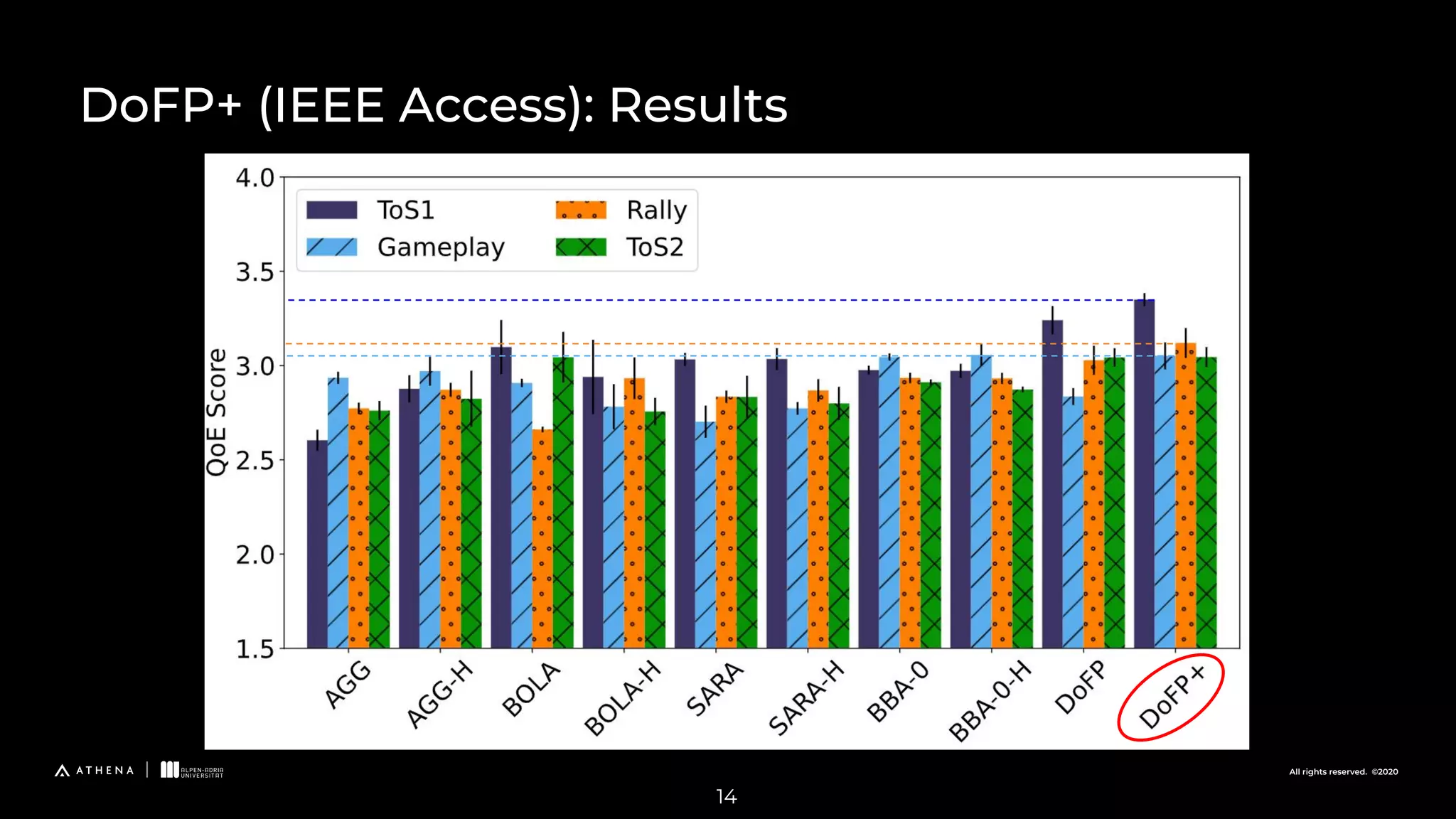
DoFP+ (IEEE Access): Results
All rights reserved. ©2020
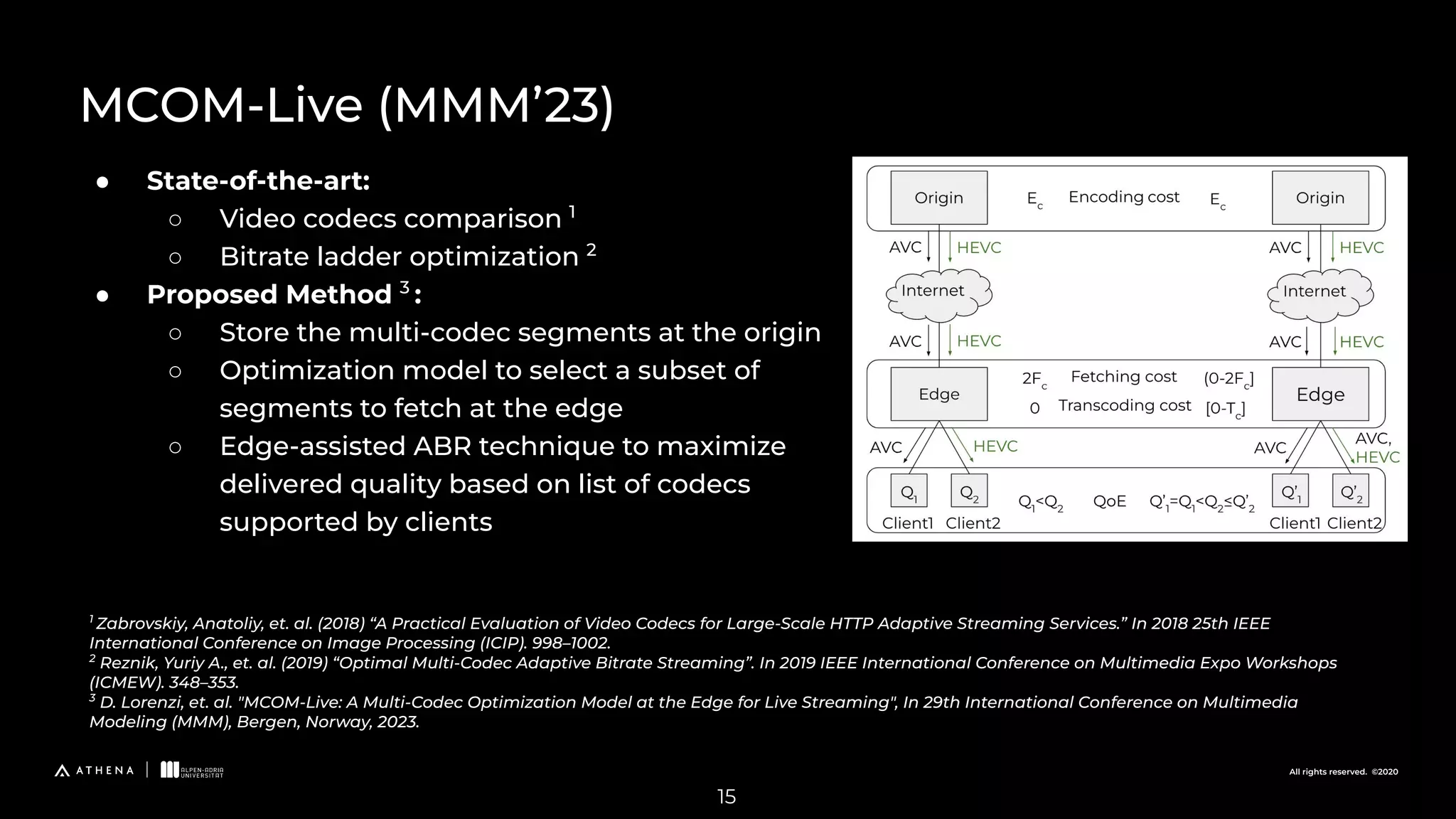
● State-of-the-art:
○ Video codecs comparison 1
○ Bitrate ladder optimization 2
● Proposed Method 3
:
○ Store the multi-codec segments at the origin
○ Optimization model to select a subset of
segments to fetch at the edge
○ Edge-assisted ABR technique to maximize
delivered quality based on list of codecs
supported by clients
1
Zabrovskiy, Anatoliy, et. al. (2018) “A Practical Evaluation of Video Codecs for Large-Scale HTTP Adaptive Streaming Services.” In 2018 25th IEEE
International Conference on Image Processing (ICIP). 998–1002.
2
Reznik, Yuriy A., et. al. (2019) “Optimal Multi-Codec Adaptive Bitrate Streaming”. In 2019 IEEE International Conference on Multimedia Expo Workshops
(ICMEW). 348–353.
3
D. Lorenzi, et. al. "MCOM-Live: A Multi-Codec Optimization Model at the Edge for Live Streaming", In 29th International Conference on Multimedia
Modeling (MMM), Bergen, Norway, 2023.
15
MCOM-Live (MMM’23)
All rights reserved. ©2020
16
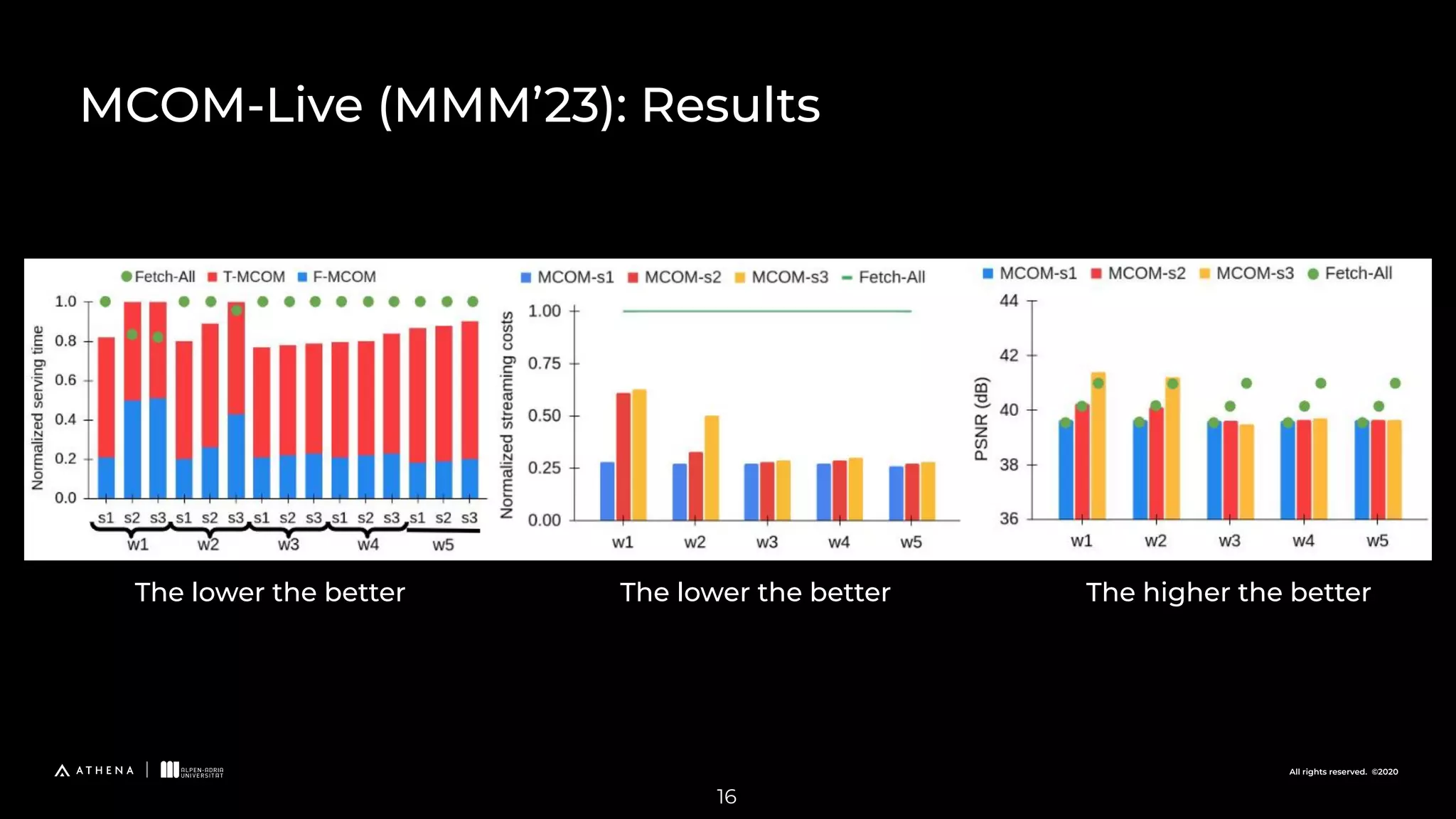
MCOM-Live (MMM’23): Results
The lower the better The lower the better The higher the better
Publications & Ongoing Work
All rights reserved. ©2020
17
All rights reserved. ©2020
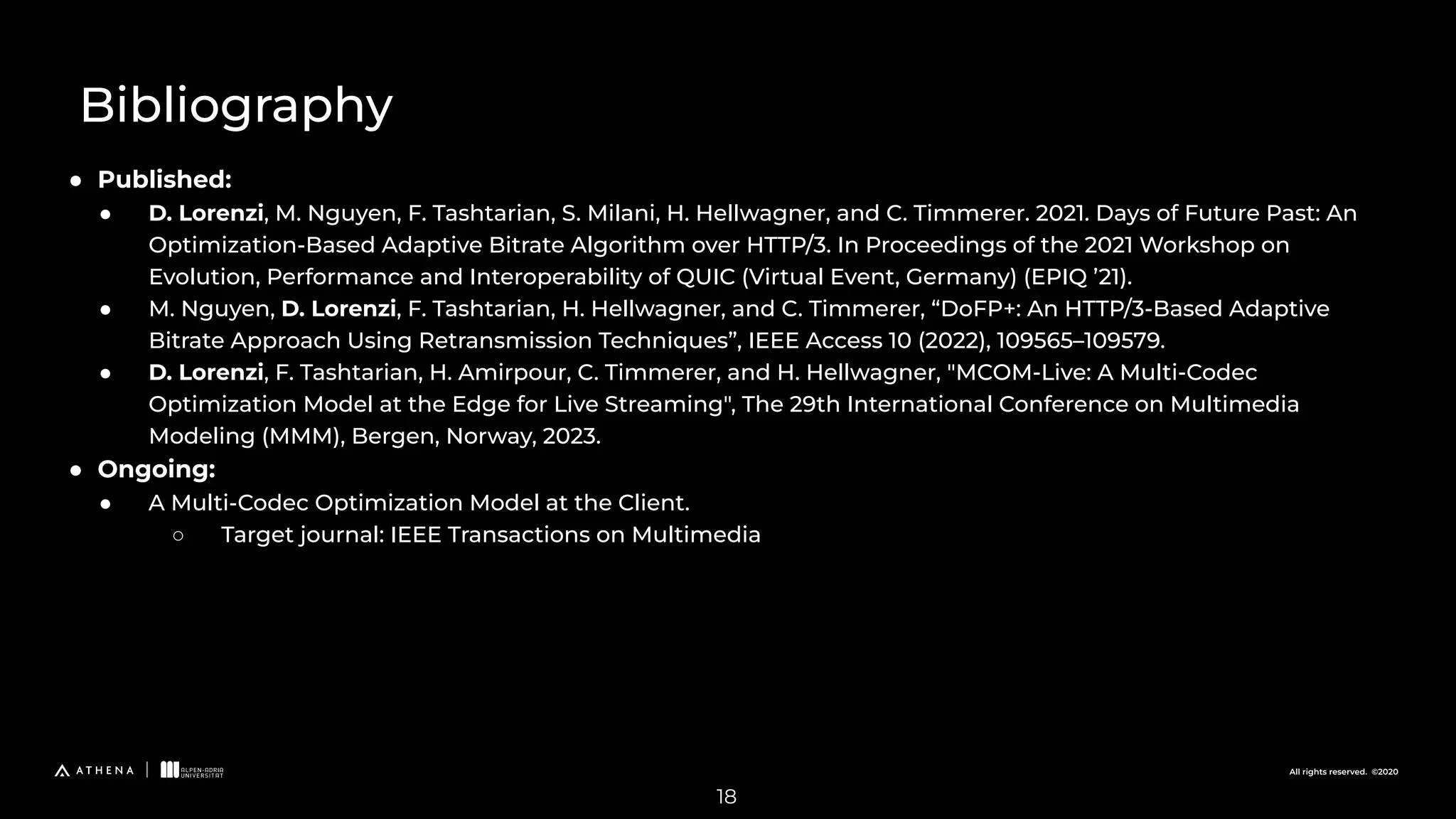
● Published:
● D. Lorenzi, M. Nguyen, F. Tashtarian, S. Milani, H. Hellwagner, and C. Timmerer. 2021. Days of Future Past: An
Optimization-Based Adaptive Bitrate Algorithm over HTTP/3. In Proceedings of the 2021 Workshop on
Evolution, Performance and Interoperability of QUIC (Virtual Event, Germany) (EPIQ ’21).
● M. Nguyen, D. Lorenzi, F. Tashtarian, H. Hellwagner, and C. Timmerer, “DoFP+: An HTTP/3-Based Adaptive
Bitrate Approach Using Retransmission Techniques”, IEEE Access 10 (2022), 109565–109579.
● D. Lorenzi, F. Tashtarian, H. Amirpour, C. Timmerer, and H. Hellwagner, "MCOM-Live: A Multi-Codec
Optimization Model at the Edge for Live Streaming", The 29th International Conference on Multimedia
Modeling (MMM), Bergen, Norway, 2023.
● Ongoing:
● A Multi-Codec Optimization Model at the Client.
○ Target journal: IEEE Transactions on Multimedia
Bibliography
18
All rights reserved. ©2020
19
1
http://www.conferenceranks.com/
2
http://www.guide2research.com/
3
https://www.scimagojr.com/journalrank.php?type=j
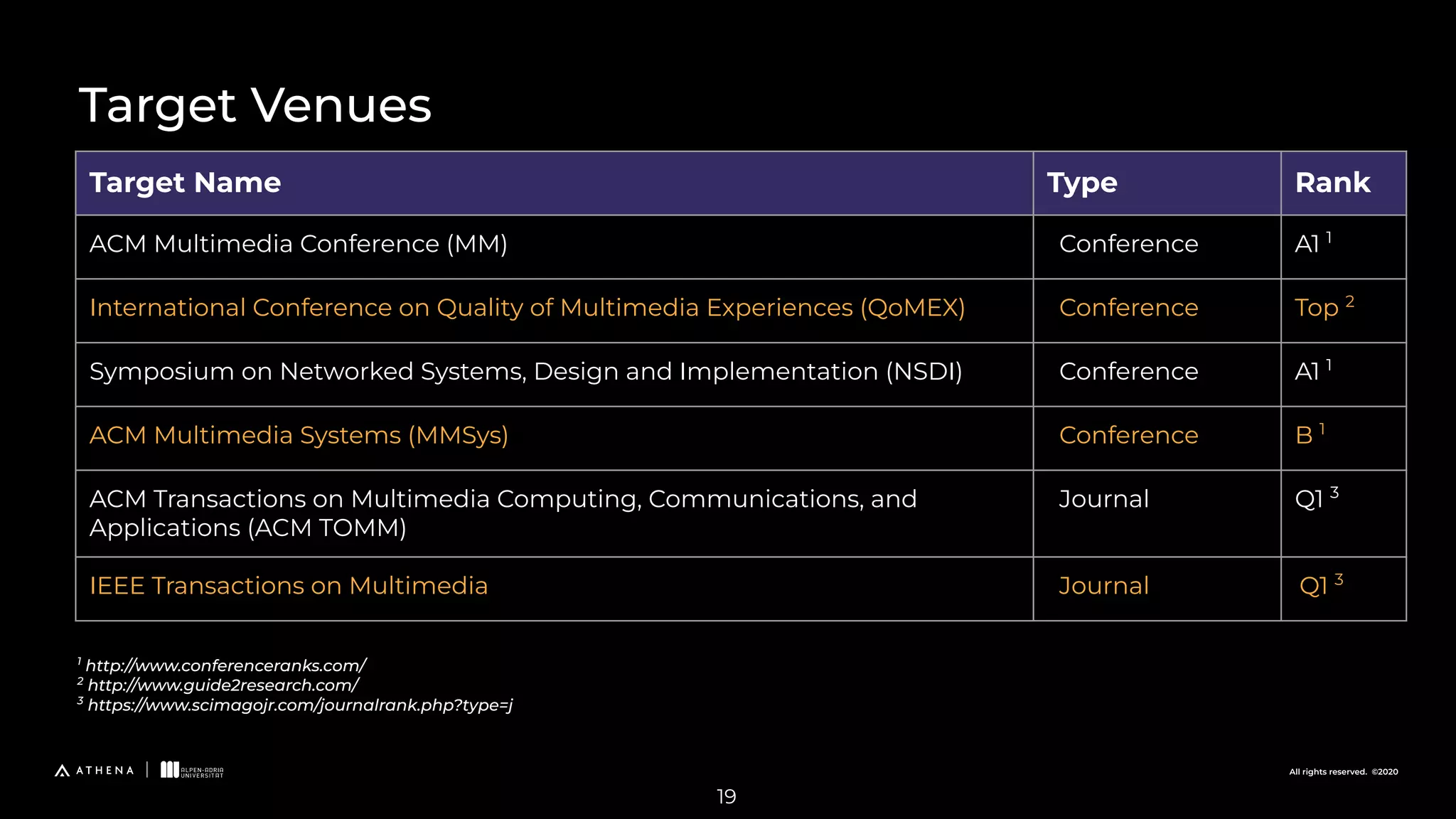
Target Venues
Target Name Type Rank
ACM Multimedia Conference (MM) Conference A1 1
International Conference on Quality of Multimedia Experiences (QoMEX) Conference Top 2
Symposium on Networked Systems, Design and Implementation (NSDI) Conference A1 1
ACM Multimedia Systems (MMSys) Conference B 1
ACM Transactions on Multimedia Computing, Communications, and
Applications (ACM TOMM)
Journal Q1 3
IEEE Transactions on Multimedia Journal Q1 3
Schedule & Work Plan
All rights reserved. ©2020
20
All rights reserved. ©2020
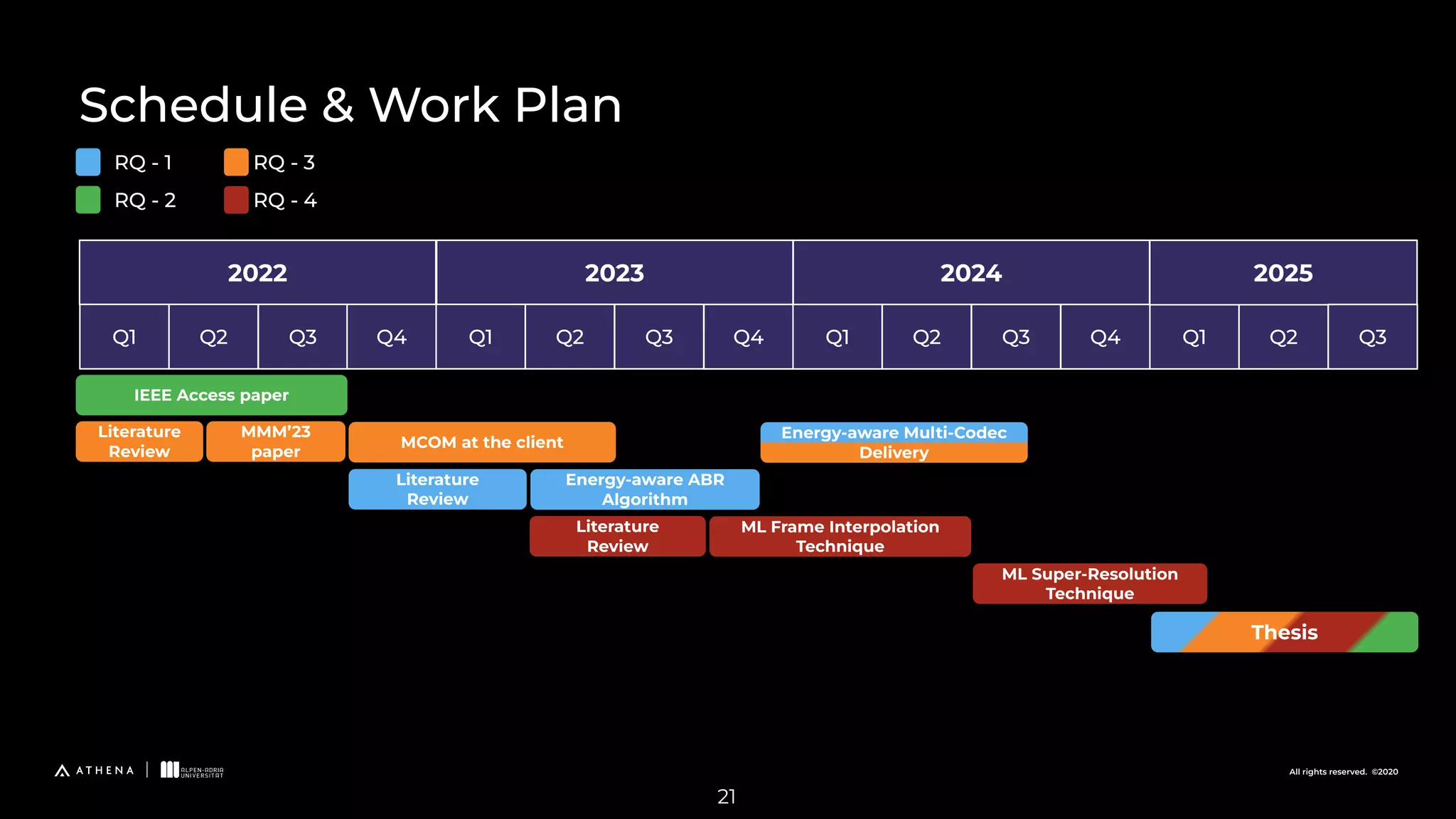
Schedule & Work Plan
2022 2023 2024
Q1 Q2 Q3 Q4 Q1 Q2 Q3 Q4 Q1 Q2 Q3 Q4 Q1 Q2
Literature
Review
IEEE Access paper
RQ - 1
RQ - 2
RQ - 3
RQ - 4
MCOM at the client
Literature
Review
ML Frame Interpolation
Technique
2025
Thesis
Energy-aware ABR
Algorithm
Literature
Review
21
Q3
MMM’23
paper
ML Super-Resolution
Technique
Energy-aware Multi-Codec
Delivery
Q&A
All rights reserved. ©2020
22

QoE- and Energy-aware Content Consumption for HTTP Adaptive Streaming

  • 1.
    All rights reserved.©2020 All rights reserved. ©2020 QoE- and Energy-aware Content Consumption for HTTP Adaptive Streaming ACM MMSys ’23 - Doctoral Symposium June 8th , 2023 - Vancouver, Canada Daniele Lorenzi 1
  • 2.
    All rights reserved.©2020 ● Introduction ● Research Questions ● Existing Results ● Publications and Ongoing Work ● Schedule & Work Plan ● Q&A Agenda All rights reserved. ©2020 2
  • 3.
  • 4.
    All rights reserved.©2020 HTTP Adaptive Streaming 4 Video segmentation Video encoding ... ... ... Server Client - HAS player Adaptive bitrate algorithm Throughput estimation Playout buffer Video decoding ... HTTP GET requests Version 3 Version 2 Version 1 Internet Throughput Time Timeline
  • 5.
    All rights reserved.©2020 Quality of Experience (QoE) 5 Average quality Start-up delay Stalls & stall duration Downward quality switches Video instability ... ... ... ... ... ... ... ... + + + + = MOS (1-5)
  • 6.
  • 7.
    All rights reserved.©2020 RQ - 1 ) How to exploit features of emerging/future networking paradigms for improving end-users’ QoE in HAS? RQ - 2 ) How to efficiently deliver video representations encoded with multiple codecs for increasing the QoE of the end user in HAS? RQ - 3 ) How to devise energy-aware ABR techniques to jointly increase the QoE of the end user and reduce the energy consumption in HAS systems? RQ - 4 ) How to exploit machine learning techniques at the client side to enhance video content and improve the QoE of the end-user in HAS? Research Questions 7
  • 8.
    All rights reserved.©2020 RQ - 1 ) How to exploit features of emerging/future networking paradigms for improving end-users’ QoE in HAS? Related Work in Literature 1 M. Nguyen, et. al. (2020) “H2BR: An HTTP/2-based Retransmission Technique to Improve the QoE of Adaptive Video Streaming”. In Proceedings of the 25th Packet Video Workshop. 1–7. 2 Perna, Gianluca et. al. (2022). “A first look at HTTP/3 adoption and performance”. Computer Communications 187, 115–124. 8 State-of-the-art: ● Exploitation of HTTP/2 features for retransmission techniques 1 ● Analysis of HTTP/3 performance in default mode 2 Research gaps: ● Analyse HTTP/3 performance in “features mode” ● Exploit HTTP/3 features for jointly request next segment and buffered segments
  • 9.
    All rights reserved.©2020 RQ - 2 ) How to efficiently deliver video representations encoded with multiple codecs for increasing the QoE of the end user in HAS? Related Work in Literature 3 Zabrovskiy, Anatoliy, et. al. (2018) “A Practical Evaluation of Video Codecs for Large-Scale HTTP Adaptive Streaming Services.” In 2018 25th IEEE International Conference on Image Processing (ICIP). 998–1002. 4 Reznik, Yuriy A., et. al. (2019) “Optimal Multi-Codec Adaptive Bitrate Streaming”. In 2019 IEEE International Conference on Multimedia Expo Workshops (ICMEW). 348–353. 9 State-of-the-art: ● Comparison of video codecs’ performances on different contents 3 ● Creation of multi-codec bitrate ladders based on network conditions and content complexity 4 Research gaps: ● Deliver video segments with different codecs over time based on segments metadata ● Analyse relationship between video quality and segment size for multiple codecs and sequences
  • 10.
    All rights reserved.©2020 RQ - 3 ) How to devise energy-aware ABR techniques to jointly increase the QoE of the end user and reduce the energy consumption in HAS systems? Related Work in Literature 5 Varghese, Benoy, et. al. (2017) “e-DASH: Modelling an energy-aware DASH player”. In IEEE 18th International Symposium on A World of Wireless, Mobile and Multimedia Networks (WoWMoM). 1–9. 6 M. Uitto, et. al. (2018) “Towards Energy-Efficient Adaptive Mpeg-Dash Streaming Using Hevc”. In IEEE International Conference on Multimedia Expo Workshops (ICMEW), pp. 1–6. 10 State-of-the-art: ● Energy-aware ABR decision based on bitrate and video brightness 5 ● Encode and deliver HEVC segments 6 Research gaps: ● Consider additional video metadata (content complexity, video quality, resolution, codec) ● Analyse effectiveness of video relighting techniques to reduce display brightness impact on energy consumption
  • 11.
    All rights reserved.©2020 RQ - 4 ) How to exploit machine learning techniques at the client side to enhance video content and improve the QoE of the end-user in HAS? Related Work in Literature 7 Robin Rombach et al. “High-Resolution Image Synthesis with Latent Diffusion Models”. In: Proceedings of the IEEE Conference on Computer Vision and Pattern Recognition (CVPR). 2022. 8 Minh Nguyen, and Ekrem Çetinkaya, et. al. (2022) “Super-Resolution Based Bitrate Adaptation for HTTP Adaptive Streaming for Mobile Devices”. In Proceedings of the 1st Mile-High Video Conference (Denver, Colorado) (MHV ’22). Association for Computing Machinery, New York, NY, USA, 70–76. 11 State-of-the-art: ● Latent diffusion models for T2I synthesis, in-paint modification, and super-resolution 7 ● Fast super-resolution in HAS for mobile devices 8 Research gaps: ● ML-based video frame interpolation techniques for HAS ● Reduce execution time of latent diffusion models for super-resolution on the client
  • 12.
    Existing Results All rightsreserved. ©2020 12
  • 13.
    All rights reserved.©2020 ● State-of-the-art: ○ Quality selection for the next segment 1 ○ Use of remaining throughput to retransmit the buffered segment 2 ● Proposed Method 3 : ○ Exploit HTTP/3 and QUIC’s features ○ Check for gaps in the buffer ○ Select the quality for the next segment ○ Concurrently retransmit the buffered segments in different streams ○ Assign different priorities to the streams 1 A. Bentaleb, et. al. (2018) “A survey on bitrate adaptation schemes for streaming media over HTTP”. IEEE Communications Surveys & Tutorials 21, 1, 562–585. 2 M. Nguyen, et. al. (2020) “H2BR: An HTTP/2-based Retransmission Technique to Improve the QoE of Adaptive Video Streaming”. In Proceedings of the 25th Packet Video Workshop. 1–7. 3 M. Nguyen, and D. Lorenzi, et. al. (2022). DoFP+: An HTTP/3-Based Adaptive Bitrate Approach Using Retransmission Techniques. IEEE Access 10, 109565–109579. 13 DoFP+ (IEEE Access)
  • 14.
    All rights reserved.©2020 14 DoFP+ (IEEE Access): Results
  • 15.
    All rights reserved.©2020 ● State-of-the-art: ○ Video codecs comparison 1 ○ Bitrate ladder optimization 2 ● Proposed Method 3 : ○ Store the multi-codec segments at the origin ○ Optimization model to select a subset of segments to fetch at the edge ○ Edge-assisted ABR technique to maximize delivered quality based on list of codecs supported by clients 1 Zabrovskiy, Anatoliy, et. al. (2018) “A Practical Evaluation of Video Codecs for Large-Scale HTTP Adaptive Streaming Services.” In 2018 25th IEEE International Conference on Image Processing (ICIP). 998–1002. 2 Reznik, Yuriy A., et. al. (2019) “Optimal Multi-Codec Adaptive Bitrate Streaming”. In 2019 IEEE International Conference on Multimedia Expo Workshops (ICMEW). 348–353. 3 D. Lorenzi, et. al. "MCOM-Live: A Multi-Codec Optimization Model at the Edge for Live Streaming", In 29th International Conference on Multimedia Modeling (MMM), Bergen, Norway, 2023. 15 MCOM-Live (MMM’23)
  • 16.
    All rights reserved.©2020 16 MCOM-Live (MMM’23): Results The lower the better The lower the better The higher the better
  • 17.
    Publications & OngoingWork All rights reserved. ©2020 17
  • 18.
    All rights reserved.©2020 ● Published: ● D. Lorenzi, M. Nguyen, F. Tashtarian, S. Milani, H. Hellwagner, and C. Timmerer. 2021. Days of Future Past: An Optimization-Based Adaptive Bitrate Algorithm over HTTP/3. In Proceedings of the 2021 Workshop on Evolution, Performance and Interoperability of QUIC (Virtual Event, Germany) (EPIQ ’21). ● M. Nguyen, D. Lorenzi, F. Tashtarian, H. Hellwagner, and C. Timmerer, “DoFP+: An HTTP/3-Based Adaptive Bitrate Approach Using Retransmission Techniques”, IEEE Access 10 (2022), 109565–109579. ● D. Lorenzi, F. Tashtarian, H. Amirpour, C. Timmerer, and H. Hellwagner, "MCOM-Live: A Multi-Codec Optimization Model at the Edge for Live Streaming", The 29th International Conference on Multimedia Modeling (MMM), Bergen, Norway, 2023. ● Ongoing: ● A Multi-Codec Optimization Model at the Client. ○ Target journal: IEEE Transactions on Multimedia Bibliography 18
  • 19.
    All rights reserved.©2020 19 1 http://www.conferenceranks.com/ 2 http://www.guide2research.com/ 3 https://www.scimagojr.com/journalrank.php?type=j Target Venues Target Name Type Rank ACM Multimedia Conference (MM) Conference A1 1 International Conference on Quality of Multimedia Experiences (QoMEX) Conference Top 2 Symposium on Networked Systems, Design and Implementation (NSDI) Conference A1 1 ACM Multimedia Systems (MMSys) Conference B 1 ACM Transactions on Multimedia Computing, Communications, and Applications (ACM TOMM) Journal Q1 3 IEEE Transactions on Multimedia Journal Q1 3
  • 20.
    Schedule & WorkPlan All rights reserved. ©2020 20
  • 21.
    All rights reserved.©2020 Schedule & Work Plan 2022 2023 2024 Q1 Q2 Q3 Q4 Q1 Q2 Q3 Q4 Q1 Q2 Q3 Q4 Q1 Q2 Literature Review IEEE Access paper RQ - 1 RQ - 2 RQ - 3 RQ - 4 MCOM at the client Literature Review ML Frame Interpolation Technique 2025 Thesis Energy-aware ABR Algorithm Literature Review 21 Q3 MMM’23 paper ML Super-Resolution Technique Energy-aware Multi-Codec Delivery
  • 22.