CSDN: CDN-Aware QoE Optimization in SDN-Assisted
HTTP Adaptive Video Streaming
46th
IEEE LCN 2021
October 7th
2021
reza.farahani@aau.at | https://athena.itec.aau.at/
Reza Farahani, Farzad Tashtarian, Hadi Amirpour, Christian Timmerer, Mohammad Ghanbari, Hermann Hellwagner
Agenda
● Introduction
● State of the art
● Motivating example
● Proposed solution
● Evaluation setup
● Experimental results
● Conclusion and Future work
Introduction
3
● Video traffic has become the dominant traffic over the
Internet.
● It is expected to reach more than 82% of all Internet traffic in
2021 [1].
● HTTP adaptive streaming (HAS) has been considered as the
de-facto video delivery technology over the Internet.
Introduction- Video Streaming
4
[1] Cisco. Global - 2021 Forecast Highlights. https://www.cisco.com/c/dam/m/en_us/solutions/service-provider/vni-forecast-highlights/pdf/Global_2021_Forecast_Highlights.pddf
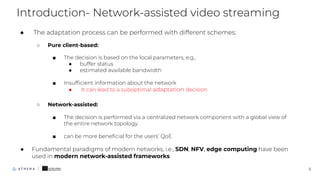
● The adaptation process can be performed with different schemes:
○ Pure client-based:
■ The decision is based on the local parameters, e.g.,
● buffer status
● estimated available bandwidth
■ Insufficient information about the network
● It can lead to a suboptimal adaptation decision
○ Network-assisted:
■ The decision is performed via a centralized network component with a global view of
the entire network topology.
■ can be more beneficial for the users’ QoE
● Fundamental paradigms of modern networks, i.e., SDN, NFV, edge computing have been
used in modern network-assisted frameworks
Introduction- Network-assisted video streaming
5
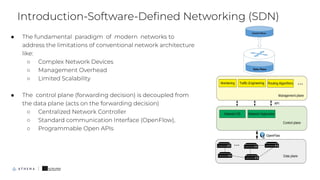
● The fundamental paradigm of modern networks to
address the limitations of conventional network architecture
like:
○ Complex Network Devices
○ Management Overhead
○ Limited Scalability
● The control plane (forwarding decision) is decoupled from
the data plane (acts on the forwarding decision)
○ Centralized Network Controller
○ Standard communication Interface (OpenFlow),
○ Programmable Open APIs
Introduction-Software-Defined Networking (SDN)
6
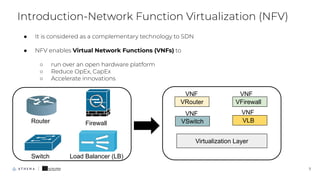
● It is considered as a complementary technology to SDN
● NFV enables Virtual Network Functions (VNFs) to
○ run over an open hardware platform
○ Reduce OpEx, CapEx
○ Accelerate innovations
Introduction-Network Function Virtualization (NFV)
7
Router
Switch Load Balancer (LB)
Firewall
Virtualization Layer
VRouter VFirewall
VSwitch VLB
VNF VNF
VNF VNF
State of the art
8
9
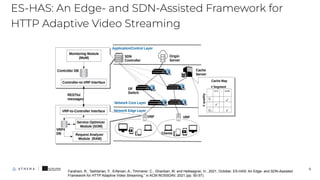
Farahani, R., Tashtarian, F., Erfanian, A., Timmerer, C., Ghanbari, M. and Hellwagner, H., 2021, October. ES-HAS: An Edge- and SDN-Assisted
Framework for HTTP Adaptive Video Streaming,” in ACM NOSSDAV, 2021.(pp. 50-57).
ES-HAS: An Edge- and SDN-Assisted Framework for
HTTP Adaptive Video Streaming
Motivating example
10
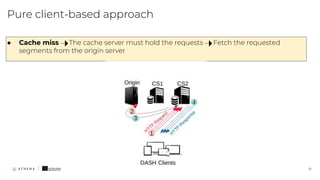
Pure client-based approach
11
● Cache miss The cache server must hold the requests Fetch the requested
segments from the origin server
ES-HAS
12
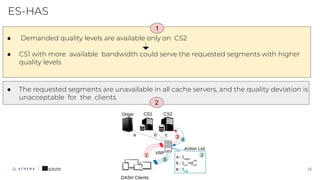
● Demanded quality levels are available only on CS2
● CS1 with more available bandwidth could serve the requested segments with higher
quality levels
● The requested segments are unavailable in all cache servers, and the quality deviation is
unacceptable for the clients
1
2
Proposed solution
13
Proposed solution
14
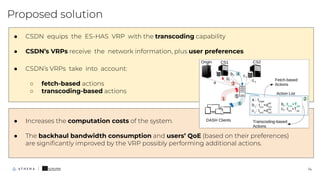
● CSDN equips the ES-HAS VRP with the transcoding capability
● CSDN’s VRPs receive the network information, plus user preferences
● CSDN’s VRPs take into account:
○ fetch-based actions
○ transcoding-based actions
● Increases the computation costs of the system.
● The backhaul bandwidth consumption and users’ QoE (based on their preferences)
are significantly improved by the VRP possibly performing additional actions.
CSDN Architecture
15
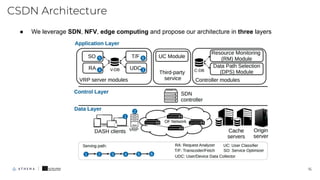
● We leverage SDN, NFV, edge computing and propose our architecture in three layers
Time-slot Structure
16
Server/Segment selection policy
17
Our server/segment policy is :
1. When the requested quality level exist in the cache servers (Cache hit)
○ find the cache server with minimum serving time
● Original requested quality
● Transcoded quality
2. When the requested quality level is not available in any cache server (Cache miss)
○ Use replacement quality from a cache server with minimum fetch time
○ Transcode the original quality from better quality level at the edge
○ fetch the original requested quality from the origin server
Evaluation setup
18
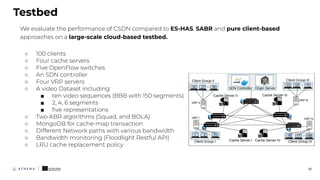
We evaluate the performance of CSDN compared to ES-HAS, SABR and pure client-based
approaches on a large-scale cloud-based testbed.
○ 100 clients
○ Four cache servers
○ Five OpenFlow switches
○ An SDN controller
○ Four VRP servers
○ A video Dataset including:
■ ten video sequences (BBB with 150 segments)
■ 2, 4, 6 segments
■ five representations
○ Two ABR algorithms (Squad, and BOLA)
○ MongoDB for cache-map transaction
○ Different Network paths with various bandwidth
○ Bandwidth monitoring (Floodlight Restful API)
○ LRU cache replacement policy
Testbed
19
Experimental results
20
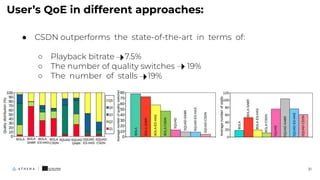
● CSDN outperforms the state-of-the-art in terms of:
○ Playback bitrate 7.5%
○ The number of quality switches 19%
○ The number of stalls 19%
User’s QoE in different approaches:
21
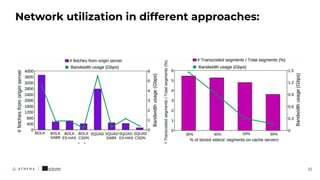
Network utilization in different approaches:
22
23
Conclusion and Future work
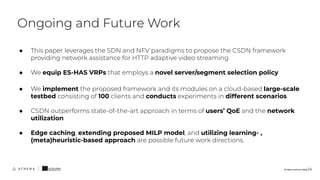
● This paper leverages the SDN and NFV paradigms to propose the CSDN framework
providing network assistance for HTTP adaptive video streaming
● We equip ES-HAS VRPs that employs a novel server/segment selection policy
● We implement the proposed framework and its modules on a cloud-based large-scale
testbed consisting of 100 clients and conducts experiments in different scenarios
● CSDN outperforms state-of-the-art approach in terms of users’ QoE and the network
utilization
● Edge caching, extending proposed MILP model, and utilizing learning- ,
(meta)heuristic-based approach are possible future work directions.
Ongoing and Future Work
All rights reserved. ©2020 24
Thank you for your attention
reza.farahani@aau.at | https://athena.itec.aau.at/
All rights reserved. ©2020
25

CSDN_ CDN-Aware QoE Optimization inSDN-Assisted HTTP Adaptive Video Streaming.pdf

  • 1.
    CSDN: CDN-Aware QoEOptimization in SDN-Assisted HTTP Adaptive Video Streaming 46th IEEE LCN 2021 October 7th 2021 reza.farahani@aau.at | https://athena.itec.aau.at/ Reza Farahani, Farzad Tashtarian, Hadi Amirpour, Christian Timmerer, Mohammad Ghanbari, Hermann Hellwagner
  • 2.
    Agenda ● Introduction ● Stateof the art ● Motivating example ● Proposed solution ● Evaluation setup ● Experimental results ● Conclusion and Future work
  • 3.
  • 4.
    ● Video traffichas become the dominant traffic over the Internet. ● It is expected to reach more than 82% of all Internet traffic in 2021 [1]. ● HTTP adaptive streaming (HAS) has been considered as the de-facto video delivery technology over the Internet. Introduction- Video Streaming 4 [1] Cisco. Global - 2021 Forecast Highlights. https://www.cisco.com/c/dam/m/en_us/solutions/service-provider/vni-forecast-highlights/pdf/Global_2021_Forecast_Highlights.pddf
  • 5.
    ● The adaptationprocess can be performed with different schemes: ○ Pure client-based: ■ The decision is based on the local parameters, e.g., ● buffer status ● estimated available bandwidth ■ Insufficient information about the network ● It can lead to a suboptimal adaptation decision ○ Network-assisted: ■ The decision is performed via a centralized network component with a global view of the entire network topology. ■ can be more beneficial for the users’ QoE ● Fundamental paradigms of modern networks, i.e., SDN, NFV, edge computing have been used in modern network-assisted frameworks Introduction- Network-assisted video streaming 5
  • 6.
    ● The fundamentalparadigm of modern networks to address the limitations of conventional network architecture like: ○ Complex Network Devices ○ Management Overhead ○ Limited Scalability ● The control plane (forwarding decision) is decoupled from the data plane (acts on the forwarding decision) ○ Centralized Network Controller ○ Standard communication Interface (OpenFlow), ○ Programmable Open APIs Introduction-Software-Defined Networking (SDN) 6
  • 7.
    ● It isconsidered as a complementary technology to SDN ● NFV enables Virtual Network Functions (VNFs) to ○ run over an open hardware platform ○ Reduce OpEx, CapEx ○ Accelerate innovations Introduction-Network Function Virtualization (NFV) 7 Router Switch Load Balancer (LB) Firewall Virtualization Layer VRouter VFirewall VSwitch VLB VNF VNF VNF VNF
  • 8.
  • 9.
    9 Farahani, R., Tashtarian,F., Erfanian, A., Timmerer, C., Ghanbari, M. and Hellwagner, H., 2021, October. ES-HAS: An Edge- and SDN-Assisted Framework for HTTP Adaptive Video Streaming,” in ACM NOSSDAV, 2021.(pp. 50-57). ES-HAS: An Edge- and SDN-Assisted Framework for HTTP Adaptive Video Streaming
  • 10.
  • 11.
    Pure client-based approach 11 ●Cache miss The cache server must hold the requests Fetch the requested segments from the origin server
  • 12.
    ES-HAS 12 ● Demanded qualitylevels are available only on CS2 ● CS1 with more available bandwidth could serve the requested segments with higher quality levels ● The requested segments are unavailable in all cache servers, and the quality deviation is unacceptable for the clients 1 2
  • 13.
  • 14.
    Proposed solution 14 ● CSDNequips the ES-HAS VRP with the transcoding capability ● CSDN’s VRPs receive the network information, plus user preferences ● CSDN’s VRPs take into account: ○ fetch-based actions ○ transcoding-based actions ● Increases the computation costs of the system. ● The backhaul bandwidth consumption and users’ QoE (based on their preferences) are significantly improved by the VRP possibly performing additional actions.
  • 15.
    CSDN Architecture 15 ● Weleverage SDN, NFV, edge computing and propose our architecture in three layers
  • 16.
  • 17.
    Server/Segment selection policy 17 Ourserver/segment policy is : 1. When the requested quality level exist in the cache servers (Cache hit) ○ find the cache server with minimum serving time ● Original requested quality ● Transcoded quality 2. When the requested quality level is not available in any cache server (Cache miss) ○ Use replacement quality from a cache server with minimum fetch time ○ Transcode the original quality from better quality level at the edge ○ fetch the original requested quality from the origin server
  • 18.
  • 19.
    We evaluate theperformance of CSDN compared to ES-HAS, SABR and pure client-based approaches on a large-scale cloud-based testbed. ○ 100 clients ○ Four cache servers ○ Five OpenFlow switches ○ An SDN controller ○ Four VRP servers ○ A video Dataset including: ■ ten video sequences (BBB with 150 segments) ■ 2, 4, 6 segments ■ five representations ○ Two ABR algorithms (Squad, and BOLA) ○ MongoDB for cache-map transaction ○ Different Network paths with various bandwidth ○ Bandwidth monitoring (Floodlight Restful API) ○ LRU cache replacement policy Testbed 19
  • 20.
  • 21.
    ● CSDN outperformsthe state-of-the-art in terms of: ○ Playback bitrate 7.5% ○ The number of quality switches 19% ○ The number of stalls 19% User’s QoE in different approaches: 21
  • 22.
    Network utilization indifferent approaches: 22
  • 23.
  • 24.
    ● This paperleverages the SDN and NFV paradigms to propose the CSDN framework providing network assistance for HTTP adaptive video streaming ● We equip ES-HAS VRPs that employs a novel server/segment selection policy ● We implement the proposed framework and its modules on a cloud-based large-scale testbed consisting of 100 clients and conducts experiments in different scenarios ● CSDN outperforms state-of-the-art approach in terms of users’ QoE and the network utilization ● Edge caching, extending proposed MILP model, and utilizing learning- , (meta)heuristic-based approach are possible future work directions. Ongoing and Future Work All rights reserved. ©2020 24
  • 25.
    Thank you foryour attention reza.farahani@aau.at | https://athena.itec.aau.at/ All rights reserved. ©2020 25