Theory of Reasoned Action Theory of Planned Behaviour MKT4025
Value Expectancy 1950s: Growing concern about  Benefit ≠Action (even if logical!) HBM explains some possible factors but it fails to predict a number of other cases.  Consider, for example,  exercise... or healthy eating...
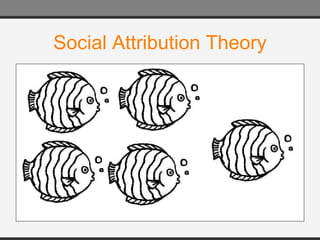
Social Attribution Theory
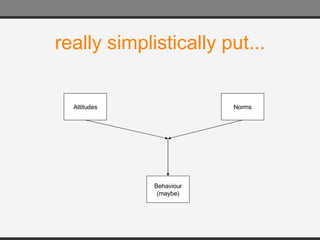
really simplistically put... Attitudes Norms Behaviour (maybe)
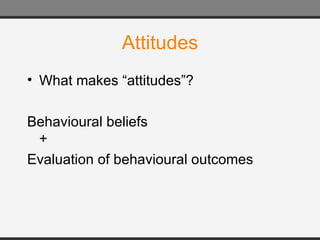
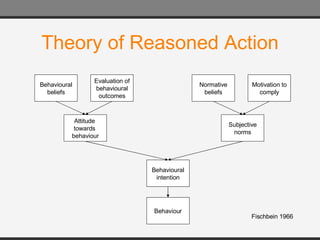
Attitudes What makes “attitudes”? Behavioural beliefs + Evaluation of behavioural outcomes
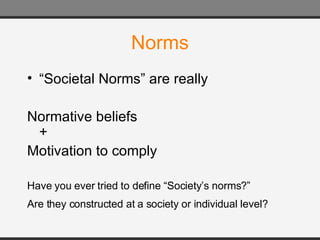
Norms “ Societal Norms” are really Normative beliefs + Motivation to comply Have you ever tried to define “Society’s norms?”  Are they constructed at a society or individual level?
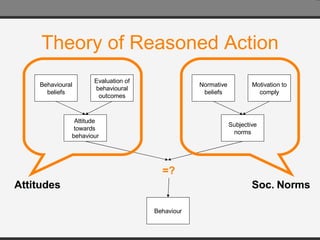
Theory of Reasoned Action Behavioural beliefs Evaluation of behavioural outcomes Attitude  towards  behaviour Normative beliefs Motivation to comply Subjective norms Behaviour Attitudes Soc. Norms =?
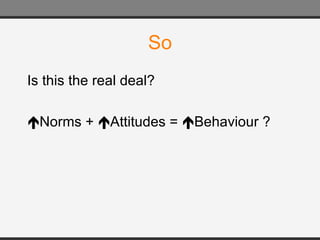
So Is this the real deal?  Norms +   Attitudes =   Behaviour ?
Theory of Reasoned Action Behavioural beliefs Evaluation of behavioural outcomes Attitude  towards  behaviour Normative beliefs Motivation to comply Subjective norms Behavioural intention Behaviour Fischbein 1966
TRA Explains variance between attitudes and behaviour Explains “Intention”- rather than just behaviour
SET Self Efficacy Theory (or concept): “I can actually make this work” May mean psychological attributes as well as physical attributes N.B. It is not about self-esteem and not (necessarily) competence
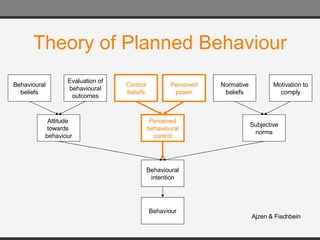
Theory of Planned Behaviour Behavioural beliefs Evaluation of behavioural outcomes Attitude  towards  behaviour Normative beliefs Motivation to comply Subjective norms Behavioural intention Behaviour Ajzen & Fischbein Control beliefs Perceived power Perceived behavioural control
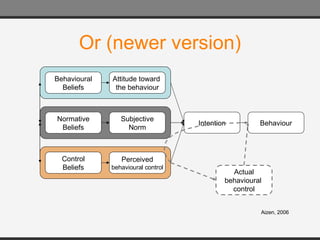
Or (newer version) Aizen, 2006 Behavioural Beliefs Attitude toward  the behaviour Normative Beliefs Subjective Norm Control Beliefs Perceived behavioural control Intention Behaviour Actual behavioural  control
Points to note Used in around 1200 published cases It can predict behavioural outcomes It can guide intervention design, but lacks being a planning model!

Mkt4025 W4

  • 1.
    Theory of ReasonedAction Theory of Planned Behaviour MKT4025
  • 2.
    Value Expectancy 1950s:Growing concern about Benefit ≠Action (even if logical!) HBM explains some possible factors but it fails to predict a number of other cases. Consider, for example, exercise... or healthy eating...
  • 3.
  • 4.
    really simplistically put...Attitudes Norms Behaviour (maybe)
  • 5.
    Attitudes What makes“attitudes”? Behavioural beliefs + Evaluation of behavioural outcomes
  • 6.
    Norms “ SocietalNorms” are really Normative beliefs + Motivation to comply Have you ever tried to define “Society’s norms?” Are they constructed at a society or individual level?
  • 7.
    Theory of ReasonedAction Behavioural beliefs Evaluation of behavioural outcomes Attitude towards behaviour Normative beliefs Motivation to comply Subjective norms Behaviour Attitudes Soc. Norms =?
  • 8.
    So Is thisthe real deal?  Norms +  Attitudes =  Behaviour ?
  • 9.
    Theory of ReasonedAction Behavioural beliefs Evaluation of behavioural outcomes Attitude towards behaviour Normative beliefs Motivation to comply Subjective norms Behavioural intention Behaviour Fischbein 1966
  • 10.
    TRA Explains variancebetween attitudes and behaviour Explains “Intention”- rather than just behaviour
  • 11.
    SET Self EfficacyTheory (or concept): “I can actually make this work” May mean psychological attributes as well as physical attributes N.B. It is not about self-esteem and not (necessarily) competence
  • 12.
    Theory of PlannedBehaviour Behavioural beliefs Evaluation of behavioural outcomes Attitude towards behaviour Normative beliefs Motivation to comply Subjective norms Behavioural intention Behaviour Ajzen & Fischbein Control beliefs Perceived power Perceived behavioural control
  • 13.
    Or (newer version)Aizen, 2006 Behavioural Beliefs Attitude toward the behaviour Normative Beliefs Subjective Norm Control Beliefs Perceived behavioural control Intention Behaviour Actual behavioural control
  • 14.
    Points to noteUsed in around 1200 published cases It can predict behavioural outcomes It can guide intervention design, but lacks being a planning model!