Workshop 2:  Planning Social Marketing Campaigns Dr Stephan Dahl Middlesex University Business School
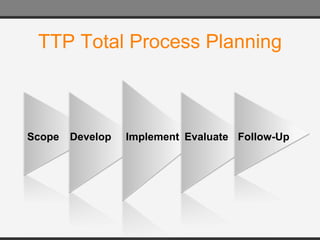
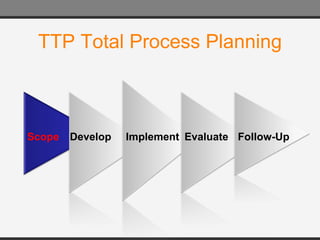
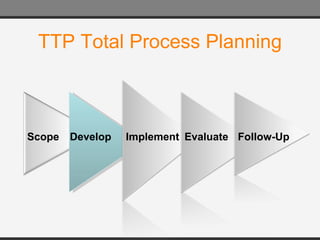
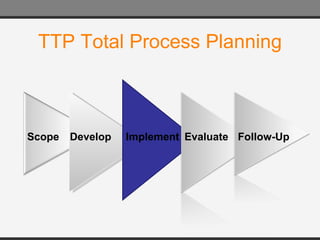
TTP Total Process Planning Scope Develop Implement Evaluate Follow-Up
Scoping Finding out & getting started phase: Expectations Review & Challenge Statement Team & Stakeholder Development SWOT & PEST Analysis Existing Knowledge & Assets Review Profiling & Segmentation Behavioural Analysis Competition Analysis Options Review Goals Establishment
Development Taking shape stage: Further Stakeholder Analysis Further Behavioural Analysis Intervention & Product Development Communication Development Pre-Testing
Implementation Going live phase: Tackling initial responses Dealing with on-going responses Opportunity Spotting Threat Management Continued Stakeholder Engagement Information & Data capture
Evaluation Next workshop theme: Impact Evaluation - Outcomes  - Outputs Process Evaluation Cost Benefit Analysis
Follow-Up Formal Review Stakeholder Review Evaluation Report Next Steps Review/Options Promotion & Exchange
TTP Total Process Planning Scope Develop Implement Evaluate Follow-Up
Scoping: Team & Stakeholder
Segmenting Dividing the market into  homogenous (similar customers)  groups which are  heterogenous (distinct from other groups) “ meaningful population segments”
Steps Identification of key variables Prioritising of variables Drawing up of possible segments Prioritising segments Elimination of segments Combination of segments
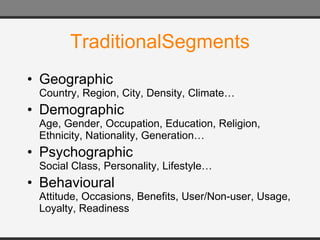
TraditionalSegments Geographic Country, Region, City, Density, Climate… Demographic Age, Gender, Occupation, Education, Religion, Ethnicity, Nationality, Generation… Psychographic Social Class, Personality, Lifestyle… Behavioural Attitude, Occasions, Benefits, User/Non-user, Usage, Loyalty, Readiness
Psychographic Variables SM segmentation tends to  use more behavioural variables  than traditional marketing –  though this depends of course! e.g. Transtheoretical Model can be a good segmentation tool!
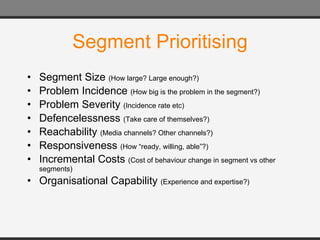
Segment Prioritising Segment Size  (How large? Large enough?) Problem Incidence  (How big is the problem in the segment?) Problem Severity  (Incidence rate etc) Defencelessness  (Take care of themselves?) Reachability  (Media channels? Other channels?) Responsiveness  (How “ready, willing, able”?) Incremental Costs  (Cost of behaviour change in segment vs other segments) Organisational Capability  (Experience and expertise?)
Priority strategies Greatest need first  (size, incidence, severity based) Most ready for action  (responsiveness based) Easiest to reach Best organisational match
Segment derived strategies Undifferentiated/Mass Marketing Wide cross-section of segments (5 a day, seat belts, sun protection) Differentiated Marketing Large scale with priority segments (breast cancer, immunisation etc) Concentrated/Niche Marketing Specialised focus on key segments (HIV prevention for drug users, folic acid for mothers to be)
Segmentation Summary Similar strategies to conventional marketing Though often more behaviour/attitude based Sometimes difficult to prioritise, esp. in an outcome driven environment!
Behavioural Analysis Analysing  behaviour  and importantly the motivational factors!! Indicates ways to change  behaviour Very theory driven!
Some questions to ask What is the  perceived  consequence of unwanted behaviour? What is the  “gain”  of doing unwanted behaviour? How susceptible is the target group to these consequences? How severe does the target group  perceive  these consequences to be? Are there any  currently perceived  consequences of the behaviour?
Behaviour: Exchange Focus What are the perceived  rewards  for - desired behaviour (long life?) - undesired behaviour (fun?) What are the perceived  barriers  for desired behaviour – how can they be removed? What are the “costs”?
Competition Analysis What behaviour is competing for time/attention with desired behaviour? Who is influencing this competition? What are the choice and consequences (= cost?) Competition can be an organisation, something to do – or doing nothing at all!
Make it real! Use exchange & competition analysis to talk about real benefits – not abstract ones e.g.  Smoke Alarms wake you up when there is a fire!  Not: Smoke Alarms save lives!
Scoping Team & Stakeholder Development SWOT & PEST Analysis Existing Knowledge & Assets Review Profiling & Segmentation Behavioural Analysis Competition Analysis Options Review Goals Establishment
TTP Total Process Planning Scope Develop Implement Evaluate Follow-Up
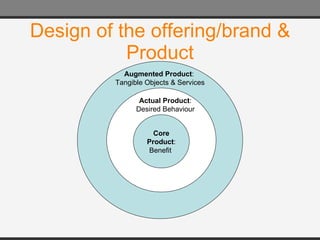
Design of the offering/brand & Product Core Product : Benefit  Actual Product : Desired Behaviour Augmented Product :  Tangible Objects & Services
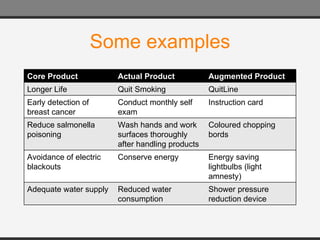
Some examples Core Product Actual Product Augmented Product Longer Life Quit Smoking QuitLine Early detection of breast cancer Conduct monthly self exam Instruction card Reduce salmonella poisoning Wash hands and work surfaces thoroughly after handling products Coloured chopping bords Avoidance of electric blackouts  Conserve energy Energy saving lightbulbs (light amnesty) Adequate water supply Reduced water consumption Shower pressure reduction device
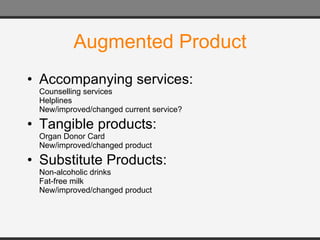
Augmented Product Accompanying services: Counselling services Helplines New/improved/changed current service? Tangible products: Organ Donor Card New/improved/changed product Substitute Products: Non-alcoholic drinks Fat-free milk New/improved/changed product
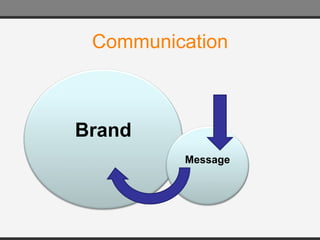
Communication Brand Message
Negative or Positive Appeals? Negative = real solution for problem Fear in particular for easy solutions, for unconcerned target audiences can be used for influencers (parents) Positive = good for means of satisfying personal goal or objective Humour  effective if a unique approach for issue/if suitable! becomes stale fast not for complex messages
The trouble about changing behaviour Be realistic: 50% won’t happen, 5% might! Snyder (2000) report 5-12% for health related campaigns: Twice as likely to take up new behaviour (12%) than change current behaviour (5%) Prevention/screening is around 7%
Pitfalls Focus on long-term health benefits rather than short-term consumer benefits Appealing to non-critical values (good-health) rather than core values (freedom, autonomy, control, independence)
Pitfalls Supporting message with facts alone where  emotional  appeals are more effective Using mass media to convey complex messages Developing strategies for different audiences that conflict or send mixed messages Siegel and Doner, 1998
Good “Brand”: Ideally  Brand=Message=Image Message easier remembered if actionable! Brand & Message: Easy to pronounce, recognise and remember Captures and defines product benefit Defines qualities and appeal of product Distinctive
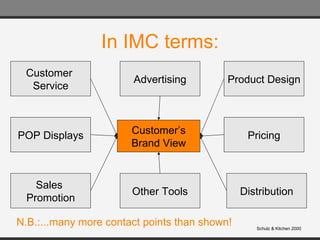
Remember to IMC!! “ a planning process designed to assure that all  brand contacts  received by a customer or prospect for a product, service, or organisation are  relevant  to that person and  consistent  over time.”
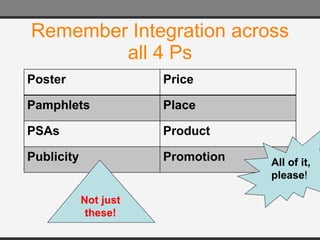
Remember Integration across all 4 Ps Not just these! All of it, please ! Poster Price Pamphlets Place PSAs Product Publicity Promotion
In IMC terms: Customer’s Brand View Customer  Service POP Displays Sales  Promotion Advertising Distribution Pricing Product Design Other Tools Schulz & Kitchen 2000 N.B.:...many more contact points than shown!
In HSM terms? How do we brand our “offering”? Can we in fact brand some “offerings”? How do we achieve brand consistency across multi-agency delivery?
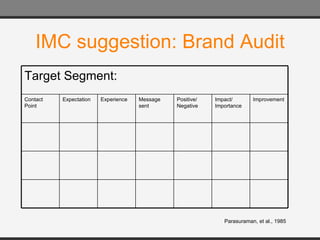
IMC suggestion: Brand Audit Parasuraman, et al., 1985 Target Segment: Contact Point Expectation Experience Message sent Positive/ Negative Impact/ Importance Improvement
Development Taking shape stage: Further Stakeholder Analysis Further Behavioural Analysis Intervention & Product Development Communication Development Pre-Testing
TTP Total Process Planning Scope Develop Implement Evaluate Follow-Up
Tackling responses Monitor  - Primary audience (target group) - Secondary audience (family, community, media) Adjust where necessary  BUT  remember to  stay on target ! ALSO  for new opportunities!
Opportunities & Threats Use new opportunities during implementation (e.g supportive research etc...) Monitor for threats during implementation –  and prepare to deal with it!
Stakeholders Remember to engage the stakeholders: Regular updates Regular engagement Praising & thanking Data capturing
Implementation Going live phase: Tackling initial responses Dealing with on-going responses Opportunity Spotting Threat Management Continued Stakeholder Engagement Information & Data capture
Remember the NSMC Benchmarks 1. Behavioural goals  2. Consumer research  3. Competition analysis  4. Insight driven  5. Articulated exchange  6. Theory data & evidence  7. Targeting and segmentation  8. Marketing mix
Alternative Models May add a few extra steps/pointers
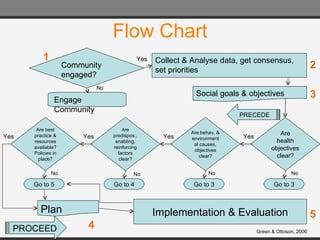
PRECEDE-PROCEED P redisposing,  R einforcing, and  E nabling  C onstructs in  E ducational/Environmental  D iagnosis and  E valuation P olicy,  R egulatory, and  O rganisational  C ontructs in  E ducational and  E nvironmental  D evelopment
Flow Chart Community engaged? Collect & Analyse data, get consensus, set priorities Engage Community Social goals & objectives Are health objectives clear? Go to 3 Yes Are behav. & environmental causes, objectives clear? Go to 3 Yes A re predispos., enabling, reinforcing factors clear? Go to 4 No Yes Are best practice & resources available? Policies in place? Go to 5 Yes Plan Implementation & Evaluation 1 2 3 4 5 No No No No Yes PROCEED PRECEDE Green & Ottoson, 2006
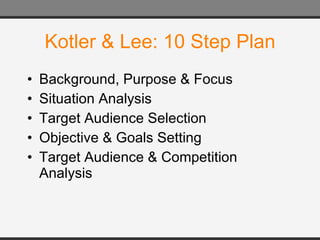
Kotler & Lee: 10 Step Plan Background, Purpose & Focus Situation Analysis Target Audience Selection Objective & Goals Setting Target Audience & Competition Analysis
10 Step Plan (2) Define desired Positioning We want [target audience] to see [desired behaviour] as [descriptive phase] and as more important and beneficial than [competition] Develop Marketing Strategy - Product - Price (Incl. Incentives & Disincentives) - Place (Access) - Promotion (What is said/communicated)
10 Step Plan (3) Evaluation & Monitoring Plan Budget & Funding Sources Implementation Plan

Social Marketing Workshop - Part 2

  • 1.
    Workshop 2: Planning Social Marketing Campaigns Dr Stephan Dahl Middlesex University Business School
  • 2.
    TTP Total ProcessPlanning Scope Develop Implement Evaluate Follow-Up
  • 3.
    Scoping Finding out& getting started phase: Expectations Review & Challenge Statement Team & Stakeholder Development SWOT & PEST Analysis Existing Knowledge & Assets Review Profiling & Segmentation Behavioural Analysis Competition Analysis Options Review Goals Establishment
  • 4.
    Development Taking shapestage: Further Stakeholder Analysis Further Behavioural Analysis Intervention & Product Development Communication Development Pre-Testing
  • 5.
    Implementation Going livephase: Tackling initial responses Dealing with on-going responses Opportunity Spotting Threat Management Continued Stakeholder Engagement Information & Data capture
  • 6.
    Evaluation Next workshoptheme: Impact Evaluation - Outcomes - Outputs Process Evaluation Cost Benefit Analysis
  • 7.
    Follow-Up Formal ReviewStakeholder Review Evaluation Report Next Steps Review/Options Promotion & Exchange
  • 8.
    TTP Total ProcessPlanning Scope Develop Implement Evaluate Follow-Up
  • 9.
    Scoping: Team &Stakeholder
  • 10.
    Segmenting Dividing themarket into homogenous (similar customers) groups which are heterogenous (distinct from other groups) “ meaningful population segments”
  • 11.
    Steps Identification ofkey variables Prioritising of variables Drawing up of possible segments Prioritising segments Elimination of segments Combination of segments
  • 12.
    TraditionalSegments Geographic Country,Region, City, Density, Climate… Demographic Age, Gender, Occupation, Education, Religion, Ethnicity, Nationality, Generation… Psychographic Social Class, Personality, Lifestyle… Behavioural Attitude, Occasions, Benefits, User/Non-user, Usage, Loyalty, Readiness
  • 13.
    Psychographic Variables SMsegmentation tends to use more behavioural variables than traditional marketing – though this depends of course! e.g. Transtheoretical Model can be a good segmentation tool!
  • 14.
    Segment Prioritising SegmentSize (How large? Large enough?) Problem Incidence (How big is the problem in the segment?) Problem Severity (Incidence rate etc) Defencelessness (Take care of themselves?) Reachability (Media channels? Other channels?) Responsiveness (How “ready, willing, able”?) Incremental Costs (Cost of behaviour change in segment vs other segments) Organisational Capability (Experience and expertise?)
  • 15.
    Priority strategies Greatestneed first (size, incidence, severity based) Most ready for action (responsiveness based) Easiest to reach Best organisational match
  • 16.
    Segment derived strategiesUndifferentiated/Mass Marketing Wide cross-section of segments (5 a day, seat belts, sun protection) Differentiated Marketing Large scale with priority segments (breast cancer, immunisation etc) Concentrated/Niche Marketing Specialised focus on key segments (HIV prevention for drug users, folic acid for mothers to be)
  • 17.
    Segmentation Summary Similarstrategies to conventional marketing Though often more behaviour/attitude based Sometimes difficult to prioritise, esp. in an outcome driven environment!
  • 18.
    Behavioural Analysis Analysing behaviour and importantly the motivational factors!! Indicates ways to change behaviour Very theory driven!
  • 19.
    Some questions toask What is the perceived consequence of unwanted behaviour? What is the “gain” of doing unwanted behaviour? How susceptible is the target group to these consequences? How severe does the target group perceive these consequences to be? Are there any currently perceived consequences of the behaviour?
  • 20.
    Behaviour: Exchange FocusWhat are the perceived rewards for - desired behaviour (long life?) - undesired behaviour (fun?) What are the perceived barriers for desired behaviour – how can they be removed? What are the “costs”?
  • 21.
    Competition Analysis Whatbehaviour is competing for time/attention with desired behaviour? Who is influencing this competition? What are the choice and consequences (= cost?) Competition can be an organisation, something to do – or doing nothing at all!
  • 22.
    Make it real!Use exchange & competition analysis to talk about real benefits – not abstract ones e.g. Smoke Alarms wake you up when there is a fire! Not: Smoke Alarms save lives!
  • 23.
    Scoping Team &Stakeholder Development SWOT & PEST Analysis Existing Knowledge & Assets Review Profiling & Segmentation Behavioural Analysis Competition Analysis Options Review Goals Establishment
  • 24.
    TTP Total ProcessPlanning Scope Develop Implement Evaluate Follow-Up
  • 25.
    Design of theoffering/brand & Product Core Product : Benefit Actual Product : Desired Behaviour Augmented Product : Tangible Objects & Services
  • 26.
    Some examples CoreProduct Actual Product Augmented Product Longer Life Quit Smoking QuitLine Early detection of breast cancer Conduct monthly self exam Instruction card Reduce salmonella poisoning Wash hands and work surfaces thoroughly after handling products Coloured chopping bords Avoidance of electric blackouts Conserve energy Energy saving lightbulbs (light amnesty) Adequate water supply Reduced water consumption Shower pressure reduction device
  • 27.
    Augmented Product Accompanyingservices: Counselling services Helplines New/improved/changed current service? Tangible products: Organ Donor Card New/improved/changed product Substitute Products: Non-alcoholic drinks Fat-free milk New/improved/changed product
  • 28.
  • 29.
    Negative or PositiveAppeals? Negative = real solution for problem Fear in particular for easy solutions, for unconcerned target audiences can be used for influencers (parents) Positive = good for means of satisfying personal goal or objective Humour effective if a unique approach for issue/if suitable! becomes stale fast not for complex messages
  • 30.
    The trouble aboutchanging behaviour Be realistic: 50% won’t happen, 5% might! Snyder (2000) report 5-12% for health related campaigns: Twice as likely to take up new behaviour (12%) than change current behaviour (5%) Prevention/screening is around 7%
  • 31.
    Pitfalls Focus onlong-term health benefits rather than short-term consumer benefits Appealing to non-critical values (good-health) rather than core values (freedom, autonomy, control, independence)
  • 32.
    Pitfalls Supporting messagewith facts alone where emotional appeals are more effective Using mass media to convey complex messages Developing strategies for different audiences that conflict or send mixed messages Siegel and Doner, 1998
  • 33.
    Good “Brand”: Ideally Brand=Message=Image Message easier remembered if actionable! Brand & Message: Easy to pronounce, recognise and remember Captures and defines product benefit Defines qualities and appeal of product Distinctive
  • 34.
    Remember to IMC!!“ a planning process designed to assure that all brand contacts received by a customer or prospect for a product, service, or organisation are relevant to that person and consistent over time.”
  • 35.
    Remember Integration acrossall 4 Ps Not just these! All of it, please ! Poster Price Pamphlets Place PSAs Product Publicity Promotion
  • 36.
    In IMC terms:Customer’s Brand View Customer Service POP Displays Sales Promotion Advertising Distribution Pricing Product Design Other Tools Schulz & Kitchen 2000 N.B.:...many more contact points than shown!
  • 37.
    In HSM terms?How do we brand our “offering”? Can we in fact brand some “offerings”? How do we achieve brand consistency across multi-agency delivery?
  • 38.
    IMC suggestion: BrandAudit Parasuraman, et al., 1985 Target Segment: Contact Point Expectation Experience Message sent Positive/ Negative Impact/ Importance Improvement
  • 39.
    Development Taking shapestage: Further Stakeholder Analysis Further Behavioural Analysis Intervention & Product Development Communication Development Pre-Testing
  • 40.
    TTP Total ProcessPlanning Scope Develop Implement Evaluate Follow-Up
  • 41.
    Tackling responses Monitor - Primary audience (target group) - Secondary audience (family, community, media) Adjust where necessary BUT remember to stay on target ! ALSO for new opportunities!
  • 42.
    Opportunities & ThreatsUse new opportunities during implementation (e.g supportive research etc...) Monitor for threats during implementation – and prepare to deal with it!
  • 43.
    Stakeholders Remember toengage the stakeholders: Regular updates Regular engagement Praising & thanking Data capturing
  • 44.
    Implementation Going livephase: Tackling initial responses Dealing with on-going responses Opportunity Spotting Threat Management Continued Stakeholder Engagement Information & Data capture
  • 45.
    Remember the NSMCBenchmarks 1. Behavioural goals 2. Consumer research 3. Competition analysis 4. Insight driven 5. Articulated exchange 6. Theory data & evidence 7. Targeting and segmentation 8. Marketing mix
  • 46.
    Alternative Models Mayadd a few extra steps/pointers
  • 47.
    PRECEDE-PROCEED P redisposing, R einforcing, and E nabling C onstructs in E ducational/Environmental D iagnosis and E valuation P olicy, R egulatory, and O rganisational C ontructs in E ducational and E nvironmental D evelopment
  • 48.
    Flow Chart Communityengaged? Collect & Analyse data, get consensus, set priorities Engage Community Social goals & objectives Are health objectives clear? Go to 3 Yes Are behav. & environmental causes, objectives clear? Go to 3 Yes A re predispos., enabling, reinforcing factors clear? Go to 4 No Yes Are best practice & resources available? Policies in place? Go to 5 Yes Plan Implementation & Evaluation 1 2 3 4 5 No No No No Yes PROCEED PRECEDE Green & Ottoson, 2006
  • 49.
    Kotler & Lee:10 Step Plan Background, Purpose & Focus Situation Analysis Target Audience Selection Objective & Goals Setting Target Audience & Competition Analysis
  • 50.
    10 Step Plan(2) Define desired Positioning We want [target audience] to see [desired behaviour] as [descriptive phase] and as more important and beneficial than [competition] Develop Marketing Strategy - Product - Price (Incl. Incentives & Disincentives) - Place (Access) - Promotion (What is said/communicated)
  • 51.
    10 Step Plan(3) Evaluation & Monitoring Plan Budget & Funding Sources Implementation Plan