Theory of Reasoned
Action and Theory of
Planned Behavior
Kiran S. Bajracharya
Fishbein and Ajzen’s Theory of
Reasoned Action
 Originally developed in 1967; further developed
during the 1970’s.
 By the 1980’s, very commonly used to study
human behavior
 Fishbein and Ajzen were both working on similar
concepts to explain human behavior, and
eventually collaborated to create and publish the
model in 1980.
History of the model
 Originated in the field of social psychology.
 The concept of “attitude” as a trigger and
predictor of human behavior.
 Value-Expectancy theory
Assumptions of the Model
 Human behavior is under the voluntary control of
the individual
 People think about the consequences and
implications of their actions behavior the decide
whether or not to do something.
 Therefore, intention must be highly correlated
with behavior.
 Whether or not a person intends to perform a health
behavior should correlate with whether or not they
actually DO the behavior
Theory of Reasoned Action (TRA)
 TRA is based on the general idea that humans are
rational and that they make systematic use of the
information available to them in making decisions.
 According to TRA, a decision to perform a
behavior is ultimately determined after
consideration of the implications of the behavior.
Most behavior is under volitional control, and is not
automatic. As such, behavior can be predicted
once the determinants of the behavior are
identified.
Components of TRA
 The components of TRA are three general
constructs: behavioral intention (BI), attitude
(A), and subjective norm (SN).
 TRA suggests that a person's behavioral
intention depends on the person's attitude
about the behavior and subjective norms (BI
= A + SN). If a person intends to do a
behavior then it is likely that the person will
do it.
Components of the Model
 Behavior is a function of 2 things:
 Attitudes toward a specific action
What will happen if I engage in this behavior?
Is this outcome desirable or undesirable
 Subjective norms regarding that action
Normative beliefs: others expectations
Motivation to comply: do I want to do what
they tell me? How much? Why?
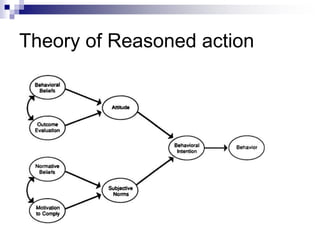
Theory of Reasoned action
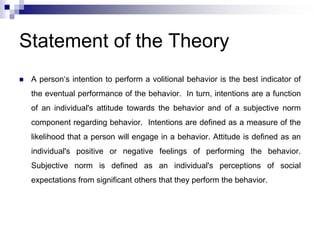
Statement of the Theory
 A person‘s intention to perform a volitional behavior is the best indicator of
the eventual performance of the behavior. In turn, intentions are a function
of an individual's attitude towards the behavior and of a subjective norm
component regarding behavior. Intentions are defined as a measure of the
likelihood that a person will engage in a behavior. Attitude is defined as an
individual's positive or negative feelings of performing the behavior.
Subjective norm is defined as an individual's perceptions of social
expectations from significant others that they perform the behavior.
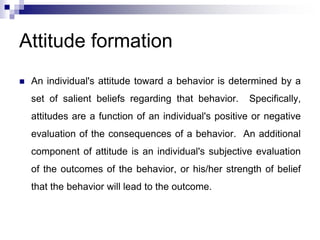
Attitude formation
 An individual's attitude toward a behavior is determined by a
set of salient beliefs regarding that behavior. Specifically,
attitudes are a function of an individual's positive or negative
evaluation of the consequences of a behavior. An additional
component of attitude is an individual's subjective evaluation
of the outcomes of the behavior, or his/her strength of belief
that the behavior will lead to the outcome.
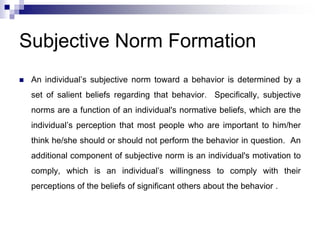
Subjective Norm Formation
 An individual’s subjective norm toward a behavior is determined by a
set of salient beliefs regarding that behavior. Specifically, subjective
norms are a function of an individual's normative beliefs, which are the
individual’s perception that most people who are important to him/her
think he/she should or should not perform the behavior in question. An
additional component of subjective norm is an individual's motivation to
comply, which is an individual’s willingness to comply with their
perceptions of the beliefs of significant others about the behavior .
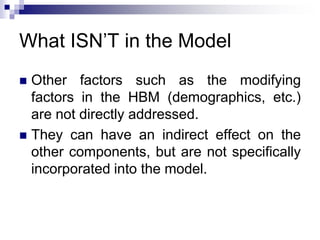
What ISN’T in the Model
 Other factors such as the modifying
factors in the HBM (demographics, etc.)
are not directly addressed.
 They can have an indirect effect on the
other components, but are not specifically
incorporated into the model.
Limitations of TRA
 People who have little power over their
behaviors (or believe they have little
power).
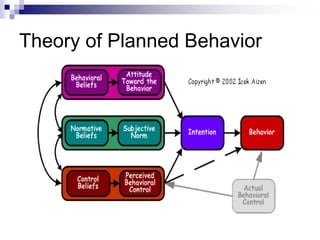
 As a result, Ajzen added a third element to
the original theory:
 Perceived Behavioral Control
Theory of Planned Behavior
Control beliefs and Perceived
behavioral control
 Perceived behavioral control: an individual's perceived ease or
difficulty of performing the particular behavior. It is assumed that
perceived behavioral control is determined by the total set of
accessible control beliefs.
 Control beliefs: an individual's beliefs about the presence of factors
that may facilitate or impede performance of the behavior. The
concept of perceived behavioral control is conceptually related to
self-efficacy.
Uses for TRA/TPB
 TRA works best when applied to behaviors
that are under the person’s control (or they
think they are)
 TPB works best when the behavior is NOT
perceived to be under the person’s control.
Limitations
 Factors such as demographics and personality still not in
model
 No clear definition of perceived behavioral control (hard
to measure)
 Assumption that perceived behavioral control predicts
actual behavioral control.
 The more time between behavioral intent and actually
doing the behavior, the less likely the behavior will
happen.
 Theory assumes people are rational and make
systematic decisions based on available information.
Ignores unconscious motives

TRA-TPB.pptkkkkkkkkkkkkkkkkkkkkkbbbbbbbbbbbbbbbbbbbbbbbbbbbbbb

  • 1.
    Theory of Reasoned Actionand Theory of Planned Behavior Kiran S. Bajracharya
  • 2.
    Fishbein and Ajzen’sTheory of Reasoned Action  Originally developed in 1967; further developed during the 1970’s.  By the 1980’s, very commonly used to study human behavior  Fishbein and Ajzen were both working on similar concepts to explain human behavior, and eventually collaborated to create and publish the model in 1980.
  • 3.
    History of themodel  Originated in the field of social psychology.  The concept of “attitude” as a trigger and predictor of human behavior.  Value-Expectancy theory
  • 4.
    Assumptions of theModel  Human behavior is under the voluntary control of the individual  People think about the consequences and implications of their actions behavior the decide whether or not to do something.  Therefore, intention must be highly correlated with behavior.  Whether or not a person intends to perform a health behavior should correlate with whether or not they actually DO the behavior
  • 5.
    Theory of ReasonedAction (TRA)  TRA is based on the general idea that humans are rational and that they make systematic use of the information available to them in making decisions.  According to TRA, a decision to perform a behavior is ultimately determined after consideration of the implications of the behavior. Most behavior is under volitional control, and is not automatic. As such, behavior can be predicted once the determinants of the behavior are identified.
  • 6.
    Components of TRA The components of TRA are three general constructs: behavioral intention (BI), attitude (A), and subjective norm (SN).  TRA suggests that a person's behavioral intention depends on the person's attitude about the behavior and subjective norms (BI = A + SN). If a person intends to do a behavior then it is likely that the person will do it.
  • 7.
    Components of theModel  Behavior is a function of 2 things:  Attitudes toward a specific action What will happen if I engage in this behavior? Is this outcome desirable or undesirable  Subjective norms regarding that action Normative beliefs: others expectations Motivation to comply: do I want to do what they tell me? How much? Why?
  • 8.
  • 9.
    Statement of theTheory  A person‘s intention to perform a volitional behavior is the best indicator of the eventual performance of the behavior. In turn, intentions are a function of an individual's attitude towards the behavior and of a subjective norm component regarding behavior. Intentions are defined as a measure of the likelihood that a person will engage in a behavior. Attitude is defined as an individual's positive or negative feelings of performing the behavior. Subjective norm is defined as an individual's perceptions of social expectations from significant others that they perform the behavior.
  • 10.
    Attitude formation  Anindividual's attitude toward a behavior is determined by a set of salient beliefs regarding that behavior. Specifically, attitudes are a function of an individual's positive or negative evaluation of the consequences of a behavior. An additional component of attitude is an individual's subjective evaluation of the outcomes of the behavior, or his/her strength of belief that the behavior will lead to the outcome.
  • 11.
    Subjective Norm Formation An individual’s subjective norm toward a behavior is determined by a set of salient beliefs regarding that behavior. Specifically, subjective norms are a function of an individual's normative beliefs, which are the individual’s perception that most people who are important to him/her think he/she should or should not perform the behavior in question. An additional component of subjective norm is an individual's motivation to comply, which is an individual’s willingness to comply with their perceptions of the beliefs of significant others about the behavior .
  • 12.
    What ISN’T inthe Model  Other factors such as the modifying factors in the HBM (demographics, etc.) are not directly addressed.  They can have an indirect effect on the other components, but are not specifically incorporated into the model.
  • 13.
    Limitations of TRA People who have little power over their behaviors (or believe they have little power).  As a result, Ajzen added a third element to the original theory:  Perceived Behavioral Control
  • 14.
  • 15.
    Control beliefs andPerceived behavioral control  Perceived behavioral control: an individual's perceived ease or difficulty of performing the particular behavior. It is assumed that perceived behavioral control is determined by the total set of accessible control beliefs.  Control beliefs: an individual's beliefs about the presence of factors that may facilitate or impede performance of the behavior. The concept of perceived behavioral control is conceptually related to self-efficacy.
  • 16.
    Uses for TRA/TPB TRA works best when applied to behaviors that are under the person’s control (or they think they are)  TPB works best when the behavior is NOT perceived to be under the person’s control.
  • 17.
    Limitations  Factors suchas demographics and personality still not in model  No clear definition of perceived behavioral control (hard to measure)  Assumption that perceived behavioral control predicts actual behavioral control.  The more time between behavioral intent and actually doing the behavior, the less likely the behavior will happen.  Theory assumes people are rational and make systematic decisions based on available information. Ignores unconscious motives