10/1/2024
Eyasu B.( MPH)
1
Module-3
THEORIES & MODELS IN HEALTH
EDUCATIONS
OBJECTIVEs
10/1/2024
Eyasu B.( MPH)
2
At the end of this lecture students will be able to:
 Discuss the role of the theories/models in HE
 Describe the most common theories used in HE
What is theory?
10/1/2024
Eyasu B.( MPH)
3
Theory is
“A set of interrelated concepts, definitions, and
proposition.
 present a systematic view of phenomena
 by specifying relations among variables with the purpose
of explaining and predicting the phenomenon”
 Theories explain why, what, how and when a particular
behavior occurs.
What is Models?
10/1/2024
Eyasu B.( MPH)
4
Model is
“Generalized, hypothetical description used to
analyze or explain something’’.
 Is diagrammatic representation of a phenomena
 It provides plan foe investigating and/or addressing
phenomena.
Why theories/models?
10/1/2024
Eyasu B.( MPH)
5
 Provides a road map for studying problems, developing
appropriate interventions, and evaluating their successes.
 Help to explain the dynamics of health behaviors.
 Help planners identify the most suitable target audiences,
methods for fostering change, and outcomes for evaluation.
 Guides the search for reasons why people do or do not
engage in certain health behaviors;
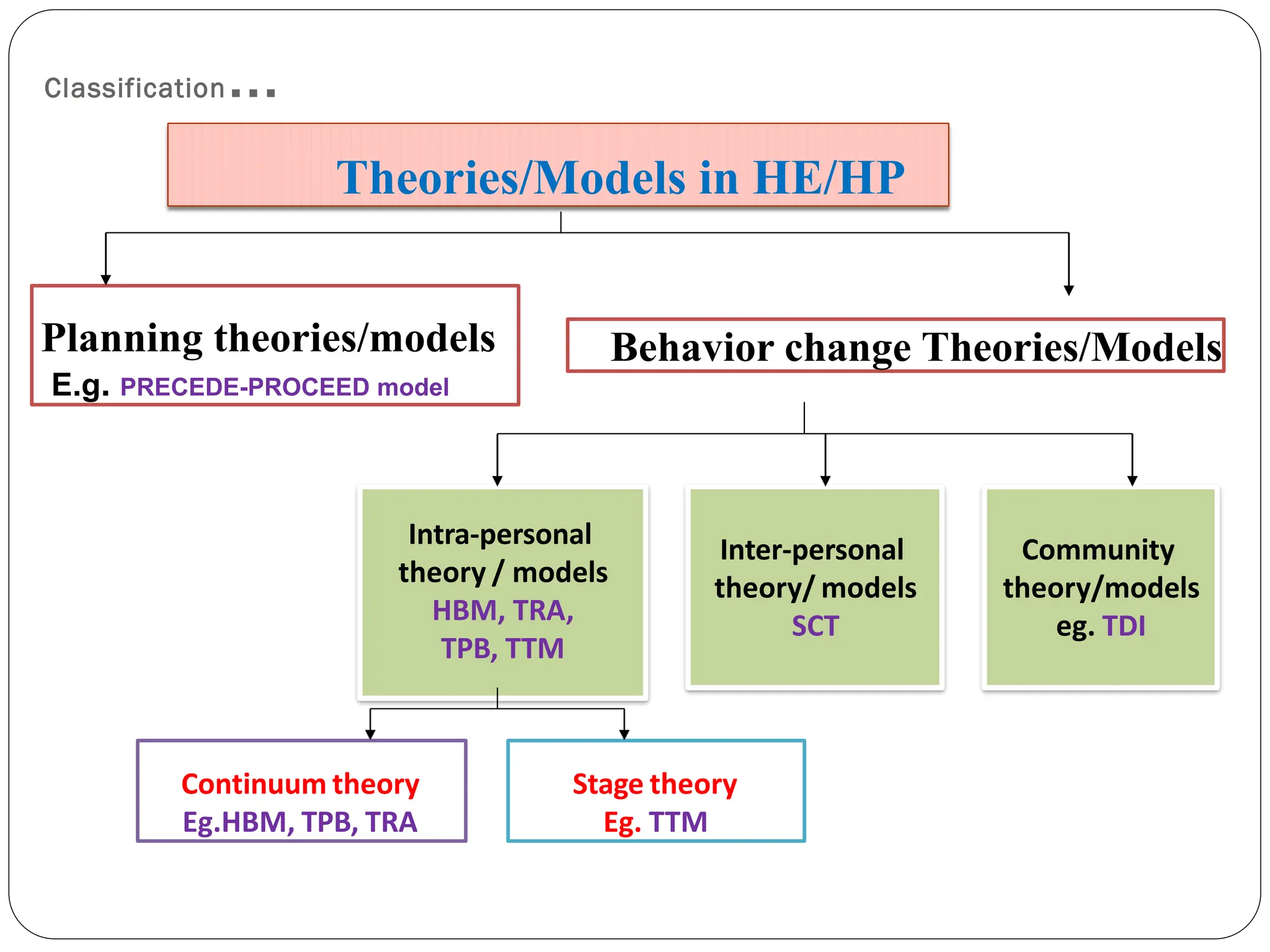
Classification…
Theories/Models in HE/HP
Planning theories/models
E.g. PRECEDE-PROCEED model
Behavior change Theories/Models
Intra-personal
theory / models
HBM, TRA,
TPB, TTM
Inter-personal
theory/ models
SCT
Community
theory/models
eg. TDI
Continuum theory
Eg.HBM, TPB, TRA
Stage theory
Eg. TTM
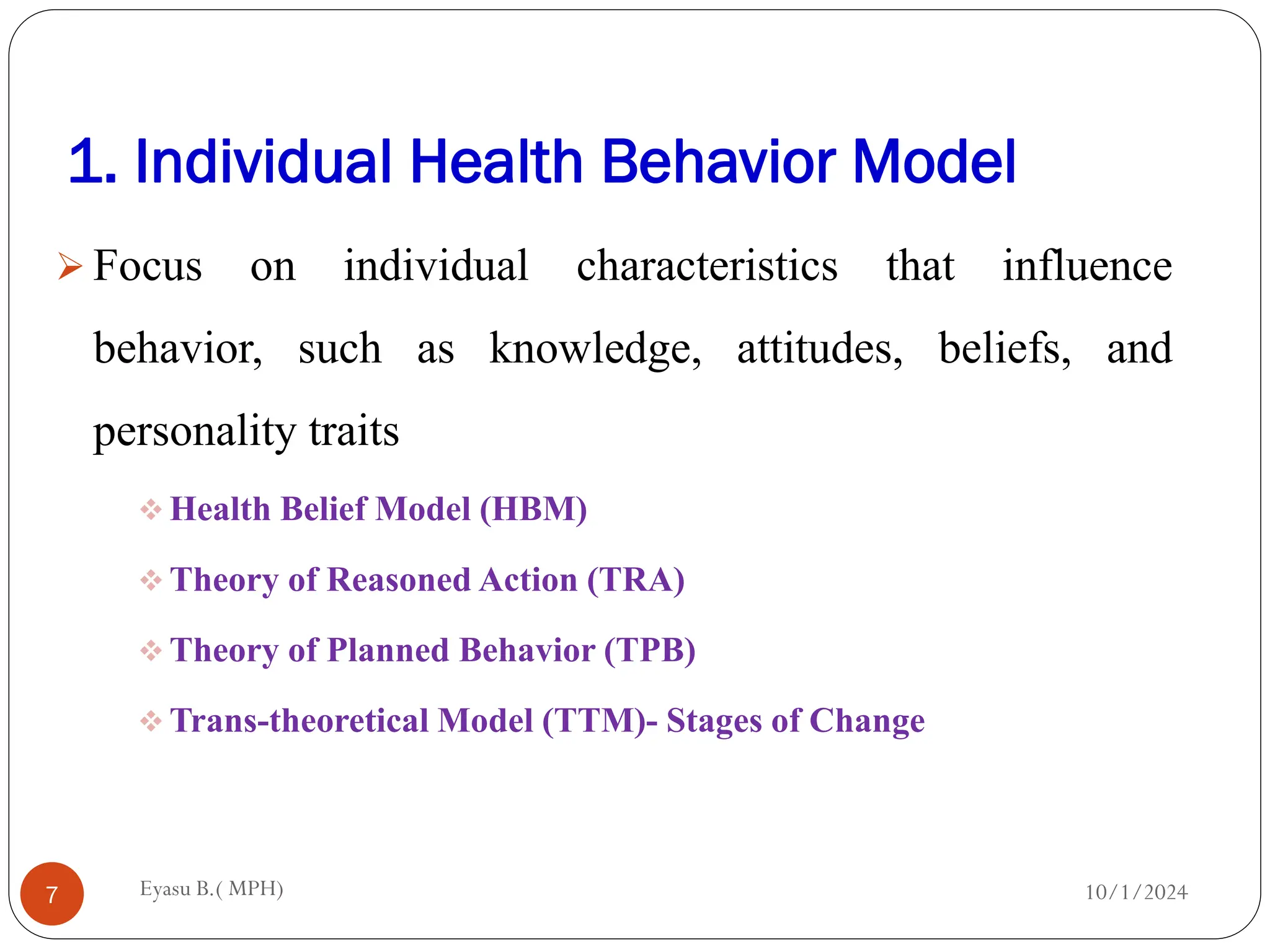
1. Individual Health Behavior Model
10/1/2024
Eyasu B.( MPH)
7
 Focus on individual characteristics that influence
behavior, such as knowledge, attitudes, beliefs, and
personality traits
 Health Belief Model (HBM)
 Theory of Reasoned Action (TRA)
 Theory of Planned Behavior (TPB)
 Trans-theoretical Model (TTM)- Stages of Change
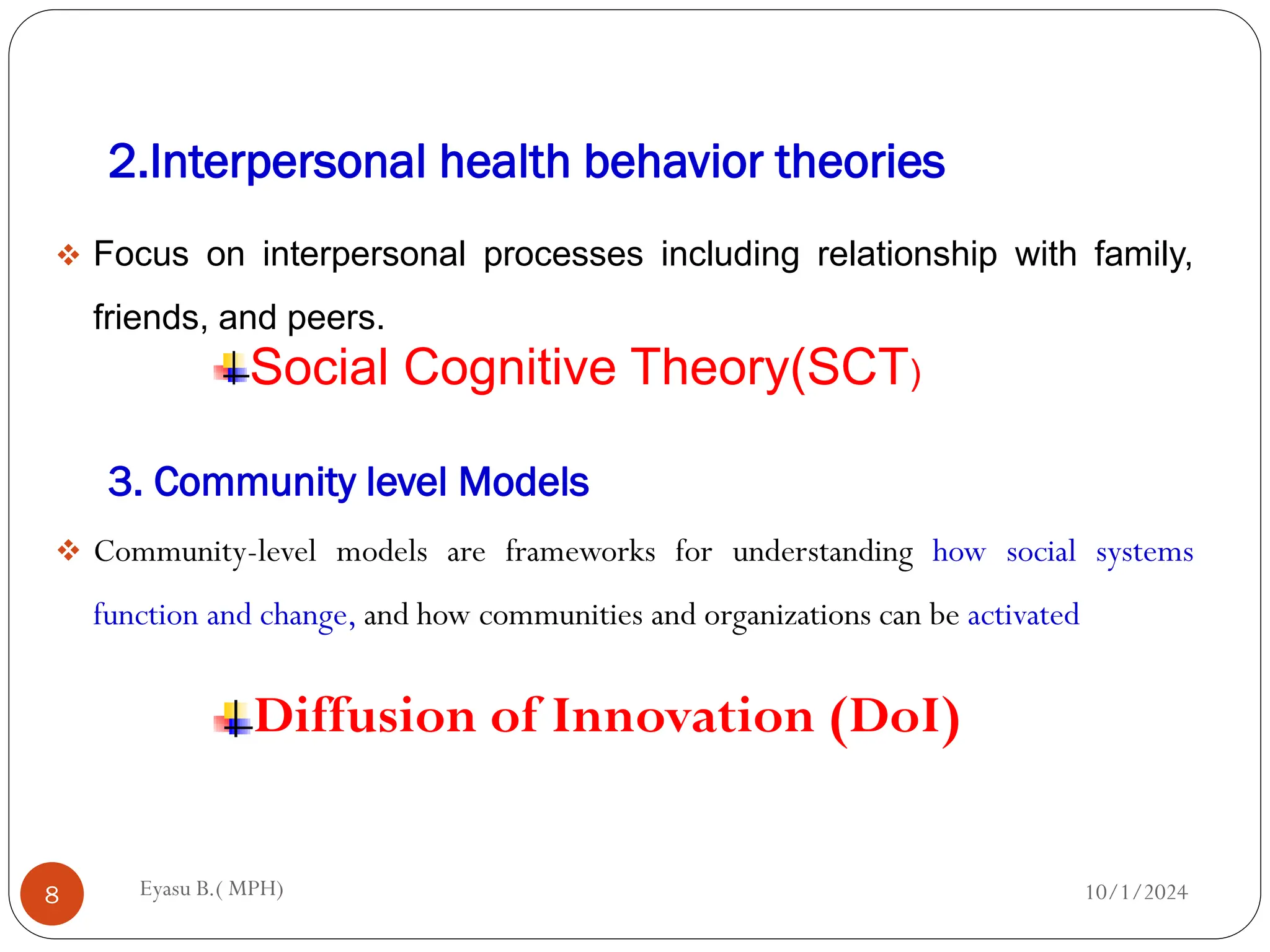
2.Interpersonal health behavior theories
10/1/2024
Eyasu B.( MPH)
8
 Focus on interpersonal processes including relationship with family,
friends, and peers.
Social Cognitive Theory(SCT)
3. Community level Models
 Community-level models are frameworks for understanding how social systems
function and change, and how communities and organizations can be activated
Diffusion of Innovation (DoI)
HEALTH BELIEF MODEL
10/1/2024
Eyasu B.( MPH)
9
1. The health belief model (HBM)
10/1/2024
Eyasu B.( MPH)
10
 The HBM has been developed by a group of psychologists in the
1950s to explain why people would or would not use health
services
 The model is used in explaining and predicting preventive health
behavior, as well as sick-role and illness behavior.
 It emphasizes the intellectual dimension of health
behavior.
HBM
10/1/2024
Eyasu B.( MPH)
11
Focus:
 Individuals’ perceptions of the threat posed
by a health problem, the benefits of avoiding the threat, and
factors influencing the decision to act.
 Six main constructs influence people’s decisions about
whether to take action to prevent, screen for, and control
illness
constructs of the HBM
10/1/2024
Eyasu B.( MPH)
12
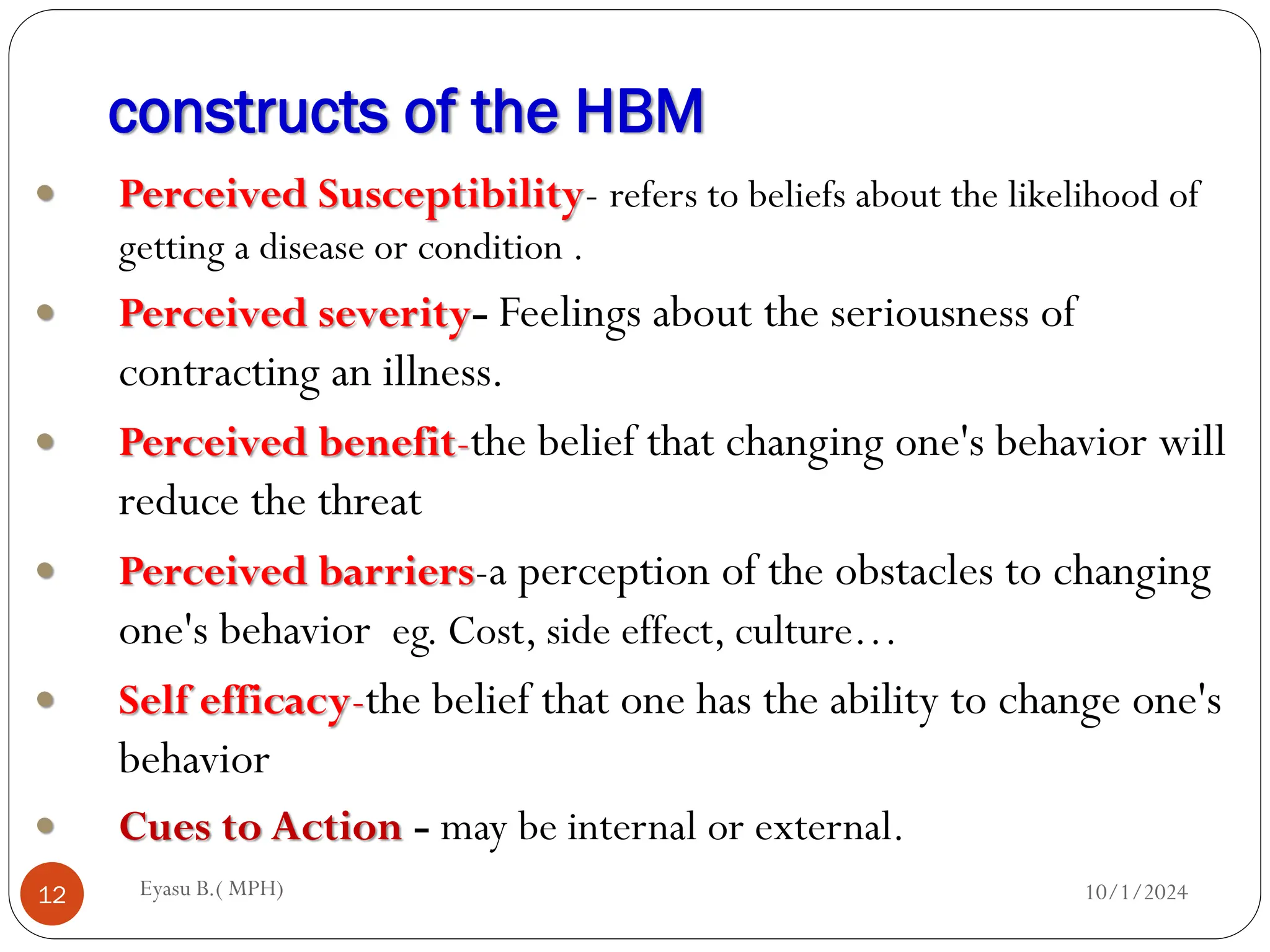
 Perceived Susceptibility- refers to beliefs about the likelihood of
getting a disease or condition .
 Perceived severity- Feelings about the seriousness of
contracting an illness.
 Perceived benefit-the belief that changing one's behavior will
reduce the threat
 Perceived barriers-a perception of the obstacles to changing
one's behavior eg. Cost, side effect, culture…
 Self efficacy-the belief that one has the ability to change one's
behavior
 Cues to Action - may be internal or external.
10/1/2024
Eyasu B.( MPH)
13
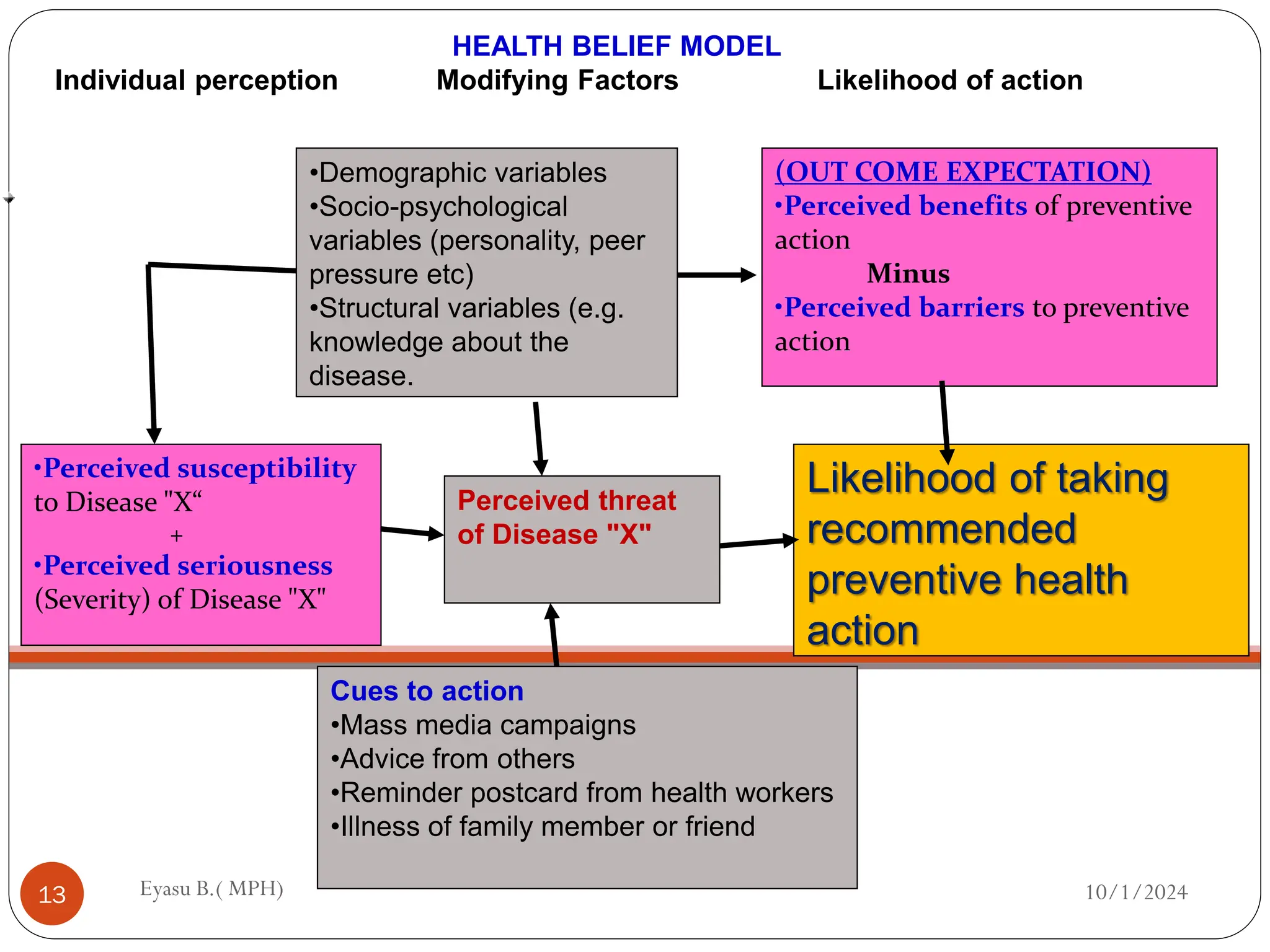
•Demographic variables
•Socio-psychological
variables (personality, peer
pressure etc)
•Structural variables (e.g.
knowledge about the
disease.
(OUT COME EXPECTATION)
•Perceived benefits of preventive
action
Minus
•Perceived barriers to preventive
action
•Perceived susceptibility
to Disease "X“
+
•Perceived seriousness
(Severity) of Disease "X"
Perceived threat
of Disease "X"
Likelihood of taking
recommended
preventive health
action
Cues to action
•Mass media campaigns
•Advice from others
•Reminder postcard from health workers
•Illness of family member or friend
HEALTH BELIEF MODEL
Individual perception Modifying Factors Likelihood of action
Exercise( 5 minutes)
10/1/2024
Eyasu B.( MPH)
14
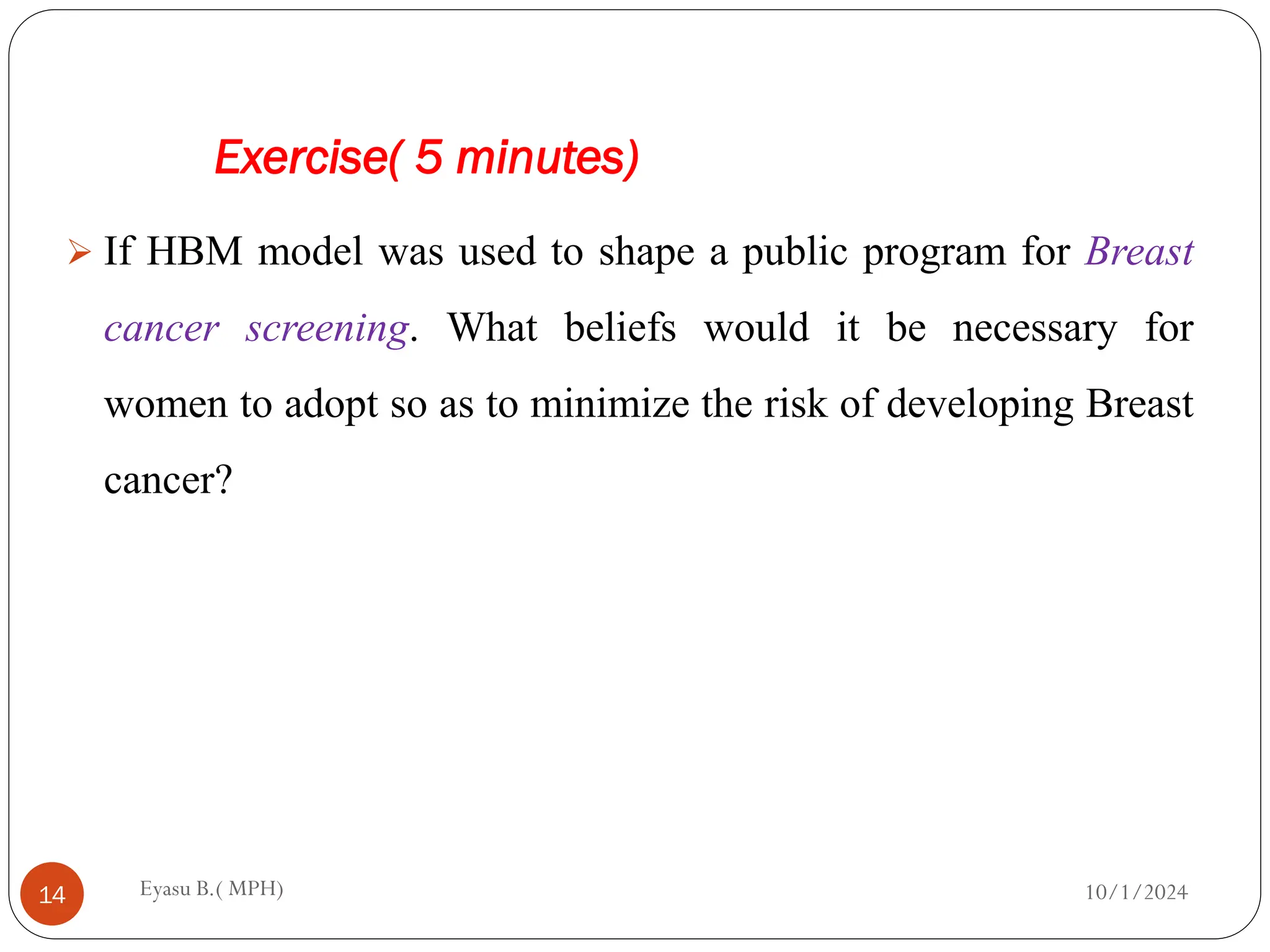
 If HBM model was used to shape a public program for Breast
cancer screening. What beliefs would it be necessary for
women to adopt so as to minimize the risk of developing Breast
cancer?
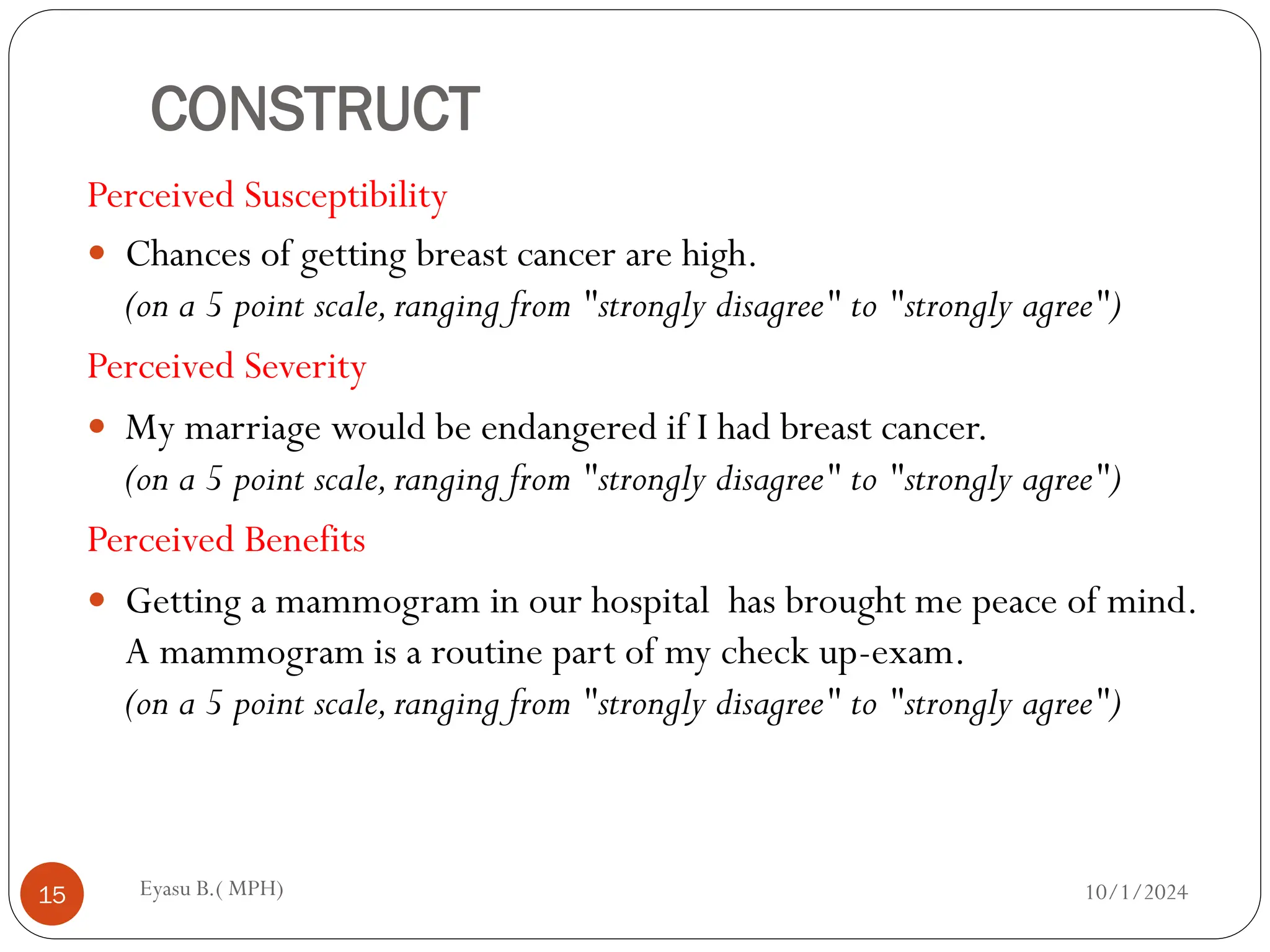
CONSTRUCT
Perceived Susceptibility
 Chances of getting breast cancer are high.
(on a 5 point scale,ranging from "strongly disagree" to "strongly agree")
Perceived Severity
 My marriage would be endangered if I had breast cancer.
(on a 5 point scale,ranging from "strongly disagree" to "strongly agree")
Perceived Benefits
 Getting a mammogram in our hospital has brought me peace of mind.
A mammogram is a routine part of my check up-exam.
(on a 5 point scale,ranging from "strongly disagree" to "strongly agree")
10/1/2024
Eyasu B.( MPH)
15
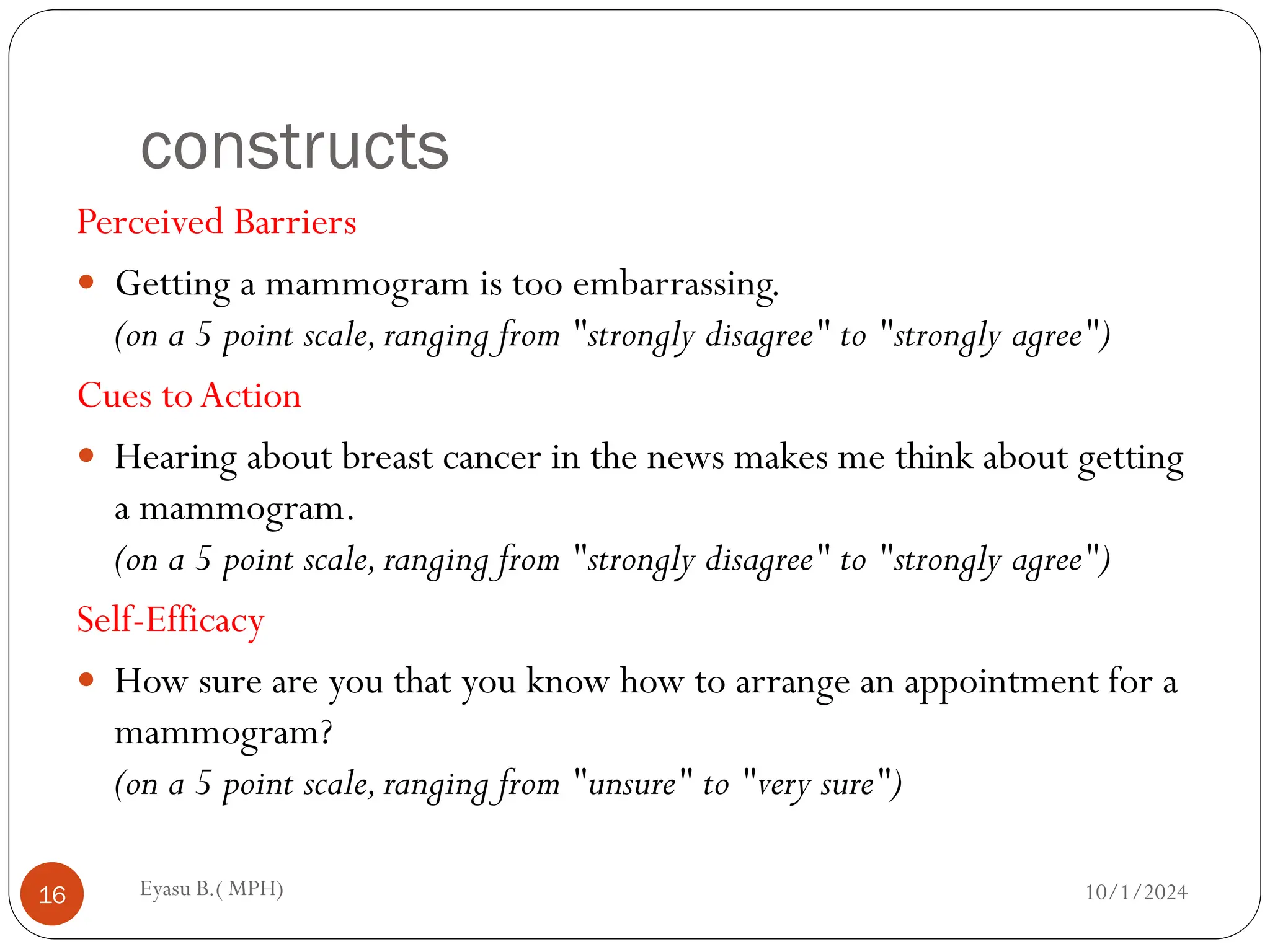
constructs
Perceived Barriers
 Getting a mammogram is too embarrassing.
(on a 5 point scale,ranging from "strongly disagree" to "strongly agree")
Cues to Action
 Hearing about breast cancer in the news makes me think about getting
a mammogram.
(on a 5 point scale,ranging from "strongly disagree" to "strongly agree")
Self-Efficacy
 How sure are you that you know how to arrange an appointment for a
mammogram?
(on a 5 point scale,ranging from "unsure" to "very sure")
10/1/2024
Eyasu B.( MPH)
16
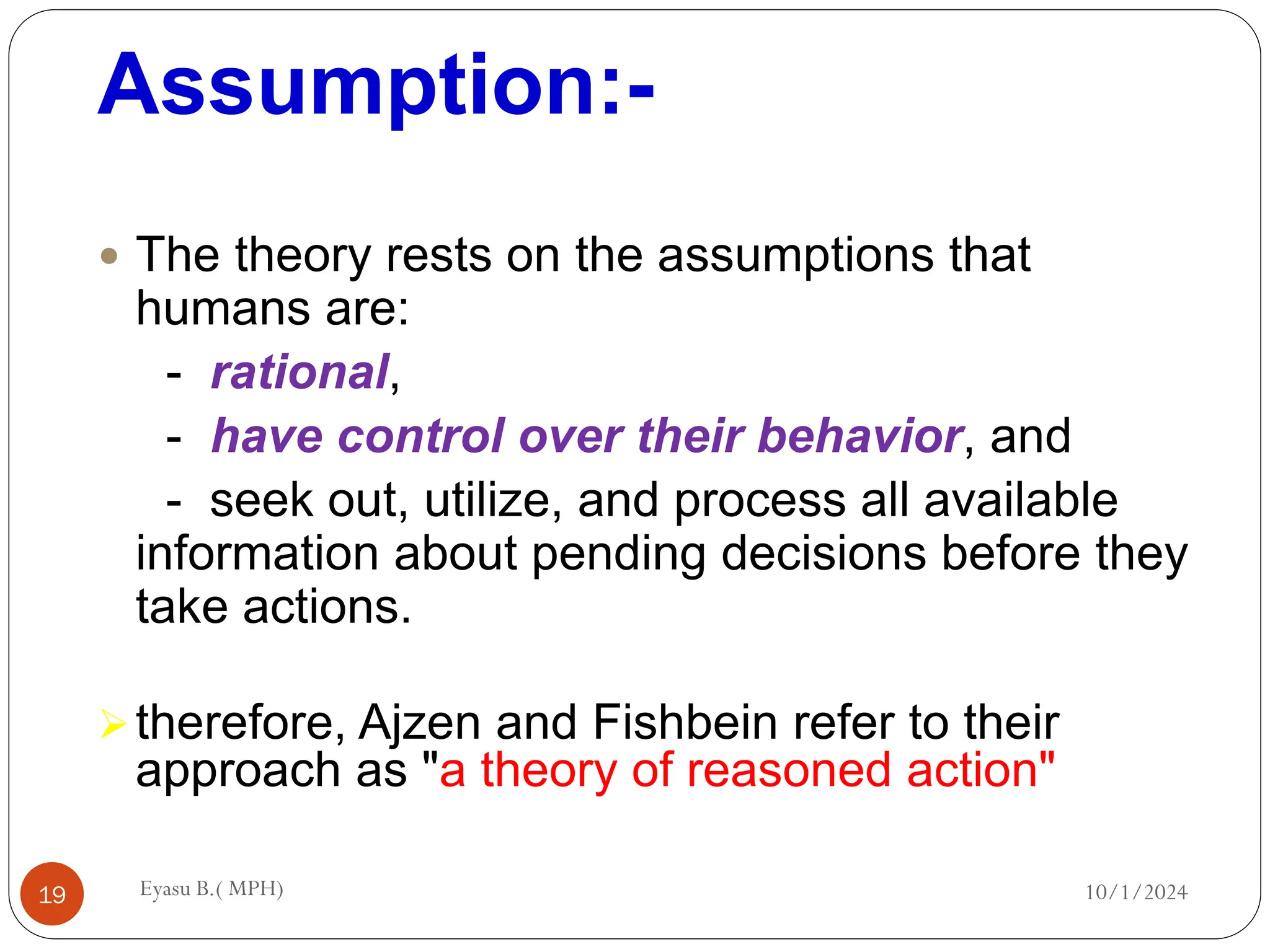
2. Theory of Reasoned Action
(Fishbein & Ajzen, 1970’s)
…TPB is the extension of TRA…
Introduction
10/1/2024
Eyasu B.( MPH)
18
 TRA was introduced by Fishbein in 1967
 Modified & Refined over time (eg. Ajzen & Fishbein,
1980)
- concerned with the prediction and understanding
of human behavior
 It was designed to explain all human behavior that is
under volitional control.
Assumption:-
10/1/2024
Eyasu B.( MPH)
19
 The theory rests on the assumptions that
humans are:
- rational,
- have control over their behavior, and
- seek out, utilize, and process all available
information about pending decisions before they
take actions.
therefore, Ajzen and Fishbein refer to their
approach as "a theory of reasoned action"
10/1/2024
Eyasu B.( MPH)
20
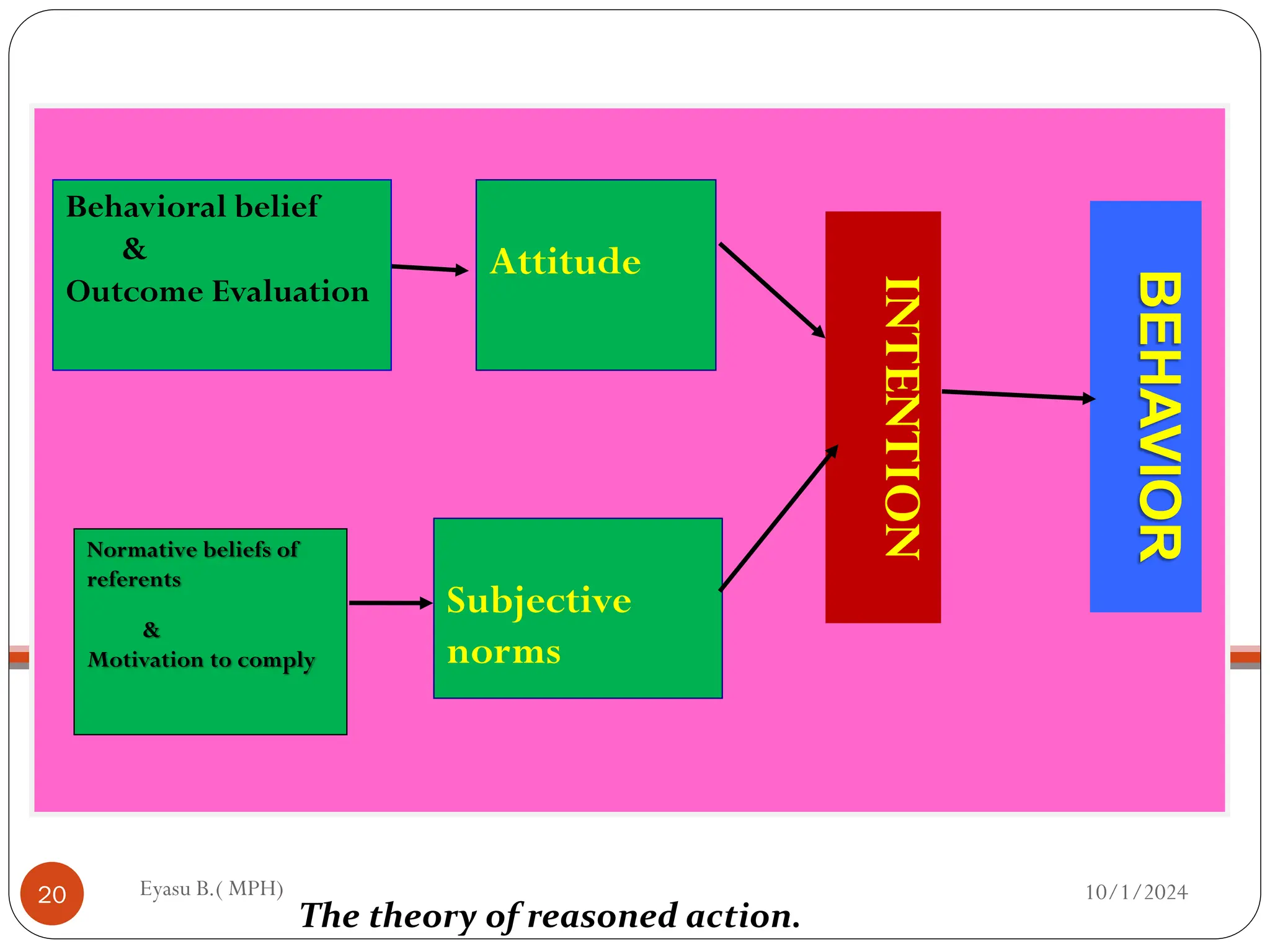
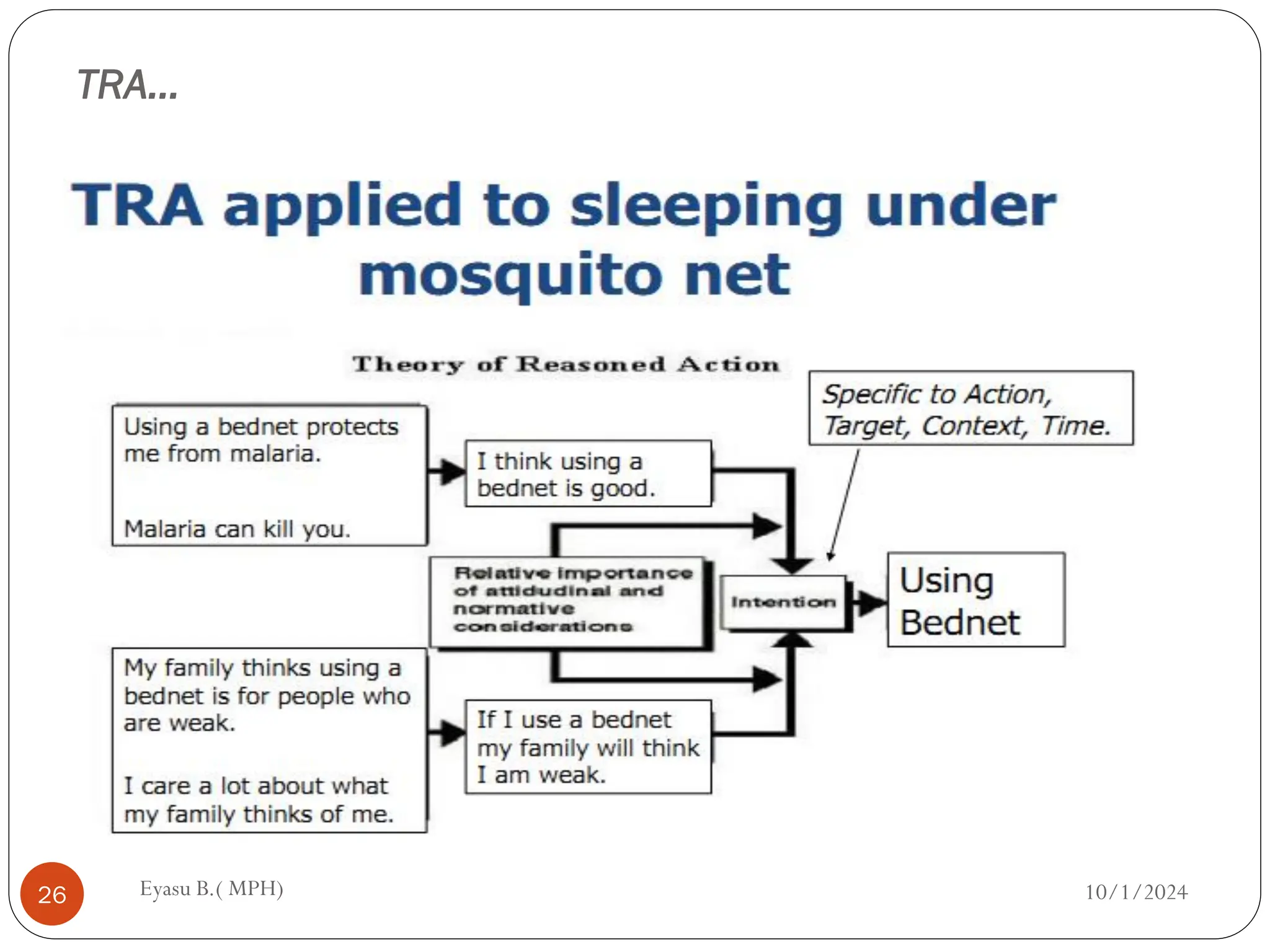
INTENTION
Subjective
norms
Attitude
Behavioral belief
&
Outcome Evaluation
Normative beliefs of
referents
&
Motivation to comply
The theory of reasoned action.
BEHAVIOR
TRA…
10/1/2024
Eyasu B.( MPH)
21
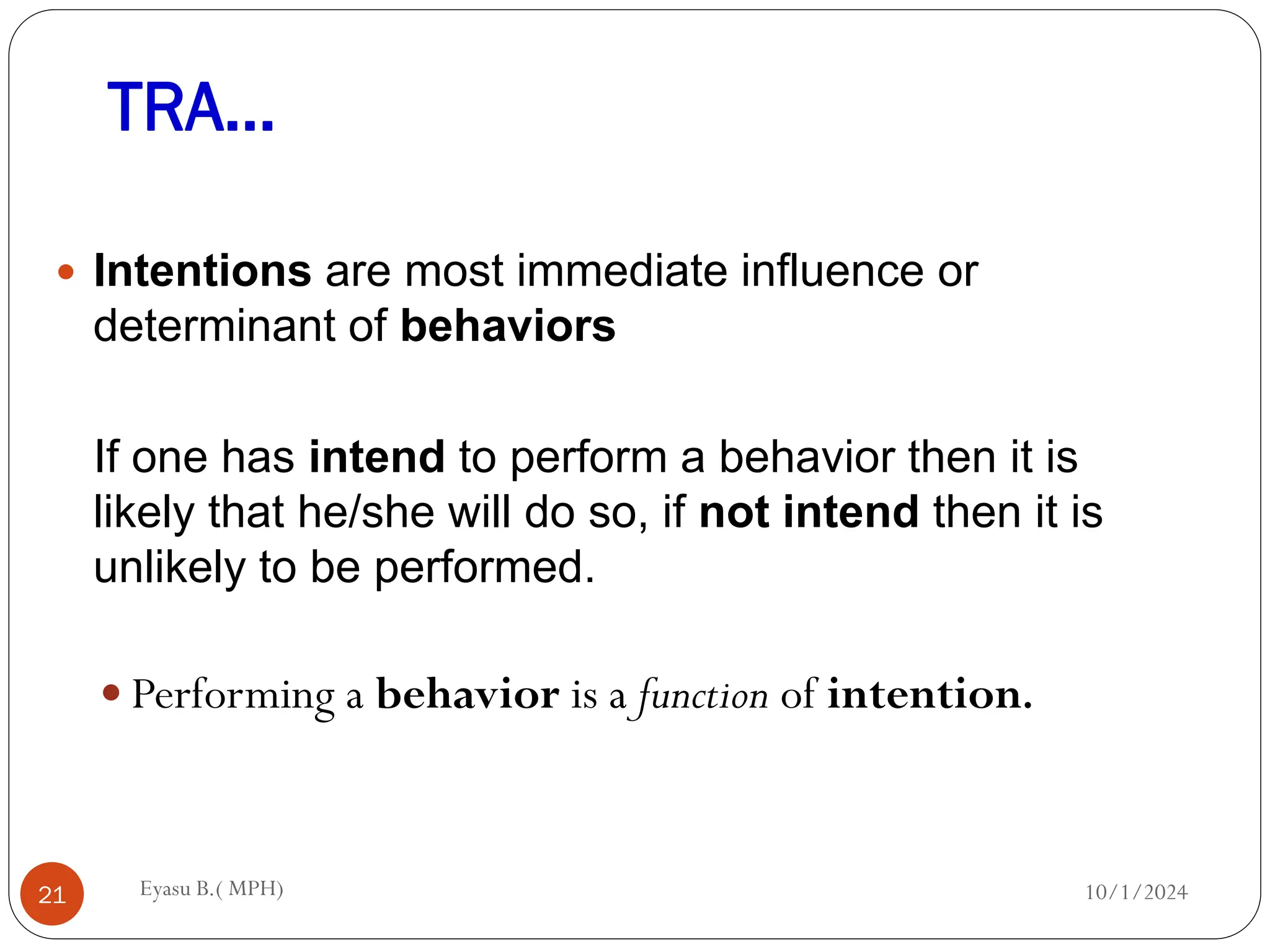
 Intentions are most immediate influence or
determinant of behaviors
If one has intend to perform a behavior then it is
likely that he/she will do so, if not intend then it is
unlikely to be performed.
 Performing a behavior is a function of intention.
TRA…
10/1/2024
Eyasu B.( MPH)
22
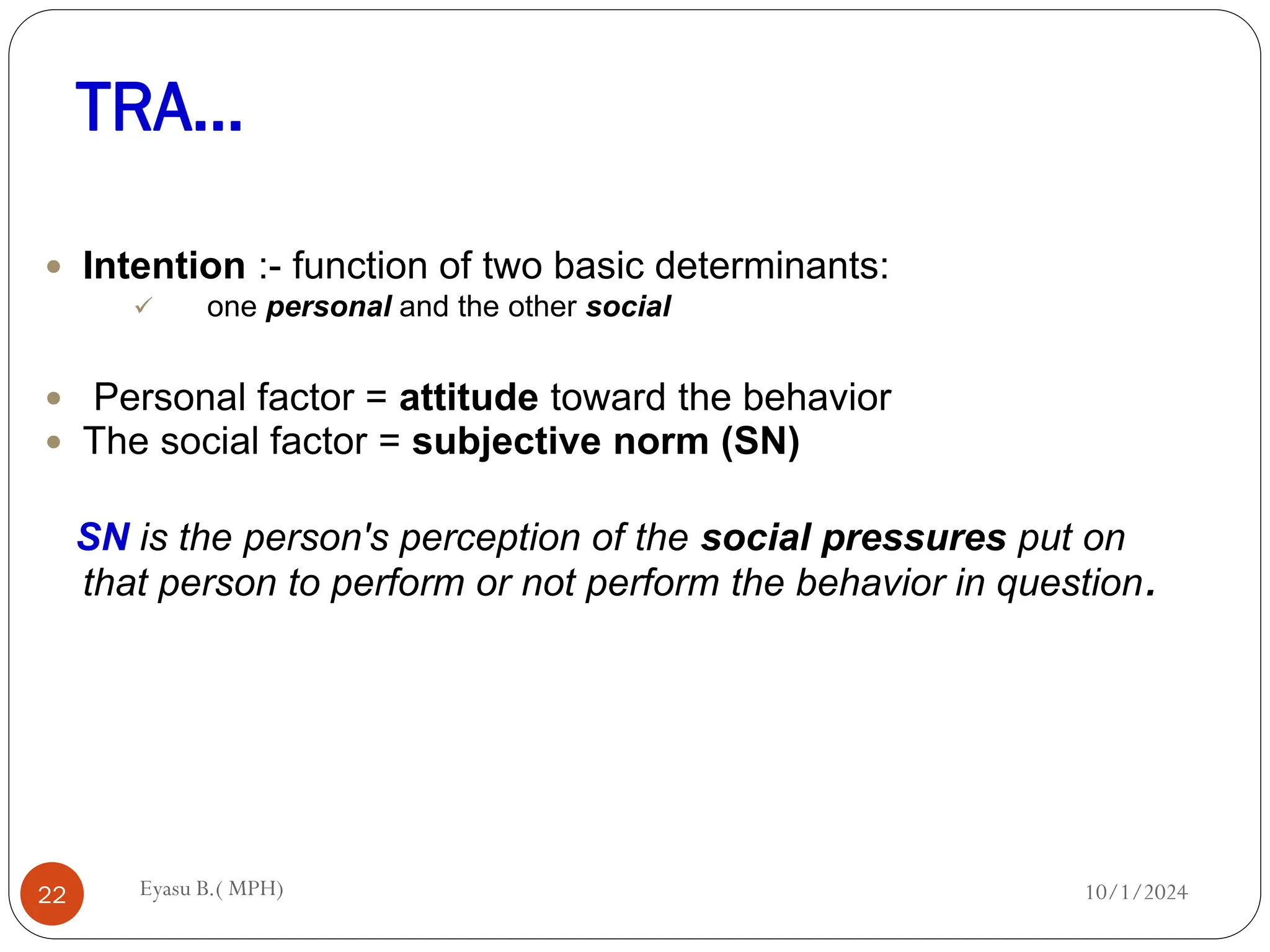
 Intention :- function of two basic determinants:
 one personal and the other social
 Personal factor = attitude toward the behavior
 The social factor = subjective norm (SN)
SN is the person's perception of the social pressures put on
that person to perform or not perform the behavior in question.
TRA…
10/1/2024
Eyasu B.( MPH)
23
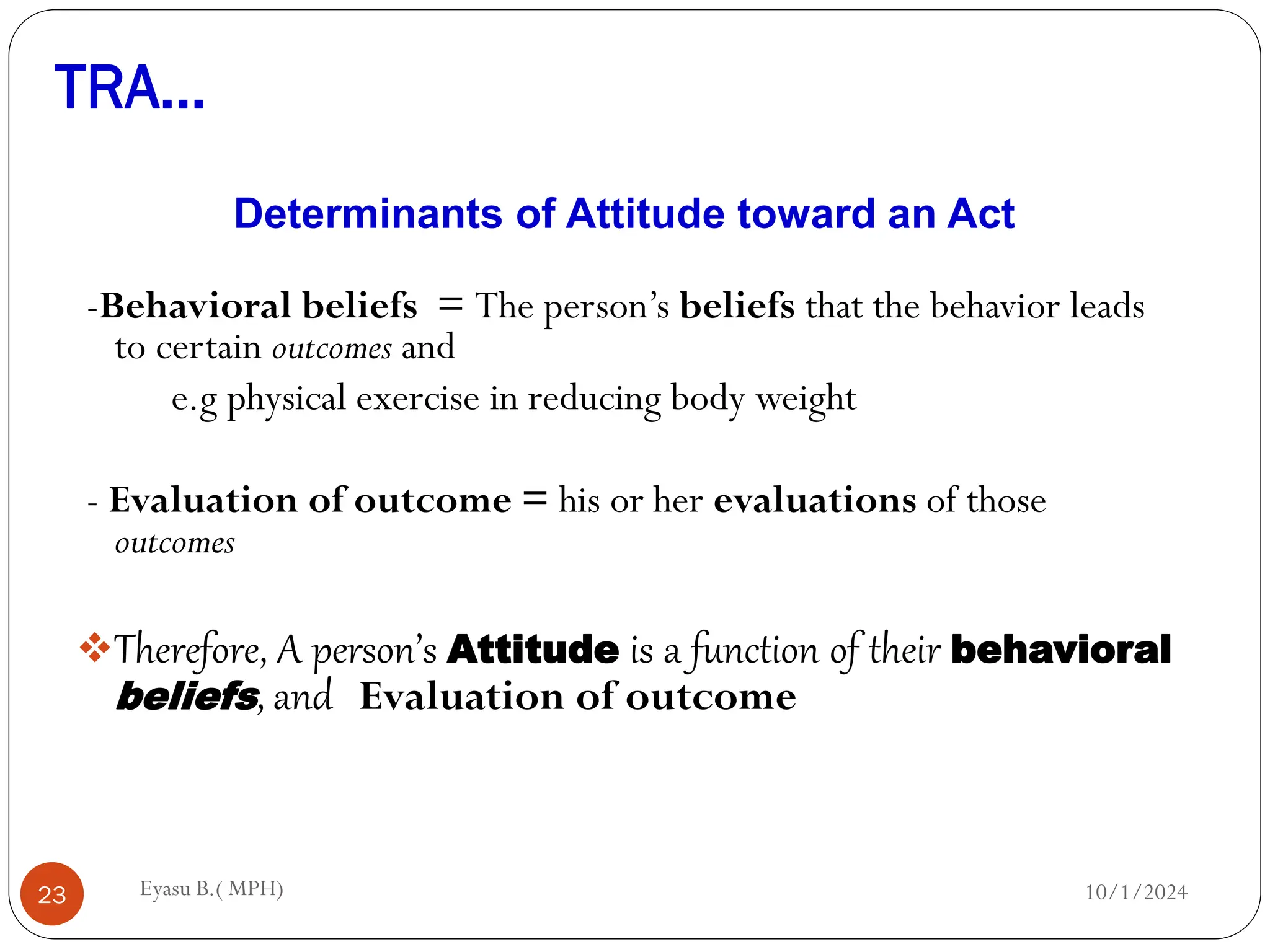
Determinants of Attitude toward an Act
-Behavioral beliefs = The person’s beliefs that the behavior leads
to certain outcomes and
e.g physical exercise in reducing body weight
- Evaluation of outcome = his or her evaluations of those
outcomes
Therefore, A person’s Attitude is a function of their behavioral
beliefs, and Evaluation of outcome
TRA…
10/1/2024
Eyasu B.( MPH)
24
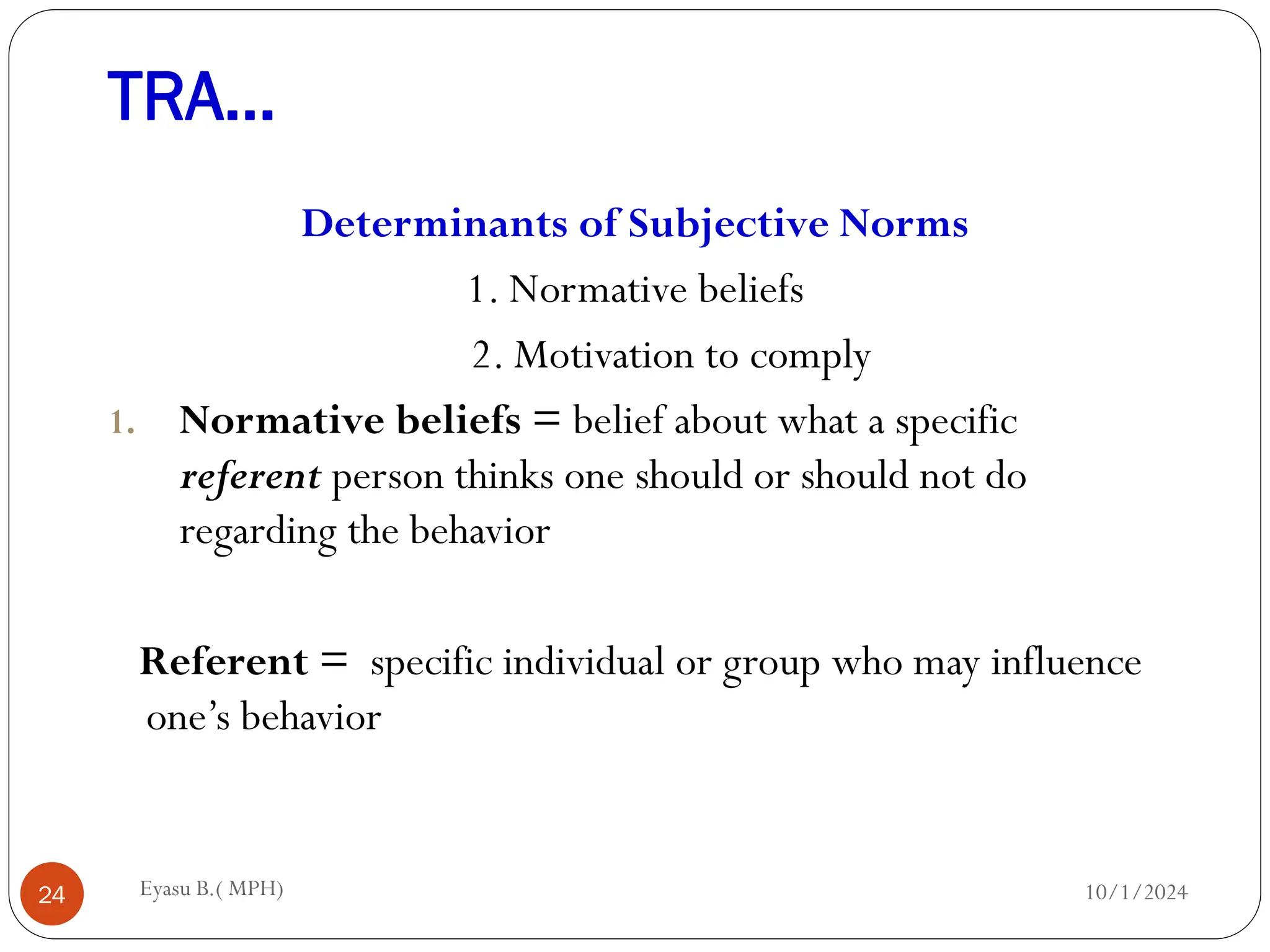
Determinants of Subjective Norms
1. Normative beliefs
2. Motivation to comply
1. Normative beliefs = belief about what a specific
referent person thinks one should or should not do
regarding the behavior
Referent = specific individual or group who may influence
one’s behavior
TRA…
10/1/2024
Eyasu B.( MPH)
25
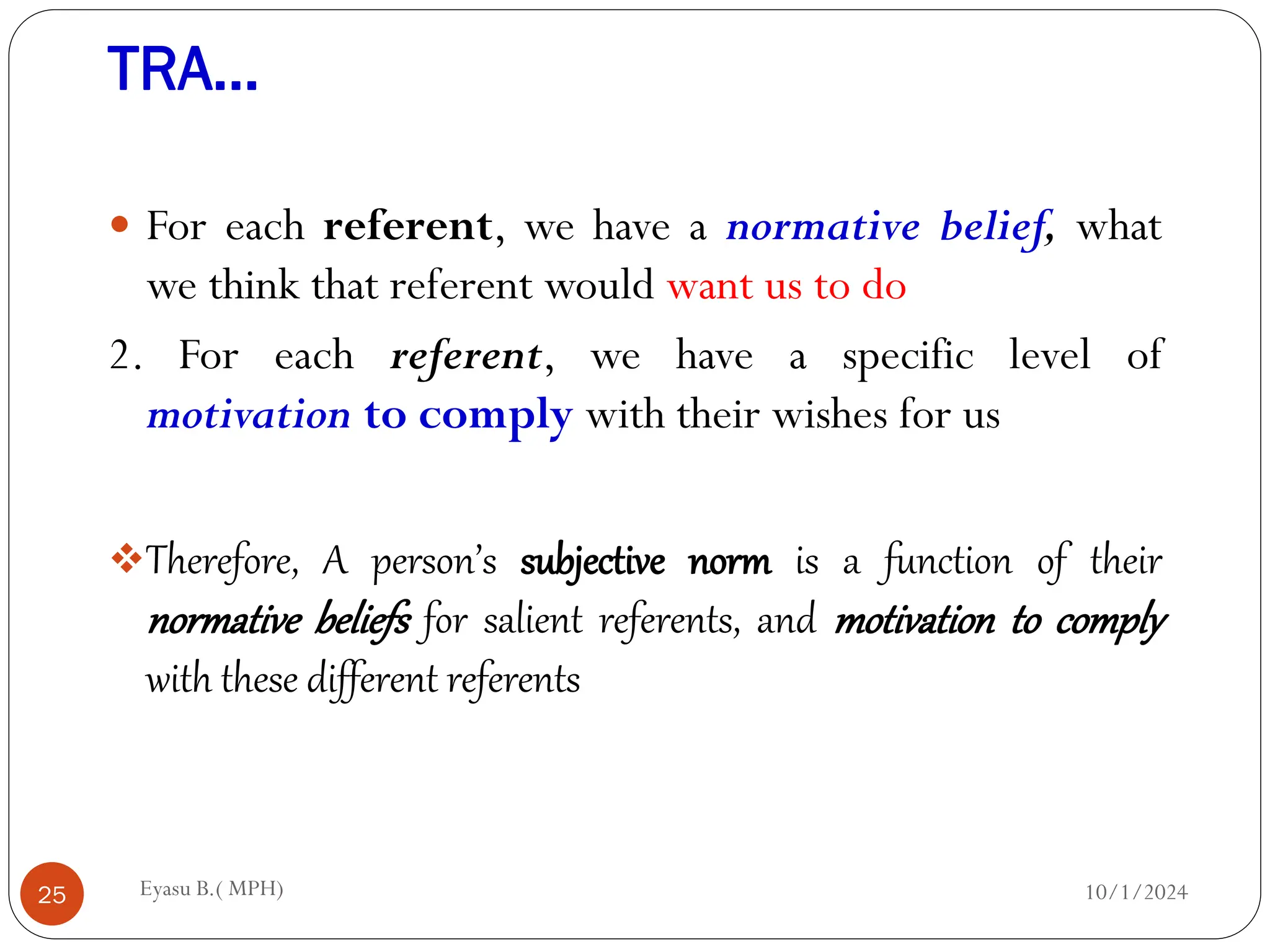
 For each referent, we have a normative belief, what
we think that referent would want us to do
2. For each referent, we have a specific level of
motivation to comply with their wishes for us
Therefore, A person’s subjective norm is a function of their
normative beliefs for salient referents, and motivation to comply
with these different referents
TRA…
10/1/2024
Eyasu B.( MPH)
26
Limitations
10/1/2024
Eyasu B.( MPH)
27
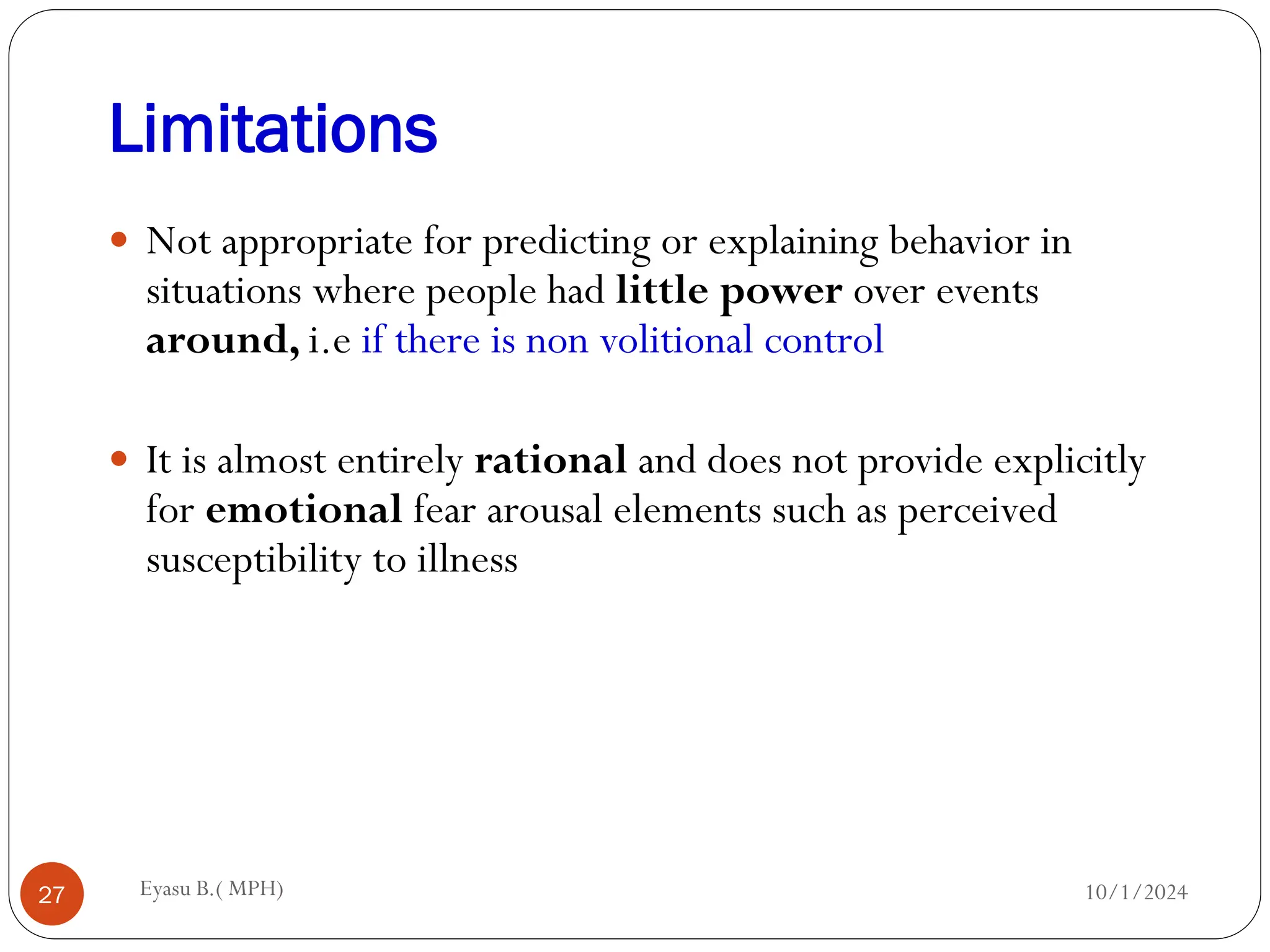
 Not appropriate for predicting or explaining behavior in
situations where people had little power over events
around, i.e if there is non volitional control
 It is almost entirely rational and does not provide explicitly
for emotional fear arousal elements such as perceived
susceptibility to illness
Extensions (TPB)
10/1/2024
Eyasu B.( MPH)
28
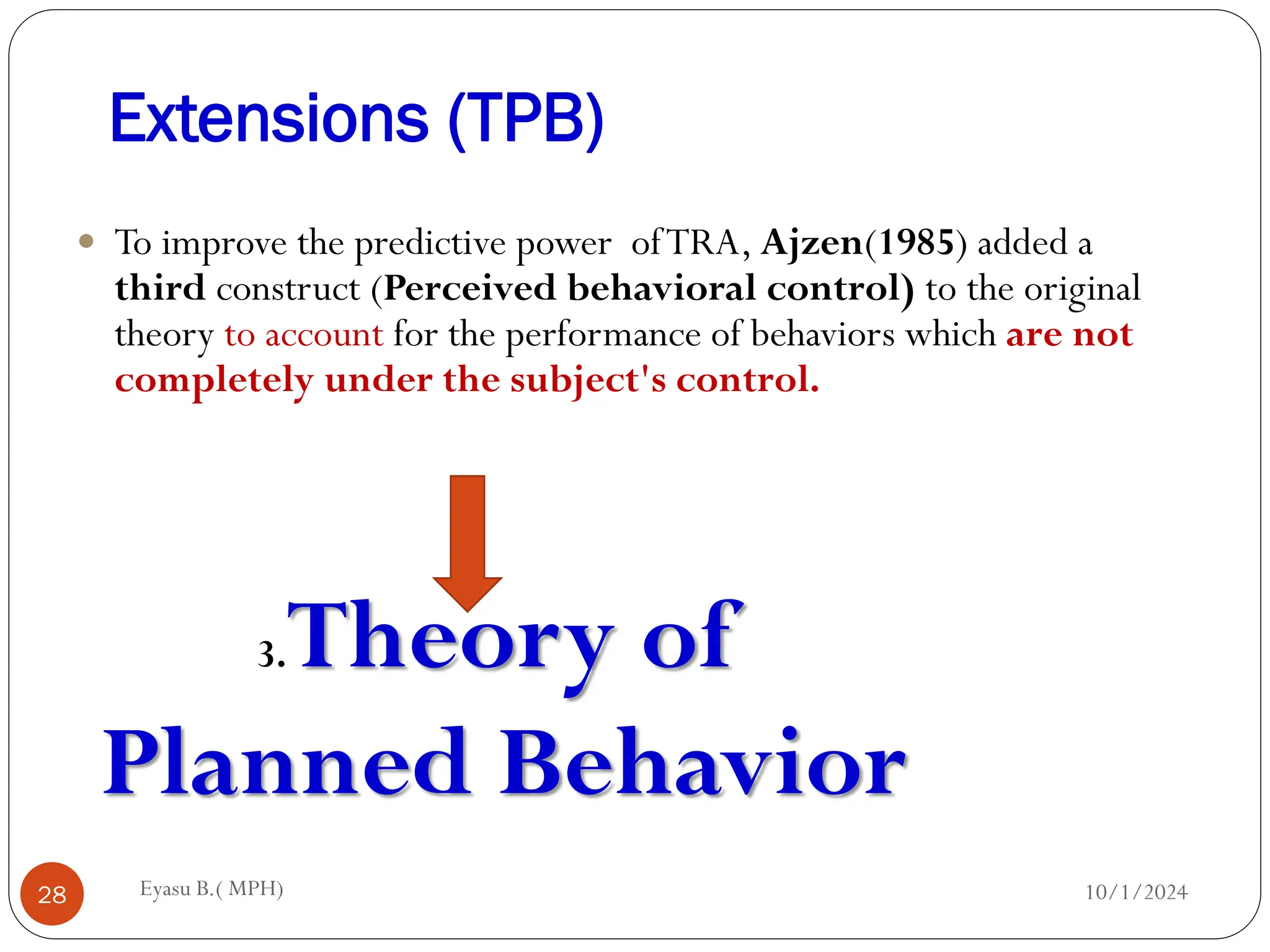
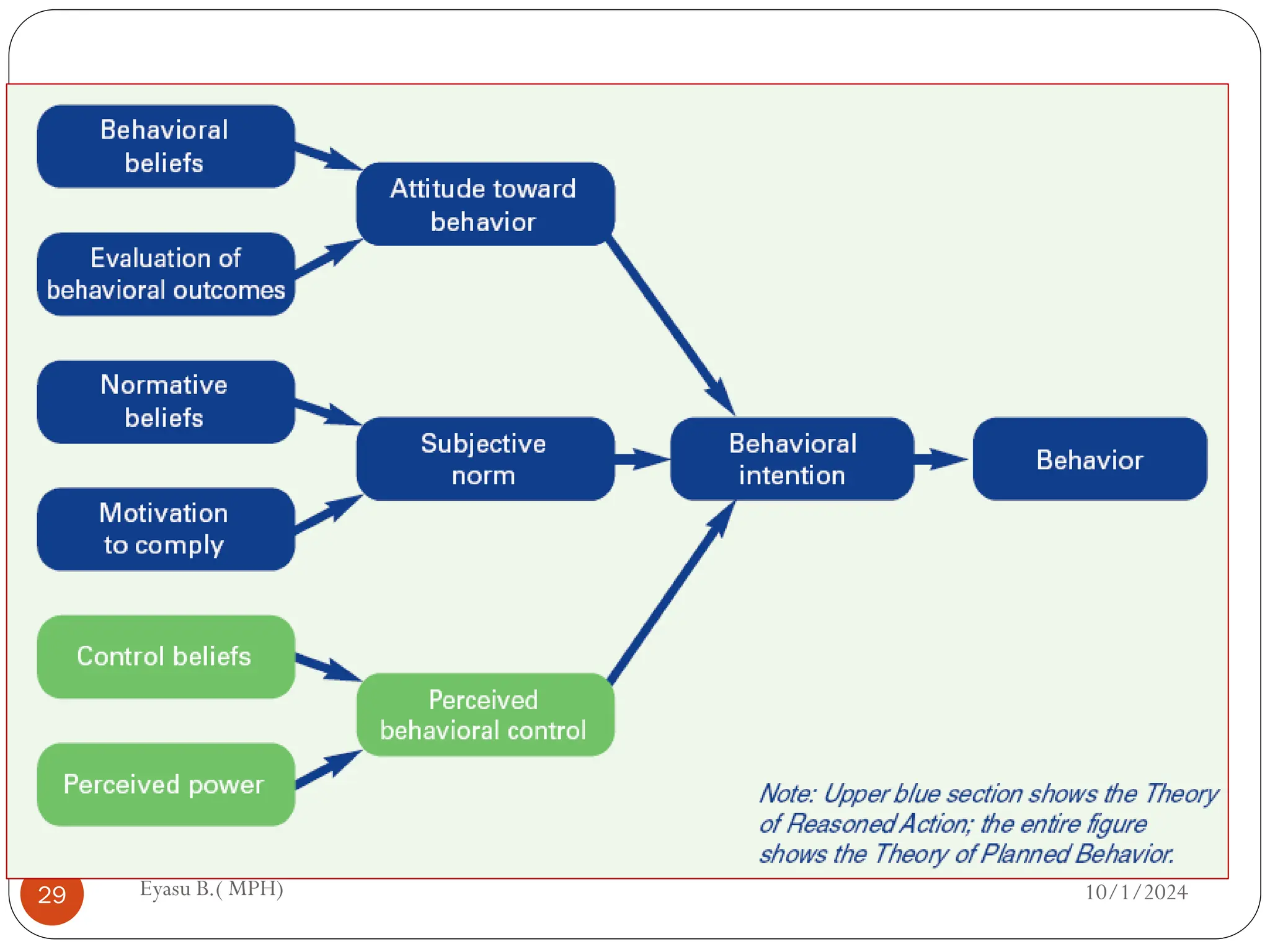
 To improve the predictive power ofTRA, Ajzen(1985) added a
third construct (Perceived behavioral control) to the original
theory to account for the performance of behaviors which are not
completely under the subject's control.
3.Theory of
Planned Behavior
10/1/2024
Eyasu B.( MPH)
29
TPB…
10/1/2024
Eyasu B.( MPH)
30
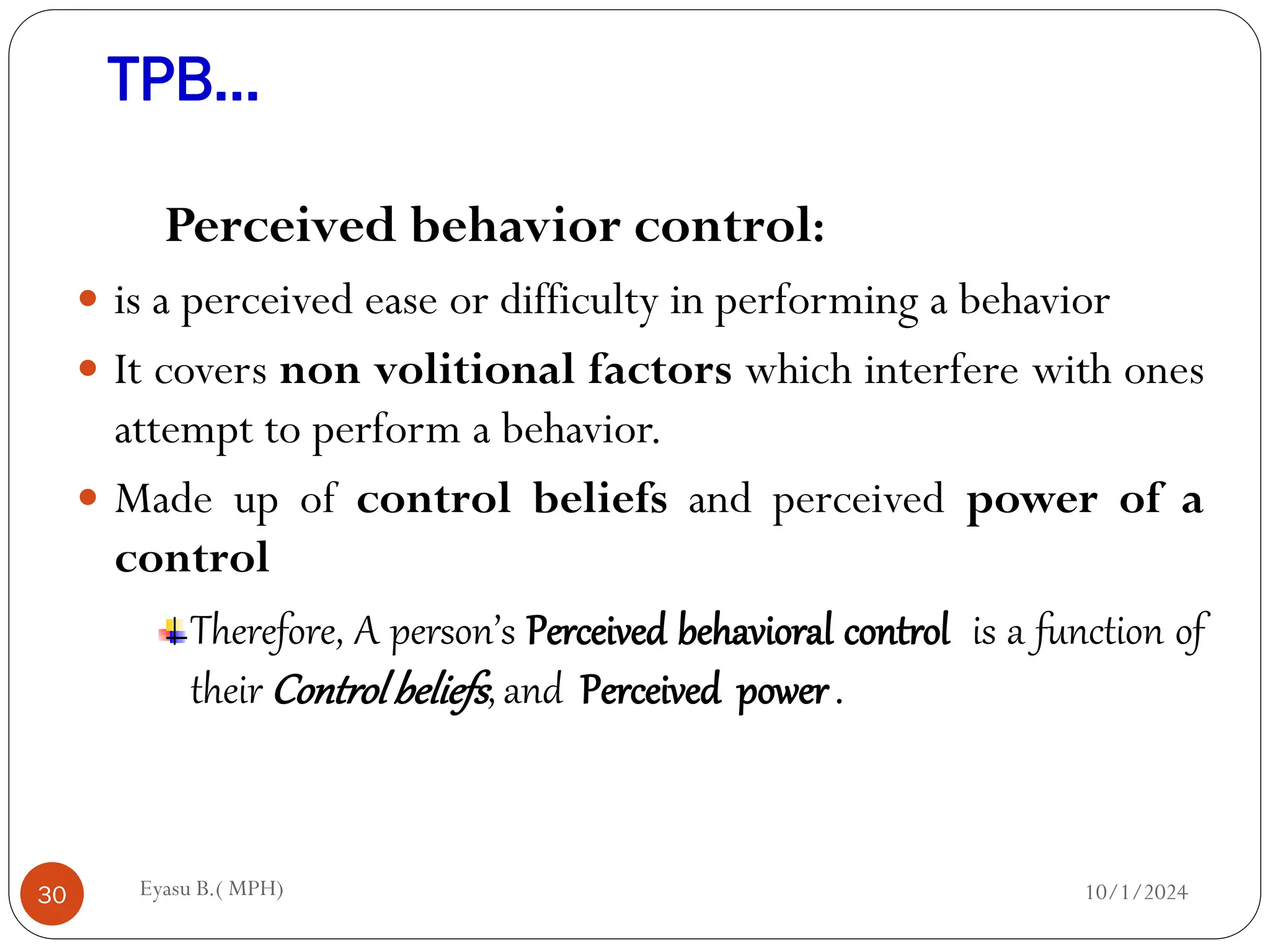
Perceived behavior control:
 is a perceived ease or difficulty in performing a behavior
 It covers non volitional factors which interfere with ones
attempt to perform a behavior.
 Made up of control beliefs and perceived power of a
control
Therefore, A person’s Perceived behavioral control is a function of
their Controlbeliefs, and Perceived power .
4. Trans-theoretical Model (T TM)
(Prochaska & Diclemente, 1979)
…changeis a process with stages not just an event…
Introduction
10/1/2024
Eyasu B.( MPH)
32
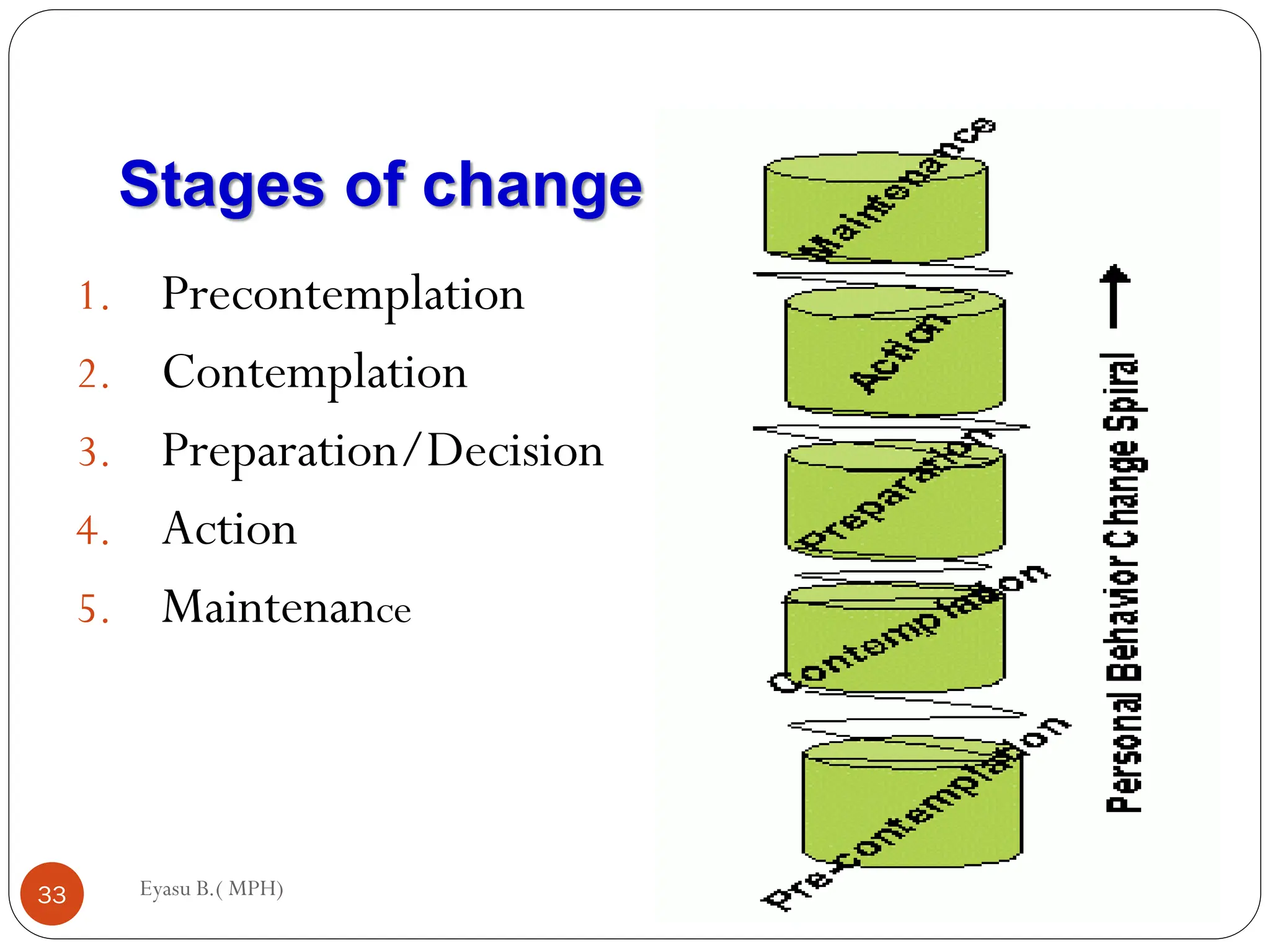
• Evidence suggest that behavior change occurs in stages or
steps
• Movement through these stages is not linear
• But, rather cyclical involving pattern of adoption, maintenance,
relapse & re-adoption over time .
 The model’s basic premise is that behavior change is a
process, not an event
10/1/2024
Eyasu B.( MPH)
33
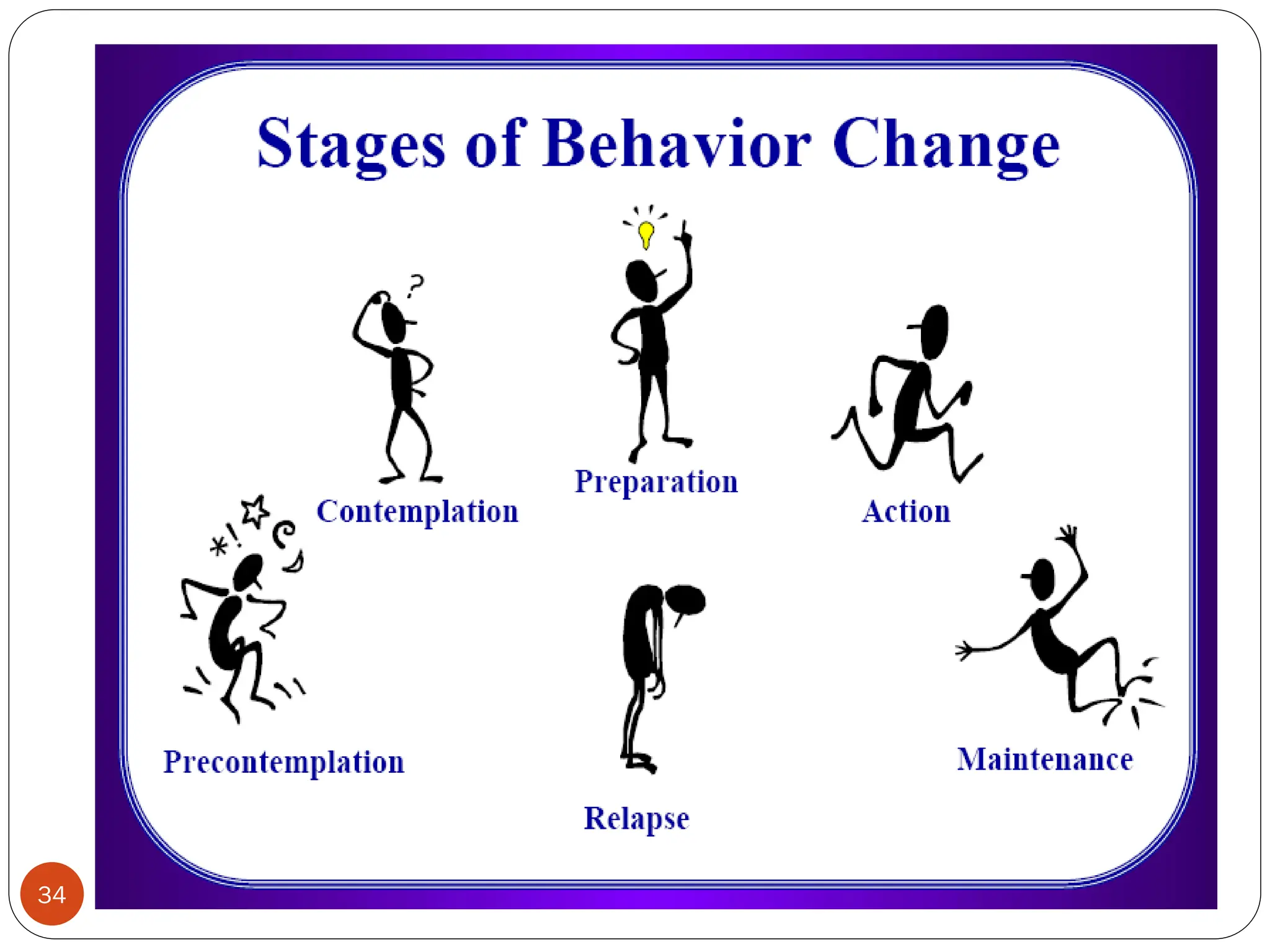
Stages of change
1. Precontemplation
2. Contemplation
3. Preparation/Decision
4. Action
5. Maintenance
10/1/2024
Eyasu B.( MPH)
34
STAGES OF BEHAVIOR CHANGE
10/1/2024
Eyasu B.( MPH)
35
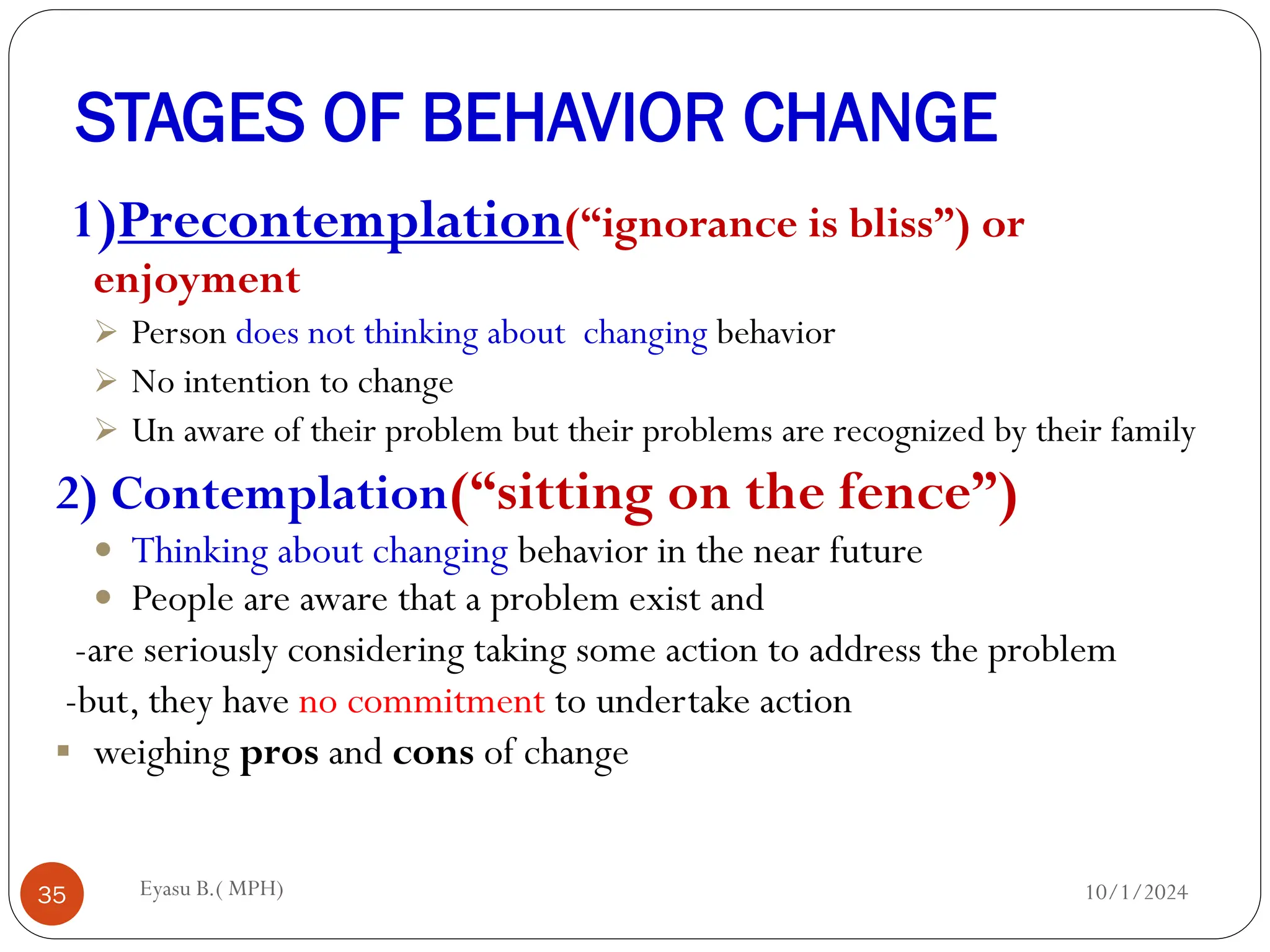
1)Precontemplation(“ignorance is bliss”) or
enjoyment
 Person does not thinking about changing behavior
 No intention to change
 Un aware of their problem but their problems are recognized by their family
2) Contemplation(“sitting on the fence”)
 Thinking about changing behavior in the near future
 People are aware that a problem exist and
-are seriously considering taking some action to address the problem
-but, they have no commitment to undertake action
 weighing pros and cons of change
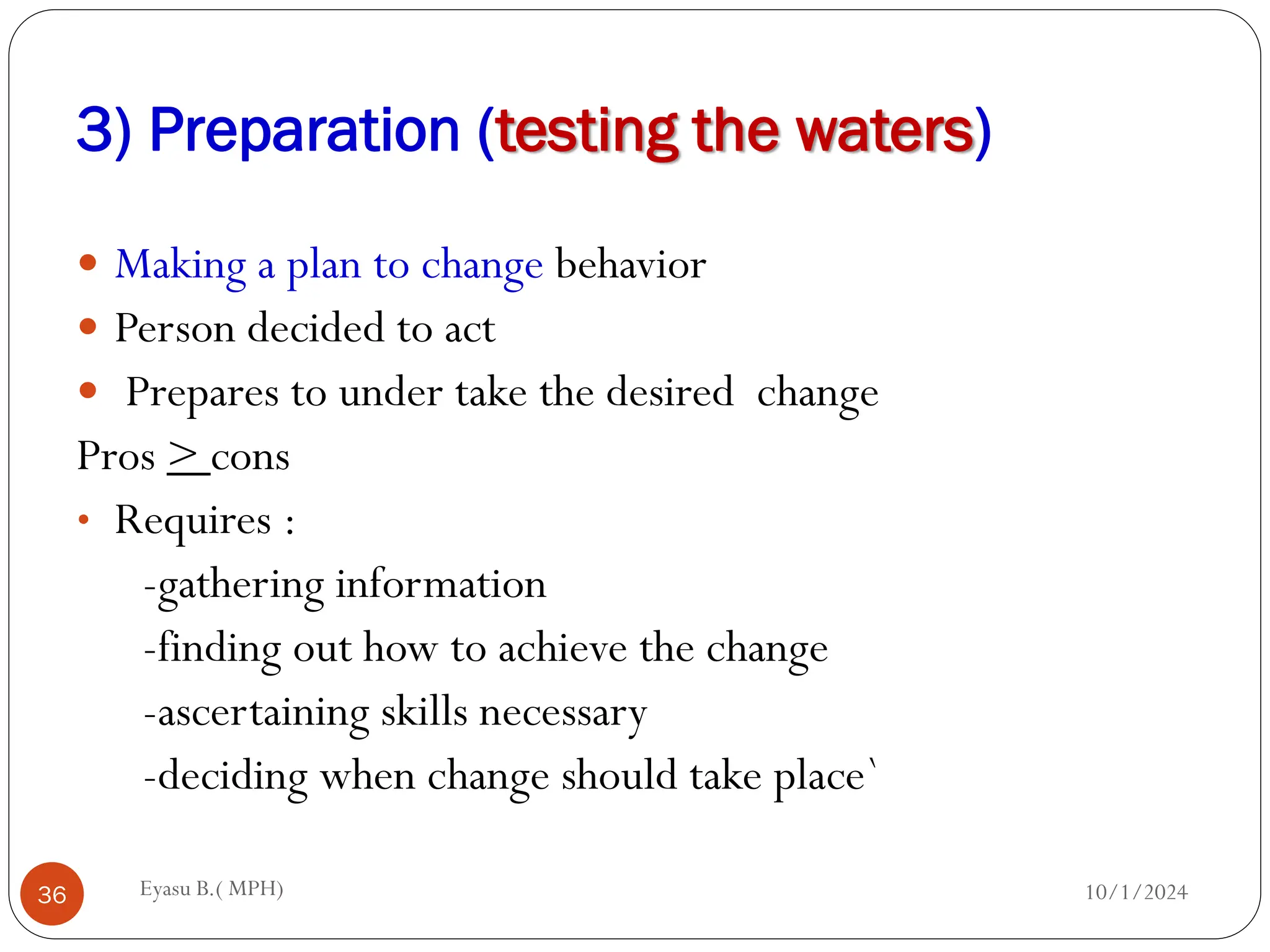
3) Preparation (testing the waters)
10/1/2024
Eyasu B.( MPH)
36
 Making a plan to change behavior
 Person decided to act
 Prepares to under take the desired change
Pros > cons
• Requires :
-gathering information
-finding out how to achieve the change
-ascertaining skills necessary
-deciding when change should take place`
4) Action (“go for it”)
10/1/2024
Eyasu B.( MPH)
37
• Implementing the plan to change behavior
• Individuals actually modify their behavior, experiences, or
environment in order to overcome their problems or to meet
their goals
5)Maintenance (“steady as she goes”)
10/1/2024
Eyasu B.( MPH)
38
 Continuation of behavior change
 People work to prevent relapse & consolidate, secure the
gains attained in the action stage
 Characteristics :
-Stabilization of the new behavior
-Avoidance of relapse
5. Social Cognitive Theory
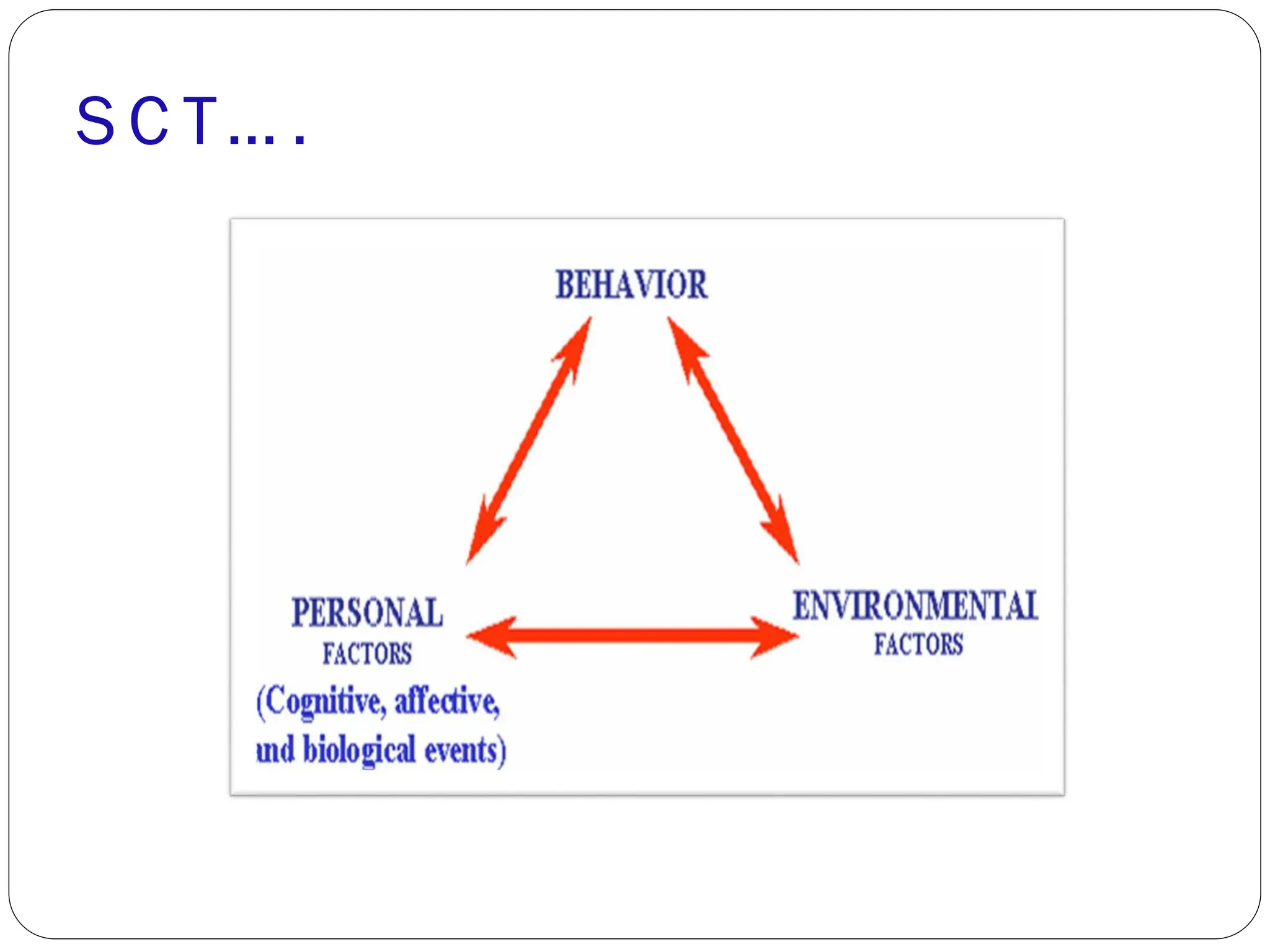
• Human behavior is the product of the dynamic interplay of
personal, behavioral, and environmental influences
• Give due attention to the human minds, and external
environment.
• S C T emphasizes reciprocal determinism in the interaction
between people and their environments
S C T… .
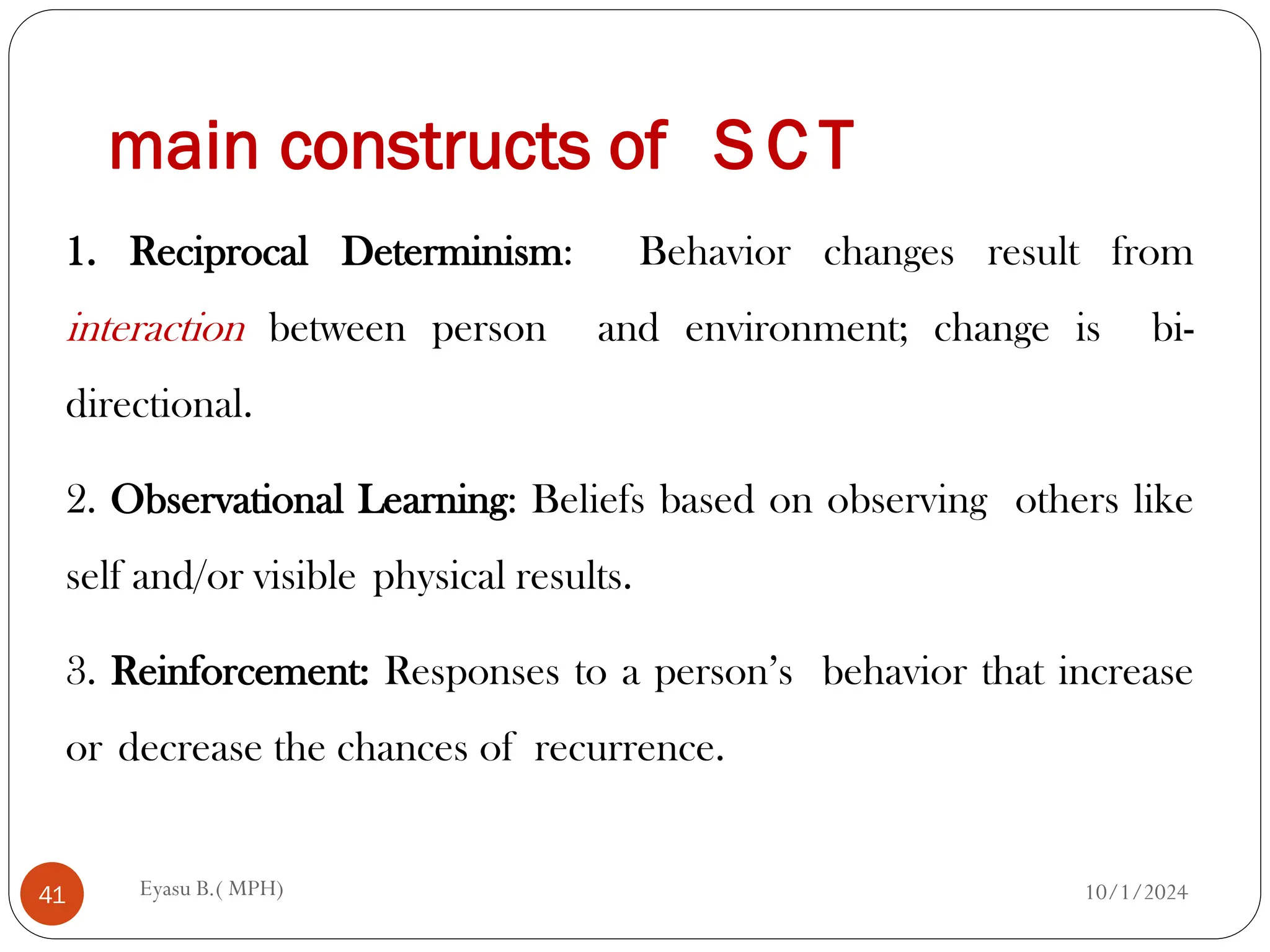
main constructs of S C T
10/1/2024
Eyasu B.( MPH)
41
1. Reciprocal Determinism: Behavior changes result from
interaction between person and environment; change is bi-
directional.
2. Observational Learning: Beliefs based on observing others like
self and/or visible physical results.
3. Reinforcement: Responses to a person’s behavior that increase
or decrease the chances of recurrence.
10/1/2024
Eyasu B.( MPH)
42
6. DIFFUSION
OF
INNOVATIONSTHEORY
(DOI)
Diffusion of innovation theory
10/1/2024
Eyasu B.( MPH)
43
 process by which innovation is communicated through certain
channels over time among the members of a social system
 The four main elements of the definition are:
I. Innovation
II. Communication channels
III.Time
IV. Social system
I. Innovation
10/1/2024
Eyasu B.( MPH)
44
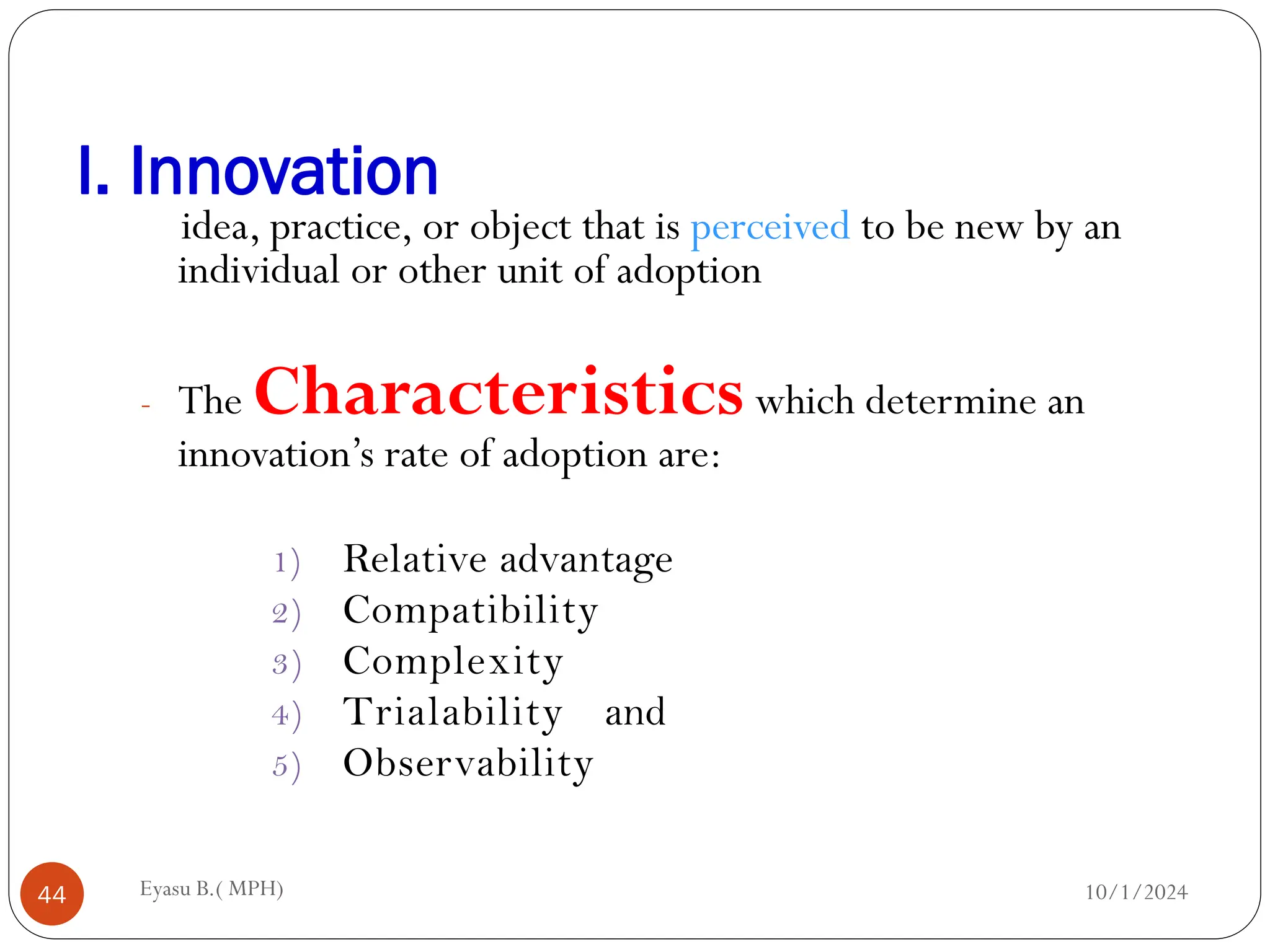
idea, practice, or object that is perceived to be new by an
individual or other unit of adoption
- The Characteristicswhich determine an
innovation’s rate of adoption are:
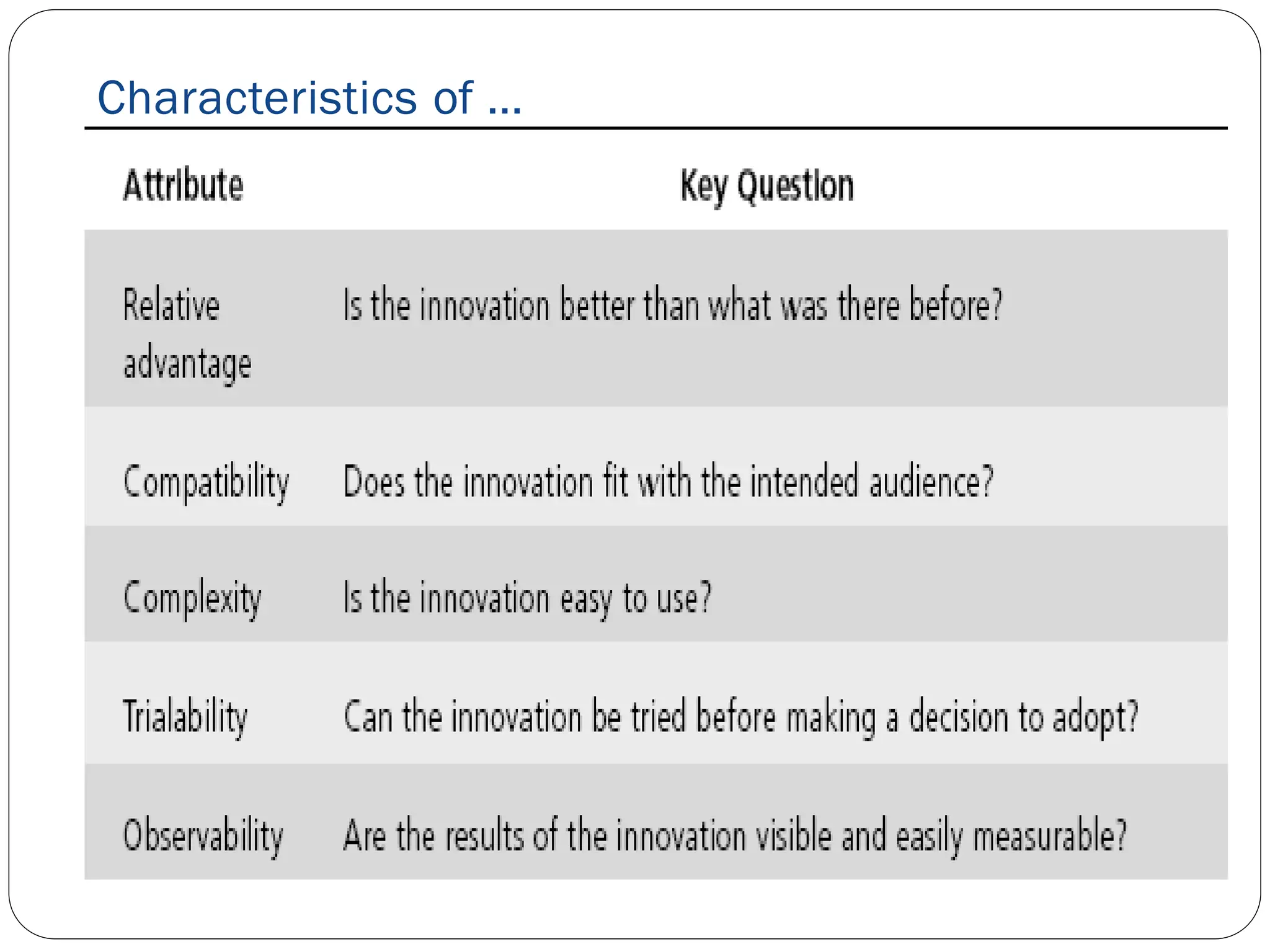
1) Relative advantage
2) Compatibility
3) Complexity
4) Trialability and
5) Observability
Characteristics of …
II) communication channels
10/1/2024
Eyasu B.( MPH)
46
-It is the means by which messages get from one individual to
another.
Mass media
Interpersonal
III. TIME
10/1/2024
Eyasu B.( MPH)
47
- the two time factors are:
(a) innovation-decision process
(b) innovativeness
a) The Innovation - Decision Process
10/1/2024
Eyasu B.( MPH)
48
 /The Adoption Process / - the process an individual
passes from first knowledge of an innovation to confirmation
of his decision.
 Five stages through which innovation passes:
5 stages of Innovation-Decision Process…
10/1/2024
Eyasu B.( MPH)
49
1. Awareness/knowledge-exposure to existence of the innovation
2. Interest/persuasion-the individual becomes interested in the new
idea
-seeks additional information about it
3. Evaluation/decision-individual mentally applies the innovation to his
present and anticipated future situation
-and then decides whether or not to try it
-commitment to its adoption
5 stages…
10/1/2024
Eyasu B.( MPH)
50
4. Trial/implementation-the individual makes full use of the innovation
5. Adoption/confirmation-the individual decides to continue the full
use of the innovation
b) ADOPTER CATEGORIES based on their
innovativeness
10/1/2024
Eyasu B.( MPH)
51
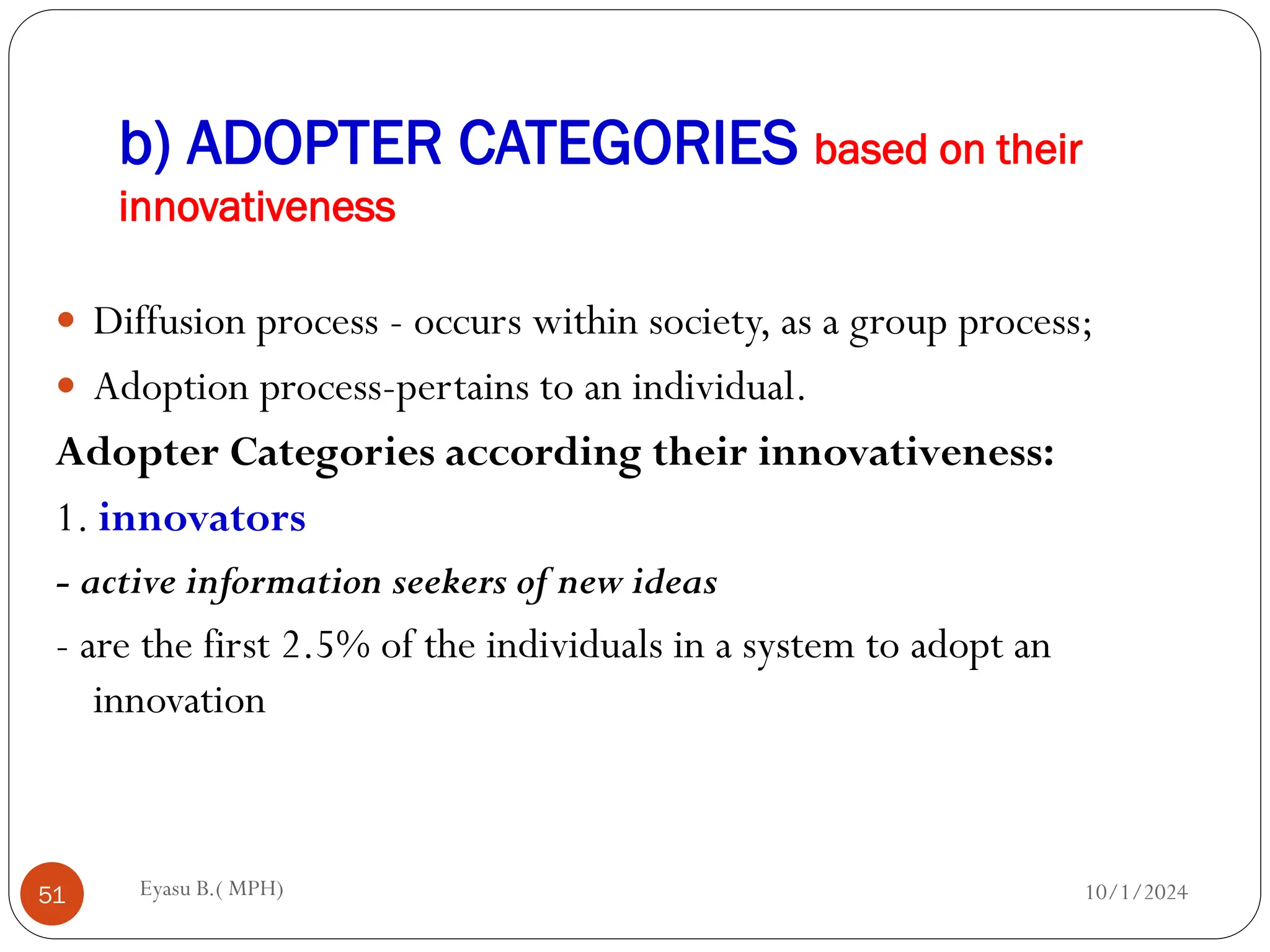
 Diffusion process - occurs within society, as a group process;
 Adoption process-pertains to an individual.
Adopter Categories according their innovativeness:
1. innovators
- active information seekers of new ideas
- are the first 2.5% of the individuals in a system to adopt an
innovation
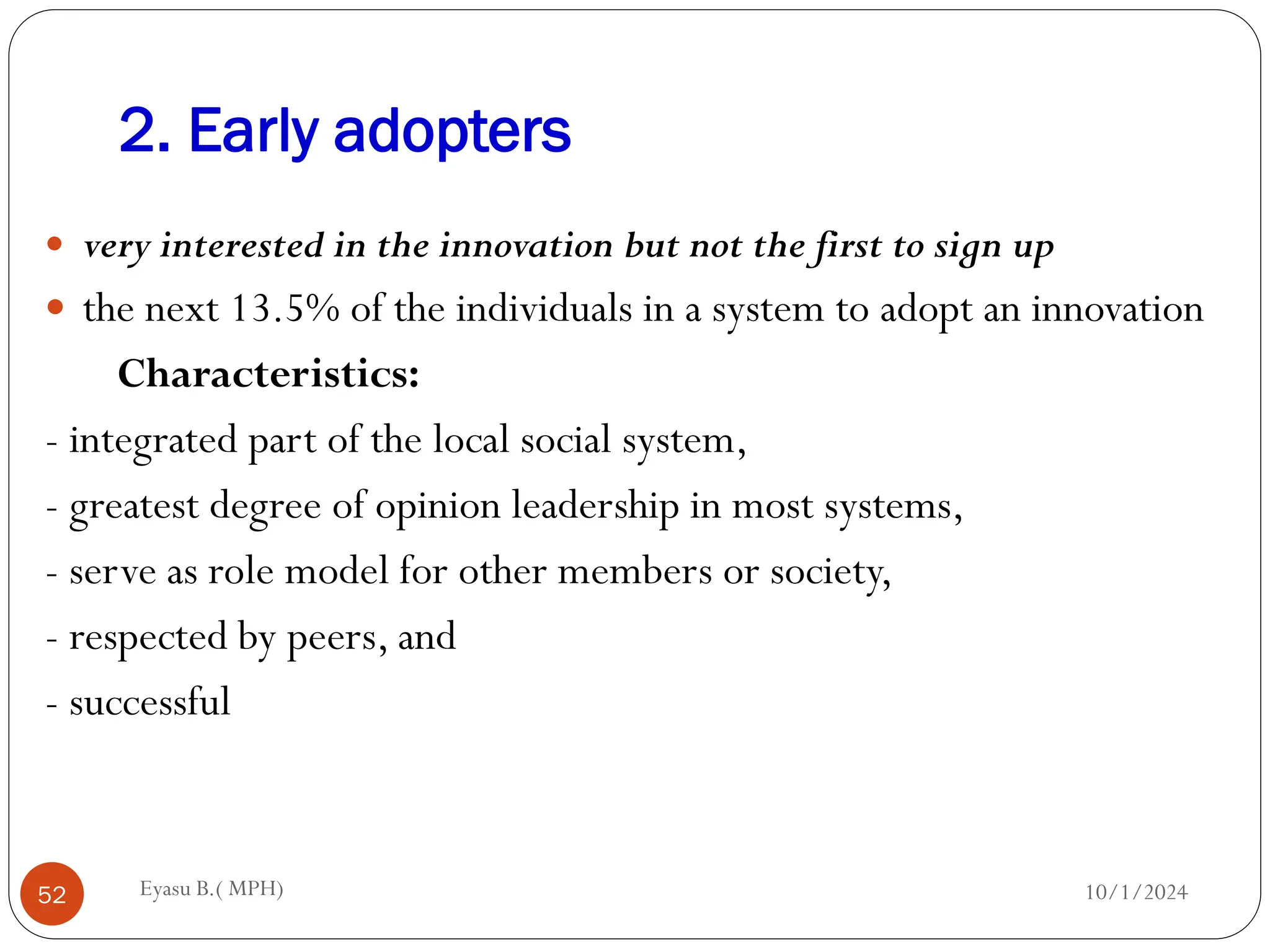
2. Early adopters
10/1/2024
Eyasu B.( MPH)
52
 very interested in the innovation but not the first to sign up
 the next 13.5% of the individuals in a system to adopt an innovation
Characteristics:
- integrated part of the local social system,
- greatest degree of opinion leadership in most systems,
- serve as role model for other members or society,
- respected by peers, and
- successful
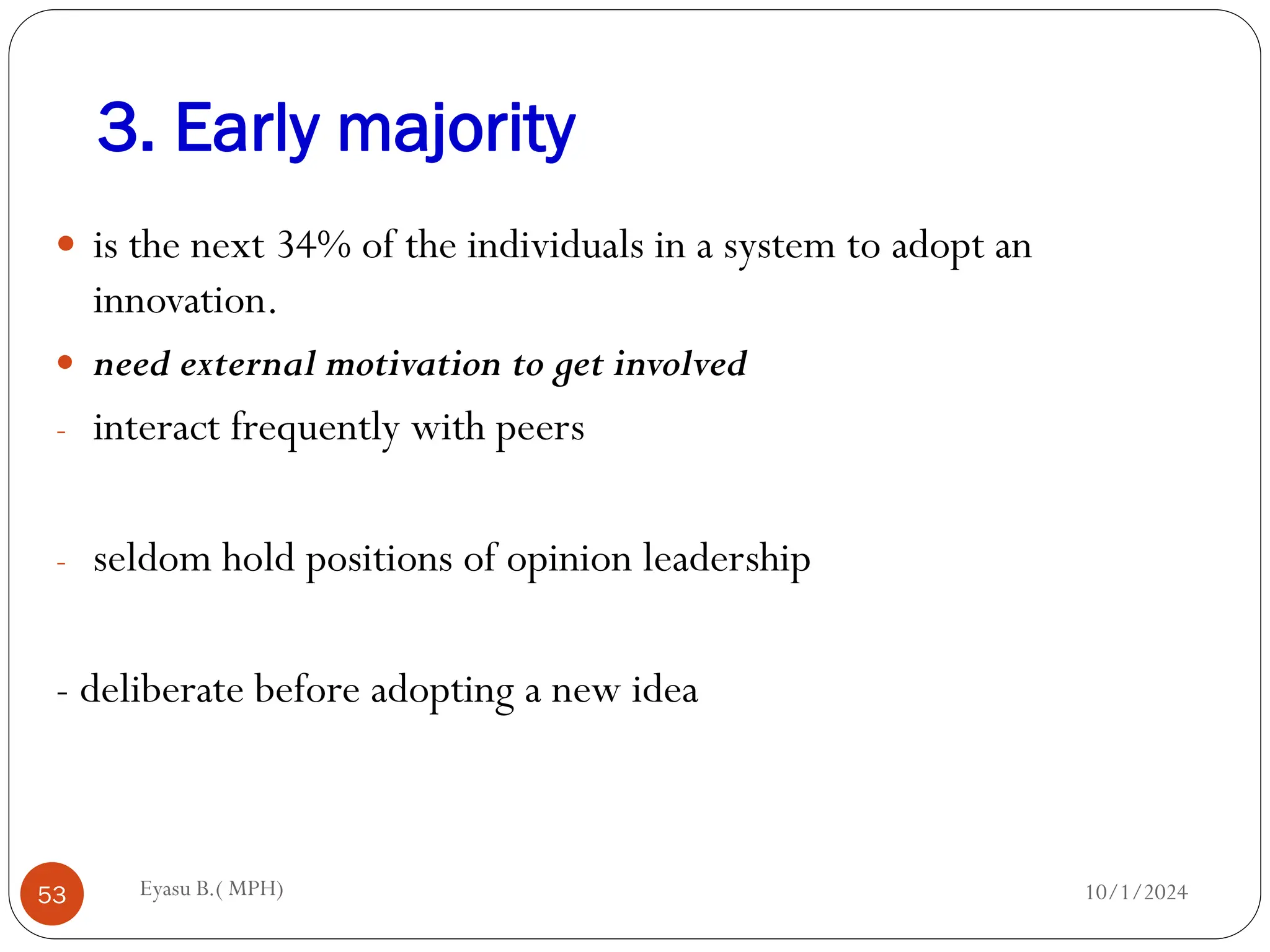
3. Early majority
10/1/2024
Eyasu B.( MPH)
53
 is the next 34% of the individuals in a system to adopt an
innovation.
 need external motivation to get involved
- interact frequently with peers
- seldom hold positions of opinion leadership
- deliberate before adopting a new idea
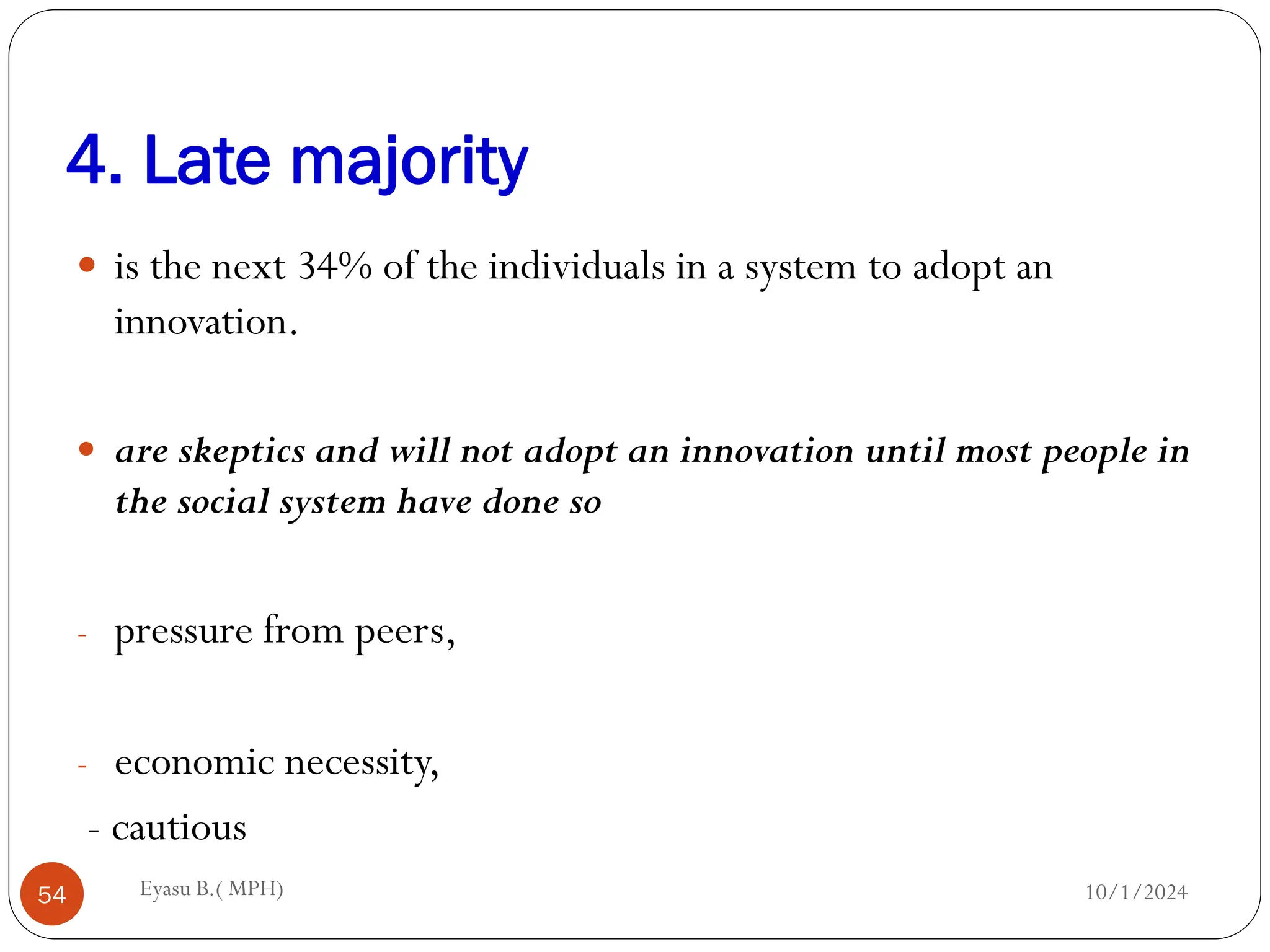
4. Late majority
10/1/2024
Eyasu B.( MPH)
54
 is the next 34% of the individuals in a system to adopt an
innovation.
 are skeptics and will not adopt an innovation until most people in
the social system have done so
- pressure from peers,
- economic necessity,
- cautious
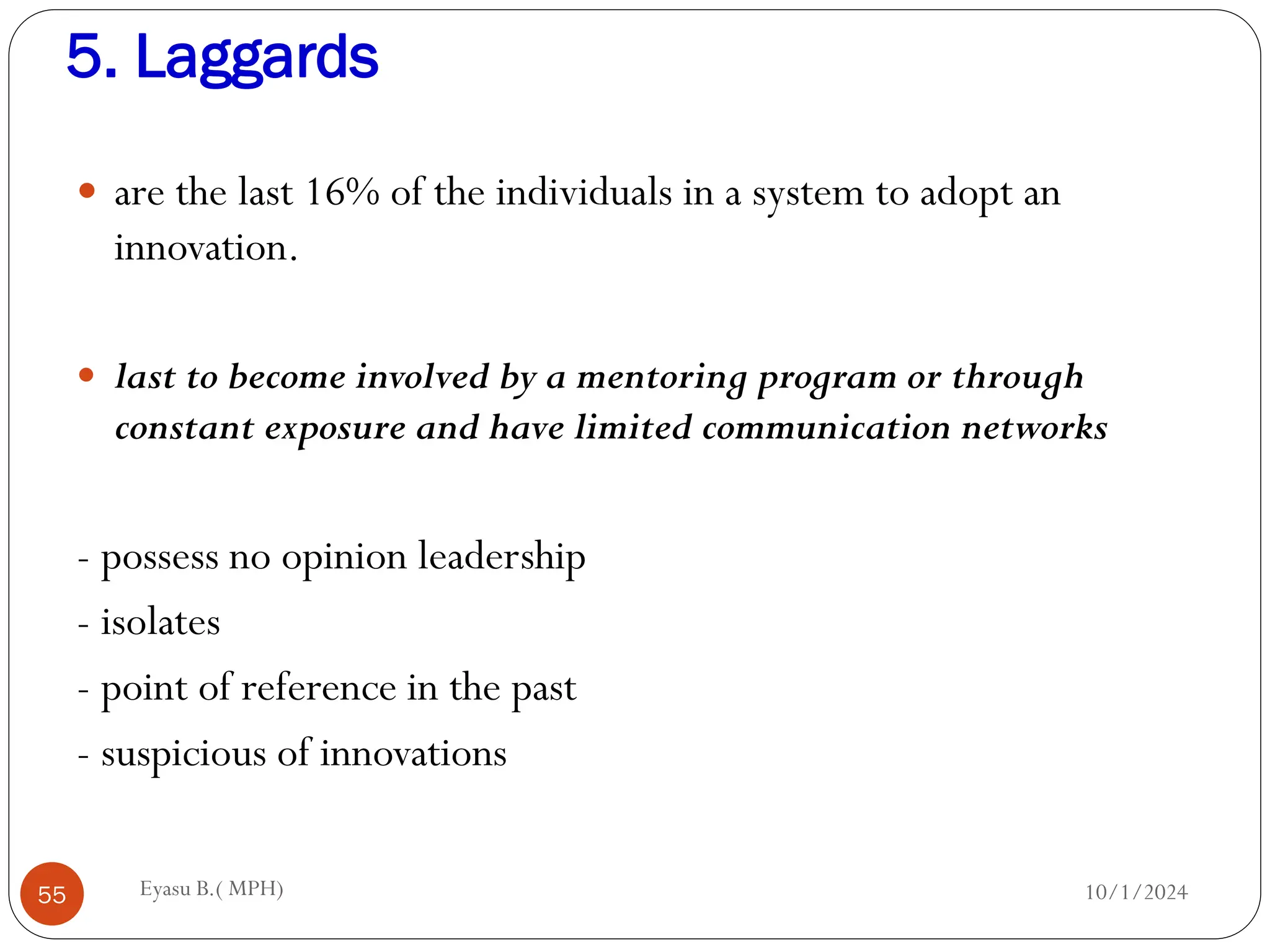
5. Laggards
10/1/2024
Eyasu B.( MPH)
55
 are the last 16% of the individuals in a system to adopt an
innovation.
 last to become involved by a mentoring program or through
constant exposure and have limited communication networks
- possess no opinion leadership
- isolates
- point of reference in the past
- suspicious of innovations
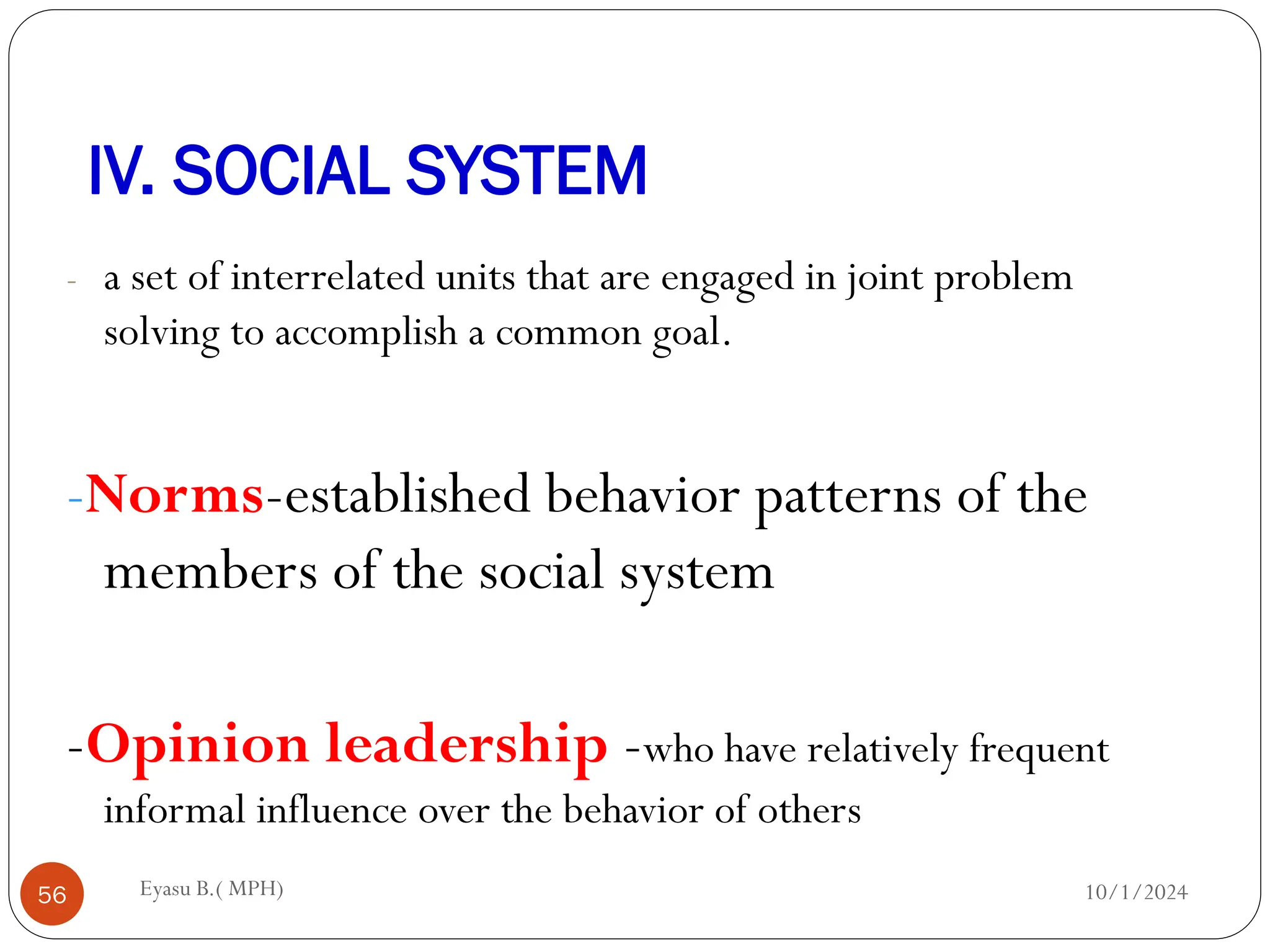
IV. SOCIAL SYSTEM
10/1/2024
Eyasu B.( MPH)
56
- a set of interrelated units that are engaged in joint problem
solving to accomplish a common goal.
-Norms-established behavior patterns of the
members of the social system
-Opinion leadership -who have relatively frequent
informal influence over the behavior of others
Summary
10/1/2024
Eyasu B.( MPH)
57
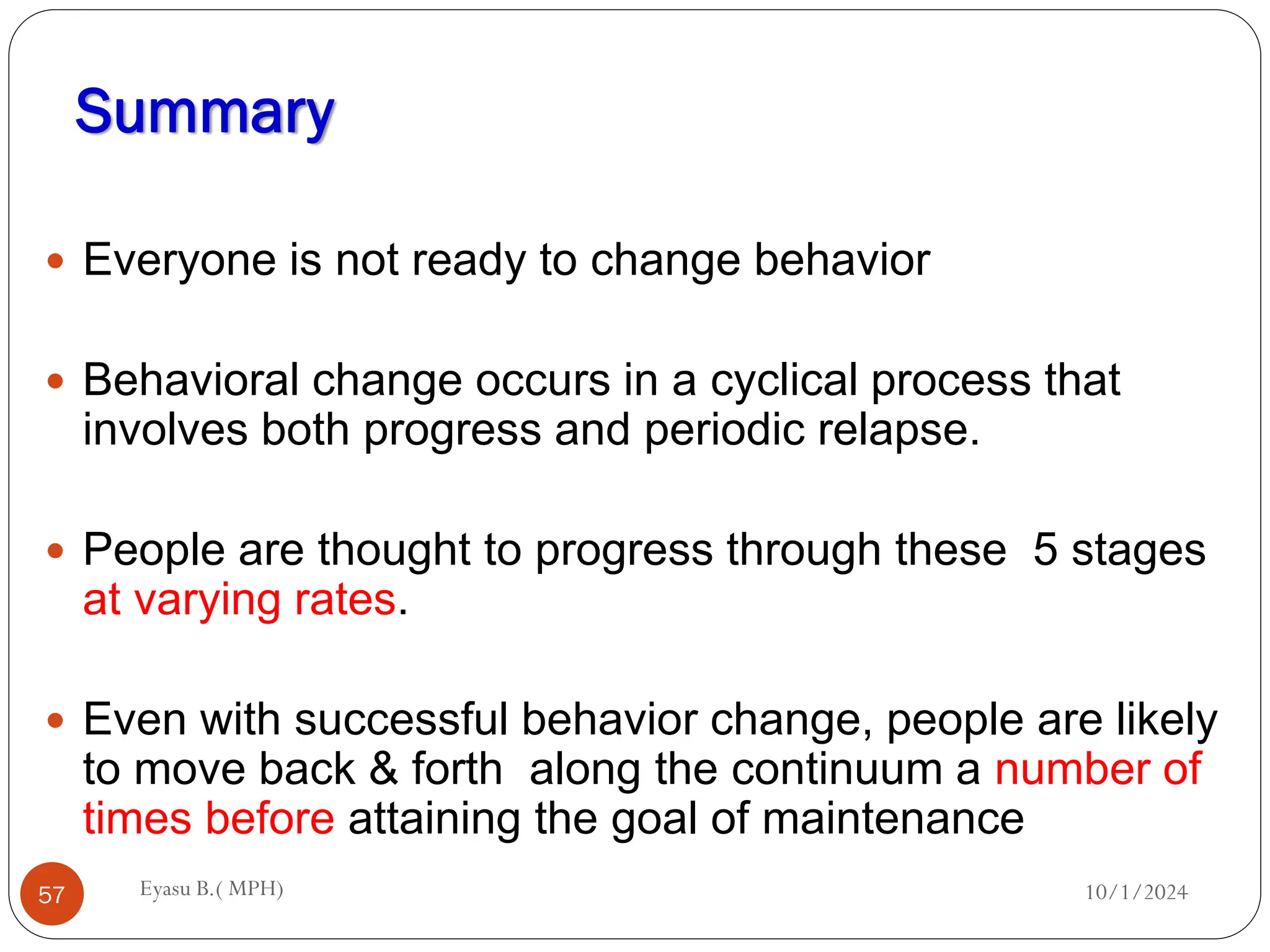
 Everyone is not ready to change behavior
 Behavioral change occurs in a cyclical process that
involves both progress and periodic relapse.
 People are thought to progress through these 5 stages
at varying rates.
 Even with successful behavior change, people are likely
to move back & forth along the continuum a number of
times before attaining the goal of maintenance
Summary …
10/1/2024
Eyasu B.( MPH)
58
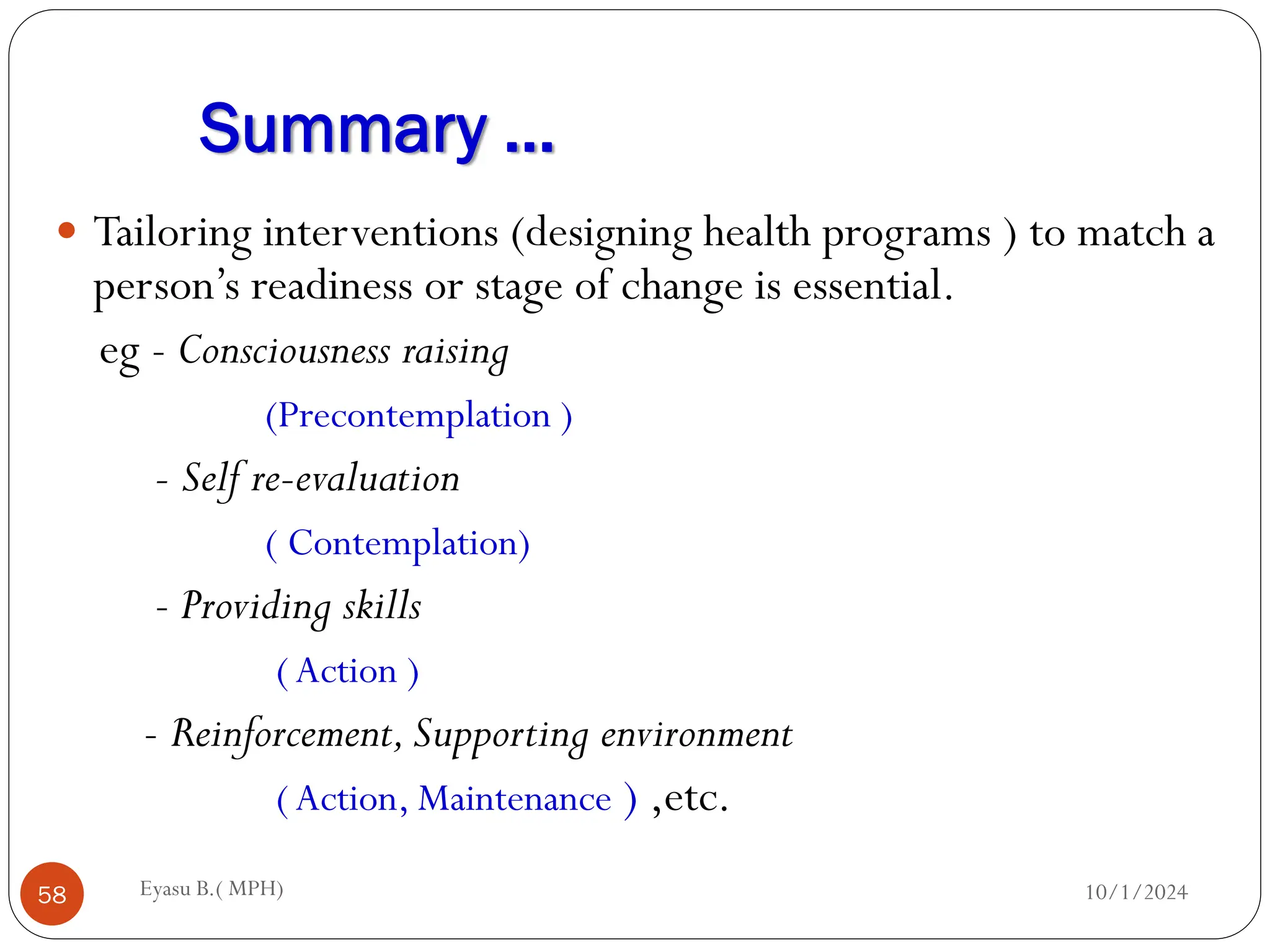
 Tailoring interventions (designing health programs ) to match a
person’s readiness or stage of change is essential.
eg - Consciousness raising
(Precontemplation )
- Self re-evaluation
( Contemplation)
- Providing skills
(Action )
- Reinforcement,Supporting environment
(Action, Maintenance ) ,etc.
Module-3 Health education Theories & Models.pdf

Module-3 Health education Theories & Models.pdf

  • 1.
    10/1/2024 Eyasu B.( MPH) 1 Module-3 THEORIES& MODELS IN HEALTH EDUCATIONS
  • 2.
    OBJECTIVEs 10/1/2024 Eyasu B.( MPH) 2 Atthe end of this lecture students will be able to:  Discuss the role of the theories/models in HE  Describe the most common theories used in HE
  • 3.
    What is theory? 10/1/2024 EyasuB.( MPH) 3 Theory is “A set of interrelated concepts, definitions, and proposition.  present a systematic view of phenomena  by specifying relations among variables with the purpose of explaining and predicting the phenomenon”  Theories explain why, what, how and when a particular behavior occurs.
  • 4.
    What is Models? 10/1/2024 EyasuB.( MPH) 4 Model is “Generalized, hypothetical description used to analyze or explain something’’.  Is diagrammatic representation of a phenomena  It provides plan foe investigating and/or addressing phenomena.
  • 5.
    Why theories/models? 10/1/2024 Eyasu B.(MPH) 5  Provides a road map for studying problems, developing appropriate interventions, and evaluating their successes.  Help to explain the dynamics of health behaviors.  Help planners identify the most suitable target audiences, methods for fostering change, and outcomes for evaluation.  Guides the search for reasons why people do or do not engage in certain health behaviors;
  • 6.
    Classification… Theories/Models in HE/HP Planningtheories/models E.g. PRECEDE-PROCEED model Behavior change Theories/Models Intra-personal theory / models HBM, TRA, TPB, TTM Inter-personal theory/ models SCT Community theory/models eg. TDI Continuum theory Eg.HBM, TPB, TRA Stage theory Eg. TTM
  • 7.
    1. Individual HealthBehavior Model 10/1/2024 Eyasu B.( MPH) 7  Focus on individual characteristics that influence behavior, such as knowledge, attitudes, beliefs, and personality traits  Health Belief Model (HBM)  Theory of Reasoned Action (TRA)  Theory of Planned Behavior (TPB)  Trans-theoretical Model (TTM)- Stages of Change
  • 8.
    2.Interpersonal health behaviortheories 10/1/2024 Eyasu B.( MPH) 8  Focus on interpersonal processes including relationship with family, friends, and peers. Social Cognitive Theory(SCT) 3. Community level Models  Community-level models are frameworks for understanding how social systems function and change, and how communities and organizations can be activated Diffusion of Innovation (DoI)
  • 9.
  • 10.
    1. The healthbelief model (HBM) 10/1/2024 Eyasu B.( MPH) 10  The HBM has been developed by a group of psychologists in the 1950s to explain why people would or would not use health services  The model is used in explaining and predicting preventive health behavior, as well as sick-role and illness behavior.  It emphasizes the intellectual dimension of health behavior.
  • 11.
    HBM 10/1/2024 Eyasu B.( MPH) 11 Focus: Individuals’ perceptions of the threat posed by a health problem, the benefits of avoiding the threat, and factors influencing the decision to act.  Six main constructs influence people’s decisions about whether to take action to prevent, screen for, and control illness
  • 12.
    constructs of theHBM 10/1/2024 Eyasu B.( MPH) 12  Perceived Susceptibility- refers to beliefs about the likelihood of getting a disease or condition .  Perceived severity- Feelings about the seriousness of contracting an illness.  Perceived benefit-the belief that changing one's behavior will reduce the threat  Perceived barriers-a perception of the obstacles to changing one's behavior eg. Cost, side effect, culture…  Self efficacy-the belief that one has the ability to change one's behavior  Cues to Action - may be internal or external.
  • 13.
    10/1/2024 Eyasu B.( MPH) 13 •Demographicvariables •Socio-psychological variables (personality, peer pressure etc) •Structural variables (e.g. knowledge about the disease. (OUT COME EXPECTATION) •Perceived benefits of preventive action Minus •Perceived barriers to preventive action •Perceived susceptibility to Disease "X“ + •Perceived seriousness (Severity) of Disease "X" Perceived threat of Disease "X" Likelihood of taking recommended preventive health action Cues to action •Mass media campaigns •Advice from others •Reminder postcard from health workers •Illness of family member or friend HEALTH BELIEF MODEL Individual perception Modifying Factors Likelihood of action
  • 14.
    Exercise( 5 minutes) 10/1/2024 EyasuB.( MPH) 14  If HBM model was used to shape a public program for Breast cancer screening. What beliefs would it be necessary for women to adopt so as to minimize the risk of developing Breast cancer?
  • 15.
    CONSTRUCT Perceived Susceptibility  Chancesof getting breast cancer are high. (on a 5 point scale,ranging from "strongly disagree" to "strongly agree") Perceived Severity  My marriage would be endangered if I had breast cancer. (on a 5 point scale,ranging from "strongly disagree" to "strongly agree") Perceived Benefits  Getting a mammogram in our hospital has brought me peace of mind. A mammogram is a routine part of my check up-exam. (on a 5 point scale,ranging from "strongly disagree" to "strongly agree") 10/1/2024 Eyasu B.( MPH) 15
  • 16.
    constructs Perceived Barriers  Gettinga mammogram is too embarrassing. (on a 5 point scale,ranging from "strongly disagree" to "strongly agree") Cues to Action  Hearing about breast cancer in the news makes me think about getting a mammogram. (on a 5 point scale,ranging from "strongly disagree" to "strongly agree") Self-Efficacy  How sure are you that you know how to arrange an appointment for a mammogram? (on a 5 point scale,ranging from "unsure" to "very sure") 10/1/2024 Eyasu B.( MPH) 16
  • 17.
    2. Theory ofReasoned Action (Fishbein & Ajzen, 1970’s) …TPB is the extension of TRA…
  • 18.
    Introduction 10/1/2024 Eyasu B.( MPH) 18 TRA was introduced by Fishbein in 1967  Modified & Refined over time (eg. Ajzen & Fishbein, 1980) - concerned with the prediction and understanding of human behavior  It was designed to explain all human behavior that is under volitional control.
  • 19.
    Assumption:- 10/1/2024 Eyasu B.( MPH) 19 The theory rests on the assumptions that humans are: - rational, - have control over their behavior, and - seek out, utilize, and process all available information about pending decisions before they take actions. therefore, Ajzen and Fishbein refer to their approach as "a theory of reasoned action"
  • 20.
    10/1/2024 Eyasu B.( MPH) 20 INTENTION Subjective norms Attitude Behavioralbelief & Outcome Evaluation Normative beliefs of referents & Motivation to comply The theory of reasoned action. BEHAVIOR
  • 21.
    TRA… 10/1/2024 Eyasu B.( MPH) 21 Intentions are most immediate influence or determinant of behaviors If one has intend to perform a behavior then it is likely that he/she will do so, if not intend then it is unlikely to be performed.  Performing a behavior is a function of intention.
  • 22.
    TRA… 10/1/2024 Eyasu B.( MPH) 22 Intention :- function of two basic determinants:  one personal and the other social  Personal factor = attitude toward the behavior  The social factor = subjective norm (SN) SN is the person's perception of the social pressures put on that person to perform or not perform the behavior in question.
  • 23.
    TRA… 10/1/2024 Eyasu B.( MPH) 23 Determinantsof Attitude toward an Act -Behavioral beliefs = The person’s beliefs that the behavior leads to certain outcomes and e.g physical exercise in reducing body weight - Evaluation of outcome = his or her evaluations of those outcomes Therefore, A person’s Attitude is a function of their behavioral beliefs, and Evaluation of outcome
  • 24.
    TRA… 10/1/2024 Eyasu B.( MPH) 24 Determinantsof Subjective Norms 1. Normative beliefs 2. Motivation to comply 1. Normative beliefs = belief about what a specific referent person thinks one should or should not do regarding the behavior Referent = specific individual or group who may influence one’s behavior
  • 25.
    TRA… 10/1/2024 Eyasu B.( MPH) 25 For each referent, we have a normative belief, what we think that referent would want us to do 2. For each referent, we have a specific level of motivation to comply with their wishes for us Therefore, A person’s subjective norm is a function of their normative beliefs for salient referents, and motivation to comply with these different referents
  • 26.
  • 27.
    Limitations 10/1/2024 Eyasu B.( MPH) 27 Not appropriate for predicting or explaining behavior in situations where people had little power over events around, i.e if there is non volitional control  It is almost entirely rational and does not provide explicitly for emotional fear arousal elements such as perceived susceptibility to illness
  • 28.
    Extensions (TPB) 10/1/2024 Eyasu B.(MPH) 28  To improve the predictive power ofTRA, Ajzen(1985) added a third construct (Perceived behavioral control) to the original theory to account for the performance of behaviors which are not completely under the subject's control. 3.Theory of Planned Behavior
  • 29.
  • 30.
    TPB… 10/1/2024 Eyasu B.( MPH) 30 Perceivedbehavior control:  is a perceived ease or difficulty in performing a behavior  It covers non volitional factors which interfere with ones attempt to perform a behavior.  Made up of control beliefs and perceived power of a control Therefore, A person’s Perceived behavioral control is a function of their Controlbeliefs, and Perceived power .
  • 31.
    4. Trans-theoretical Model(T TM) (Prochaska & Diclemente, 1979) …changeis a process with stages not just an event…
  • 32.
    Introduction 10/1/2024 Eyasu B.( MPH) 32 •Evidence suggest that behavior change occurs in stages or steps • Movement through these stages is not linear • But, rather cyclical involving pattern of adoption, maintenance, relapse & re-adoption over time .  The model’s basic premise is that behavior change is a process, not an event
  • 33.
    10/1/2024 Eyasu B.( MPH) 33 Stagesof change 1. Precontemplation 2. Contemplation 3. Preparation/Decision 4. Action 5. Maintenance
  • 34.
  • 35.
    STAGES OF BEHAVIORCHANGE 10/1/2024 Eyasu B.( MPH) 35 1)Precontemplation(“ignorance is bliss”) or enjoyment  Person does not thinking about changing behavior  No intention to change  Un aware of their problem but their problems are recognized by their family 2) Contemplation(“sitting on the fence”)  Thinking about changing behavior in the near future  People are aware that a problem exist and -are seriously considering taking some action to address the problem -but, they have no commitment to undertake action  weighing pros and cons of change
  • 36.
    3) Preparation (testingthe waters) 10/1/2024 Eyasu B.( MPH) 36  Making a plan to change behavior  Person decided to act  Prepares to under take the desired change Pros > cons • Requires : -gathering information -finding out how to achieve the change -ascertaining skills necessary -deciding when change should take place`
  • 37.
    4) Action (“gofor it”) 10/1/2024 Eyasu B.( MPH) 37 • Implementing the plan to change behavior • Individuals actually modify their behavior, experiences, or environment in order to overcome their problems or to meet their goals
  • 38.
    5)Maintenance (“steady asshe goes”) 10/1/2024 Eyasu B.( MPH) 38  Continuation of behavior change  People work to prevent relapse & consolidate, secure the gains attained in the action stage  Characteristics : -Stabilization of the new behavior -Avoidance of relapse
  • 39.
    5. Social CognitiveTheory • Human behavior is the product of the dynamic interplay of personal, behavioral, and environmental influences • Give due attention to the human minds, and external environment. • S C T emphasizes reciprocal determinism in the interaction between people and their environments
  • 40.
  • 41.
    main constructs ofS C T 10/1/2024 Eyasu B.( MPH) 41 1. Reciprocal Determinism: Behavior changes result from interaction between person and environment; change is bi- directional. 2. Observational Learning: Beliefs based on observing others like self and/or visible physical results. 3. Reinforcement: Responses to a person’s behavior that increase or decrease the chances of recurrence.
  • 42.
    10/1/2024 Eyasu B.( MPH) 42 6.DIFFUSION OF INNOVATIONSTHEORY (DOI)
  • 43.
    Diffusion of innovationtheory 10/1/2024 Eyasu B.( MPH) 43  process by which innovation is communicated through certain channels over time among the members of a social system  The four main elements of the definition are: I. Innovation II. Communication channels III.Time IV. Social system
  • 44.
    I. Innovation 10/1/2024 Eyasu B.(MPH) 44 idea, practice, or object that is perceived to be new by an individual or other unit of adoption - The Characteristicswhich determine an innovation’s rate of adoption are: 1) Relative advantage 2) Compatibility 3) Complexity 4) Trialability and 5) Observability
  • 45.
  • 46.
    II) communication channels 10/1/2024 EyasuB.( MPH) 46 -It is the means by which messages get from one individual to another. Mass media Interpersonal
  • 47.
    III. TIME 10/1/2024 Eyasu B.(MPH) 47 - the two time factors are: (a) innovation-decision process (b) innovativeness
  • 48.
    a) The Innovation- Decision Process 10/1/2024 Eyasu B.( MPH) 48  /The Adoption Process / - the process an individual passes from first knowledge of an innovation to confirmation of his decision.  Five stages through which innovation passes:
  • 49.
    5 stages ofInnovation-Decision Process… 10/1/2024 Eyasu B.( MPH) 49 1. Awareness/knowledge-exposure to existence of the innovation 2. Interest/persuasion-the individual becomes interested in the new idea -seeks additional information about it 3. Evaluation/decision-individual mentally applies the innovation to his present and anticipated future situation -and then decides whether or not to try it -commitment to its adoption
  • 50.
    5 stages… 10/1/2024 Eyasu B.(MPH) 50 4. Trial/implementation-the individual makes full use of the innovation 5. Adoption/confirmation-the individual decides to continue the full use of the innovation
  • 51.
    b) ADOPTER CATEGORIESbased on their innovativeness 10/1/2024 Eyasu B.( MPH) 51  Diffusion process - occurs within society, as a group process;  Adoption process-pertains to an individual. Adopter Categories according their innovativeness: 1. innovators - active information seekers of new ideas - are the first 2.5% of the individuals in a system to adopt an innovation
  • 52.
    2. Early adopters 10/1/2024 EyasuB.( MPH) 52  very interested in the innovation but not the first to sign up  the next 13.5% of the individuals in a system to adopt an innovation Characteristics: - integrated part of the local social system, - greatest degree of opinion leadership in most systems, - serve as role model for other members or society, - respected by peers, and - successful
  • 53.
    3. Early majority 10/1/2024 EyasuB.( MPH) 53  is the next 34% of the individuals in a system to adopt an innovation.  need external motivation to get involved - interact frequently with peers - seldom hold positions of opinion leadership - deliberate before adopting a new idea
  • 54.
    4. Late majority 10/1/2024 EyasuB.( MPH) 54  is the next 34% of the individuals in a system to adopt an innovation.  are skeptics and will not adopt an innovation until most people in the social system have done so - pressure from peers, - economic necessity, - cautious
  • 55.
    5. Laggards 10/1/2024 Eyasu B.(MPH) 55  are the last 16% of the individuals in a system to adopt an innovation.  last to become involved by a mentoring program or through constant exposure and have limited communication networks - possess no opinion leadership - isolates - point of reference in the past - suspicious of innovations
  • 56.
    IV. SOCIAL SYSTEM 10/1/2024 EyasuB.( MPH) 56 - a set of interrelated units that are engaged in joint problem solving to accomplish a common goal. -Norms-established behavior patterns of the members of the social system -Opinion leadership -who have relatively frequent informal influence over the behavior of others
  • 57.
    Summary 10/1/2024 Eyasu B.( MPH) 57 Everyone is not ready to change behavior  Behavioral change occurs in a cyclical process that involves both progress and periodic relapse.  People are thought to progress through these 5 stages at varying rates.  Even with successful behavior change, people are likely to move back & forth along the continuum a number of times before attaining the goal of maintenance
  • 58.
    Summary … 10/1/2024 Eyasu B.(MPH) 58  Tailoring interventions (designing health programs ) to match a person’s readiness or stage of change is essential. eg - Consciousness raising (Precontemplation ) - Self re-evaluation ( Contemplation) - Providing skills (Action ) - Reinforcement,Supporting environment (Action, Maintenance ) ,etc.