When Design Met  Anthropology Christina Wasson
Outline of presentation How design met anthropology Emergence of a new, hybrid field: design anthropology Process of collaboration Case study Collaboration between design and anthropology during economic crisis
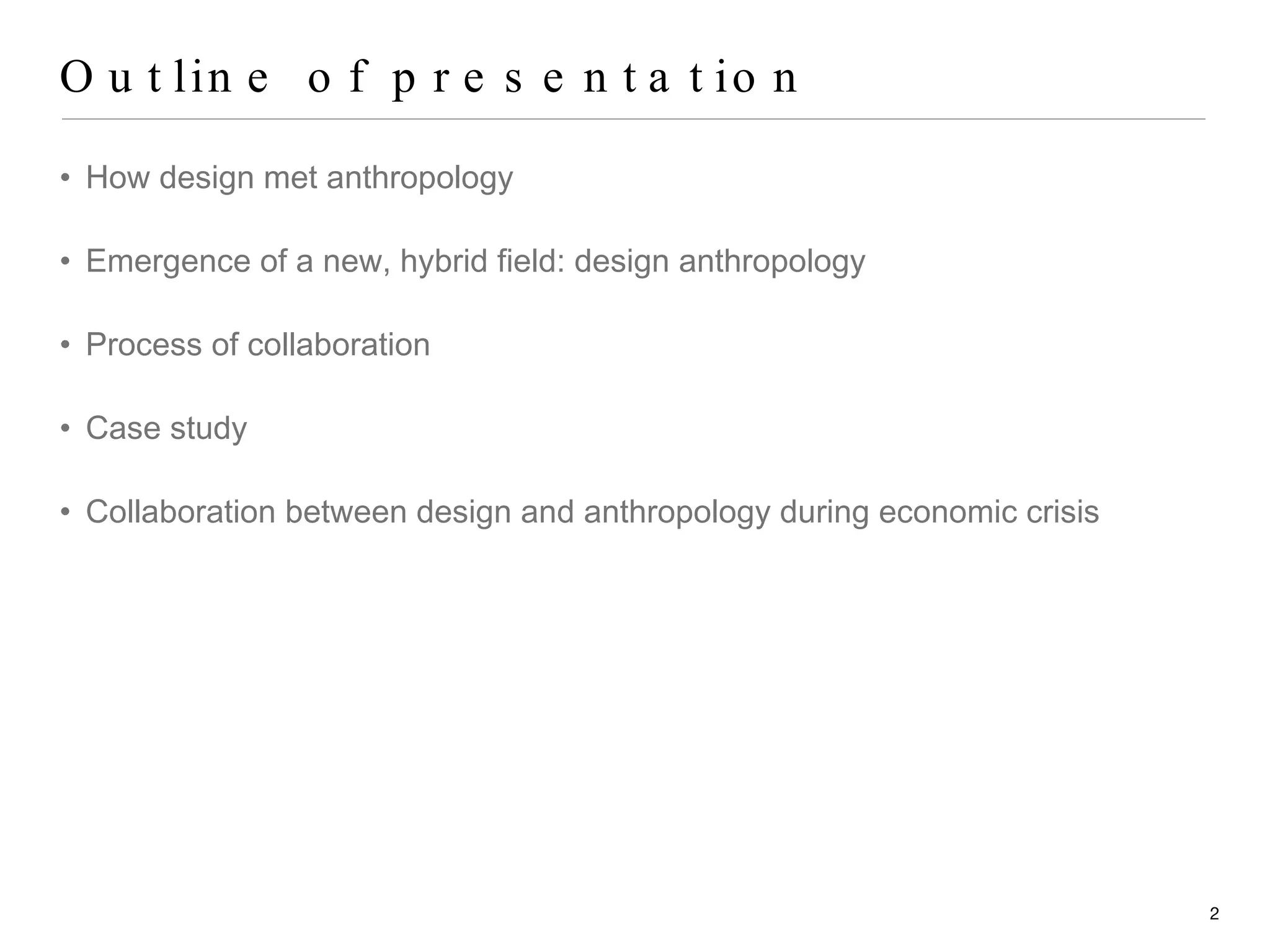
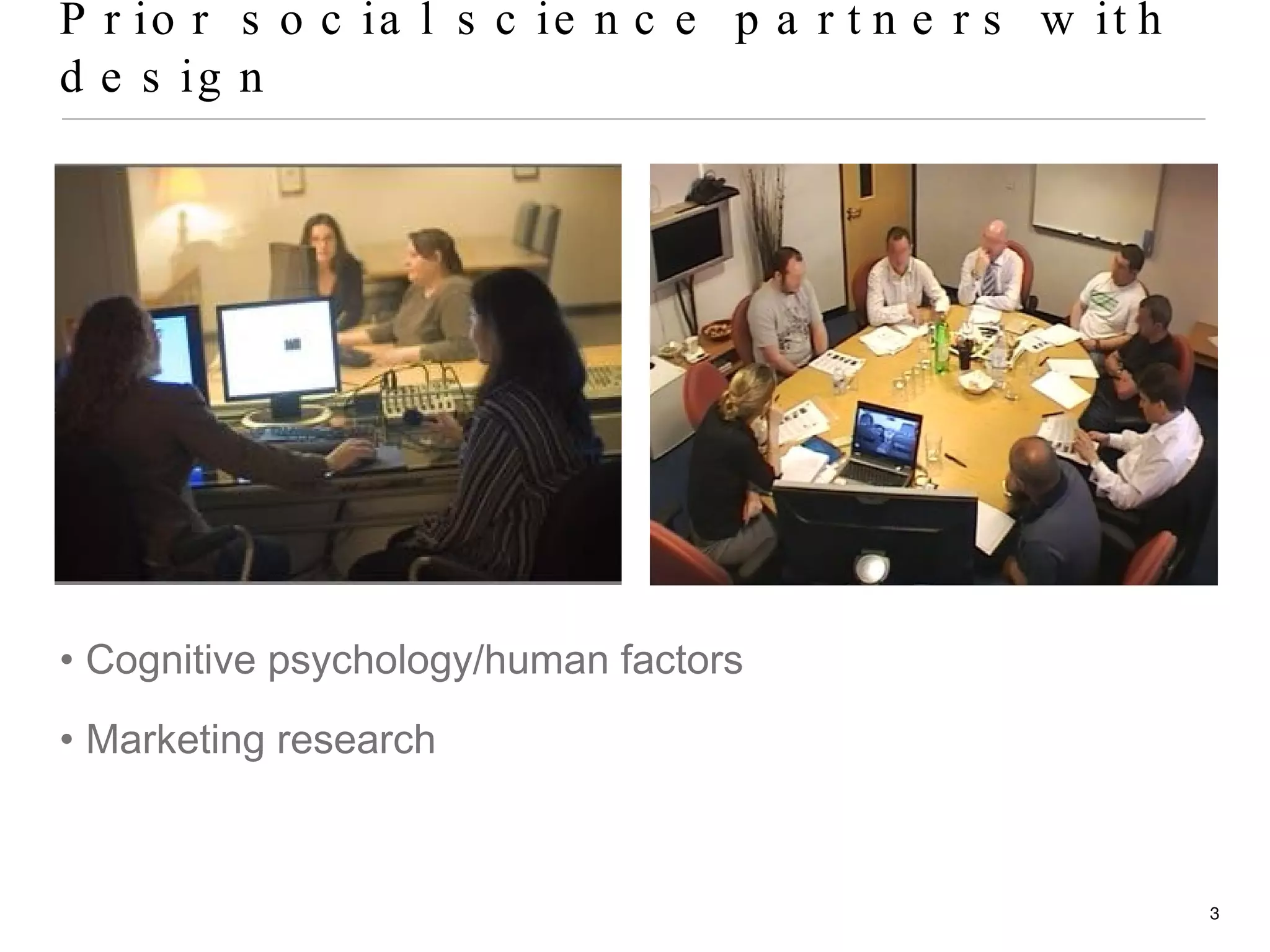
Prior social science partners with design Cognitive psychology/human factors Marketing research
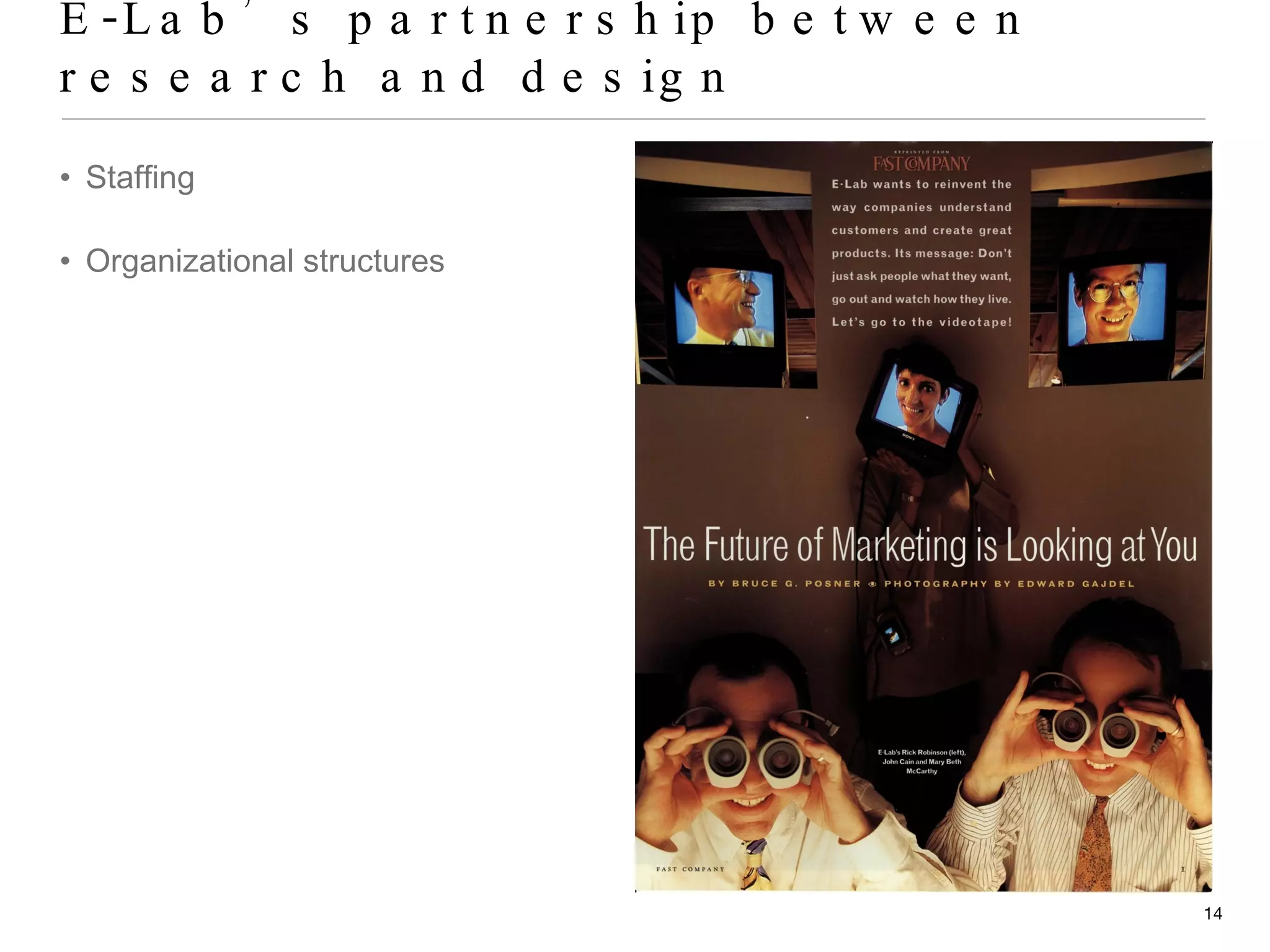
How design met anthropology Computer-supported cooperative work (CSCW) Xerox PARC E-Lab “ Ethnography” became buzzword rather than anthropology
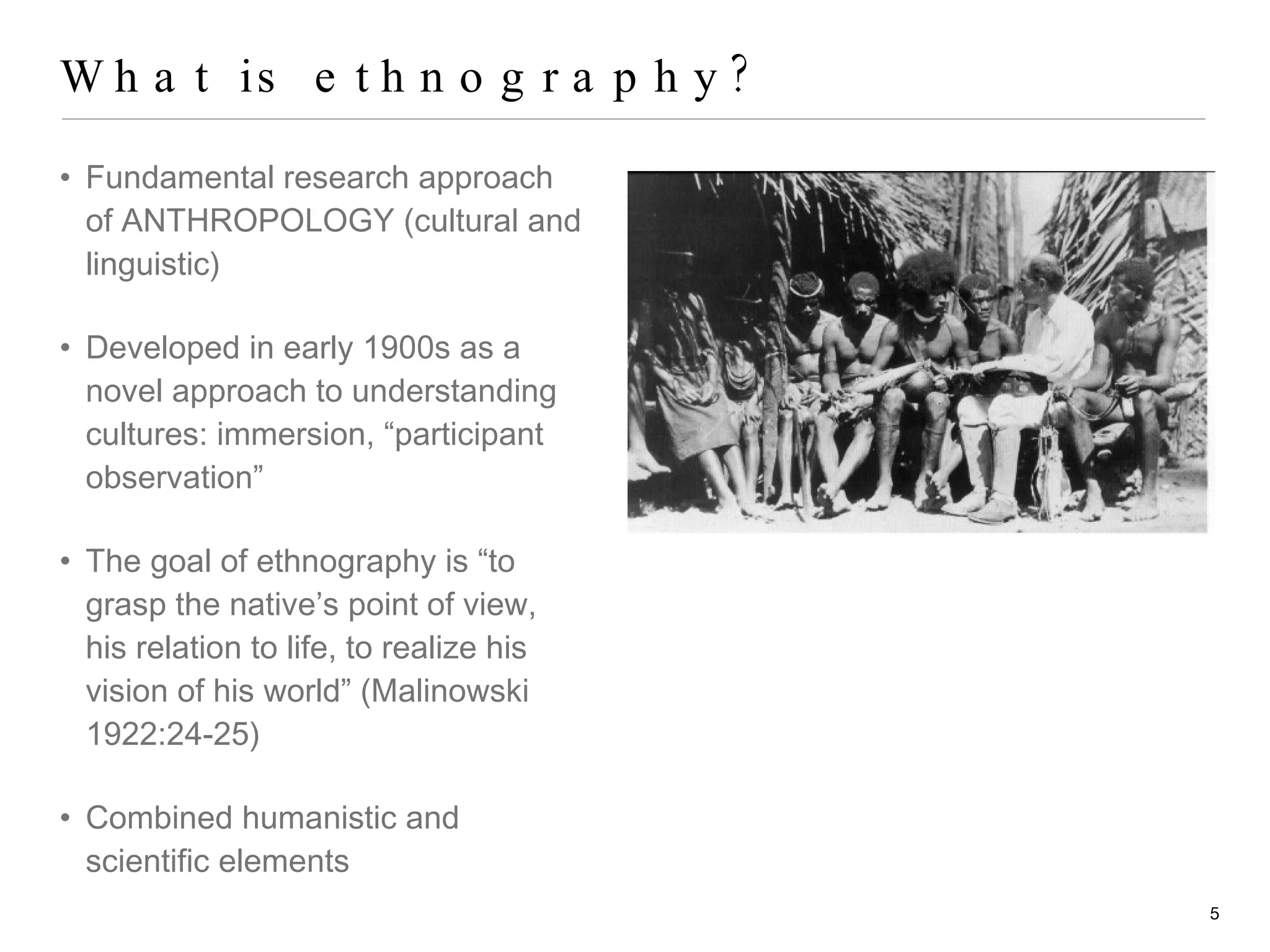
What is ethnography? Fundamental research approach of ANTHROPOLOGY (cultural and linguistic) Developed in early 1900s as a novel approach to understanding cultures: immersion, “participant observation” The goal of ethnography is “to grasp the native’s point of view, his relation to life, to realize his vision of his world” (Malinowski 1922:24-25) Combined humanistic and scientific elements
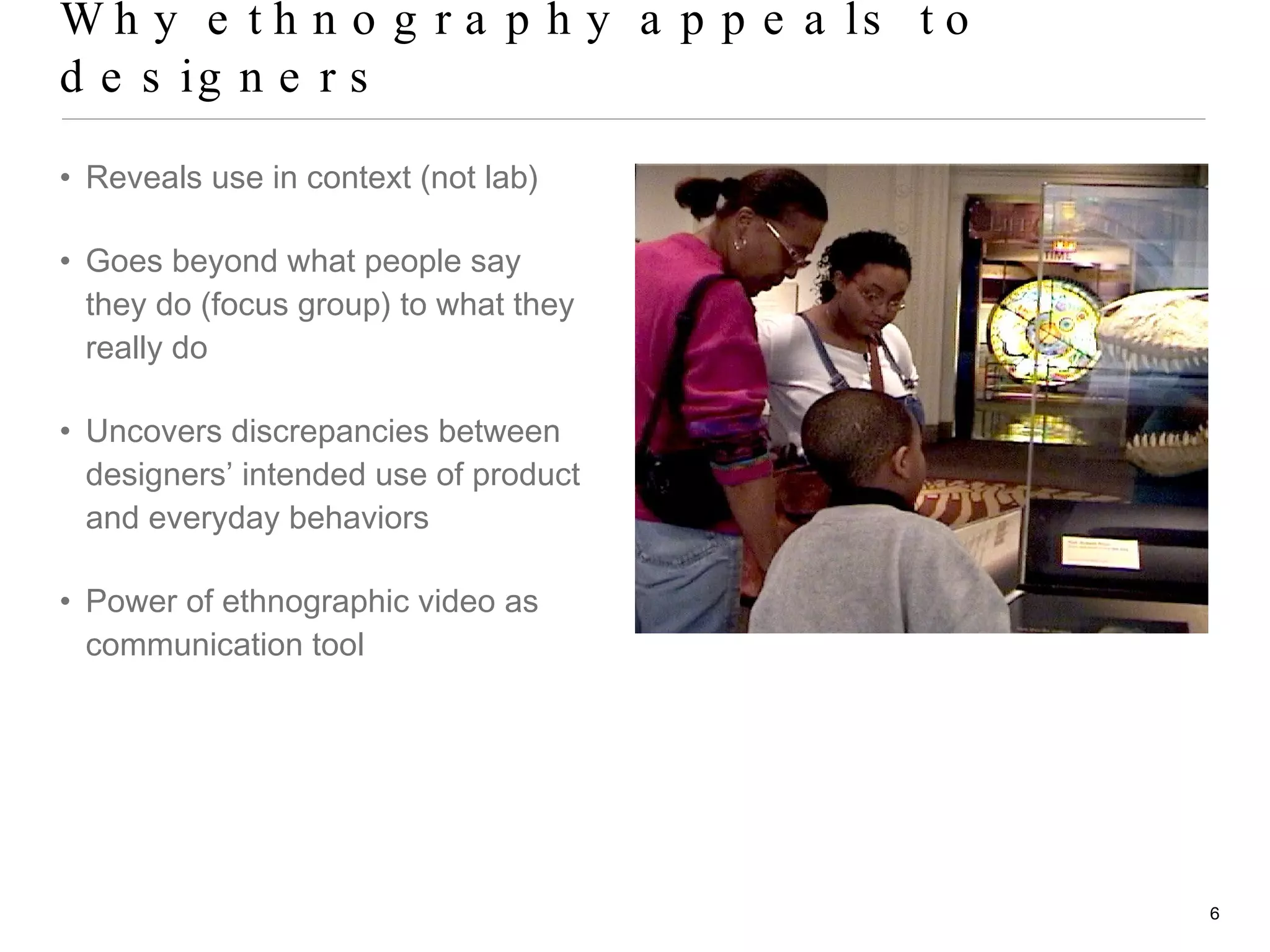
Why ethnography appeals to designers Reveals use in context (not lab) Goes beyond what people say they do (focus group) to what they really do Uncovers discrepancies between designers’ intended use of product and everyday behaviors Power of ethnographic video as communication tool
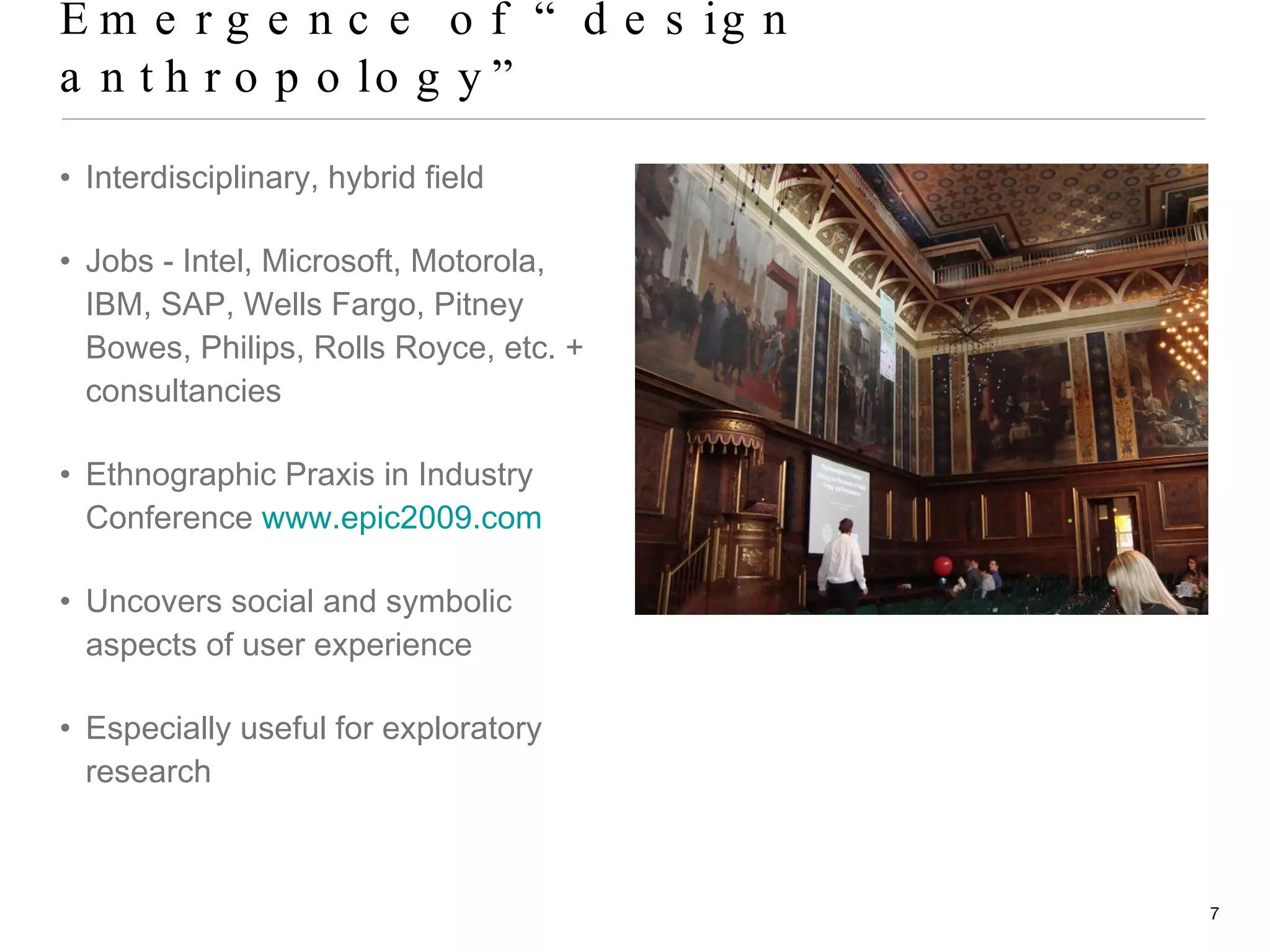
Emergence of “design anthropology” Interdisciplinary, hybrid field Jobs - Intel, Microsoft, Motorola, IBM, SAP, Wells Fargo, Pitney Bowes, Philips, Rolls Royce, etc. + consultancies Ethnographic Praxis in Industry Conference  www.epic2009.com   Uncovers social and symbolic aspects of user experience Especially useful for exploratory research
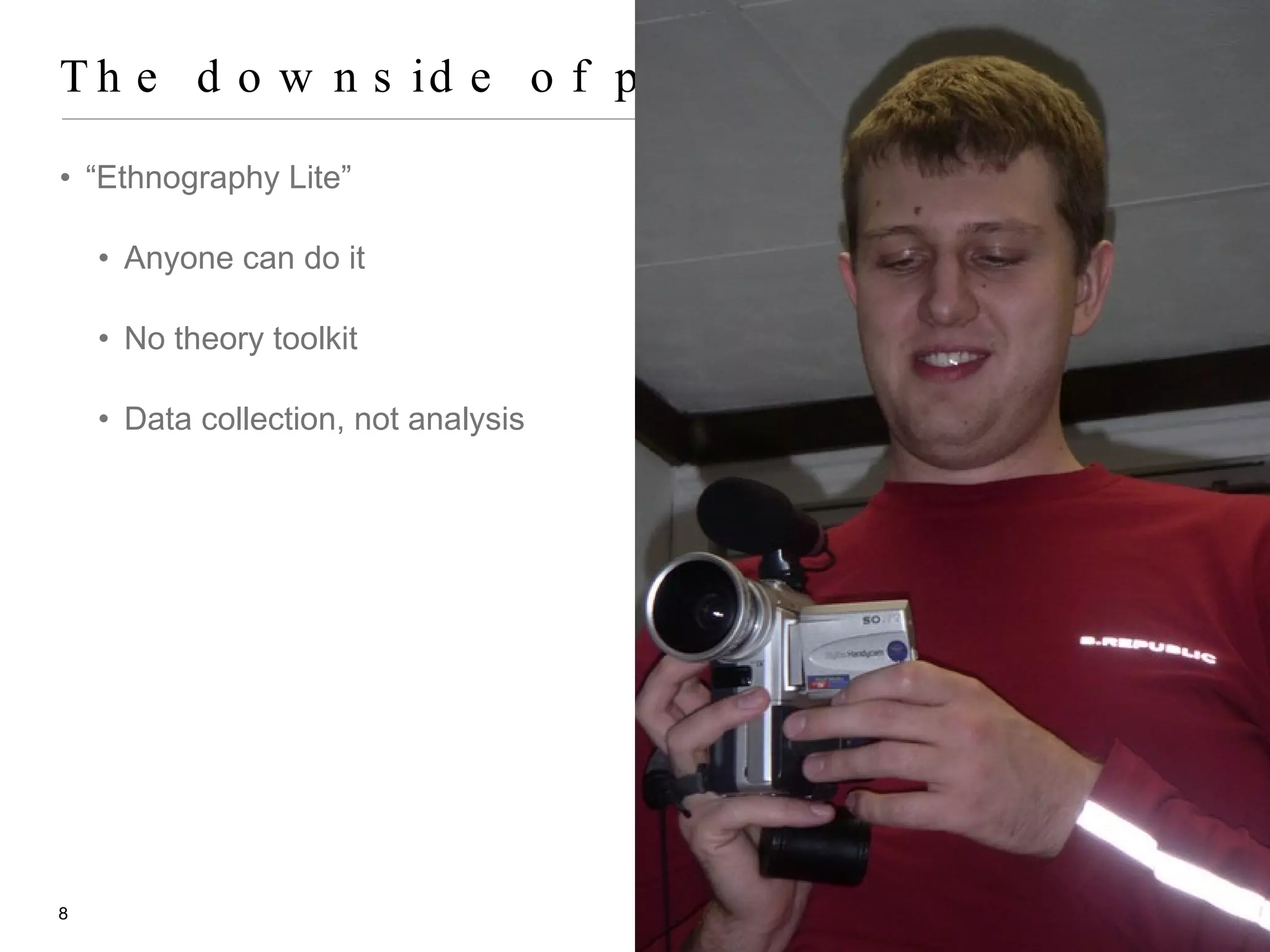
The downside of popularity “ Ethnography Lite” Anyone can do it No theory toolkit Data collection, not analysis
Theories in design anthropology General anthropology “toolkit” includes theories about globalization, modernity, consumption, technology use, identity, religion, kinship, political economy, social organization... Particular focus on interactions between people and artifacts, drawing on  ethnomethodology, conversation analysis, activity theory E-Lab’s AEIOU framework: Activities Environments Interactions Objects Users
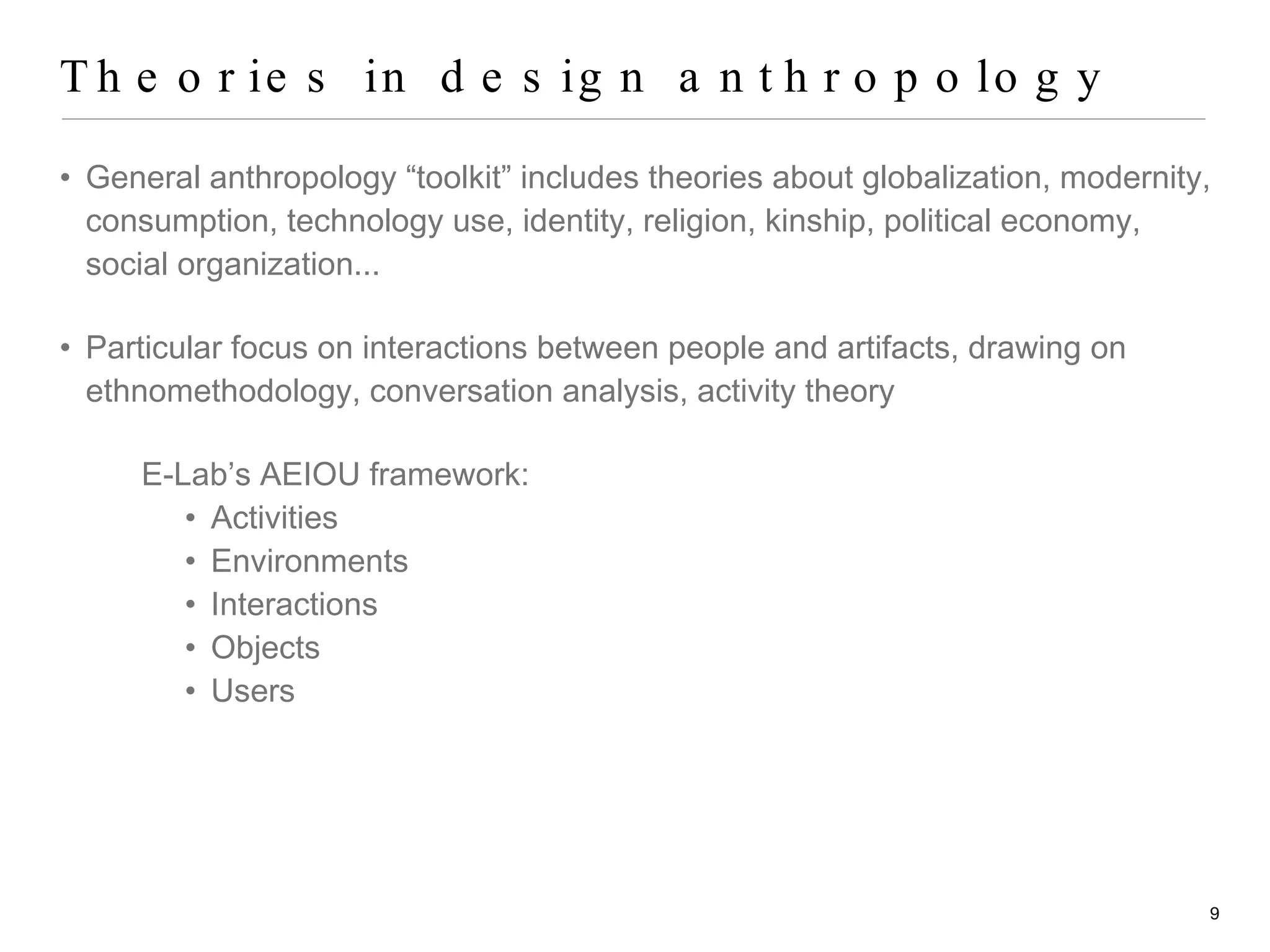
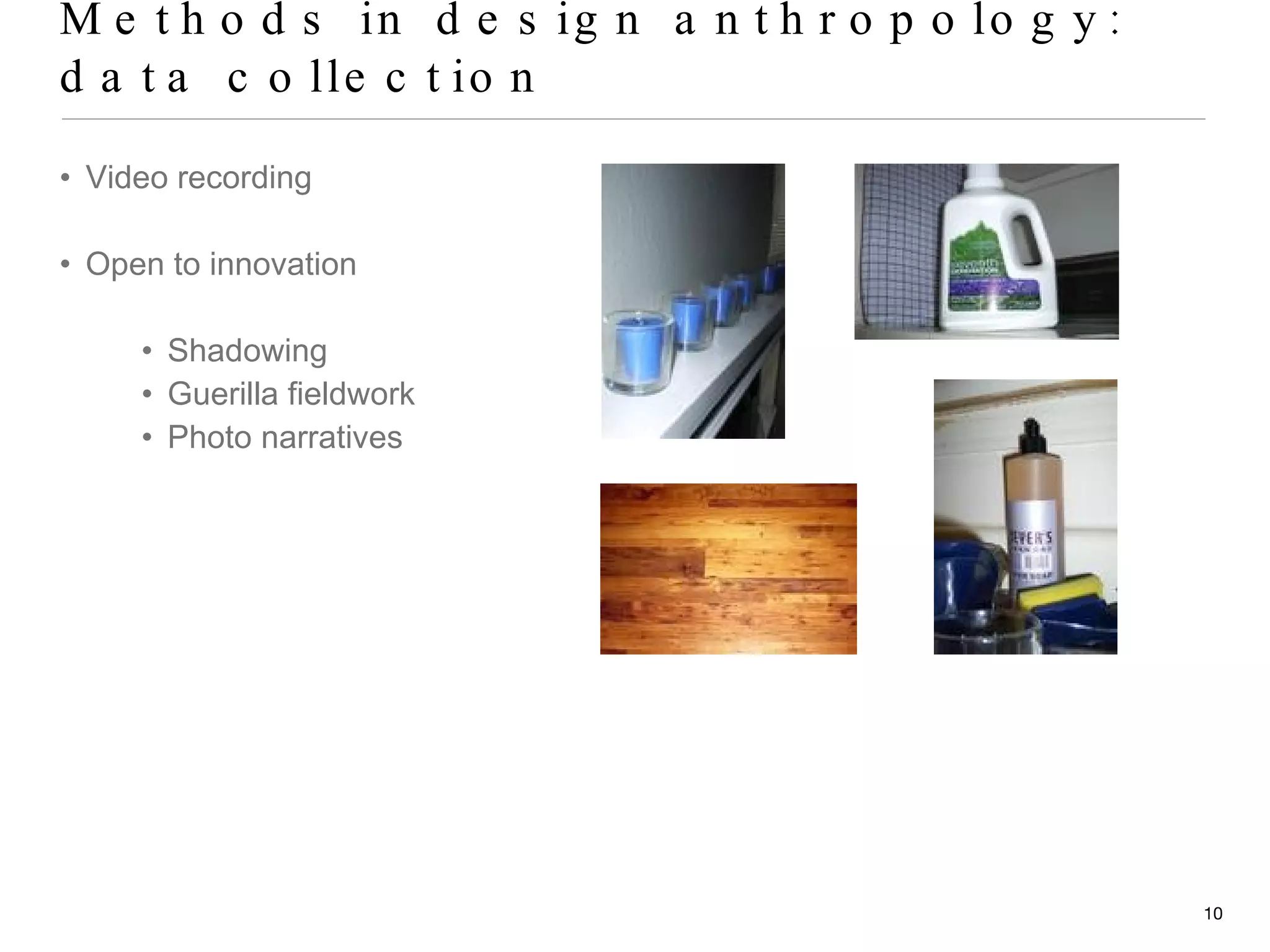
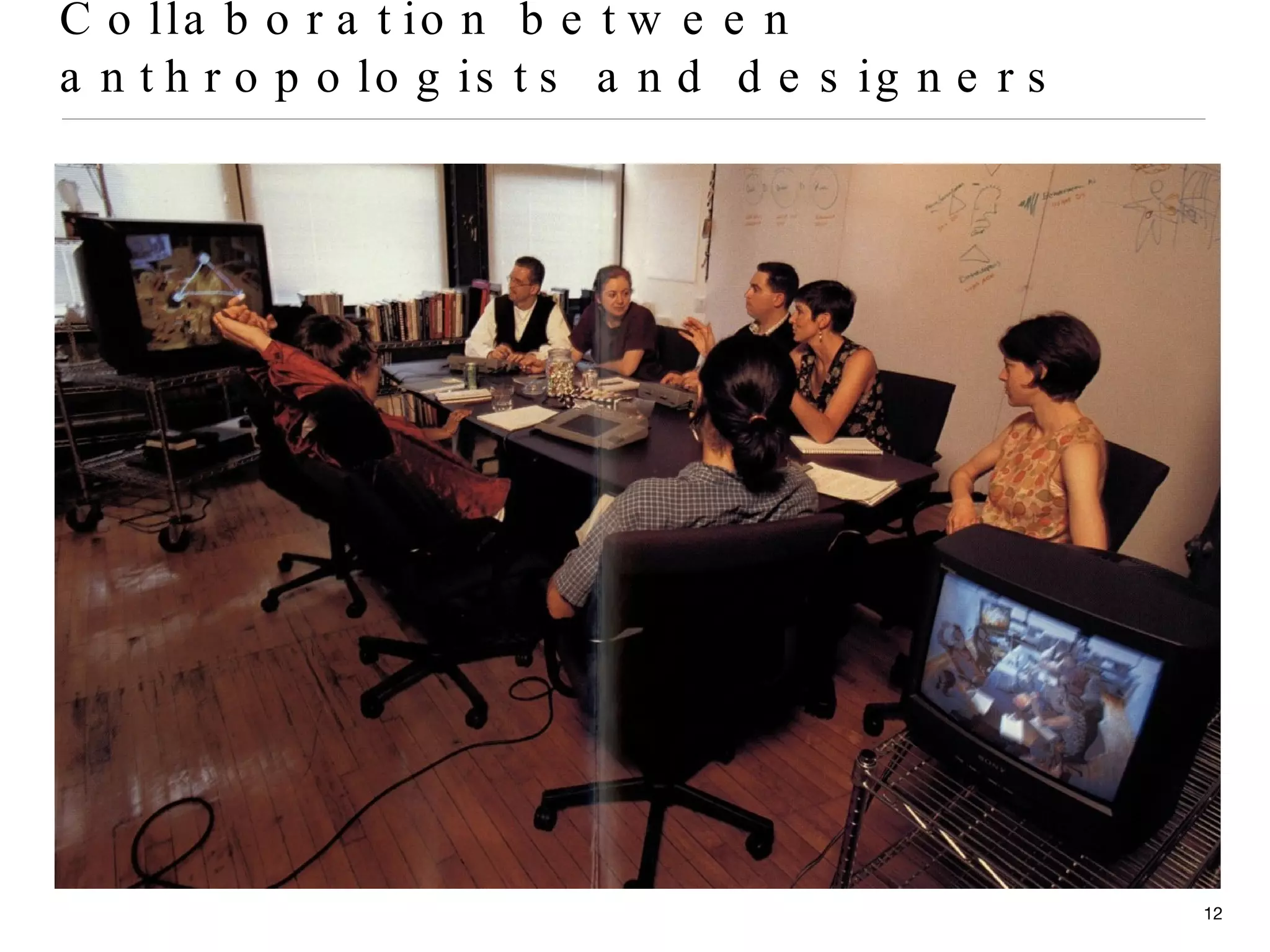
Methods in design anthropology: data collection Video recording Open to innovation Shadowing Guerilla fieldwork Photo narratives
Methods in design anthropology: analysis What are the patterns? Intuition/memory can be misleading Use software to code videorecordings and transcripts Move from patterns to explanatory models
Collaboration between anthropologists and designers
What can go wrong in the collaboration Anthropologists may feel their expertise is not valued and they are underutilized Designers encounter frustration when they are given research results that do not point to practical applications
E-Lab’s partnership between research and design Staffing Organizational structures
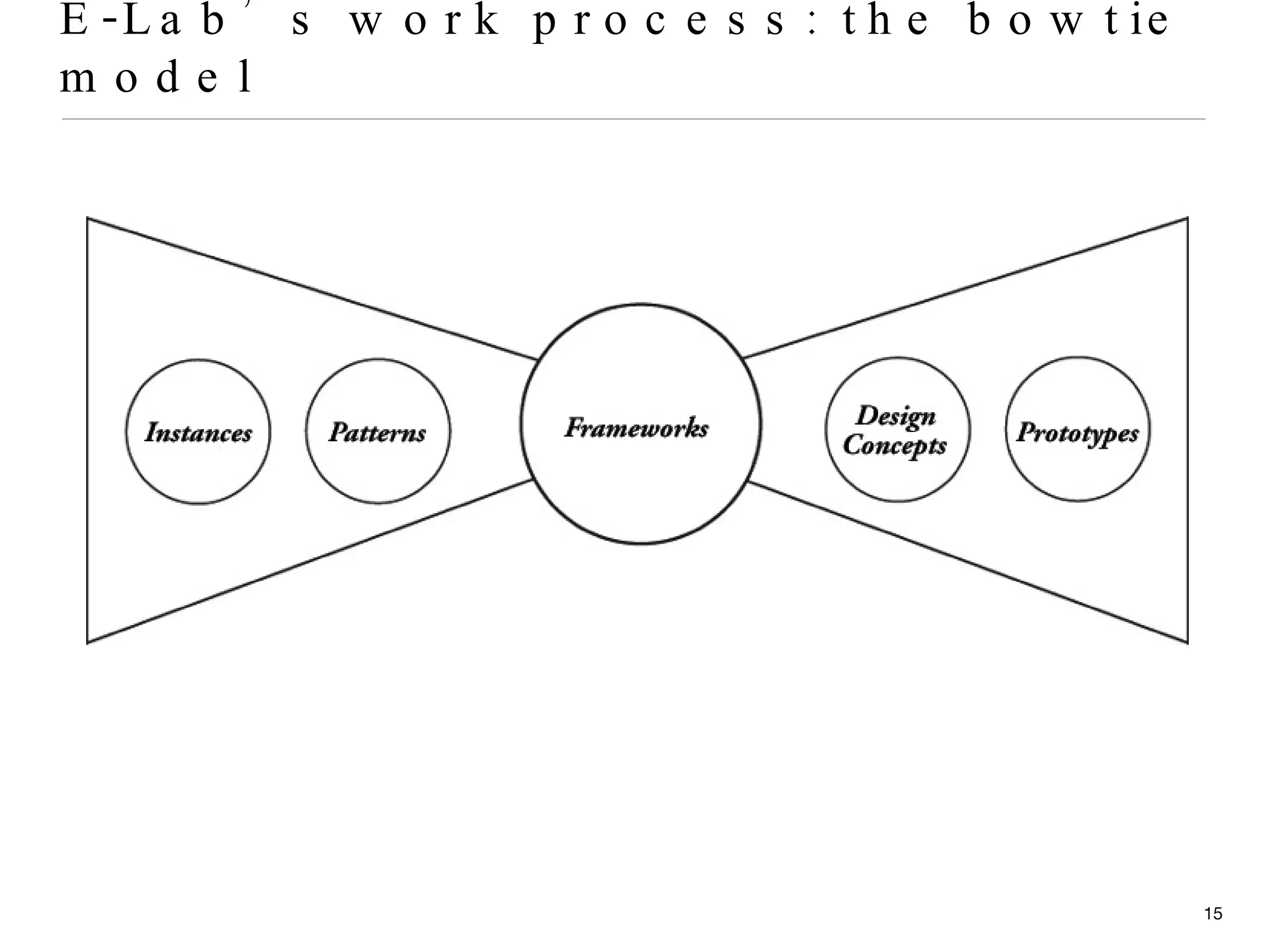
E-Lab’s work process: the bowtie model
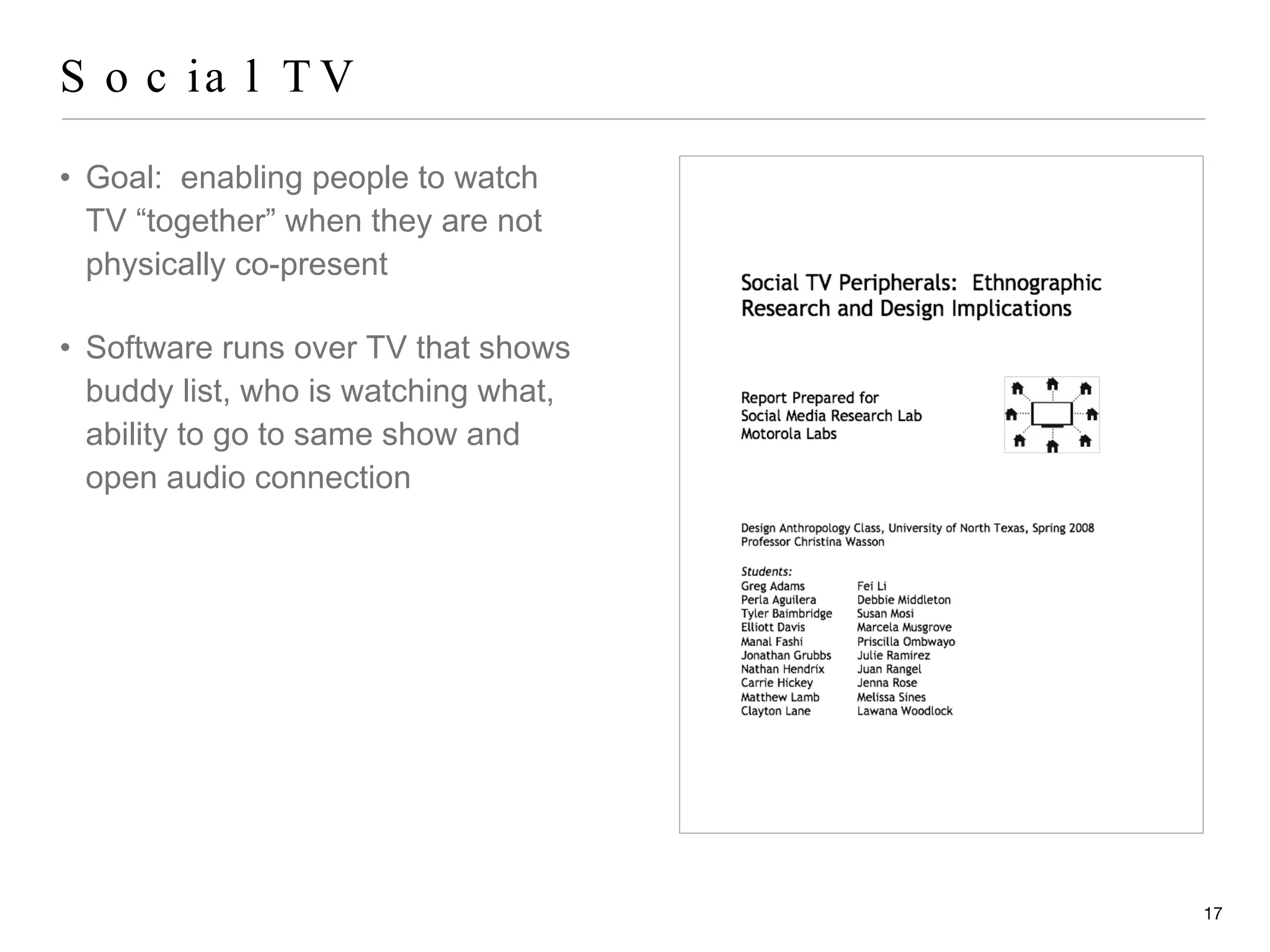
Case study Social TV Peripherals: Ethnographic Research and Design Implications Client:  Motorola Spring 2008
Social TV Goal:  enabling people to watch TV “together” when they are not physically co-present Software runs over TV that shows buddy list, who is watching what, ability to go to same show and open audio connection
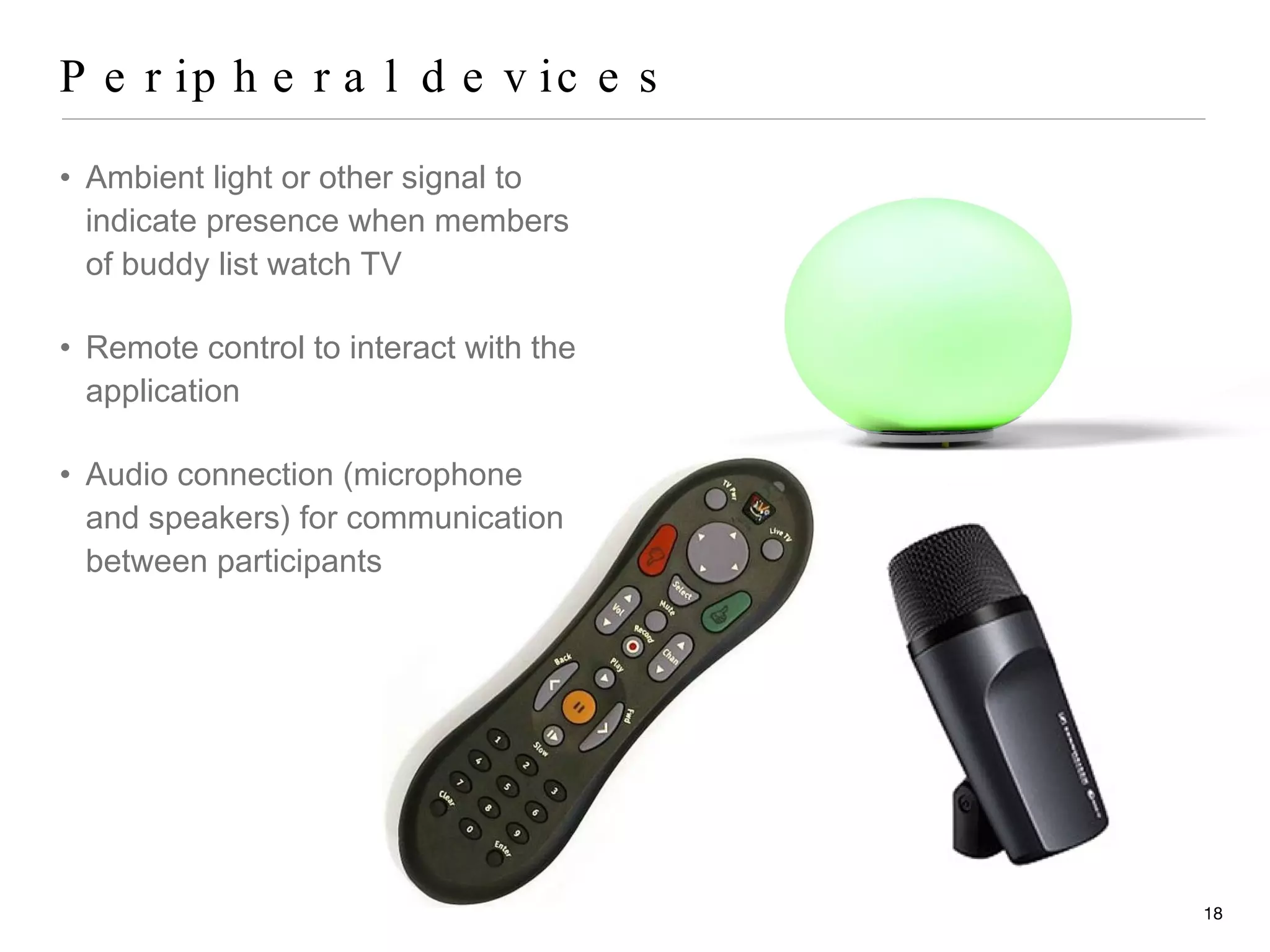
Peripheral devices Ambient light or other signal to indicate presence when members of buddy list watch TV Remote control to interact with the application  Audio connection (microphone and speakers) for communication between participants
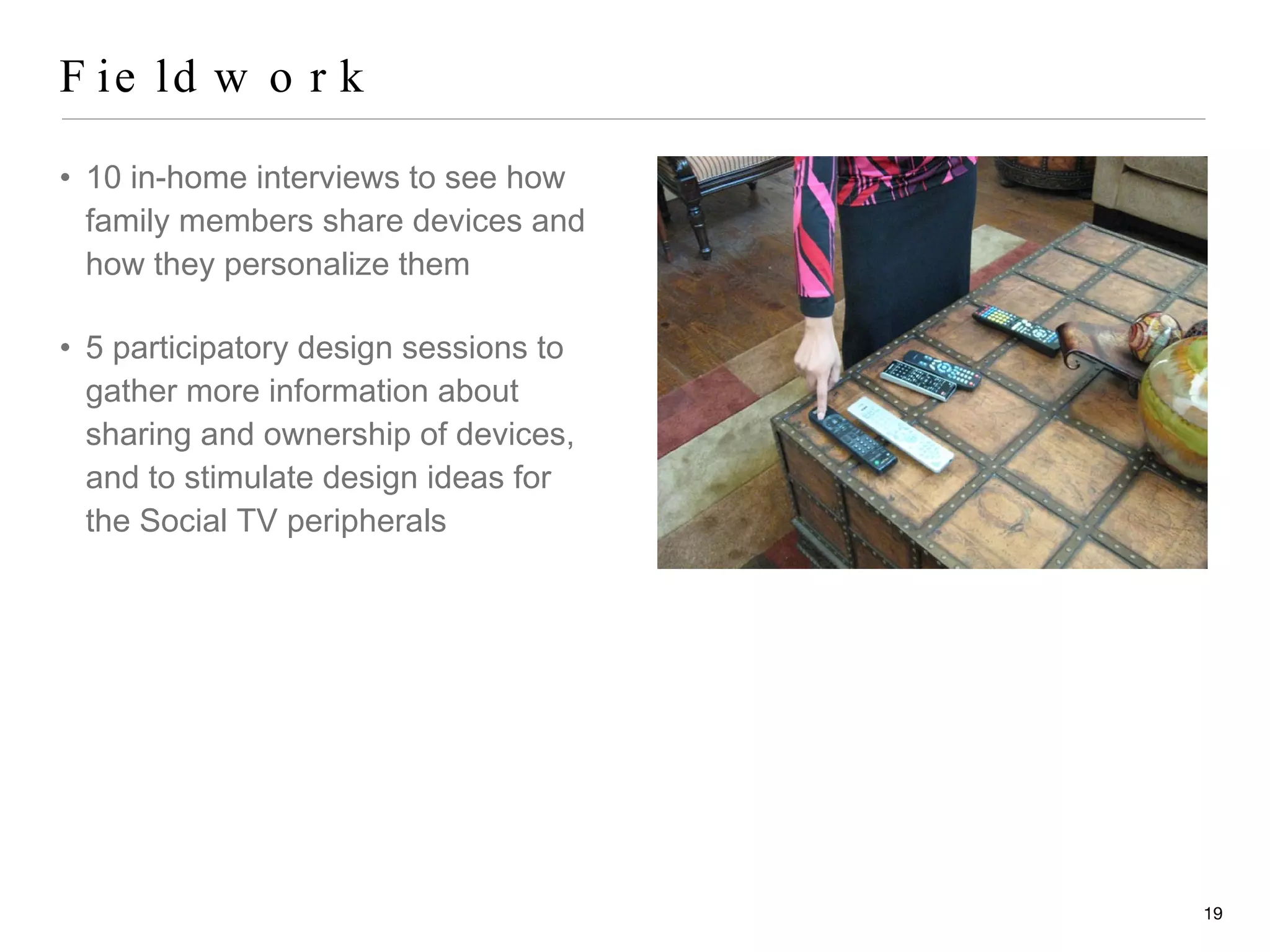
Fieldwork 10 in-home interviews to see how family members share devices and how they personalize them 5 participatory design sessions to gather more information about sharing and ownership of devices, and to stimulate design ideas for the Social TV peripherals
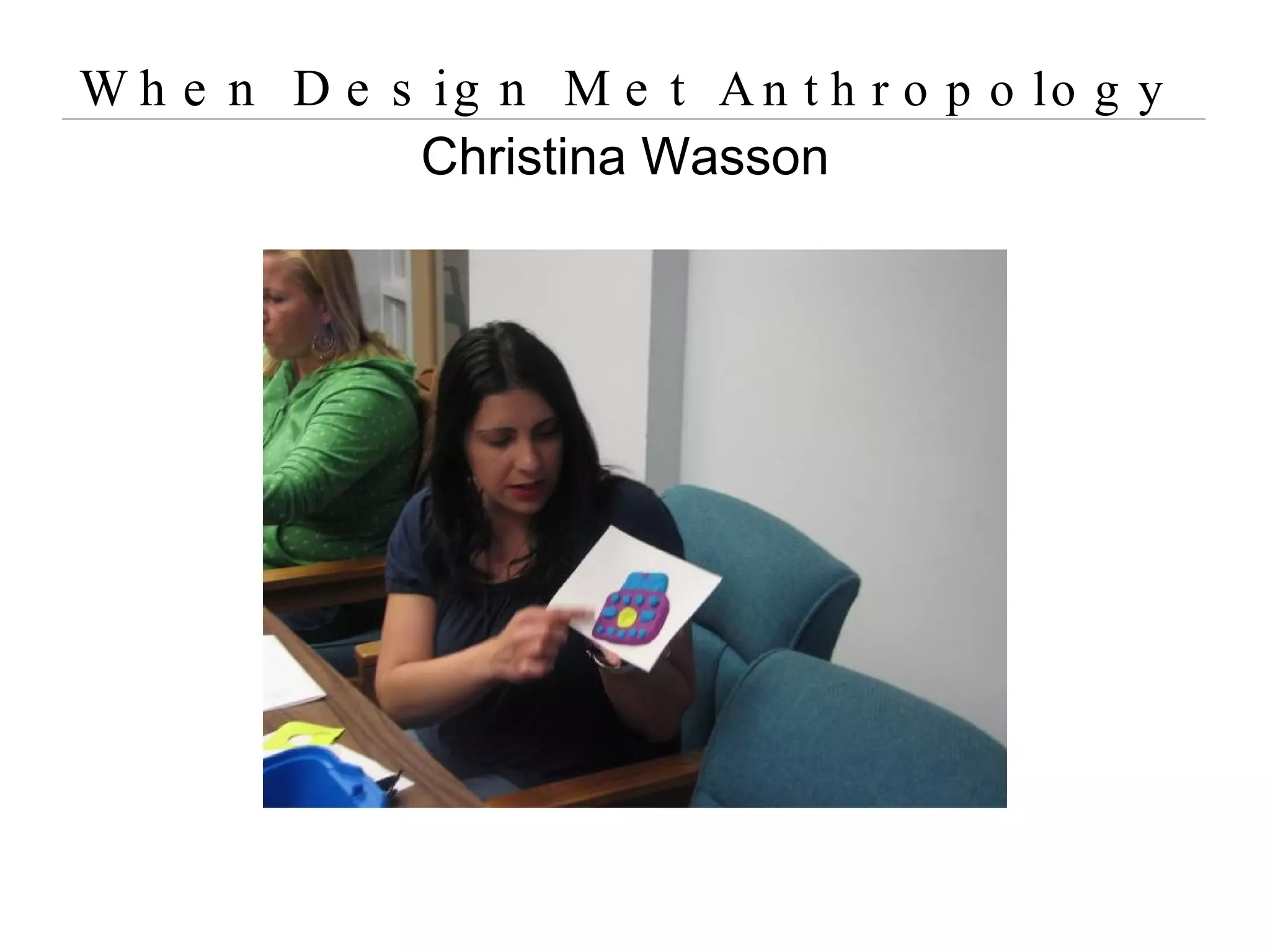
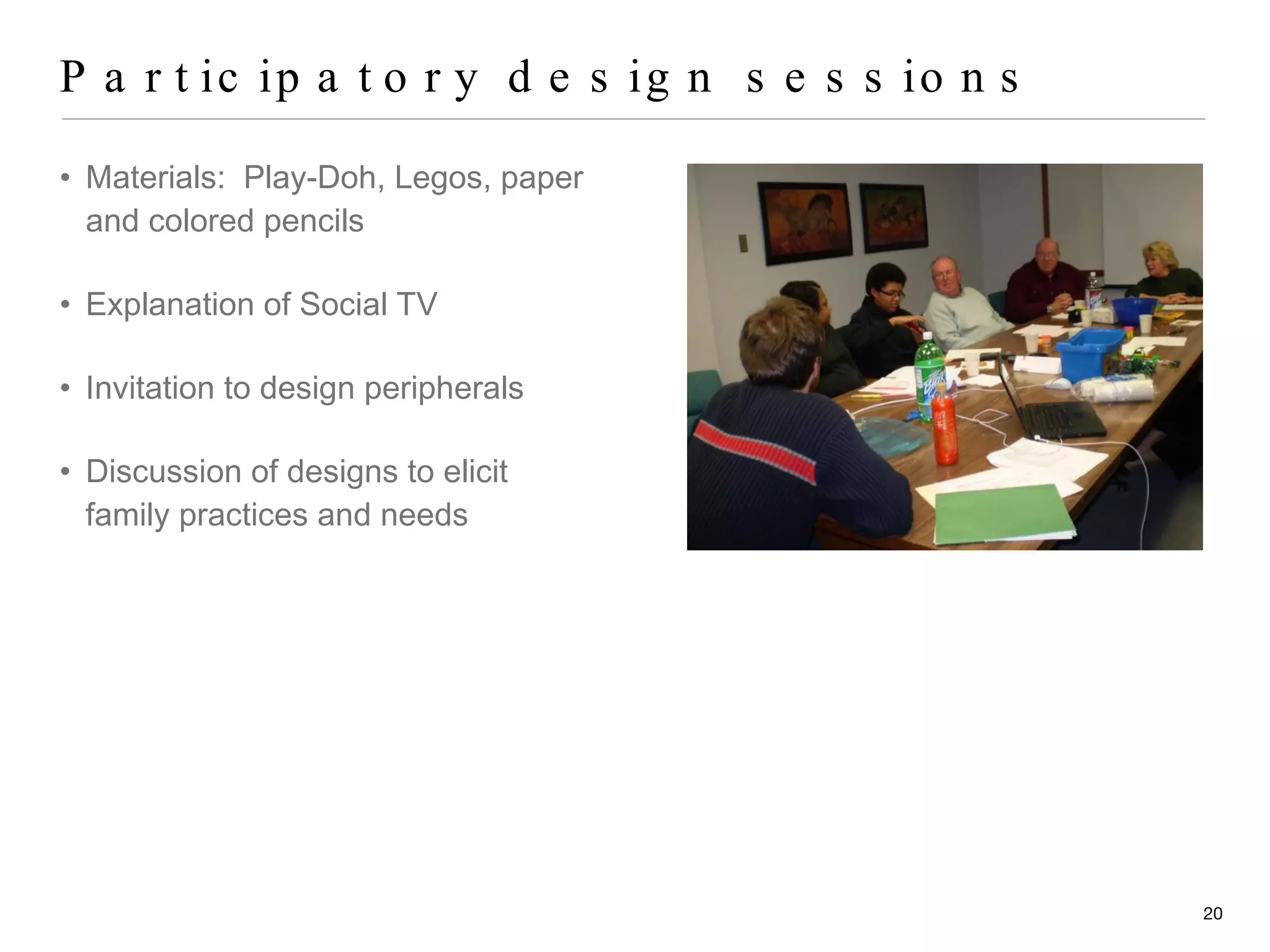
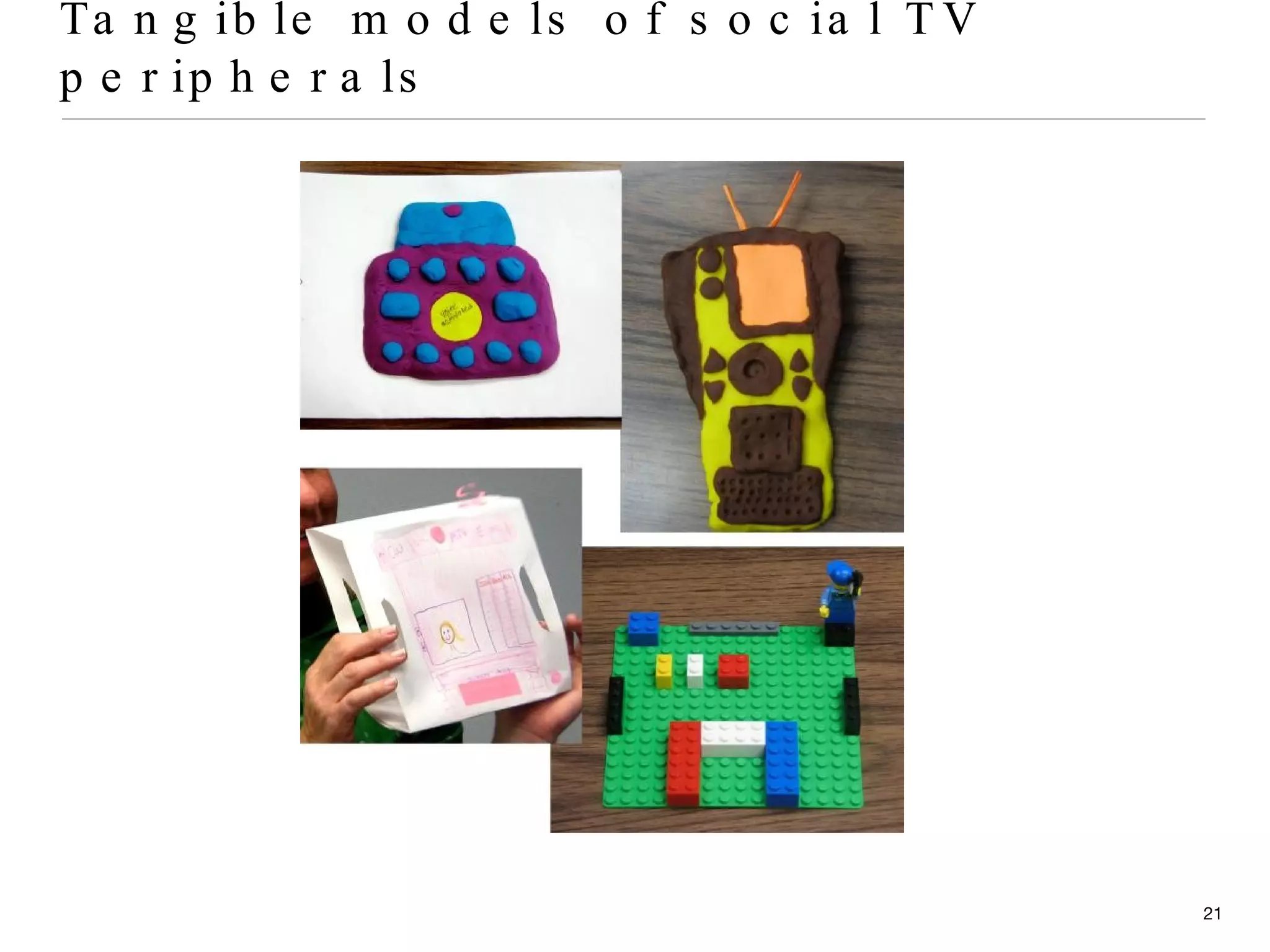
Participatory design sessions Materials:  Play-Doh, Legos, paper and colored pencils Explanation of Social TV Invitation to design peripherals Discussion of designs to elicit family practices and needs
Tangible models of social TV peripherals
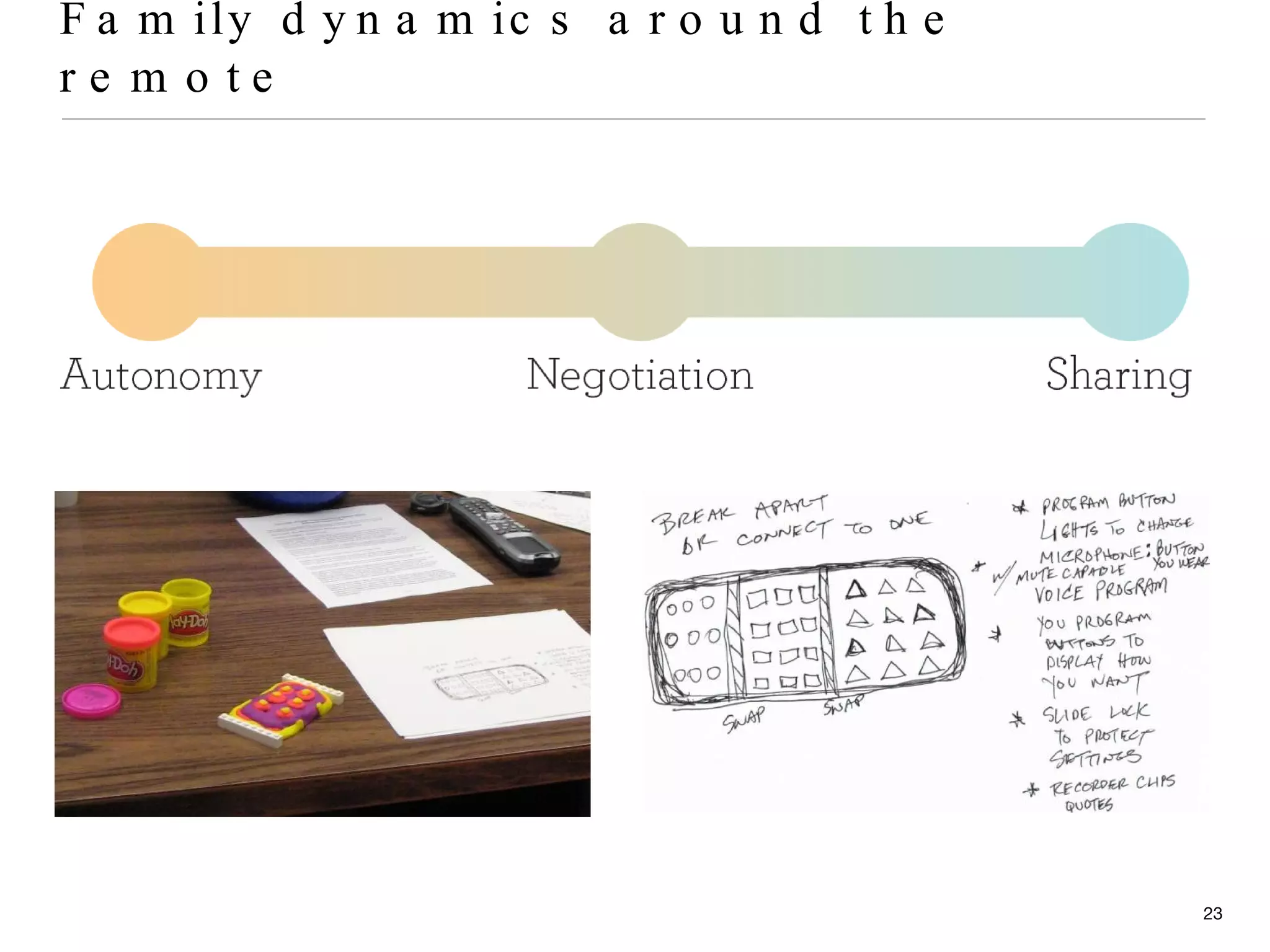
Explanatory frameworks Family dynamics around the remote How copresent families watch TV Mobility while watching TV
Family dynamics around the remote
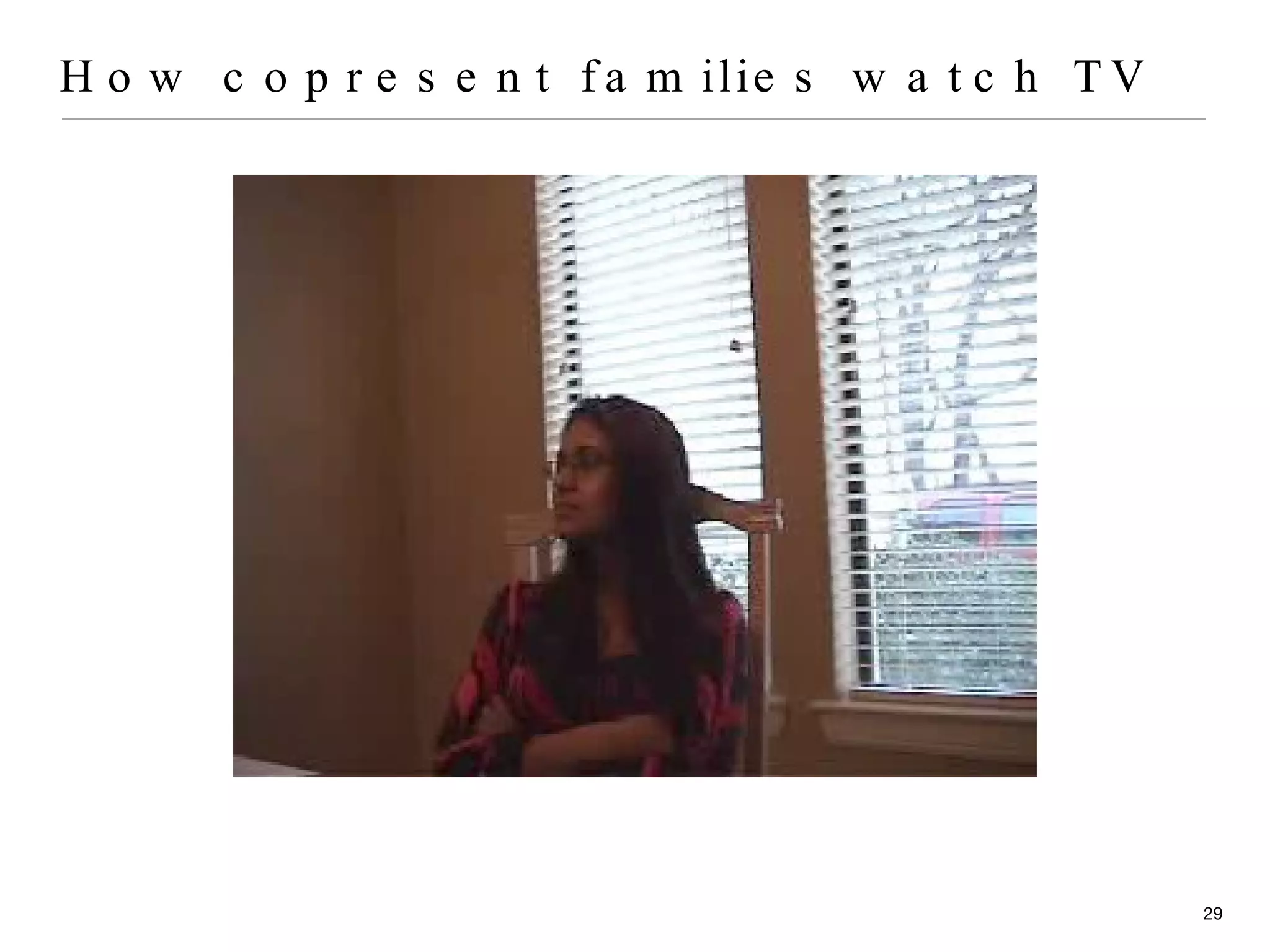
How copresent families watch TV Current practices that need to be taken into account to develop a successful social TV product Each family member pursued own trajectory of activities, and they often engaged in multitasking Every household in the in-home interviews had more than one television Majority of TV watching was done alone Family members connected to their friends virtually via phone, internet Design implication:  one person, one social TV
How copresent families watch TV
Mobility while watching TV
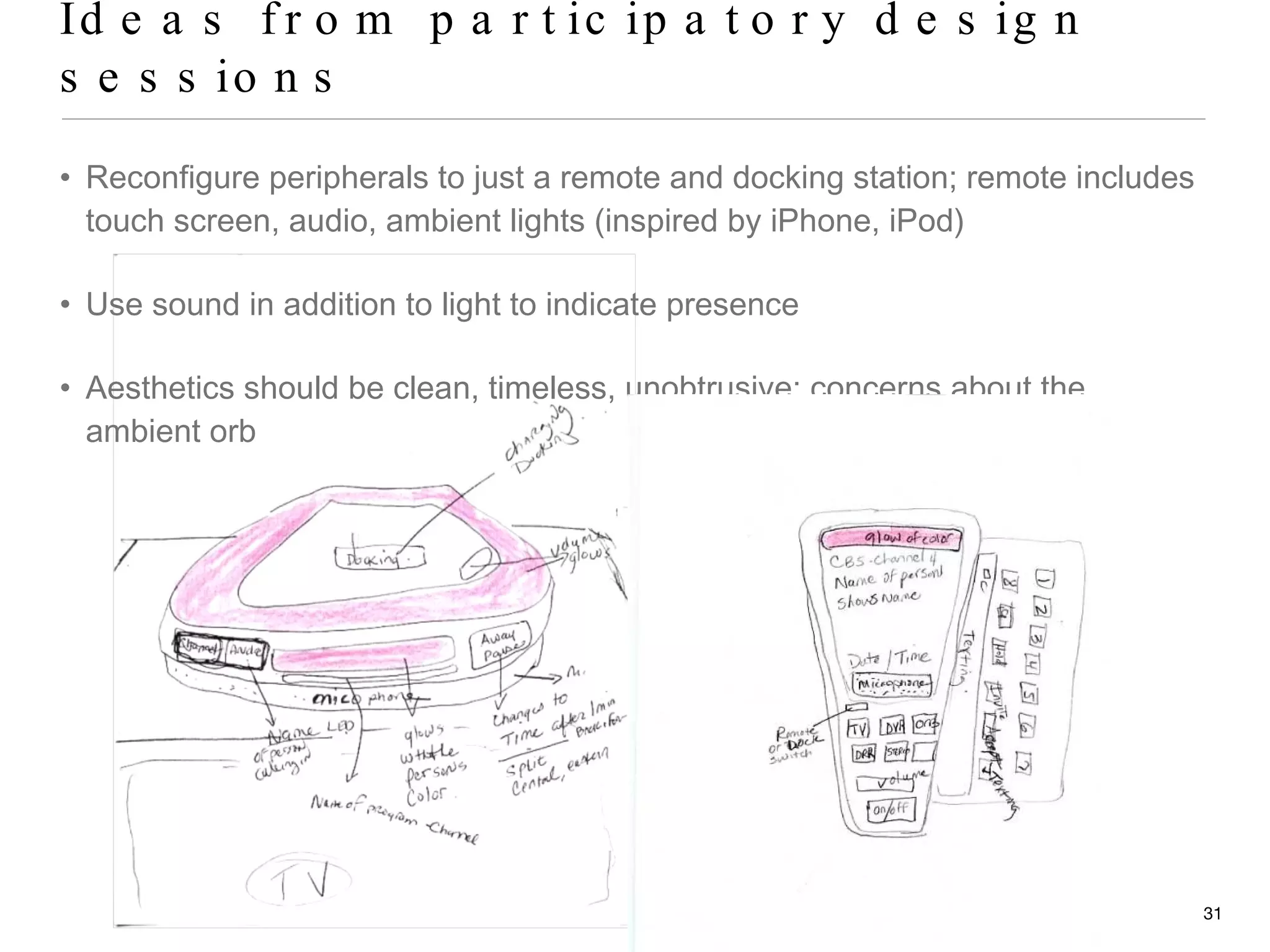
Ideas from participatory design sessions Reconfigure peripherals to just a remote and docking station; remote includes touch screen, audio, ambient lights (inspired by iPhone, iPod) Use sound in addition to light to indicate presence Aesthetics should be clean, timeless, unobtrusive; concerns about the ambient orb
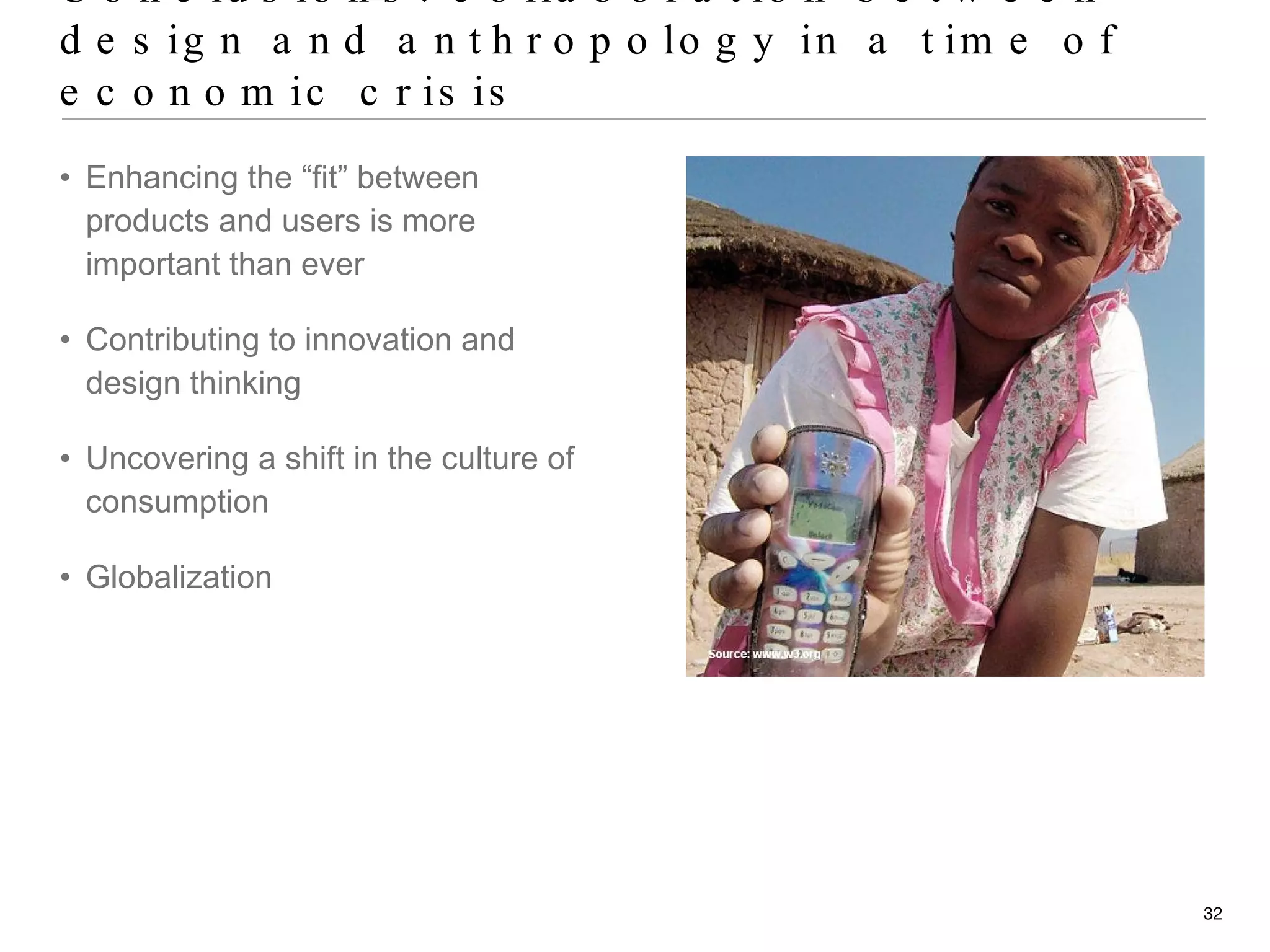
Conclusions: collaboration between design and anthropology in a time of economic crisis Enhancing the “fit” between products and users is more important than ever Contributing to innovation and design thinking Uncovering a shift in the culture of consumption Globalization
Questions?

When Design Met Anthropology

  • 1.
    When Design Met Anthropology Christina Wasson
  • 2.
    Outline of presentationHow design met anthropology Emergence of a new, hybrid field: design anthropology Process of collaboration Case study Collaboration between design and anthropology during economic crisis
  • 3.
    Prior social sciencepartners with design Cognitive psychology/human factors Marketing research
  • 4.
    How design metanthropology Computer-supported cooperative work (CSCW) Xerox PARC E-Lab “ Ethnography” became buzzword rather than anthropology
  • 5.
    What is ethnography?Fundamental research approach of ANTHROPOLOGY (cultural and linguistic) Developed in early 1900s as a novel approach to understanding cultures: immersion, “participant observation” The goal of ethnography is “to grasp the native’s point of view, his relation to life, to realize his vision of his world” (Malinowski 1922:24-25) Combined humanistic and scientific elements
  • 6.
    Why ethnography appealsto designers Reveals use in context (not lab) Goes beyond what people say they do (focus group) to what they really do Uncovers discrepancies between designers’ intended use of product and everyday behaviors Power of ethnographic video as communication tool
  • 7.
    Emergence of “designanthropology” Interdisciplinary, hybrid field Jobs - Intel, Microsoft, Motorola, IBM, SAP, Wells Fargo, Pitney Bowes, Philips, Rolls Royce, etc. + consultancies Ethnographic Praxis in Industry Conference www.epic2009.com Uncovers social and symbolic aspects of user experience Especially useful for exploratory research
  • 8.
    The downside ofpopularity “ Ethnography Lite” Anyone can do it No theory toolkit Data collection, not analysis
  • 9.
    Theories in designanthropology General anthropology “toolkit” includes theories about globalization, modernity, consumption, technology use, identity, religion, kinship, political economy, social organization... Particular focus on interactions between people and artifacts, drawing on ethnomethodology, conversation analysis, activity theory E-Lab’s AEIOU framework: Activities Environments Interactions Objects Users
  • 10.
    Methods in designanthropology: data collection Video recording Open to innovation Shadowing Guerilla fieldwork Photo narratives
  • 11.
    Methods in designanthropology: analysis What are the patterns? Intuition/memory can be misleading Use software to code videorecordings and transcripts Move from patterns to explanatory models
  • 12.
  • 13.
    What can gowrong in the collaboration Anthropologists may feel their expertise is not valued and they are underutilized Designers encounter frustration when they are given research results that do not point to practical applications
  • 14.
    E-Lab’s partnership betweenresearch and design Staffing Organizational structures
  • 15.
    E-Lab’s work process:the bowtie model
  • 16.
    Case study SocialTV Peripherals: Ethnographic Research and Design Implications Client: Motorola Spring 2008
  • 17.
    Social TV Goal: enabling people to watch TV “together” when they are not physically co-present Software runs over TV that shows buddy list, who is watching what, ability to go to same show and open audio connection
  • 18.
    Peripheral devices Ambientlight or other signal to indicate presence when members of buddy list watch TV Remote control to interact with the application Audio connection (microphone and speakers) for communication between participants
  • 19.
    Fieldwork 10 in-homeinterviews to see how family members share devices and how they personalize them 5 participatory design sessions to gather more information about sharing and ownership of devices, and to stimulate design ideas for the Social TV peripherals
  • 20.
    Participatory design sessionsMaterials: Play-Doh, Legos, paper and colored pencils Explanation of Social TV Invitation to design peripherals Discussion of designs to elicit family practices and needs
  • 21.
    Tangible models ofsocial TV peripherals
  • 22.
    Explanatory frameworks Familydynamics around the remote How copresent families watch TV Mobility while watching TV
  • 23.
  • 24.
  • 25.
  • 26.
    How copresent familieswatch TV Current practices that need to be taken into account to develop a successful social TV product Each family member pursued own trajectory of activities, and they often engaged in multitasking Every household in the in-home interviews had more than one television Majority of TV watching was done alone Family members connected to their friends virtually via phone, internet Design implication: one person, one social TV
  • 27.
  • 28.
  • 29.
  • 30.
  • 31.
    Ideas from participatorydesign sessions Reconfigure peripherals to just a remote and docking station; remote includes touch screen, audio, ambient lights (inspired by iPhone, iPod) Use sound in addition to light to indicate presence Aesthetics should be clean, timeless, unobtrusive; concerns about the ambient orb
  • 32.
    Conclusions: collaboration betweendesign and anthropology in a time of economic crisis Enhancing the “fit” between products and users is more important than ever Contributing to innovation and design thinking Uncovering a shift in the culture of consumption Globalization
  • 33.