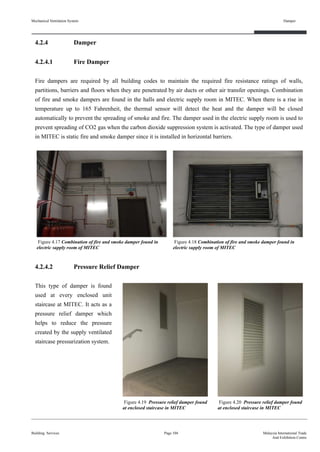
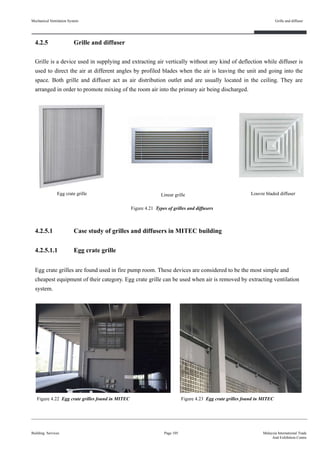
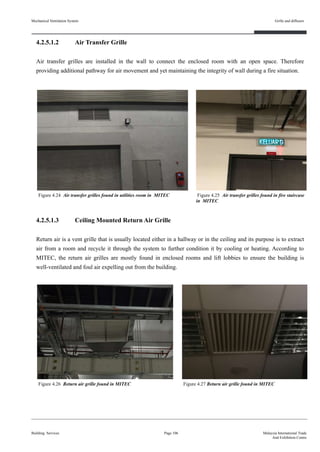
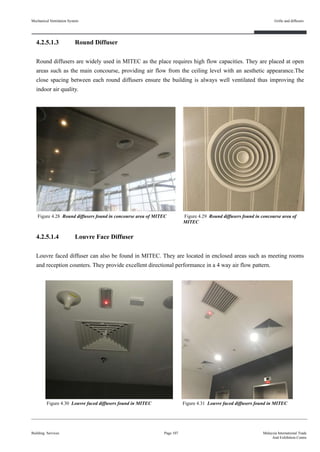
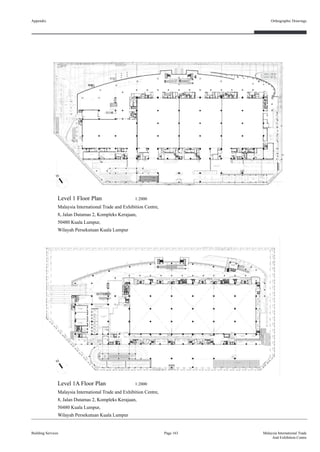
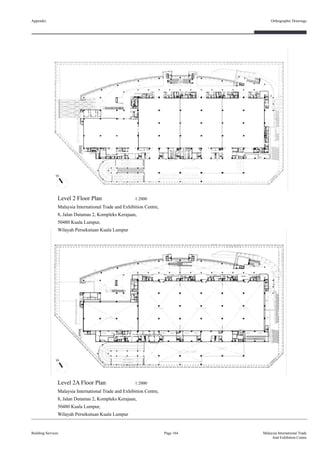
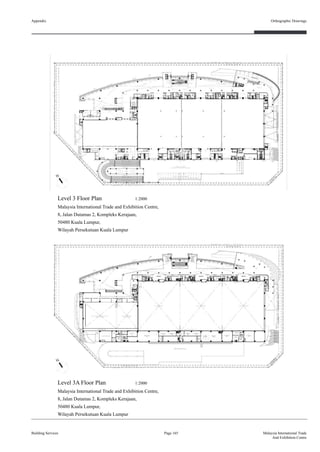
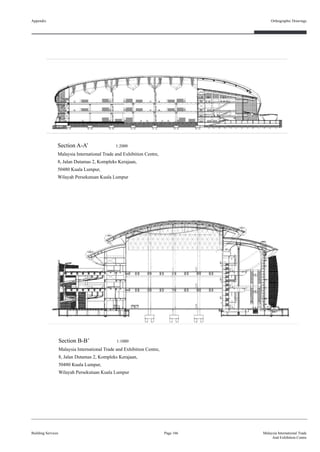
BUILDING SERVICES SYSTEM
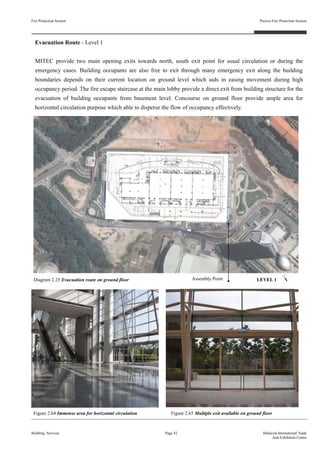
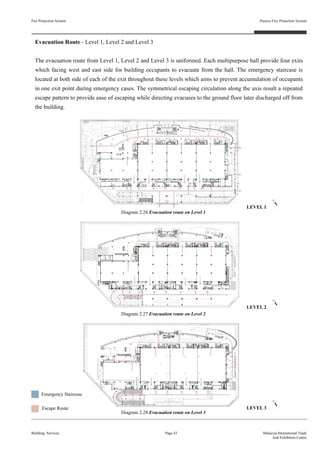
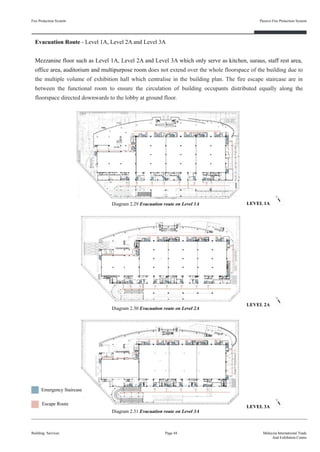
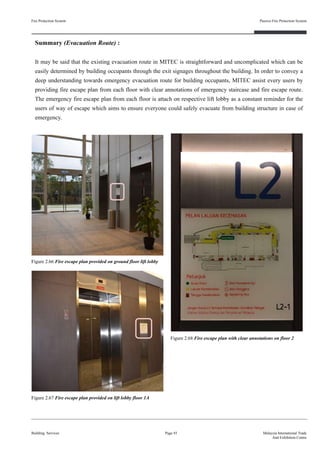
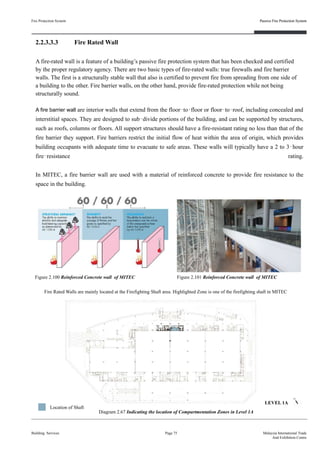
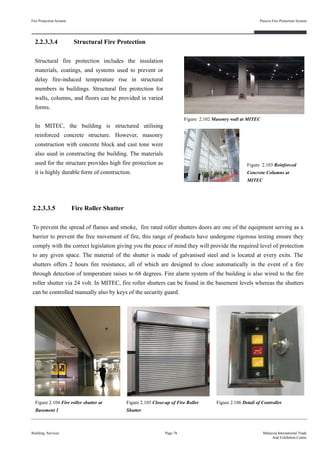
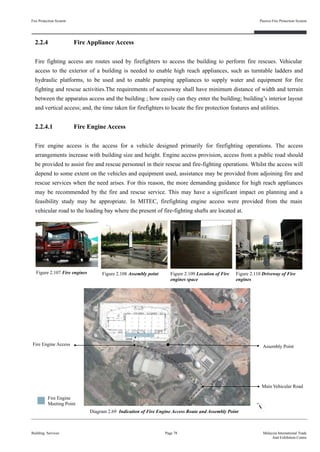
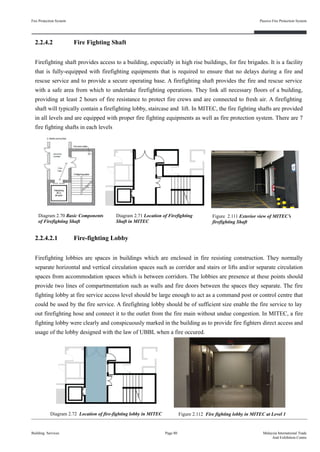
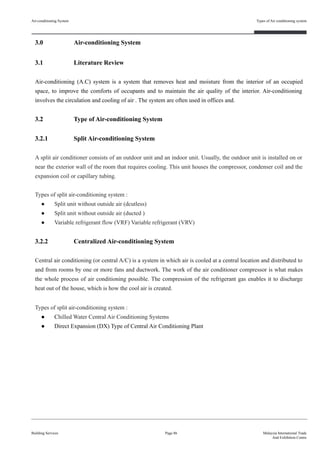
MALAYSIA INTERNATIONAL TRADE AND EXHIBITION CENTRE
Prepared by
Esther Wong Jia En 0332188
Gavin Tio Kang Hui 0333373
Loi Chi Wun 0328652
Priscilla Huong Yunn 0332599
Wendy Lau Jia Yee 0333538
Yong Ping Ping 0332585
Building Services
BLD 60903
Lecturer : Ar. Zafar Rozaly
i
LIST OF FIGURES
2.0 Fire Protection System………………………………………………………………….
Figure 2.1 An overview of fire pump system and sprinkler tank
Figure 2.2 Fire sprinkler tank and wet riser-hose reel tank
Figure 2.3 EBSRAY Jockey Pump
Figure 2.4 Duty Pump
Figure 2.5 Standby Pump
Figure 2.6 Pumpset Pressure Indicator
Figure 2.7 Fire Pump Controller
Figure 2.8 Electric Service Room
Figure 2.9 Indoor Second Floor Corridor
Figure 2.10 First Floor Loading Bay
Figure 2.11 Basement Level 1
Figure 2.12 Upright fire sprinkler
Figure 2.13 Alarm Valve System for each zonings
Figure 2.14 System Side Water Gauge
Figure 2.15 Alarm Valve Clapper
Figure 2.16 Water Cannon System
Figure 2.17 Testing out water cannon
Figure 2.18 Wet Riser System
Figure 2.19 Wet riser system that located in the wall
Figure 2.20 Wet riser main
Figure 2.21 Air Vent
Figure 2.22 Landing Valves on the top floor
Figure 2.23 Canvas hose placed on the cradle
Figure 2.24 L1-H3-FYHR80 stands for ‘Level 1, Hall 3, Foyer Hose Reel 80’
Figure 2.25 Cabinet for hose reel system and fire extinguisher
Figure 2.26 Hose Reel System
Figure 2.27 Drum
Figure 2.28 Stop Valve
Figure 2.29 Rubber Hose
Figure 2.30 Spray Nozzle
Figure 2.31 Dry Riser Outlet
Figure 2.32 Dry Riser Inlet
Figure 2.33 Fire Hydrant located at staff car park
Figure 2.34 ABC Fire Extinguisher in MITEC
Figure 2.35 ABC Fire Extinguisher
Figure 2.36 CO2 Fire Extinguisher
Figure 2.37 Electric Control Room
Figure 2.38 Fire Curtain
Figure 2.39 Damper
Figure 2.40 Solenoid 24V DC Tripping Device
Figure 2.41 Carbon Dioxide Suppression System
Figure 2.42 Fireman switches located at basement escape staircase
Figure 2.43 Fireman Intercom located at basement escape staircase (left) and fire pump room
Figure 2.44 Emergency Speaker
Figure 2.45 Emergency light
Figure 2.46 Emergency Break Glass
ii
LIST OF FIGURES
Figure 2.47 Smoke Detector
Figure 2.48 Heat Detector
Figure 2.49 Fire Detection Control Panel
Figure 2.50 Smoke Detector in Mega Exhibition Hall
Figure 2.51 Smoke Detector in Control Room
Figure 2.52 Ionization Smoke Detector
Figure 2.53 Photoelectric Smoke Detector
Figure 2.54 Heat Detector on ceiling of ground floor
Figure 2.55 Heat Detector on ceiling of ground floor
Figure 2.56 Heat Detector in MITEC
Figure 2.57 Smoke and heat detectors in lift lobby
Figure 2.58 Fire Alarm Control Panel
Figure 2.59 Fire Alarm Bell
Figure 2.60 Indication of location of Manual Call point
Figure 2.61 Manual Call Point
Figure 2.62 Fire escape staircase towards main lobby
Figure 2.63 Fire escape staircase 2 on Basement 1
Figure 2.64 Immense area for horizontal circulation
Figure 2.65 Multiple exit available on ground floor
Figure 2.66 Fire escape plan provided on ground floor lift lobby
Figure 2.67 Fire escape plan provided on lift lobby floor 1A
Figure 2.68 Fire escape plan with clear annotations on floor 2
Figure 2.69 South exit point on ground floor
Figure 2.70 North exit point on ground floor
Figure 2.71 Storey exits with clear fire escape signage
Figure 2.72 Storey exits with clear fire escape signage
Figure 2.73 Broad aisle towards assembly point
Figure 2.74 Clear signage to indicate location of assembly point
Figure 2.75 Assembly point around the public parking area
Figure 2.76 Evacuation route towards assembly point
Figure 2.77 Horizontal exits access from basement to fire lobby
Figure 2.78 Horizontal exit in between basement and lift lobby
Figure 2.79 Staircase as vertical exit in basement
Figure 2.80 Enclosed stairway in basement 1 with fire-rated door
Figure 2.81 Dog legged staircase in MITEC
Figure 2.82 Dog legged staircase in MITEC
Figure 2.83 Dog legged staircase in MITEC
Figure 2.84 Louvered heat ventilator found in loading bay
Figure 2.85 Louvered heat ventilator with permanent openings
Figure 2.86 Permanent opening in stairwell
Figure 2.87 Louvered structure details
Figure 2.88 Structure embedded into wall
Figure 2.89 Louvered openings
Figure 2.90 Fire escape staircase provided with handrails
Figure 2.91 Cafeteria of MITEC
Figure 2.92 Kitchen of MITEC
Figure 2.93 Organiser’s Control Room
iii
LIST OF FIGURES
Figure 2.94 Fire Rated Lock
Figure 2.95 Fire Rated Glass
Figure 2.96 Door Closer
Figure 2.97 Accreditation from Sirim
Figure 2.98 Concrete Slab at MITEC
Figure 2.99 Concrete Floor at MITEC
Figure 2.100 Reinforced Concrete wall of MITEC
Figure 2.101 Reinforced Concrete wall of MITEC
Figure 2.102 Masonry wall at MITEC
Figure 2.103 Reinforced Concrete Columns at MITEC
Figure 2.104 Fire roller shutter at Basement 1
Figure 2.105 Close-up of Fire Roller Shutter
Figure 2.106 Detail of Controller
Figure 2.107 Fire engines
Figure 2.108 Assembly point
Figure 2.109 Location of Fire engines space
Figure 2.110 Driveway of Fire engines
Figure 2.111 Exterior view of MITEC’s firefighting Shaft
Figure 2.112 Fire fighting lobby in MITEC at Level 1
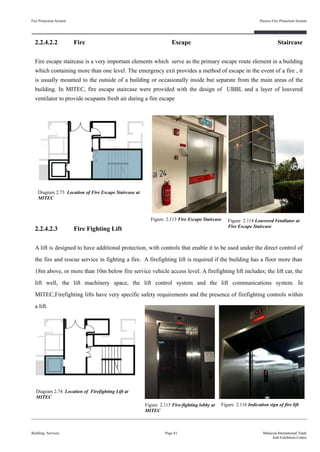
Figure 2.113 Fire Escape Staircase
Figure 2.114 Louvered Ventilator at Fire Escape Staircase
Figure 2.115 Fire-fighting lobby at MITEC
Figure 2.116 Indication sign of fire lift
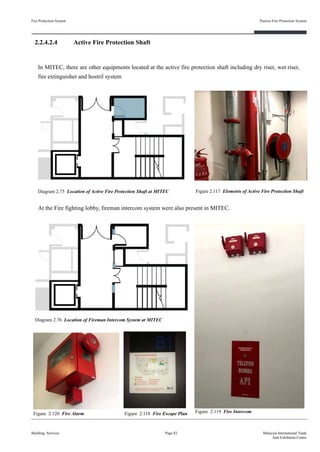
Figure 2.117 Elements of Active Fire Protection Shaft
Figure 2.118 Fire Escape Plan
Figure 2.119 Fire Intercom
Figure 2.120 Fire Alarm
3.0 Air-Conditioning System……………………………………….…………………….
Figure 3.1 View of cooling tower
Figure 3.2 Water tank with ladder to access the top
Figure 3.3 View of chiller in MITEC.
Figure 3.4 View of chiller in MITEC
Figure 3.5 Row of chiller water pump
Figure 3.6 Temperature sensor is placed on the pump unit
Figure 3.7 Individual control panel
Figure 3.8 Control unit in the mechanical room
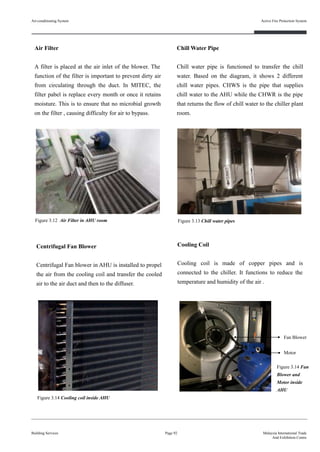
Figure 3.9 Model of AHU used in MITEC
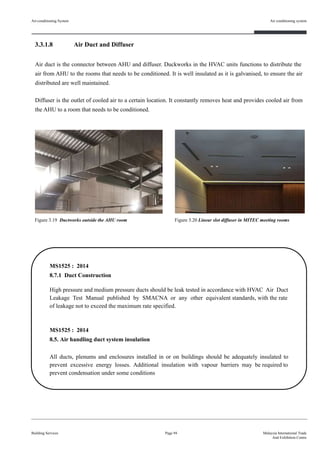
Figure 3.10 AHU unit in AHU room
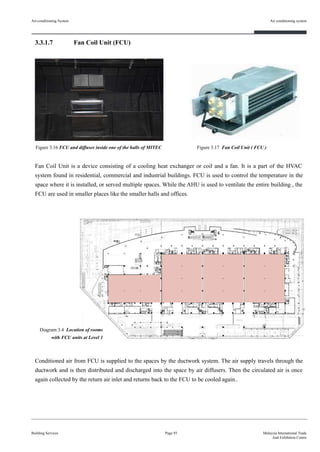
Figure 3.11 AHU unit in AHU room
Figure 3.12 Air Filter in AHU room
Figure 3.13 Cooling coil inside AHU
Figure 3.14 Fan Blower and Motor inside AHU
Figure 3.15 Chill water pipes
Figure 3.16 FCU and diffuser inside one of the halls of MITEC
Figure 3.17 Fan Coil Unit (FCU)
Figure 3.18 Location of rooms with FCU units at Level 1
iv
LIST OF FIGURES
Figure 3.19 Ductworks outside the AHU room
Figure 3.20 Linear slot diffuser in MITEC meeting rooms
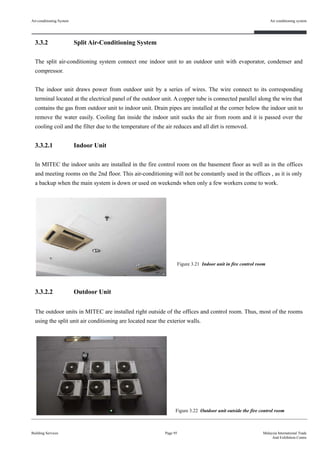
Figure 3.21 Indoor unit in fire control room
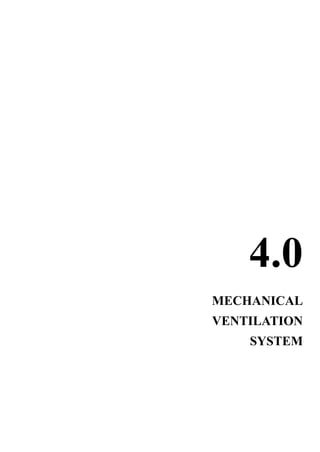
Figure 3.22 Outdoor unit outside the fire control room
4.0 Mechanical Ventilation System……………………………………….…………………
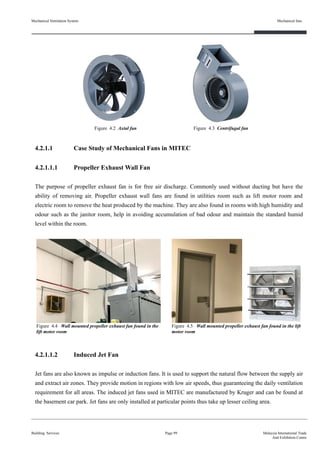
Figure 4.1 Propeller fan
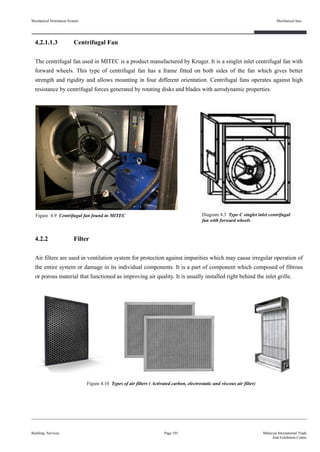
Figure 4.2 Axial fan
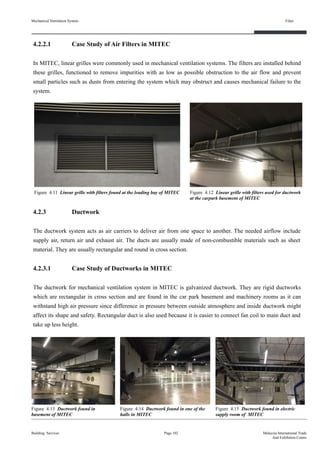
Figure 4.3 Centrifugal fan
Figure 4.4 Wall mounted propeller exhaust fan found in the lift motor room
Figure 4.5 Wall mounted propeller exhaust fan found in the lift motor room
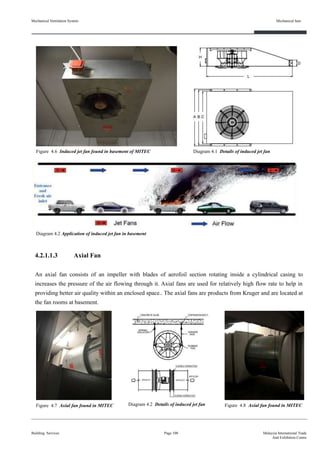
Figure 4.6 Induced jet fan found in basement of MITEC
Figure 4.7 Axial fan found in MITEC
Figure 4.8 Axial fan found in MITEC
Figure 4.9 Centrifugal fan found in MITEC
Figure 4.10 Types of air filters (Activated carbon, electrostatic and viscous air filter)
Figure 4.11 Linear grille with filters found at the loading bay of MITEC
Figure 4.12 Linear grille with filters used for ductwork at the carpark basement of MITEC
Figure 4.13 Ductwork found in basement of MITEC
Figure 4.14 Ductwork found in one of the halls in MITEC
Figure 4.15 Ductwork found in electric supply room of MITEC
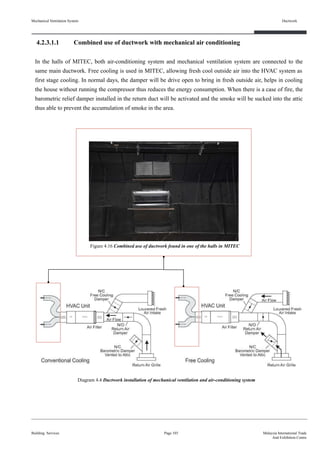
Figure 4.16 Combined use of ductwork found in one of the halls in MITEC
Figure 4.17 Combination of fire and smoke damper found in electric supply room of MITEC
Figure 4.18 Combination of fire and smoke damper found in electric supply room of MITEC
Figure 4.19 Pressure relief damper found at enclosed staircase in MITEC
Figure 4.20 Pressure relief damper found at enclosed staircase in MITEC
Figure 4.21 Types of grilles and diffusers
Figure 4.22 Egg crate grilles found in MITEC
Figure 4.23 Egg crate grilles found in MITEC
Figure 4.24 Air transfer grilles found in utilities room in MITEC
Figure 4.25 Air transfer grilles found in fire staircase in MITEC
Figure 4.26 Return air grille found in MITEC
Figure 4.27 Return air grille found in MITEC
Figure 4.28 Round diffusers found in concourse area of MITEC
Figure 4.29 Round diffusers found in concourse area of MITEC
Figure 4.30 Louvre faced diffusers found in MITEC
Figure 4.31 Louvre faced diffusers found in MITEC
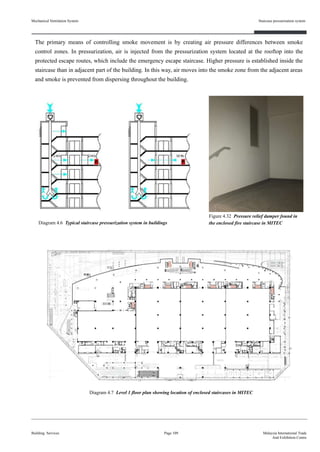
Figure 4.32 Pressure relief damper found in the enclosed fire staircase in MITEC
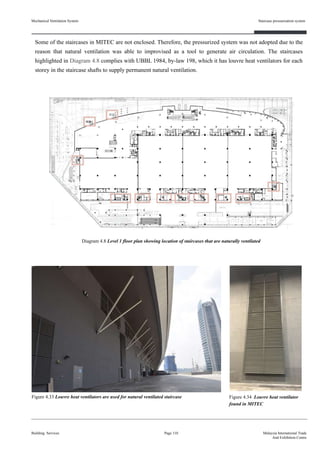
Figure 4.33 Louvre heat ventilators are used for natural ventilated staircase
Figure 4.34 Louvre heat ventilator found in MITEC
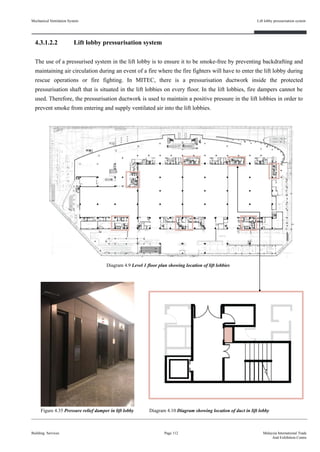
Figure 4.35 Pressure relief damper in lift lobby
Figure 4.36 Induced jet fan found in the basement car park
Figure 4.37 Ductwork in the basement carpark
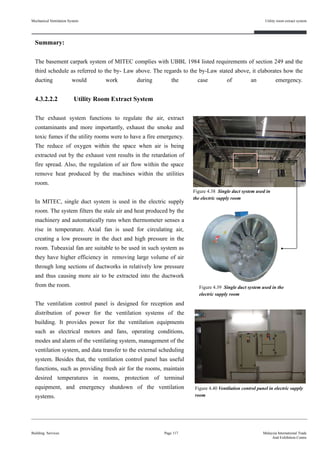
Figure 4.38 Single duct system used in the electric supply room
Figure 4.39 Single duct system used in the electric supply room
Figure 4.40 Ventilation control panel in electric supply room
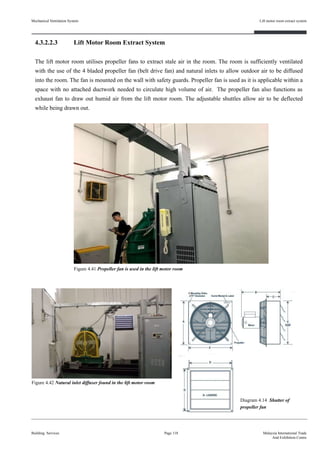
Figure 4.41 Propeller fan is used in the lift motor room
v
LIST OF FIGURES
Figure 4.42 Natural inlet diffuser found in the lift motor room
5.0 Mechanical Transportation System……………………………………….………...
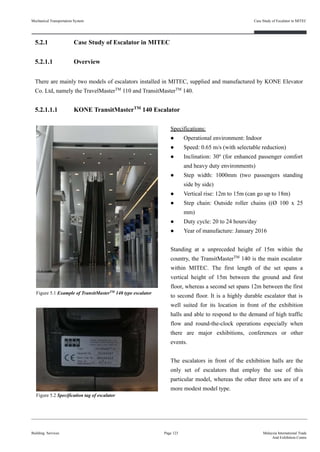
Figure 5.1 Example of TransitMasterTM
140 type escalator
Figure 5.2 Specification tag of escalator
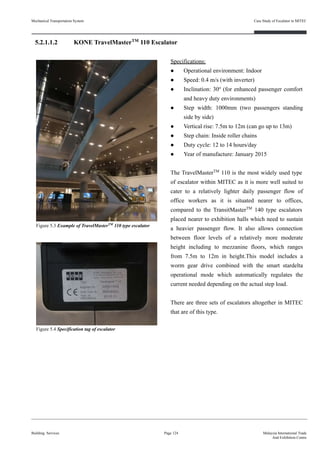
Figure 5.3 Example of TravelMasterTM
110 type escalator
Figure 5.4 Specification tag of escalator
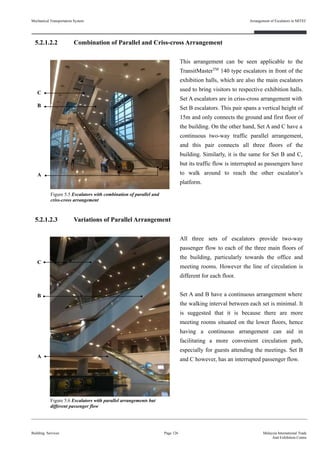
Figure 5.5 Escalators with combination of parallel and criss-cross arrangement
Figure 5.6 Escalators with parallel arrangements but different passenger flow
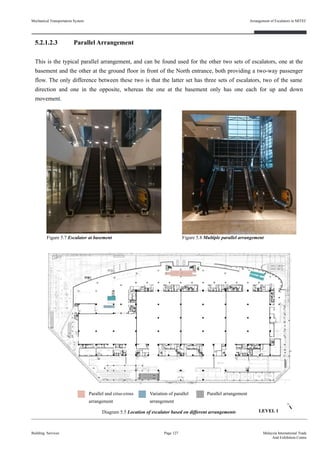
Figure 5.7 Escalator at basement
Figure 5.8 Multiple parallel arrangement
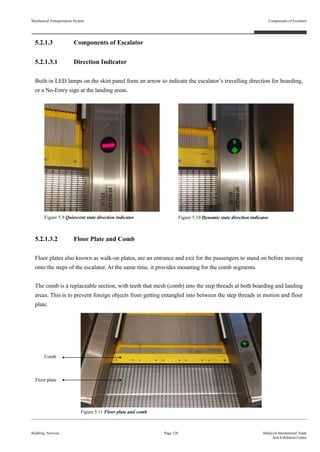
Figure 5.9 Quiescent state direction indicator
Figure 5.10 Dynamic state direction indicator
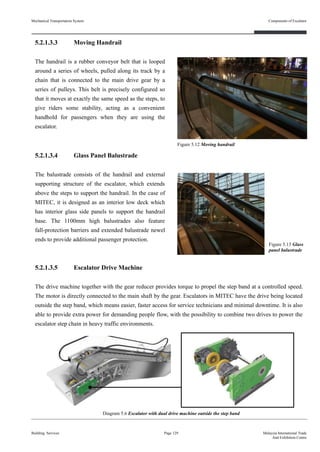
Figure 5.11 Floor plate and comb
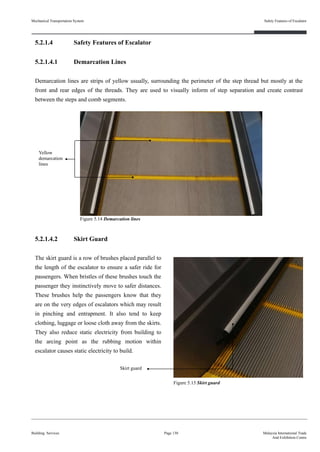
Figure 5.12 Moving handrail
Figure 5.13 Glass panel balustrade
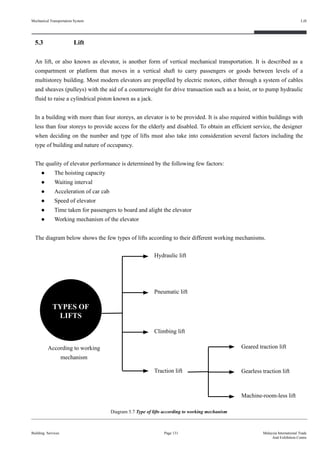
Figure 5.14 Demarcation lines
Figure 5.15 Skirt guard
Figure 5.16 Passenger lift and fire lift placed together
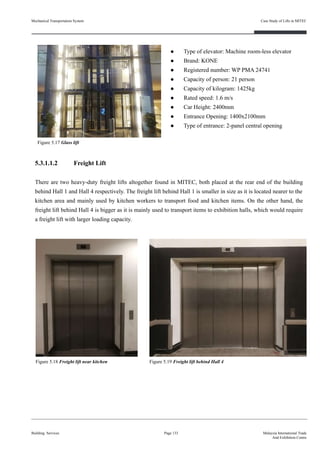
Figure 5.17 Glass lift
Figure 5.18 Freight lift near kitchen
Figure 5.19 Freight lift behind Hall 4
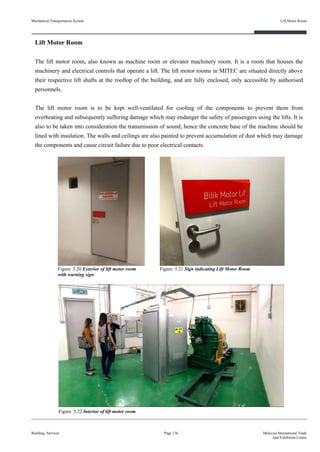
Figure 5.20 Exterior of lift motor room with warning sign
Figure 5.21 Sign indicating Lift Motor Room
Figure 5.22 Interior of lift motor room
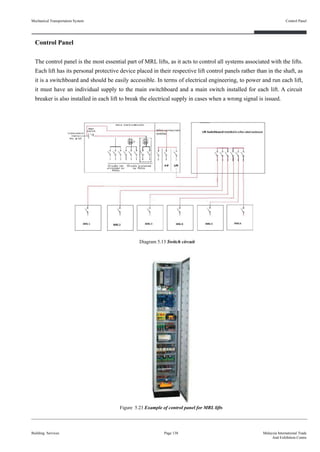
Figure 5.23 Example of control panel for MRL lifts
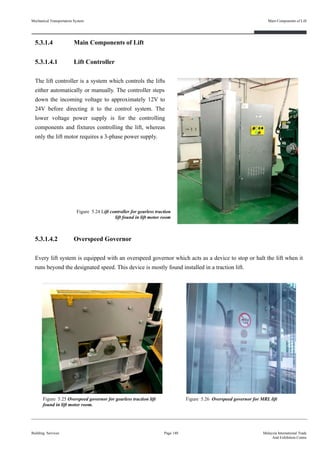
Figure 5.24 Lift controller for gearless traction lift found in lift motor room
Figure 5.25 Overspeed governor for gearless traction lift found in lift motor room
Figure 5.26 Overspeed governor for MRL lift
Figure 5.27 Lift motor machine found in lift motor room
Figure 5.28 Lift motor machine of MRL lift
Figure 5.29 Guide rail of lift in MITEC
Figure 5.30 Spring lift buffer
Figure 5.31 Suspension steel wire ropes
Figure 5.32 Example of car sill
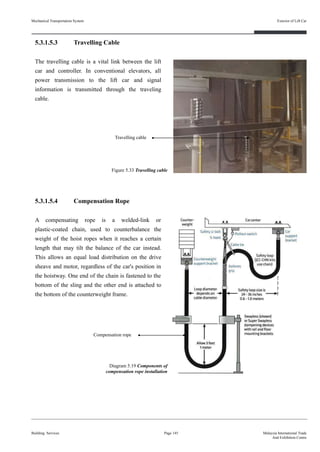
Figure 5.33 Travelling cable
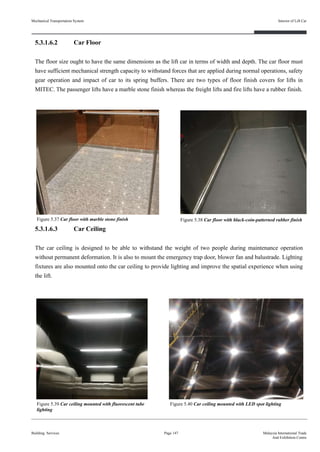
Figure 5.34 Example of two-panel central opening landing door in MITEC
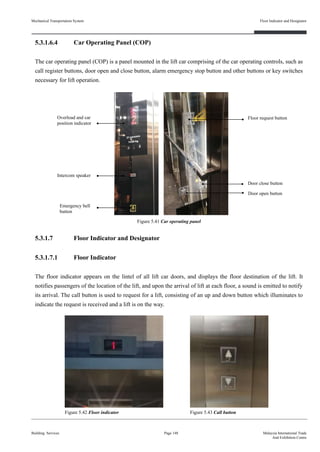
Figure 5.35 Stainless steel car wall
Figure 5.36 Glass panel car wall
Figure 5.37 Car floor with marble stone finish
Figure 5.38 Car floor with black-coin-patterned rubber finish
Figure 5.39 Car ceiling mounted with fluorescent tube lighting
Figure 5.40 Car ceiling mounted with LED spot lighting
Figure 5.41 Car operating panel
Figure 5.42 Floor indicator
Figure 5.43 Call button
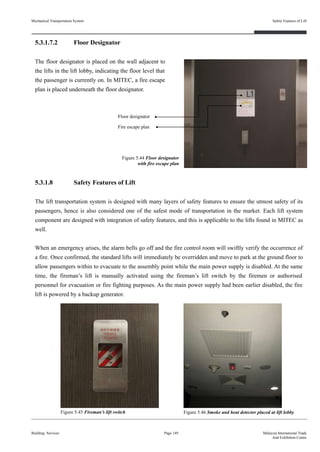
Figure 5.44 Floor designator with fire escape plan
vi
LIST OF DIAGRAMS
Figure 5.45 Fireman’s lift switch
Figure 5.46 Smoke and heat detector placed at lift lobby
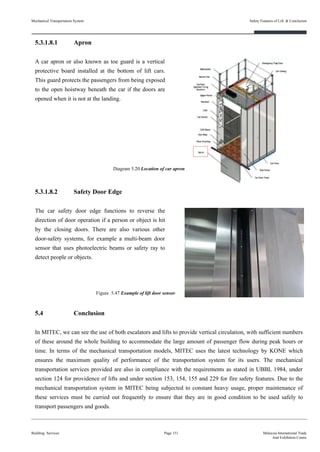
Figure 5.47 Example of lift door sensor
2.0 Fire Protection System………………………………………………………………….
Diagram 2.1 Jockey Pump Components
Diagram 2.2 An overview of automatic fire sprinkler system
Diagram 2.3 Call-out details
Diagram 2.4 Components of a pendant fire sprinkler
Diagram 2.5 Types of the bulb liquid colour
Diagram 2.6 Pendant fire sprinkler
Diagram 2.7 Upright fire sprinkler
Diagram 2.8 Both pendant and upright sprinkler head spray water in circle pattern
Diagram 2.9 An overview of valve system mechanism
Diagram 2.10 Location of Fire Pump Room on the Level 1A Floor Plan
Diagram 2.11 Location of Pillar-less Exhibition Hall where the water cannon system is located
Diagram 2.12 Water Cannon Plan
Diagram 2.13 Water Cannon Elevation
Diagram 2.14 System Operation Overview
Diagram 2.15 Overall layout of Fire Detection System
Diagram 2.16 Normal conditions heat detector
Diagram 2.17 Fixed Temperature heat detector
Diagram 2.18 ROR heat detector
Diagram 2.19 Diagram of Alarm Control Panel
Diagram 2.20 Programme of type of system and hazards
Diagram 2.21 Fire Alarm System
Diagram 2.22 Section showing general direction of evacuation route from each level to ground floor
Diagram 2.23 Evacuation Route on Basement 1
Diagram 2.24 Evacuation Route on Basement 1A
Diagram 2.25 Evacuation route on ground floor
Diagram 2.26 Evacuation route on Level 1
Diagram 2.27 Evacuation route on Level 2
Diagram 2.28 Evacuation route on Level 3
Diagram 2.29 Evacuation route on Level 1A
Diagram 2.30 Evacuation route on Level 2A
Diagram 2.31 Evacuation route on Level 3A
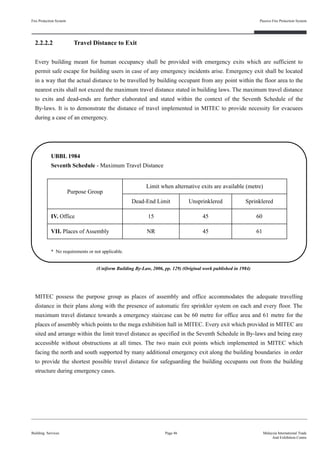
Diagram 2.32 Distance radius as 61 metres on Level 1
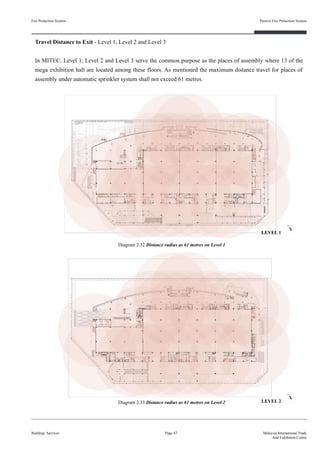
Diagram 2.33 Distance radius as 61 metres on Level 2
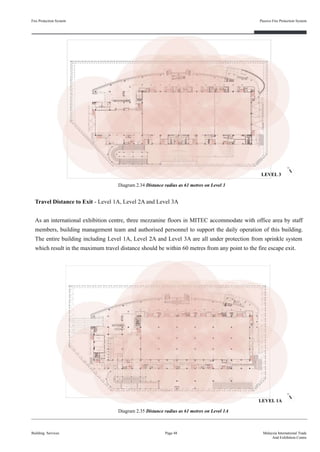
Diagram 2.34 Distance radius as 61 metres on Level 3
Diagram 2.35 Distance radius as 61 metres on Level 1A
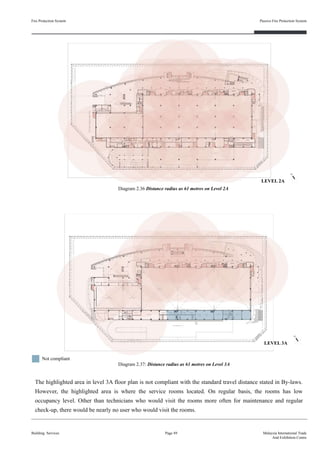
Diagram 2.36 Distance radius as 61 metres on Level 2A
Diagram 2.37 Distance radius as 61 metres on Level 3A
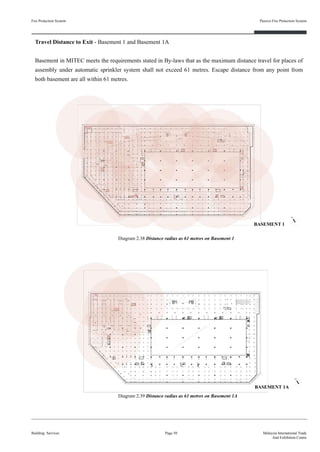
Diagram 2.38 Distance radius as 61 metres on Basement 1
Diagram 2.39 Distance radius as 61 metres on Basement 1A
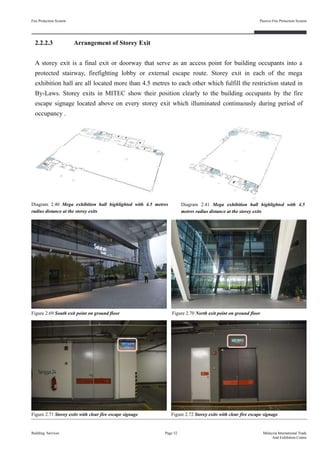
Diagram 2.40 Mega exhibition hall highlighted with 4.5 metres radius distance at the storey exits
Diagram 2.41 Mega exhibition hall highlighted with 4.5 metres radius distance at the storey exits
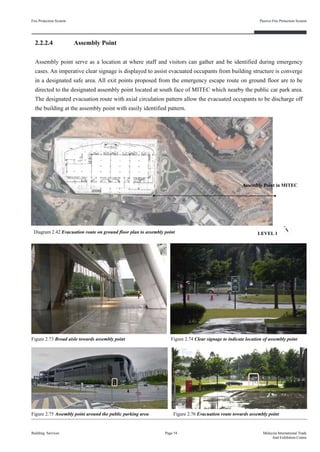
Diagram 2.42 Evacuation route on ground floor plan to assembly point
vii
LIST OF DIAGRAMS
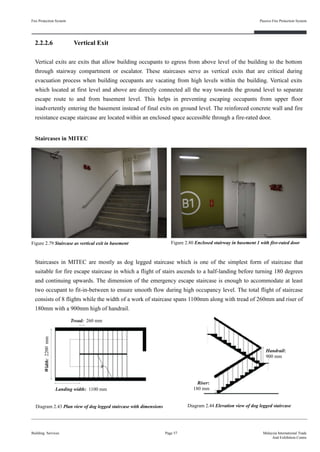
Diagram 2.43 Plan view of dog legged staircase with dimensions
Diagram 2.44 Elevation view of dog legged staircase
Diagram 2.45 Swing shall of door does not affect circulation in escaping route
Diagram 2.46 Headroom distance labelled in section
Diagram 2.47 Air flow diagram through louvered openings labelled in section
Diagram 2.48 Horizontal and vertical exits highlighted in Level 1
Diagram 2.49 Horizontal and vertical exits highlighted in Level 2
Diagram 2.50 Horizontal and vertical exits highlighted in Level 3
Diagram 2.51 Horizontal and vertical exits highlighted in Level 1A
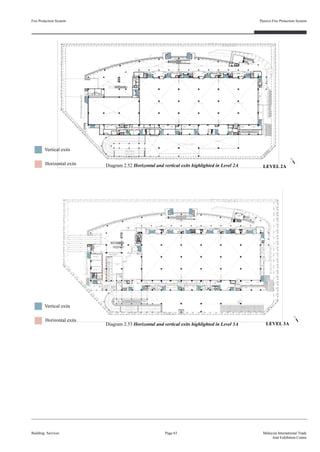
Diagram 2.52 Horizontal and vertical exits highlighted in Level 2A
Diagram 2.53 Horizontal and vertical exits highlighted in Level 3A
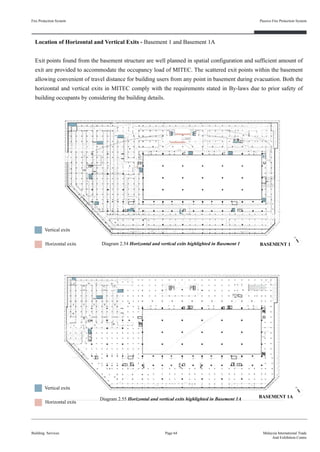
Diagram 2.54 Horizontal and vertical exits highlighted in Basement 1
Diagram 2.55 Horizontal and vertical exits highlighted in Basement 1A
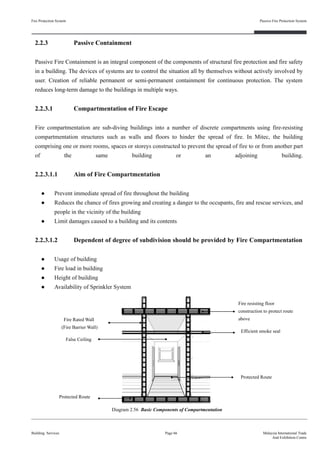
Diagram 2.56 Basic Components of Compartmentation
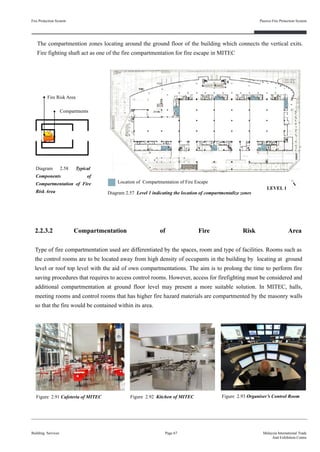
Diagram 2.57 Level 1 indicating the location of compartmentalize zones
Diagram 2.58 Typical Components of Compartmentation of Fire Risk Area
Diagram 2.59 Level 1 indicating the location of Compartmentation Zones
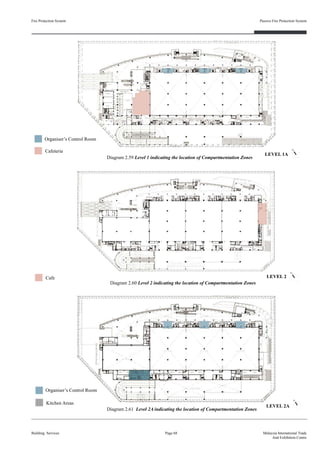
Diagram 2.60 Level 2 indicating the location of Compartmentation Zones
Diagram 2.61 Level 2A indicating the location of Compartmentation Zones
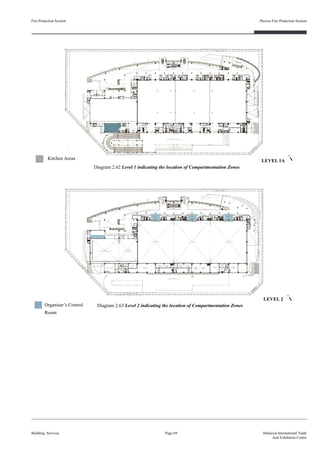
Diagram 2.62 Level 1 indicating the location of Compartmentation Zones
Diagram 2.63 Level 2 indicating the location of Compartmentation Zones
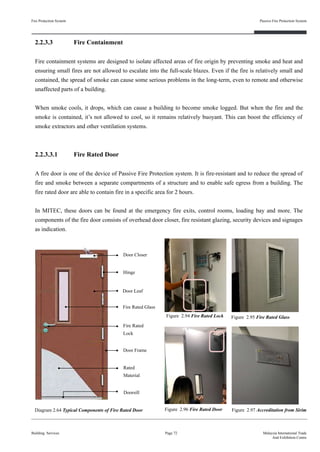
Diagram 2.64 Typical Components of Fire Rated Door
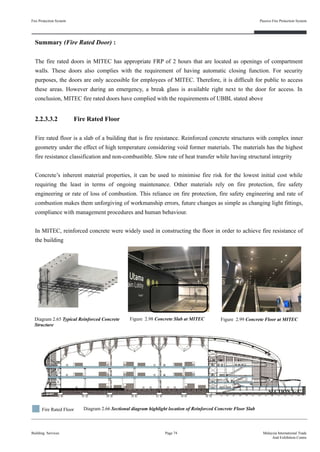
Diagram 2.65 Typical Reinforced Concrete Structure
Diagram 2.66 Sectional diagram highlight location of Reinforced Concrete Floor Slab
Diagram 2.67 Indicating the location of Compartmentation Zones in Level 1A
Diagram 2.68 Components of Fire Roller Shutter
Diagram 2.69 Indication of Fire Engine Access Route and Assembly Point
Diagram 2.70 Basic Components of Firefighting Shaft
Diagram 2.71 Location of Firefighting Shaft in MITEC
Diagram 2.72 Location of fire-fighting lobby in MITEC
Diagram 2.73 Location of Fire Escape Staircase at MITEC
Diagram 2.74 Location of Firefighting Lift at MITEC
Diagram 2.75 Location of Active Fire Protection Shaft at MITEC
Diagram 2.76 Location of Fireman Intercom System at MITEC
3.0 Air-Conditioning System……………………………………….…………………….
Diagram 3.1 Introduction of components in an air-conditioning system (Source : Khemani , 2009)
Diagram 3.2 Location of the plant room
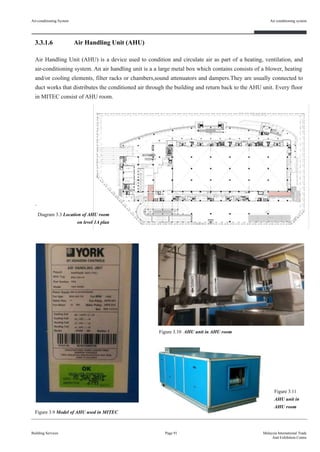
Diagram 3.3 Location of AHU room on level 1A plan
Diagram 3.4 Location of rooms with FCU units
4.0 Mechanical Ventilation System……………………………………….……………..
Diagram 4.1 Details of induced jet fan
Diagram 4.2 Application of induced jet fan in basement
Diagram 4.3 Type C singlet inlet centrifugal fan with forward wheels
Diagram 4.4 Ductwork installation of mechanical ventilation and air-conditioning system
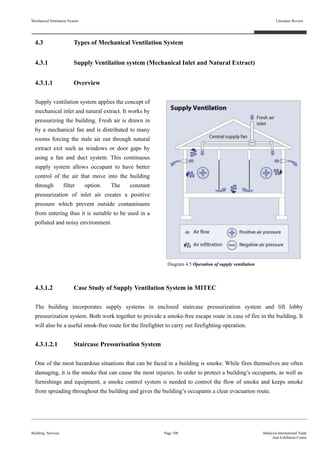
Diagram 4.5 Operation of supply ventilation
viii
LIST OF DIAGRAMS
Diagram 4.6 Typical staircase pressurization system in buildings
Diagram 4.7 Level 1 floor plan showing location of enclosed staircases in MITEC.
Diagram 4.8 Level 1 floor plan showing location of staircases that are naturally ventilated
Diagram 4.9 Level 1 floor plan showing location of lift lobbies
Diagram 4.10 Diagram showing location of duct in lift lobby
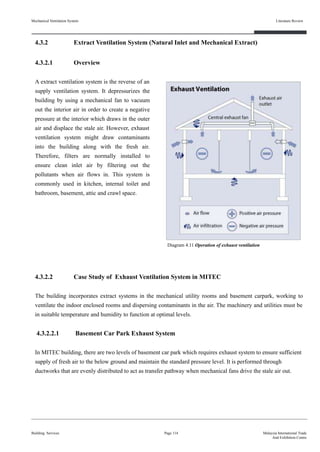
Diagram 4.11 Operation of exhaust ventilation
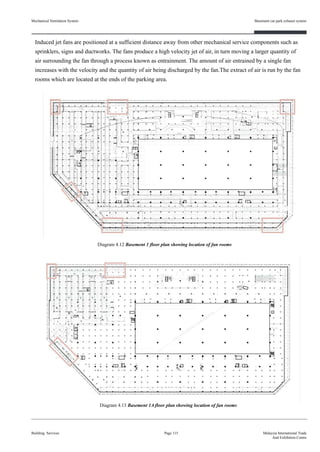
Diagram 4.12 Basement 1 floor plan showing location of fan rooms.
Diagram 4.13 Basement 1A floor plan showing location of fan rooms.
Diagram 4.14 Shutter of propeller fan
5.0 Mechanical Transportation System……………………………………….….……
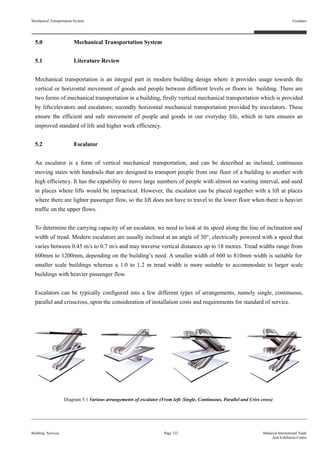
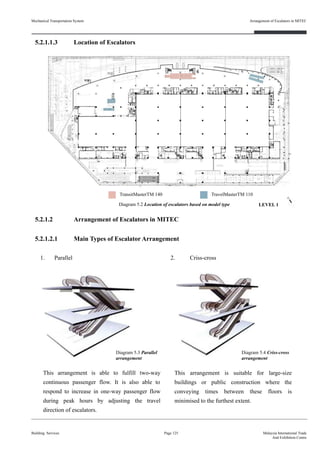
Diagram 5.1 Various arrangements of escalator (From left: Single, Continuous, Parallel and Criss cross)
Diagram 5.2 Location of escalators based on model type
Diagram 5.3 Parallel arrangement
Diagram 5.4 Criss-cross arrangement
Diagram 5.5 Location of escalator based on different arrangements
Diagram 5.6 Escalator with dual drive machine outside the step band
Diagram 5.7 Type of lifts according to working mechanism
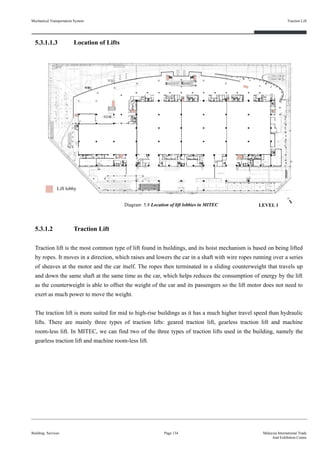
Diagram 5.8 Location of lift lobbies in MITEC
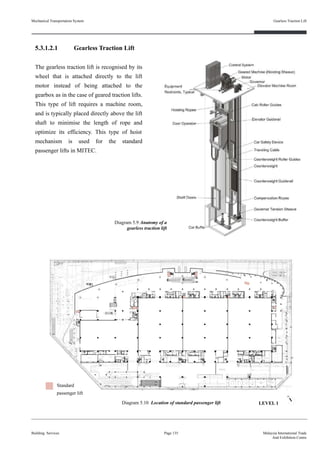
Diagram 5.9 Anatomy of a gearless traction lift
Diagram 5.10 Location of normal passenger lift
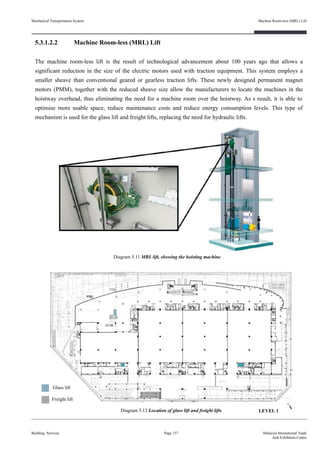
Diagram 5.11 MRL lift, showing the hoisting machine
Diagram 5.12 Location of glass lift and freight lifts
Diagram 5.13 Switch circuit
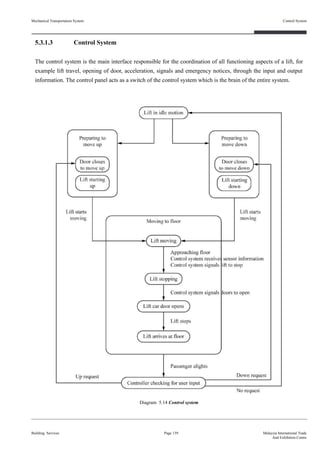
Diagram 5.14 Control system
Diagram 5.15 Position of drive sheave within the lift motor machine
Diagram 5.16 Placement of counterweight in hoisting mechanism of lift
Diagram 5.17 Anatomy of counterweight components
Diagram 5.18 Car frame
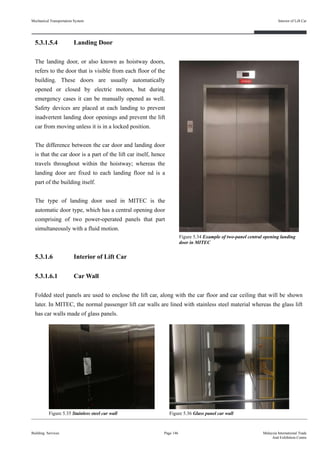
Diagram 5.19 Components of compensation rope installation
Diagram 5.20 Location of car apron
ix
TABLE OF CONTENT
1.0 Introduction 1
1.1 Abstract
1.2 Acknowledgement
1.3 Overview of MITEC
2.0 Fire Protection System 6
2.1 Active Fire Protection System
2.1.1 Literature Review
2.1.2 Water Based System
2.1.2.1 Fire Pump System
2.1.2.2 Fire Sprinkler System
2.1.2.3 Water Cannon System
2.1.2.4 Wet Riser System
2.1.2.5 Hose Reel System
2.1.2.6 Dry Riser System
2.1.2.7 Fire Hydrant System
2.1.3 Non-water Based System
2.1.3.1 Fire Suppression System
2.1.3.1.1 ABC Dry Powder Fire Extinguisher
2.1.3.1.2 Carbon Dioxide Fire Extinguisher
2.1.3.1.3 Carbon Dioxide Suppression System
2.1.3.2 Voice Communication System
2.1.3.3 Fire Switch
2.1.3.4 Emergency Speaker
2.1.3.5 Emergency Light
2.1.4 Fire Detection System
2.1.4.1 Smoke Detector
2.1.4.2 Heat Detector
2.1.5 Fire Alarm System
2.1.5.1 Fire Alarm Control Panel
2.1.5.2 Fire Alarm Bell
2.1.5.3 Manual Call Point
2.2 Passive Fire Protection System 38
2.2.1 Literature Review
2.2.1.1 Purpose Group
2.2.2 Mean of Escape
2.2.2.1 Evacuation Route
2.2.2.2 Travel Distance to Exit
x
TABLE OF CONTENT
2.2.2.3 Arrangement of storey exit
2.2.2.4 Assembly Point
2.2.2.5 Horizontal Exit
2.2.2.6 Vertical Exit
2.2.2.6.1 Exit Stairway
2.2.2.6.2 Headroom
2.2.2.6.3 Louvered Heat Ventilator
2.2.2.7 Handrail
2.2.3 Passive Containment
2.2.3.1 Compartmentation of Fire Escape
2.2.3.2 Compartmentation of Fire Risk Area
2.2.3.3 Fire Containment
2.2.3.3.1 Fire Rated Door
2.2.3.3.2 Fire Rated Floor
2.2.3.3.3 Fire Rated Wall
2.2.3.3.4 Structural Fire Protection
2.2.3.3.5 Fire Roller Shutter
2.2.4 Fire Appliance Access
2.2.4.1 Fire Engine Access
2.2.4.2 Fire-fighting Shaft
2.2.4.2.1 Fire-fighting Lobby
2.2.4.2.2 Fire Engine Staircase
2.2.4.2.3 Fire-fighting Lift
2.3 Conclusion
3.0 Air-conditioning System 85
3.1 Literature Review
3.2 Type of Air-conditioning System
3.2.1 Split Air-conditioning System
3.2.2 Centralized Air-conditioning System
3.3 Case Study of MITEC for Air-conditioning System
3.3.1 Chilled Water Central Air-conditioning System
3.3.1.1 Cooling Water and Water Tank
3.3.1.2 Chiller Plant Room
3.3.1.3 Chiller
3.3.1.4 Chiller Water Pump
3.3.1.5 Control Unit
3.3.1.6 Air Handling UNit (AHU)
3.3.1.7 Fan Coil Unit (FCU)
xi
TABLE OF CONTENT
3.3.1.8 Air Duct and Diffuser
3.3.2 Split Air-Conditioning System (VRF)
3.3.2.1 Indoor Unit
3.3.2.2 Outdoor Unit
3.3.2.3 Cassette Type
3.4 Conclusion
4.0 Mechanical Ventilation System 97
4.1 Literature Review
4.2 Components of Mechanical Ventilation System
4.2.1 Fan
4.2.2 Filter
4.2.3 Ductwork
4.2.4 Damper
4.2.5 Grille and Diffuser
4.3 Types of Mechanical Ventilation system
4.3.1 Supply ventilation system (Mechanical Inlet and Natural Extract)
4.3.1.1 Overview
4.3.1.2 Staircase Pressurisation System
4.3.1.3 Lift Lobby Pressurisation System
4.3.2 Extract Ventilation System
4.3.2.1 Overview
4.3.2.2 Basement Car Park Exhaust System
4.3.2.3 Utility Room Extract System
4.3.2.4 Lift Motor Room Extract System
4.4 Conclusion
5.0 Mechanical Transportation System 121
5.1 Literature Review
5.2 Escalator
5.2.1 Case Study of Escalator in MITEC
5.2.1.1 Overview
5.2.1.2 Arrangement of Escalators
5.2.1.2.1 Main Types of Escalator Arrangement
5.2.1.3 Components of Escalator
5.2.1.4 Safety Features of Escalator
5.3 Lift
5.3.1 Case Study of Lifts in MITEC
5.3.1.1 Overview
xii
TABLE OF CONTENT
5.3.1.1.1 Passenger Lift
5.3.1.1.2 Freight Lift
5.3.1.1.3 Location of Lifts
5.3.1.2 Traction Lift
5.3.1.2.1 Gearless Traction Lift
5.3.1.2.2 Machine Room-less (MRL) Lift
5.3.1.3 Control System
5.3.1.4 Main Components of Lift
5.3.1.5 Exterior of Lift Car
5.3.1.6 Interior of Lift Car
5.3.1.7 Floor Indicator and Designator
5.3.1.8 Safety Features
5.4 Conclusion
6.0 Conclusion 152
7.0 Reference 154
8.0 Appendix 161
1.0
INTRODUCTION
Page 2
1.1 Abstract
This project aims to provide real-life case as an introduction to building services system installed in a
multi-storey building. By introducing the common system used in the bigger volume of space with a variety of
users, this knowledge can be integrated into future design studio project to ensure a practical and technically
functional building design proposal.
The case study building that our group have chosen is the Malaysia International Trade and Exhibition Centre.
We are to analyse four system associated with building services which are active and passive fire protection
system, air-conditioning system, mechanical ventilation system and mechanical transportation system. A
thorough research was done prior to site visits. Two site visits were conducted to ensure complete data collection
such as information and pictures of building services components. The complete data is then analysed with
reference to Uniform Building By-Law 1984 (UBBL 1984), MS 1184 and MS 1525.
We are to produce a documentation and analytical report with a 5-minute video to present our findings about the
building services in MITEC. Pictures and video taken on site were used to visually portray the components of
each building services system with a comprehensives study describing the function and its importance.
All in all, we have learned a substantial amount of knowledge regarding to building services and its functions in
creating a safe environment for the occupants of the buildings. The site visit provides us an insight and a realistic
simulation of how building services are done in our local buildings and its implication towards a building design.
Introduction
Building Services
Abstract
Malaysia International Trade
And Exhibition Centre
Page 3
1.2 Acknowledgement
We have taken much efforts in this assignment. However, it would not have been possible without the kind
support and help of many individuals and organizations. We would like to express of sincere appreciation to all
of them.
We are highly indebted to Mr. Zafar Rozaly for his guidance and constant supervisions as well as for providing
necessary information regarding the project. Also, we would like to express special gratitude to Ms. Mawar,
Assistant Training Manager from Human Resource Department of MITEC and Mr. Jaque, Mechanical and
Electrical Manager of MITEC for giving us the opportunities to visit the building and also spending time
explaining the services system in MITEC to us.
Introduction
Building Services
Acknowledgement
Malaysia International Trade
And Exhibition Centre
Page 4
MALAYSIA INTERNATIONAL TRADE AND EXHIBITION CENTRE
Address : MITEC, 8, Jalan Dutamas 2, Kompleks Kerajaan, 50480 Kuala Lumpur, Wilayah Persekutuan
Kuala Lumpur
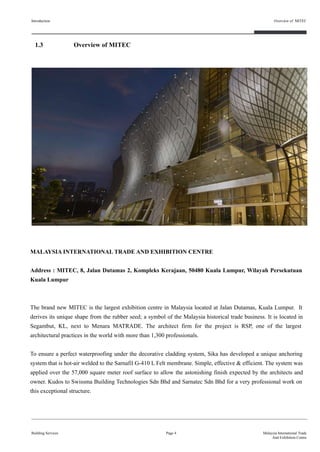
The brand new MITEC is the largest exhibition centre in Malaysia located at Jalan Dutamas, Kuala Lumpur. It
derives its unique shape from the rubber seed; a symbol of the Malaysia historical trade business. It is located in
Segambut, KL, next to Menara MATRADE. The architect firm for the project is RSP, one of the largest
architectural practices in the world with more than 1,300 professionals.
To ensure a perfect waterproofing under the decorative cladding system, Sika has developed a unique anchoring
system that is hot-air welded to the Sarnafil G-410 L Felt membrane. Simple, effective & efficient. The system was
applied over the 57,000 square meter roof surface to allow the astonishing finish expected by the architects and
owner. Kudos to Swissma Building Technologies Sdn Bhd and Sarnatec Sdn Bhd for a very professional work on
this exceptional structure.
1.3 Overview of MITEC
Introduction
Building Services
Overview of MITEC
Malaysia International Trade
And Exhibition Centre
Introduction
Building Services
Overview of MITEC
Page 5 Malaysia International Trade
And Exhibition Centre
2.0
FIRE
PROTECTION
SYSTEM
2.0 Fire Protection System
Fire protection system is the means to inhabit or mitigate the ignition, growth and spread of fire and its effects
through the built environment. The system serves the purpose to extinguish the fire, control the fire and provide
exposure protection to prevent domino effects. It can be classified into two types, which are active fire protection
system and passive fire protection system. Active fire protection system is the component of fire detection and
prevention which reacts to action or motion, while passive fire protection system is the component which seeks
to contain or slow down the spread of a fire. In general, the role of active fire protection within the fire
containment process is to detect, alert about, and seek to eliminate the fire hazard; passive fire protection, on the
other hand, is in place in case the active component fails in its objective, and is put in place as more of a failsafe
measure, rather than an active way to combat a fire hazard.
2.1 Active Fire Protection System
2.1.1 Literature Review
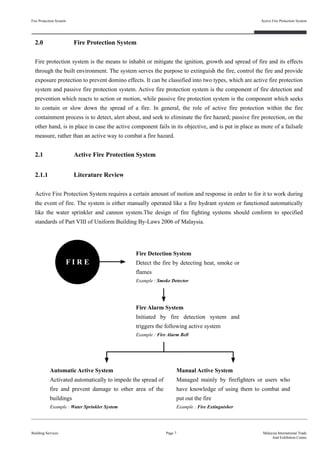
Active Fire Protection System requires a certain amount of motion and response in order to for it to work during
the event of fire. The system is either manually operated like a fire hydrant system or functioned automatically
like the water sprinkler and cannon system.The design of fire fighting systems should conform to specified
standards of Part VIII of Uniform Building By-Laws 2006 of Malaysia.
Fire Detection System
Detect the fire by detecting heat, smoke or
flames
Example : Smoke Detector
Fire Alarm System
Initiated by fire detection system and
triggers the following active system
Example : Fire Alarm Bell
Automatic Active System
Activated automatically to impede the spread of
fire and prevent damage to other area of the
buildings
Example : Water Sprinkler System
Manual Active System
Managed mainly by firefighters or users who
have knowledge of using them to combat and
put out the fire
Example : Fire Extinguisher
F I R E
Fire Protection System
Building Services
Active Fire Protection System
Page 7 Malaysia International Trade
And Exhibition Centre
2.1.2 Water Based System
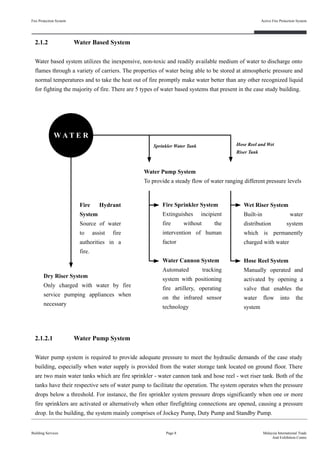
Water based system utilizes the inexpensive, non-toxic and readily available medium of water to discharge onto
flames through a variety of carriers. The properties of water being able to be stored at atmospheric pressure and
normal temperatures and to take the heat out of fire promptly make water better than any other recognized liquid
for fighting the majority of fire. There are 5 types of water based systems that present in the case study building.
Fire Protection System
Building Services
Active Fire Protection System
Page 8 Malaysia International Trade
And Exhibition Centre
Fire Sprinkler System
Extinguishes incipient
fire without the
intervention of human
factor
Water Cannon System
Automated tracking
system with positioning
fire artillery, operating
on the infrared sensor
technology
Dry Riser System
Only charged with water by fire
service pumping appliances when
necessary
W A T E R
Sprinkler Water Tank
Fire Hydrant
System
Source of water
to assist fire
authorities in a
fire.
2.1.2.1 Water Pump System
Water pump system is required to provide adequate pressure to meet the hydraulic demands of the case study
building, especially when water supply is provided from the water storage tank located on ground floor. There
are two main water tanks which are fire sprinkler - water cannon tank and hose reel - wet riser tank. Both of the
tanks have their respective sets of water pump to facilitate the operation. The system operates when the pressure
drops below a threshold. For instance, the fire sprinkler system pressure drops significantly when one or more
fire sprinklers are activated or alternatively when other firefighting connections are opened, causing a pressure
drop. In the building, the system mainly comprises of Jockey Pump, Duty Pump and Standby Pump.
Wet Riser System
Built-in water
distribution system
which is permanently
charged with water
Hose Reel System
Manually operated and
activated by opening a
valve that enables the
water flow into the
system
Water Pump System
To provide a steady flow of water ranging different pressure levels
Hose Reel and Wet
Riser Tank
2.1.2.1.1 Jockey Pump
Jockey pump, also known as a pressure-maintenance pump, is a
relatively small device that works together with the fire pump. It
is designed to keep the pressure in the system elevated to a
specific level when the system is not in use, so that the fire pump
doesn’t have to run all the time. This prevents the sprinklers
from going off unnecessarily. Moreover, since pipes are
susceptible to leakage over time, the water pressure inside them
tends to go down. As soon as the jockey pump senses this, it fills
them back up to normal pressure. Also, it can also help prevent
the system from damage when a fire happens and pressurized
water rushes into the pipes by regulating the pressure. It is
powered by electric supply and is connected directly to the fire
sprinkler water tank.
Fire Protection System
Building Services
Active Fire Protection System
Page 9 Malaysia International Trade
And Exhibition Centre
Jockey Pump
Duty Pump
Standby Pump
Common Suction
Pipe
Common
Discharge Pipe
Figure 2.1 An overview of fire pump system and sprinkler tank
Figure 2.3 EBSRAY Jockey Pump
Figure 2.2 Fire sprinkler tank and wet
riser-hose reel tank
UBBL 1984
Part VIII: Fire Alarms, Fire Detection, Fire Extinguishment and Fire Fighting Access
[ Clause 247 ] Water Storage
(1) Water storage capacity and water flow rate for fire fighting systems and installations shall be
provided in accordance with the scale as set out in the Tenth Schedule to these By-laws.
(2) Main water storage tanks within the building, other than for hose reel systems, shall be
located at ground, first or second basement levels, with fire brigade pumping inlet
connections accessible to fire appliances.
(Uniform Building By-Law, 2006, pp. 87) (Original work published in 1984)
Fire Protection System
Building Services
Active Fire Protection System
Page 10 Malaysia International Trade
And Exhibition Centre
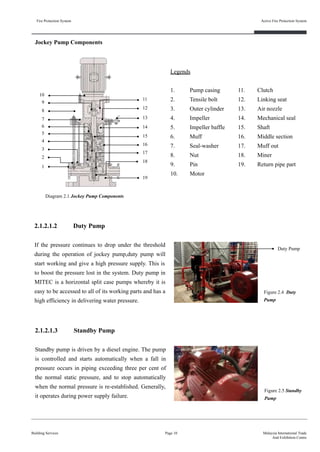
Legends
1. Pump casing
2. Tensile bolt
3. Outer cylinder
4. Impeller
5. Impeller baffle
6. Muff
7. Seal-washer
8. Nut
9. Pin
10. Motor
11. Clutch
12. Linking seat
13. Air nozzle
14. Mechanical seal
15. Shaft
16. Middle section
17. Muff out
18. Miner
19. Return pipe part
Diagram 2.1 Jockey Pump Components
1
2
3
4
5
6
7
8
9
10
11
12
13
14
15
16
17
18
19
2.1.2.1.2 Duty Pump
If the pressure continues to drop under the threshold
during the operation of jockey pump,duty pump will
start working and give a high pressure supply. This is
to boost the pressure lost in the system. Duty pump in
MITEC is a horizontal split case pumps whereby it is
easy to be accessed to all of its working parts and has a
high efficiency in delivering water pressure.
2.1.2.1.3 Standby Pump
Standby pump is driven by a diesel engine. The pump
is controlled and starts automatically when a fall in
pressure occurs in piping exceeding three per cent of
the normal static pressure, and to stop automatically
when the normal pressure is re-established. Generally,
it operates during power supply failure.
Figure 2.4 Duty
Pump
Duty Pump
Figure 2.5 Standby
Pump
Jockey Pump Components
Fire Protection System
Building Services
Active Fire Protection System
Page 11 Malaysia International Trade
And Exhibition Centre
2.1.2.1.4 Pumpset Pressure Indicator
Standby pump is driven by a diesel engine. The pump
is controlled and starts automatically when a fall in
pressure occurs in piping exceeding three per cent of
the normal static pressure, and to stop automatically
when the normal pressure is re-established. Generally,
it operates during power supply failure.
Figure 2.6 Pumpset
Pressure Indicator
2.1.2.1.5 Fire Pump Controller
The fire pump controller is designed to monitor the
operation status and in the case of fire, the controller
will receive a signal from the pressure switch and start
the fire pump. The fire switch in the controller is
passive, requiring no manual operation by the owner.
Water pressure does it all. When the pressure drops,
the normally open contacts close, completing the
electrical circuit and activating the pump.
Figure 2.7 Fire
Pump Controller
UBBL 1984
Part VIII: Fire Alarms, Fire Detection, Fire Extinguishment and Fire Fighting Access
[ Clause 226 ] Automatic System for Hazardous Occupancy
Where hazardous processes, storage or occupancy are of such character as to require automatic
sprinklers or other automatic extinguish fires in the hazardous materials stored or handled or for the
safety of the occupants.
Summary (Fire Pump) :
The water storage tank for both wet riser system and fire sprinkler system meets the UBBL 1984 requirement
listed under Clause 247, (2). The tanks are located on the fire appliance access level for the ease of monitoring.
The automated system including fire pump system, fire sprinkler system and water cannon system meets the
UBBL 1984 requirement listed under Clause 226.
(Uniform Building By-Law, 2006, pp. 82) (Original work published in 1984)
Fire Protection System
Building Services
Active Fire Protection System
Page 12 Malaysia International Trade
And Exhibition Centre
2.1.2.2 Fire Sprinkler System
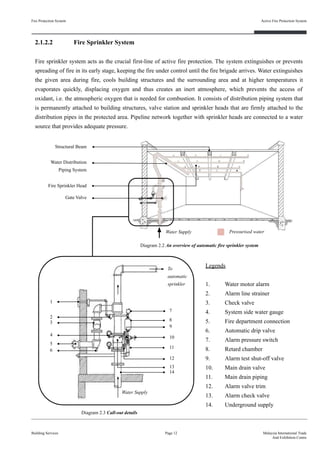
Fire sprinkler system acts as the crucial first-line of active fire protection. The system extinguishes or prevents
spreading of fire in its early stage, keeping the fire under control until the fire brigade arrives. Water extinguishes
the given area during fire, cools building structures and the surrounding area and at higher temperatures it
evaporates quickly, displacing oxygen and thus creates an inert atmosphere, which prevents the access of
oxidant, i.e. the atmospheric oxygen that is needed for combustion. It consists of distribution piping system that
is permanently attached to building structures, valve station and sprinkler heads that are firmly attached to the
distribution pipes in the protected area. Pipeline network together with sprinkler heads are connected to a water
source that provides adequate pressure.
Fire Sprinkler Head
Gate Valve
Water Distribution
Piping System
Structural Beam
Water Supply Pressurised water
Diagram 2.2 An overview of automatic fire sprinkler system
Diagram 2.3 Call-out details
To
automatic
sprinkler
Water Supply
1
2
3
4
5
6
7
8
9
10
11
12
13
14
Legends
1. Water motor alarm
2. Alarm line strainer
3. Check valve
4. System side water gauge
5. Fire department connection
6. Automatic drip valve
7. Alarm pressure switch
8. Retard chamber
9. Alarm test shut-off valve
10. Main drain valve
11. Main drain piping
12. Alarm valve trim
13. Alarm check valve
14. Underground supply
Fire Protection System
Building Services
Active Fire Protection System
Page 13 Malaysia International Trade
And Exhibition Centre
2.1.2.1.1 Sprinkler Head
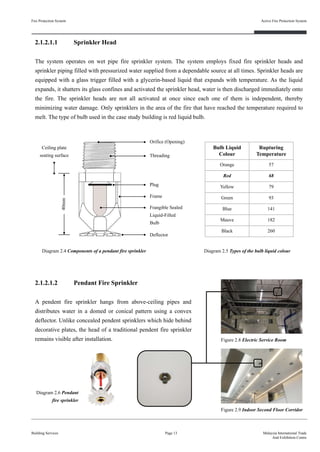
The system operates on wet pipe fire sprinkler system. The system employs fixed fire sprinkler heads and
sprinkler piping filled with pressurized water supplied from a dependable source at all times. Sprinkler heads are
equipped with a glass trigger filled with a glycerin-based liquid that expands with temperature. As the liquid
expands, it shatters its glass confines and activated the sprinkler head, water is then discharged immediately onto
the fire. The sprinkler heads are not all activated at once since each one of them is independent, thereby
minimizing water damage. Only sprinklers in the area of the fire that have reached the temperature required to
melt. The type of bulb used in the case study building is red liquid bulb.
Bulb Liquid
Colour
Rupturing
Temperature
Orange 57
Red 68
Yellow 79
Green 93
Blue 141
Mauve 182
Black 260
40mm
Ceiling plate
seating surface
Orifice (Opening)
Threading
Plug
Frangible Sealed
Liquid-Filled
Bulb
Frame
Deflector
Diagram 2.4 Components of a pendant fire sprinkler Diagram 2.5 Types of the bulb liquid colour
2.1.2.1.2 Pendant Fire Sprinkler
A pendent fire sprinkler hangs from above-ceiling pipes and
distributes water in a domed or conical pattern using a convex
deflector. Unlike concealed pendent sprinklers which hide behind
decorative plates, the head of a traditional pendent fire sprinkler
remains visible after installation. Figure 2.8 Electric Service Room
Figure 2.9 Indoor Second Floor Corridor
Diagram 2.6 Pendant
fire sprinkler
Fire Protection System
Building Services
Active Fire Protection System
Page 14 Malaysia International Trade
And Exhibition Centre
Figure 2.10 First Floor Loading Bay
Diagram 2.7 Upright
fire sprinkler
Figure 2.11 Basement Level 1
2.1.2.1.4 Alarm Valve System
These sprinkler heads are attached to a reliable system of water pipes that are typically built into the walls or
ceiling. Beneath the sprinkler heads, a valve keeps the water from leaking out. When the sprinkler head is
triggered, the valve is opened and pressurized water is released from the pipe system. It’s important for water in
a fire sprinkler system to be pressurized. This allows the water to spray outward in an arc to more thoroughly
douse the fire and prevent it from reigniting.The alarm check valve is a key component of the wet pipe system. It
is designed to indicate when a sprinkler has operated as well as to provide a system check valve. The alarm
check valve serves as a check valve by holding the pressurized water above the clapper and preventing reverse
flow from the sprinkler piping. The valve initiates an alarm during a sustained flow of water by operating a water
motor alarm and alarm pressure switch. When it is installed with the water motor alarm, the system can provide
a local alarm even when electric power is lost.
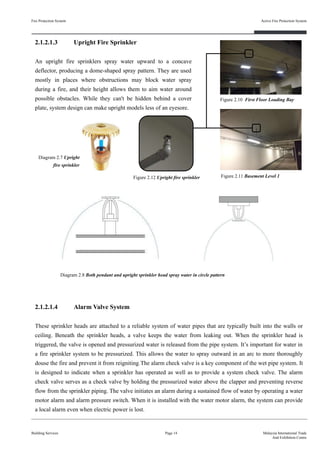
Diagram 2.8 Both pendant and upright sprinkler head spray water in circle pattern
2.1.2.1.3 Upright Fire Sprinkler
An upright fire sprinklers spray water upward to a concave
deflector, producing a dome-shaped spray pattern. They are used
mostly in places where obstructions may block water spray
during a fire, and their height allows them to aim water around
possible obstacles. While they can't be hidden behind a cover
plate, system design can make upright models less of an eyesore.
Figure 2.12 Upright fire sprinkler
Fire Protection System
Building Services
Active Fire Protection System
Page 15 Malaysia International Trade
And Exhibition Centre
1
2 3
4
5
6
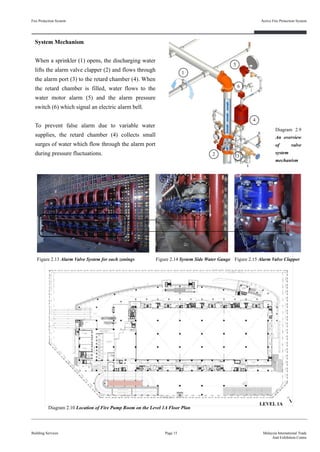
System Mechanism
When a sprinkler (1) opens, the discharging water
lifts the alarm valve clapper (2) and flows through
the alarm port (3) to the retard chamber (4). When
the retard chamber is filled, water flows to the
water motor alarm (5) and the alarm pressure
switch (6) which signal an electric alarm bell.
To prevent false alarm due to variable water
supplies, the retard chamber (4) collects small
surges of water which flow through the alarm port
during pressure fluctuations.
Diagram 2.9
An overview
of valve
system
mechanism
Figure 2.13 Alarm Valve System for each zonings Figure 2.14 System Side Water Gauge Figure 2.15 Alarm Valve Clapper
Diagram 2.10 Location of Fire Pump Room on the Level 1A Floor Plan
LEVEL 1A
Fire Protection System
Building Services
Active Fire Protection System
Page 16 Malaysia International Trade
And Exhibition Centre
UBBL 1984
Part VIII: Fire Alarms, Fire Detection, Fire Extinguishment and Fire Fighting Access
[ Clause 228 ] Sprinkler Valves
(1) Sprinkler valves shall be located in a safe and enclosed position on the exterior wall and
shall be readily accessible to the Fire Authority
(2) All sprinkler system shall be electricity connected to the nearest fire station to provide
immediate and automatic relay of the alarm when activated.
Summary (Fire Sprinkler System) :
The fire sprinkler system in MITEC meets the UBBL 1984 requirements listed under clause 228, (1) and (2). In
Figure 2.13, the sprinkler alarm valve system is placed along the exterior wall of the fire pump room located at
ground floor. This allow ease of monitoring during the event of fire even without access into the fire pump room.
Also, it is connected to the fire alarm system which is directly linked to the nearest fire station through the fire
control panel.
2.1.2.3 Water Cannon System
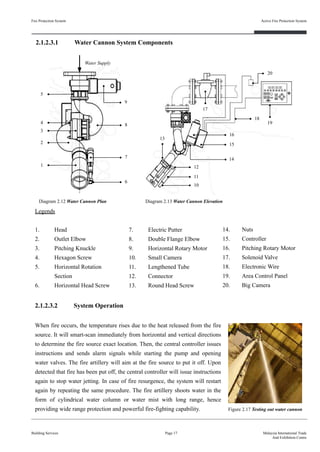
There are 12 water cannons located at level 3 in the largest exhibition
pillar-less hall. The water cannon system employed in MITEC is an
automatic tracking technology with mechanized positioning fire
artillery, combining the infrared sensor technology. The signal
processing technology, communication control technology, computer
technology and mechanical driven technology work together effectively.
It is exceptionally suitable for tall and big space like the pillar-less hall. Figure 2.16 Water Cannon System
Diagram 2.11 Location of Pillar-less Exhibition Hall where the water cannon system is located
(Uniform Building By-Law, 2006, pp. 82) (Original work published in 1984)
SECTION B-B’
Fire Protection System
Building Services
Active Fire Protection System
Page 17 Malaysia International Trade
And Exhibition Centre
2.1.2.3.1 Water Cannon System Components
1
2
3
4
5
6
7
8
9
10
11
12
13
14
15
16
18
17
20
19
Legends
1. Head
2. Outlet Elbow
3. Pitching Knuckle
4. Hexagon Screw
5. Horizontal Rotation
Section
6. Horizontal Head Screw
14. Nuts
15. Controller
16. Pitching Rotary Motor
17. Solenoid Valve
18. Electronic Wire
19. Area Control Panel
20. Big Camera
7. Electric Putter
8. Double Flange Elbow
9. Horizontal Rotary Motor
10. Small Camera
11. Lengthened Tube
12. Connector
13. Round Head Screw
Diagram 2.12 Water Cannon Plan Diagram 2.13 Water Cannon Elevation
Water Supply
2.1.2.3.2 System Operation
When fire occurs, the temperature rises due to the heat released from the fire
source. It will smart-scan immediately from horizontal and vertical directions
to determine the fire source exact location. Then, the central controller issues
instructions and sends alarm signals while starting the pump and opening
water valves. The fire artillery will aim at the fire source to put it off. Upon
detected that fire has been put off, the central controller will issue instructions
again to stop water jetting. In case of fire resurgence, the system will restart
again by repeating the same procedure. The fire artillery shoots water in the
form of cylindrical water column or water mist with long range, hence
providing wide range protection and powerful fire-fighting capability. Figure 2.17 Testing out water cannon
Fire Protection System
Building Services
Active Fire Protection System
Page 18 Malaysia International Trade
And Exhibition Centre
2.1.2.4 Wet Riser System
MITEC has a height of 63 metres above the fire appliance access level therefore wet riser system is installed to
supply pressurized water within buildings for firefighting purposes. The wet rise system in MITEC consists of a
wet riser main, a wet riser landing valve and a hose cradle. Some of the system are being recessed in the wall
located in a cabinet clearly labelled ‘Sesalur Basah’ on a red panel, which means ‘wet riser’ when being direct
translated into English language.
UBBL 1984
Part VIII: Fire Alarms, Fire Detection, Fire Extinguishment and Fire Fighting Access
[ Clause 231 ] Installation and testing of wet rising system
(1) Wet rising systems shall be provided in every building in which the topmost floor is more
than 30.5 metres above fire appliance access level.
[ Clause 248 ] Markings on wet riser, etc.
(1) Wet riser, dry riser, sprinkler and other fire installation pipes and fittings shall be painted
red.
(2) All cabinets and areas recessed in walls for location of fire installations and extinguishers
shall be clearly identified to the satisfaction of the Fire Authority or otherwise clearly
identified.
Figure 2.18 Wet Riser System
Wet Riser
Main
Wet Riser
Landing Valve
Canvas Hose
Hose Cradle
Figure 2.19 Wet riser system that located in the wall
(Uniform Building By-Law, 2006, pp. 84, 87) (Original work published in 1984)
Fire Protection System
Building Services
Active Fire Protection System
Page 19 Malaysia International Trade
And Exhibition Centre
2.1.2.4.2 Wet Riser Landing Valve
Landing valves which are 65mm in diameter, connecting directly to
the wet riser main, serve as the main water supply to fire department
to the upper floors in MITEC whereas fire hydrants serve as the
water source on the ground level. It functions as a water tab whereby
it is to connect the canvas hose to access to the water source on the
upper levels for fire-fighting. The valves are equipped with a
coupling adapter which is directly screwed to the outlet and
stoppered with a cap.
2.1.2.4.1 Wet Riser Main and Air Vent
Wet fire mains are 150mm in diameter and are installed owing to the
pressures required to provide adequate fire-fighting water supplies at
the landing valves at upper floors and also to ensure that water is
immediately available at all floor levels. The provision of a built-in
water distribution system means that firefighters do not need to
create their own distribution system in order to fight a fire and
avoids the breaching of fire compartments by running hose lines
between them.
2.1.2.4.3 Canvas Hose and Hose Cradle
Hose Cradle and Canvas Hose of brand ‘Proflex’ is used in MITEC.
The canvas hose has a length of 30 metres and 65mm in diameter. It
is connected to a faucet and placed on a hose cradle nearby the
landing valve. The hose has no all-time water supply like hose reel
system.
Figure 2.20 Wet riser main
Outlet Coupling Adapter
Figure 2.22 Landing Valves on the top floor
UBBL 1984
Part VIII: Fire Alarms, Fire Detection, Fire Extinguishment and Fire Fighting Access
[ Clause 231 ] Installation and testing of wet rising system
(4) Each wet risers outlet shall comprise standard 63.5 millimeters instantaneous coupling fitted
with a hose of not less than 38.1 millimeters diameter equipped with an approved typed
cradle and a variable fog nozzle.
Figure 2.23 Canvas hose placed on the cradle
Figure 2.21 Air Vent
(Uniform Building By-Law, 2006, pp. 84) (Original work published in 1984)
Fire Protection System
Building Services
Active Fire Protection System
Page 20 Malaysia International Trade
And Exhibition Centre
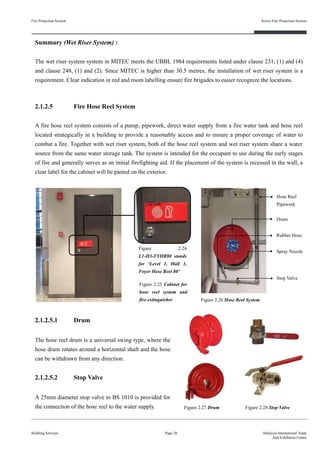
2.1.2.5 Fire Hose Reel System
A fire hose reel system consists of a pump, pipework, direct water supply from a fire water tank and hose reel
located strategically in a building to provide a reasonably access and to ensure a proper coverage of water to
combat a fire. Together with wet riser system, both of the hose reel system and wet riser system share a water
source from the same water storage tank. The system is intended for the occupant to use during the early stages
of fire and generally serves as an initial firefighting aid. If the placement of the system is recessed in the wall, a
clear label for the cabinet will be pasted on the exterior.
Figure 2.26 Hose Reel System
Figure 2.24
L1-H3-FYHR80 stands
for ‘Level 1, Hall 3,
Foyer Hose Reel 80’
Figure 2.25 Cabinet for
hose reel system and
fire extinguisher
Hose Reel
Pipework
Drum
Rubber Hose
Spray Nozzle
Stop Valve
2.1.2.5.1 Drum
The hose reel drum is a universal swing type, where the
hose drum rotates around a horizontal shaft and the hose
can be withdrawn from any direction.
2.1.2.5.2 Stop Valve
A 25mm diameter stop valve to BS 1010 is provided for
the connection of the hose reel to the water supply. Figure 2.27 Drum Figure 2.28 Stop Valve
Summary (Wet Riser System) :
The wet riser system system in MITEC meets the UBBL 1984 requirements listed under clause 231, (1) and (4)
and clause 248, (1) and (2). Since MITEC is higher than 30.5 metres, the installation of wet riser system is a
requirement. Clear indication in red and room labelling ensure fire brigades to easier recognize the locations.
Fire Protection System
Building Services
Active Fire Protection System
Page 21 Malaysia International Trade
And Exhibition Centre
2.1.2.5.5 System Operation
The system is manually operated and activated by opening the stop valve, enabling the water to flow into the
hose that is 30 meters long. The system pressure loss will activate the pump, ensuring adequate water flow and
pressure to provide a water jet of a minimum of 10 meter from the nozzle (0.33L of water per second). The
nozzle attached to the hose enables the operator to control the direction and flow of water to the fire.
Turn water on to the hose reel
by operating the control valve
and remove the nozzle from its
bracket.
Direct the water at the base of
the flames and extinguish the
fire by using a sweeping
action.
Proceed to a safe distance
from the fire and turn the
water on by operating the
nozzle.
UBBL 1984
Part VIII: Fire Alarms, Fire Detection, Fire Extinguishment and Fire Fighting Access
[ Clause 231 ] Installation and testing of wet rising system
(2) A hose connection shall be provided in each fire fighting access lobby
2.1.2.5.3 Spray Nozzle
The shut-off nozzle assembly which is fitted at the end
of the hose is constructed of corrosion resistant material.
There are markings to indicate the open/shut positions of
the nozzle.
2.1.2.5.4 Rubber Hose
The fire hose reel is made of non-kinking, braided
rubber type and the length of the hose is 30 meter. Figure 2.30 Spray NozzleFigure 2.29 Rubber Hose
(Uniform Building By-Law, 2006, pp. 84) (Original work published in 1984)
Fire Protection System
Building Services
Active Fire Protection System
Page 22 Malaysia International Trade
And Exhibition Centre
2.1.2.6 Dry Riser System
Dry riser system is empty and is only filled with water by fire fighters when they arrive. Fire fighters will
connect the pump outlet in one of their appliances to the dry riser inlet located at fire appliance access level. The
system in MITEC consists of an empty pipe of a diameter of 150mm running up the inside of a building which
can be connected to by firefighters. Water is then drawn from the nearest public fire hydrant and this is
pressurised by the fire pump to provide water at the correct flow and pressure for fire fighting operations at the
relevant upper floor level.
Summary (Fire Hose Reel System) :
The fire hose reel system in MITEC meets the UBBL 1984 requirements listed under clause 231, (2). Each fire
lobbies is provided with the system, clearly indicated with numbering system.
UBBL 1984
Part VIII: Fire Alarms, Fire Detection, Fire Extinguishment and Fire Fighting Access
[ Clause 230 ] Installation and testing of dry rising system
(1) Dry rising systems shall be provided in every building in which the topmost floor is more
than 18.3 metres but less than 30.5 metres above fire appliance access level.
Figure 2.32
Dry Riser
Inlet
Figure 2.31
Dry Riser
Outlet
Air Vent
External Wall
Summary (Dry Riser System) :
The dry riser system in MITEC meets the UBBL 1984 requirements listed under clause 230, (1) whereby
MITEC is provided with the system since it is more than 18.3 metres from the fire appliance access level
(Uniform Building By-Law, 2006, pp. 83) (Original work published in 1984)
Fire Protection System
Building Services
Active Fire Protection System
Page 23 Malaysia International Trade
And Exhibition Centre
2.1.2.7 Fire Hydrant System
A fire hydrant system is a water supply with a sufficient
pressure and flow delivered through pipes throughout a
building to strategically located network of valves for
fire-fighting purposes. Two way fire hydrant installation
in MITEC consists of a system of pipe work connected
directly to the water supply main to provide water to each
and every hydrant outlet and is intended to provide water
for the firemen to fight a fire. Where the water supply is
not reliable or inadequate, hydrant pumps are provided to
pressurize the fire mains. A firefighter connects a fire hose
to the fire hydrant and releases a valve to get water from
the water main. The fire hydrants are designed to allow
250 gallons of water to flow through the hydrant per
minute.
Body Material : Cast Iron to BS 1452
Outlet : Copper alloy BS 1400
Test Pressure : 30 bar (435 Psi)
Working Pressure : 20 bar (290 Psi)
Finishing : Yellow painting
Private hydrant
Figure 2.33 Fire Hydrant located at staff car park
UBBL 1984
Part VIII: Fire Alarms, Fire Detection, Fire Extinguishment and Fire Fighting Access
[ Section 225 ] Detecting and extinguishing fire
(3) Depending on the size and location of the building and the provision of access for
appliances, additional fire hydrant shall be provided as may be required by the Fire
Authority.
Summary (Fire Hydrant System) :
The external fire hydrant system in MITEC meets the UBBL 1984 requirements listed under Section 225, (3)
whereby they are placed around the perimeter of the building to provide immediate access for the fire brigades
during the event of fire.
(Uniform Building By-Law, 2006, pp. 82) (Original work published in 1984)
2.1.3 Non-Water Based System
Non-water fire suppression system is a fire suppression mechanism which works on putting the fire out without
using water-based agents. A common belief among the people is that the best way to fight fire is by using water.
But that is not the case, as not all fires can be dozed out using water. There are many cases where a standard
water-based fire protection system cannot and will not protect the building in the event of a fire. For instances
where you are fighting electrical fires, certain chemicals, metals, or flammable materials less dense than water
you need a specialty system to extinguish fires. In fact, most of the time water can cause more damage than
damage-controlling.
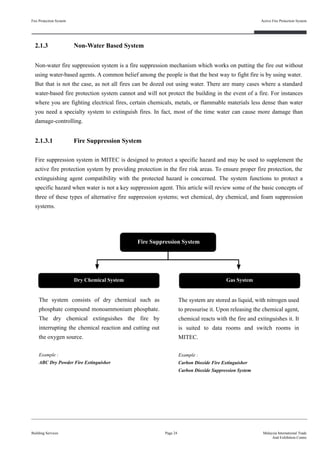
2.1.3.1 Fire Suppression System
Fire suppression system in MITEC is designed to protect a specific hazard and may be used to supplement the
active fire protection system by providing protection in the fire risk areas. To ensure proper fire protection, the
extinguishing agent compatibility with the protected hazard is concerned. The system functions to protect a
specific hazard when water is not a key suppression agent. This article will review some of the basic concepts of
three of these types of alternative fire suppression systems; wet chemical, dry chemical, and foam suppression
systems.
Fire Protection System
Building Services
Active Fire Protection System
Page 24 Malaysia International Trade
And Exhibition Centre
Fire Suppression System
The system consists of dry chemical such as
phosphate compound monoammonium phosphate.
The dry chemical extinguishes the fire by
interrupting the chemical reaction and cutting out
the oxygen source.
Example :
ABC Dry Powder Fire Extinguisher
Dry Chemical System Gas System
The system are stored as liquid, with nitrogen used
to pressurise it. Upon releasing the chemical agent,
chemical reacts with the fire and extinguishes it. It
is suited to data rooms and switch rooms in
MITEC.
Example :
Carbon Dioxide Fire Extinguisher
Carbon Dioxide Suppression System
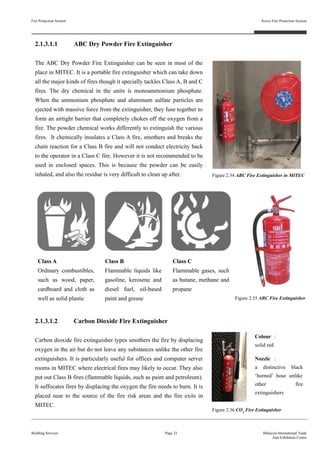
2.1.3.1.1 ABC Dry Powder Fire Extinguisher
The ABC Dry Powder Fire Extinguisher can be seen in most of the
place in MITEC. It is a portable fire extinguisher which can take down
all the major kinds of fires though it specially tackles Class A, B and C
fires. The dry chemical in the units is monoammonium phosphate.
When the ammonium phosphate and aluminum sulfate particles are
ejected with massive force from the extinguisher, they fuse together to
form an airtight barrier that completely chokes off the oxygen from a
fire. The powder chemical works differently to extinguish the various
fires. It chemically insulates a Class A fire, smothers and breaks the
chain reaction for a Class B fire and will not conduct electricity back
to the operator in a Class C fire. However it is not recommended to be
used in enclosed spaces. This is because the powder can be easily
inhaled, and also the residue is very difficult to clean up after.
Class C
Flammable gases, such
as butane, methane and
propane
Figure 2.34 ABC Fire Extinguisher in MITEC
Class A
Ordinary combustibles,
such as wood, paper,
cardboard and cloth as
well as solid plastic
Class B
Flammable liquids like
gasoline, kerosene and
diesel fuel, oil-based
paint and grease Figure 2.35 ABC Fire Extinguisher
2.1.3.1.2 Carbon Dioxide Fire Extinguisher
Carbon dioxide fire extinguisher types smothers the fire by displacing
oxygen in the air but do not leave any substances unlike the other fire
extinguishers. It is particularly useful for offices and computer server
rooms in MITEC where electrical fires may likely to occur. They also
put out Class B fires (flammable liquids, such as paint and petroleum).
It suffocates fires by displacing the oxygen the fire needs to burn. It is
placed near to the source of the fire risk areas and the fire exits in
MITEC.
Colour :
solid red
Nozzle :
a distinctive black
‘horned’ hose unlike
other fire
extinguishers
Figure 2.36 CO2
Fire Extinguisher
Fire Protection System
Building Services
Active Fire Protection System
Page 25 Malaysia International Trade
And Exhibition Centre
2.1.3.1.3 Carbon Dioxide Suppression System
Carbon dioxide (CO2) is a colorless, odorless, and chemically inert gas that is both readily available and
electrically non-conductive that leaves no residue behind. This means any sensitive equipment that is in the
protected space is not damaged by the CO2, which reduces downtime and costs. Once the CO2 has dispersed to
safe levels from the protected space, personnel can access any damage from the fire or smoke and quickly get
back to work with no cleanup needed. It extinguishes fire primarily by lowering the level of oxygen that supports
combustion. This mechanism of fire suppression is highly effective, requiring minimal clean-up and is used in
normally unoccupied hazard locations or otherwise avoided by personnel when discharged. In MITEC, each
electrical room has an carbon dioxide suppression system.
Fire Protection System
Building Services
Active Fire Protection System
Page 26 Malaysia International Trade
And Exhibition Centre
Diagram 2.14 System Operation Overview
UBBL 1984
Part VIII: Fire Alarms, Fire Detection, Fire Extinguishment and Fire Fighting Access
[ Section 227 ] Portable Extinguishers
Portable extinguisher shall be provided in accordance with the relevant codes of practice and shall
be sited in prominent positions on exit routes to be visible from all directions and similar
extinguishers in a building shall be of the same method of operation.
Summary (Fire Extinguisher) :
The fire extinguishers system in MITEC meets the UBBL 1984 requirements listed under Section 227, (3). The
fire extinguishers are strategically placed at many locations to be easily accessible by users in the building
during the event of fire.
System Operation
A carbon dioxide fire suppression system eliminates the oxygen to
suppress the fire. The system is equipped with a smoke and heat
detector which will trigger the alarm system and send signal to the fire
control room through the fire control panel upon detecting smoke and
temperature rise. It then releases the carbon dioxide agent into the space
it is protecting. After 30 seconds, all the gas inside will be discharged
through piping, leaving only carbon dioxide inside with the fire curtain
opened and smoke damper closed. The drop in oxygen level quickly
causes the fire to be suppressed or extinguished. On the control panel
outside, if green light lights up, it means that personnel is free to enter
the room whereas if the red light lights up, it means that the carbon
dioxide agent is being discharged and the room cannot be entered.
Extinguishing
Agent
Control
Panel
Detector
Nozzle
(Uniform Building By-Law, 2006, pp. 82) (Original work published in 1984)
Fire Protection System
Building Services
Active Fire Protection System
Page 27 Malaysia International Trade
And Exhibition Centre
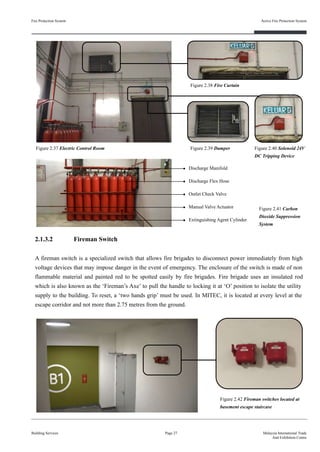
Figure 2.38 Fire Curtain
Figure 2.39 Damper Figure 2.40 Solenoid 24V
DC Tripping Device
Figure 2.37 Electric Control Room
Discharge Flex Hose
Outlet Check Valve
Discharge Manifold
Manual Valve Actuator
Extinguishing Agent Cylinder
Figure 2.41 Carbon
Dioxide Suppression
System
2.1.3.2 Fireman Switch
A fireman switch is a specialized switch that allows fire brigades to disconnect power immediately from high
voltage devices that may impose danger in the event of emergency. The enclosure of the switch is made of non
flammable material and painted red to be spotted easily by fire brigades. Fire brigade uses an insulated rod
which is also known as the ‘Fireman’s Axe’ to pull the handle to locking it at ‘O’ position to isolate the utility
supply to the building. To reset, a ‘two hands grip’ must be used. In MITEC, it is located at every level at the
escape corridor and not more than 2.75 metres from the ground.
Figure 2.42 Fireman switches located at
basement escape staircase
Fire Protection System
Building Services
Active Fire Protection System
Page 28 Malaysia International Trade
And Exhibition Centre
2.1.3.3 Voice Communication System
It is a two-way emergency communication system
connecting fireman intercoms located throughout the
building and a master telephone handset is located in the
fire control room. The fireman intercom handset is being
placed behind a locked door, housed within a red metal
cabinet and rested on a cradle. Lifting the handset from the
cradle will cause the buzzer to sound and light a ‘common
call’ indicator. A maximum call of 7 RFIS and master
handsets can communicate simultaneously.
Figure 2.43 Fireman Intercom located at basement escape
staircase (left) and fire pump room
UBBL 1984
Part VIII: Fire Alarms, Fire Detection, Fire Extinguishment and Fire Fighting Access
[ Section 239 ] Voice Communication System
There shall be two separate approved continuously electrically supervised voice communications
systems, one a fire brigade communications system and the other a public address system between
the central control station and the following areas :
(a) Lifts, lift lobbies, corridors and staircases;
(b) In every office area exceeding 92.9 square metres in area;
(c) In each dwelling unit and hotel guest room where the fire brigade system may be combined
with the public address system.
Summary (Voice Communication System) :
The voice communication system in MITEC meets the UBBL 1984 requirements listed under Section 239. The
two-way communication system ensures the connection between the master handset in the fire control room and
the remote fireman corridor. This allows efficient communication in the event of fire or emergency.
2.1.3.4 Emergency Speaker
The emergency speaker is a network of monitored loud speakers.
The speakers are distributed throughout MITEC to ensure warning
messages and tones satisfy a specific sound pressure level
(volume) and are distinctly audible throughout all required areas
of the building. Also, it ensures warning messages are intelligible
and clearly understood by the occupants.
Figure 2.44
Emergency
Speaker
(Uniform Building By-Law, 2006, pp. 85) (Original work published in 1984)
Fire Protection System
Building Services
Active Fire Protection System
Page 29 Malaysia International Trade
And Exhibition Centre
2.1.3.5 Emergency Light
An emergency light is a battery-backed lighting device that
switches on automatically when a building experiences a
power outage. During an event of emergency, it is used to
illuminate the access pathways leading to the exits, fire
staircase, aisles, corridors, ramps and at the exit discharge
pathways towards public area. The level of illumination and
quality consistency of emergency illumination are the crucial
factors to the safety occupants during evacuation.
UBBL 1984
Part VIII: Fire Alarms, Fire Detection, Fire Extinguishment and Fire Fighting Access
[ Section 253 ] Emergency power system
(1) Emergency power system shall be provided to supply illumination and power automatically
in the vent of failure of the normal supply or in the event of accident to elements of the
system supplying power and illumination essential for safety of life and property.
(5) Current supply shall be such that in the event of failure of the normal supply to or within the
buildings concerned, the emergency lighting or emergency power, or both emergency
lighting and power will be available within 10 seconds of the interruption of the normal
supply. The supply system for emergency purposes shall comprise one of the following
approved types:
(a) Storage Battery
Storage Battery of suitable rating and capacity to supply and maintain at not less
than 871/2 percent of the system voltage the total of the circuits supplying
emergency lighting and emergency power for a period of at least 11/2 hours;
(b) Generator set
A generator set driven by some form of prime mover and of sufficient capacity and
proper rating to supply circuit carrying emergency lighting or lighting and power
with suitable means for automatically starting the prime mover on failure on the
normal service.
Summary (Emergency Light) :
The emergency light system in MITEC meets the UBBL 1984 requirements listed under Section 253, (1) and (5).
The emergency lights are well-maintained and equipped with storage battery to ensure proper lighting during the
event of emergency.
Figure 2.45 Emergency light
(Uniform Building By-Law, 2006, pp. 88) (Original work published in 1984)
2.1.5 Fire Detection System
A Fire Detection System (FDS) is an alarm system that receives data on, assesses and then responds to event
reported by various detector which usually consists of smoke detector, heat detector and damper which play a
significant role in protecting the the safety of emergency personnel. Fire Detection System are permanently
installed manual and automatic systems to detect fires at the earliest stage, warn those affected and quickly
inform the relevant emergency service. A properly installed and maintained Fire Detection System commit to
save lives and largely reduces building property damage. To be useful, fire detection system should work with
fire alarm system to become a life-safety system which ensure a rapid detection of fire.
Fire Protection System
Building Services
Active Fire Protection System
Page 30 Malaysia International Trade
And Exhibition Centre
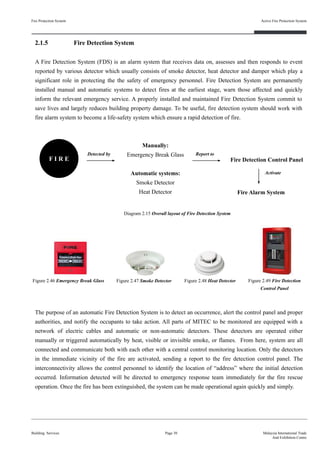
F I R E
Manually:
Emergency Break Glass
Automatic systems:
Smoke Detector
Heat Detector
Fire Detection Control Panel
Fire Alarm System
Detected by Report to
Activate
Figure 2.46 Emergency Break Glass Figure 2.47 Smoke Detector Figure 2.48 Heat Detector Figure 2.49 Fire Detection
Control Panel
The purpose of an automatic Fire Detection System is to detect an occurrence, alert the control panel and proper
authorities, and notify the occupants to take action. All parts of MITEC to be monitored are equipped with a
network of electric cables and automatic or non-automatic detectors. These detectors are operated either
manually or triggered automatically by heat, visible or invisible smoke, or flames. From here, system are all
connected and communicate both with each other with a central control monitoring location. Only the detectors
in the immediate vicinity of the fire are activated, sending a report to the fire detection control panel. The
interconnectivity allows the control personnel to identify the location of “address” where the initial detection
occurred. Information detected will be directed to emergency response team immediately for the fire rescue
operation. Once the fire has been extinguished, the system can be made operational again quickly and simply.
Diagram 2.15 Overall layout of Fire Detection System
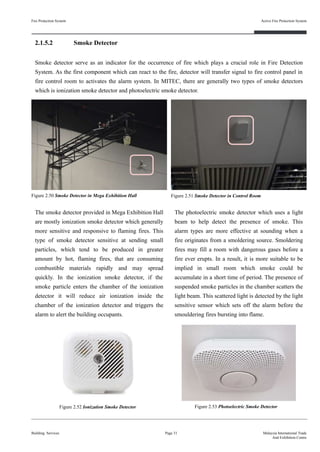
2.1.5.2 Smoke Detector
Smoke detector serve as an indicator for the occurrence of fire which plays a crucial role in Fire Detection
System. As the first component which can react to the fire, detector will transfer signal to fire control panel in
fire control room to activates the alarm system. In MITEC, there are generally two types of smoke detectors
which is ionization smoke detector and photoelectric smoke detector.
Fire Protection System
Building Services
Active Fire Protection System
Page 31 Malaysia International Trade
And Exhibition Centre
Figure 2.50 Smoke Detector in Mega Exhibition Hall Figure 2.51 Smoke Detector in Control Room
The smoke detector provided in Mega Exhibition Hall
are mostly ionization smoke detector which generally
more sensitive and responsive to flaming fires. This
type of smoke detector sensitive at sending small
particles, which tend to be produced in greater
amount by hot, flaming fires, that are consuming
combustible materials rapidly and may spread
quickly. In the ionization smoke detector, if the
smoke particle enters the chamber of the ionization
detector it will reduce air ionization inside the
chamber of the ionization detector and triggers the
alarm to alert the building occupants.
The photoelectric smoke detector which uses a light
beam to help detect the presence of smoke. This
alarm types are more effective at sounding when a
fire originates from a smoldering source. Smoldering
fires may fill a room with dangerous gases before a
fire ever erupts. In a result, it is more suitable to be
implied in small room which smoke could be
accumulate in a short time of period. The presence of
suspended smoke particles in the chamber scatters the
light beam. This scattered light is detected by the light
sensitive sensor which sets off the alarm before the
smouldering fires bursting into flame.
Figure 2.52 Ionization Smoke Detector Figure 2.53 Photoelectric Smoke Detector
Fire Protection System
Building Services
Active Fire Protection System
Page 32 Malaysia International Trade
And Exhibition Centre
Figure 2.54 Heat Detector on ceiling of ground floor
Figure 2.56 Heat Detector in MITEC
2.1.5.3 Heat Detector
Heat Detector is a fire alarm device which designed to respond with sudden thermal changes or high temperature
from fire hazards around the installation area. Heat detector usually has a lower false alarm rate but it is slower
than smoke detector in detecting fires. In general, there are two types of heat detectors which are fixed
temperature heat detector and rate-of-rise heat detector.
Fixed Temperature Heat Detector:
Operate when the ambient temperature increases sufficiently to predetermined level where the heat detector will
operate. The heat is accumulated at the sensitive element due to a thermal lag. This causes the temperature of the
device to reach its operating temperature a while after the surrounding air temperature exceeds the device
temperature. When this happens, the detector is activated and an alarm is sounded.
Rate-of-rise Heat Detector (ROR):
ROR heat detectors may not respond to slowly developing fires. In order to detect slowly developing fires,
usually a fixed temperature element is added to the ROR detector which will be activated when the element
reaches the pre-set threshold temperature then triggered the alarm system.
Figure 2.55 Heat Detector on ceiling of ground floor
Addressable heat detector provided in MITEC are installed in concourse
are on ground floor and Mega Exhibition Hall. Heat detectors have a
common profile with photoelectric and ionization smoke detectors but
have a lower air flow resistance case made of self-extinguishing white
polycarbonate.
Fire detected on slow increase
of ambient temperature
Fire detected on fast increase
of ambient temperature
Thermistor partially
sealed from
surrounding air
Thermistor partially
exposed to air
Diagram 2.16 Normal conditions heat detector Diagram 2.17 Fixed Temperature heat detector Diagram 2.18 ROR heat detector
Fire Protection System
Building Services
Active Fire Protection System
Page 33 Malaysia International Trade
And Exhibition Centre
UBBL 1984
Part VII: Fire Requirements
[ Section 153 ] Smoke detectors for lift lobbies
(1) All life lobbies shall be provided with smoke detectors.
(2) Lift not opening into a smoke lobby shall not use door reopening devices controlled by light
beam or photodetectors unless incorporated with a force close feature which after thirty
seconds of any interruption of the beam cause the door to close within a preset time.
Part VIII: Fire Alarms, Fire Detection, Fire Extinguishment and Fire Fighting Access
[ Section 225 ] Detecting and extinguishing fire
(1) Every building shall be provided with means of detecting and extinguishing fire and with
fire alarms together with illuminated exit signs in accordance with the requirements as
specified in the Tenth Schedule to these By-laws.
(Uniform Building By-Law, 2006, pp. 58, 82) (Original work published in 1984)
Summary (Smoke Detector) :
Smoke detectors and heat detectors in MITEC does fulfill the requirements stated in By-laws under Section 153
and Section 225. Both of the detector are installed on the ceiling level of the lift lobbies area in every floor to
detect fire hazard. They work together with fire alarm bell can be remotely controlled from the fire control room
as well.
Figure 2.57 Smoke and heat detectors in lift lobby
Smoke Detector
Heat Detector
2.1.4 Fire Alarm System
A fire alarm system has a number of devices working together to detect and warn people through visual and
audio appliances when smoke, fire, carbon monoxide or other emergencies are present. These alarms may be
activated automatically from smoke detectors, and heat detectors or may also be activated via manual fire alarm
activation devices such as manual call points or pull stations.
2.1.4.1 Fire Alarm Control Panel
A fire alarm control panel (FACP), fire alarm control unit (FACU), or simply fire alarm panel is the controlling
component of a fire alarm system. The panel receives information from devices designed to detect and report
fires, monitors their operational integrity and provides for automatic control of equipment, and transmission of
information necessary to prepare the facility for fire based on a predetermined sequence. The panel may also
supply electrical energy to operate any associated initiating device, notification appliance, control, transmitter, or
relay. There are four basic types of panels: coded panels, conventional panels, addressable panels, and multiplex
systems.
Fire Protection System
Building Services
Active Fire Protection System
Page 34 Malaysia International Trade
And Exhibition Centre
Diagram 2.20 Programme of type of system and hazards
Activate a Pre-discharge
Alarm
Initiate Agent Release
Shut Down Ventilation
System
Notify Emergency
Response Personnel
Activate Visual and
Audible Fire Alarm
Shut Down Machinery
Equipment
Diagram 2.19 Diagram of Alarm Control Panel Figure 2.58 Fire Alarm Control Panel
Fire Protection System
Building Services
Active Fire Protection System
Page 35 Malaysia International Trade
And Exhibition Centre
UBBL 1984
Part VII: Fire Requirements Fighting Access
[ Section 237 ] Fire Mode of Operation
(1) The fire mode of operation shall be initiated by a signal from the fire alarm panel which
may be activated automatically by one of the alarm devices in the building or manually
Summary (Fire Alarm Control Panel) :
The Fire Alarm Control Panel in MITEC complies with the UBBL 1984 requirements listed under Section
155(1). The fire alarm control panel is equipped with fire mimic diagram for each floor in the building to allow
efficient signal identification during fire emergency
(Uniform Building By-Law, 2006, pp. 85) (Original work published in 1984)
2.1.4.1 Fire Alarm Bell
A fire alarm is an electronic sounder or a bell. The alarm makes a loud, high pitched sound to notify people that
there is a fire in the building. Fire alarms may be activated automatically from smoke detectors, and heat
detectors. When a fire occur, the smoke detector and heat detector will send a signal to the fire alarm control
panel to activate the alarm bell. In MITEC, the alarm bells are installed at escape corridor and car park area. It
provides alert to the occupants in the building and detailed information as to the location of the fire occurred to
meet the needs of firefighting and detection system with central control equipment.
Diagram 2.21 Fire Alarm SystemFigure 2.59 Fire Alarm Bell
2.1.4.2 Manual Call Point
A manual call point is a device which enables personnel to raise an alarm in the event of a fire incident by
pressing a frangible element to activate the alarm system. A fire alarm call point should also be spaced so that
one may always be found within a maximum distance of 30m apart. The manual call points are located nearby
the exits and doorways for the occupants of the building to break the glass therefore a warning signal will then
send to the fire alarm control panel. In MITEC, manual call point were installed at a height of 1.4m above floor
level at easily accessible and conspicuous positions. This includes on exit routes, at the entry floor landing of
staircases and at all exits to the open air. It is a quick means for a person who does not have access privileges to
certain information to gain access when necessary. It is intended to specifically cover emergency cases and the
switch is used to cut electric circuit immediately. User authentication system is used to control and monitor
access to sensitive data. It is designed to preserve security by restricting access.
Fire Protection System
Building Services
Active Fire Protection System
Page 36 Malaysia International Trade
And Exhibition Centre
Exits /
Doorways
Manual Call
Point
Figure 2.60 Indication of location of Manual Call point Figure 2.61 Manual Call Point
UBBL 1984
Part VII: Fire Alarms, Fire Detection, Fire Extinguishment and Firefighting Access
[ Section 237 ] Fire Alarms
(1) Fire alarms shall be provided in accordance with the Tenth Schedule to there By-Laws.
(2) All premises and building with gross floor area excluding car park and storage areas
exceeding 9290 square metres or exceeding 30.5 metres in height shall be provided with a
two-storage alarm system with evacuation (continuous signal) to be given immediately in
the affected section of the premises while an alert (intermittent signal) be given in
adjoining section
(3) Provision shall be made for the general evacuation of the premises by action of master
control
(Uniform Building By-Law, 2006, pp. 85) (Original work published in 1984)
Fire Protection System
Building Services
Active Fire Protection System
Page 37 Malaysia International Trade
And Exhibition Centre
[ Section 240 ] Electrical isolation switch
(1) Every floor or zone of any floor with a net area exceeding 929 square metres shall be
provided with an electrical isolation switch located within a staircase enclosure to permit
the disconnection of electrical power supply to the relevant floor or zone served
(2) The switch shall be of a type similar to the fireman’s switch specified in Institution of
Electrical Engineers Regulation then in force
Summary (Manual Call Point) :
The fire alarm bell and manual call point used in MITEC complies to the UBBL 1984 requirements listed under
Section 237 (1) , (2) , (3) and Section 240 (1) (2). These systems are placed on every floor of the building at the
escape corridor to allow disconnection of electrical power in any case of emergency.
(Uniform Building By-Law, 2006, pp.85) (Original work published in 1984)
2.2 Passive Fire Protection System
2.2.1 Literature Review
Passive Fire Protection System (PFP) is a group of systems that compartmentalize a building through the use of
fire-resistance rated walls, doors and floors. Compartmentalizing building into smaller sections helps to contain
or delay the spread of fire and smoke from the room of fire origin to the other building spaces through fire
compartmentation. PFP attempts to limit the amount of damage done to a building and provides more time
safeguarding building occupants for evacuation. PFP systems must comply with the associated Listing and
approval use which compliance to Part VII of Uniform Building By-Laws 2006 of Malaysia in order to provide
the effectiveness expected by building codes.
Fire Protection System
Building Services
Passive Fire Protection System
Page 38 Malaysia International Trade
And Exhibition Centre
Passive Fire Protection System (PFP)
Safe routes and clear
information provided for
building occupants to
access the final exit in
the shortest time.
Example :
Evacuation Route
Fire Escape Plan
Emergency Escape Sign
Exits
Assembly Point
Mean of Escape Passive Containment Fire Appliance Access
Compartmentalise a
building to limit the
spread of fire and smoke
from the origin spot to
adjacent buildings.
Example :
Compartmentation
Fire Containment
Structural Fire Protection
Proper and eligible
access for firefighter and
fire brigade appliances
in a fire incident with
ease.
Example :
Fire Service Shaft
Fire Service Lift
Fire Truck Routing
2.2.1.1 Purpose Group
According to the listed building law in Part V of Uniform Building By-Laws 2006 of Malaysia, building being
categorised accordance with their intended usage or dominant used. The anticipated fire hazards presented by
any building will predominantly be dictated by the purpose of building while each termed purpose groups
represent different levels of hazard. The level of occupancy as well as the types of material used or anticipated
fireloads possess a direct connection with the type of occupancy which hold different physical dimensions limits
or parameters to achieve the minimum passive safety requirements as well as the fire safety installations
necessary to comply with the UBBL.
Fire Protection System
Building Services
Passive Fire Protection System
Page 39 Malaysia International Trade
And Exhibition Centre
UBBL 1984
Part VII: Fire Requirements
[ Section 134 ] Designation of purpose groups
For the purpose of this Part every building or compartment shall be regarded according to its use or
intended use as falling within one of the purpose groups set out in the Fifth Schedule to these
By-laws and, where a building is divided into compartments used or intended to be used for
different purposes, the purpose group of each compartment shall be determined separately:
Provided that where the whole or part of the building or compartment, as the case may be, is used or
intended to be used for more than one purpose, only the main purpose of use of that building or
compartment shall be taken into account in determining into which purpose group it falls.
Summary (Purpose Group):
MITEC serves as a place of assembly which offers 13 meeting rooms in various sized that can be configured for
a multitude of functions, such as conference, ballroom, concerts, indoor sports and exhibition hall. The purpose
group of MITEC are compartmented and regarded accordingly while complies with the to the UBBL 1984, Part
VII: Fire Requirements, with the purpose group of IV (Office) and VII (Places of Assembly) The user group
within MITEC is centered around office workers and professionals.
(Uniform Building By-Law, 2006, pp. 45, 46, 47) (Original work published in 1984)
2.2.2 Means of Escape
A clear, ongoing and obstructed free way travel from anypoint within a workplace to a place of safety. By using
enclosed corridors or emergency staircases of each floor to safeguard the building occupants to the final exit
from interior building structure. Mean of escape cover evacuation route, storey exit, fire escape plan, emergency
escape sign, horizontal exit vertical exit and assembly point.
2.2.2.1 Evacuation Route
MITEC consists of 3 main superstructure level of main hall, 3 mezzanine floors serve as concourse and 1.5
substructure level of basement parking area. MITEC as a largest exhibition centre in Malaysia reach about 64
meters from ground level which encompassess a total of 11 exhibition halls, a three-acre pillar-less
multi-purpose hall with up to 36 metre high ceilings. Exhibition hall in level 1 and 2 with a height of 15 meters
and 12 meters respectively. Both North and South Entrance acts as the main exit on ground floor for all building
occupants from every levels to evacuate to the open area away from the building to the final assembly point.
Occupants from each levels will evacuate through the emergency staircase vertically downwards or upwards
towards the ground floor level and horizontally out from the exit point towards the assembly point.
Fire Protection System
Building Services
Passive Fire Protection System
Page 40 Malaysia International Trade
And Exhibition Centre
Diagram 2.22 Section showing general direction of evacuation route from each level to ground floor
Horizontal exit routes Vertical exit routes Assembly Point
SECTION A-A’
Evacuation Route - Basement 1 & Basement 1A
Emergency route in both basement parking area allows occupant to circulate vertically towards through fire
escape staircase to the assembly point on ground floor. Both basement allocate with fire escape staircase in
uniform travel pattern which aid to lead building occupants escape from basement through an axial circulation.
Fire escape staircase in basement intersperse in between the parking area to ease the building occupants
converge towards the nearest emergency staircase from their current location. The uniform spatial circulation
implied in both these levels result a coherent circulation pattern which easier to be identity by users to access and
evacuate from basement.
Fire Protection System
Building Services
Passive Fire Protection System
Page 41 Malaysia International Trade
And Exhibition Centre
Diagram 2.23 Evacuation Route on Basement 1
Diagram 2.24 Evacuation Route on Basement 1A
Figure 2.62 Fire escape staircase towards main lobby Figure 2.63 Fire escape staircase 2 on Basement 1
Escape Route
Emergency Staircase
Escape Route
Emergency Staircase
BASEMENT 1
BASEMENT 1A
Evacuation Route - Level 1
MITEC provide two main opening exits towards north, south exit point for usual circulation or during the
emergency cases. Building occupants are also free to exit through many emergency exit along the building
boundaries depends on their current location on ground level which aids in easing movement during high
occupancy period. The fire escape staircase at the main lobby provide a direct exit from building structure for the
evacuation of building occupants from basement level. Concourse on ground floor provide ample area for
horizontal circulation purpose which able to disperse the flow of occupancy effectively.
Fire Protection System
Building Services
Passive Fire Protection System
Page 42 Malaysia International Trade
And Exhibition Centre
Diagram 2.25 Evacuation route on ground floor
Figure 2.64 Immense area for horizontal circulation Figure 2.65 Multiple exit available on ground floor
Assembly Point LEVEL 1
Fire Protection System
Building Services
Passive Fire Protection System
Page 43 Malaysia International Trade
And Exhibition Centre
Evacuation Route - Level 1, Level 2 and Level 3
The evacuation route from Level 1, Level 2 and Level 3 is uniformed. Each multipurpose hall provide four exits
which facing west and east side for building occupants to evacuate from the hall. The emergency staircase is
located at both side of each of the exit throughout these levels which aims to prevent accumulation of occupants
in one exit point during emergency cases. The symmetrical escaping circulation along the axis result a repeated
escape pattern to provide ease of escaping while directing evacuees to the ground floor later discharged off from
the building.
Diagram 2.26 Evacuation route on Level 1
Diagram 2.27 Evacuation route on Level 2
Diagram 2.28 Evacuation route on Level 3
Escape Route
Emergency Staircase
LEVEL 1
LEVEL 2
LEVEL 3
Fire Protection System
Building Services
Passive Fire Protection System
Page 44 Malaysia International Trade
And Exhibition Centre
Evacuation Route - Level 1A, Level 2A and Level 3A
Mezzanine floor such as Level 1A, Level 2A and Level 3A which only serve as kitchen, suraus, staff rest area,
office area, auditorium and multipurpose room does not extend over the whole floorspace of the building due to
the multiple volume of exhibition hall which centralise in the building plan. The fire escape staircase are in
between the functional room to ensure the circulation of building occupants distributed equally along the
floorspace directed downwards to the lobby at ground floor.
Diagram 2.29 Evacuation route on Level 1A
Diagram 2.30 Evacuation route on Level 2A
Diagram 2.31 Evacuation route on Level 3A
Escape Route
Emergency Staircase
LEVEL 1A
LEVEL 2A
LEVEL 3A
Summary (Evacuation Route) :
It may be said that the existing evacuation route in MITEC is straightforward and uncomplicated which can be
easily determined by building occupants through the exit signages throughout the building. In order to convey a
deep understanding towards emergency evacuation route for building occupants, MITEC assist every users by
providing fire escape plan from each floor with clear annotations of emergency staircase and fire escape route.
The emergency fire escape plan from each floor is attach on respective lift lobby as a constant reminder for the
users of way of escape which aims to ensure everyone could safely evacuate from building structure in case of
emergency.
Fire Protection System
Building Services
Passive Fire Protection System
Page 45 Malaysia International Trade
And Exhibition Centre
Figure 2.66 Fire escape plan provided on ground floor lift lobby
Figure 2.67 Fire escape plan provided on lift lobby floor 1A
Figure 2.68 Fire escape plan with clear annotations on floor 2
UBBL 1984
Seventh Schedule - Maximum Travel Distance
* No requirements or not applicable.
2.2.2.2 Travel Distance to Exit
Every building meant for human occupancy shall be provided with emergency exits which are sufficient to
permit safe escape for building users in case of any emergency incidents arise. Emergency exit shall be located
in a way that the actual distance to be travelled by building occupant from any point within the floor area to the
nearest exits shall not exceed the maximum travel distance stated in building laws. The maximum travel distance
to exits and dead-ends are further elaborated and stated within the context of the Seventh Schedule of the
By-laws. It is to demonstrate the distance of travel implemented in MITEC to provide necessity for evacuees
during a case of an emergency.
Fire Protection System
Building Services
Passive Fire Protection System
Page 46 Malaysia International Trade
And Exhibition Centre
Purpose Group
Limit when alternative exits are available (metre)
Dead-End Limit Unsprinklered Sprinklered
IV. Office 15 45 60
VII. Places of Assembly NR 45 61
(Uniform Building By-Law, 2006, pp. 129) (Original work published in 1984)
MITEC possess the purpose group as places of assembly and office accommodates the adequate travelling
distance in their plans along with the presence of automatic fire sprinkler system on each and every floor. The
maximum travel distance towards a emergency staircase can be 60 metre for office area and 61 metre for the
places of assembly which points to the mega exhibition hall in MITEC. Every exit which provided in MITEC are
sited and arrange within the limit travel distance as specified in the Seventh Schedule in By-laws and being easy
accessible without obstructions at all times. The two main exit points which implemented in MITEC which
facing the north and south supported by many additional emergency exit along the building boundaries in order
to provide the shortest possible travel distance for safeguarding the building occupants out from the building
structure during emergency cases.
Fire Protection System
Building Services
Passive Fire Protection System
Page 47 Malaysia International Trade
And Exhibition Centre
Travel Distance to Exit - Level 1, Level 2 and Level 3
In MITEC, Level 1, Level 2 and Level 3 serve the common purpose as the places of assembly where 13 of the
mega exhibition hall are located among these floors. As mentioned the maximum distance travel for places of
assembly under automatic sprinkler system shall not exceed 61 metres.
Diagram 2.32 Distance radius as 61 metres on Level 1
Diagram 2.33 Distance radius as 61 metres on Level 2
LEVEL 1
LEVEL 2
Fire Protection System
Building Services
Passive Fire Protection System
Page 48 Malaysia International Trade
And Exhibition Centre
Diagram 2.34 Distance radius as 61 metres on Level 3
Travel Distance to Exit - Level 1A, Level 2A and Level 3A
As an international exhibition centre, three mezzanine floors in MITEC accommodate with office area by staff
members, building management team and authorised personnel to support the daily operation of this building.
The entire building including Level 1A, Level 2A and Level 3A are all under protection from sprinkle system
which result in the maximum travel distance should be within 60 metres from any point to the fire escape exit.
Diagram 2.35 Distance radius as 61 metres on Level 1A
LEVEL 3
LEVEL 1A
Fire Protection System
Building Services
Passive Fire Protection System
Page 49 Malaysia International Trade
And Exhibition Centre
Diagram 2.36 Distance radius as 61 metres on Level 2A
Diagram 2.37: Distance radius as 61 metres on Level 3A
The highlighted area in level 3A floor plan is not compliant with the standard travel distance stated in By-laws.
However, the highlighted area is where the service rooms located. On regular basis, the rooms has low
occupancy level. Other than technicians who would visit the rooms more often for maintenance and regular
check-up, there would be nearly no user who would visit the rooms.
Not compliant
LEVEL 2A
LEVEL 3A
Fire Protection System
Building Services
Passive Fire Protection System
Page 50 Malaysia International Trade
And Exhibition Centre
Travel Distance to Exit - Basement 1 and Basement 1A
Basement in MITEC meets the requirements stated in By-laws that as the maximum distance travel for places of
assembly under automatic sprinkler system shall not exceed 61 metres. Escape distance from any point from
both basement are all within 61 metres.
Diagram 2.38 Distance radius as 61 metres on Basement 1
Diagram 2.39 Distance radius as 61 metres on Basement 1A
BASEMENT 1
BASEMENT 1A
Summary (Travel Distance to Exit) :
As shown in all the diagrams above, all exit points are arranged within the maximum travel distance for building
occupants to escape the building in the shortest time possible in case of emergency. The spacious concourse area
on ground level able to escort building users escape from the building even during high occupancy level. Other
than the insufficient vertical exit on level 3A which has less occupants since most of the rooms are service
rooms, evacuation routes in MITEC are well-designed and efficiently planned, exit points provided are obvious
and unobstructed at all times. To conclude, the measurement of distance travel to exit within MITEC meets the
requirement stated in By-laws under Section 165 (1), Section 166 (1), (2) and Section 169.
Fire Protection System
Building Services
Passive Fire Protection System
Page 51 Malaysia International Trade
And Exhibition Centre
UBBL 1984
Part VII: Fire Requirements
[ Section 165 ] Measurement of travel distance to exits
(1) The travel distance to an exit shall be measured on the floor or other walking surface along
the centre line of the natural path of travel, starting 0.300 metre from the most remote
point of occupancy, curving around any corners or obstructions with 0.300 metre clearance
therefrom and ending at the storey exit. Where measurement includes stairs, it shall be
taken in the plane of the trend noising.
[ Section 166 ] Exits to be accessible at all times
(1) Except as permitted by by-law 167 not less than two separate exits shall be provided from
each storey together with such additional exits as may be necessary.
(2) The exits shall be so sited and the exit access shall be so arranged that the exits are within
the limits of travel distance as specified in the Seventh Schedule to these By-laws and are
readily accessible at all times.
[ Section 169 ] Exit route
No exit route may reduce in width along its path of travel from the storey exit to the final exit.
(Uniform Building By-Law, 2006, pp. 62, 63) (Original work published in 1984)
2.2.2.3 Arrangement of Storey Exit
A storey exit is a final exit or doorway that serve as an access point for building occupants into a
protected stairway, firefighting lobby or external escape route. Storey exit in each of the mega
exhibition hall are all located more than 4.5 metres to each other which fulfill the restriction stated in
By-Laws. Storey exits in MITEC show their position clearly to the building occupants by the fire
escape signage located above on every storey exit which illuminated continuously during period of
occupancy .
Fire Protection System
Building Services
Passive Fire Protection System
Page 52 Malaysia International Trade
And Exhibition Centre
Figure 2.70 North exit point on ground floorFigure 2.69 South exit point on ground floor
Figure 2.71 Storey exits with clear fire escape signage
Diagram 2.40 Mega exhibition hall highlighted with 4.5 metres
radius distance at the storey exits
Figure 2.72 Storey exits with clear fire escape signage
Diagram 2.41 Mega exhibition hall highlighted with 4.5
metres radius distance at the storey exits
Summary (Arrangement of Storey Exit) :
The arrangement of storey exits in MITEC are complies to the restriction stated in By-laws in which the distance
between two storey exits is more than 4.5 metres to ensure a constant and stable flow of circulation. Every storey
exits is provided with a clear escape signage positioned above the fire-rated door. An effective designated
evacuation route required to work with a proper well planned storey exit to maximise the quality of fire escape
route.
Fire Protection System
Building Services
Passive Fire Protection System
Page 53 Malaysia International Trade
And Exhibition Centre
UBBL 1984
Part VII: Fire Requirements
[ Section 167 ] Storey exits
(1) Except as provided for in By-laws 194 every compartment shall be provided with at least
two storey exits located as far as practical from each other in no case less than 4.5 metres
and in such position that the travel distances specified in the Seventh Schedule to these
By-laws are not exceeded.
(2) The width of storey exits shall be accordance with the provisions in the Seventh Schedule
to these By-laws.
[ Section 172 ] Emergency exits sign
(1) Storey exits and access to such exits shall be marked by readily visible signs and shall not
be obscured by any decorations, furnishings or other equipment.
(2) Every exit sign shall have the word “KELUAR” in plainly legible letters not less than 150
millimetres high with the principal strokes of the letters not less than 18 millimetres wide.
The lettering shall be in red against a black background.
(3) All exit signs shall be illuminated continuously during periods of occupancy.
[ Section 174 ] Arrangement of storey exits
(1) Where two or more storey exits are required they shall be spaced at not less than 5 metres
apart measured between the nearest edges of the openings.
(2) Each exit shall give access to -
(a) A final exit;
(b) A protected staircase leading to a final exit; or
(c) An external route leading to a final exit.
(3) Basements and roof structures used solely for services need not be provided with
alternative means of egres.
(Uniform Building By-Law, 2006, pp. 63, 64, 65) (Original work published in 1984)
2.2.2.4 Assembly Point
Assembly point serve as a location at where staff and visitors can gather and be identified during emergency
cases. An imperative clear signage is displayed to assist evacuated occupants from building structure is converge
in a designated safe area. All exit points proposed from the emergency escape route on ground floor are to be
directed to the designated assembly point located at south face of MITEC which nearby the public car park area.
The designated evacuation route with axial circulation pattern allow the evacuated occupants to be discharge off
the building at the assembly point with easily identified pattern.
Fire Protection System
Building Services
Passive Fire Protection System
Page 54 Malaysia International Trade
And Exhibition Centre
Figure 2.73 Broad aisle towards assembly point Figure 2.74 Clear signage to indicate location of assembly point
Figure 2.75 Assembly point around the public parking area
Diagram 2.42 Evacuation route on ground floor plan to assembly point
Figure 2.76 Evacuation route towards assembly point
Assembly Point in MITEC
LEVEL 1
Summary (Assembly Point) :
MITEC category under Class A place of assembly which able to accommodate up to 60,000 occupants in the
building. Two of the main exits are supported by additional exits on ground floor that lead to assembly point also
complies with Section 183. The assembly point provided within the open parking area located about 50 meters
away from the building which are at a distant from danger. To conclude, the assembly point of MITEC is a
suitable spot to evacuate in case of an emergency which meets the requirement stated in By-laws under Section
178, Section 179 and Section 183 (b), (c) and (d).
Fire Protection System
Building Services
Passive Fire Protection System
Page 55 Malaysia International Trade
And Exhibition Centre
UBBL 1984
Part VII: Fire Requirements
[ Section 178 ] Exits for institutional and places of assembly
In building classified as institutional or places of assembly, exits to a street or large open space,
together with staircases, corridors and passages leading to such exits shall be located, separated or
protected as to avoid any undue danger to the occupants of the place of assembly from fire
originating in the other occupancy or smoke therefrom.
[ Section 179 ] Classification of places of assembly
Each place of assembly shall be classified according to its capacity as follows:
Class A - Capacity …… 1,000 persons or more
Class B - Capacity …… 300 to 1,000 persons
Class C - Capacity …… 100 to 300 persons
[ Section 183 ] Exit details for places of assembly
Every place of assembly, every tier or balcony and every individual room used as a place of
assembly shall have exits sufficient to provide for the total capacity thereof as determined in
accordance with by-law 180 and as follows:
(b) doors leading outside the building at ground level or not more than three risers above or
below ground one hundred persons per exit unit;
(c) staircases or other types of exit not specified in by-law 177 above seventy-five persons
per exit unit;
(d) every Class A place of assembly (capacity one thousand persons or more) shall have at
least four separate exits as remote from each other as practicable;
(Uniform Building By-Law, 2006, pp. 66, 67) (Original work published in 1984)
2.2.2.5 Horizontal Exit
Horizontal exit are the exit discharge occupant to another side of a building along a protected path of egress
travel in a horizontal direction. This category of exit points provide an additional layer of fire resistive protection
from the fire source by using firewall or fire barrier to secure building occupants towards the exit components. In
MITEC, the horizontal exits include the fire fighting lobby, lift lobby, corridor and fire-protected pathway that
lead towards the emergency escape staircase accessed through fire-rated doors. In case of emergency,
compartmented building as MITEC allow building occupants to utilise the fire rated door as a separation from
the origin of fire section to one another.
Fire Protection System
Building Services
Passive Fire Protection System
Page 56 Malaysia International Trade
And Exhibition Centre
Figure 2.77 Horizontal exits access from basement to fire lobby Figure 2.78 Horizontal exit in between basement and lift lobby
UBBL 1984
Part VII: Fire Requirements
[ Section 171 ] Horizontal exits
(1) Where appropriate, horizontal exits may be provided in lieu of other exits.
(2) Where horizontal exits are provided protected staircases and final exits need only be of a
width to accommodate the occupancy load of the larger compartment or building
discharging into it so long as the total number of exit widths provided is not reduced to less
than half that would otherwise be required for the whole building.
(Uniform Building By-Law, 2006, pp. 64) (Original work published in 1984)
Summary (Horizontal Exits) :
Horizontal exits in MITEC meet the requirement stated in By-laws. In reference with the evacuation route, all
horizontal exits are placed in leading to fire escape staircase whilst the ground floor provide sufficient amount of
horizontal exits which can be easily identifies for occupants to egress off the building structure with ease.
2.2.2.6 Vertical Exit
Vertical exits are exits that allow building occupants to egress from above level of the building to the bottom
through stairway compartment or escalator. These staircases serve as vertical exits that are critical during
evacuation process when building occupants are vacating from high levels within the building. Vertical exits
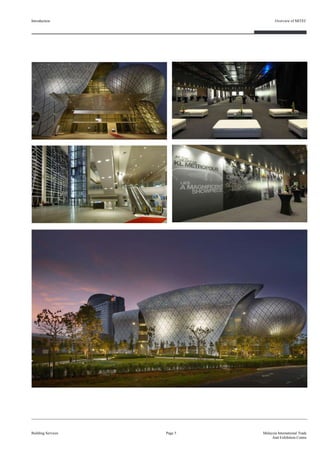
which located at first level and above are directly connected all the way towards the ground level to separate
escape route to and from basement level. This helps in preventing escaping occupants from upper floor
inadvertently entering the basement instead of final exits on ground level. The reinforced concrete wall and fire
resistance escape staircase are located within an enclosed space accessible through a fire-rated door.
Fire Protection System
Building Services
Passive Fire Protection System
Page 57 Malaysia International Trade
And Exhibition Centre
Figure 2.79 Staircase as vertical exit in basement Figure 2.80 Enclosed stairway in basement 1 with fire-rated door
Staircases in MITEC are mostly as dog legged staircase which is one of the simplest form of staircase that
suitable for fire escape staircase in which a flight of stairs ascends to a half-landing before turning 180 degrees
and continuing upwards. The dimension of the emergency escape staircase is enough to accommodate at least
two occupant to fit-in-between to ensure smooth flow during high occupancy level. The total flight of staircase
consists of 8 flights while the width of a work of staircase spans 1100mm along with tread of 260mm and riser of
180mm with a 900mm high of handrail.
Diagram 2.43 Plan view of dog legged staircase with dimensions Diagram 2.44 Elevation view of dog legged staircase
Staircases in MITEC
Tread: 260 mm
Width:2200mm
Landing width: 1100 mm
Handrail:
900 mm
Riser:
180 mm
2.2.2.6.1 Exit Stairway
An exit stairway is a stairway within the exit access portion of the means of egress system. The exit stairway
obeys the regulations stated in By-laws as the escape staircase are located within an enclosed space accessible
through a fire-rated door. Door giving access to fire escape staircase shall be positioned that its swing shall at no
point encroach on the required width of the staircase or landing.
Fire Protection System
Building Services
Passive Fire Protection System
Page 58 Malaysia International Trade
And Exhibition Centre
Diagram 2.45 Swing shall of door does not affect circulation in
escaping route
Figure 2.81 Dog legged staircase in MITEC
2.2.2.6.2 Headroom
Fire escape staircase should posses a minimum headroom
height of 2 metres measured between the stair tread upper
surface measured at the tread outer edge, and the ceiling
above. The distance of headroom between two storeys of
staircase in MITEC does fulfill the minimum standard
requirement of 2 metres.
Diagram 2.46 Headroom distance labelled in section
Figure 2.82 Dog legged staircase in MITEC
Headroom:
2000 mm
Minimum width for landing: 914 mm
Figure 2.83 Dog legged staircase in MITEC
2.2.2.6.3 Louvered Heat Ventilator
Fire escape stairway in MITEC designed with a permanent opening covered with steel louver which serve to
provide natural ventilation into the enclosed shaft. The process of supplying and removing air from the stairway
ensure the constant air flow to comfort occupants whilst accessing the fire escape staircase even during high
density of circulation in emergency cases.
Fire Protection System
Building Services
Passive Fire Protection System
Page 59 Malaysia International Trade
And Exhibition Centre
Figure 2.84 Louvered heat ventilator
found in loading bay
A steel louvered structure with the horizontal slats that are angled to admit natural lighting and ventilation which
embedded into wall with a gap of 60mm could be found from the loading bay in MITEC. This louvered structure
projected throughout three levels of the fire escape staircase to provide permanent ventilation. The permanent
openings may also act an important role to discharge off smoke from the stairwell to enhance the comfort level
during evacuation in emergency cases such as fire.
Diagram 2.47 Air flow diagram through
louvered openings labelled in section
Figure 2.86 Permanent opening in stairwell
Figure 2.87 Louvered structure details
Figure 2.88 Structure embedded into wall Figure 2.89 Louvered openings
Louvered heat
ventilator
Figure 2.85 Louvered heat ventilator
with permanent openings
Fire Protection System
Building Services
Passive Fire Protection System
Page 60 Malaysia International Trade
And Exhibition Centre
UBBL 1984
Part VII: Fire Requirements
[ Section 106 ] Dimensions of staircases
(1) In any staircase, the riser of any staircase shall be not more than 180 millimetres and the
tread shall be not less than 255 millimetres and the dimensions of the rise and the tread of
the staircase so chosen shall be uniform and consistent throughout.
(2) The widths of staircases shall be in accordance with By-laws 168.
(3) The depths of landing shall be not less than the width of the staircases.
[ Section 168 ] Staircases
(1) Except as provided for in By-laws 194 every upper floor shall have means of egress via at
least two separate staircases.
(2) Staircases shall be of such width that in the event of any one staircase not being available
for escape purposes the remaining staircases shall accommodate the highest occupancy
load of any one floor discharging into it calculated in accordance with provisions in the
Seventh schedule to these By-laws.
(3) The required width of a staircase shall be the clear width between walls but handrails may
be permitted to encroach on this width to a maximum of 75 millimetres.
(4) The required width of a staircase shall be maintained throughout its length including at
landings.
(5) Doors giving access to staircase shall be so positioned that their swing shall no point
encroach on the required width of the staircase or landing.
[ Section 198 ] Ventilation of staircase enclosures
(1) All staircases enclosures shall be ventilation at each floor or landing levels by either
permanent openings or openable windows to the open air having a free area of not less
than 1 square metre per floor.
Summary (Vertical Exits) :
All of the vertical exits found in MITEC complies with the By-laws stated in Section 106, Section 168 and
Section 198. Dimension of tread and riser of fire escape staircase are all in suitable and constant length and
width throughout the evacuation route to prevent accident. The 900mm width of fire-rated door create a door
swing that does not intersect with the required width of landing. Designated travelling path keep ventilated and
unobstructed by providing a clear flow of movement during tie of egress as the vertical exits provided in MITEC
act in accordance to the requirement.
(Uniform Building By-Law, 2006, pp. 39, 63, 71) (Original work published in 1984)
Fire Protection System
Building Services
Passive Fire Protection System
Page 61 Malaysia International Trade
And Exhibition Centre
Location of Horizontal and Vertical Exits - Level 1, Level 2 and Level 3
Mega exhibition hall are located within Level 1, Level 2 and Level 3, the horizontal exits arranged within an axis
with one being perpendicular to the line by the middle of the axis. Ground floor which act as the final evacuation
platform for the occupant possess the highest density of horizontal exits available among all three levels. In
MITEC, the presence of horizontal exits always paired with vertical exits which will definitely lead occupants to
a proper evacuation route in the shortest time without hesitation. The main entrance and fire fighting shaft also
forming an axis along the building within the concourse.
Diagram 2.48 Horizontal and vertical exits highlighted in Level 1
Diagram 2.49 Horizontal and vertical exits highlighted in Level 2Horizontal exits
Vertical exits
Horizontal exits
Vertical exits
LEVEL 1
LEVEL 2
Fire Protection System
Building Services
Passive Fire Protection System
Page 62 Malaysia International Trade
And Exhibition Centre
Diagram 2.50 Horizontal and vertical exits highlighted in Level 3
Location of Horizontal and Vertical Exits - Level 1A, Level 2A and Level 3A
Three mezzanine floors in MITEC including Level 1A, Level 2A and Level 3A possess a uniformly distributed
of exit points in between the office area, suraus and staff rest area. In result, the amount of exits is lesser
compared to the main level as much less amount of occupants having to travel through these exits. Organization
of horizontal exits are simple and easily identified along the corridor for main circulation. Linear moving pattern
that leading building occupants to the vertical exits on the side for evacuation through horizontal exits.
Diagram 2.51 Horizontal and vertical exits highlighted in Level 1AHorizontal exits
Vertical exits
Horizontal exits
Vertical exits
LEVEL 3
LEVEL 1A
Fire Protection System
Building Services
Passive Fire Protection System
Page 63 Malaysia International Trade
And Exhibition Centre
Diagram 2.52 Horizontal and vertical exits highlighted in Level 2A
Diagram 2.53 Horizontal and vertical exits highlighted in Level 3A
Horizontal exits
Vertical exits
Horizontal exits
Vertical exits
LEVEL 2A
LEVEL 3A
Fire Protection System
Building Services
Passive Fire Protection System
Page 64 Malaysia International Trade
And Exhibition Centre
Location of Horizontal and Vertical Exits - Basement 1 and Basement 1A
Exit points found from the basement structure are well planned in spatial configuration and sufficient amount of
exit are provided to accommodate the occupancy load of MITEC. The scattered exit points within the basement
allowing convenient of travel distance for building users from any point in basement during evacuation. Both the
horizontal and vertical exits in MITEC comply with the requirements stated in By-laws due to prior safety of
building occupants by considering the building details.
Diagram 2.54 Horizontal and vertical exits highlighted in Basement 1
Diagram 2.55 Horizontal and vertical exits highlighted in Basement 1A
Horizontal exits
Vertical exits
Horizontal exits
Vertical exits
BASEMENT 1
BASEMENT 1A
2.2.2.7 Handrail
Rail which designed to be grasped by hand to provide stability and support while ascending or descending
stairways in order to prevent injurious falls. Staircase which more than 4 flights shall be provided with at least
one handrail beside the staircase. Handrails provided in MITEC are mostly embedded directly into the wall
structure while some of the handrail are subjected the ground to achieve a better support for building occupants
Fire Protection System
Building Services
Passive Fire Protection System
Page 65 Malaysia International Trade
And Exhibition Centre
Figure 2.90 Fire escape staircase provided with handrails
UBBL 1984
Part VI: Constructional Requirements
[ Section 107 ] Handrails
(1) Except for staircases of less than 4 risers, all staircases shall be provided with at least one
handrail.
(2) In building other than residential buildings, a handrail shall be provided on each side of the
staircase when the width of the staircase is 1100 millimeters or more.
(3) All handrails shall project not more than 100 millimetres from the face of the finishing wall
surface and shall be located not less than 825 millimetres and not more than 900 millimetres
measured from the nosing of the treads provided that handrails to landings shall not be less
than 900 millimetres from the level of the landing.
(Uniform Building By-Law, 2006, pp. 39) (Original work published in 1984)
Handrail provided on each side of staircase
Wall mounted handrail
Width of staircase : 1200mm
Height of handrail : 900mm
Summary (Handrails) :
Handrails provided in MITEC complies to Section 107 stated in By-laws which width that exceed 1100mm shall
cater with two handrails at each side of the staircase. The height of staircase also maintain within the suitable
range listed in building law with a minimum of 900mm.
2.2.3 Passive Containment
Passive Fire Containment is an integral component of the components of structural fire protection and fire safety
in a building. The devices of systems are to control the situation all by themselves without actively involved by
user. Creation of reliable permanent or semi-permanent containment for continuous protection. The system
reduces long-term damage to the buildings in multiple ways.
2.2.3.1 Compartmentation of Fire Escape
Fire compartmentation are sub-diving buildings into a number of discrete compartments using fire-resisting
compartmentation structures such as walls and floors to hinder the spread of fire. In Mitec, the building
comprising one or more rooms, spaces or storeys constructed to prevent the spread of fire to or from another part
of the same building or an adjoining building.
2.2.3.1.1 Aim of Fire Compartmentation
● Prevent immediate spread of fire throughout the building
● Reduces the chance of fires growing and creating a danger to the occupants, fire and rescue services, and
people in the vicinity of the building
● Limit damages caused to a building and its contents
2.2.3.1.2 Dependent of degree of subdivision should be provided by Fire Compartmentation
● Usage of building
● Fire load in building
● Height of building
● Availability of Sprinkler System
Fire Protection System
Building Services
Passive Fire Protection System
Page 66 Malaysia International Trade
And Exhibition Centre
Diagram 2.56 Basic Components of Compartmentation
Fire resisting floor
construction to protect route
aboveFire Rated Wall
(Fire Barrier Wall)
False Ceiling
Efficient smoke seal
Protected Route
Protected Route
Fire Protection System
Building Services
Passive Fire Protection System
Page 67 Malaysia International Trade
And Exhibition Centre
Location of Compartmentation of Fire Escape
Diagram 2.57 Level 1 indicating the location of compartmentalize zones
The compartmention zones locating around the ground floor of the building which connects the vertical exits.
Fire fighting shaft act as one of the fire compartmentation for fire escape in MITEC
LEVEL 1
2.2.3.2 Compartmentation of Fire Risk Area
Type of fire compartmentation used are differentiated by the spaces, room and type of facilities. Rooms such as
the control rooms are to be located away from high density of occupants in the building by locating at ground
level or roof top level with the aid of own compartmentations. The aim is to prolong the time to perform fire
saving procedures that requires to access control rooms. However, access for firefighting must be considered and
additional compartmentation at ground floor level may present a more suitable solution. In MITEC, halls,
meeting rooms and control rooms that has higher fire hazard materials are compartmented by the masonry walls
so that the fire would be contained within its area.
Figure 2.91 Cafeteria of MITEC
Diagram 2.58 Typical
Components of
Compartmentation of Fire
Risk Area
Fire Risk Area
Compartments
Figure 2.92 Kitchen of MITEC Figure 2.93 Organiser’s Control Room
Fire Protection System
Building Services
Passive Fire Protection System
Page 68 Malaysia International Trade
And Exhibition Centre
Diagram 2.59 Level 1 indicating the location of Compartmentation Zones
Diagram 2.60 Level 2 indicating the location of Compartmentation Zones
Diagram 2.61 Level 2A indicating the location of Compartmentation Zones
LEVEL 1A
LEVEL 2
LEVEL 2A
Cafeteria
Organiser’s Control Room
Cafe
Kitchen Areas
Organiser’s Control Room
Fire Protection System
Building Services
Passive Fire Protection System
Page 69 Malaysia International Trade
And Exhibition Centre
Diagram 2.62 Level 1 indicating the location of Compartmentation Zones
Diagram 2.63 Level 2 indicating the location of Compartmentation Zones
LEVEL 1A
LEVEL 2
Organiser’s Control
Room
Kitchen Areas
Fire Protection System
Building Services
Passive Fire Protection System
Page 70 Malaysia International Trade
And Exhibition Centre
UBBL 1984
Part VIII: Fire Requirements
[ Section 136 ] Provision of Compartment Walls and Compartment Floors
Any building, other than a single storey building, of a purpose group specified in the Fifth
Schedule to these By-Laws and which has -
(a) Any storey the floor area of which exceeds that specified as relevant to a building of that
purpose group and height ; or
(b) A cubic capacity which exceeds that specified as so relevant shall be so divided into
compartments, by means of compartment walls or compartment floors or both, that -
(i) No such compartment has any storey the floor area of which exceeds the area specified has a
relevant to that building ; and
(ii) No such compartment has a cubic capacity which exceeds that specified a so relevant to that
building;
Provided that if any building is provided which an automatic sprinkler installation which
complies with the relevant recommendations o the F.OC Rules or Automatic Sprinkler
Installation, 29th edition, this by-law has effect in relation to that building as if the limits of
dimension specified are doubled
[ Section 137 ] Floor in Building exceeding 30 metres in height to be Constructed as
Compartment Floor
In any building which 30 metres in height, any floor which is more than 9 metres above ground
floor level which separates are storey from another storey, other than a floor which is either
within maisonette or a mezzanine floor shall be constructed as a compartment floor
[ Section 139 ] Separation of Fire Risk Areas
The following areas or users shall be separated from the other areas of the occupancy in which
they are located by fire resisting construction of elements of structure of a FRP to be determined
by the local authority based on the degree of hire hazard ;
(a) boiler rooms and associated fuel storage areas
Fire Protection System
Building Services
Passive Fire Protection System
Page 71 Malaysia International Trade
And Exhibition Centre
(b) laundries
(c) Repair shops involving hazardous processes and materials ;
(d) Storage areas of materials in qualities deemed hazardous ;
(e) Liquified petroleum gas storage areas ;
(f) linen rooms ;
(g) Transformer rooms and Substations ;
(h) Flammable liquid stores
[ Section 189 ] Enclosing Means of Escape in Certain Buildings
(1) Every staircase provided under these By-laws in a building of four storey or more, or in a
building where the highest floor level is more than 1200 millimetres above the ground level, or in
any place of assembly, or in any school when such staircase is to be used as an alternative means of
escape shall be enclosed shall be enclosed throughout its length with fire resisting materials.
(2) Any necessary openings, except openings, except openings in external walls which shall not for
the purpose of this by-law include walls to air-wells, in the length of such staircase shall be provided
with self-closing doors constructed of fire-resisting materials.
Summary (Fire Compartmentation) :
The compartmentation of MITEC meets the UBBL 1984 requirements stated. From Diagram 2.59 to Diagram
2.63, the compartation of means of escape and fire risk areas meets the by-laws. MITEC exceed 30 metres
height, therefore, it is required to have compartment floor. Spaces that deemed hazardous are compartmentalize
by fire-resistive components to avoid spread of fire during fire emergency and allow the occupants in the
building to escape.
(Uniform Building By-Law, 2006, pp. 51,52,67) (Original work published in 1984)
Fire Rated
Lock
2.2.3.3 Fire Containment
Fire containment systems are designed to isolate affected areas of fire origin by preventing smoke and heat and
ensuring small fires are not allowed to escalate into the full-scale blazes. Even if the fire is relatively small and
contained, the spread of smoke can cause some serious problems in the long-term, even to remote and otherwise
unaffected parts of a building.
When smoke cools, it drops, which can cause a building to become smoke logged. But when the fire and the
smoke is contained, it’s not allowed to cool, so it remains relatively buoyant. This can boost the efficiency of
smoke extractors and other ventilation systems.
2.2.3.3.1 Fire Rated Door
A fire door is one of the device of Passive Fire Protection system. It is fire-resistant and to reduce the spread of
fire and smoke between a separate compartments of a structure and to enable safe egress from a building. The
fire rated door are able to contain fire in a specific area for 2 hours.
In MITEC, these doors can be found at the emergency fire exits, control rooms, loading bay and more. The
components of the fire door consists of overhead door closer, fire resistant glazing, security devices and signages
as indication.
Fire Protection System
Building Services
Passive Fire Protection System
Page 72 Malaysia International Trade
And Exhibition Centre
Figure 2.96 Fire Rated Door
Figure 2.94 Fire Rated Lock
Figure 2.97 Accreditation from SirimDiagram 2.64 Typical Components of Fire Rated Door
Figure 2.95 Fire Rated Glass
Door Closer
Hinge
Door Leaf
Door Frame
Doorsill
Fire Rated Glass
Rated
Material
Fire Protection System
Building Services
Passive Fire Protection System
Page 73 Malaysia International Trade
And Exhibition Centre
UBBL 1984
Part VII: Fire Requirements
[ Section 162 ] Fire Doors in Compartment walls and separating walls
(1) Fire doors of the appropriate FRP shall be provided
(2) Openings in compartment walls and separating walls shall be protected by a fire door having
a FRP in accordance with the requirements for that wall specified in the Ninth Schedule to
these By-Laws
(3) Openings in protecting structures shall be protected by fire doors having FRP of not less
than half the requirements for the surrounding wall specified in the Ninth Schedules to these
By-Laws but in no case less than half hour
(4) Openings in partitions enclosing a protected corridor or lobby shall be protected by ire doors
having RP of half-hour
(5) Fire doors including frames shall be constructed to a specification which can be shown to
meet the requirements for the relevant FRP when tested in accordance with section 3 of
BS476:1951
[ Section 164 ] Door Closers for Fire Doors
(1) All the fire doors shall be fitted with automatic door closers of the hydraulically spring
operated type in case of sliding doors
(2) Double doors with rebated meeting stiles shall be provided with coordinating device to
ensure that leafs close in the proper sequence
(3) Fire doors may be held open provided the hold open device incorporates a heat actuated
device to release the door. Heat actuated devices shall not be permitted on fire doors
protecting openings to protected corridors or protected staircases
[ Section 173 ] Exit Doors
(1) All exit doors shall be openable from inside without the use of key or any special knowledge
or effort
(2) Exit doors shall close automatically when released and all door devices including magnetic
door holder, shall release the doors upon power failure or actuation of the fire alarm
(Uniform Building By-Law, 2006, pp. 60, 62, 64, 65) (Original work published in 1984)
Fire Protection System
Building Services
Passive Fire Protection System
Page 74 Malaysia International Trade
And Exhibition Centre
Summary (Fire Rated Door) :
The fire rated doors in MITEC has appropriate FRP of 2 hours that are located as openings of compartment
walls. These doors also complies with the requirement of having automatic closing function. For security
purposes, the doors are only accessible for employees of MITEC. Therefore, it is difficult for public to access
these areas. However during an emergency, a break glass is available right next to the door for access. In
conclusion, MITEC fire rated doors have complied with the requirements of UBBL stated above
2.2.3.3.2 Fire Rated Floor
Fire rated floor is a slab of a building that is fire resistance. Reinforced concrete structures with complex inner
geometry under the effect of high temperature considering void former materials. The materials has the highest
fire resistance classification and non-combustible. Slow rate of heat transfer while having structural integrity
Concrete’s inherent material properties, it can be used to minimise fire risk for the lowest initial cost while
requiring the least in terms of ongoing maintenance. Other materials rely on fire protection, fire safety
engineering or rate of loss of combustion. This reliance on fire protection, fire safety engineering and rate of
combustion makes them unforgiving of workmanship errors, future changes as simple as changing light fittings,
compliance with management procedures and human behaviour.
In MITEC, reinforced concrete were widely used in constructing the floor in order to achieve fire resistance of
the building
Figure 2.99 Concrete Floor at MITECFigure 2.98 Concrete Slab at MITECDiagram 2.65 Typical Reinforced Concrete
Structure
Diagram 2.66 Sectional diagram highlight location of Reinforced Concrete Floor Slab
SECTION A-A’
Fire Rated Floor
2.2.3.3.3 Fire Rated Wall
A fire-rated wall is a feature of a building’s passive fire protection system that has been checked and certified
by the proper regulatory agency. There are two basic types of fire-rated walls: true firewalls and fire barrier
walls. The first is a structurally stable wall that also is certified to prevent fire from spreading from one side of
a building to the other. Fire barrier walls, on the other hand, provide fire-rated protection while not being
structurally sound.
A fire barrier wall are interior walls that extend from the floor‐to‐floor or floor‐to‐roof, including concealed and
interstitial spaces. They are designed to sub‐divide portions of the building, and can be supported by structures,
such as roofs, columns or floors. All support structures should have a fire-resistant rating no less than that of the
fire barrier they support. Fire barriers restrict the initial flow of heat within the area of origin, which provides
building occupants with adequate time to evacuate to safe areas. These walls will typically have a 2 to 3‐hour
fire‐resistance rating.
In MITEC, a fire barrier wall are used with a material of reinforced concrete to provide fire resistance to the
space in the building.
Fire Protection System
Building Services
Passive Fire Protection System
Page 75 Malaysia International Trade
And Exhibition Centre
Figure 2.101 Reinforced Concrete wall of MITECFigure 2.100 Reinforced Concrete wall of MITEC
Diagram 2.67 Indicating the location of Compartmentation Zones in Level 1A
LEVEL 1A
Location of Shaft
Fire Rated Walls are mainly located at the Firefighting Shaft area. Highlighted Zone is one of the firefighting shaft in MITEC
Passive Fire Protection System
2.2.3.3.4 Structural Fire Protection
Structural fire protection includes the insulation
materials, coatings, and systems used to prevent or
delay fire-induced temperature rise in structural
members in buildings. Structural fire protection for
walls, columns, and floors can be provided in varied
forms.
In MITEC, the building is structured utilising
reinforced concrete structure. However, masonry
construction with concrete block and cast tone were
also used in constructing the building. The materials
used for the structure provides high fire protection as
it is highly durable form of construction.
Fire Protection System
Building Services
Passive Fire Protection System
Page 76 Malaysia International Trade
And Exhibition Centre
Figure 2.102 Masonry wall at MITEC
Figure 2.103 Reinforced
Concrete Columns at
MITEC
2.2.3.3.5 Fire Roller Shutter
To prevent the spread of flames and smoke, fire rated roller shutters doors are one of the equipment serving as a
barrier to prevent the free movement of fire, this range of products have undergone rigorous testing ensure they
comply with the correct legislation giving you the peace of mind they will provide the required level of protection
to any given space. The material of the shutter is made of galvanised steel and is located at every exits. The
shutters offers 2 hours fire resistance, all of which are designed to close automatically in the event of a fire
through detection of temperature raises to 68 degrees. Fire alarm system of the building is also wired to the fire
roller shutter via 24 volt. In MITEC, fire roller shutters can be found in the basement levels whereas the shutters
can be controlled manually also by keys of the security guard.
Figure 2.104 Fire roller shutter at
Basement 1
Figure 2.106 Detail of ControllerFigure 2.105 Close-up of Fire Roller
Shutter
UBBL 1984
Part VIII: Fire Requirements
[ Section 143 ] Beam or Column
Any beam or column forming part of, and any structure arrying, and external wall which is required
to be constructed of non-combustible materials shall comply with the provisions of paragraph (3) od
By-Law 142 as to non-combustibility
[ Section 147 ] Construction of Separating wall
(1) Any separating wall, other than a wall separating buildings not divided into compartments
within the limits of size indicated by the letter “X” in Part I of the Ninth Schedule to there
By-Laws, shall be constructed wholly of non-combustible materials, excluding any surface
finish to a wall complies with the requirements of thee By-laws and the required FRP for the
wall shall be obtained without assistance from such non-combustible material
(2) Any beam or column forming part of, and any structure carrying, a separating wall which is
required to be constructed of non-combustible materials shall itself comply with the
requirements of paragraph (1) as to non-combustibility
Fire Protection System
Building Services
Passive Fire Protection System
Page 77 Malaysia International Trade
And Exhibition Centre
(Uniform Building By-Law, 2006, pp. 54, 55) (Original work published in 1984)
Summary (Structural Components) :
The structural components of MITEC have respected the laws of UBBL in the categories stated above.
Therefore, we can conclude that the structure of MITEC is sufficient remain stable while the fire fighters
perform rescue for a certain period of time.
Aluminium Box Top
Caps for Guide Rail
ControllerSide Frame
Guide Rail
End Slat
Aluminium Slats
Diagram 2.68 Components of Fire Roller Shutter
Aluminium Box Bottom
2.2.4 Fire Appliance Access
Fire fighting access are routes used by firefighters to access the building to perform fire rescues. Vehicular
access to the exterior of a building is needed to enable high reach appliances, such as turntable ladders and
hydraulic platforms, to be used and to enable pumping appliances to supply water and equipment for fire
fighting and rescue activities.The requirements of accessway shall have minimum distance of width and terrain
between the apparatus access and the building ; how easily can they enter the building; building’s interior layout
and vertical access; and, the time taken for firefighters to locate the fire protection features and utilities.
2.2.4.1 Fire Engine Access
Fire engine access is the access for a vehicle designed primarily for firefighting operations. The access
arrangements increase with building size and height. Engine access provision, access from a public road should
be provided to assist fire and rescue personnel in their rescue and fire-fighting operations. Whilst the access will
depend to some extent on the vehicles and equipment used, assistance may be provided from adjoining fire and
rescue services when the need arises. For this reason, the more demanding guidance for high reach appliances
may be recommended by the fire and rescue service. This may have a significant impact on planning and a
feasibility study may be appropriate. In MITEC, firefighting engine access were provided from the main
vehicular road to the loading bay where the present of fire-fighting shafts are located at.
Fire Protection System
Building Services
Passive Fire Protection System
Page 78 Malaysia International Trade
And Exhibition Centre
Figure 2.108 Assembly pointFigure 2.107 Fire engines Figure 2.109 Location of Fire
engines space
Figure 2.110 Driveway of Fire
engines
Assembly Point
Main Vehicular Road
Fire Engine Access
Diagram 2.69 Indication of Fire Engine Access Route and Assembly Point
Fire Engine
Meeting Point
Fire Protection System
Building Services
Passive Fire Protection System
Page 79 Malaysia International Trade
And Exhibition Centre
UBBL 1984
Part VIII: Fire Requirements
[ Section 140 ] Fire Appliance Access
All buildings in excess of 7000 cubic metres shall abut upon a street or road or open space of not
less than 12 metres width and accessible to fire brigade appliances. The proportion of the building
abutting the street, road or open spaces shall be in accordance with the following scale :
Summary (Fire Engine Access) :
MITEC has a volume of approximately 1,165,680m³. The width of the neighbouring street for fire fighting
access is 13m. MITEC proportion of building abutting street comply with the 12 metres requirement stated in
By-laws. Hence, there will be a low tendency of slow traffic occur to the fire engine access, facilitating the
rescue attempt during the event of fire
(Uniform Building By-Law, 2006, pp. 52) (Original work published in 1984)
Volume of building in cubic meter Minimum proportions of perimeter of
building
7000 to 28000 One - sixth
2800 to 56000 One - Fourth
56000 to 84000 One - Half
84000 to 112000 Three - Fourths
112000 and above Island Site
2.2.4.2 Fire Fighting Shaft
Firefighting shaft provides access to a building, especially in high rise buildings, for fire brigades. It is a facility
that is fully-equipped with firefighting equipments that is required to ensure that no delays during a fire and
rescue service and to provide a secure operating base. A firefighting shaft provides the fire and rescue service
with a safe area from which to undertake firefighting operations. They link all necessary floors of a building,
providing at least 2 hours of fire resistance to protect fire crews and are connected to fresh air. A firefighting
shaft will typically contain a firefighting lobby, staircase and lift. In MITEC, the fire fighting shafts are provided
in all levels and are equipped with proper fire fighting equipments as well as fire protection system. There are 7
fire fighting shafts in each levels
Fire Protection System
Building Services
Passive Fire Protection System
Page 80 Malaysia International Trade
And Exhibition Centre
Figure 2.111 Exterior view of MITEC’s
firefighting Shaft
Diagram 2.70 Basic Components
of Firefighting Shaft
Diagram 2.71 Location of Firefighting
Shaft in MITEC
2.2.4.2.1 Fire-fighting Lobby
Firefighting lobbies are spaces in buildings which are enclosed in fire resisting construction. They normally
separate horizontal and vertical circulation spaces such as corridor and stairs or lifts and/or separate circulation
spaces from accommodation spaces which is between corridors. The lobbies are presence at these points should
provide two lines of compartmentation such as walls and fire doors between the spaces they separate. The fire
fighting lobby at fire service access level should be large enough to act as a command post or control centre that
could be used by the fire service. A firefighting lobby should be of sufficient size enable the fire service to lay
out firefighting hose and connect it to the outlet from the fire main without undue congestion. In MITEC, a fire
fighting lobby were clearly and conspicuously marked in the building as to provide fire fighters direct access and
usage of the lobby designed with the law of UBBL when a fire occured.
Diagram 2.72 Location of fire-fighting lobby in MITEC Figure 2.112 Fire fighting lobby in MITEC at Level 1
2.2.4.2.2 Fire Escape Staircase
Fire escape staircase is a very important elements which serve as the primary escape route element in a building
which containing more than one level. The emergency exit provides a method of escape in the event of a fire , it
is usually mounted to the outside of a building or occasionally inside but separate from the main areas of the
building. In MITEC, fire escape staircase were provided with the design of UBBL and a layer of louvered
ventilator to provide ocupants fresh air during a fire escape
2.2.4.2.3 Fire Fighting Lift
A lift is designed to have additional protection, with controls that enable it to be used under the direct control of
the fire and rescue service in fighting a fire. A firefighting lift is required if the building has a floor more than
18m above, or more than 10m below fire service vehicle access level. A firefighting lift includes; the lift car, the
lift well, the lift machinery space, the lift control system and the lift communications system. In
MITEC,Firefighting lifts have very specific safety requirements and the presence of firefighting controls within
a lift.
Fire Protection System
Building Services
Passive Fire Protection System
Figure 2.113 Fire Escape Staircase
Page 81 Malaysia International Trade
And Exhibition Centre
Figure 2.116 Indication sign of fire liftFigure 2.115 Fire-fighting lobby at
MITEC
Diagram 2.73 Location of Fire Escape Staircase at
MITEC
Diagram 2.74 Location of Firefighting Lift at
MITEC
Figure 2.114 Louvered Ventilator at
Fire Escape Staircase
2.2.4.2.4 Active Fire Protection Shaft
Fire Protection System
Building Services
Passive Fire Protection System
Page 82 Malaysia International Trade
And Exhibition Centre
Diagram 2.75 Location of Active Fire Protection Shaft at MITEC
Figure 2.118 Fire Escape Plan
Diagram 2.76 Location of Fireman Intercom System at MITEC
Figure 2.119 Fire IntercomFigure 2.120 Fire Alarm
Figure 2.117 Elements of Active Fire Protection Shaft
At the Fire fighting lobby, fireman intercom system were also present in MITEC.
In MITEC, there are other equipments located at the active fire protection shaft including dry riser, wet riser,
fire extinguisher and hostril system
Summary (Firefighting Shaft) :
The firefighting shafts in MITEC meets the requirements stated by the UBBL above. The fire lobbies are
well-equipped and the number of lobbies is sufficiently enough to fulfil the overall safety criteria of the building,
Fire Protection System
Building Services
Passive Fire Protection System
Page 83 Malaysia International Trade
And Exhibition Centre
UBBL 1984
Part VIII: Fire alarms, fire detection, fire extinguishment and fire fighting access
[ Section 229] Means of access and fire fighting in buildings over 18.3 metres high access
(1) Buildings in which the topmost floor i more than 18.3 metres above fire appliances access
level shall be provided with means of gaining access and fighting fire from within the
building consisting of fire fighting access lobbies, fire fighting staircases, fire lifts and dry
or wet rising systems
(2) Fire fighting access lobbies shall be provided at every floor level and shall be located that
the level distance from the furthermost point of the floor does not exceed 45.75 metres
(3) A fire fighting staircase shall be provided to give direct access to each fire fighting access
lobby and shall be directly accessible from outside the building at fire appliance level. This
may be one of the staircase required as a means of egress from the building
(4) The fire lift shall be discharged directly into the fire fighting access lobby, fire fighting
staircase or shall be connected to it by a protected corridor
(5) A fire lift shall be provided to give access to each fire-fighting access lobby or in the
adsense of a lobby to the fire-fighting staircase at each floor level
(6) The fire lift shall discharge directly into the fire-fighting access lobby fire-fighting staircase
or shall be connected to it by a protected corridor
[ Section 243] Fire Lifts
(1) In a building where the top occupied floor is over 18.5 metres above the fire appliance
access level fire lifts shall be provided
(2) A penthouse occupying not more than 50% of the area of the floor immediately below shall
be exempted from this measurement
(3) The fire lifts shall be located within a separate protected shaft if it opens into a separate
lobby
(4) Fire lifts shall be provided as the rate of one lift in every group of lifts which discharge into
the some protected enclosure or smoke lobby containing the rising main, provided that the
ire lifts are located not more than 61 metres travel distance from the furthermost point of the
floor.
(Uniform Building By-Law, 2006, pp. 83, 86) (Original work published in 1984)
Fire Protection System
Building Services
Passive Fire Protection System
Page 84 Malaysia International Trade
And Exhibition Centre
2.3 Conclusion
In conclusion, MITEC has a standard active and passive fire system, respecting majority of the By-laws. The
active fire protection system provided such as fire pump system, fire sprinkler system, hose reel system, wet and
dry riser system etc. are systematic and effective. Regular maintenances are carried out to ensure all the systems
are functionable and to be used during the event of fire. This system is essential in playing the role of preventing
the spread of fire, reducing the spread of smoke, increasing the time for occupants to escape the building and
reducing the damage of building during fire emergency. On the other hand, the passive fire protection system in
MITEC provides an adequate travel distance to escape an area in the building through exits. Suitable position of
exits in complement with the location of assembly point. Furthermore, the horizontal exit have proven to be
adequate in location and generous in its width which would facilitate the evacuation during the event of
emergency. MITEC is well compartmented together with well-thought structural materials and installation of fire
rated doors, walls and floors.
3.0
AIR-CONDITIONING
SYSTEM
3.0 Air-conditioning System
3.1 Literature Review
Air-conditioning (A.C) system is a system that removes heat and moisture from the interior of an occupied
space, to improve the comforts of occupants and to maintain the air quality of the interior. Air-conditioning
involves the circulation and cooling of air . The system are often used in offices and.
3.2 Type of Air-conditioning System
3.2.1 Split Air-conditioning System
A split air conditioner consists of an outdoor unit and an indoor unit. Usually, the outdoor unit is installed on or
near the exterior wall of the room that requires cooling. This unit houses the compressor, condenser coil and the
expansion coil or capillary tubing.
Types of split air-conditioning system :
● Split unit without outside air (dcutless)
● Split unit without outside air (ducted )
● Variable refrigerant flow (VRF) Variable refrigerant (VRV)
3.2.2 Centralized Air-conditioning System
Central air conditioning (or central A/C) is a system in which air is cooled at a central location and distributed to
and from rooms by one or more fans and ductwork. The work of the air conditioner compressor is what makes
the whole process of air conditioning possible. The compression of the refrigerant gas enables it to discharge
heat out of the house, which is how the cool air is created.
Types of split air-conditioning system :
● Chilled Water Central Air Conditioning Systems
● Direct Expansion (DX) Type of Central Air Conditioning Plant
Air-conditioning System
Building Services
Types of Air conditioning system
Page 86 Malaysia International Trade
And Exhibition Centre
3.3 Case study of MITEC for Air-Conditioning System
In the MITEC building, there are 2 types of air-conditioning system which are the centralized air-conditioning
system and the split air-conditioning system. The main air-conditioning system is the centralized
air-conditioning while the split air-conditioning system in MITEC is used only in the fire control room and as
backup air-conditioning when the main system is down.
3.3.1 Chilled Water Central Air-Conditioning System
Air-conditioning System
Building Services
Air conditioning system
Page 87 Malaysia International Trade
And Exhibition Centre
UBBL 1984
Part III: Space, Light and Ventilation
[ Section 41 ] Mechanical ventilation and air-conditioning (3):
The provisions of the Third Schedule By-Law shall apply to buildings which are mechanically
ventilated or air-conditioned.
Diagram 3.1 Introduction of components in an
air-conditioning system
(Source : Khemani , 2009)
(Uniform Building By-Law, 2006, pp. 18, 19) (Original work published in 1984)
In the MITEC building, majority of the
building is air-conditioned by the chilled
water central air-conditioning system . It
comprises of centralized duct system,
consisting an air handling unit, air supply
system , air return duct and grilled that
circulate warm air from furnace cooled
air to spaces. The warm air from the
spaces is then returned back to the
system to be cooled down again.
3.3.1.1 Cooling Tower and Water Tank
Cooling towers are heat rejection device that are used to transfer heat to the atmosphere through the cooling of a
water stream to a lower temperature. An HVAC cooling tower is used to dispose of unwanted heat from chiller.
In MITEC, one chiller is paired with one cooling tower. Therefore, there are 6 cooling towers in MITEC .
Air-conditioning make up tank is located at the rooftop, usually near the cooling towers. As for MITEC, cooling
towers and water tanks are located both at the rooftop next to each other. Water tanks are to replenish the amount
of water in the condenser water systems in case there is any water loss due to cooling tower operation or
maintenance.
3.3.1.2 Chiller Plant Room
The chiller plant room comprises of all the important components of the chilled water air-conditioning plant.
These include the compressor, condenser, thermostatic expansion valve and the evaporator or the chiller. The
compressor is of open type and can be driven by the motor directly or by the belt via pulley arrangement
connected to the motor. It is cooled by the water just like the automotive engine.
Air-conditioning System
Building Services
Air conditioning system
Page 88 Malaysia International Trade
And Exhibition Centre
Figure 3.1 View of cooling tower Figure 3.2 Water tank with ladder to access the top.
Diagram 3.2 Location of the plant room
3.3.1.3 Chiller
Chillers removes heat from liquid via absorption refrigeration cycle, it consist of evaporator, compressor and
condenser, it cooled down the water flow through pipes in the building as well as cooling down the building.
MITEC is equipped with 6 large chillers . Usually , only 2 chillers are operating on a daily basis when there is no
events happening which means less space needs air conditioning. All 6 chillers are located in one chiller plant
room.
3.3.1.4 Chiller Water Pump
Chiller water pumps functions to return warm water to the chiller and also to pump the chilled water to every
AHU room. The pressure gauge enables visual verification of the state of the water refrigerant in the water line,
upstream of the thermostatic expansion valve. It also detects the humidity of the circuit.
Each chiller has 2 pump, one for the condenser, another one for the chiller to go to wet riser through a big pump
to the other part of the building.
Air-conditioning System
Building Services
Air conditioning system
Page 89 Malaysia International Trade
And Exhibition Centre
Figure 3.3 View of chiller in MITEC Figure 3.4 View of chiller in MITEC
Figure 3.5 Row of chiller water pump Figure 3.6 Temperature sensor is placed on the pump unit
3.3.1.5 Control Unit
.
Chilled water system control unit is located beside the chiller plant room. The control for the chiller is automated
which monitor and the control the operation system of condenser water pump, chilled water pump and cooling
tower. In order to start the system, the chiller has to be started up, next the motorized valve of the cooling tower
will be turned on, thus activating the contact. Then, the condenser water pump will start . Once chiller detects a
flow in the chilled water system , it will start automatically. Then, the fan assembly for cooling tower will start.
After the water system is in operation, it will regulate the compressor to full or partially loaded based on total
cooling required. Temperature sensor is used to compare actual temperature of space with a target temperature.
Then a conclusion is made by the control system to take action. For example, activate blower.
Air-conditioning System
Building Services
Air conditioning system
Page 90 Malaysia International Trade
And Exhibition Centre
MS1525 : 2014
8.2. System and equipment sizing
Where chillers are used and when the design load is greater than 1 000 kWr, a minimum of
two chillers or a single multi-compressor chiller should be provided to meet the required load.
Figure 3.7 Individual control panel Figure 3.8 Control unit in the mechanical room
MS1525 : 2014
8.4.1 Temperature control
Each system should be provided at least one thermostat for the regulation of temperature. Each
thermostat should be capable of being set by adjustment or selection of sensors over a minimum
range of between 22-27 degree celsius.
3.3.1.6 Air Handling Unit (AHU)
Air Handling Unit (AHU) is a device used to condition and circulate air as part of a heating, ventilation, and
air-conditioning system. An air handling unit is a a large metal box which contains consists of a blower, heating
and/or cooling elements, filter racks or chambers,sound attenuators and dampers.They are usually connected to
duct works that distributes the conditioned air through the building and return back to the AHU unit. Every floor
in MITEC consist of AHU room.
.
Figure 3.9 Model of AHU used in MITEC
Air-conditioning System
Building Services
Air conditioning system
Page 91 Malaysia International Trade
And Exhibition Centre
Figure 3.10 AHU unit in AHU room
Figure 3.11
AHU unit in
AHU room
Diagram 3.3 Location of AHU room
on level 1A plan
Air Filter
A filter is placed at the air inlet of the blower. The
function of the filter is important to prevent dirty air
from circulating through the duct. In MITEC, the
filter pabel is replace every month or once it retains
moisture. This is to ensure that no microbial growth
on the filter , causing difficulty for air to bypass.
Building Services
Active Fire Protection System
Page 92 Malaysia International Trade
And Exhibition Centre
Cooling Coil
Cooling coil is made of copper pipes and is
connected to the chiller. It functions to reduce the
temperature and humidity of the air .
Centrifugal Fan Blower
Centrifugal Fan blower in AHU is installed to propel
the air from the cooling coil and transfer the cooled
air to the air duct and then to the diffuser.
Figure 3.12 Air Filter in AHU room
Fan Blower
Motor
Figure 3.14 Cooling coil inside AHU
Figure 3.14 Fan
Blower and
Motor inside
AHU
Chill Water Pipe
Chill water pipe is functioned to transfer the chill
water. Based on the diagram, it shows 2 different
chill water pipes. CHWS is the pipe that supplies
chill water to the AHU while the CHWR is the pipe
that returns the flow of chill water to the chiller plant
room.
Figure 3.13 Chill water pipes
Air-conditioning System
3.3.1.7 Fan Coil Unit (FCU)
Fan Coil Unit is a device consisting of a cooling heat exchanger or coil and a fan. It is a part of the HVAC
system found in residential, commercial and industrial buildings. FCU is used to control the temperature in the
space where it is installed, or served multiple spaces. While the AHU is used to ventilate the entire building , the
FCU are used in smaller places like the smaller halls and offices.
Conditioned air from FCU is supplied to the spaces by the ductwork system. The air supply travels through the
ductwork and is then distributed and discharged into the space by air diffusers. Then the circulated air is once
again collected by the return air inlet and returns back to the FCU to be cooled again..
Building Services
Air conditioning system
Page 93 Malaysia International Trade
And Exhibition Centre
Figure 3.16 FCU and diffuser inside one of the halls of MITEC Figure 3.17 Fan Coil Unit ( FCU )
Air-conditioning System
Diagram 3.4 Location of rooms
with FCU units at Level 1
3.3.1.8 Air Duct and Diffuser
Air duct is the connector between AHU and diffuser. Duckworks in the HVAC units functions to distribute the
air from AHU to the rooms that needs to be conditioned. It is well insulated as it is galvanised, to ensure the air
distributed are well maintained.
Diffuser is the outlet of cooled air to a certain location. It constantly removes heat and provides cooled air from
the AHU to a room that needs to be conditioned.
Building Services
Air conditioning system
Page 94 Malaysia International Trade
And Exhibition Centre
MS1525 : 2014
8.7.1 Duct Construction
High pressure and medium pressure ducts should be leak tested in accordance with HVAC Air Duct
Leakage Test Manual published by SMACNA or any other equivalent standards, with the rate
of leakage not to exceed the maximum rate specified.
MS1525 : 2014
8.5. Air handling duct system insulation
All ducts, plenums and enclosures installed in or on buildings should be adequately insulated to
prevent excessive energy losses. Additional insulation with vapour barriers may be required to
prevent condensation under some conditions
Figure 3.19 Ductworks outside the AHU room Figure 3.20 Linear slot diffuser in MITEC meeting rooms
Air-conditioning System
3.3.2 Split Air-Conditioning System
The split air-conditioning system connect one indoor unit to an outdoor unit with evaporator, condenser and
compressor.
The indoor unit draws power from outdoor unit by a series of wires. The wire connect to its corresponding
terminal located at the electrical panel of the outdoor unit. A copper tube is connected parallel along the wire that
contains the gas from outdoor unit to indoor unit. Drain pipes are installed at the corner below the indoor unit to
remove the water easily. Cooling fan inside the indoor unit sucks the air from room and it is passed over the
cooling coil and the filter due to the temperature of the air reduces and all dirt is removed.
3.3.2.1 Indoor Unit
In MITEC the indoor units are installed in the fire control room on the basement floor as well as in the offices
and meeting rooms on the 2nd floor. This air-conditioning will not be constantly used in the offices , as it is only
a backup when the main system is down or used on weekends when only a few workers come to work.
3.3.2.2 Outdoor Unit
The outdoor units in MITEC are installed right outside of the offices and control room. Thus, most of the rooms
using the split unit air conditioning are located near the exterior walls.
Building Services
Air conditioning system
Page 95 Malaysia International Trade
And Exhibition Centre
Figure 3.21 Indoor unit in fire control room
Figure 3.22 Outdoor unit outside the fire control room
Air-conditioning System
3.4 Conclusion
Analysis :
● Air-conditioning system in MITEC are very well maintains and strategically planned out. Machines that
produce very large sounds such as the chillers are placed in the basement away from the halls and
meeting rooms, the interior of the chiller plant room is also covered will paddings of sponges to block of
the sound from causing disturbance.
● Most of the room ventilation are using air-conditioner as the main purpose for the building. There is also
back up electricity machine to store electricity when there is a case of sudden cut off electricity in the
middle of utilizing the rooms. Thus, in any case of air-conditioning is spoilt , mechanical ventilation will
be provided to ventilate the space.
In conclusion, the Chilled Water Central Air Conditioning System and the Split Unit System of MITEC has
compiled with all the By Laws stated in UBBL section 41 as well as MS1525 : 2014 which are the guidelines
for mechanical ventilation and air conditioning set by the government to be followed. With sufficient facilities,
regular maintenance and back-up plans are planned and designed for the halls , meeting rooms and offices, this
ensures the thermal comfort of the environment in MITEC is achieved.
Building Services
Air conditioning system
Page 96 Malaysia International Trade
And Exhibition Centre
UBBL 1984
Part III: Space, Light and Ventilation
[ Section 41 ] Mechanical ventilation and air-conditioning
(2) Any application for the waiver of the relevant By-Law shall only be considered if in
addition to the permanent air conditioning system there is provide alternative approved
means of ventilating the air conditioned enclosure, such the within half an hour of the
conditioning system failing, not less than the stipulated volume of the fresh air specified
here in after shall introduced into the enclosure during the period of air conditioning system
is not functioning.
Air-conditioning System
(Uniform Building By-Law, 2006, pp. 18) (Original work published in 1984)
4.0
MECHANICAL
VENTILATION
SYSTEM
4.1 Literature Review
Ventilation plays a vital role in building to remove the stale air and replace it with fresh air from an external
environment.Ventilation system can be classified into two categories, natural ventilation and mechanical
ventilation. Both system had implemented in the building design as the need suited to the nature of building. In
mechanical ventilation system, components such as fan, filter, ductwork, dampers, grille and diffusers are used to
expel the stale air, working as a makeup air supply to enhance indoor quality. Mechanical ventilation can be
spotted usually in enclosed spaces that require good airflow.
Importance of mechanical ventilation system:
● Preservation of oxygen content and removal of carbon dioxide
● Control of humidity levels
● Prevention of heat concentrations from machinery, lighting and people
● Solution for unreliable natural ventilation system
● Reduce accumulation of moisture, dust, bacteria and smoke
● Dilution and disposal of contaminants.
There are various types of ventilation methods each serving different purposes and mechanical ventilation are
often used when natural ventilation is insufficient. There are 3 types of mechanical ventilation system:
● Supply system
● Extract system
● Balanced / Combined system
4.2 Components of Mechanical Ventilation System
4.2.1 Mechanical Fans
Fan is an important component of a mechanical ventilation system
which is used to create air movement. It provides a function of
removing hot, heat and polluted air. The mechanical fan consists of
a rotating arrangement of vanes or blades that aids in capturing
contaminants by carrying them to the air cleaning devices through
duct system. It brings in outdoor air for comfort ventilation or
convection cooling of buildings at night as well as provide constant
indoor circulation. There are mainly three types of fan, which are
propeller fan, axial fan and centrifugal fan as shown in the figures
below.
Mechanical Ventilation System
Building Services
Literature Review
Page 98 Malaysia International Trade
And Exhibition Centre
Figure 4.1 Propeller fan
4.2.1.1 Case Study of Mechanical Fans in MITEC
4.2.1.1.1 Propeller Exhaust Wall Fan
The purpose of propeller exhaust fan is for free air discharge. Commonly used without ducting but have the
ability of removing air. Propeller exhaust wall fans are found in utilities room such as lift motor room and
electric room to remove the heat produced by the machine. They are also found in rooms with high humidity and
odour such as the janitor room, help in avoiding accumulation of bad odour and maintain the standard humid
level within the room.
4.2.1.1.2 Induced Jet Fan
Jet fans are also known as impulse or induction fans. It is used to support the natural flow between the supply air
and extract air zones. They provide motion in regions with low air speeds, thus guaranteeing the daily ventilation
requirement for all areas. The induced jet fans used in MITEC are manufactured by Kruger and can be found at
the basement car park. Jet fans are only installed at particular points thus take up lesser ceiling area.
Mechanical Ventilation System
Building Services
Mechanical fans
Page 99 Malaysia International Trade
And Exhibition Centre
Figure 4.2 Axial fan Figure 4.3 Centrifugal fan
Figure 4.4 Wall mounted propeller exhaust fan found in the
lift motor room
Figure 4.5 Wall mounted propeller exhaust fan found in the lift
motor room
Mechanical Ventilation System
4.2.1.1.3 Axial Fan
An axial fan consists of an impeller with blades of aerofoil section rotating inside a cylindrical casing to
increases the pressure of the air flowing through it. Axial fans are used for relatively high flow rate to help in
providing better air quality within an enclosed space.. The axial fans are products from Kruger and are located at
the fan rooms at basement.
Building Services
Mechanical fans
Page 100 Malaysia International Trade
And Exhibition Centre
Figure 4.6 Induced jet fan found in basement of MITEC Diagram 4.1 Details of induced jet fan
Diagram 4.2 Application of induced jet fan in basement
Figure 4.7 Axial fan found in MITEC Figure 4.8 Axial fan found in MITECDiagram 4.2 Details of induced jet fan
Mechanical Ventilation System
4.2.1.1.3 Centrifugal Fan
The centrifugal fan used in MITEC is a product manufactured by Kruger. It is a singlet inlet centrifugal fan with
forward wheels. This type of centrifugal fan has a frame fitted on both sides of the fan which gives better
strength and rigidity and allows mounting in four different orientation. Centrifugal fans operates against high
resistance by centrifugal forces generated by rotating disks and blades with aerodynamic properties.
4.2.2 Filter
Air filters are used in ventilation system for protection against impurities which may cause irregular operation of
the entire system or damage in its individual components. It is a part of component which composed of fibrous
or porous material that functioned as improving air quality. It is usually installed right behind the inlet grille.
Building Services
Mechanical fans
Page 101 Malaysia International Trade
And Exhibition Centre
Figure 4.9 Centrifugal fan found in MITEC Diagram 4.3 Type C singlet inlet centrifugal
fan with forward wheels
Figure 4.10 Types of air filters ( Activated carbon, electrostatic and viscous air filter)
Mechanical Ventilation System
4.2.2.1 Case Study of Air Filters in MITEC
In MITEC, linear grilles were commonly used in mechanical ventilation systems. The filters are installed behind
these grilles, functioned to remove impurities with as low as possible obstruction to the air flow and prevent
small particles such as dusts from entering the system which may obstruct and causes mechanical failure to the
system.
4.2.3 Ductwork
The ductwork system acts as air carriers to deliver air from one space to another. The needed airflow include
supply air, return air and exhaust air. The ducts are usually made of non-combustible materials such as sheet
material. They are usually rectangular and round in cross section.
4.2.3.1 Case Study of Ductworks in MITEC
The ductwork for mechanical ventilation system in MITEC is galvanized ductwork. They are rigid ductworks
which are rectangular in cross section and are found in the car park basement and machinery rooms as it can
withstand high air pressure since difference in pressure between outside atmosphere and inside ductwork might
affect its shape and safety. Rectangular duct is also used because it is easier to connect fan coil to main duct and
take up less height.
Building Services
Filter
Page 102 Malaysia International Trade
And Exhibition Centre
Figure 4.11 Linear grille with filters found at the loading bay of MITEC Figure 4.12 Linear grille with filters used for ductwork
at the carpark basement of MITEC
Figure 4.13 Ductwork found in
basement of MITEC
Figure 4.14 Ductwork found in one of the
halls in MITEC
Figure 4.15 Ductwork found in electric
supply room of MITEC
4.2.3.1.1 Combined use of ductwork with mechanical air conditioning
In the halls of MITEC, both air-conditioning system and mechanical ventilation system are connected to the
same main ductwork. Free cooling is used in MITEC, allowing fresh cool outside air into the HVAC system as
first stage cooling. In normal days, the damper will be drive open to bring in fresh outside air, helps in cooling
the house without running the compressor thus reduces the energy consumption. When there is a case of fire, the
barometric relief damper installed in the return duct will be activated and the smoke will be sucked into the attic
thus able to prevent the accumulation of smoke in the area.
Mechanical Ventilation System
Building Services
Ductwork
Page 103 Malaysia International Trade
And Exhibition Centre
Figure 4.16 Combined use of ductwork found in one of the halls in MITEC
Diagram 4.4 Ductwork installation of mechanical ventilation and air-conditioning system
Mechanical Ventilation System
4.2.4 Damper
4.2.4.1 Fire Damper
Fire dampers are required by all building codes to maintain the required fire resistance ratings of walls,
partitions, barriers and floors when they are penetrated by air ducts or other air transfer openings. Combination
of fire and smoke dampers are found in the halls and electric supply room in MITEC. When there is a rise in
temperature up to 165 Fahrenheit, the thermal sensor will detect the heat and the damper will be closed
automatically to prevent the spreading of smoke and fire. The damper used in the electric supply room is used to
prevent spreading of CO2 gas when the carbon dioxide suppression system is activated. The type of damper used
in MITEC is static fire and smoke damper since it is installed in horizontal barriers.
4.2.4.2 Pressure Relief Damper
This type of damper is found
used at every enclosed unit
staircase at MITEC. It acts as a
pressure relief damper which
helps to reduce the pressure
created by the supply ventilated
staircase pressurization system.
Building Services
Damper
Page 104 Malaysia International Trade
And Exhibition Centre
Figure 4.17 Combination of fire and smoke damper found in
electric supply room of MITEC
Figure 4.18 Combination of fire and smoke damper found in
electric supply room of MITEC
Figure 4.19 Pressure relief damper found
at enclosed staircase in MITEC
Figure 4.20 Pressure relief damper found
at enclosed staircase in MITEC
Mechanical Ventilation System
4.2.5 Grille and diffuser
Grille is a device used in supplying and extracting air vertically without any kind of deflection while diffuser is
used to direct the air at different angles by profiled blades when the air is leaving the unit and going into the
space. Both grille and diffuser act as air distribution outlet and are usually located in the ceiling. They are
arranged in order to promote mixing of the room air into the primary air being discharged.
4.2.5.1 Case study of grilles and diffusers in MITEC building
4.2.5.1.1 Egg crate grille
Building Services
Grille and diffuser
Page 105 Malaysia International Trade
And Exhibition Centre
Linear grille Louvre bladed diffuser
Figure 4.21 Types of grilles and diffusers
Figure 4.22 Egg crate grilles found in MITEC
Egg crate grilles are found used in fire pump room. These devices are considered to be the most simple and
cheapest equipment of their category. Egg crate grille can be used when air is removed by extracting ventilation
system.
Figure 4.23 Egg crate grilles found in MITEC
Egg crate grille
4.2.5.1.2 Air Transfer Grille
Air transfer grilles are installed in the wall to connect the enclosed room with an open space. Therefore
providing additional pathway for air movement and yet maintaining the integrity of wall during a fire situation.
4.2.5.1.3 Ceiling Mounted Return Air Grille
Return air is a vent grille that is usually located either in a hallway or in the ceiling and its purpose is to extract
air from a room and recycle it through the system to further condition it by cooling or heating. According to
MITEC, the return air grilles are mostly found in enclosed rooms and lift lobbies to ensure the building is
well-ventilated and foul air expelling out from the building.
Mechanical Ventilation System
Building Services
Grille and diffusers
Page 106 Malaysia International Trade
And Exhibition Centre
Figure 4.24 Air transfer grilles found in utilities room in MITEC
Figure 4.26 Return air grille found in MITEC
Figure 4.25 Air transfer grilles found in fire staircase
in MITEC
Figure 4.27 Return air grille found in MITEC
Mechanical Ventilation System
4.2.5.1.3 Round Diffuser
Round diffusers are widely used in MITEC as the place requires high flow capacities. They are placed at open
areas such as the main concourse, providing air flow from the ceiling level with an aesthetic appearance.The
close spacing between each round diffusers ensure the building is always well ventilated thus improving the
indoor air quality.
4.2.5.1.4 Louvre Face Diffuser
Louvre faced diffuser can also be found in MITEC. They are located in enclosed areas such as meeting rooms
and reception counters. They provide excellent directional performance in a 4 way air flow pattern.
Building Services
Grille and diffusers
Page 107 Malaysia International Trade
And Exhibition Centre
Figure 4.28 Round diffusers found in concourse area of MITEC
Figure 4.30 Louvre faced diffusers found in MITEC
Figure 4.29 Round diffusers found in concourse area of
MITEC
Figure 4.31 Louvre faced diffusers found in MITEC
Mechanical Ventilation System
4.3 Types of Mechanical Ventilation System
4.3.1 Supply Ventilation system (Mechanical Inlet and Natural Extract)
4.3.1.1 Overview
Supply ventilation system applies the concept of
mechanical inlet and natural extract. It works by
pressurizing the building. Fresh air is drawn in
by a mechanical fan and is distributed to many
rooms forcing the stale air out through natural
extract exit such as windows or door gaps by
using a fan and duct system. This continuous
supply system allows occupant to have better
control of the air that move into the building
through filter option. The constant
pressurization of inlet air creates a positive
pressure which prevent outside contaminants
from entering thus it is suitable to be used in a
polluted and noisy environment.
4.3.1.2 Case Study of Supply Ventilation System in MITEC
The building incorporates supply systems in enclosed staircase pressurization system and lift lobby
pressurization system. Both work together to provide a smoke-free escape route in case of fire in the building. It
will also be a useful smok-free route for the firefighter to carry out firefighting operation.
4.3.1.2.1 Staircase Pressurisation System
One of the most hazardous situations that can be faced in a building is smoke. While fires themselves are often
damaging, it is the smoke that can cause the most injuries. In order to protect a building’s occupants, as well as
furnishings and equipment, a smoke control system is needed to control the flow of smoke and keeps smoke
from spreading throughout the building and gives the building’s occupants a clear evacuation route.
Building Services
Literature Review
Page 108 Malaysia International Trade
And Exhibition Centre
Diagram 4.5 Operation of supply ventilation
The primary means of controlling smoke movement is by creating air pressure differences between smoke
control zones. In pressurization, air is injected from the pressurization system located at the rooftop into the
protected escape routes, which include the emergency escape staircase. Higher pressure is established inside the
staircase than in adjacent part of the building. In this way, air moves into the smoke zone from the adjacent areas
and smoke is prevented from dispersing throughout the building.
Figure 4.32 Pressure relief damper found in
the enclosed fire staircase in MITEC
Mechanical Ventilation System
Building Services
Staircase pressurisation system
Page 109 Malaysia International Trade
And Exhibition Centre
Diagram 4.6 Typical staircase pressurization system in buildings
Diagram 4.7 Level 1 floor plan showing location of enclosed staircases in MITEC
Some of the staircases in MITEC are not enclosed. Therefore, the pressurized system was not adopted due to the
reason that natural ventilation was able to improvised as a tool to generate air circulation. The staircases
highlighted in Diagram 4.8 complies with UBBL 1984, by-law 198, which it has louvre heat ventilators for each
storey in the staircase shafts to supply permanent natural ventilation.
Mechanical Ventilation System
Building Services
Staircase pressurisation system
Page 110 Malaysia International Trade
And Exhibition Centre
Figure 4.34 Louvre heat ventilator
found in MITEC
Figure 4.33 Louvre heat ventilators are used for natural ventilated staircase
Diagram 4.8 Level 1 floor plan showing location of staircases that are naturally ventilated
Mechanical Ventilation System
Building Services
Staircase pressurisation system
Page 111 Malaysia International Trade
And Exhibition Centre
UBBL 1984
Part VII: Fire Requirements
[ Section 198] Ventilation of staircase enclosures
(1) All staircase enclosures shall be ventilated at each floor of landing level by either permanent
openings or openable windows to the open air having a free area of not less than 1 square
metre per floor.
[ Section 202 ] Pressurized system for staircase
All staircases serving buildings of more than 47.75 metres in height where there is no adequate
ventilation as required shall be provided with a basic system of pressurization--
(a) Where the air capacity of the fan shall be sufficient to maintain an air flow of not less than
60 metres per minute through the doors which are deemed to be open;
(b) Where the number of doors which are deemed to be opened at the one time shall be 10% of
the total number of doors opening into the staircase with a minimum number of two doors
open;
(c) Where with all the doors closed the air pressure differential between the staircases and the
areas served by it shall not exceed 5 millimetres water gauge.
(d) Where the mechanical system to prevent smoke from entering the staircases shall be
automatically activated by a suitable heat detecting device, manual or automatic alarm or
automatic wet pipe sprinkler system;
(e) Which meets the functional requirements as may be agreed with the D.G.F.S.
Summary :
The staircase pressurization system in MITEC meets the requirement stated in UBBL 1984 under section 202.
The pressurization system is provided for each enclosed staircase in the building. It is well-maintained and still
functioning to supply air from outside to pressurize the stairwell during fire emergency.
The natural ventilated staircase in MITEC has fulfil the UBBL requirements of which vent louvres can achieve
the same purposes of securing air circulation without the necessary to install a pressurized system for staircase.
(Uniform Building By-Law, 2006, pp. 71, 72) (Original work published in 1984)
4.3.1.2.2 Lift lobby pressurisation system
The use of a pressurised system in the lift lobby is to ensure it to be smoke-free by preventing backdrafting and
maintaining air circulation during an event of a fire where the fire fighters will have to enter the lift lobby during
rescue operations or fire fighting. In MITEC, there is a pressurisation ductwork inside the protected
pressurisation shaft that is situated in the lift lobbies on every floor. In the lift lobbies, fire dampers cannot be
used. Therefore, the pressurisation ductwork is used to maintain a positive pressure in the lift lobbies in order to
prevent smoke from entering and supply ventilated air into the lift lobbies.
Mechanical Ventilation System
Building Services
Lift lobby pressurisation system
Page 112 Malaysia International Trade
And Exhibition Centre
Figure 4.35 Pressure relief damper in lift lobby Diagram 4.10 Diagram showing location of duct in lift lobby
Diagram 4.9 Level 1 floor plan showing location of lift lobbies
Mechanical Ventilation System
Building Services
Lift lobby pressurisation system
Page 113 Malaysia International Trade
And Exhibition Centre
UBBL 1984
Part VII: Fire Requirements
[Section 150] Protected shafts
1) No protected shaft shall be constructed for use for any purposes additional to those specified
in this Part other than for the accomodation of any pipe or duct, or as sanitary
accommodation or washrooms, or both.
2) Subject to the provisions of this Part, any protected shaft should be completed enclosed.
There shall be no opening in any protecting structure other than any one or more of the following:
(d) If the protected shaft serves as, or contains a ventilating duct, an inlet to outlet from the duct or
an opening for the duct.
[Section 197] Protected lobbies
1. Protected lobbies shall be provided to serve staircases in buildings exceeding 18 metres
above ground level where the staircase enclosures are not ventilated through the external
walls
2. In buildings exceeding 45 metres above ground level, such protected lobbies shall be
pressurised to meet the requirements of Section 7 of the Australian Standard 1668, Part
1-1974 or any other system meeting the functional requirement of the D.G.F.S
3. Protected lobbies may be omitted the staircase enclosures are pressurized to meet the
requirements of by-law 200.
Summary :
The lift lobby pressurization system in MITEC meets the requirement stated in UBBL 1984 under section 150
and section 197. The protected lift lobby is pressurized to ease fire-fighting operation to be carried out during the
case of emergency.
(Uniform Building By-Law, 2006, pp. 57, 71) (Original work published in 1984)
Mechanical Ventilation System
4.3.2 Extract Ventilation System (Natural Inlet and Mechanical Extract)
4.3.2.1 Overview
A extract ventilation system is the reverse of an
supply ventilation system. It depressurizes the
building by using a mechanical fan to vacuum
out the interior air in order to create a negative
pressure at the interior which draws in the outer
air and displace the stale air. However, exhaust
ventilation system might draw contaminants
into the building along with the fresh air.
Therefore, filters are normally installed to
ensure clean inlet air by filtering out the
pollutants when air flows in. This system is
commonly used in kitchen, internal toilet and
bathroom, basement, attic and crawl space.
4.3.2.2 Case Study of Exhaust Ventilation System in MITEC
The building incorporates extract systems in the mechanical utility rooms and basement carpark, working to
ventilate the indoor enclosed rooms and dispersing contaminants in the air. The machinery and utilities must be
in suitable temperature and humidity to function at optimal levels.
4.3.2.2.1 Basement Car Park Exhaust System
In MITEC building, there are two levels of basement car park which requires exhaust system to ensure sufficient
supply of fresh air to the below ground and maintain the standard pressure level. It is performed through
ductworks that are evenly distributed to act as transfer pathway when mechanical fans drive the stale air out.
Building Services
Literature Review
Page 114 Malaysia International Trade
And Exhibition Centre
Diagram 4.11 Operation of exhaust ventilation
Mechanical Ventilation System
Induced jet fans are positioned at a sufficient distance away from other mechanical service components such as
sprinklers, signs and ductworks. The fans produce a high velocity jet of air, in turn moving a larger quantity of
air surrounding the fan through a process known as entrainment. The amount of air entrained by a single fan
increases with the velocity and the quantity of air being discharged by the fan.The extract of air is run by the fan
rooms which are located at the ends of the parking area.
Building Services
Basement car park exhaust system
Page 115 Malaysia International Trade
And Exhibition Centre
Diagram 4.13 Basement 1A floor plan showing location of fan rooms
Diagram 4.12 Basement 1 floor plan showing location of fan rooms
Mechanical Ventilation System
Building Services
Basement car park exhaust system
Page 116 Malaysia International Trade
And Exhibition Centre
UBBL 1984
Part VIII: Fire Alarms, Fire Detection, Fire Extinguishment and Fire Fighting Access
[ Section 249 ] Smoke and heat venting
In windowless buildings, underground structures and large factories, smoking venting facilities shall
be provided for the safe use of exit.
Third schedule
7- Mechanical ventilation systems in basement areas
(1) Basement and other enclosures below ground level used for working areas or for occupancy
of more than two hours duration shall be provided with mechanical ventilation having a
minimum of six air changes per hour.
(2) Basement or underground car parks shall be provided with mechanical ventilation such that
the air exhausted to the external atmosphere should be constitute not less than six air
changes per hours. AIr extract opening shall be arranged such that it is not less than 0.5
metres above the floor level period system.
(3) Basement and other enclosures below ground level used for working areas or for occupancy
of more than two hours duration shall be provided with a minimum of one fresh air change
per hour, or the minimum of 0.28mm per person working in such area.
(Uniform Building By-Law, 2006, pp. 87) (Original work published in 1984)
Figure 4.36 Induced jet fan found in the basement car park Figure 4.37 Ductwork in the basement carpark
Mechanical Ventilation System
Summary:
The basement carpark system of MITEC complies with UBBL 1984 listed requirements of section 249 and the
third schedule as referred to the by- Law above. The regards to the by-Law stated above, it elaborates how the
ducting would work during the case of an emergency.
4.3.2.2.2 Utility Room Extract System
The exhaust system functions to regulate the air, extract
contaminants and more importantly, exhaust the smoke and
toxic fumes if the utility rooms were to have a fire emergency.
The reduce of oxygen within the space when air is being
extracted out by the exhaust vent results in the retardation of
fire spread. Also, the regulation of air flow within the space
remove heat produced by the machines within the utilities
room.
In MITEC, single duct system is used in the electric supply
room. The system filters the stale air and heat produced by the
machinery and automatically runs when thermometer senses a
rise in temperature. Axial fan is used for circulating air,
creating a low pressure in the duct and high pressure in the
room. Tubeaxial fan are suitable to be used in such system as
they have higher efficiency in removing large volume of air
through long sections of ductworks in relatively low pressure
and thus causing more air to be extracted into the ductwork
from the room.
The ventilation control panel is designed for reception and
distribution of power for the ventilation systems of the
building. It provides power for the ventilation equipments
such as electrical motors and fans, operating conditions,
modes and alarm of the ventilating system, management of the
ventilation system, and data transfer to the external scheduling
system. Besides that, the ventilation control panel has useful
functions, such as providing fresh air for the rooms, maintain
desired temperatures in rooms, protection of terminal
equipment, and emergency shutdown of the ventilation
systems.
Building Services
Utility room extract system
Page 117 Malaysia International Trade
And Exhibition Centre
Figure 4.40 Ventilation control panel in electric supply
room
Figure 4.38 Single duct system used in
the electric supply room
Figure 4.39 Single duct system used in the
electric supply room
Mechanical Ventilation System
4.3.2.2.3 Lift Motor Room Extract System
The lift motor room utilises propeller fans to extract stale air in the room. The room is sufficiently ventilated
with the use of the 4 bladed propeller fan (belt drive fan) and natural inlets to allow outdoor air to be diffused
into the room. The fan is mounted on the wall with safety guards. Propeller fan is used as it is applicable within a
space with no attached ductwork needed to circulate high volume of air. The propeller fan also functions as
exhaust fan to draw out humid air from the lift motor room. The adjustable shuttles allow air to be deflected
while being drawn out.
Building Services
Lift motor room extract system
Page 118 Malaysia International Trade
And Exhibition Centre
Diagram 4.14 Shutter of
propeller fan
Figure 4.42 Natural inlet diffuser found in the lift motor room
Figure 4.41 Propeller fan is used in the lift motor room
UBBL 1984
Part VIII: Fire Alarms, Fire Detection, Fire Extinguishment and Fire Fighting Access
[ Section 249 ] Smoke and heat venting
In windowless buildings, underground structures and large factories, smoking venting facilities shall
be provided for the safe use of exit.
[ Section 250 ] Natural draught smoke ventilation
(1) Natural draught smoke venting shall utilize roof vents or vents in walls at or near the ceiling
level.
(2) Such vents shall normally be in open positions of they are closed they shall be so designed
to open automatically by an approved means in the events of a fire.
[ Section 251 ] Smoke vents to be adequate to prevent dangerous accumulation of smoke.
When smoke venting facilities are installed for purposes of exit safety in accordance with the
requirements of this Part they shall be adequate to prevent dangerous accumulation of smoke during
the period of time necessary to evacuate the area served using available exit facilities with a margin
of safety to allow for unforeseen contingencies.
Mechanical Ventilation System
Building Services
Lift motor room extract system
Page 119 Malaysia International Trade
And Exhibition Centre
Summary:
MITEC complies by the UBBL 1984 requirements for its ventilation system in aiding and providing regulated
air in concern for property damage as well as occupant safety. The ventilation concludes the requirement of the
section of 249, section 250 and section 251 as regards to the diagrams and figures above stating as the basement
carpark is fitted with necessity of an exhaust system to extract and disperse smoke, and harmful air particles
during a fire emergency.
(Uniform Building By-Law, 2006, pp. 87) (Original work published in 1984)
4.4 Conclusion
Mechanical ventilation system used in MITEC serves not only as a continuous channel for fresh air but also as a
safety feature like their staircase and lift lobby pressurization system. The lift lobby and enclosed staircases are
properly pressurised as following the requirement of UBBL 1984 under section 249, section 250 and section
251. MITEC complies with UBBL 1984 as it provides each component of mechanical ventilation accordingly to
the by-Law’s requirements. The indoor air quality of the building cannot be maintained with only HVAC system.
Hence it is important to implement mechanical ventilation system in the building for the occupant’s comfort and
safety.
Mechanical Ventilation System
Building Services
Conclusion
Page 120 Malaysia International Trade
And Exhibition Centre
5.0
MECHANICAL
TRANSPORTATION
SYSTEM
5.0 Mechanical Transportation System
5.1 Literature Review
Mechanical transportation is an integral part in modern building design where it provides usage towards the
vertical or horizontal movement of goods and people between different levels or floors in building. There are
two forms of mechanical transportation in a building, firstly vertical mechanical transportation which is provided
by lifts/elevators and escalators; secondly horizontal mechanical transportation provided by travelators. These
ensure the efficient and safe movement of people and goods in our everyday life, which in turn ensures an
improved standard of life and higher work efficiency.
5.2 Escalator
An escalator is a form of vertical mechanical transportation, and can be described as inclined, continuous
moving stairs with handrails that are designed to transport people from one floor of a building to another with
high efficiency. It has the capability to move large numbers of people with almost no waiting interval, and used
in places where lifts would be impractical. However, the escalator can be placed together with a lift at places
where there are lighter passenger flow, so the lift does not have to travel to the lower floor when there is heavier
traffic on the upper flows.
To determine the carrying capacity of an escalator, we need to look at its speed along the line of inclination and
width of tread. Modern escalators are usually inclined at an angle of 30°, electrically powered with a speed that
varies between 0.45 m/s to 0.7 m/s and may traverse vertical distances up to 18 metres. Tread widths range from
600mm to 1200mm, depending on the building’s need. A smaller width of 600 to 810mm width is suitable for
smaller scale buildings whereas a 1.0 to 1.2 m tread width is more suitable to accommodate to larger scale
buildings with heavier passenger flow.
Escalators can be typically configured into a few different types of arrangements, namely single, continuous,
parallel and crisscross, upon the consideration of installation costs and requirements for standard of service.
Mechanical Transportation System
Building Services
Escalator
Page 122 Malaysia International Trade
And Exhibition Centre
Diagram 5.1 Various arrangements of escalator (From left: Single, Continuous, Parallel and Criss cross)
5.2.1 Case Study of Escalator in MITEC
5.2.1.1 Overview
There are mainly two models of escalators installed in MITEC, supplied and manufactured by KONE Elevator
Co. Ltd, namely the TravelMasterTM
110 and TransitMasterTM
140.
5.2.1.1.1 KONE TransitMasterTM
140 Escalator
Specifications:
● Operational environment: Indoor
● Speed: 0.65 m/s (with selectable reduction)
● Inclination: 30o
(for enhanced passenger comfort
and heavy duty environments)
● Step width: 1000mm (two passengers standing
side by side)
● Vertical rise: 12m to 15m (can go up to 18m)
● Step chain: Outside roller chains ((Ø 100 x 25
mm)
● Duty cycle: 20 to 24 hours/day
● Year of manufacture: January 2016
Standing at a unpreceded height of 15m within the
country, the TransitMasterTM
140 is the main escalator
within MITEC. The first length of the set spans a
vertical height of 15m between the ground and first
floor, whereas a second set spans 12m between the first
to second floor. It is a highly durable escalator that is
well suited for its location in front of the exhibition
halls and able to respond to the demand of high traffic
flow and round-the-clock operations especially when
there are major exhibitions, conferences or other
events.
The escalators in front of the exhibition halls are the
only set of escalators that employ the use of this
particular model, whereas the other three sets are of a
more modest model type.
Building Services
Case Study of Escalator in MITEC
Page 123 Malaysia International Trade
And Exhibition Centre
Figure 5.1 Example of TransitMasterTM
140 type escalator
Figure 5.2 Specification tag of escalator
Mechanical Transportation System
5.2.1.1.2 KONE TravelMasterTM
110 Escalator
Specifications:
● Operational environment: Indoor
● Speed: 0.4 m/s (with inverter)
● Inclination: 30o
(for enhanced passenger comfort
and heavy duty environments)
● Step width: 1000mm (two passengers standing
side by side)
● Vertical rise: 7.5m to 12m (can go up to 13m)
● Step chain: Inside roller chains
● Duty cycle: 12 to 14 hours/day
● Year of manufacture: January 2015
The TravelMasterTM
110 is the most widely used type
of escalator within MITEC as it is more well suited to
cater to a relatively lighter daily passenger flow of
office workers as it is situated nearer to offices,
compared to the TransitMasterTM
140 type escalators
placed nearer to exhibition halls which need to sustain
a heavier passenger flow. It also allows connection
between floor levels of a relatively more moderate
height including to mezzanine floors, which ranges
from 7.5m to 12m in height.This model includes a
worm gear drive combined with the smart stardelta
operational mode which automatically regulates the
current needed depending on the actual step load.
There are three sets of escalators altogether in MITEC
that are of this type.
Building Services Page 124 Malaysia International Trade
And Exhibition Centre
Figure 5.3 Example of TravelMasterTM
110 type escalator
Figure 5.4 Specification tag of escalator
Mechanical Transportation System Case Study of Escalator in MITEC
5.2.1.1.3 Location of Escalators
5.2.1.2 Arrangement of Escalators in MITEC
5.2.1.2.1 Main Types of Escalator Arrangement
1. Parallel 2. Criss-cross
Building Services
Arrangement of Escalators in MITEC
Page 125 Malaysia International Trade
And Exhibition Centre
This arrangement is able to fulfill two-way
continuous passenger flow. It is also able to
respond to increase in one-way passenger flow
during peak hours by adjusting the travel
direction of escalators.
This arrangement is suitable for large-size
buildings or public construction where the
conveying times between these floors is
minimised to the furthest extent.
Diagram 5.2 Location of escalators based on model type
Diagram 5.3 Parallel
arrangement
Diagram 5.4 Criss-cross
arrangement
TransitMasterTM 140 TravelMasterTM 110
Mechanical Transportation System
LEVEL 1
5.2.1.2.2 Combination of Parallel and Criss-cross Arrangement
This arrangement can be seen applicable to the
TransitMasterTM
140 type escalators in front of the
exhibition halls, which are also the main escalators
used to bring visitors to respective exhibition halls.
Set A escalators are in criss-cross arrangement with
Set B escalators. This pair spans a vertical height of
15m and only connects the ground and first floor of
the building. On the other hand, Set A and C have a
continuous two-way traffic parallel arrangement,
and this pair connects all three floors of the
building. Similarly, it is the same for Set B and C,
but its traffic flow is interrupted as passengers have
to walk around to reach the other escalator’s
platform.
5.2.1.2.3 Variations of Parallel Arrangement
All three sets of escalators provide two-way
passenger flow to each of the three main floors of
the building, particularly towards the office and
meeting rooms. However the line of circulation is
different for each floor.
Set A and B have a continuous arrangement where
the walking interval between each set is minimal. It
is suggested that it is because there are more
meeting rooms situated on the lower floors, hence
having a continuous arrangement can aid in
facilitating a more convenient circulation path,
especially for guests attending the meetings. Set B
and C however, has an interrupted passenger flow.
Building Services Page 126 Malaysia International Trade
And Exhibition Centre
A
B
C
Figure 5.5 Escalators with combination of parallel and
criss-cross arrangement
A
B
C
Figure 5.6 Escalators with parallel arrangements but
different passenger flow
Mechanical Transportation System Arrangement of Escalators in MITEC
5.2.1.2.3 Parallel Arrangement
This is the typical parallel arrangement, and can be found used for the other two sets of escalators, one at the
basement and the other at the ground floor in front of the North entrance, both providing a two-way passenger
flow. The only difference between these two is that the latter set has three sets of escalators, two of the same
direction and one in the opposite, whereas the one at the basement only has one each for up and down
movement.
Building Services Page 127 Malaysia International Trade
And Exhibition Centre
Figure 5.7 Escalator at basement Figure 5.8 Multiple parallel arrangement
Diagram 5.5 Location of escalator based on different arrangements
Parallel and criss-cross
arrangement
Variation of parallel
arrangement
Parallel arrangement
Mechanical Transportation System Arrangement of Escalators in MITEC
LEVEL 1
5.2.1.3 Components of Escalator
5.2.1.3.1 Direction Indicator
Built-in LED lamps on the skirt panel form an arrow to indicate the escalator’s travelling direction for boarding,
or a No-Entry sign at the landing areas.
5.2.1.3.2 Floor Plate and Comb
Floor plates also known as walk-on plates, are an entrance and exit for the passengers to stand on before moving
onto the steps of the escalator. At the same time, it provides mounting for the comb segments.
The comb is a replaceable section, with teeth that mesh (comb) into the step threads at both boarding and landing
areas. This is to prevent foreign objects from getting entangled into between the step threads in motion and floor
plate.
Building Services
Components of Escalator
Page 128 Malaysia International Trade
And Exhibition Centre
Figure 5.9 Quiescent state direction indicator Figure 5.10 Dynamic state direction indicator
Figure 5.11 Floor plate and comb
Comb
Floor plate
Mechanical Transportation System
5.2.1.3.3 Moving Handrail
The handrail is a rubber conveyor belt that is looped
around a series of wheels, pulled along its track by a
chain that is connected to the main drive gear by a
series of pulleys. This belt is precisely configured so
that it moves at exactly the same speed as the steps, to
give riders some stability, acting as a convenient
handhold for passengers when they are using the
escalator.
5.2.1.3.4 Glass Panel Balustrade
The balustrade consists of the handrail and external
supporting structure of the escalator, which extends
above the steps to support the handrail. In the case of
MITEC, it is designed as an interior low deck which
has interior glass side panels to support the handrail
base. The 1100mm high balustrades also feature
fall-protection barriers and extended balustrade newel
ends to provide additional passenger protection.
5.2.1.3.5 Escalator Drive Machine
The drive machine together with the gear reducer provides torque to propel the step band at a controlled speed.
The motor is directly connected to the main shaft by the gear. Escalators in MITEC have the drive being located
outside the step band, which means easier, faster access for service technicians and minimal downtime. It is also
able to provide extra power for demanding people flow, with the possibility to combine two drives to power the
escalator step chain in heavy traffic environments.
Building Services Page 129 Malaysia International Trade
And Exhibition Centre
Figure 5.12 Moving handrail
Figure 5.13 Glass
panel balustrade
Mechanical Transportation System
Diagram 5.6 Escalator with dual drive machine outside the step band
Components of Escalator
5.2.1.4 Safety Features of Escalator
5.2.1.4.1 Demarcation Lines
Demarcation lines are strips of yellow usually, surrounding the perimeter of the step thread but mostly at the
front and rear edges of the threads. They are used to visually inform of step separation and create contrast
between the steps and comb segments.
5.2.1.4.2 Skirt Guard
The skirt guard is a row of brushes placed parallel to
the length of the escalator to ensure a safer ride for
passengers. When bristles of these brushes touch the
passenger they instinctively move to safer distances.
These brushes help the passengers know that they
are on the very edges of escalators which may result
in pinching and entrapment. It also tend to keep
clothing, luggage or loose cloth away from the skirts.
They also reduce static electricity from building to
the arcing point as the rubbing motion within
escalator causes static electricity to build.
Building Services
Safety Features of Escalator
Page 130 Malaysia International Trade
And Exhibition Centre
Figure 5.14 Demarcation lines
Yellow
demarcation
lines
Mechanical Transportation System
Figure 5.15 Skirt guard
Skirt guard
5.3 Lift
An lift, or also known as elevator, is another form of vertical mechanical transportation. It is described as a
compartment or platform that moves in a vertical shaft to carry passengers or goods between levels of a
multistorey building. Most modern elevators are propelled by electric motors, either through a system of cables
and sheaves (pulleys) with the aid of a counterweight for drive transaction such as a hoist, or to pump hydraulic
fluid to raise a cylindrical piston known as a jack.
In a building with more than four storeys, an elevator is to be provided. It is also required within buildings with
less than four storeys to provide access for the elderly and disabled. To obtain an efficient service, the designer
when deciding on the number and type of lifts must also take into consideration several factors including the
type of building and nature of occupancy.
The quality of elevator performance is determined by the following few factors:
● The hoisting capacity
● Waiting interval
● Acceleration of car cab
● Speed of elevator
● Time taken for passengers to board and alight the elevator
● Working mechanism of the elevator
The diagram below shows the few types of lifts according to their different working mechanisms.
Building Services
Lift
Page 131 Malaysia International Trade
And Exhibition Centre
Hydraulic lift
TYPES OF
LIFTS
Pneumatic lift
Climbing lift
Traction lift
Geared traction lift
Gearless traction lift
Machine-room-less lift
According to working
mechanism
Diagram 5.7 Type of lifts according to working mechanism
Mechanical Transportation System
5.3.1 Case Study of Lifts in MITEC
5.3.1.1 Overview
There are ten locations in MITEC where lifts can be found, summing up to 17 lifts altogether, of which 15 are
passenger lifts and two are freight lifts. Even though the building only has three main superstructure levels,
another three mezzanine floors for each level and two basement levels, the amount of lifts are necessary to
respond to the nature of the building as an international exhibition centre that needs to accommodate huge
numbers of visitors almost daily, and also to ensure sufficient circulation points are provided within the large
building.
5.3.1.1.1 Passenger Lift
There are two different models of passengers lift in MITEC. The first type is the commonly seen lift that is
embedded into the walls of the building, whereas the second type is a see-through glass lift that is also
considered the centrepiece of the building.
● Type of elevator: Gearless traction elevator
● Brand: KONE
● Registered number: WP PMA 24034
● Capacity of person: 24 person
● Capacity of kilogram: 1576kg
● Rated speed: 1.0 - 1.75 m/s
● Car Height: 2400mm
● Entrance Opening: 1500x2100mm
● Type of entrance: 2-panel central opening
Building Services
Case Study of Lifts in MITEC
Page 132 Malaysia International Trade
And Exhibition Centre
UBBL 1984
Part VI: Construction Requirements
[ Section 124 ] Lifts
For non-residential buildings exceeding 4 storeys above or below the main access level at least one
lift shall be provided.
Figure 5.16 Passenger lift and fire lift placed together
(Uniform Building By-Law, 2006, pp. 43) (Original work published in 1984)
Mechanical Transportation System
● Type of elevator: Machine room-less elevator
● Brand: KONE
● Registered number: WP PMA 24741
● Capacity of person: 21 person
● Capacity of kilogram: 1425kg
● Rated speed: 1.6 m/s
● Car Height: 2400mm
● Entrance Opening: 1400x2100mm
● Type of entrance: 2-panel central opening
5.3.1.1.2 Freight Lift
There are two heavy-duty freight lifts altogether found in MITEC, both placed at the rear end of the building
behind Hall 1 and Hall 4 respectively. The freight lift behind Hall 1 is smaller in size as it is located nearer to the
kitchen area and mainly used by kitchen workers to transport food and kitchen items. On the other hand, the
freight lift behind Hall 4 is bigger as it is mainly used to transport items to exhibition halls, which would require
a freight lift with larger loading capacity.
Building Services Page 133 Malaysia International Trade
And Exhibition Centre
Figure 5.18 Freight lift near kitchen
Figure 5.17 Glass lift
Figure 5.19 Freight lift behind Hall 4
Mechanical Transportation System Case Study of Lifts in MITEC
5.3.1.1.3 Location of Lifts
5.3.1.2 Traction Lift
Traction lift is the most common type of lift found in buildings, and its hoist mechanism is based on being lifted
by ropes. It moves in a direction, which raises and lowers the car in a shaft with wire ropes running over a series
of sheaves at the motor and the car itself. The ropes then terminated in a sliding counterweight that travels up
and down the same shaft at the same time as the car, which helps reduces the consumption of energy by the lift
as the counterweight is able to offset the weight of the car and its passengers so the lift motor does not need to
exert as much power to move the weight.
The traction lift is more suited for mid to high-rise buildings as it has a much higher travel speed than hydraulic
lifts. There are mainly three types of traction lifts: geared traction lift, gearless traction lift and machine
room-less lift. In MITEC, we can find two of the three types of traction lifts used in the building, namely the
gearless traction lift and machine room-less lift.
Building Services
Traction Lift
Page 134 Malaysia International Trade
And Exhibition Centre
Diagram 5.8 Location of lift lobbies in MITEC
Lift lobby
Mechanical Transportation System
LEVEL 1
5.3.1.2.1 Gearless Traction Lift
The gearless traction lift is recognised by its
wheel that is attached directly to the lift
motor instead of being attached to the
gearbox as in the case of geared traction lifts.
This type of lift requires a machine room,
and is typically placed directly above the lift
shaft to minimise the length of rope and
optimize its efficiency. This type of hoist
mechanism is used for the standard
passenger lifts in MITEC.
Building Services Page 135 Malaysia International Trade
And Exhibition Centre
Diagram 5.10 Location of standard passenger lift
Standard
passenger lift
Mechanical Transportation System
Diagram 5.9 Anatomy of a
gearless traction lift
Gearless Traction Lift
LEVEL 1
Lift Motor Room
The lift motor room, also known as machine room or elevator machinery room. It is a room that houses the
machinery and electrical controls that operate a lift. The lift motor rooms in MITEC are situated directly above
their respective lift shafts at the rooftop of the building, and are fully enclosed, only accessible by authorised
personnels.
The lift motor room is to be kept well-ventilated for cooling of the components to prevent them from
overheating and subsequently suffering damage which may endanger the safety of passengers using the lifts. It is
also to be taken into consideration the transmission of sound, hence the concrete base of the machine should be
lined with insulation. The walls and ceilings are also painted to prevent accumulation of dust which may damage
the components and cause circuit failure due to poor electrical contacts.
Building Services Page 136 Malaysia International Trade
And Exhibition Centre
Figure 5.20 Exterior of lift motor room
with warning sign
Figure 5.22 Interior of lift motor room
Figure 5.21 Sign indicating Lift Motor Room
Mechanical Transportation System Lift Motor Room
5.3.1.2.2 Machine Room-less (MRL) Lift
The machine room-less lift is the result of technological advancement about 100 years ago that allows a
significant reduction in the size of the electric motors used with traction equipment. This system employs a
smaller sheave than conventional geared or gearless traction lifts. These newly designed permanent magnet
motors (PMM), together with the reduced sheave size allow the manufacturers to locate the machines in the
hoistway overhead, thus eliminating the need for a machine room over the hoistway. As s result, it is able to
optimise more usable space, reduce maintenance costs and reduce energy consumption levels. This type of
mechanism is used for the glass lift and freight lifts, replacing the need for hydraulic lifts.
Building Services
Machine Room-less (MRL) Lift
Page 137 Malaysia International Trade
And Exhibition Centre
Diagram 5.12 Location of glass lift and freight lifts
Glass lift
Freight lift
Mechanical Transportation System
Diagram 5.11 MRL lift, showing the hoisting machine
LEVEL 1
Control Panel
The control panel is the most essential part of MRL lifts, as it acts to control all systems associated with the lifts.
Each lift has its personal protective device placed in their respective lift control panels rather than in the shaft, as
it is a switchboard and should be easily accessible. In terms of electrical engineering, to power and run each lift,
it must have an individual supply to the main switchboard and a main switch installed for each lift. A circuit
breaker is also installed in each lift to break the electrical supply in cases when a wrong signal is issued.
Building Services
Control Panel
Page 138 Malaysia International Trade
And Exhibition Centre
Diagram 5.13 Switch circuit
Figure 5.23 Example of control panel for MRL lifts
Mechanical Transportation System
5.3.1.3 Control System
The control system is the main interface responsible for the coordination of all functioning aspects of a lift, for
example lift travel, opening of door, acceleration, signals and emergency notices, through the input and output
information. The control panel acts as a switch of the control system which is the brain of the entire system.
Building Services
Control System
Page 139 Malaysia International Trade
And Exhibition Centre
Diagram 5.14 Control system
Mechanical Transportation System
5.3.1.4 Main Components of Lift
5.3.1.4.1 Lift Controller
The lift controller is a system which controls the lifts
either automatically or manually. The controller steps
down the incoming voltage to approximately 12V to
24V before directing it to the control system. The
lower voltage power supply is for the controlling
components and fixtures controlling the lift, whereas
only the lift motor requires a 3-phase power supply.
5.3.1.4.2 Overspeed Governor
Every lift system is equipped with an overspeed governor which acts as a device to stop or halt the lift when it
runs beyond the designated speed. This device is mostly found installed in a traction lift.
Building Services
Main Components of Lift
Page 140 Malaysia International Trade
And Exhibition Centre
Figure 5.24 Lift controller for gearless traction
lift found in lift motor room
Figure 5.25 Overspeed governor for gearless traction lift
found in lift motor room.
Figure 5.26 Overspeed governor for MRL lift
Mechanical Transportation System
5.3.1.4.3 Electric Motor
The lift motor machine used in MITEC is the KONE EcoDisc permanent magnet synchronous machine, which is
used for both the gearless traction lifts and MRL lifts. Its assemblage comprises of a permanent magnet
synchronous motor, together with a vector-controlled drive system and energy regeneration options, providing
the highest total efficiency and minimizing both mechanical and electrical losses when compared to traditional
products.
5.3.1.4.4 Sheave
The drive sheave or also known as the traction sheave,
is described comprising of a metal sheave body or
pulley fixed to an electric motor and having a novel
cable groove liner around the circumference. The
sheave grips the hoist ropes, so when the sheave is
rotated, the ropes move too thus hoisting the lift car or
counterweight.
Building Services Page 141 Malaysia International Trade
And Exhibition Centre
Figure 5.27 Lift motor machine found in lift motor room
Diagram 5.15 Position of drive
sheave within the lift motor machine
Figure 5.28 Lift motor machine of MRL lift
Mechanical Transportation System Main Components of Lift
5.3.1.4.5 Counterweight
The counterweight acts as an opposite to the load by exerting an almost equal opposite force. Its main purpose is
to provide balance and stability when the lift is in motion, also optimizing the efficiency of lifting loads which
helps to save energy. The counterweight can be found located in the hoistway which hangs on the others side of
the sheave.
5.3.1.4.6 Guide Rail
Both the counterweight and lift car travel along the
guide rails along the sides of the lift shaft. Its purpose
is to prevent the counterweight and lift car from
swaying back and forth when in motion, and also work
as a breaking rail with safety measures to stop the car
during an emergency.
Building Services Page 142 Malaysia International Trade
And Exhibition Centre
Diagram 5.16 Placement of counterweight in
hoisting mechanism of lift
Figure 5.29 Guide rail of lift in MITEC
Diagram 5.17 Anatomy of
counterweight components
Guide rail
Mechanical Transportation System Main Components of Lift
5.3.1.4.7 Lift Buffer
The lift buffer can be usually found at the bottom of the lift shaft. Its purpose is to stop or halt the descending
travel of the lift car or counterweight when it goes beyond its normal limit. This component is essential so as to
reduce the injury suffered by users during an emergency fall.
5.3.1.4.8 Suspension Rope
Suspension (hoist) rope (cable) is a device used to lift
or lower a load, represented by steel wire ropes which
act as suspension means for the car and counterweight.
These are usually used on traction type lifts, attached
to the crosshead and extending up into the lift motor
room looping over the sheave on the motor then down
to the counterweights.
Building Services Page 143 Malaysia International Trade
And Exhibition Centre
Figure 5.31 Suspension steel wire ropes.
Figure 5.30 Spring lift buffer
Spring lift
buffer
Suspension ropes
Mechanical Transportation System Main Components of Lift
5.3.1.5 Exterior of Lift Car
5.3.1.5.1 Car Frame
Car frame or also known as car sling, is a metal
framework connected to the means of suspension. It
is the load carrier element in the lift car as well as
helps isolate vibration produced due to motion.
5.3.1.5.2 Car Sill
The car sill consists of a sill plate, a support sill beneath the sill plate that has a rail present on the inboard sliding
surface and outboard sliding surface.
Building Services
Exterior of Lift Car
Page 144 Malaysia International Trade
And Exhibition Centre
Figure 5.32 Example of car sill
Diagram 5.18 Car frame
Mechanical Transportation System
5.3.1.5.3 Travelling Cable
The travelling cable is a vital link between the lift
car and controller. In conventional elevators, all
power transmission to the lift car and signal
information is transmitted through the traveling
cable.
5.3.1.5.4 Compensation Rope
A compensating rope is a welded-link or
plastic-coated chain, used to counterbalance the
weight of the hoist ropes when it reaches a certain
length that may tilt the balance of the car instead.
This allows an equal load distribution on the drive
sheave and motor, regardless of the car's position in
the hoistway. One end of the chain is fastened to the
bottom of the sling and the other end is attached to
the bottom of the counterweight frame.
Building Services Page 145 Malaysia International Trade
And Exhibition Centre
Diagram 5.19 Components of
compensation rope installation
Figure 5.33 Travelling cable
Travelling cable
Compensation rope
Mechanical Transportation System Exterior of Lift Car
5.3.1.5.4 Landing Door
The landing door, or also known as hoistway doors,
refers to the door that is visible from each floor of the
building. These doors are usually automatically
opened or closed by electric motors, but during
emergency cases it can be manually opened as well.
Safety devices are placed at each landing to prevent
inadvertent landing door openings and prevent the lift
car from moving unless it is in a locked position.
The difference between the car door and landing door
is that the car door is a part of the lift car itself, hence
travels throughout within the hoistway; whereas the
landing door are fixed to each landing floor nd is a
part of the building itself.
The type of landing door used in MITEC is the
automatic door type, which has a central opening door
comprising of two power-operated panels that part
simultaneously with a fluid motion.
5.3.1.6 Interior of Lift Car
5.3.1.6.1 Car Wall
Folded steel panels are used to enclose the lift car, along with the car floor and car ceiling that will be shown
later. In MITEC, the normal passenger lift car walls are lined with stainless steel material whereas the glass lift
has car walls made of glass panels.
Building Services Page 146 Malaysia International Trade
And Exhibition Centre
Figure 5.34 Example of two-panel central opening landing
door in MITEC
Mechanical Transportation System
Figure 5.35 Stainless steel car wall Figure 5.36 Glass panel car wall
Interior of Lift Car
5.3.1.6.2 Car Floor
The floor size ought to have the same dimensions as the lift car in terms of width and depth. The car floor must
have sufficient mechanical strength capacity to withstand forces that are applied during normal operations, safety
gear operation and impact of car to its spring buffers. There are two types of floor finish covers for lifts in
MITEC. The passenger lifts have a marble stone finish whereas the freight lifts and fire lifts have a rubber finish.
5.3.1.6.3 Car Ceiling
The car ceiling is designed to be able to withstand the weight of two people during maintenance operation
without permanent deformation. It is also to mount the emergency trap door, blower fan and balustrade. Lighting
fixtures are also mounted onto the car ceiling to provide lighting and improve the spatial experience when using
the lift.
Building Services Page 147 Malaysia International Trade
And Exhibition Centre
Figure 5.37 Car floor with marble stone finish Figure 5.38 Car floor with black-coin-patterned rubber finish
Mechanical Transportation System
Figure 5.40 Car ceiling mounted with LED spot lightingFigure 5.39 Car ceiling mounted with fluorescent tube
lighting
Interior of Lift Car
5.3.1.6.4 Car Operating Panel (COP)
The car operating panel (COP) is a panel mounted in the lift car comprising of the car operating controls, such as
call register buttons, door open and close button, alarm emergency stop button and other buttons or key switches
necessary for lift operation.
5.3.1.7 Floor Indicator and Designator
5.3.1.7.1 Floor Indicator
The floor indicator appears on the lintel of all lift car doors, and displays the floor destination of the lift. It
notifies passengers of the location of the lift, and upon the arrival of lift at each floor, a sound is emitted to notify
its arrival. The call button is used to request for a lift, consisting of an up and down button which illuminates to
indicate the request is received and a lift is on the way.
Building Services
Floor Indicator and Designator
Page 148 Malaysia International Trade
And Exhibition Centre
Figure 5.41 Car operating panel
Overload and car
position indicator
Intercom speaker
Emergency bell
button
Floor request button
Door close button
Door open button
Mechanical Transportation System
Figure 5.42 Floor indicator Figure 5.43 Call button
5.3.1.7.2 Floor Designator
The floor designator is placed on the wall adjacent to
the lifts in the lift lobby, indicating the floor level that
the passenger is currently on. In MITEC, a fire escape
plan is placed underneath the floor designator.
5.3.1.8 Safety Features of Lift
The lift transportation system is designed with many layers of safety features to ensure the utmost safety of its
passengers, hence is also considered one of the safest mode of transportation in the market. Each lift system
component are designed with integration of safety features, and this is applicable to the lifts found in MITEC as
well.
When an emergency arises, the alarm bells go off and the fire control room will swiftly verify the occurrence of
a fire. Once confirmed, the standard lifts will immediately be overridden and move to park at the ground floor to
allow passengers within to evacuate to the assembly point while the main power supply is disabled. At the same
time, the fireman’s lift is manually activated using the fireman’s lift switch by the firemen or authorised
personnel for evacuation or fire fighting purposes. As the main power supply had been earlier disabled, the fire
lift is powered by a backup generator.
Building Services
Safety Features of Lift
Page 149 Malaysia International Trade
And Exhibition Centre
Figure 5.44 Floor designator
with fire escape plan
Floor designator
Fire escape plan
Mechanical Transportation System
Figure 5.45 Fireman’s lift switch Figure 5.46 Smoke and heat detector placed at lift lobby
Building Services Page 150 Malaysia International Trade
And Exhibition Centre
UBBL 1984
Part VII: Fire Requirements
[ Section 153 ] Smoke detectors for lift lobbies
(1) All lift lobbies shall be provided with smoke detectors.
[ Section 154 ] Emergency mode of operation in event of main power failure
(1) On failure of main power lifts shall return in sequence directly to the designated floor,
commencing with the fire lifts, without answering any car or landing calls and park with
doors open.
[ Section 155 ] Fire mode of operation
(2) If main power is available all lifts shall return in sequence directly to the designated floor,
commencing with the fire lifts, without answering any car or landing calls, overriding the
emergency stop button inside the car, but not any other emergency or safety devices, and
park with doors open.
(3) The fire lifts shall be available for use by the fire brigade on operation of the fireman’s
switch.
(4) Under this mode of operation, the fire lifts shall only operate in response to car calls but not
to landing calls in a mode of operation in accordance with by-law 154.
Part VIII: Fire Alarms, Fire Detection, Fire Extinguishment and Fire Fighting Access
[ Section 229 ] Means of access and fire fighting in buildings over 18.3 metres high
(5) A fire lift shall be provided to give access to each fire fighting access lobby or in the
absence of a lobby to the fire fighting staircase at each floor level.
(Uniform Building By-Law, 2006, pp. 58, 83) (Original work published in 1984)
Mechanical Transportation System Safety Features of Lift
5.3.1.8.1 Apron
A car apron or also known as toe guard is a vertical
protective board installed at the bottom of lift cars.
This guard protects the passengers from being exposed
to the open hoistway beneath the car if the doors are
opened when it is not at the landing.
5.3.1.8.2 Safety Door Edge
The car safety door edge functions to reverse the
direction of door operation if a person or object is hit
by the closing doors. There are also various other
door-safety systems, for example a multi-beam door
sensor that uses photoelectric beams or safety ray to
detect people or objects.
5.4 Conclusion
In MITEC, we can see the use of both escalators and lifts to provide vertical circulation, with sufficient numbers
of these around the whole building to accommodate the large amount of passenger flow during peak hours or
time. In terms of the mechanical transportation models, MITEC uses the latest technology by KONE which
ensures the maximum quality of performance of the transportation system for its users. The mechanical
transportation services provided are also in compliance with the requirements as stated in UBBL 1984, under
section 124 for providence of lifts and under section 153, 154, 155 and 229 for fire safety features. Due to the
mechanical transportation system in MITEC being subjected to constant heavy usage, proper maintenance of
these services must be carried out frequently to ensure that they are in good condition to be used safely to
transport passengers and goods.
Building Services Page 151 Malaysia International Trade
And Exhibition Centre
Figure 5.47 Example of lift door sensor
Diagram 5.20 Location of car apron
Mechanical Transportation System Safety Features of Lift & Conclusion
6.0
CONCLUSION
Conclusion
We have chosen the Malaysia International Trade and Exhibition Centre as our case study building for its various
type of building services system such as active and passive fire protection system, air-conditioning system,
mechanical ventilation system and mechanical transportation system. Being a newly-established building with its
iconic enveloping form, leaving no stones unturned, we are being enthusiastic to learn about the practicality and
the implementation of technology of the services system.
Throughout the building service project 1, we have learnt how to identify and clarify the relevant information
that are related to active and passive fire protection system, air-conditioning system, mechanical ventilation
system and mechanical transportation system. This project had truly been a stepping stone for us to understand
the systems. We are now able to understand how each building services functions, for instances the connections
and position of different types of systems and how it complements each other. Through readings of various
guideline references and books, we could understand and are able to explain the principles and service systems
as well as space implications and regulations related to different services,
All in all, this project showed us the importance of practically and functional requirements of a building which
give comfort and safety to the occupants. It has been an eye opening experience for us to be exposed to the
building services system.
Conclusion
Building Services Page 153 Malaysia International Trade
And Exhibition Centre
7.0
REFERENCE
References
Active Fire Protection System
1. Jones, A. M. (2009). Fire protection systems. Clifton Park, NY: Delmar Cengage Learning.
2. Schroll, R. C. (2002). Industrial fire protection handbook. Boca Raton, FL: CRC Press.
3. Evans, David D., Peacock, Richard D., Kuligowski, Erica D., Dols, W. S., Grosshandler, William L.
(2005). Active Fire Protection System.
4. Active / passive fire protection. (2017, June 18). Health and Safety Executive. Retrieved from :
http://www.hse.gov.uk/comah/sragtech/techmeasfire.htm
5. Active VS. Passive Fire Protection System. (2017, July 17). Jim’s Fire Safety. Retrieved from :
https://www.jimsfiresafety.com.au/active-passive-fire-protection-systems
6. Active Fire Protection System VS Passive Fire Protection System. (2018, July 10). The Stancold Blog.
Retrieved from : https://www.stancold.co.uk/blog/active-fire-protection-vs-passive-fire-protection/
7. Passive Fire Protection VS. Active Fire Protection. (2015, July 5). Life Safety Services. Retrieved from :
http://news.lifesafetyservices.com/blog/difference-between-passive-and-active-fire-protection
8. What is Active Fire Protection System? (2017, March 8). Thermotech. Retrieved from :
https://www.thermotechsolutions.co.uk/thermotech-news/active-fire-protection/
9. Automatic Fire Sprinkler Systems - Principle of Operation. (2010, April 30). Firewize, Innovation for
life. Retrieved from :
http://firewize.com/blog/2010/04/automatic-fire-sprinkler-systems-principal-operation
10. Fire Sprinkler. (2018, July 27). Fire Sprinkler System for Domestic and Residential Occupancies.
Retrieved from : https://www.explainthatstuff.com/firesprinklers.html
11. Fire Hose Reel System. (2017, May 3). Grundfos. Retrieved from :
https://my.grundfos.com/products/find-product/fire-systems.html
12. Fire Hose Reel System. (2013, September 23). Spectrum Int’l. Retrieved from :
https://www.spectrumfire.com/products/fire-hose-reel-system
13. Fire Extinguishers, Hose Reels and Fire Blankets. (2019, September 6). Fire NZ. Retrieved from :
http://www.fireprotection.org.nz/information-on/extinguishes-and-hose-reels
14. Wet Risers (Wet /pre-pumped standpipes). (2012, July. HIGH-RISE Fire Fighting. Retrieved from :
http://www.highrisefirefighting.co.uk/wr.html
15. Wet Riser. (2018, July 14). Designing Buildings Wiki, Share your construction industry knowledge.
Retrieved from : https://www.designingbuildings.co.uk/wiki/Wet_riser
16. WET & DRY RISER SYSTEMS. (2015, February 17). Steel Recon Industries Sdn Bhd. Retrieved from
: https://www.sri.com.my/
17. Wet/Dry Riser Systems. (2019, June 4). PROTEC, Fire and Security Group. Retrieved from :
https://www.protec.co.uk/product-page/sprinklers-and-water-mist/product/product/wet-dry-riser-systems
/
18. Wet Riser System Malaysia. (2016, August). Fire Fighting Equipments. Retrieved from :
https://www.firefightingequipment.my/wet-riser-system/
Reference
Building Services Page 155 Malaysia International Trade
And Exhibition Centre
1. How Fire-Detection Systems Work. (2009, July 1). Buildings, Smarter Facility Management. Retrieved
from : https://www.buildings.com/article-details/articleid/8627/title/how-fire-detection-systems-work
2. Fire Detection and Alarm Systems: A Brief Guide. (2007, December 1). Occupational Health and Safety.
Retrieved from :
https://ohsonline.com/Articles/2007/12/Fire-Detection-and-Alarm-Systems-A-Brief-Guide.aspx
3. The Function of a Smoke Detector. (2018, February 28). Home Hacks & Answers. Retrieved from :
https://www.hunker.com/13419385/the-function-of-a-smoke-detector
4. Smoke Detectors. (2018, April 30). Explain that stuff. Retrieved from :
https://www.explainthatstuff.com/smokedetector.html
5. Fire Alarm Systems. (2019, May 15). Fire Safety Advice Centre. Retrieved from :
https://www.firesafe.org.uk/fire-alarms/
Passive Fire Protection System
1. Protected escape route, Designing Buildings Wiki. (May 3, 2018). Designing Buildings Wiki Share your
construction industry knowledge. Retrieved from :
https://www.designingbuildings.co.uk/wiki/Protected_escape_route
2. Software, P. (n.d.). Emergency Escape and Fire Fighting. Retrieved from :
https://www.hsa.ie/eng/Topics/Fire/Emergency_Escape_and_Fire_Fighting/
3. Designing Buildings Wiki Share your construction industry knowledge www.designingbuildings.co.uk.
(n.d.). Retrieved from https://www.designingbuildings.co.uk/wiki/Firefighting_lobby
4. Dog Legged Staircases. (n.d.). Retrieved from
https://brainmass.com/engineering/architecture/dog-legged-staircases-484994
5. Basic Means of Escape from Fire. (n.d.). Retrieved from
https://www.firesafe.org.uk/basic-means-of-escape-from-fire/
6. Pietrosanti, T. (n.d.). Louvers & Dampers. Retrieved from http://louvers-dampers.com/
7. Standard Size of Stairs. (n.d.). Retrieved from https://www.hunker.com/12568350/standard-size-of-stairs
8. Legal Requirements for the Location of Fire Assembly Points. (n.d.). Retrieved from
https://www.firesafetycompany.com/blog/legal-requirements-for-the-location-of-fire-assembly-points/
9. Staircase Dimensions. (n.d.). Retrieved from
https://www.houseplanshelper.com/staircase-dimensions.html
10. Designing Buildings Wiki Share your construction industry knowledge www.designingbuildings.co.uk.
(n.d.). Retrieved from https://www.designingbuildings.co.uk/wiki/Protected_stairway
11. Fire Protected Staircases - Certification of Timber Stairs. (n.d.). Retrieved from
https://www.bwf.org.uk/choose-wood/stairs/woodenfirestairs/
12. Fire escape staircase. (n.d.). Retrieved from http://www.sanchitha.ikm.in/node/2245
13. Fire Evacuation Procedures: Choosing an Assembly Point. (2018, October 26). Retrieved from
https://www.fireaction.co.uk/news/fire-evacuation-procedures-part-1-choosing-assembly-point/
14. Assembly Points: Getting it Right. (2019, February 21). Retrieved from
https://www.elitefire.co.uk/help-advice/assembly-points-getting-right/
Reference
Building Services Page 156 Malaysia International Trade
And Exhibition Centre
15. Fire Engineering. (n.d.). Retrieved from
https://www.fireengineering.com/articles/print/volume-77/issue-10/features/horizontal-versus-vertical-fi
re-exits.html
16. Building code. (n.d.). Chapter 10 Means Of Egress. Retrieved from
https://codes.iccsafe.org/content/IFC2018/CHAPTER-10-MEANS-OF-EGRESS
17. What is Passive Fire Protection (PFP). (n.d.). Retrieved from
https://www.safelincs.co.uk/what-is-passive-fire-protection/
18. Active and passive fire protection. (n.d.). Retrieved from
http://www.hse.gov.uk/comah/sragtech/techmeasfire.html
19. Rc.nason. (2017, September 21). Life Safety 101, 2009.. Retrieved from
https://community.nfpa.org/thread/33309
20. UpCodes. (2017, November 24). Searchable platform for building codes. Retrieved from
https://up.codes/s/vertical-exit-enclosures
21. What is Means of Escape? - Definition from Safeopedia. (n.d.). Retrieved from
https://www.safeopedia.com/definition/4870/means-of-escape
22. OSHA Railing Requirements - Avoid problems With OSHA. (2019, January 25). Retrieved from
http://www.wagnercompanies.com/osha-railing-requirements/
23. Friedman, D. J. (n.d.). Railing Codes, Construction & Inspection Guardrails, Stair Rails, &
Handrailings: Codes, definitions, construction, fall hazards, inspections. Retrieved from
https://inspectapedia.com/Stairs/Railing_Codes_Specifications.php
24. Wallender, L. (2019, February 01). Stair Railing Building Code Summarized. Retrieved from
https://www.thespruce.com/stair-handrail-and-guard-code-1822015
25. Fire Precautions - Compartmentation. (n.d.). Retrieved from
http://www.lwf.co.uk/bulletin/fire-precautions-compartmentation/
26. Insulated Fire Shutter. (n.d.). Retrieved from
http://skb-shutters.com/products/roller-shutters/industrial-commerical/insulated-fire-shutter
27. Industrial Fire Rated Roller Shutters. (n.d.). Retrieved from
http://necofiregard.com/fireguard-roller-doors/
28. Designing Buildings Wiki Share your construction industry knowledge www.designingbuildings.co.uk.
(n.d.). Retrieved from https://www.designingbuildings.co.uk/wiki/Fire_compartment
Air-Conditioning System
1. Heating & Cooling 101. . Retrieved from
https://www.goodmanmfg.com/resources/heating-cooling-101/how-central-ac-systems-wor
2. MS 1525:2014. Retrieved from
https://kupdf.net/download/ms-15252014_5aa8c298e2b6f514422368cd_pdf
3. Altiche, A. (2014, January 12). Water Chilled Air-conditioning. Retrieved from
https://www.slideshare.net/taratitz/airconditioning-repaired
Reference
Building Services Page 157 Malaysia International Trade
And Exhibition Centre
4. VRF or VRV ? Learn About The Differences And VRF System Design. (n.d.). Retrieved from
https://coolautomation.com/wiki/vrv-or-vrf/
5. Khemani, H. (2018, November 12). Chilled Water Central Air Conditioning Plants. Retrieved from
https://www.brighthubengineering.com/hvac/50160-chilled-water-central-air-conditioning-systems/
6. Suvo. (2018, November 12). Understanding Central Air Conditioning and Heating Systems. Retrieved
from
https://www.brighthubengineering.com/hvac/104486-working-with-central-air-conditioning-and-heat-pu
mps/
7. Chilled Water System Basics [HVAC Commercial Cooling]. (2019, May 09). Retrieved from
https://highperformancehvac.com/chilled-water-system-basics/
8. How Air Conditioners Work. (2011, June 28). Retrieved from https://home.howstuffworks.com/ac4.htm
9. Chilled Water Air Conditioning Principles And Applications. (n.d.). Retrieved from
https://www.airconditioning-systems.com/chilled-water-air-conditioning.html
10. Thermal Care, Inc. (n.d.). Thermal Care, Inc. Retrieved from
https://www.thermalcare.com/how-does-a-chiller-work/
11. Air Handling Unit. (n.d.). Retrieved from
https://www.airconditioning-systems.com/air-handling-unit.html
12. Ravti, & Ravti. (2016, September 10). Equipment - Air Handling Units (AHU). Retrieved from
https://blog.ravti.com/equipment-air-handling-units-ahu-4900e8b85f83
13. Functions of An Air Handling Unit And Its Components. (n.d.). Retrieved from
http://www.mynewsdesk.com/in/pressreleases/functions-of-an-air-handling-unit-and-its-components-71
8365
14. Evans, P. (2019, May 20). How Air Handling Units work. Retrieved from
https://theengineeringmindset.com/air-handling-units-explained/
15. Fan Coil Unit Systems. (n.d.). Retrieved from :
https://www.betterbuildingspartnership.com.au/information/fan-coil-unit-systems/
16. What's a Split Air Conditioner? | Split vs Packaged AC Units. (2018, June 17). Retrieved from
https://asm-air.com/airconditioning/what-is-a-split-air-conditioner/
17. Khemani, H. (2018, November 12). Parts of Split Air Conditioners: Outdoor Unit. Retrieved from
https://www.brighthubengineering.com/hvac/45044-parts-of-the-split-air-condioners-outdoor-unit/
18. Khemani, H. (2018, November 12). Types of Air Conditioning Systems: Window, Split, Packaged and
Central. Retrieved from
https://www.brighthubengineering.com/hvac/897-types-of-air-conditioning-systems/
19. What is a Split Air Conditioner System? (n.d.). Retrieved from :
https://www.networx.com/article/split-air-conditioner-system
Mechanical Ventilation System
1. Introduction to Mechanical Fans. (2017, June 16). Retrieved May 15, 2019, from
https://www.mechlectures.com/mechanical-fans
Reference
Building Services Page 158 Malaysia International Trade
And Exhibition Centre
2. HVAC PROBLEM SOLVER. (n.d.). Retrieved May 22, 2019, from
http://www.hvacproblemsolver.com/free-cooling.asp
3. Designing Buildings Wiki Share your construction industry knowledge www.designingbuildings.co.uk.
(n.d.). Retrieved April 16, 2019, from
https://www.designingbuildings.co.uk/wiki/Mechanical_ventilation_of_buildings
4. White, C., & White, C. (2017, March 09). Construction And Types Of Grille And Diffusers. Retrieved
May 19, 2019, from
https://medium.com/@clareruskint/construction-and-types-of-grille-and-diffusers-c08ef9f6f83
5. GRILLES & DIFFUSERS. (n.d.). Retrieved May 19, 2019, from http://conaire.in/grillesdiffusers.html
6. Secure, B. (n.d.). Staircase Pressurization System. Retrieved May 19, 2019, from
https://www.bloombahrain.com/staircase-pressurization-system
7. Elevator Pressurization. (n.d.). Retrieved May 10, 2019, from
https://www.sfpe.org/page/2013_Q2_3/Elevator-Pressurization.html
8. Industrial, B. (n.d.). What Are Axial Fans Used For? Retrieved May 19, 2019, from
https://www.breeza.com/2016/02/26/what-are-axial-fans-used-for/
9. J. A. (2016). Fire smoke venting: A practical guide to smoke control for enclosed car park. Fans in Fire
Safety,1.1. Retrieved May 15, 2019, from
http://resources.flaktwoods.com/Perfion/File.aspx?id=b96b3560-6af1-4bb2-a8b5-5dda38daa15c
10. J. K. (n.d.). Fire Dampers and Smoke Dampers: The difference is important. Retrieved May 15, 2019,
from https://www.amca.org/assets/resources/public/documents/FireSmokeDampers.pdf.
11. Mechanical ventilation: Breathe easy with Fresh Air in the Home. (n.d.). Retrieved May 14, 2019, from
https://www.energystar.gov/ia/new_homes/features/MechVent_062906.pdf.
12. Jet Fans | Induction Fans For Emergency Smoke Extraction. (n.d.). Retrieved May 20, 2019, from
https://www.axair-fans.co.uk/industrial-fans/fans-for-emergency-smoke-extraction-and-car-park-ventilat
ion/jet-fans/
13. Brian. (2018, September 11). Brian. Retrieved May 21, 2019, from
https://www.dynamicfan.com/what-is-a-centrifugal-fan-used-for/
14. Pelonis Technologies, Inc. (n.d.). Axial Vs. Centrifugal Fans. Retrieved May 21, 2019, from
https://www.pelonistechnologies.com/blog/axial-vs.-centrifugal-fans
Mechanical Transportation System
1. Amuda, Y.G. (2016). Transportation Systems in Building: Lift and Escalators, Department of Quantity
Surveying, University of Ilorin, Kwara State, Nigeria. Unpublished Lecture Note.
2. Basic Elevator Components - Part One. (n.d.). Retrieved from
https://www.electrical-knowhow.com/2012/04/basic-elevator-components-part-one.html?fbclid=IwAR3
e8ocIN0ByMGU4X_9QrBUwj_EKtBL3awddv6HSRHPYAhYj7iroAAOKsc4
3. Design, components, and operation. (2014, October 03). Retrieved from
https://escalaupd.blogspot.com/2014/10/design-components-and-operation.html?fbclid=IwAR1en0DGb-
EzBZCAG-H7qQ9g4rH0_iAIpafOVfsrPHEJIZ5AxyzkAmVz-0o
Reference
Building Services Page 159 Malaysia International Trade
And Exhibition Centre
4. Elevator control system. (n.d.). Retrieved from
https://elevation.fandom.com/wiki/Elevator_control_system
5. Elevator Controls and Indicators. (n.d.). Retrieved from
https://www.archtoolbox.com/materials-systems/vertical-circulation/elevcontrols.html
6. Escalators and travelators. (2016). Retrieved from
http://www.epgroup.com.au/escalators-and-travelators-what-are-their-advantages-in-the-modern-world.p
hp
7. Greeno, R. (2015). Building services, technology and design. London: Routledge.
8. Harris, T. (2018, June 28). How Elevators Work. Retrieved from
https://science.howstuffworks.com/transport/engines-equipment/elevator3.htm
9. KONE escalators and autowalks for new buildings. (n.d.). Retrieved from
https://www.kone.my/new-buildings/escalators-and-moving-walkways/
10. KONE MRL System. (n.d.). Retrieved from
https://www.koneliftbd.com/kone-mrl-machine-room-less-lifts/
11. Lift Motor Room. (2019, February 12). Retrieved from
https://www.designingbuildings.co.uk/wiki/Lift_motor_room
12. Robertson, A. (2019). Installation guidelines for lifts without motor-rooms. Retrieved from
https://www.esv.vic.gov.au/technical-information/electrical-installations-and-infrastructure/electrical-tec
hnical-guidelines-and-determinations/installation-guidelines-for-lifts-without-motor-rooms/
13. Traction Lifts. (2011). Retrieved from http://www.expresslift.co.in/traction.html
14. What is Elevator (Lift) : Working Principle, Different Types and Their Uses. (2019, March 11).
Retrieved from
https://www.elprocus.com/what-is-elevator-working-different-types-and-their-uses/?fbclid=IwAR0_swe
V5gvvZCEpJYGmaoozmr8vZKXhg_RrNtdEAGosZVWAmmbA1kqBhqE
15. What Function Does The Elevator Compensation Chain Do? (2019). Retrieved from
https://www.elevatorvip.com/whats-function-does-the-elevator-compensation-chain-do/
Reference
Building Services Page 160 Malaysia International Trade
And Exhibition Centre
8.0
APPENDIX
Appendix
Building Services
Orthographic Drawings
Page 162 Malaysia International Trade
And Exhibition Centre
Basement Level 1 Floor Plan 1:2000
Malaysia International Trade and Exhibition Centre,
8, Jalan Dutamas 2, Kompleks Kerajaan,
50480 Kuala Lumpur,
Wilayah Persekutuan Kuala Lumpur
Basement Level 1A Floor Plan 1:2000
Malaysia International Trade and Exhibition Centre,
8, Jalan Dutamas 2, Kompleks Kerajaan,
50480 Kuala Lumpur,
Wilayah Persekutuan Kuala Lumpur
Appendix
Building Services
Orthographic Drawings
Page 163 Malaysia International Trade
And Exhibition Centre
Level 1 Floor Plan 1:2000
Malaysia International Trade and Exhibition Centre,
8, Jalan Dutamas 2, Kompleks Kerajaan,
50480 Kuala Lumpur,
Wilayah Persekutuan Kuala Lumpur
Level 1A Floor Plan 1:2000
Malaysia International Trade and Exhibition Centre,
8, Jalan Dutamas 2, Kompleks Kerajaan,
50480 Kuala Lumpur,
Wilayah Persekutuan Kuala Lumpur
Appendix
Building Services
Orthographic Drawings
Page 164 Malaysia International Trade
And Exhibition Centre
Level 2 Floor Plan 1:2000
Malaysia International Trade and Exhibition Centre,
8, Jalan Dutamas 2, Kompleks Kerajaan,
50480 Kuala Lumpur,
Wilayah Persekutuan Kuala Lumpur
Level 2A Floor Plan 1:2000
Malaysia International Trade and Exhibition Centre,
8, Jalan Dutamas 2, Kompleks Kerajaan,
50480 Kuala Lumpur,
Wilayah Persekutuan Kuala Lumpur
Appendix
Building Services
Orthographic Drawings
Page 165 Malaysia International Trade
And Exhibition Centre
Level 3 Floor Plan 1:2000
Malaysia International Trade and Exhibition Centre,
8, Jalan Dutamas 2, Kompleks Kerajaan,
50480 Kuala Lumpur,
Wilayah Persekutuan Kuala Lumpur
Level 3A Floor Plan 1:2000
Malaysia International Trade and Exhibition Centre,
8, Jalan Dutamas 2, Kompleks Kerajaan,
50480 Kuala Lumpur,
Wilayah Persekutuan Kuala Lumpur
Appendix
Building Services
Orthographic Drawings
Page 166 Malaysia International Trade
And Exhibition Centre
Section A-A’ 1:2000
Malaysia International Trade and Exhibition Centre,
8, Jalan Dutamas 2, Kompleks Kerajaan,
50480 Kuala Lumpur,
Wilayah Persekutuan Kuala Lumpur
Section B-B’ 1:1000
Malaysia International Trade and Exhibition Centre,
8, Jalan Dutamas 2, Kompleks Kerajaan,
50480 Kuala Lumpur,
Wilayah Persekutuan Kuala Lumpur
Appendix
Building Services
Photobook
Page 167 Malaysia International Trade
And Exhibition Centre
Appendix
Building Services
Photobook
Page 168 Malaysia International Trade
And Exhibition Centre

MITEC : Building Service System

  • 1.
    BUILDING SERVICES SYSTEM MALAYSIAINTERNATIONAL TRADE AND EXHIBITION CENTRE Prepared by Esther Wong Jia En 0332188 Gavin Tio Kang Hui 0333373 Loi Chi Wun 0328652 Priscilla Huong Yunn 0332599 Wendy Lau Jia Yee 0333538 Yong Ping Ping 0332585 Building Services BLD 60903 Lecturer : Ar. Zafar Rozaly
  • 2.
    i LIST OF FIGURES 2.0Fire Protection System…………………………………………………………………. Figure 2.1 An overview of fire pump system and sprinkler tank Figure 2.2 Fire sprinkler tank and wet riser-hose reel tank Figure 2.3 EBSRAY Jockey Pump Figure 2.4 Duty Pump Figure 2.5 Standby Pump Figure 2.6 Pumpset Pressure Indicator Figure 2.7 Fire Pump Controller Figure 2.8 Electric Service Room Figure 2.9 Indoor Second Floor Corridor Figure 2.10 First Floor Loading Bay Figure 2.11 Basement Level 1 Figure 2.12 Upright fire sprinkler Figure 2.13 Alarm Valve System for each zonings Figure 2.14 System Side Water Gauge Figure 2.15 Alarm Valve Clapper Figure 2.16 Water Cannon System Figure 2.17 Testing out water cannon Figure 2.18 Wet Riser System Figure 2.19 Wet riser system that located in the wall Figure 2.20 Wet riser main Figure 2.21 Air Vent Figure 2.22 Landing Valves on the top floor Figure 2.23 Canvas hose placed on the cradle Figure 2.24 L1-H3-FYHR80 stands for ‘Level 1, Hall 3, Foyer Hose Reel 80’ Figure 2.25 Cabinet for hose reel system and fire extinguisher Figure 2.26 Hose Reel System Figure 2.27 Drum Figure 2.28 Stop Valve Figure 2.29 Rubber Hose Figure 2.30 Spray Nozzle Figure 2.31 Dry Riser Outlet Figure 2.32 Dry Riser Inlet Figure 2.33 Fire Hydrant located at staff car park Figure 2.34 ABC Fire Extinguisher in MITEC Figure 2.35 ABC Fire Extinguisher Figure 2.36 CO2 Fire Extinguisher Figure 2.37 Electric Control Room Figure 2.38 Fire Curtain Figure 2.39 Damper Figure 2.40 Solenoid 24V DC Tripping Device Figure 2.41 Carbon Dioxide Suppression System Figure 2.42 Fireman switches located at basement escape staircase Figure 2.43 Fireman Intercom located at basement escape staircase (left) and fire pump room Figure 2.44 Emergency Speaker Figure 2.45 Emergency light Figure 2.46 Emergency Break Glass
  • 3.
    ii LIST OF FIGURES Figure2.47 Smoke Detector Figure 2.48 Heat Detector Figure 2.49 Fire Detection Control Panel Figure 2.50 Smoke Detector in Mega Exhibition Hall Figure 2.51 Smoke Detector in Control Room Figure 2.52 Ionization Smoke Detector Figure 2.53 Photoelectric Smoke Detector Figure 2.54 Heat Detector on ceiling of ground floor Figure 2.55 Heat Detector on ceiling of ground floor Figure 2.56 Heat Detector in MITEC Figure 2.57 Smoke and heat detectors in lift lobby Figure 2.58 Fire Alarm Control Panel Figure 2.59 Fire Alarm Bell Figure 2.60 Indication of location of Manual Call point Figure 2.61 Manual Call Point Figure 2.62 Fire escape staircase towards main lobby Figure 2.63 Fire escape staircase 2 on Basement 1 Figure 2.64 Immense area for horizontal circulation Figure 2.65 Multiple exit available on ground floor Figure 2.66 Fire escape plan provided on ground floor lift lobby Figure 2.67 Fire escape plan provided on lift lobby floor 1A Figure 2.68 Fire escape plan with clear annotations on floor 2 Figure 2.69 South exit point on ground floor Figure 2.70 North exit point on ground floor Figure 2.71 Storey exits with clear fire escape signage Figure 2.72 Storey exits with clear fire escape signage Figure 2.73 Broad aisle towards assembly point Figure 2.74 Clear signage to indicate location of assembly point Figure 2.75 Assembly point around the public parking area Figure 2.76 Evacuation route towards assembly point Figure 2.77 Horizontal exits access from basement to fire lobby Figure 2.78 Horizontal exit in between basement and lift lobby Figure 2.79 Staircase as vertical exit in basement Figure 2.80 Enclosed stairway in basement 1 with fire-rated door Figure 2.81 Dog legged staircase in MITEC Figure 2.82 Dog legged staircase in MITEC Figure 2.83 Dog legged staircase in MITEC Figure 2.84 Louvered heat ventilator found in loading bay Figure 2.85 Louvered heat ventilator with permanent openings Figure 2.86 Permanent opening in stairwell Figure 2.87 Louvered structure details Figure 2.88 Structure embedded into wall Figure 2.89 Louvered openings Figure 2.90 Fire escape staircase provided with handrails Figure 2.91 Cafeteria of MITEC Figure 2.92 Kitchen of MITEC Figure 2.93 Organiser’s Control Room
  • 4.
    iii LIST OF FIGURES Figure2.94 Fire Rated Lock Figure 2.95 Fire Rated Glass Figure 2.96 Door Closer Figure 2.97 Accreditation from Sirim Figure 2.98 Concrete Slab at MITEC Figure 2.99 Concrete Floor at MITEC Figure 2.100 Reinforced Concrete wall of MITEC Figure 2.101 Reinforced Concrete wall of MITEC Figure 2.102 Masonry wall at MITEC Figure 2.103 Reinforced Concrete Columns at MITEC Figure 2.104 Fire roller shutter at Basement 1 Figure 2.105 Close-up of Fire Roller Shutter Figure 2.106 Detail of Controller Figure 2.107 Fire engines Figure 2.108 Assembly point Figure 2.109 Location of Fire engines space Figure 2.110 Driveway of Fire engines Figure 2.111 Exterior view of MITEC’s firefighting Shaft Figure 2.112 Fire fighting lobby in MITEC at Level 1 Figure 2.113 Fire Escape Staircase Figure 2.114 Louvered Ventilator at Fire Escape Staircase Figure 2.115 Fire-fighting lobby at MITEC Figure 2.116 Indication sign of fire lift Figure 2.117 Elements of Active Fire Protection Shaft Figure 2.118 Fire Escape Plan Figure 2.119 Fire Intercom Figure 2.120 Fire Alarm 3.0 Air-Conditioning System……………………………………….……………………. Figure 3.1 View of cooling tower Figure 3.2 Water tank with ladder to access the top Figure 3.3 View of chiller in MITEC. Figure 3.4 View of chiller in MITEC Figure 3.5 Row of chiller water pump Figure 3.6 Temperature sensor is placed on the pump unit Figure 3.7 Individual control panel Figure 3.8 Control unit in the mechanical room Figure 3.9 Model of AHU used in MITEC Figure 3.10 AHU unit in AHU room Figure 3.11 AHU unit in AHU room Figure 3.12 Air Filter in AHU room Figure 3.13 Cooling coil inside AHU Figure 3.14 Fan Blower and Motor inside AHU Figure 3.15 Chill water pipes Figure 3.16 FCU and diffuser inside one of the halls of MITEC Figure 3.17 Fan Coil Unit (FCU) Figure 3.18 Location of rooms with FCU units at Level 1
  • 5.
    iv LIST OF FIGURES Figure3.19 Ductworks outside the AHU room Figure 3.20 Linear slot diffuser in MITEC meeting rooms Figure 3.21 Indoor unit in fire control room Figure 3.22 Outdoor unit outside the fire control room 4.0 Mechanical Ventilation System……………………………………….………………… Figure 4.1 Propeller fan Figure 4.2 Axial fan Figure 4.3 Centrifugal fan Figure 4.4 Wall mounted propeller exhaust fan found in the lift motor room Figure 4.5 Wall mounted propeller exhaust fan found in the lift motor room Figure 4.6 Induced jet fan found in basement of MITEC Figure 4.7 Axial fan found in MITEC Figure 4.8 Axial fan found in MITEC Figure 4.9 Centrifugal fan found in MITEC Figure 4.10 Types of air filters (Activated carbon, electrostatic and viscous air filter) Figure 4.11 Linear grille with filters found at the loading bay of MITEC Figure 4.12 Linear grille with filters used for ductwork at the carpark basement of MITEC Figure 4.13 Ductwork found in basement of MITEC Figure 4.14 Ductwork found in one of the halls in MITEC Figure 4.15 Ductwork found in electric supply room of MITEC Figure 4.16 Combined use of ductwork found in one of the halls in MITEC Figure 4.17 Combination of fire and smoke damper found in electric supply room of MITEC Figure 4.18 Combination of fire and smoke damper found in electric supply room of MITEC Figure 4.19 Pressure relief damper found at enclosed staircase in MITEC Figure 4.20 Pressure relief damper found at enclosed staircase in MITEC Figure 4.21 Types of grilles and diffusers Figure 4.22 Egg crate grilles found in MITEC Figure 4.23 Egg crate grilles found in MITEC Figure 4.24 Air transfer grilles found in utilities room in MITEC Figure 4.25 Air transfer grilles found in fire staircase in MITEC Figure 4.26 Return air grille found in MITEC Figure 4.27 Return air grille found in MITEC Figure 4.28 Round diffusers found in concourse area of MITEC Figure 4.29 Round diffusers found in concourse area of MITEC Figure 4.30 Louvre faced diffusers found in MITEC Figure 4.31 Louvre faced diffusers found in MITEC Figure 4.32 Pressure relief damper found in the enclosed fire staircase in MITEC Figure 4.33 Louvre heat ventilators are used for natural ventilated staircase Figure 4.34 Louvre heat ventilator found in MITEC Figure 4.35 Pressure relief damper in lift lobby Figure 4.36 Induced jet fan found in the basement car park Figure 4.37 Ductwork in the basement carpark Figure 4.38 Single duct system used in the electric supply room Figure 4.39 Single duct system used in the electric supply room Figure 4.40 Ventilation control panel in electric supply room Figure 4.41 Propeller fan is used in the lift motor room
  • 6.
    v LIST OF FIGURES Figure4.42 Natural inlet diffuser found in the lift motor room 5.0 Mechanical Transportation System……………………………………….………... Figure 5.1 Example of TransitMasterTM 140 type escalator Figure 5.2 Specification tag of escalator Figure 5.3 Example of TravelMasterTM 110 type escalator Figure 5.4 Specification tag of escalator Figure 5.5 Escalators with combination of parallel and criss-cross arrangement Figure 5.6 Escalators with parallel arrangements but different passenger flow Figure 5.7 Escalator at basement Figure 5.8 Multiple parallel arrangement Figure 5.9 Quiescent state direction indicator Figure 5.10 Dynamic state direction indicator Figure 5.11 Floor plate and comb Figure 5.12 Moving handrail Figure 5.13 Glass panel balustrade Figure 5.14 Demarcation lines Figure 5.15 Skirt guard Figure 5.16 Passenger lift and fire lift placed together Figure 5.17 Glass lift Figure 5.18 Freight lift near kitchen Figure 5.19 Freight lift behind Hall 4 Figure 5.20 Exterior of lift motor room with warning sign Figure 5.21 Sign indicating Lift Motor Room Figure 5.22 Interior of lift motor room Figure 5.23 Example of control panel for MRL lifts Figure 5.24 Lift controller for gearless traction lift found in lift motor room Figure 5.25 Overspeed governor for gearless traction lift found in lift motor room Figure 5.26 Overspeed governor for MRL lift Figure 5.27 Lift motor machine found in lift motor room Figure 5.28 Lift motor machine of MRL lift Figure 5.29 Guide rail of lift in MITEC Figure 5.30 Spring lift buffer Figure 5.31 Suspension steel wire ropes Figure 5.32 Example of car sill Figure 5.33 Travelling cable Figure 5.34 Example of two-panel central opening landing door in MITEC Figure 5.35 Stainless steel car wall Figure 5.36 Glass panel car wall Figure 5.37 Car floor with marble stone finish Figure 5.38 Car floor with black-coin-patterned rubber finish Figure 5.39 Car ceiling mounted with fluorescent tube lighting Figure 5.40 Car ceiling mounted with LED spot lighting Figure 5.41 Car operating panel Figure 5.42 Floor indicator Figure 5.43 Call button Figure 5.44 Floor designator with fire escape plan
  • 7.
    vi LIST OF DIAGRAMS Figure5.45 Fireman’s lift switch Figure 5.46 Smoke and heat detector placed at lift lobby Figure 5.47 Example of lift door sensor 2.0 Fire Protection System…………………………………………………………………. Diagram 2.1 Jockey Pump Components Diagram 2.2 An overview of automatic fire sprinkler system Diagram 2.3 Call-out details Diagram 2.4 Components of a pendant fire sprinkler Diagram 2.5 Types of the bulb liquid colour Diagram 2.6 Pendant fire sprinkler Diagram 2.7 Upright fire sprinkler Diagram 2.8 Both pendant and upright sprinkler head spray water in circle pattern Diagram 2.9 An overview of valve system mechanism Diagram 2.10 Location of Fire Pump Room on the Level 1A Floor Plan Diagram 2.11 Location of Pillar-less Exhibition Hall where the water cannon system is located Diagram 2.12 Water Cannon Plan Diagram 2.13 Water Cannon Elevation Diagram 2.14 System Operation Overview Diagram 2.15 Overall layout of Fire Detection System Diagram 2.16 Normal conditions heat detector Diagram 2.17 Fixed Temperature heat detector Diagram 2.18 ROR heat detector Diagram 2.19 Diagram of Alarm Control Panel Diagram 2.20 Programme of type of system and hazards Diagram 2.21 Fire Alarm System Diagram 2.22 Section showing general direction of evacuation route from each level to ground floor Diagram 2.23 Evacuation Route on Basement 1 Diagram 2.24 Evacuation Route on Basement 1A Diagram 2.25 Evacuation route on ground floor Diagram 2.26 Evacuation route on Level 1 Diagram 2.27 Evacuation route on Level 2 Diagram 2.28 Evacuation route on Level 3 Diagram 2.29 Evacuation route on Level 1A Diagram 2.30 Evacuation route on Level 2A Diagram 2.31 Evacuation route on Level 3A Diagram 2.32 Distance radius as 61 metres on Level 1 Diagram 2.33 Distance radius as 61 metres on Level 2 Diagram 2.34 Distance radius as 61 metres on Level 3 Diagram 2.35 Distance radius as 61 metres on Level 1A Diagram 2.36 Distance radius as 61 metres on Level 2A Diagram 2.37 Distance radius as 61 metres on Level 3A Diagram 2.38 Distance radius as 61 metres on Basement 1 Diagram 2.39 Distance radius as 61 metres on Basement 1A Diagram 2.40 Mega exhibition hall highlighted with 4.5 metres radius distance at the storey exits Diagram 2.41 Mega exhibition hall highlighted with 4.5 metres radius distance at the storey exits Diagram 2.42 Evacuation route on ground floor plan to assembly point
  • 8.
    vii LIST OF DIAGRAMS Diagram2.43 Plan view of dog legged staircase with dimensions Diagram 2.44 Elevation view of dog legged staircase Diagram 2.45 Swing shall of door does not affect circulation in escaping route Diagram 2.46 Headroom distance labelled in section Diagram 2.47 Air flow diagram through louvered openings labelled in section Diagram 2.48 Horizontal and vertical exits highlighted in Level 1 Diagram 2.49 Horizontal and vertical exits highlighted in Level 2 Diagram 2.50 Horizontal and vertical exits highlighted in Level 3 Diagram 2.51 Horizontal and vertical exits highlighted in Level 1A Diagram 2.52 Horizontal and vertical exits highlighted in Level 2A Diagram 2.53 Horizontal and vertical exits highlighted in Level 3A Diagram 2.54 Horizontal and vertical exits highlighted in Basement 1 Diagram 2.55 Horizontal and vertical exits highlighted in Basement 1A Diagram 2.56 Basic Components of Compartmentation Diagram 2.57 Level 1 indicating the location of compartmentalize zones Diagram 2.58 Typical Components of Compartmentation of Fire Risk Area Diagram 2.59 Level 1 indicating the location of Compartmentation Zones Diagram 2.60 Level 2 indicating the location of Compartmentation Zones Diagram 2.61 Level 2A indicating the location of Compartmentation Zones Diagram 2.62 Level 1 indicating the location of Compartmentation Zones Diagram 2.63 Level 2 indicating the location of Compartmentation Zones Diagram 2.64 Typical Components of Fire Rated Door Diagram 2.65 Typical Reinforced Concrete Structure Diagram 2.66 Sectional diagram highlight location of Reinforced Concrete Floor Slab Diagram 2.67 Indicating the location of Compartmentation Zones in Level 1A Diagram 2.68 Components of Fire Roller Shutter Diagram 2.69 Indication of Fire Engine Access Route and Assembly Point Diagram 2.70 Basic Components of Firefighting Shaft Diagram 2.71 Location of Firefighting Shaft in MITEC Diagram 2.72 Location of fire-fighting lobby in MITEC Diagram 2.73 Location of Fire Escape Staircase at MITEC Diagram 2.74 Location of Firefighting Lift at MITEC Diagram 2.75 Location of Active Fire Protection Shaft at MITEC Diagram 2.76 Location of Fireman Intercom System at MITEC 3.0 Air-Conditioning System……………………………………….……………………. Diagram 3.1 Introduction of components in an air-conditioning system (Source : Khemani , 2009) Diagram 3.2 Location of the plant room Diagram 3.3 Location of AHU room on level 1A plan Diagram 3.4 Location of rooms with FCU units 4.0 Mechanical Ventilation System……………………………………….…………….. Diagram 4.1 Details of induced jet fan Diagram 4.2 Application of induced jet fan in basement Diagram 4.3 Type C singlet inlet centrifugal fan with forward wheels Diagram 4.4 Ductwork installation of mechanical ventilation and air-conditioning system Diagram 4.5 Operation of supply ventilation
  • 9.
    viii LIST OF DIAGRAMS Diagram4.6 Typical staircase pressurization system in buildings Diagram 4.7 Level 1 floor plan showing location of enclosed staircases in MITEC. Diagram 4.8 Level 1 floor plan showing location of staircases that are naturally ventilated Diagram 4.9 Level 1 floor plan showing location of lift lobbies Diagram 4.10 Diagram showing location of duct in lift lobby Diagram 4.11 Operation of exhaust ventilation Diagram 4.12 Basement 1 floor plan showing location of fan rooms. Diagram 4.13 Basement 1A floor plan showing location of fan rooms. Diagram 4.14 Shutter of propeller fan 5.0 Mechanical Transportation System……………………………………….….…… Diagram 5.1 Various arrangements of escalator (From left: Single, Continuous, Parallel and Criss cross) Diagram 5.2 Location of escalators based on model type Diagram 5.3 Parallel arrangement Diagram 5.4 Criss-cross arrangement Diagram 5.5 Location of escalator based on different arrangements Diagram 5.6 Escalator with dual drive machine outside the step band Diagram 5.7 Type of lifts according to working mechanism Diagram 5.8 Location of lift lobbies in MITEC Diagram 5.9 Anatomy of a gearless traction lift Diagram 5.10 Location of normal passenger lift Diagram 5.11 MRL lift, showing the hoisting machine Diagram 5.12 Location of glass lift and freight lifts Diagram 5.13 Switch circuit Diagram 5.14 Control system Diagram 5.15 Position of drive sheave within the lift motor machine Diagram 5.16 Placement of counterweight in hoisting mechanism of lift Diagram 5.17 Anatomy of counterweight components Diagram 5.18 Car frame Diagram 5.19 Components of compensation rope installation Diagram 5.20 Location of car apron
  • 10.
    ix TABLE OF CONTENT 1.0Introduction 1 1.1 Abstract 1.2 Acknowledgement 1.3 Overview of MITEC 2.0 Fire Protection System 6 2.1 Active Fire Protection System 2.1.1 Literature Review 2.1.2 Water Based System 2.1.2.1 Fire Pump System 2.1.2.2 Fire Sprinkler System 2.1.2.3 Water Cannon System 2.1.2.4 Wet Riser System 2.1.2.5 Hose Reel System 2.1.2.6 Dry Riser System 2.1.2.7 Fire Hydrant System 2.1.3 Non-water Based System 2.1.3.1 Fire Suppression System 2.1.3.1.1 ABC Dry Powder Fire Extinguisher 2.1.3.1.2 Carbon Dioxide Fire Extinguisher 2.1.3.1.3 Carbon Dioxide Suppression System 2.1.3.2 Voice Communication System 2.1.3.3 Fire Switch 2.1.3.4 Emergency Speaker 2.1.3.5 Emergency Light 2.1.4 Fire Detection System 2.1.4.1 Smoke Detector 2.1.4.2 Heat Detector 2.1.5 Fire Alarm System 2.1.5.1 Fire Alarm Control Panel 2.1.5.2 Fire Alarm Bell 2.1.5.3 Manual Call Point 2.2 Passive Fire Protection System 38 2.2.1 Literature Review 2.2.1.1 Purpose Group 2.2.2 Mean of Escape 2.2.2.1 Evacuation Route 2.2.2.2 Travel Distance to Exit
  • 11.
    x TABLE OF CONTENT 2.2.2.3Arrangement of storey exit 2.2.2.4 Assembly Point 2.2.2.5 Horizontal Exit 2.2.2.6 Vertical Exit 2.2.2.6.1 Exit Stairway 2.2.2.6.2 Headroom 2.2.2.6.3 Louvered Heat Ventilator 2.2.2.7 Handrail 2.2.3 Passive Containment 2.2.3.1 Compartmentation of Fire Escape 2.2.3.2 Compartmentation of Fire Risk Area 2.2.3.3 Fire Containment 2.2.3.3.1 Fire Rated Door 2.2.3.3.2 Fire Rated Floor 2.2.3.3.3 Fire Rated Wall 2.2.3.3.4 Structural Fire Protection 2.2.3.3.5 Fire Roller Shutter 2.2.4 Fire Appliance Access 2.2.4.1 Fire Engine Access 2.2.4.2 Fire-fighting Shaft 2.2.4.2.1 Fire-fighting Lobby 2.2.4.2.2 Fire Engine Staircase 2.2.4.2.3 Fire-fighting Lift 2.3 Conclusion 3.0 Air-conditioning System 85 3.1 Literature Review 3.2 Type of Air-conditioning System 3.2.1 Split Air-conditioning System 3.2.2 Centralized Air-conditioning System 3.3 Case Study of MITEC for Air-conditioning System 3.3.1 Chilled Water Central Air-conditioning System 3.3.1.1 Cooling Water and Water Tank 3.3.1.2 Chiller Plant Room 3.3.1.3 Chiller 3.3.1.4 Chiller Water Pump 3.3.1.5 Control Unit 3.3.1.6 Air Handling UNit (AHU) 3.3.1.7 Fan Coil Unit (FCU)
  • 12.
    xi TABLE OF CONTENT 3.3.1.8Air Duct and Diffuser 3.3.2 Split Air-Conditioning System (VRF) 3.3.2.1 Indoor Unit 3.3.2.2 Outdoor Unit 3.3.2.3 Cassette Type 3.4 Conclusion 4.0 Mechanical Ventilation System 97 4.1 Literature Review 4.2 Components of Mechanical Ventilation System 4.2.1 Fan 4.2.2 Filter 4.2.3 Ductwork 4.2.4 Damper 4.2.5 Grille and Diffuser 4.3 Types of Mechanical Ventilation system 4.3.1 Supply ventilation system (Mechanical Inlet and Natural Extract) 4.3.1.1 Overview 4.3.1.2 Staircase Pressurisation System 4.3.1.3 Lift Lobby Pressurisation System 4.3.2 Extract Ventilation System 4.3.2.1 Overview 4.3.2.2 Basement Car Park Exhaust System 4.3.2.3 Utility Room Extract System 4.3.2.4 Lift Motor Room Extract System 4.4 Conclusion 5.0 Mechanical Transportation System 121 5.1 Literature Review 5.2 Escalator 5.2.1 Case Study of Escalator in MITEC 5.2.1.1 Overview 5.2.1.2 Arrangement of Escalators 5.2.1.2.1 Main Types of Escalator Arrangement 5.2.1.3 Components of Escalator 5.2.1.4 Safety Features of Escalator 5.3 Lift 5.3.1 Case Study of Lifts in MITEC 5.3.1.1 Overview
  • 13.
    xii TABLE OF CONTENT 5.3.1.1.1Passenger Lift 5.3.1.1.2 Freight Lift 5.3.1.1.3 Location of Lifts 5.3.1.2 Traction Lift 5.3.1.2.1 Gearless Traction Lift 5.3.1.2.2 Machine Room-less (MRL) Lift 5.3.1.3 Control System 5.3.1.4 Main Components of Lift 5.3.1.5 Exterior of Lift Car 5.3.1.6 Interior of Lift Car 5.3.1.7 Floor Indicator and Designator 5.3.1.8 Safety Features 5.4 Conclusion 6.0 Conclusion 152 7.0 Reference 154 8.0 Appendix 161
  • 14.
  • 15.
    Page 2 1.1 Abstract Thisproject aims to provide real-life case as an introduction to building services system installed in a multi-storey building. By introducing the common system used in the bigger volume of space with a variety of users, this knowledge can be integrated into future design studio project to ensure a practical and technically functional building design proposal. The case study building that our group have chosen is the Malaysia International Trade and Exhibition Centre. We are to analyse four system associated with building services which are active and passive fire protection system, air-conditioning system, mechanical ventilation system and mechanical transportation system. A thorough research was done prior to site visits. Two site visits were conducted to ensure complete data collection such as information and pictures of building services components. The complete data is then analysed with reference to Uniform Building By-Law 1984 (UBBL 1984), MS 1184 and MS 1525. We are to produce a documentation and analytical report with a 5-minute video to present our findings about the building services in MITEC. Pictures and video taken on site were used to visually portray the components of each building services system with a comprehensives study describing the function and its importance. All in all, we have learned a substantial amount of knowledge regarding to building services and its functions in creating a safe environment for the occupants of the buildings. The site visit provides us an insight and a realistic simulation of how building services are done in our local buildings and its implication towards a building design. Introduction Building Services Abstract Malaysia International Trade And Exhibition Centre
  • 16.
    Page 3 1.2 Acknowledgement Wehave taken much efforts in this assignment. However, it would not have been possible without the kind support and help of many individuals and organizations. We would like to express of sincere appreciation to all of them. We are highly indebted to Mr. Zafar Rozaly for his guidance and constant supervisions as well as for providing necessary information regarding the project. Also, we would like to express special gratitude to Ms. Mawar, Assistant Training Manager from Human Resource Department of MITEC and Mr. Jaque, Mechanical and Electrical Manager of MITEC for giving us the opportunities to visit the building and also spending time explaining the services system in MITEC to us. Introduction Building Services Acknowledgement Malaysia International Trade And Exhibition Centre
  • 17.
    Page 4 MALAYSIA INTERNATIONALTRADE AND EXHIBITION CENTRE Address : MITEC, 8, Jalan Dutamas 2, Kompleks Kerajaan, 50480 Kuala Lumpur, Wilayah Persekutuan Kuala Lumpur The brand new MITEC is the largest exhibition centre in Malaysia located at Jalan Dutamas, Kuala Lumpur. It derives its unique shape from the rubber seed; a symbol of the Malaysia historical trade business. It is located in Segambut, KL, next to Menara MATRADE. The architect firm for the project is RSP, one of the largest architectural practices in the world with more than 1,300 professionals. To ensure a perfect waterproofing under the decorative cladding system, Sika has developed a unique anchoring system that is hot-air welded to the Sarnafil G-410 L Felt membrane. Simple, effective & efficient. The system was applied over the 57,000 square meter roof surface to allow the astonishing finish expected by the architects and owner. Kudos to Swissma Building Technologies Sdn Bhd and Sarnatec Sdn Bhd for a very professional work on this exceptional structure. 1.3 Overview of MITEC Introduction Building Services Overview of MITEC Malaysia International Trade And Exhibition Centre
  • 18.
    Introduction Building Services Overview ofMITEC Page 5 Malaysia International Trade And Exhibition Centre
  • 19.
  • 20.
    2.0 Fire ProtectionSystem Fire protection system is the means to inhabit or mitigate the ignition, growth and spread of fire and its effects through the built environment. The system serves the purpose to extinguish the fire, control the fire and provide exposure protection to prevent domino effects. It can be classified into two types, which are active fire protection system and passive fire protection system. Active fire protection system is the component of fire detection and prevention which reacts to action or motion, while passive fire protection system is the component which seeks to contain or slow down the spread of a fire. In general, the role of active fire protection within the fire containment process is to detect, alert about, and seek to eliminate the fire hazard; passive fire protection, on the other hand, is in place in case the active component fails in its objective, and is put in place as more of a failsafe measure, rather than an active way to combat a fire hazard. 2.1 Active Fire Protection System 2.1.1 Literature Review Active Fire Protection System requires a certain amount of motion and response in order to for it to work during the event of fire. The system is either manually operated like a fire hydrant system or functioned automatically like the water sprinkler and cannon system.The design of fire fighting systems should conform to specified standards of Part VIII of Uniform Building By-Laws 2006 of Malaysia. Fire Detection System Detect the fire by detecting heat, smoke or flames Example : Smoke Detector Fire Alarm System Initiated by fire detection system and triggers the following active system Example : Fire Alarm Bell Automatic Active System Activated automatically to impede the spread of fire and prevent damage to other area of the buildings Example : Water Sprinkler System Manual Active System Managed mainly by firefighters or users who have knowledge of using them to combat and put out the fire Example : Fire Extinguisher F I R E Fire Protection System Building Services Active Fire Protection System Page 7 Malaysia International Trade And Exhibition Centre
  • 21.
    2.1.2 Water BasedSystem Water based system utilizes the inexpensive, non-toxic and readily available medium of water to discharge onto flames through a variety of carriers. The properties of water being able to be stored at atmospheric pressure and normal temperatures and to take the heat out of fire promptly make water better than any other recognized liquid for fighting the majority of fire. There are 5 types of water based systems that present in the case study building. Fire Protection System Building Services Active Fire Protection System Page 8 Malaysia International Trade And Exhibition Centre Fire Sprinkler System Extinguishes incipient fire without the intervention of human factor Water Cannon System Automated tracking system with positioning fire artillery, operating on the infrared sensor technology Dry Riser System Only charged with water by fire service pumping appliances when necessary W A T E R Sprinkler Water Tank Fire Hydrant System Source of water to assist fire authorities in a fire. 2.1.2.1 Water Pump System Water pump system is required to provide adequate pressure to meet the hydraulic demands of the case study building, especially when water supply is provided from the water storage tank located on ground floor. There are two main water tanks which are fire sprinkler - water cannon tank and hose reel - wet riser tank. Both of the tanks have their respective sets of water pump to facilitate the operation. The system operates when the pressure drops below a threshold. For instance, the fire sprinkler system pressure drops significantly when one or more fire sprinklers are activated or alternatively when other firefighting connections are opened, causing a pressure drop. In the building, the system mainly comprises of Jockey Pump, Duty Pump and Standby Pump. Wet Riser System Built-in water distribution system which is permanently charged with water Hose Reel System Manually operated and activated by opening a valve that enables the water flow into the system Water Pump System To provide a steady flow of water ranging different pressure levels Hose Reel and Wet Riser Tank
  • 22.
    2.1.2.1.1 Jockey Pump Jockeypump, also known as a pressure-maintenance pump, is a relatively small device that works together with the fire pump. It is designed to keep the pressure in the system elevated to a specific level when the system is not in use, so that the fire pump doesn’t have to run all the time. This prevents the sprinklers from going off unnecessarily. Moreover, since pipes are susceptible to leakage over time, the water pressure inside them tends to go down. As soon as the jockey pump senses this, it fills them back up to normal pressure. Also, it can also help prevent the system from damage when a fire happens and pressurized water rushes into the pipes by regulating the pressure. It is powered by electric supply and is connected directly to the fire sprinkler water tank. Fire Protection System Building Services Active Fire Protection System Page 9 Malaysia International Trade And Exhibition Centre Jockey Pump Duty Pump Standby Pump Common Suction Pipe Common Discharge Pipe Figure 2.1 An overview of fire pump system and sprinkler tank Figure 2.3 EBSRAY Jockey Pump Figure 2.2 Fire sprinkler tank and wet riser-hose reel tank UBBL 1984 Part VIII: Fire Alarms, Fire Detection, Fire Extinguishment and Fire Fighting Access [ Clause 247 ] Water Storage (1) Water storage capacity and water flow rate for fire fighting systems and installations shall be provided in accordance with the scale as set out in the Tenth Schedule to these By-laws. (2) Main water storage tanks within the building, other than for hose reel systems, shall be located at ground, first or second basement levels, with fire brigade pumping inlet connections accessible to fire appliances. (Uniform Building By-Law, 2006, pp. 87) (Original work published in 1984)
  • 23.
    Fire Protection System BuildingServices Active Fire Protection System Page 10 Malaysia International Trade And Exhibition Centre Legends 1. Pump casing 2. Tensile bolt 3. Outer cylinder 4. Impeller 5. Impeller baffle 6. Muff 7. Seal-washer 8. Nut 9. Pin 10. Motor 11. Clutch 12. Linking seat 13. Air nozzle 14. Mechanical seal 15. Shaft 16. Middle section 17. Muff out 18. Miner 19. Return pipe part Diagram 2.1 Jockey Pump Components 1 2 3 4 5 6 7 8 9 10 11 12 13 14 15 16 17 18 19 2.1.2.1.2 Duty Pump If the pressure continues to drop under the threshold during the operation of jockey pump,duty pump will start working and give a high pressure supply. This is to boost the pressure lost in the system. Duty pump in MITEC is a horizontal split case pumps whereby it is easy to be accessed to all of its working parts and has a high efficiency in delivering water pressure. 2.1.2.1.3 Standby Pump Standby pump is driven by a diesel engine. The pump is controlled and starts automatically when a fall in pressure occurs in piping exceeding three per cent of the normal static pressure, and to stop automatically when the normal pressure is re-established. Generally, it operates during power supply failure. Figure 2.4 Duty Pump Duty Pump Figure 2.5 Standby Pump Jockey Pump Components
  • 24.
    Fire Protection System BuildingServices Active Fire Protection System Page 11 Malaysia International Trade And Exhibition Centre 2.1.2.1.4 Pumpset Pressure Indicator Standby pump is driven by a diesel engine. The pump is controlled and starts automatically when a fall in pressure occurs in piping exceeding three per cent of the normal static pressure, and to stop automatically when the normal pressure is re-established. Generally, it operates during power supply failure. Figure 2.6 Pumpset Pressure Indicator 2.1.2.1.5 Fire Pump Controller The fire pump controller is designed to monitor the operation status and in the case of fire, the controller will receive a signal from the pressure switch and start the fire pump. The fire switch in the controller is passive, requiring no manual operation by the owner. Water pressure does it all. When the pressure drops, the normally open contacts close, completing the electrical circuit and activating the pump. Figure 2.7 Fire Pump Controller UBBL 1984 Part VIII: Fire Alarms, Fire Detection, Fire Extinguishment and Fire Fighting Access [ Clause 226 ] Automatic System for Hazardous Occupancy Where hazardous processes, storage or occupancy are of such character as to require automatic sprinklers or other automatic extinguish fires in the hazardous materials stored or handled or for the safety of the occupants. Summary (Fire Pump) : The water storage tank for both wet riser system and fire sprinkler system meets the UBBL 1984 requirement listed under Clause 247, (2). The tanks are located on the fire appliance access level for the ease of monitoring. The automated system including fire pump system, fire sprinkler system and water cannon system meets the UBBL 1984 requirement listed under Clause 226. (Uniform Building By-Law, 2006, pp. 82) (Original work published in 1984)
  • 25.
    Fire Protection System BuildingServices Active Fire Protection System Page 12 Malaysia International Trade And Exhibition Centre 2.1.2.2 Fire Sprinkler System Fire sprinkler system acts as the crucial first-line of active fire protection. The system extinguishes or prevents spreading of fire in its early stage, keeping the fire under control until the fire brigade arrives. Water extinguishes the given area during fire, cools building structures and the surrounding area and at higher temperatures it evaporates quickly, displacing oxygen and thus creates an inert atmosphere, which prevents the access of oxidant, i.e. the atmospheric oxygen that is needed for combustion. It consists of distribution piping system that is permanently attached to building structures, valve station and sprinkler heads that are firmly attached to the distribution pipes in the protected area. Pipeline network together with sprinkler heads are connected to a water source that provides adequate pressure. Fire Sprinkler Head Gate Valve Water Distribution Piping System Structural Beam Water Supply Pressurised water Diagram 2.2 An overview of automatic fire sprinkler system Diagram 2.3 Call-out details To automatic sprinkler Water Supply 1 2 3 4 5 6 7 8 9 10 11 12 13 14 Legends 1. Water motor alarm 2. Alarm line strainer 3. Check valve 4. System side water gauge 5. Fire department connection 6. Automatic drip valve 7. Alarm pressure switch 8. Retard chamber 9. Alarm test shut-off valve 10. Main drain valve 11. Main drain piping 12. Alarm valve trim 13. Alarm check valve 14. Underground supply
  • 26.
    Fire Protection System BuildingServices Active Fire Protection System Page 13 Malaysia International Trade And Exhibition Centre 2.1.2.1.1 Sprinkler Head The system operates on wet pipe fire sprinkler system. The system employs fixed fire sprinkler heads and sprinkler piping filled with pressurized water supplied from a dependable source at all times. Sprinkler heads are equipped with a glass trigger filled with a glycerin-based liquid that expands with temperature. As the liquid expands, it shatters its glass confines and activated the sprinkler head, water is then discharged immediately onto the fire. The sprinkler heads are not all activated at once since each one of them is independent, thereby minimizing water damage. Only sprinklers in the area of the fire that have reached the temperature required to melt. The type of bulb used in the case study building is red liquid bulb. Bulb Liquid Colour Rupturing Temperature Orange 57 Red 68 Yellow 79 Green 93 Blue 141 Mauve 182 Black 260 40mm Ceiling plate seating surface Orifice (Opening) Threading Plug Frangible Sealed Liquid-Filled Bulb Frame Deflector Diagram 2.4 Components of a pendant fire sprinkler Diagram 2.5 Types of the bulb liquid colour 2.1.2.1.2 Pendant Fire Sprinkler A pendent fire sprinkler hangs from above-ceiling pipes and distributes water in a domed or conical pattern using a convex deflector. Unlike concealed pendent sprinklers which hide behind decorative plates, the head of a traditional pendent fire sprinkler remains visible after installation. Figure 2.8 Electric Service Room Figure 2.9 Indoor Second Floor Corridor Diagram 2.6 Pendant fire sprinkler
  • 27.
    Fire Protection System BuildingServices Active Fire Protection System Page 14 Malaysia International Trade And Exhibition Centre Figure 2.10 First Floor Loading Bay Diagram 2.7 Upright fire sprinkler Figure 2.11 Basement Level 1 2.1.2.1.4 Alarm Valve System These sprinkler heads are attached to a reliable system of water pipes that are typically built into the walls or ceiling. Beneath the sprinkler heads, a valve keeps the water from leaking out. When the sprinkler head is triggered, the valve is opened and pressurized water is released from the pipe system. It’s important for water in a fire sprinkler system to be pressurized. This allows the water to spray outward in an arc to more thoroughly douse the fire and prevent it from reigniting.The alarm check valve is a key component of the wet pipe system. It is designed to indicate when a sprinkler has operated as well as to provide a system check valve. The alarm check valve serves as a check valve by holding the pressurized water above the clapper and preventing reverse flow from the sprinkler piping. The valve initiates an alarm during a sustained flow of water by operating a water motor alarm and alarm pressure switch. When it is installed with the water motor alarm, the system can provide a local alarm even when electric power is lost. Diagram 2.8 Both pendant and upright sprinkler head spray water in circle pattern 2.1.2.1.3 Upright Fire Sprinkler An upright fire sprinklers spray water upward to a concave deflector, producing a dome-shaped spray pattern. They are used mostly in places where obstructions may block water spray during a fire, and their height allows them to aim water around possible obstacles. While they can't be hidden behind a cover plate, system design can make upright models less of an eyesore. Figure 2.12 Upright fire sprinkler
  • 28.
    Fire Protection System BuildingServices Active Fire Protection System Page 15 Malaysia International Trade And Exhibition Centre 1 2 3 4 5 6 System Mechanism When a sprinkler (1) opens, the discharging water lifts the alarm valve clapper (2) and flows through the alarm port (3) to the retard chamber (4). When the retard chamber is filled, water flows to the water motor alarm (5) and the alarm pressure switch (6) which signal an electric alarm bell. To prevent false alarm due to variable water supplies, the retard chamber (4) collects small surges of water which flow through the alarm port during pressure fluctuations. Diagram 2.9 An overview of valve system mechanism Figure 2.13 Alarm Valve System for each zonings Figure 2.14 System Side Water Gauge Figure 2.15 Alarm Valve Clapper Diagram 2.10 Location of Fire Pump Room on the Level 1A Floor Plan LEVEL 1A
  • 29.
    Fire Protection System BuildingServices Active Fire Protection System Page 16 Malaysia International Trade And Exhibition Centre UBBL 1984 Part VIII: Fire Alarms, Fire Detection, Fire Extinguishment and Fire Fighting Access [ Clause 228 ] Sprinkler Valves (1) Sprinkler valves shall be located in a safe and enclosed position on the exterior wall and shall be readily accessible to the Fire Authority (2) All sprinkler system shall be electricity connected to the nearest fire station to provide immediate and automatic relay of the alarm when activated. Summary (Fire Sprinkler System) : The fire sprinkler system in MITEC meets the UBBL 1984 requirements listed under clause 228, (1) and (2). In Figure 2.13, the sprinkler alarm valve system is placed along the exterior wall of the fire pump room located at ground floor. This allow ease of monitoring during the event of fire even without access into the fire pump room. Also, it is connected to the fire alarm system which is directly linked to the nearest fire station through the fire control panel. 2.1.2.3 Water Cannon System There are 12 water cannons located at level 3 in the largest exhibition pillar-less hall. The water cannon system employed in MITEC is an automatic tracking technology with mechanized positioning fire artillery, combining the infrared sensor technology. The signal processing technology, communication control technology, computer technology and mechanical driven technology work together effectively. It is exceptionally suitable for tall and big space like the pillar-less hall. Figure 2.16 Water Cannon System Diagram 2.11 Location of Pillar-less Exhibition Hall where the water cannon system is located (Uniform Building By-Law, 2006, pp. 82) (Original work published in 1984) SECTION B-B’
  • 30.
    Fire Protection System BuildingServices Active Fire Protection System Page 17 Malaysia International Trade And Exhibition Centre 2.1.2.3.1 Water Cannon System Components 1 2 3 4 5 6 7 8 9 10 11 12 13 14 15 16 18 17 20 19 Legends 1. Head 2. Outlet Elbow 3. Pitching Knuckle 4. Hexagon Screw 5. Horizontal Rotation Section 6. Horizontal Head Screw 14. Nuts 15. Controller 16. Pitching Rotary Motor 17. Solenoid Valve 18. Electronic Wire 19. Area Control Panel 20. Big Camera 7. Electric Putter 8. Double Flange Elbow 9. Horizontal Rotary Motor 10. Small Camera 11. Lengthened Tube 12. Connector 13. Round Head Screw Diagram 2.12 Water Cannon Plan Diagram 2.13 Water Cannon Elevation Water Supply 2.1.2.3.2 System Operation When fire occurs, the temperature rises due to the heat released from the fire source. It will smart-scan immediately from horizontal and vertical directions to determine the fire source exact location. Then, the central controller issues instructions and sends alarm signals while starting the pump and opening water valves. The fire artillery will aim at the fire source to put it off. Upon detected that fire has been put off, the central controller will issue instructions again to stop water jetting. In case of fire resurgence, the system will restart again by repeating the same procedure. The fire artillery shoots water in the form of cylindrical water column or water mist with long range, hence providing wide range protection and powerful fire-fighting capability. Figure 2.17 Testing out water cannon
  • 31.
    Fire Protection System BuildingServices Active Fire Protection System Page 18 Malaysia International Trade And Exhibition Centre 2.1.2.4 Wet Riser System MITEC has a height of 63 metres above the fire appliance access level therefore wet riser system is installed to supply pressurized water within buildings for firefighting purposes. The wet rise system in MITEC consists of a wet riser main, a wet riser landing valve and a hose cradle. Some of the system are being recessed in the wall located in a cabinet clearly labelled ‘Sesalur Basah’ on a red panel, which means ‘wet riser’ when being direct translated into English language. UBBL 1984 Part VIII: Fire Alarms, Fire Detection, Fire Extinguishment and Fire Fighting Access [ Clause 231 ] Installation and testing of wet rising system (1) Wet rising systems shall be provided in every building in which the topmost floor is more than 30.5 metres above fire appliance access level. [ Clause 248 ] Markings on wet riser, etc. (1) Wet riser, dry riser, sprinkler and other fire installation pipes and fittings shall be painted red. (2) All cabinets and areas recessed in walls for location of fire installations and extinguishers shall be clearly identified to the satisfaction of the Fire Authority or otherwise clearly identified. Figure 2.18 Wet Riser System Wet Riser Main Wet Riser Landing Valve Canvas Hose Hose Cradle Figure 2.19 Wet riser system that located in the wall (Uniform Building By-Law, 2006, pp. 84, 87) (Original work published in 1984)
  • 32.
    Fire Protection System BuildingServices Active Fire Protection System Page 19 Malaysia International Trade And Exhibition Centre 2.1.2.4.2 Wet Riser Landing Valve Landing valves which are 65mm in diameter, connecting directly to the wet riser main, serve as the main water supply to fire department to the upper floors in MITEC whereas fire hydrants serve as the water source on the ground level. It functions as a water tab whereby it is to connect the canvas hose to access to the water source on the upper levels for fire-fighting. The valves are equipped with a coupling adapter which is directly screwed to the outlet and stoppered with a cap. 2.1.2.4.1 Wet Riser Main and Air Vent Wet fire mains are 150mm in diameter and are installed owing to the pressures required to provide adequate fire-fighting water supplies at the landing valves at upper floors and also to ensure that water is immediately available at all floor levels. The provision of a built-in water distribution system means that firefighters do not need to create their own distribution system in order to fight a fire and avoids the breaching of fire compartments by running hose lines between them. 2.1.2.4.3 Canvas Hose and Hose Cradle Hose Cradle and Canvas Hose of brand ‘Proflex’ is used in MITEC. The canvas hose has a length of 30 metres and 65mm in diameter. It is connected to a faucet and placed on a hose cradle nearby the landing valve. The hose has no all-time water supply like hose reel system. Figure 2.20 Wet riser main Outlet Coupling Adapter Figure 2.22 Landing Valves on the top floor UBBL 1984 Part VIII: Fire Alarms, Fire Detection, Fire Extinguishment and Fire Fighting Access [ Clause 231 ] Installation and testing of wet rising system (4) Each wet risers outlet shall comprise standard 63.5 millimeters instantaneous coupling fitted with a hose of not less than 38.1 millimeters diameter equipped with an approved typed cradle and a variable fog nozzle. Figure 2.23 Canvas hose placed on the cradle Figure 2.21 Air Vent (Uniform Building By-Law, 2006, pp. 84) (Original work published in 1984)
  • 33.
    Fire Protection System BuildingServices Active Fire Protection System Page 20 Malaysia International Trade And Exhibition Centre 2.1.2.5 Fire Hose Reel System A fire hose reel system consists of a pump, pipework, direct water supply from a fire water tank and hose reel located strategically in a building to provide a reasonably access and to ensure a proper coverage of water to combat a fire. Together with wet riser system, both of the hose reel system and wet riser system share a water source from the same water storage tank. The system is intended for the occupant to use during the early stages of fire and generally serves as an initial firefighting aid. If the placement of the system is recessed in the wall, a clear label for the cabinet will be pasted on the exterior. Figure 2.26 Hose Reel System Figure 2.24 L1-H3-FYHR80 stands for ‘Level 1, Hall 3, Foyer Hose Reel 80’ Figure 2.25 Cabinet for hose reel system and fire extinguisher Hose Reel Pipework Drum Rubber Hose Spray Nozzle Stop Valve 2.1.2.5.1 Drum The hose reel drum is a universal swing type, where the hose drum rotates around a horizontal shaft and the hose can be withdrawn from any direction. 2.1.2.5.2 Stop Valve A 25mm diameter stop valve to BS 1010 is provided for the connection of the hose reel to the water supply. Figure 2.27 Drum Figure 2.28 Stop Valve Summary (Wet Riser System) : The wet riser system system in MITEC meets the UBBL 1984 requirements listed under clause 231, (1) and (4) and clause 248, (1) and (2). Since MITEC is higher than 30.5 metres, the installation of wet riser system is a requirement. Clear indication in red and room labelling ensure fire brigades to easier recognize the locations.
  • 34.
    Fire Protection System BuildingServices Active Fire Protection System Page 21 Malaysia International Trade And Exhibition Centre 2.1.2.5.5 System Operation The system is manually operated and activated by opening the stop valve, enabling the water to flow into the hose that is 30 meters long. The system pressure loss will activate the pump, ensuring adequate water flow and pressure to provide a water jet of a minimum of 10 meter from the nozzle (0.33L of water per second). The nozzle attached to the hose enables the operator to control the direction and flow of water to the fire. Turn water on to the hose reel by operating the control valve and remove the nozzle from its bracket. Direct the water at the base of the flames and extinguish the fire by using a sweeping action. Proceed to a safe distance from the fire and turn the water on by operating the nozzle. UBBL 1984 Part VIII: Fire Alarms, Fire Detection, Fire Extinguishment and Fire Fighting Access [ Clause 231 ] Installation and testing of wet rising system (2) A hose connection shall be provided in each fire fighting access lobby 2.1.2.5.3 Spray Nozzle The shut-off nozzle assembly which is fitted at the end of the hose is constructed of corrosion resistant material. There are markings to indicate the open/shut positions of the nozzle. 2.1.2.5.4 Rubber Hose The fire hose reel is made of non-kinking, braided rubber type and the length of the hose is 30 meter. Figure 2.30 Spray NozzleFigure 2.29 Rubber Hose (Uniform Building By-Law, 2006, pp. 84) (Original work published in 1984)
  • 35.
    Fire Protection System BuildingServices Active Fire Protection System Page 22 Malaysia International Trade And Exhibition Centre 2.1.2.6 Dry Riser System Dry riser system is empty and is only filled with water by fire fighters when they arrive. Fire fighters will connect the pump outlet in one of their appliances to the dry riser inlet located at fire appliance access level. The system in MITEC consists of an empty pipe of a diameter of 150mm running up the inside of a building which can be connected to by firefighters. Water is then drawn from the nearest public fire hydrant and this is pressurised by the fire pump to provide water at the correct flow and pressure for fire fighting operations at the relevant upper floor level. Summary (Fire Hose Reel System) : The fire hose reel system in MITEC meets the UBBL 1984 requirements listed under clause 231, (2). Each fire lobbies is provided with the system, clearly indicated with numbering system. UBBL 1984 Part VIII: Fire Alarms, Fire Detection, Fire Extinguishment and Fire Fighting Access [ Clause 230 ] Installation and testing of dry rising system (1) Dry rising systems shall be provided in every building in which the topmost floor is more than 18.3 metres but less than 30.5 metres above fire appliance access level. Figure 2.32 Dry Riser Inlet Figure 2.31 Dry Riser Outlet Air Vent External Wall Summary (Dry Riser System) : The dry riser system in MITEC meets the UBBL 1984 requirements listed under clause 230, (1) whereby MITEC is provided with the system since it is more than 18.3 metres from the fire appliance access level (Uniform Building By-Law, 2006, pp. 83) (Original work published in 1984)
  • 36.
    Fire Protection System BuildingServices Active Fire Protection System Page 23 Malaysia International Trade And Exhibition Centre 2.1.2.7 Fire Hydrant System A fire hydrant system is a water supply with a sufficient pressure and flow delivered through pipes throughout a building to strategically located network of valves for fire-fighting purposes. Two way fire hydrant installation in MITEC consists of a system of pipe work connected directly to the water supply main to provide water to each and every hydrant outlet and is intended to provide water for the firemen to fight a fire. Where the water supply is not reliable or inadequate, hydrant pumps are provided to pressurize the fire mains. A firefighter connects a fire hose to the fire hydrant and releases a valve to get water from the water main. The fire hydrants are designed to allow 250 gallons of water to flow through the hydrant per minute. Body Material : Cast Iron to BS 1452 Outlet : Copper alloy BS 1400 Test Pressure : 30 bar (435 Psi) Working Pressure : 20 bar (290 Psi) Finishing : Yellow painting Private hydrant Figure 2.33 Fire Hydrant located at staff car park UBBL 1984 Part VIII: Fire Alarms, Fire Detection, Fire Extinguishment and Fire Fighting Access [ Section 225 ] Detecting and extinguishing fire (3) Depending on the size and location of the building and the provision of access for appliances, additional fire hydrant shall be provided as may be required by the Fire Authority. Summary (Fire Hydrant System) : The external fire hydrant system in MITEC meets the UBBL 1984 requirements listed under Section 225, (3) whereby they are placed around the perimeter of the building to provide immediate access for the fire brigades during the event of fire. (Uniform Building By-Law, 2006, pp. 82) (Original work published in 1984)
  • 37.
    2.1.3 Non-Water BasedSystem Non-water fire suppression system is a fire suppression mechanism which works on putting the fire out without using water-based agents. A common belief among the people is that the best way to fight fire is by using water. But that is not the case, as not all fires can be dozed out using water. There are many cases where a standard water-based fire protection system cannot and will not protect the building in the event of a fire. For instances where you are fighting electrical fires, certain chemicals, metals, or flammable materials less dense than water you need a specialty system to extinguish fires. In fact, most of the time water can cause more damage than damage-controlling. 2.1.3.1 Fire Suppression System Fire suppression system in MITEC is designed to protect a specific hazard and may be used to supplement the active fire protection system by providing protection in the fire risk areas. To ensure proper fire protection, the extinguishing agent compatibility with the protected hazard is concerned. The system functions to protect a specific hazard when water is not a key suppression agent. This article will review some of the basic concepts of three of these types of alternative fire suppression systems; wet chemical, dry chemical, and foam suppression systems. Fire Protection System Building Services Active Fire Protection System Page 24 Malaysia International Trade And Exhibition Centre Fire Suppression System The system consists of dry chemical such as phosphate compound monoammonium phosphate. The dry chemical extinguishes the fire by interrupting the chemical reaction and cutting out the oxygen source. Example : ABC Dry Powder Fire Extinguisher Dry Chemical System Gas System The system are stored as liquid, with nitrogen used to pressurise it. Upon releasing the chemical agent, chemical reacts with the fire and extinguishes it. It is suited to data rooms and switch rooms in MITEC. Example : Carbon Dioxide Fire Extinguisher Carbon Dioxide Suppression System
  • 38.
    2.1.3.1.1 ABC DryPowder Fire Extinguisher The ABC Dry Powder Fire Extinguisher can be seen in most of the place in MITEC. It is a portable fire extinguisher which can take down all the major kinds of fires though it specially tackles Class A, B and C fires. The dry chemical in the units is monoammonium phosphate. When the ammonium phosphate and aluminum sulfate particles are ejected with massive force from the extinguisher, they fuse together to form an airtight barrier that completely chokes off the oxygen from a fire. The powder chemical works differently to extinguish the various fires. It chemically insulates a Class A fire, smothers and breaks the chain reaction for a Class B fire and will not conduct electricity back to the operator in a Class C fire. However it is not recommended to be used in enclosed spaces. This is because the powder can be easily inhaled, and also the residue is very difficult to clean up after. Class C Flammable gases, such as butane, methane and propane Figure 2.34 ABC Fire Extinguisher in MITEC Class A Ordinary combustibles, such as wood, paper, cardboard and cloth as well as solid plastic Class B Flammable liquids like gasoline, kerosene and diesel fuel, oil-based paint and grease Figure 2.35 ABC Fire Extinguisher 2.1.3.1.2 Carbon Dioxide Fire Extinguisher Carbon dioxide fire extinguisher types smothers the fire by displacing oxygen in the air but do not leave any substances unlike the other fire extinguishers. It is particularly useful for offices and computer server rooms in MITEC where electrical fires may likely to occur. They also put out Class B fires (flammable liquids, such as paint and petroleum). It suffocates fires by displacing the oxygen the fire needs to burn. It is placed near to the source of the fire risk areas and the fire exits in MITEC. Colour : solid red Nozzle : a distinctive black ‘horned’ hose unlike other fire extinguishers Figure 2.36 CO2 Fire Extinguisher Fire Protection System Building Services Active Fire Protection System Page 25 Malaysia International Trade And Exhibition Centre
  • 39.
    2.1.3.1.3 Carbon DioxideSuppression System Carbon dioxide (CO2) is a colorless, odorless, and chemically inert gas that is both readily available and electrically non-conductive that leaves no residue behind. This means any sensitive equipment that is in the protected space is not damaged by the CO2, which reduces downtime and costs. Once the CO2 has dispersed to safe levels from the protected space, personnel can access any damage from the fire or smoke and quickly get back to work with no cleanup needed. It extinguishes fire primarily by lowering the level of oxygen that supports combustion. This mechanism of fire suppression is highly effective, requiring minimal clean-up and is used in normally unoccupied hazard locations or otherwise avoided by personnel when discharged. In MITEC, each electrical room has an carbon dioxide suppression system. Fire Protection System Building Services Active Fire Protection System Page 26 Malaysia International Trade And Exhibition Centre Diagram 2.14 System Operation Overview UBBL 1984 Part VIII: Fire Alarms, Fire Detection, Fire Extinguishment and Fire Fighting Access [ Section 227 ] Portable Extinguishers Portable extinguisher shall be provided in accordance with the relevant codes of practice and shall be sited in prominent positions on exit routes to be visible from all directions and similar extinguishers in a building shall be of the same method of operation. Summary (Fire Extinguisher) : The fire extinguishers system in MITEC meets the UBBL 1984 requirements listed under Section 227, (3). The fire extinguishers are strategically placed at many locations to be easily accessible by users in the building during the event of fire. System Operation A carbon dioxide fire suppression system eliminates the oxygen to suppress the fire. The system is equipped with a smoke and heat detector which will trigger the alarm system and send signal to the fire control room through the fire control panel upon detecting smoke and temperature rise. It then releases the carbon dioxide agent into the space it is protecting. After 30 seconds, all the gas inside will be discharged through piping, leaving only carbon dioxide inside with the fire curtain opened and smoke damper closed. The drop in oxygen level quickly causes the fire to be suppressed or extinguished. On the control panel outside, if green light lights up, it means that personnel is free to enter the room whereas if the red light lights up, it means that the carbon dioxide agent is being discharged and the room cannot be entered. Extinguishing Agent Control Panel Detector Nozzle (Uniform Building By-Law, 2006, pp. 82) (Original work published in 1984)
  • 40.
    Fire Protection System BuildingServices Active Fire Protection System Page 27 Malaysia International Trade And Exhibition Centre Figure 2.38 Fire Curtain Figure 2.39 Damper Figure 2.40 Solenoid 24V DC Tripping Device Figure 2.37 Electric Control Room Discharge Flex Hose Outlet Check Valve Discharge Manifold Manual Valve Actuator Extinguishing Agent Cylinder Figure 2.41 Carbon Dioxide Suppression System 2.1.3.2 Fireman Switch A fireman switch is a specialized switch that allows fire brigades to disconnect power immediately from high voltage devices that may impose danger in the event of emergency. The enclosure of the switch is made of non flammable material and painted red to be spotted easily by fire brigades. Fire brigade uses an insulated rod which is also known as the ‘Fireman’s Axe’ to pull the handle to locking it at ‘O’ position to isolate the utility supply to the building. To reset, a ‘two hands grip’ must be used. In MITEC, it is located at every level at the escape corridor and not more than 2.75 metres from the ground. Figure 2.42 Fireman switches located at basement escape staircase
  • 41.
    Fire Protection System BuildingServices Active Fire Protection System Page 28 Malaysia International Trade And Exhibition Centre 2.1.3.3 Voice Communication System It is a two-way emergency communication system connecting fireman intercoms located throughout the building and a master telephone handset is located in the fire control room. The fireman intercom handset is being placed behind a locked door, housed within a red metal cabinet and rested on a cradle. Lifting the handset from the cradle will cause the buzzer to sound and light a ‘common call’ indicator. A maximum call of 7 RFIS and master handsets can communicate simultaneously. Figure 2.43 Fireman Intercom located at basement escape staircase (left) and fire pump room UBBL 1984 Part VIII: Fire Alarms, Fire Detection, Fire Extinguishment and Fire Fighting Access [ Section 239 ] Voice Communication System There shall be two separate approved continuously electrically supervised voice communications systems, one a fire brigade communications system and the other a public address system between the central control station and the following areas : (a) Lifts, lift lobbies, corridors and staircases; (b) In every office area exceeding 92.9 square metres in area; (c) In each dwelling unit and hotel guest room where the fire brigade system may be combined with the public address system. Summary (Voice Communication System) : The voice communication system in MITEC meets the UBBL 1984 requirements listed under Section 239. The two-way communication system ensures the connection between the master handset in the fire control room and the remote fireman corridor. This allows efficient communication in the event of fire or emergency. 2.1.3.4 Emergency Speaker The emergency speaker is a network of monitored loud speakers. The speakers are distributed throughout MITEC to ensure warning messages and tones satisfy a specific sound pressure level (volume) and are distinctly audible throughout all required areas of the building. Also, it ensures warning messages are intelligible and clearly understood by the occupants. Figure 2.44 Emergency Speaker (Uniform Building By-Law, 2006, pp. 85) (Original work published in 1984)
  • 42.
    Fire Protection System BuildingServices Active Fire Protection System Page 29 Malaysia International Trade And Exhibition Centre 2.1.3.5 Emergency Light An emergency light is a battery-backed lighting device that switches on automatically when a building experiences a power outage. During an event of emergency, it is used to illuminate the access pathways leading to the exits, fire staircase, aisles, corridors, ramps and at the exit discharge pathways towards public area. The level of illumination and quality consistency of emergency illumination are the crucial factors to the safety occupants during evacuation. UBBL 1984 Part VIII: Fire Alarms, Fire Detection, Fire Extinguishment and Fire Fighting Access [ Section 253 ] Emergency power system (1) Emergency power system shall be provided to supply illumination and power automatically in the vent of failure of the normal supply or in the event of accident to elements of the system supplying power and illumination essential for safety of life and property. (5) Current supply shall be such that in the event of failure of the normal supply to or within the buildings concerned, the emergency lighting or emergency power, or both emergency lighting and power will be available within 10 seconds of the interruption of the normal supply. The supply system for emergency purposes shall comprise one of the following approved types: (a) Storage Battery Storage Battery of suitable rating and capacity to supply and maintain at not less than 871/2 percent of the system voltage the total of the circuits supplying emergency lighting and emergency power for a period of at least 11/2 hours; (b) Generator set A generator set driven by some form of prime mover and of sufficient capacity and proper rating to supply circuit carrying emergency lighting or lighting and power with suitable means for automatically starting the prime mover on failure on the normal service. Summary (Emergency Light) : The emergency light system in MITEC meets the UBBL 1984 requirements listed under Section 253, (1) and (5). The emergency lights are well-maintained and equipped with storage battery to ensure proper lighting during the event of emergency. Figure 2.45 Emergency light (Uniform Building By-Law, 2006, pp. 88) (Original work published in 1984)
  • 43.
    2.1.5 Fire DetectionSystem A Fire Detection System (FDS) is an alarm system that receives data on, assesses and then responds to event reported by various detector which usually consists of smoke detector, heat detector and damper which play a significant role in protecting the the safety of emergency personnel. Fire Detection System are permanently installed manual and automatic systems to detect fires at the earliest stage, warn those affected and quickly inform the relevant emergency service. A properly installed and maintained Fire Detection System commit to save lives and largely reduces building property damage. To be useful, fire detection system should work with fire alarm system to become a life-safety system which ensure a rapid detection of fire. Fire Protection System Building Services Active Fire Protection System Page 30 Malaysia International Trade And Exhibition Centre F I R E Manually: Emergency Break Glass Automatic systems: Smoke Detector Heat Detector Fire Detection Control Panel Fire Alarm System Detected by Report to Activate Figure 2.46 Emergency Break Glass Figure 2.47 Smoke Detector Figure 2.48 Heat Detector Figure 2.49 Fire Detection Control Panel The purpose of an automatic Fire Detection System is to detect an occurrence, alert the control panel and proper authorities, and notify the occupants to take action. All parts of MITEC to be monitored are equipped with a network of electric cables and automatic or non-automatic detectors. These detectors are operated either manually or triggered automatically by heat, visible or invisible smoke, or flames. From here, system are all connected and communicate both with each other with a central control monitoring location. Only the detectors in the immediate vicinity of the fire are activated, sending a report to the fire detection control panel. The interconnectivity allows the control personnel to identify the location of “address” where the initial detection occurred. Information detected will be directed to emergency response team immediately for the fire rescue operation. Once the fire has been extinguished, the system can be made operational again quickly and simply. Diagram 2.15 Overall layout of Fire Detection System
  • 44.
    2.1.5.2 Smoke Detector Smokedetector serve as an indicator for the occurrence of fire which plays a crucial role in Fire Detection System. As the first component which can react to the fire, detector will transfer signal to fire control panel in fire control room to activates the alarm system. In MITEC, there are generally two types of smoke detectors which is ionization smoke detector and photoelectric smoke detector. Fire Protection System Building Services Active Fire Protection System Page 31 Malaysia International Trade And Exhibition Centre Figure 2.50 Smoke Detector in Mega Exhibition Hall Figure 2.51 Smoke Detector in Control Room The smoke detector provided in Mega Exhibition Hall are mostly ionization smoke detector which generally more sensitive and responsive to flaming fires. This type of smoke detector sensitive at sending small particles, which tend to be produced in greater amount by hot, flaming fires, that are consuming combustible materials rapidly and may spread quickly. In the ionization smoke detector, if the smoke particle enters the chamber of the ionization detector it will reduce air ionization inside the chamber of the ionization detector and triggers the alarm to alert the building occupants. The photoelectric smoke detector which uses a light beam to help detect the presence of smoke. This alarm types are more effective at sounding when a fire originates from a smoldering source. Smoldering fires may fill a room with dangerous gases before a fire ever erupts. In a result, it is more suitable to be implied in small room which smoke could be accumulate in a short time of period. The presence of suspended smoke particles in the chamber scatters the light beam. This scattered light is detected by the light sensitive sensor which sets off the alarm before the smouldering fires bursting into flame. Figure 2.52 Ionization Smoke Detector Figure 2.53 Photoelectric Smoke Detector
  • 45.
    Fire Protection System BuildingServices Active Fire Protection System Page 32 Malaysia International Trade And Exhibition Centre Figure 2.54 Heat Detector on ceiling of ground floor Figure 2.56 Heat Detector in MITEC 2.1.5.3 Heat Detector Heat Detector is a fire alarm device which designed to respond with sudden thermal changes or high temperature from fire hazards around the installation area. Heat detector usually has a lower false alarm rate but it is slower than smoke detector in detecting fires. In general, there are two types of heat detectors which are fixed temperature heat detector and rate-of-rise heat detector. Fixed Temperature Heat Detector: Operate when the ambient temperature increases sufficiently to predetermined level where the heat detector will operate. The heat is accumulated at the sensitive element due to a thermal lag. This causes the temperature of the device to reach its operating temperature a while after the surrounding air temperature exceeds the device temperature. When this happens, the detector is activated and an alarm is sounded. Rate-of-rise Heat Detector (ROR): ROR heat detectors may not respond to slowly developing fires. In order to detect slowly developing fires, usually a fixed temperature element is added to the ROR detector which will be activated when the element reaches the pre-set threshold temperature then triggered the alarm system. Figure 2.55 Heat Detector on ceiling of ground floor Addressable heat detector provided in MITEC are installed in concourse are on ground floor and Mega Exhibition Hall. Heat detectors have a common profile with photoelectric and ionization smoke detectors but have a lower air flow resistance case made of self-extinguishing white polycarbonate. Fire detected on slow increase of ambient temperature Fire detected on fast increase of ambient temperature Thermistor partially sealed from surrounding air Thermistor partially exposed to air Diagram 2.16 Normal conditions heat detector Diagram 2.17 Fixed Temperature heat detector Diagram 2.18 ROR heat detector
  • 46.
    Fire Protection System BuildingServices Active Fire Protection System Page 33 Malaysia International Trade And Exhibition Centre UBBL 1984 Part VII: Fire Requirements [ Section 153 ] Smoke detectors for lift lobbies (1) All life lobbies shall be provided with smoke detectors. (2) Lift not opening into a smoke lobby shall not use door reopening devices controlled by light beam or photodetectors unless incorporated with a force close feature which after thirty seconds of any interruption of the beam cause the door to close within a preset time. Part VIII: Fire Alarms, Fire Detection, Fire Extinguishment and Fire Fighting Access [ Section 225 ] Detecting and extinguishing fire (1) Every building shall be provided with means of detecting and extinguishing fire and with fire alarms together with illuminated exit signs in accordance with the requirements as specified in the Tenth Schedule to these By-laws. (Uniform Building By-Law, 2006, pp. 58, 82) (Original work published in 1984) Summary (Smoke Detector) : Smoke detectors and heat detectors in MITEC does fulfill the requirements stated in By-laws under Section 153 and Section 225. Both of the detector are installed on the ceiling level of the lift lobbies area in every floor to detect fire hazard. They work together with fire alarm bell can be remotely controlled from the fire control room as well. Figure 2.57 Smoke and heat detectors in lift lobby Smoke Detector Heat Detector
  • 47.
    2.1.4 Fire AlarmSystem A fire alarm system has a number of devices working together to detect and warn people through visual and audio appliances when smoke, fire, carbon monoxide or other emergencies are present. These alarms may be activated automatically from smoke detectors, and heat detectors or may also be activated via manual fire alarm activation devices such as manual call points or pull stations. 2.1.4.1 Fire Alarm Control Panel A fire alarm control panel (FACP), fire alarm control unit (FACU), or simply fire alarm panel is the controlling component of a fire alarm system. The panel receives information from devices designed to detect and report fires, monitors their operational integrity and provides for automatic control of equipment, and transmission of information necessary to prepare the facility for fire based on a predetermined sequence. The panel may also supply electrical energy to operate any associated initiating device, notification appliance, control, transmitter, or relay. There are four basic types of panels: coded panels, conventional panels, addressable panels, and multiplex systems. Fire Protection System Building Services Active Fire Protection System Page 34 Malaysia International Trade And Exhibition Centre Diagram 2.20 Programme of type of system and hazards Activate a Pre-discharge Alarm Initiate Agent Release Shut Down Ventilation System Notify Emergency Response Personnel Activate Visual and Audible Fire Alarm Shut Down Machinery Equipment Diagram 2.19 Diagram of Alarm Control Panel Figure 2.58 Fire Alarm Control Panel
  • 48.
    Fire Protection System BuildingServices Active Fire Protection System Page 35 Malaysia International Trade And Exhibition Centre UBBL 1984 Part VII: Fire Requirements Fighting Access [ Section 237 ] Fire Mode of Operation (1) The fire mode of operation shall be initiated by a signal from the fire alarm panel which may be activated automatically by one of the alarm devices in the building or manually Summary (Fire Alarm Control Panel) : The Fire Alarm Control Panel in MITEC complies with the UBBL 1984 requirements listed under Section 155(1). The fire alarm control panel is equipped with fire mimic diagram for each floor in the building to allow efficient signal identification during fire emergency (Uniform Building By-Law, 2006, pp. 85) (Original work published in 1984) 2.1.4.1 Fire Alarm Bell A fire alarm is an electronic sounder or a bell. The alarm makes a loud, high pitched sound to notify people that there is a fire in the building. Fire alarms may be activated automatically from smoke detectors, and heat detectors. When a fire occur, the smoke detector and heat detector will send a signal to the fire alarm control panel to activate the alarm bell. In MITEC, the alarm bells are installed at escape corridor and car park area. It provides alert to the occupants in the building and detailed information as to the location of the fire occurred to meet the needs of firefighting and detection system with central control equipment. Diagram 2.21 Fire Alarm SystemFigure 2.59 Fire Alarm Bell
  • 49.
    2.1.4.2 Manual CallPoint A manual call point is a device which enables personnel to raise an alarm in the event of a fire incident by pressing a frangible element to activate the alarm system. A fire alarm call point should also be spaced so that one may always be found within a maximum distance of 30m apart. The manual call points are located nearby the exits and doorways for the occupants of the building to break the glass therefore a warning signal will then send to the fire alarm control panel. In MITEC, manual call point were installed at a height of 1.4m above floor level at easily accessible and conspicuous positions. This includes on exit routes, at the entry floor landing of staircases and at all exits to the open air. It is a quick means for a person who does not have access privileges to certain information to gain access when necessary. It is intended to specifically cover emergency cases and the switch is used to cut electric circuit immediately. User authentication system is used to control and monitor access to sensitive data. It is designed to preserve security by restricting access. Fire Protection System Building Services Active Fire Protection System Page 36 Malaysia International Trade And Exhibition Centre Exits / Doorways Manual Call Point Figure 2.60 Indication of location of Manual Call point Figure 2.61 Manual Call Point UBBL 1984 Part VII: Fire Alarms, Fire Detection, Fire Extinguishment and Firefighting Access [ Section 237 ] Fire Alarms (1) Fire alarms shall be provided in accordance with the Tenth Schedule to there By-Laws. (2) All premises and building with gross floor area excluding car park and storage areas exceeding 9290 square metres or exceeding 30.5 metres in height shall be provided with a two-storage alarm system with evacuation (continuous signal) to be given immediately in the affected section of the premises while an alert (intermittent signal) be given in adjoining section (3) Provision shall be made for the general evacuation of the premises by action of master control (Uniform Building By-Law, 2006, pp. 85) (Original work published in 1984)
  • 50.
    Fire Protection System BuildingServices Active Fire Protection System Page 37 Malaysia International Trade And Exhibition Centre [ Section 240 ] Electrical isolation switch (1) Every floor or zone of any floor with a net area exceeding 929 square metres shall be provided with an electrical isolation switch located within a staircase enclosure to permit the disconnection of electrical power supply to the relevant floor or zone served (2) The switch shall be of a type similar to the fireman’s switch specified in Institution of Electrical Engineers Regulation then in force Summary (Manual Call Point) : The fire alarm bell and manual call point used in MITEC complies to the UBBL 1984 requirements listed under Section 237 (1) , (2) , (3) and Section 240 (1) (2). These systems are placed on every floor of the building at the escape corridor to allow disconnection of electrical power in any case of emergency. (Uniform Building By-Law, 2006, pp.85) (Original work published in 1984)
  • 51.
    2.2 Passive FireProtection System 2.2.1 Literature Review Passive Fire Protection System (PFP) is a group of systems that compartmentalize a building through the use of fire-resistance rated walls, doors and floors. Compartmentalizing building into smaller sections helps to contain or delay the spread of fire and smoke from the room of fire origin to the other building spaces through fire compartmentation. PFP attempts to limit the amount of damage done to a building and provides more time safeguarding building occupants for evacuation. PFP systems must comply with the associated Listing and approval use which compliance to Part VII of Uniform Building By-Laws 2006 of Malaysia in order to provide the effectiveness expected by building codes. Fire Protection System Building Services Passive Fire Protection System Page 38 Malaysia International Trade And Exhibition Centre Passive Fire Protection System (PFP) Safe routes and clear information provided for building occupants to access the final exit in the shortest time. Example : Evacuation Route Fire Escape Plan Emergency Escape Sign Exits Assembly Point Mean of Escape Passive Containment Fire Appliance Access Compartmentalise a building to limit the spread of fire and smoke from the origin spot to adjacent buildings. Example : Compartmentation Fire Containment Structural Fire Protection Proper and eligible access for firefighter and fire brigade appliances in a fire incident with ease. Example : Fire Service Shaft Fire Service Lift Fire Truck Routing 2.2.1.1 Purpose Group According to the listed building law in Part V of Uniform Building By-Laws 2006 of Malaysia, building being categorised accordance with their intended usage or dominant used. The anticipated fire hazards presented by any building will predominantly be dictated by the purpose of building while each termed purpose groups represent different levels of hazard. The level of occupancy as well as the types of material used or anticipated fireloads possess a direct connection with the type of occupancy which hold different physical dimensions limits or parameters to achieve the minimum passive safety requirements as well as the fire safety installations necessary to comply with the UBBL.
  • 52.
    Fire Protection System BuildingServices Passive Fire Protection System Page 39 Malaysia International Trade And Exhibition Centre UBBL 1984 Part VII: Fire Requirements [ Section 134 ] Designation of purpose groups For the purpose of this Part every building or compartment shall be regarded according to its use or intended use as falling within one of the purpose groups set out in the Fifth Schedule to these By-laws and, where a building is divided into compartments used or intended to be used for different purposes, the purpose group of each compartment shall be determined separately: Provided that where the whole or part of the building or compartment, as the case may be, is used or intended to be used for more than one purpose, only the main purpose of use of that building or compartment shall be taken into account in determining into which purpose group it falls. Summary (Purpose Group): MITEC serves as a place of assembly which offers 13 meeting rooms in various sized that can be configured for a multitude of functions, such as conference, ballroom, concerts, indoor sports and exhibition hall. The purpose group of MITEC are compartmented and regarded accordingly while complies with the to the UBBL 1984, Part VII: Fire Requirements, with the purpose group of IV (Office) and VII (Places of Assembly) The user group within MITEC is centered around office workers and professionals. (Uniform Building By-Law, 2006, pp. 45, 46, 47) (Original work published in 1984)
  • 53.
    2.2.2 Means ofEscape A clear, ongoing and obstructed free way travel from anypoint within a workplace to a place of safety. By using enclosed corridors or emergency staircases of each floor to safeguard the building occupants to the final exit from interior building structure. Mean of escape cover evacuation route, storey exit, fire escape plan, emergency escape sign, horizontal exit vertical exit and assembly point. 2.2.2.1 Evacuation Route MITEC consists of 3 main superstructure level of main hall, 3 mezzanine floors serve as concourse and 1.5 substructure level of basement parking area. MITEC as a largest exhibition centre in Malaysia reach about 64 meters from ground level which encompassess a total of 11 exhibition halls, a three-acre pillar-less multi-purpose hall with up to 36 metre high ceilings. Exhibition hall in level 1 and 2 with a height of 15 meters and 12 meters respectively. Both North and South Entrance acts as the main exit on ground floor for all building occupants from every levels to evacuate to the open area away from the building to the final assembly point. Occupants from each levels will evacuate through the emergency staircase vertically downwards or upwards towards the ground floor level and horizontally out from the exit point towards the assembly point. Fire Protection System Building Services Passive Fire Protection System Page 40 Malaysia International Trade And Exhibition Centre Diagram 2.22 Section showing general direction of evacuation route from each level to ground floor Horizontal exit routes Vertical exit routes Assembly Point SECTION A-A’
  • 54.
    Evacuation Route -Basement 1 & Basement 1A Emergency route in both basement parking area allows occupant to circulate vertically towards through fire escape staircase to the assembly point on ground floor. Both basement allocate with fire escape staircase in uniform travel pattern which aid to lead building occupants escape from basement through an axial circulation. Fire escape staircase in basement intersperse in between the parking area to ease the building occupants converge towards the nearest emergency staircase from their current location. The uniform spatial circulation implied in both these levels result a coherent circulation pattern which easier to be identity by users to access and evacuate from basement. Fire Protection System Building Services Passive Fire Protection System Page 41 Malaysia International Trade And Exhibition Centre Diagram 2.23 Evacuation Route on Basement 1 Diagram 2.24 Evacuation Route on Basement 1A Figure 2.62 Fire escape staircase towards main lobby Figure 2.63 Fire escape staircase 2 on Basement 1 Escape Route Emergency Staircase Escape Route Emergency Staircase BASEMENT 1 BASEMENT 1A
  • 55.
    Evacuation Route -Level 1 MITEC provide two main opening exits towards north, south exit point for usual circulation or during the emergency cases. Building occupants are also free to exit through many emergency exit along the building boundaries depends on their current location on ground level which aids in easing movement during high occupancy period. The fire escape staircase at the main lobby provide a direct exit from building structure for the evacuation of building occupants from basement level. Concourse on ground floor provide ample area for horizontal circulation purpose which able to disperse the flow of occupancy effectively. Fire Protection System Building Services Passive Fire Protection System Page 42 Malaysia International Trade And Exhibition Centre Diagram 2.25 Evacuation route on ground floor Figure 2.64 Immense area for horizontal circulation Figure 2.65 Multiple exit available on ground floor Assembly Point LEVEL 1
  • 56.
    Fire Protection System BuildingServices Passive Fire Protection System Page 43 Malaysia International Trade And Exhibition Centre Evacuation Route - Level 1, Level 2 and Level 3 The evacuation route from Level 1, Level 2 and Level 3 is uniformed. Each multipurpose hall provide four exits which facing west and east side for building occupants to evacuate from the hall. The emergency staircase is located at both side of each of the exit throughout these levels which aims to prevent accumulation of occupants in one exit point during emergency cases. The symmetrical escaping circulation along the axis result a repeated escape pattern to provide ease of escaping while directing evacuees to the ground floor later discharged off from the building. Diagram 2.26 Evacuation route on Level 1 Diagram 2.27 Evacuation route on Level 2 Diagram 2.28 Evacuation route on Level 3 Escape Route Emergency Staircase LEVEL 1 LEVEL 2 LEVEL 3
  • 57.
    Fire Protection System BuildingServices Passive Fire Protection System Page 44 Malaysia International Trade And Exhibition Centre Evacuation Route - Level 1A, Level 2A and Level 3A Mezzanine floor such as Level 1A, Level 2A and Level 3A which only serve as kitchen, suraus, staff rest area, office area, auditorium and multipurpose room does not extend over the whole floorspace of the building due to the multiple volume of exhibition hall which centralise in the building plan. The fire escape staircase are in between the functional room to ensure the circulation of building occupants distributed equally along the floorspace directed downwards to the lobby at ground floor. Diagram 2.29 Evacuation route on Level 1A Diagram 2.30 Evacuation route on Level 2A Diagram 2.31 Evacuation route on Level 3A Escape Route Emergency Staircase LEVEL 1A LEVEL 2A LEVEL 3A
  • 58.
    Summary (Evacuation Route): It may be said that the existing evacuation route in MITEC is straightforward and uncomplicated which can be easily determined by building occupants through the exit signages throughout the building. In order to convey a deep understanding towards emergency evacuation route for building occupants, MITEC assist every users by providing fire escape plan from each floor with clear annotations of emergency staircase and fire escape route. The emergency fire escape plan from each floor is attach on respective lift lobby as a constant reminder for the users of way of escape which aims to ensure everyone could safely evacuate from building structure in case of emergency. Fire Protection System Building Services Passive Fire Protection System Page 45 Malaysia International Trade And Exhibition Centre Figure 2.66 Fire escape plan provided on ground floor lift lobby Figure 2.67 Fire escape plan provided on lift lobby floor 1A Figure 2.68 Fire escape plan with clear annotations on floor 2
  • 59.
    UBBL 1984 Seventh Schedule- Maximum Travel Distance * No requirements or not applicable. 2.2.2.2 Travel Distance to Exit Every building meant for human occupancy shall be provided with emergency exits which are sufficient to permit safe escape for building users in case of any emergency incidents arise. Emergency exit shall be located in a way that the actual distance to be travelled by building occupant from any point within the floor area to the nearest exits shall not exceed the maximum travel distance stated in building laws. The maximum travel distance to exits and dead-ends are further elaborated and stated within the context of the Seventh Schedule of the By-laws. It is to demonstrate the distance of travel implemented in MITEC to provide necessity for evacuees during a case of an emergency. Fire Protection System Building Services Passive Fire Protection System Page 46 Malaysia International Trade And Exhibition Centre Purpose Group Limit when alternative exits are available (metre) Dead-End Limit Unsprinklered Sprinklered IV. Office 15 45 60 VII. Places of Assembly NR 45 61 (Uniform Building By-Law, 2006, pp. 129) (Original work published in 1984) MITEC possess the purpose group as places of assembly and office accommodates the adequate travelling distance in their plans along with the presence of automatic fire sprinkler system on each and every floor. The maximum travel distance towards a emergency staircase can be 60 metre for office area and 61 metre for the places of assembly which points to the mega exhibition hall in MITEC. Every exit which provided in MITEC are sited and arrange within the limit travel distance as specified in the Seventh Schedule in By-laws and being easy accessible without obstructions at all times. The two main exit points which implemented in MITEC which facing the north and south supported by many additional emergency exit along the building boundaries in order to provide the shortest possible travel distance for safeguarding the building occupants out from the building structure during emergency cases.
  • 60.
    Fire Protection System BuildingServices Passive Fire Protection System Page 47 Malaysia International Trade And Exhibition Centre Travel Distance to Exit - Level 1, Level 2 and Level 3 In MITEC, Level 1, Level 2 and Level 3 serve the common purpose as the places of assembly where 13 of the mega exhibition hall are located among these floors. As mentioned the maximum distance travel for places of assembly under automatic sprinkler system shall not exceed 61 metres. Diagram 2.32 Distance radius as 61 metres on Level 1 Diagram 2.33 Distance radius as 61 metres on Level 2 LEVEL 1 LEVEL 2
  • 61.
    Fire Protection System BuildingServices Passive Fire Protection System Page 48 Malaysia International Trade And Exhibition Centre Diagram 2.34 Distance radius as 61 metres on Level 3 Travel Distance to Exit - Level 1A, Level 2A and Level 3A As an international exhibition centre, three mezzanine floors in MITEC accommodate with office area by staff members, building management team and authorised personnel to support the daily operation of this building. The entire building including Level 1A, Level 2A and Level 3A are all under protection from sprinkle system which result in the maximum travel distance should be within 60 metres from any point to the fire escape exit. Diagram 2.35 Distance radius as 61 metres on Level 1A LEVEL 3 LEVEL 1A
  • 62.
    Fire Protection System BuildingServices Passive Fire Protection System Page 49 Malaysia International Trade And Exhibition Centre Diagram 2.36 Distance radius as 61 metres on Level 2A Diagram 2.37: Distance radius as 61 metres on Level 3A The highlighted area in level 3A floor plan is not compliant with the standard travel distance stated in By-laws. However, the highlighted area is where the service rooms located. On regular basis, the rooms has low occupancy level. Other than technicians who would visit the rooms more often for maintenance and regular check-up, there would be nearly no user who would visit the rooms. Not compliant LEVEL 2A LEVEL 3A
  • 63.
    Fire Protection System BuildingServices Passive Fire Protection System Page 50 Malaysia International Trade And Exhibition Centre Travel Distance to Exit - Basement 1 and Basement 1A Basement in MITEC meets the requirements stated in By-laws that as the maximum distance travel for places of assembly under automatic sprinkler system shall not exceed 61 metres. Escape distance from any point from both basement are all within 61 metres. Diagram 2.38 Distance radius as 61 metres on Basement 1 Diagram 2.39 Distance radius as 61 metres on Basement 1A BASEMENT 1 BASEMENT 1A
  • 64.
    Summary (Travel Distanceto Exit) : As shown in all the diagrams above, all exit points are arranged within the maximum travel distance for building occupants to escape the building in the shortest time possible in case of emergency. The spacious concourse area on ground level able to escort building users escape from the building even during high occupancy level. Other than the insufficient vertical exit on level 3A which has less occupants since most of the rooms are service rooms, evacuation routes in MITEC are well-designed and efficiently planned, exit points provided are obvious and unobstructed at all times. To conclude, the measurement of distance travel to exit within MITEC meets the requirement stated in By-laws under Section 165 (1), Section 166 (1), (2) and Section 169. Fire Protection System Building Services Passive Fire Protection System Page 51 Malaysia International Trade And Exhibition Centre UBBL 1984 Part VII: Fire Requirements [ Section 165 ] Measurement of travel distance to exits (1) The travel distance to an exit shall be measured on the floor or other walking surface along the centre line of the natural path of travel, starting 0.300 metre from the most remote point of occupancy, curving around any corners or obstructions with 0.300 metre clearance therefrom and ending at the storey exit. Where measurement includes stairs, it shall be taken in the plane of the trend noising. [ Section 166 ] Exits to be accessible at all times (1) Except as permitted by by-law 167 not less than two separate exits shall be provided from each storey together with such additional exits as may be necessary. (2) The exits shall be so sited and the exit access shall be so arranged that the exits are within the limits of travel distance as specified in the Seventh Schedule to these By-laws and are readily accessible at all times. [ Section 169 ] Exit route No exit route may reduce in width along its path of travel from the storey exit to the final exit. (Uniform Building By-Law, 2006, pp. 62, 63) (Original work published in 1984)
  • 65.
    2.2.2.3 Arrangement ofStorey Exit A storey exit is a final exit or doorway that serve as an access point for building occupants into a protected stairway, firefighting lobby or external escape route. Storey exit in each of the mega exhibition hall are all located more than 4.5 metres to each other which fulfill the restriction stated in By-Laws. Storey exits in MITEC show their position clearly to the building occupants by the fire escape signage located above on every storey exit which illuminated continuously during period of occupancy . Fire Protection System Building Services Passive Fire Protection System Page 52 Malaysia International Trade And Exhibition Centre Figure 2.70 North exit point on ground floorFigure 2.69 South exit point on ground floor Figure 2.71 Storey exits with clear fire escape signage Diagram 2.40 Mega exhibition hall highlighted with 4.5 metres radius distance at the storey exits Figure 2.72 Storey exits with clear fire escape signage Diagram 2.41 Mega exhibition hall highlighted with 4.5 metres radius distance at the storey exits
  • 66.
    Summary (Arrangement ofStorey Exit) : The arrangement of storey exits in MITEC are complies to the restriction stated in By-laws in which the distance between two storey exits is more than 4.5 metres to ensure a constant and stable flow of circulation. Every storey exits is provided with a clear escape signage positioned above the fire-rated door. An effective designated evacuation route required to work with a proper well planned storey exit to maximise the quality of fire escape route. Fire Protection System Building Services Passive Fire Protection System Page 53 Malaysia International Trade And Exhibition Centre UBBL 1984 Part VII: Fire Requirements [ Section 167 ] Storey exits (1) Except as provided for in By-laws 194 every compartment shall be provided with at least two storey exits located as far as practical from each other in no case less than 4.5 metres and in such position that the travel distances specified in the Seventh Schedule to these By-laws are not exceeded. (2) The width of storey exits shall be accordance with the provisions in the Seventh Schedule to these By-laws. [ Section 172 ] Emergency exits sign (1) Storey exits and access to such exits shall be marked by readily visible signs and shall not be obscured by any decorations, furnishings or other equipment. (2) Every exit sign shall have the word “KELUAR” in plainly legible letters not less than 150 millimetres high with the principal strokes of the letters not less than 18 millimetres wide. The lettering shall be in red against a black background. (3) All exit signs shall be illuminated continuously during periods of occupancy. [ Section 174 ] Arrangement of storey exits (1) Where two or more storey exits are required they shall be spaced at not less than 5 metres apart measured between the nearest edges of the openings. (2) Each exit shall give access to - (a) A final exit; (b) A protected staircase leading to a final exit; or (c) An external route leading to a final exit. (3) Basements and roof structures used solely for services need not be provided with alternative means of egres. (Uniform Building By-Law, 2006, pp. 63, 64, 65) (Original work published in 1984)
  • 67.
    2.2.2.4 Assembly Point Assemblypoint serve as a location at where staff and visitors can gather and be identified during emergency cases. An imperative clear signage is displayed to assist evacuated occupants from building structure is converge in a designated safe area. All exit points proposed from the emergency escape route on ground floor are to be directed to the designated assembly point located at south face of MITEC which nearby the public car park area. The designated evacuation route with axial circulation pattern allow the evacuated occupants to be discharge off the building at the assembly point with easily identified pattern. Fire Protection System Building Services Passive Fire Protection System Page 54 Malaysia International Trade And Exhibition Centre Figure 2.73 Broad aisle towards assembly point Figure 2.74 Clear signage to indicate location of assembly point Figure 2.75 Assembly point around the public parking area Diagram 2.42 Evacuation route on ground floor plan to assembly point Figure 2.76 Evacuation route towards assembly point Assembly Point in MITEC LEVEL 1
  • 68.
    Summary (Assembly Point): MITEC category under Class A place of assembly which able to accommodate up to 60,000 occupants in the building. Two of the main exits are supported by additional exits on ground floor that lead to assembly point also complies with Section 183. The assembly point provided within the open parking area located about 50 meters away from the building which are at a distant from danger. To conclude, the assembly point of MITEC is a suitable spot to evacuate in case of an emergency which meets the requirement stated in By-laws under Section 178, Section 179 and Section 183 (b), (c) and (d). Fire Protection System Building Services Passive Fire Protection System Page 55 Malaysia International Trade And Exhibition Centre UBBL 1984 Part VII: Fire Requirements [ Section 178 ] Exits for institutional and places of assembly In building classified as institutional or places of assembly, exits to a street or large open space, together with staircases, corridors and passages leading to such exits shall be located, separated or protected as to avoid any undue danger to the occupants of the place of assembly from fire originating in the other occupancy or smoke therefrom. [ Section 179 ] Classification of places of assembly Each place of assembly shall be classified according to its capacity as follows: Class A - Capacity …… 1,000 persons or more Class B - Capacity …… 300 to 1,000 persons Class C - Capacity …… 100 to 300 persons [ Section 183 ] Exit details for places of assembly Every place of assembly, every tier or balcony and every individual room used as a place of assembly shall have exits sufficient to provide for the total capacity thereof as determined in accordance with by-law 180 and as follows: (b) doors leading outside the building at ground level or not more than three risers above or below ground one hundred persons per exit unit; (c) staircases or other types of exit not specified in by-law 177 above seventy-five persons per exit unit; (d) every Class A place of assembly (capacity one thousand persons or more) shall have at least four separate exits as remote from each other as practicable; (Uniform Building By-Law, 2006, pp. 66, 67) (Original work published in 1984)
  • 69.
    2.2.2.5 Horizontal Exit Horizontalexit are the exit discharge occupant to another side of a building along a protected path of egress travel in a horizontal direction. This category of exit points provide an additional layer of fire resistive protection from the fire source by using firewall or fire barrier to secure building occupants towards the exit components. In MITEC, the horizontal exits include the fire fighting lobby, lift lobby, corridor and fire-protected pathway that lead towards the emergency escape staircase accessed through fire-rated doors. In case of emergency, compartmented building as MITEC allow building occupants to utilise the fire rated door as a separation from the origin of fire section to one another. Fire Protection System Building Services Passive Fire Protection System Page 56 Malaysia International Trade And Exhibition Centre Figure 2.77 Horizontal exits access from basement to fire lobby Figure 2.78 Horizontal exit in between basement and lift lobby UBBL 1984 Part VII: Fire Requirements [ Section 171 ] Horizontal exits (1) Where appropriate, horizontal exits may be provided in lieu of other exits. (2) Where horizontal exits are provided protected staircases and final exits need only be of a width to accommodate the occupancy load of the larger compartment or building discharging into it so long as the total number of exit widths provided is not reduced to less than half that would otherwise be required for the whole building. (Uniform Building By-Law, 2006, pp. 64) (Original work published in 1984) Summary (Horizontal Exits) : Horizontal exits in MITEC meet the requirement stated in By-laws. In reference with the evacuation route, all horizontal exits are placed in leading to fire escape staircase whilst the ground floor provide sufficient amount of horizontal exits which can be easily identifies for occupants to egress off the building structure with ease.
  • 70.
    2.2.2.6 Vertical Exit Verticalexits are exits that allow building occupants to egress from above level of the building to the bottom through stairway compartment or escalator. These staircases serve as vertical exits that are critical during evacuation process when building occupants are vacating from high levels within the building. Vertical exits which located at first level and above are directly connected all the way towards the ground level to separate escape route to and from basement level. This helps in preventing escaping occupants from upper floor inadvertently entering the basement instead of final exits on ground level. The reinforced concrete wall and fire resistance escape staircase are located within an enclosed space accessible through a fire-rated door. Fire Protection System Building Services Passive Fire Protection System Page 57 Malaysia International Trade And Exhibition Centre Figure 2.79 Staircase as vertical exit in basement Figure 2.80 Enclosed stairway in basement 1 with fire-rated door Staircases in MITEC are mostly as dog legged staircase which is one of the simplest form of staircase that suitable for fire escape staircase in which a flight of stairs ascends to a half-landing before turning 180 degrees and continuing upwards. The dimension of the emergency escape staircase is enough to accommodate at least two occupant to fit-in-between to ensure smooth flow during high occupancy level. The total flight of staircase consists of 8 flights while the width of a work of staircase spans 1100mm along with tread of 260mm and riser of 180mm with a 900mm high of handrail. Diagram 2.43 Plan view of dog legged staircase with dimensions Diagram 2.44 Elevation view of dog legged staircase Staircases in MITEC Tread: 260 mm Width:2200mm Landing width: 1100 mm Handrail: 900 mm Riser: 180 mm
  • 71.
    2.2.2.6.1 Exit Stairway Anexit stairway is a stairway within the exit access portion of the means of egress system. The exit stairway obeys the regulations stated in By-laws as the escape staircase are located within an enclosed space accessible through a fire-rated door. Door giving access to fire escape staircase shall be positioned that its swing shall at no point encroach on the required width of the staircase or landing. Fire Protection System Building Services Passive Fire Protection System Page 58 Malaysia International Trade And Exhibition Centre Diagram 2.45 Swing shall of door does not affect circulation in escaping route Figure 2.81 Dog legged staircase in MITEC 2.2.2.6.2 Headroom Fire escape staircase should posses a minimum headroom height of 2 metres measured between the stair tread upper surface measured at the tread outer edge, and the ceiling above. The distance of headroom between two storeys of staircase in MITEC does fulfill the minimum standard requirement of 2 metres. Diagram 2.46 Headroom distance labelled in section Figure 2.82 Dog legged staircase in MITEC Headroom: 2000 mm Minimum width for landing: 914 mm Figure 2.83 Dog legged staircase in MITEC
  • 72.
    2.2.2.6.3 Louvered HeatVentilator Fire escape stairway in MITEC designed with a permanent opening covered with steel louver which serve to provide natural ventilation into the enclosed shaft. The process of supplying and removing air from the stairway ensure the constant air flow to comfort occupants whilst accessing the fire escape staircase even during high density of circulation in emergency cases. Fire Protection System Building Services Passive Fire Protection System Page 59 Malaysia International Trade And Exhibition Centre Figure 2.84 Louvered heat ventilator found in loading bay A steel louvered structure with the horizontal slats that are angled to admit natural lighting and ventilation which embedded into wall with a gap of 60mm could be found from the loading bay in MITEC. This louvered structure projected throughout three levels of the fire escape staircase to provide permanent ventilation. The permanent openings may also act an important role to discharge off smoke from the stairwell to enhance the comfort level during evacuation in emergency cases such as fire. Diagram 2.47 Air flow diagram through louvered openings labelled in section Figure 2.86 Permanent opening in stairwell Figure 2.87 Louvered structure details Figure 2.88 Structure embedded into wall Figure 2.89 Louvered openings Louvered heat ventilator Figure 2.85 Louvered heat ventilator with permanent openings
  • 73.
    Fire Protection System BuildingServices Passive Fire Protection System Page 60 Malaysia International Trade And Exhibition Centre UBBL 1984 Part VII: Fire Requirements [ Section 106 ] Dimensions of staircases (1) In any staircase, the riser of any staircase shall be not more than 180 millimetres and the tread shall be not less than 255 millimetres and the dimensions of the rise and the tread of the staircase so chosen shall be uniform and consistent throughout. (2) The widths of staircases shall be in accordance with By-laws 168. (3) The depths of landing shall be not less than the width of the staircases. [ Section 168 ] Staircases (1) Except as provided for in By-laws 194 every upper floor shall have means of egress via at least two separate staircases. (2) Staircases shall be of such width that in the event of any one staircase not being available for escape purposes the remaining staircases shall accommodate the highest occupancy load of any one floor discharging into it calculated in accordance with provisions in the Seventh schedule to these By-laws. (3) The required width of a staircase shall be the clear width between walls but handrails may be permitted to encroach on this width to a maximum of 75 millimetres. (4) The required width of a staircase shall be maintained throughout its length including at landings. (5) Doors giving access to staircase shall be so positioned that their swing shall no point encroach on the required width of the staircase or landing. [ Section 198 ] Ventilation of staircase enclosures (1) All staircases enclosures shall be ventilation at each floor or landing levels by either permanent openings or openable windows to the open air having a free area of not less than 1 square metre per floor. Summary (Vertical Exits) : All of the vertical exits found in MITEC complies with the By-laws stated in Section 106, Section 168 and Section 198. Dimension of tread and riser of fire escape staircase are all in suitable and constant length and width throughout the evacuation route to prevent accident. The 900mm width of fire-rated door create a door swing that does not intersect with the required width of landing. Designated travelling path keep ventilated and unobstructed by providing a clear flow of movement during tie of egress as the vertical exits provided in MITEC act in accordance to the requirement. (Uniform Building By-Law, 2006, pp. 39, 63, 71) (Original work published in 1984)
  • 74.
    Fire Protection System BuildingServices Passive Fire Protection System Page 61 Malaysia International Trade And Exhibition Centre Location of Horizontal and Vertical Exits - Level 1, Level 2 and Level 3 Mega exhibition hall are located within Level 1, Level 2 and Level 3, the horizontal exits arranged within an axis with one being perpendicular to the line by the middle of the axis. Ground floor which act as the final evacuation platform for the occupant possess the highest density of horizontal exits available among all three levels. In MITEC, the presence of horizontal exits always paired with vertical exits which will definitely lead occupants to a proper evacuation route in the shortest time without hesitation. The main entrance and fire fighting shaft also forming an axis along the building within the concourse. Diagram 2.48 Horizontal and vertical exits highlighted in Level 1 Diagram 2.49 Horizontal and vertical exits highlighted in Level 2Horizontal exits Vertical exits Horizontal exits Vertical exits LEVEL 1 LEVEL 2
  • 75.
    Fire Protection System BuildingServices Passive Fire Protection System Page 62 Malaysia International Trade And Exhibition Centre Diagram 2.50 Horizontal and vertical exits highlighted in Level 3 Location of Horizontal and Vertical Exits - Level 1A, Level 2A and Level 3A Three mezzanine floors in MITEC including Level 1A, Level 2A and Level 3A possess a uniformly distributed of exit points in between the office area, suraus and staff rest area. In result, the amount of exits is lesser compared to the main level as much less amount of occupants having to travel through these exits. Organization of horizontal exits are simple and easily identified along the corridor for main circulation. Linear moving pattern that leading building occupants to the vertical exits on the side for evacuation through horizontal exits. Diagram 2.51 Horizontal and vertical exits highlighted in Level 1AHorizontal exits Vertical exits Horizontal exits Vertical exits LEVEL 3 LEVEL 1A
  • 76.
    Fire Protection System BuildingServices Passive Fire Protection System Page 63 Malaysia International Trade And Exhibition Centre Diagram 2.52 Horizontal and vertical exits highlighted in Level 2A Diagram 2.53 Horizontal and vertical exits highlighted in Level 3A Horizontal exits Vertical exits Horizontal exits Vertical exits LEVEL 2A LEVEL 3A
  • 77.
    Fire Protection System BuildingServices Passive Fire Protection System Page 64 Malaysia International Trade And Exhibition Centre Location of Horizontal and Vertical Exits - Basement 1 and Basement 1A Exit points found from the basement structure are well planned in spatial configuration and sufficient amount of exit are provided to accommodate the occupancy load of MITEC. The scattered exit points within the basement allowing convenient of travel distance for building users from any point in basement during evacuation. Both the horizontal and vertical exits in MITEC comply with the requirements stated in By-laws due to prior safety of building occupants by considering the building details. Diagram 2.54 Horizontal and vertical exits highlighted in Basement 1 Diagram 2.55 Horizontal and vertical exits highlighted in Basement 1A Horizontal exits Vertical exits Horizontal exits Vertical exits BASEMENT 1 BASEMENT 1A
  • 78.
    2.2.2.7 Handrail Rail whichdesigned to be grasped by hand to provide stability and support while ascending or descending stairways in order to prevent injurious falls. Staircase which more than 4 flights shall be provided with at least one handrail beside the staircase. Handrails provided in MITEC are mostly embedded directly into the wall structure while some of the handrail are subjected the ground to achieve a better support for building occupants Fire Protection System Building Services Passive Fire Protection System Page 65 Malaysia International Trade And Exhibition Centre Figure 2.90 Fire escape staircase provided with handrails UBBL 1984 Part VI: Constructional Requirements [ Section 107 ] Handrails (1) Except for staircases of less than 4 risers, all staircases shall be provided with at least one handrail. (2) In building other than residential buildings, a handrail shall be provided on each side of the staircase when the width of the staircase is 1100 millimeters or more. (3) All handrails shall project not more than 100 millimetres from the face of the finishing wall surface and shall be located not less than 825 millimetres and not more than 900 millimetres measured from the nosing of the treads provided that handrails to landings shall not be less than 900 millimetres from the level of the landing. (Uniform Building By-Law, 2006, pp. 39) (Original work published in 1984) Handrail provided on each side of staircase Wall mounted handrail Width of staircase : 1200mm Height of handrail : 900mm Summary (Handrails) : Handrails provided in MITEC complies to Section 107 stated in By-laws which width that exceed 1100mm shall cater with two handrails at each side of the staircase. The height of staircase also maintain within the suitable range listed in building law with a minimum of 900mm.
  • 79.
    2.2.3 Passive Containment PassiveFire Containment is an integral component of the components of structural fire protection and fire safety in a building. The devices of systems are to control the situation all by themselves without actively involved by user. Creation of reliable permanent or semi-permanent containment for continuous protection. The system reduces long-term damage to the buildings in multiple ways. 2.2.3.1 Compartmentation of Fire Escape Fire compartmentation are sub-diving buildings into a number of discrete compartments using fire-resisting compartmentation structures such as walls and floors to hinder the spread of fire. In Mitec, the building comprising one or more rooms, spaces or storeys constructed to prevent the spread of fire to or from another part of the same building or an adjoining building. 2.2.3.1.1 Aim of Fire Compartmentation ● Prevent immediate spread of fire throughout the building ● Reduces the chance of fires growing and creating a danger to the occupants, fire and rescue services, and people in the vicinity of the building ● Limit damages caused to a building and its contents 2.2.3.1.2 Dependent of degree of subdivision should be provided by Fire Compartmentation ● Usage of building ● Fire load in building ● Height of building ● Availability of Sprinkler System Fire Protection System Building Services Passive Fire Protection System Page 66 Malaysia International Trade And Exhibition Centre Diagram 2.56 Basic Components of Compartmentation Fire resisting floor construction to protect route aboveFire Rated Wall (Fire Barrier Wall) False Ceiling Efficient smoke seal Protected Route Protected Route
  • 80.
    Fire Protection System BuildingServices Passive Fire Protection System Page 67 Malaysia International Trade And Exhibition Centre Location of Compartmentation of Fire Escape Diagram 2.57 Level 1 indicating the location of compartmentalize zones The compartmention zones locating around the ground floor of the building which connects the vertical exits. Fire fighting shaft act as one of the fire compartmentation for fire escape in MITEC LEVEL 1 2.2.3.2 Compartmentation of Fire Risk Area Type of fire compartmentation used are differentiated by the spaces, room and type of facilities. Rooms such as the control rooms are to be located away from high density of occupants in the building by locating at ground level or roof top level with the aid of own compartmentations. The aim is to prolong the time to perform fire saving procedures that requires to access control rooms. However, access for firefighting must be considered and additional compartmentation at ground floor level may present a more suitable solution. In MITEC, halls, meeting rooms and control rooms that has higher fire hazard materials are compartmented by the masonry walls so that the fire would be contained within its area. Figure 2.91 Cafeteria of MITEC Diagram 2.58 Typical Components of Compartmentation of Fire Risk Area Fire Risk Area Compartments Figure 2.92 Kitchen of MITEC Figure 2.93 Organiser’s Control Room
  • 81.
    Fire Protection System BuildingServices Passive Fire Protection System Page 68 Malaysia International Trade And Exhibition Centre Diagram 2.59 Level 1 indicating the location of Compartmentation Zones Diagram 2.60 Level 2 indicating the location of Compartmentation Zones Diagram 2.61 Level 2A indicating the location of Compartmentation Zones LEVEL 1A LEVEL 2 LEVEL 2A Cafeteria Organiser’s Control Room Cafe Kitchen Areas Organiser’s Control Room
  • 82.
    Fire Protection System BuildingServices Passive Fire Protection System Page 69 Malaysia International Trade And Exhibition Centre Diagram 2.62 Level 1 indicating the location of Compartmentation Zones Diagram 2.63 Level 2 indicating the location of Compartmentation Zones LEVEL 1A LEVEL 2 Organiser’s Control Room Kitchen Areas
  • 83.
    Fire Protection System BuildingServices Passive Fire Protection System Page 70 Malaysia International Trade And Exhibition Centre UBBL 1984 Part VIII: Fire Requirements [ Section 136 ] Provision of Compartment Walls and Compartment Floors Any building, other than a single storey building, of a purpose group specified in the Fifth Schedule to these By-Laws and which has - (a) Any storey the floor area of which exceeds that specified as relevant to a building of that purpose group and height ; or (b) A cubic capacity which exceeds that specified as so relevant shall be so divided into compartments, by means of compartment walls or compartment floors or both, that - (i) No such compartment has any storey the floor area of which exceeds the area specified has a relevant to that building ; and (ii) No such compartment has a cubic capacity which exceeds that specified a so relevant to that building; Provided that if any building is provided which an automatic sprinkler installation which complies with the relevant recommendations o the F.OC Rules or Automatic Sprinkler Installation, 29th edition, this by-law has effect in relation to that building as if the limits of dimension specified are doubled [ Section 137 ] Floor in Building exceeding 30 metres in height to be Constructed as Compartment Floor In any building which 30 metres in height, any floor which is more than 9 metres above ground floor level which separates are storey from another storey, other than a floor which is either within maisonette or a mezzanine floor shall be constructed as a compartment floor [ Section 139 ] Separation of Fire Risk Areas The following areas or users shall be separated from the other areas of the occupancy in which they are located by fire resisting construction of elements of structure of a FRP to be determined by the local authority based on the degree of hire hazard ; (a) boiler rooms and associated fuel storage areas
  • 84.
    Fire Protection System BuildingServices Passive Fire Protection System Page 71 Malaysia International Trade And Exhibition Centre (b) laundries (c) Repair shops involving hazardous processes and materials ; (d) Storage areas of materials in qualities deemed hazardous ; (e) Liquified petroleum gas storage areas ; (f) linen rooms ; (g) Transformer rooms and Substations ; (h) Flammable liquid stores [ Section 189 ] Enclosing Means of Escape in Certain Buildings (1) Every staircase provided under these By-laws in a building of four storey or more, or in a building where the highest floor level is more than 1200 millimetres above the ground level, or in any place of assembly, or in any school when such staircase is to be used as an alternative means of escape shall be enclosed shall be enclosed throughout its length with fire resisting materials. (2) Any necessary openings, except openings, except openings in external walls which shall not for the purpose of this by-law include walls to air-wells, in the length of such staircase shall be provided with self-closing doors constructed of fire-resisting materials. Summary (Fire Compartmentation) : The compartmentation of MITEC meets the UBBL 1984 requirements stated. From Diagram 2.59 to Diagram 2.63, the compartation of means of escape and fire risk areas meets the by-laws. MITEC exceed 30 metres height, therefore, it is required to have compartment floor. Spaces that deemed hazardous are compartmentalize by fire-resistive components to avoid spread of fire during fire emergency and allow the occupants in the building to escape. (Uniform Building By-Law, 2006, pp. 51,52,67) (Original work published in 1984)
  • 85.
    Fire Rated Lock 2.2.3.3 FireContainment Fire containment systems are designed to isolate affected areas of fire origin by preventing smoke and heat and ensuring small fires are not allowed to escalate into the full-scale blazes. Even if the fire is relatively small and contained, the spread of smoke can cause some serious problems in the long-term, even to remote and otherwise unaffected parts of a building. When smoke cools, it drops, which can cause a building to become smoke logged. But when the fire and the smoke is contained, it’s not allowed to cool, so it remains relatively buoyant. This can boost the efficiency of smoke extractors and other ventilation systems. 2.2.3.3.1 Fire Rated Door A fire door is one of the device of Passive Fire Protection system. It is fire-resistant and to reduce the spread of fire and smoke between a separate compartments of a structure and to enable safe egress from a building. The fire rated door are able to contain fire in a specific area for 2 hours. In MITEC, these doors can be found at the emergency fire exits, control rooms, loading bay and more. The components of the fire door consists of overhead door closer, fire resistant glazing, security devices and signages as indication. Fire Protection System Building Services Passive Fire Protection System Page 72 Malaysia International Trade And Exhibition Centre Figure 2.96 Fire Rated Door Figure 2.94 Fire Rated Lock Figure 2.97 Accreditation from SirimDiagram 2.64 Typical Components of Fire Rated Door Figure 2.95 Fire Rated Glass Door Closer Hinge Door Leaf Door Frame Doorsill Fire Rated Glass Rated Material
  • 86.
    Fire Protection System BuildingServices Passive Fire Protection System Page 73 Malaysia International Trade And Exhibition Centre UBBL 1984 Part VII: Fire Requirements [ Section 162 ] Fire Doors in Compartment walls and separating walls (1) Fire doors of the appropriate FRP shall be provided (2) Openings in compartment walls and separating walls shall be protected by a fire door having a FRP in accordance with the requirements for that wall specified in the Ninth Schedule to these By-Laws (3) Openings in protecting structures shall be protected by fire doors having FRP of not less than half the requirements for the surrounding wall specified in the Ninth Schedules to these By-Laws but in no case less than half hour (4) Openings in partitions enclosing a protected corridor or lobby shall be protected by ire doors having RP of half-hour (5) Fire doors including frames shall be constructed to a specification which can be shown to meet the requirements for the relevant FRP when tested in accordance with section 3 of BS476:1951 [ Section 164 ] Door Closers for Fire Doors (1) All the fire doors shall be fitted with automatic door closers of the hydraulically spring operated type in case of sliding doors (2) Double doors with rebated meeting stiles shall be provided with coordinating device to ensure that leafs close in the proper sequence (3) Fire doors may be held open provided the hold open device incorporates a heat actuated device to release the door. Heat actuated devices shall not be permitted on fire doors protecting openings to protected corridors or protected staircases [ Section 173 ] Exit Doors (1) All exit doors shall be openable from inside without the use of key or any special knowledge or effort (2) Exit doors shall close automatically when released and all door devices including magnetic door holder, shall release the doors upon power failure or actuation of the fire alarm (Uniform Building By-Law, 2006, pp. 60, 62, 64, 65) (Original work published in 1984)
  • 87.
    Fire Protection System BuildingServices Passive Fire Protection System Page 74 Malaysia International Trade And Exhibition Centre Summary (Fire Rated Door) : The fire rated doors in MITEC has appropriate FRP of 2 hours that are located as openings of compartment walls. These doors also complies with the requirement of having automatic closing function. For security purposes, the doors are only accessible for employees of MITEC. Therefore, it is difficult for public to access these areas. However during an emergency, a break glass is available right next to the door for access. In conclusion, MITEC fire rated doors have complied with the requirements of UBBL stated above 2.2.3.3.2 Fire Rated Floor Fire rated floor is a slab of a building that is fire resistance. Reinforced concrete structures with complex inner geometry under the effect of high temperature considering void former materials. The materials has the highest fire resistance classification and non-combustible. Slow rate of heat transfer while having structural integrity Concrete’s inherent material properties, it can be used to minimise fire risk for the lowest initial cost while requiring the least in terms of ongoing maintenance. Other materials rely on fire protection, fire safety engineering or rate of loss of combustion. This reliance on fire protection, fire safety engineering and rate of combustion makes them unforgiving of workmanship errors, future changes as simple as changing light fittings, compliance with management procedures and human behaviour. In MITEC, reinforced concrete were widely used in constructing the floor in order to achieve fire resistance of the building Figure 2.99 Concrete Floor at MITECFigure 2.98 Concrete Slab at MITECDiagram 2.65 Typical Reinforced Concrete Structure Diagram 2.66 Sectional diagram highlight location of Reinforced Concrete Floor Slab SECTION A-A’ Fire Rated Floor
  • 88.
    2.2.3.3.3 Fire RatedWall A fire-rated wall is a feature of a building’s passive fire protection system that has been checked and certified by the proper regulatory agency. There are two basic types of fire-rated walls: true firewalls and fire barrier walls. The first is a structurally stable wall that also is certified to prevent fire from spreading from one side of a building to the other. Fire barrier walls, on the other hand, provide fire-rated protection while not being structurally sound. A fire barrier wall are interior walls that extend from the floor‐to‐floor or floor‐to‐roof, including concealed and interstitial spaces. They are designed to sub‐divide portions of the building, and can be supported by structures, such as roofs, columns or floors. All support structures should have a fire-resistant rating no less than that of the fire barrier they support. Fire barriers restrict the initial flow of heat within the area of origin, which provides building occupants with adequate time to evacuate to safe areas. These walls will typically have a 2 to 3‐hour fire‐resistance rating. In MITEC, a fire barrier wall are used with a material of reinforced concrete to provide fire resistance to the space in the building. Fire Protection System Building Services Passive Fire Protection System Page 75 Malaysia International Trade And Exhibition Centre Figure 2.101 Reinforced Concrete wall of MITECFigure 2.100 Reinforced Concrete wall of MITEC Diagram 2.67 Indicating the location of Compartmentation Zones in Level 1A LEVEL 1A Location of Shaft Fire Rated Walls are mainly located at the Firefighting Shaft area. Highlighted Zone is one of the firefighting shaft in MITEC Passive Fire Protection System
  • 89.
    2.2.3.3.4 Structural FireProtection Structural fire protection includes the insulation materials, coatings, and systems used to prevent or delay fire-induced temperature rise in structural members in buildings. Structural fire protection for walls, columns, and floors can be provided in varied forms. In MITEC, the building is structured utilising reinforced concrete structure. However, masonry construction with concrete block and cast tone were also used in constructing the building. The materials used for the structure provides high fire protection as it is highly durable form of construction. Fire Protection System Building Services Passive Fire Protection System Page 76 Malaysia International Trade And Exhibition Centre Figure 2.102 Masonry wall at MITEC Figure 2.103 Reinforced Concrete Columns at MITEC 2.2.3.3.5 Fire Roller Shutter To prevent the spread of flames and smoke, fire rated roller shutters doors are one of the equipment serving as a barrier to prevent the free movement of fire, this range of products have undergone rigorous testing ensure they comply with the correct legislation giving you the peace of mind they will provide the required level of protection to any given space. The material of the shutter is made of galvanised steel and is located at every exits. The shutters offers 2 hours fire resistance, all of which are designed to close automatically in the event of a fire through detection of temperature raises to 68 degrees. Fire alarm system of the building is also wired to the fire roller shutter via 24 volt. In MITEC, fire roller shutters can be found in the basement levels whereas the shutters can be controlled manually also by keys of the security guard. Figure 2.104 Fire roller shutter at Basement 1 Figure 2.106 Detail of ControllerFigure 2.105 Close-up of Fire Roller Shutter
  • 90.
    UBBL 1984 Part VIII:Fire Requirements [ Section 143 ] Beam or Column Any beam or column forming part of, and any structure arrying, and external wall which is required to be constructed of non-combustible materials shall comply with the provisions of paragraph (3) od By-Law 142 as to non-combustibility [ Section 147 ] Construction of Separating wall (1) Any separating wall, other than a wall separating buildings not divided into compartments within the limits of size indicated by the letter “X” in Part I of the Ninth Schedule to there By-Laws, shall be constructed wholly of non-combustible materials, excluding any surface finish to a wall complies with the requirements of thee By-laws and the required FRP for the wall shall be obtained without assistance from such non-combustible material (2) Any beam or column forming part of, and any structure carrying, a separating wall which is required to be constructed of non-combustible materials shall itself comply with the requirements of paragraph (1) as to non-combustibility Fire Protection System Building Services Passive Fire Protection System Page 77 Malaysia International Trade And Exhibition Centre (Uniform Building By-Law, 2006, pp. 54, 55) (Original work published in 1984) Summary (Structural Components) : The structural components of MITEC have respected the laws of UBBL in the categories stated above. Therefore, we can conclude that the structure of MITEC is sufficient remain stable while the fire fighters perform rescue for a certain period of time. Aluminium Box Top Caps for Guide Rail ControllerSide Frame Guide Rail End Slat Aluminium Slats Diagram 2.68 Components of Fire Roller Shutter Aluminium Box Bottom
  • 91.
    2.2.4 Fire ApplianceAccess Fire fighting access are routes used by firefighters to access the building to perform fire rescues. Vehicular access to the exterior of a building is needed to enable high reach appliances, such as turntable ladders and hydraulic platforms, to be used and to enable pumping appliances to supply water and equipment for fire fighting and rescue activities.The requirements of accessway shall have minimum distance of width and terrain between the apparatus access and the building ; how easily can they enter the building; building’s interior layout and vertical access; and, the time taken for firefighters to locate the fire protection features and utilities. 2.2.4.1 Fire Engine Access Fire engine access is the access for a vehicle designed primarily for firefighting operations. The access arrangements increase with building size and height. Engine access provision, access from a public road should be provided to assist fire and rescue personnel in their rescue and fire-fighting operations. Whilst the access will depend to some extent on the vehicles and equipment used, assistance may be provided from adjoining fire and rescue services when the need arises. For this reason, the more demanding guidance for high reach appliances may be recommended by the fire and rescue service. This may have a significant impact on planning and a feasibility study may be appropriate. In MITEC, firefighting engine access were provided from the main vehicular road to the loading bay where the present of fire-fighting shafts are located at. Fire Protection System Building Services Passive Fire Protection System Page 78 Malaysia International Trade And Exhibition Centre Figure 2.108 Assembly pointFigure 2.107 Fire engines Figure 2.109 Location of Fire engines space Figure 2.110 Driveway of Fire engines Assembly Point Main Vehicular Road Fire Engine Access Diagram 2.69 Indication of Fire Engine Access Route and Assembly Point Fire Engine Meeting Point
  • 92.
    Fire Protection System BuildingServices Passive Fire Protection System Page 79 Malaysia International Trade And Exhibition Centre UBBL 1984 Part VIII: Fire Requirements [ Section 140 ] Fire Appliance Access All buildings in excess of 7000 cubic metres shall abut upon a street or road or open space of not less than 12 metres width and accessible to fire brigade appliances. The proportion of the building abutting the street, road or open spaces shall be in accordance with the following scale : Summary (Fire Engine Access) : MITEC has a volume of approximately 1,165,680m³. The width of the neighbouring street for fire fighting access is 13m. MITEC proportion of building abutting street comply with the 12 metres requirement stated in By-laws. Hence, there will be a low tendency of slow traffic occur to the fire engine access, facilitating the rescue attempt during the event of fire (Uniform Building By-Law, 2006, pp. 52) (Original work published in 1984) Volume of building in cubic meter Minimum proportions of perimeter of building 7000 to 28000 One - sixth 2800 to 56000 One - Fourth 56000 to 84000 One - Half 84000 to 112000 Three - Fourths 112000 and above Island Site
  • 93.
    2.2.4.2 Fire FightingShaft Firefighting shaft provides access to a building, especially in high rise buildings, for fire brigades. It is a facility that is fully-equipped with firefighting equipments that is required to ensure that no delays during a fire and rescue service and to provide a secure operating base. A firefighting shaft provides the fire and rescue service with a safe area from which to undertake firefighting operations. They link all necessary floors of a building, providing at least 2 hours of fire resistance to protect fire crews and are connected to fresh air. A firefighting shaft will typically contain a firefighting lobby, staircase and lift. In MITEC, the fire fighting shafts are provided in all levels and are equipped with proper fire fighting equipments as well as fire protection system. There are 7 fire fighting shafts in each levels Fire Protection System Building Services Passive Fire Protection System Page 80 Malaysia International Trade And Exhibition Centre Figure 2.111 Exterior view of MITEC’s firefighting Shaft Diagram 2.70 Basic Components of Firefighting Shaft Diagram 2.71 Location of Firefighting Shaft in MITEC 2.2.4.2.1 Fire-fighting Lobby Firefighting lobbies are spaces in buildings which are enclosed in fire resisting construction. They normally separate horizontal and vertical circulation spaces such as corridor and stairs or lifts and/or separate circulation spaces from accommodation spaces which is between corridors. The lobbies are presence at these points should provide two lines of compartmentation such as walls and fire doors between the spaces they separate. The fire fighting lobby at fire service access level should be large enough to act as a command post or control centre that could be used by the fire service. A firefighting lobby should be of sufficient size enable the fire service to lay out firefighting hose and connect it to the outlet from the fire main without undue congestion. In MITEC, a fire fighting lobby were clearly and conspicuously marked in the building as to provide fire fighters direct access and usage of the lobby designed with the law of UBBL when a fire occured. Diagram 2.72 Location of fire-fighting lobby in MITEC Figure 2.112 Fire fighting lobby in MITEC at Level 1
  • 94.
    2.2.4.2.2 Fire EscapeStaircase Fire escape staircase is a very important elements which serve as the primary escape route element in a building which containing more than one level. The emergency exit provides a method of escape in the event of a fire , it is usually mounted to the outside of a building or occasionally inside but separate from the main areas of the building. In MITEC, fire escape staircase were provided with the design of UBBL and a layer of louvered ventilator to provide ocupants fresh air during a fire escape 2.2.4.2.3 Fire Fighting Lift A lift is designed to have additional protection, with controls that enable it to be used under the direct control of the fire and rescue service in fighting a fire. A firefighting lift is required if the building has a floor more than 18m above, or more than 10m below fire service vehicle access level. A firefighting lift includes; the lift car, the lift well, the lift machinery space, the lift control system and the lift communications system. In MITEC,Firefighting lifts have very specific safety requirements and the presence of firefighting controls within a lift. Fire Protection System Building Services Passive Fire Protection System Figure 2.113 Fire Escape Staircase Page 81 Malaysia International Trade And Exhibition Centre Figure 2.116 Indication sign of fire liftFigure 2.115 Fire-fighting lobby at MITEC Diagram 2.73 Location of Fire Escape Staircase at MITEC Diagram 2.74 Location of Firefighting Lift at MITEC Figure 2.114 Louvered Ventilator at Fire Escape Staircase
  • 95.
    2.2.4.2.4 Active FireProtection Shaft Fire Protection System Building Services Passive Fire Protection System Page 82 Malaysia International Trade And Exhibition Centre Diagram 2.75 Location of Active Fire Protection Shaft at MITEC Figure 2.118 Fire Escape Plan Diagram 2.76 Location of Fireman Intercom System at MITEC Figure 2.119 Fire IntercomFigure 2.120 Fire Alarm Figure 2.117 Elements of Active Fire Protection Shaft At the Fire fighting lobby, fireman intercom system were also present in MITEC. In MITEC, there are other equipments located at the active fire protection shaft including dry riser, wet riser, fire extinguisher and hostril system
  • 96.
    Summary (Firefighting Shaft): The firefighting shafts in MITEC meets the requirements stated by the UBBL above. The fire lobbies are well-equipped and the number of lobbies is sufficiently enough to fulfil the overall safety criteria of the building, Fire Protection System Building Services Passive Fire Protection System Page 83 Malaysia International Trade And Exhibition Centre UBBL 1984 Part VIII: Fire alarms, fire detection, fire extinguishment and fire fighting access [ Section 229] Means of access and fire fighting in buildings over 18.3 metres high access (1) Buildings in which the topmost floor i more than 18.3 metres above fire appliances access level shall be provided with means of gaining access and fighting fire from within the building consisting of fire fighting access lobbies, fire fighting staircases, fire lifts and dry or wet rising systems (2) Fire fighting access lobbies shall be provided at every floor level and shall be located that the level distance from the furthermost point of the floor does not exceed 45.75 metres (3) A fire fighting staircase shall be provided to give direct access to each fire fighting access lobby and shall be directly accessible from outside the building at fire appliance level. This may be one of the staircase required as a means of egress from the building (4) The fire lift shall be discharged directly into the fire fighting access lobby, fire fighting staircase or shall be connected to it by a protected corridor (5) A fire lift shall be provided to give access to each fire-fighting access lobby or in the adsense of a lobby to the fire-fighting staircase at each floor level (6) The fire lift shall discharge directly into the fire-fighting access lobby fire-fighting staircase or shall be connected to it by a protected corridor [ Section 243] Fire Lifts (1) In a building where the top occupied floor is over 18.5 metres above the fire appliance access level fire lifts shall be provided (2) A penthouse occupying not more than 50% of the area of the floor immediately below shall be exempted from this measurement (3) The fire lifts shall be located within a separate protected shaft if it opens into a separate lobby (4) Fire lifts shall be provided as the rate of one lift in every group of lifts which discharge into the some protected enclosure or smoke lobby containing the rising main, provided that the ire lifts are located not more than 61 metres travel distance from the furthermost point of the floor. (Uniform Building By-Law, 2006, pp. 83, 86) (Original work published in 1984)
  • 97.
    Fire Protection System BuildingServices Passive Fire Protection System Page 84 Malaysia International Trade And Exhibition Centre 2.3 Conclusion In conclusion, MITEC has a standard active and passive fire system, respecting majority of the By-laws. The active fire protection system provided such as fire pump system, fire sprinkler system, hose reel system, wet and dry riser system etc. are systematic and effective. Regular maintenances are carried out to ensure all the systems are functionable and to be used during the event of fire. This system is essential in playing the role of preventing the spread of fire, reducing the spread of smoke, increasing the time for occupants to escape the building and reducing the damage of building during fire emergency. On the other hand, the passive fire protection system in MITEC provides an adequate travel distance to escape an area in the building through exits. Suitable position of exits in complement with the location of assembly point. Furthermore, the horizontal exit have proven to be adequate in location and generous in its width which would facilitate the evacuation during the event of emergency. MITEC is well compartmented together with well-thought structural materials and installation of fire rated doors, walls and floors.
  • 98.
  • 99.
    3.0 Air-conditioning System 3.1Literature Review Air-conditioning (A.C) system is a system that removes heat and moisture from the interior of an occupied space, to improve the comforts of occupants and to maintain the air quality of the interior. Air-conditioning involves the circulation and cooling of air . The system are often used in offices and. 3.2 Type of Air-conditioning System 3.2.1 Split Air-conditioning System A split air conditioner consists of an outdoor unit and an indoor unit. Usually, the outdoor unit is installed on or near the exterior wall of the room that requires cooling. This unit houses the compressor, condenser coil and the expansion coil or capillary tubing. Types of split air-conditioning system : ● Split unit without outside air (dcutless) ● Split unit without outside air (ducted ) ● Variable refrigerant flow (VRF) Variable refrigerant (VRV) 3.2.2 Centralized Air-conditioning System Central air conditioning (or central A/C) is a system in which air is cooled at a central location and distributed to and from rooms by one or more fans and ductwork. The work of the air conditioner compressor is what makes the whole process of air conditioning possible. The compression of the refrigerant gas enables it to discharge heat out of the house, which is how the cool air is created. Types of split air-conditioning system : ● Chilled Water Central Air Conditioning Systems ● Direct Expansion (DX) Type of Central Air Conditioning Plant Air-conditioning System Building Services Types of Air conditioning system Page 86 Malaysia International Trade And Exhibition Centre
  • 100.
    3.3 Case studyof MITEC for Air-Conditioning System In the MITEC building, there are 2 types of air-conditioning system which are the centralized air-conditioning system and the split air-conditioning system. The main air-conditioning system is the centralized air-conditioning while the split air-conditioning system in MITEC is used only in the fire control room and as backup air-conditioning when the main system is down. 3.3.1 Chilled Water Central Air-Conditioning System Air-conditioning System Building Services Air conditioning system Page 87 Malaysia International Trade And Exhibition Centre UBBL 1984 Part III: Space, Light and Ventilation [ Section 41 ] Mechanical ventilation and air-conditioning (3): The provisions of the Third Schedule By-Law shall apply to buildings which are mechanically ventilated or air-conditioned. Diagram 3.1 Introduction of components in an air-conditioning system (Source : Khemani , 2009) (Uniform Building By-Law, 2006, pp. 18, 19) (Original work published in 1984) In the MITEC building, majority of the building is air-conditioned by the chilled water central air-conditioning system . It comprises of centralized duct system, consisting an air handling unit, air supply system , air return duct and grilled that circulate warm air from furnace cooled air to spaces. The warm air from the spaces is then returned back to the system to be cooled down again.
  • 101.
    3.3.1.1 Cooling Towerand Water Tank Cooling towers are heat rejection device that are used to transfer heat to the atmosphere through the cooling of a water stream to a lower temperature. An HVAC cooling tower is used to dispose of unwanted heat from chiller. In MITEC, one chiller is paired with one cooling tower. Therefore, there are 6 cooling towers in MITEC . Air-conditioning make up tank is located at the rooftop, usually near the cooling towers. As for MITEC, cooling towers and water tanks are located both at the rooftop next to each other. Water tanks are to replenish the amount of water in the condenser water systems in case there is any water loss due to cooling tower operation or maintenance. 3.3.1.2 Chiller Plant Room The chiller plant room comprises of all the important components of the chilled water air-conditioning plant. These include the compressor, condenser, thermostatic expansion valve and the evaporator or the chiller. The compressor is of open type and can be driven by the motor directly or by the belt via pulley arrangement connected to the motor. It is cooled by the water just like the automotive engine. Air-conditioning System Building Services Air conditioning system Page 88 Malaysia International Trade And Exhibition Centre Figure 3.1 View of cooling tower Figure 3.2 Water tank with ladder to access the top. Diagram 3.2 Location of the plant room
  • 102.
    3.3.1.3 Chiller Chillers removesheat from liquid via absorption refrigeration cycle, it consist of evaporator, compressor and condenser, it cooled down the water flow through pipes in the building as well as cooling down the building. MITEC is equipped with 6 large chillers . Usually , only 2 chillers are operating on a daily basis when there is no events happening which means less space needs air conditioning. All 6 chillers are located in one chiller plant room. 3.3.1.4 Chiller Water Pump Chiller water pumps functions to return warm water to the chiller and also to pump the chilled water to every AHU room. The pressure gauge enables visual verification of the state of the water refrigerant in the water line, upstream of the thermostatic expansion valve. It also detects the humidity of the circuit. Each chiller has 2 pump, one for the condenser, another one for the chiller to go to wet riser through a big pump to the other part of the building. Air-conditioning System Building Services Air conditioning system Page 89 Malaysia International Trade And Exhibition Centre Figure 3.3 View of chiller in MITEC Figure 3.4 View of chiller in MITEC Figure 3.5 Row of chiller water pump Figure 3.6 Temperature sensor is placed on the pump unit
  • 103.
    3.3.1.5 Control Unit . Chilledwater system control unit is located beside the chiller plant room. The control for the chiller is automated which monitor and the control the operation system of condenser water pump, chilled water pump and cooling tower. In order to start the system, the chiller has to be started up, next the motorized valve of the cooling tower will be turned on, thus activating the contact. Then, the condenser water pump will start . Once chiller detects a flow in the chilled water system , it will start automatically. Then, the fan assembly for cooling tower will start. After the water system is in operation, it will regulate the compressor to full or partially loaded based on total cooling required. Temperature sensor is used to compare actual temperature of space with a target temperature. Then a conclusion is made by the control system to take action. For example, activate blower. Air-conditioning System Building Services Air conditioning system Page 90 Malaysia International Trade And Exhibition Centre MS1525 : 2014 8.2. System and equipment sizing Where chillers are used and when the design load is greater than 1 000 kWr, a minimum of two chillers or a single multi-compressor chiller should be provided to meet the required load. Figure 3.7 Individual control panel Figure 3.8 Control unit in the mechanical room MS1525 : 2014 8.4.1 Temperature control Each system should be provided at least one thermostat for the regulation of temperature. Each thermostat should be capable of being set by adjustment or selection of sensors over a minimum range of between 22-27 degree celsius.
  • 104.
    3.3.1.6 Air HandlingUnit (AHU) Air Handling Unit (AHU) is a device used to condition and circulate air as part of a heating, ventilation, and air-conditioning system. An air handling unit is a a large metal box which contains consists of a blower, heating and/or cooling elements, filter racks or chambers,sound attenuators and dampers.They are usually connected to duct works that distributes the conditioned air through the building and return back to the AHU unit. Every floor in MITEC consist of AHU room. . Figure 3.9 Model of AHU used in MITEC Air-conditioning System Building Services Air conditioning system Page 91 Malaysia International Trade And Exhibition Centre Figure 3.10 AHU unit in AHU room Figure 3.11 AHU unit in AHU room Diagram 3.3 Location of AHU room on level 1A plan
  • 105.
    Air Filter A filteris placed at the air inlet of the blower. The function of the filter is important to prevent dirty air from circulating through the duct. In MITEC, the filter pabel is replace every month or once it retains moisture. This is to ensure that no microbial growth on the filter , causing difficulty for air to bypass. Building Services Active Fire Protection System Page 92 Malaysia International Trade And Exhibition Centre Cooling Coil Cooling coil is made of copper pipes and is connected to the chiller. It functions to reduce the temperature and humidity of the air . Centrifugal Fan Blower Centrifugal Fan blower in AHU is installed to propel the air from the cooling coil and transfer the cooled air to the air duct and then to the diffuser. Figure 3.12 Air Filter in AHU room Fan Blower Motor Figure 3.14 Cooling coil inside AHU Figure 3.14 Fan Blower and Motor inside AHU Chill Water Pipe Chill water pipe is functioned to transfer the chill water. Based on the diagram, it shows 2 different chill water pipes. CHWS is the pipe that supplies chill water to the AHU while the CHWR is the pipe that returns the flow of chill water to the chiller plant room. Figure 3.13 Chill water pipes Air-conditioning System
  • 106.
    3.3.1.7 Fan CoilUnit (FCU) Fan Coil Unit is a device consisting of a cooling heat exchanger or coil and a fan. It is a part of the HVAC system found in residential, commercial and industrial buildings. FCU is used to control the temperature in the space where it is installed, or served multiple spaces. While the AHU is used to ventilate the entire building , the FCU are used in smaller places like the smaller halls and offices. Conditioned air from FCU is supplied to the spaces by the ductwork system. The air supply travels through the ductwork and is then distributed and discharged into the space by air diffusers. Then the circulated air is once again collected by the return air inlet and returns back to the FCU to be cooled again.. Building Services Air conditioning system Page 93 Malaysia International Trade And Exhibition Centre Figure 3.16 FCU and diffuser inside one of the halls of MITEC Figure 3.17 Fan Coil Unit ( FCU ) Air-conditioning System Diagram 3.4 Location of rooms with FCU units at Level 1
  • 107.
    3.3.1.8 Air Ductand Diffuser Air duct is the connector between AHU and diffuser. Duckworks in the HVAC units functions to distribute the air from AHU to the rooms that needs to be conditioned. It is well insulated as it is galvanised, to ensure the air distributed are well maintained. Diffuser is the outlet of cooled air to a certain location. It constantly removes heat and provides cooled air from the AHU to a room that needs to be conditioned. Building Services Air conditioning system Page 94 Malaysia International Trade And Exhibition Centre MS1525 : 2014 8.7.1 Duct Construction High pressure and medium pressure ducts should be leak tested in accordance with HVAC Air Duct Leakage Test Manual published by SMACNA or any other equivalent standards, with the rate of leakage not to exceed the maximum rate specified. MS1525 : 2014 8.5. Air handling duct system insulation All ducts, plenums and enclosures installed in or on buildings should be adequately insulated to prevent excessive energy losses. Additional insulation with vapour barriers may be required to prevent condensation under some conditions Figure 3.19 Ductworks outside the AHU room Figure 3.20 Linear slot diffuser in MITEC meeting rooms Air-conditioning System
  • 108.
    3.3.2 Split Air-ConditioningSystem The split air-conditioning system connect one indoor unit to an outdoor unit with evaporator, condenser and compressor. The indoor unit draws power from outdoor unit by a series of wires. The wire connect to its corresponding terminal located at the electrical panel of the outdoor unit. A copper tube is connected parallel along the wire that contains the gas from outdoor unit to indoor unit. Drain pipes are installed at the corner below the indoor unit to remove the water easily. Cooling fan inside the indoor unit sucks the air from room and it is passed over the cooling coil and the filter due to the temperature of the air reduces and all dirt is removed. 3.3.2.1 Indoor Unit In MITEC the indoor units are installed in the fire control room on the basement floor as well as in the offices and meeting rooms on the 2nd floor. This air-conditioning will not be constantly used in the offices , as it is only a backup when the main system is down or used on weekends when only a few workers come to work. 3.3.2.2 Outdoor Unit The outdoor units in MITEC are installed right outside of the offices and control room. Thus, most of the rooms using the split unit air conditioning are located near the exterior walls. Building Services Air conditioning system Page 95 Malaysia International Trade And Exhibition Centre Figure 3.21 Indoor unit in fire control room Figure 3.22 Outdoor unit outside the fire control room Air-conditioning System
  • 109.
    3.4 Conclusion Analysis : ●Air-conditioning system in MITEC are very well maintains and strategically planned out. Machines that produce very large sounds such as the chillers are placed in the basement away from the halls and meeting rooms, the interior of the chiller plant room is also covered will paddings of sponges to block of the sound from causing disturbance. ● Most of the room ventilation are using air-conditioner as the main purpose for the building. There is also back up electricity machine to store electricity when there is a case of sudden cut off electricity in the middle of utilizing the rooms. Thus, in any case of air-conditioning is spoilt , mechanical ventilation will be provided to ventilate the space. In conclusion, the Chilled Water Central Air Conditioning System and the Split Unit System of MITEC has compiled with all the By Laws stated in UBBL section 41 as well as MS1525 : 2014 which are the guidelines for mechanical ventilation and air conditioning set by the government to be followed. With sufficient facilities, regular maintenance and back-up plans are planned and designed for the halls , meeting rooms and offices, this ensures the thermal comfort of the environment in MITEC is achieved. Building Services Air conditioning system Page 96 Malaysia International Trade And Exhibition Centre UBBL 1984 Part III: Space, Light and Ventilation [ Section 41 ] Mechanical ventilation and air-conditioning (2) Any application for the waiver of the relevant By-Law shall only be considered if in addition to the permanent air conditioning system there is provide alternative approved means of ventilating the air conditioned enclosure, such the within half an hour of the conditioning system failing, not less than the stipulated volume of the fresh air specified here in after shall introduced into the enclosure during the period of air conditioning system is not functioning. Air-conditioning System (Uniform Building By-Law, 2006, pp. 18) (Original work published in 1984)
  • 110.
  • 111.
    4.1 Literature Review Ventilationplays a vital role in building to remove the stale air and replace it with fresh air from an external environment.Ventilation system can be classified into two categories, natural ventilation and mechanical ventilation. Both system had implemented in the building design as the need suited to the nature of building. In mechanical ventilation system, components such as fan, filter, ductwork, dampers, grille and diffusers are used to expel the stale air, working as a makeup air supply to enhance indoor quality. Mechanical ventilation can be spotted usually in enclosed spaces that require good airflow. Importance of mechanical ventilation system: ● Preservation of oxygen content and removal of carbon dioxide ● Control of humidity levels ● Prevention of heat concentrations from machinery, lighting and people ● Solution for unreliable natural ventilation system ● Reduce accumulation of moisture, dust, bacteria and smoke ● Dilution and disposal of contaminants. There are various types of ventilation methods each serving different purposes and mechanical ventilation are often used when natural ventilation is insufficient. There are 3 types of mechanical ventilation system: ● Supply system ● Extract system ● Balanced / Combined system 4.2 Components of Mechanical Ventilation System 4.2.1 Mechanical Fans Fan is an important component of a mechanical ventilation system which is used to create air movement. It provides a function of removing hot, heat and polluted air. The mechanical fan consists of a rotating arrangement of vanes or blades that aids in capturing contaminants by carrying them to the air cleaning devices through duct system. It brings in outdoor air for comfort ventilation or convection cooling of buildings at night as well as provide constant indoor circulation. There are mainly three types of fan, which are propeller fan, axial fan and centrifugal fan as shown in the figures below. Mechanical Ventilation System Building Services Literature Review Page 98 Malaysia International Trade And Exhibition Centre Figure 4.1 Propeller fan
  • 112.
    4.2.1.1 Case Studyof Mechanical Fans in MITEC 4.2.1.1.1 Propeller Exhaust Wall Fan The purpose of propeller exhaust fan is for free air discharge. Commonly used without ducting but have the ability of removing air. Propeller exhaust wall fans are found in utilities room such as lift motor room and electric room to remove the heat produced by the machine. They are also found in rooms with high humidity and odour such as the janitor room, help in avoiding accumulation of bad odour and maintain the standard humid level within the room. 4.2.1.1.2 Induced Jet Fan Jet fans are also known as impulse or induction fans. It is used to support the natural flow between the supply air and extract air zones. They provide motion in regions with low air speeds, thus guaranteeing the daily ventilation requirement for all areas. The induced jet fans used in MITEC are manufactured by Kruger and can be found at the basement car park. Jet fans are only installed at particular points thus take up lesser ceiling area. Mechanical Ventilation System Building Services Mechanical fans Page 99 Malaysia International Trade And Exhibition Centre Figure 4.2 Axial fan Figure 4.3 Centrifugal fan Figure 4.4 Wall mounted propeller exhaust fan found in the lift motor room Figure 4.5 Wall mounted propeller exhaust fan found in the lift motor room
  • 113.
    Mechanical Ventilation System 4.2.1.1.3Axial Fan An axial fan consists of an impeller with blades of aerofoil section rotating inside a cylindrical casing to increases the pressure of the air flowing through it. Axial fans are used for relatively high flow rate to help in providing better air quality within an enclosed space.. The axial fans are products from Kruger and are located at the fan rooms at basement. Building Services Mechanical fans Page 100 Malaysia International Trade And Exhibition Centre Figure 4.6 Induced jet fan found in basement of MITEC Diagram 4.1 Details of induced jet fan Diagram 4.2 Application of induced jet fan in basement Figure 4.7 Axial fan found in MITEC Figure 4.8 Axial fan found in MITECDiagram 4.2 Details of induced jet fan
  • 114.
    Mechanical Ventilation System 4.2.1.1.3Centrifugal Fan The centrifugal fan used in MITEC is a product manufactured by Kruger. It is a singlet inlet centrifugal fan with forward wheels. This type of centrifugal fan has a frame fitted on both sides of the fan which gives better strength and rigidity and allows mounting in four different orientation. Centrifugal fans operates against high resistance by centrifugal forces generated by rotating disks and blades with aerodynamic properties. 4.2.2 Filter Air filters are used in ventilation system for protection against impurities which may cause irregular operation of the entire system or damage in its individual components. It is a part of component which composed of fibrous or porous material that functioned as improving air quality. It is usually installed right behind the inlet grille. Building Services Mechanical fans Page 101 Malaysia International Trade And Exhibition Centre Figure 4.9 Centrifugal fan found in MITEC Diagram 4.3 Type C singlet inlet centrifugal fan with forward wheels Figure 4.10 Types of air filters ( Activated carbon, electrostatic and viscous air filter)
  • 115.
    Mechanical Ventilation System 4.2.2.1Case Study of Air Filters in MITEC In MITEC, linear grilles were commonly used in mechanical ventilation systems. The filters are installed behind these grilles, functioned to remove impurities with as low as possible obstruction to the air flow and prevent small particles such as dusts from entering the system which may obstruct and causes mechanical failure to the system. 4.2.3 Ductwork The ductwork system acts as air carriers to deliver air from one space to another. The needed airflow include supply air, return air and exhaust air. The ducts are usually made of non-combustible materials such as sheet material. They are usually rectangular and round in cross section. 4.2.3.1 Case Study of Ductworks in MITEC The ductwork for mechanical ventilation system in MITEC is galvanized ductwork. They are rigid ductworks which are rectangular in cross section and are found in the car park basement and machinery rooms as it can withstand high air pressure since difference in pressure between outside atmosphere and inside ductwork might affect its shape and safety. Rectangular duct is also used because it is easier to connect fan coil to main duct and take up less height. Building Services Filter Page 102 Malaysia International Trade And Exhibition Centre Figure 4.11 Linear grille with filters found at the loading bay of MITEC Figure 4.12 Linear grille with filters used for ductwork at the carpark basement of MITEC Figure 4.13 Ductwork found in basement of MITEC Figure 4.14 Ductwork found in one of the halls in MITEC Figure 4.15 Ductwork found in electric supply room of MITEC
  • 116.
    4.2.3.1.1 Combined useof ductwork with mechanical air conditioning In the halls of MITEC, both air-conditioning system and mechanical ventilation system are connected to the same main ductwork. Free cooling is used in MITEC, allowing fresh cool outside air into the HVAC system as first stage cooling. In normal days, the damper will be drive open to bring in fresh outside air, helps in cooling the house without running the compressor thus reduces the energy consumption. When there is a case of fire, the barometric relief damper installed in the return duct will be activated and the smoke will be sucked into the attic thus able to prevent the accumulation of smoke in the area. Mechanical Ventilation System Building Services Ductwork Page 103 Malaysia International Trade And Exhibition Centre Figure 4.16 Combined use of ductwork found in one of the halls in MITEC Diagram 4.4 Ductwork installation of mechanical ventilation and air-conditioning system
  • 117.
    Mechanical Ventilation System 4.2.4Damper 4.2.4.1 Fire Damper Fire dampers are required by all building codes to maintain the required fire resistance ratings of walls, partitions, barriers and floors when they are penetrated by air ducts or other air transfer openings. Combination of fire and smoke dampers are found in the halls and electric supply room in MITEC. When there is a rise in temperature up to 165 Fahrenheit, the thermal sensor will detect the heat and the damper will be closed automatically to prevent the spreading of smoke and fire. The damper used in the electric supply room is used to prevent spreading of CO2 gas when the carbon dioxide suppression system is activated. The type of damper used in MITEC is static fire and smoke damper since it is installed in horizontal barriers. 4.2.4.2 Pressure Relief Damper This type of damper is found used at every enclosed unit staircase at MITEC. It acts as a pressure relief damper which helps to reduce the pressure created by the supply ventilated staircase pressurization system. Building Services Damper Page 104 Malaysia International Trade And Exhibition Centre Figure 4.17 Combination of fire and smoke damper found in electric supply room of MITEC Figure 4.18 Combination of fire and smoke damper found in electric supply room of MITEC Figure 4.19 Pressure relief damper found at enclosed staircase in MITEC Figure 4.20 Pressure relief damper found at enclosed staircase in MITEC
  • 118.
    Mechanical Ventilation System 4.2.5Grille and diffuser Grille is a device used in supplying and extracting air vertically without any kind of deflection while diffuser is used to direct the air at different angles by profiled blades when the air is leaving the unit and going into the space. Both grille and diffuser act as air distribution outlet and are usually located in the ceiling. They are arranged in order to promote mixing of the room air into the primary air being discharged. 4.2.5.1 Case study of grilles and diffusers in MITEC building 4.2.5.1.1 Egg crate grille Building Services Grille and diffuser Page 105 Malaysia International Trade And Exhibition Centre Linear grille Louvre bladed diffuser Figure 4.21 Types of grilles and diffusers Figure 4.22 Egg crate grilles found in MITEC Egg crate grilles are found used in fire pump room. These devices are considered to be the most simple and cheapest equipment of their category. Egg crate grille can be used when air is removed by extracting ventilation system. Figure 4.23 Egg crate grilles found in MITEC Egg crate grille
  • 119.
    4.2.5.1.2 Air TransferGrille Air transfer grilles are installed in the wall to connect the enclosed room with an open space. Therefore providing additional pathway for air movement and yet maintaining the integrity of wall during a fire situation. 4.2.5.1.3 Ceiling Mounted Return Air Grille Return air is a vent grille that is usually located either in a hallway or in the ceiling and its purpose is to extract air from a room and recycle it through the system to further condition it by cooling or heating. According to MITEC, the return air grilles are mostly found in enclosed rooms and lift lobbies to ensure the building is well-ventilated and foul air expelling out from the building. Mechanical Ventilation System Building Services Grille and diffusers Page 106 Malaysia International Trade And Exhibition Centre Figure 4.24 Air transfer grilles found in utilities room in MITEC Figure 4.26 Return air grille found in MITEC Figure 4.25 Air transfer grilles found in fire staircase in MITEC Figure 4.27 Return air grille found in MITEC
  • 120.
    Mechanical Ventilation System 4.2.5.1.3Round Diffuser Round diffusers are widely used in MITEC as the place requires high flow capacities. They are placed at open areas such as the main concourse, providing air flow from the ceiling level with an aesthetic appearance.The close spacing between each round diffusers ensure the building is always well ventilated thus improving the indoor air quality. 4.2.5.1.4 Louvre Face Diffuser Louvre faced diffuser can also be found in MITEC. They are located in enclosed areas such as meeting rooms and reception counters. They provide excellent directional performance in a 4 way air flow pattern. Building Services Grille and diffusers Page 107 Malaysia International Trade And Exhibition Centre Figure 4.28 Round diffusers found in concourse area of MITEC Figure 4.30 Louvre faced diffusers found in MITEC Figure 4.29 Round diffusers found in concourse area of MITEC Figure 4.31 Louvre faced diffusers found in MITEC
  • 121.
    Mechanical Ventilation System 4.3Types of Mechanical Ventilation System 4.3.1 Supply Ventilation system (Mechanical Inlet and Natural Extract) 4.3.1.1 Overview Supply ventilation system applies the concept of mechanical inlet and natural extract. It works by pressurizing the building. Fresh air is drawn in by a mechanical fan and is distributed to many rooms forcing the stale air out through natural extract exit such as windows or door gaps by using a fan and duct system. This continuous supply system allows occupant to have better control of the air that move into the building through filter option. The constant pressurization of inlet air creates a positive pressure which prevent outside contaminants from entering thus it is suitable to be used in a polluted and noisy environment. 4.3.1.2 Case Study of Supply Ventilation System in MITEC The building incorporates supply systems in enclosed staircase pressurization system and lift lobby pressurization system. Both work together to provide a smoke-free escape route in case of fire in the building. It will also be a useful smok-free route for the firefighter to carry out firefighting operation. 4.3.1.2.1 Staircase Pressurisation System One of the most hazardous situations that can be faced in a building is smoke. While fires themselves are often damaging, it is the smoke that can cause the most injuries. In order to protect a building’s occupants, as well as furnishings and equipment, a smoke control system is needed to control the flow of smoke and keeps smoke from spreading throughout the building and gives the building’s occupants a clear evacuation route. Building Services Literature Review Page 108 Malaysia International Trade And Exhibition Centre Diagram 4.5 Operation of supply ventilation
  • 122.
    The primary meansof controlling smoke movement is by creating air pressure differences between smoke control zones. In pressurization, air is injected from the pressurization system located at the rooftop into the protected escape routes, which include the emergency escape staircase. Higher pressure is established inside the staircase than in adjacent part of the building. In this way, air moves into the smoke zone from the adjacent areas and smoke is prevented from dispersing throughout the building. Figure 4.32 Pressure relief damper found in the enclosed fire staircase in MITEC Mechanical Ventilation System Building Services Staircase pressurisation system Page 109 Malaysia International Trade And Exhibition Centre Diagram 4.6 Typical staircase pressurization system in buildings Diagram 4.7 Level 1 floor plan showing location of enclosed staircases in MITEC
  • 123.
    Some of thestaircases in MITEC are not enclosed. Therefore, the pressurized system was not adopted due to the reason that natural ventilation was able to improvised as a tool to generate air circulation. The staircases highlighted in Diagram 4.8 complies with UBBL 1984, by-law 198, which it has louvre heat ventilators for each storey in the staircase shafts to supply permanent natural ventilation. Mechanical Ventilation System Building Services Staircase pressurisation system Page 110 Malaysia International Trade And Exhibition Centre Figure 4.34 Louvre heat ventilator found in MITEC Figure 4.33 Louvre heat ventilators are used for natural ventilated staircase Diagram 4.8 Level 1 floor plan showing location of staircases that are naturally ventilated
  • 124.
    Mechanical Ventilation System BuildingServices Staircase pressurisation system Page 111 Malaysia International Trade And Exhibition Centre UBBL 1984 Part VII: Fire Requirements [ Section 198] Ventilation of staircase enclosures (1) All staircase enclosures shall be ventilated at each floor of landing level by either permanent openings or openable windows to the open air having a free area of not less than 1 square metre per floor. [ Section 202 ] Pressurized system for staircase All staircases serving buildings of more than 47.75 metres in height where there is no adequate ventilation as required shall be provided with a basic system of pressurization-- (a) Where the air capacity of the fan shall be sufficient to maintain an air flow of not less than 60 metres per minute through the doors which are deemed to be open; (b) Where the number of doors which are deemed to be opened at the one time shall be 10% of the total number of doors opening into the staircase with a minimum number of two doors open; (c) Where with all the doors closed the air pressure differential between the staircases and the areas served by it shall not exceed 5 millimetres water gauge. (d) Where the mechanical system to prevent smoke from entering the staircases shall be automatically activated by a suitable heat detecting device, manual or automatic alarm or automatic wet pipe sprinkler system; (e) Which meets the functional requirements as may be agreed with the D.G.F.S. Summary : The staircase pressurization system in MITEC meets the requirement stated in UBBL 1984 under section 202. The pressurization system is provided for each enclosed staircase in the building. It is well-maintained and still functioning to supply air from outside to pressurize the stairwell during fire emergency. The natural ventilated staircase in MITEC has fulfil the UBBL requirements of which vent louvres can achieve the same purposes of securing air circulation without the necessary to install a pressurized system for staircase. (Uniform Building By-Law, 2006, pp. 71, 72) (Original work published in 1984)
  • 125.
    4.3.1.2.2 Lift lobbypressurisation system The use of a pressurised system in the lift lobby is to ensure it to be smoke-free by preventing backdrafting and maintaining air circulation during an event of a fire where the fire fighters will have to enter the lift lobby during rescue operations or fire fighting. In MITEC, there is a pressurisation ductwork inside the protected pressurisation shaft that is situated in the lift lobbies on every floor. In the lift lobbies, fire dampers cannot be used. Therefore, the pressurisation ductwork is used to maintain a positive pressure in the lift lobbies in order to prevent smoke from entering and supply ventilated air into the lift lobbies. Mechanical Ventilation System Building Services Lift lobby pressurisation system Page 112 Malaysia International Trade And Exhibition Centre Figure 4.35 Pressure relief damper in lift lobby Diagram 4.10 Diagram showing location of duct in lift lobby Diagram 4.9 Level 1 floor plan showing location of lift lobbies
  • 126.
    Mechanical Ventilation System BuildingServices Lift lobby pressurisation system Page 113 Malaysia International Trade And Exhibition Centre UBBL 1984 Part VII: Fire Requirements [Section 150] Protected shafts 1) No protected shaft shall be constructed for use for any purposes additional to those specified in this Part other than for the accomodation of any pipe or duct, or as sanitary accommodation or washrooms, or both. 2) Subject to the provisions of this Part, any protected shaft should be completed enclosed. There shall be no opening in any protecting structure other than any one or more of the following: (d) If the protected shaft serves as, or contains a ventilating duct, an inlet to outlet from the duct or an opening for the duct. [Section 197] Protected lobbies 1. Protected lobbies shall be provided to serve staircases in buildings exceeding 18 metres above ground level where the staircase enclosures are not ventilated through the external walls 2. In buildings exceeding 45 metres above ground level, such protected lobbies shall be pressurised to meet the requirements of Section 7 of the Australian Standard 1668, Part 1-1974 or any other system meeting the functional requirement of the D.G.F.S 3. Protected lobbies may be omitted the staircase enclosures are pressurized to meet the requirements of by-law 200. Summary : The lift lobby pressurization system in MITEC meets the requirement stated in UBBL 1984 under section 150 and section 197. The protected lift lobby is pressurized to ease fire-fighting operation to be carried out during the case of emergency. (Uniform Building By-Law, 2006, pp. 57, 71) (Original work published in 1984)
  • 127.
    Mechanical Ventilation System 4.3.2Extract Ventilation System (Natural Inlet and Mechanical Extract) 4.3.2.1 Overview A extract ventilation system is the reverse of an supply ventilation system. It depressurizes the building by using a mechanical fan to vacuum out the interior air in order to create a negative pressure at the interior which draws in the outer air and displace the stale air. However, exhaust ventilation system might draw contaminants into the building along with the fresh air. Therefore, filters are normally installed to ensure clean inlet air by filtering out the pollutants when air flows in. This system is commonly used in kitchen, internal toilet and bathroom, basement, attic and crawl space. 4.3.2.2 Case Study of Exhaust Ventilation System in MITEC The building incorporates extract systems in the mechanical utility rooms and basement carpark, working to ventilate the indoor enclosed rooms and dispersing contaminants in the air. The machinery and utilities must be in suitable temperature and humidity to function at optimal levels. 4.3.2.2.1 Basement Car Park Exhaust System In MITEC building, there are two levels of basement car park which requires exhaust system to ensure sufficient supply of fresh air to the below ground and maintain the standard pressure level. It is performed through ductworks that are evenly distributed to act as transfer pathway when mechanical fans drive the stale air out. Building Services Literature Review Page 114 Malaysia International Trade And Exhibition Centre Diagram 4.11 Operation of exhaust ventilation
  • 128.
    Mechanical Ventilation System Inducedjet fans are positioned at a sufficient distance away from other mechanical service components such as sprinklers, signs and ductworks. The fans produce a high velocity jet of air, in turn moving a larger quantity of air surrounding the fan through a process known as entrainment. The amount of air entrained by a single fan increases with the velocity and the quantity of air being discharged by the fan.The extract of air is run by the fan rooms which are located at the ends of the parking area. Building Services Basement car park exhaust system Page 115 Malaysia International Trade And Exhibition Centre Diagram 4.13 Basement 1A floor plan showing location of fan rooms Diagram 4.12 Basement 1 floor plan showing location of fan rooms
  • 129.
    Mechanical Ventilation System BuildingServices Basement car park exhaust system Page 116 Malaysia International Trade And Exhibition Centre UBBL 1984 Part VIII: Fire Alarms, Fire Detection, Fire Extinguishment and Fire Fighting Access [ Section 249 ] Smoke and heat venting In windowless buildings, underground structures and large factories, smoking venting facilities shall be provided for the safe use of exit. Third schedule 7- Mechanical ventilation systems in basement areas (1) Basement and other enclosures below ground level used for working areas or for occupancy of more than two hours duration shall be provided with mechanical ventilation having a minimum of six air changes per hour. (2) Basement or underground car parks shall be provided with mechanical ventilation such that the air exhausted to the external atmosphere should be constitute not less than six air changes per hours. AIr extract opening shall be arranged such that it is not less than 0.5 metres above the floor level period system. (3) Basement and other enclosures below ground level used for working areas or for occupancy of more than two hours duration shall be provided with a minimum of one fresh air change per hour, or the minimum of 0.28mm per person working in such area. (Uniform Building By-Law, 2006, pp. 87) (Original work published in 1984) Figure 4.36 Induced jet fan found in the basement car park Figure 4.37 Ductwork in the basement carpark
  • 130.
    Mechanical Ventilation System Summary: Thebasement carpark system of MITEC complies with UBBL 1984 listed requirements of section 249 and the third schedule as referred to the by- Law above. The regards to the by-Law stated above, it elaborates how the ducting would work during the case of an emergency. 4.3.2.2.2 Utility Room Extract System The exhaust system functions to regulate the air, extract contaminants and more importantly, exhaust the smoke and toxic fumes if the utility rooms were to have a fire emergency. The reduce of oxygen within the space when air is being extracted out by the exhaust vent results in the retardation of fire spread. Also, the regulation of air flow within the space remove heat produced by the machines within the utilities room. In MITEC, single duct system is used in the electric supply room. The system filters the stale air and heat produced by the machinery and automatically runs when thermometer senses a rise in temperature. Axial fan is used for circulating air, creating a low pressure in the duct and high pressure in the room. Tubeaxial fan are suitable to be used in such system as they have higher efficiency in removing large volume of air through long sections of ductworks in relatively low pressure and thus causing more air to be extracted into the ductwork from the room. The ventilation control panel is designed for reception and distribution of power for the ventilation systems of the building. It provides power for the ventilation equipments such as electrical motors and fans, operating conditions, modes and alarm of the ventilating system, management of the ventilation system, and data transfer to the external scheduling system. Besides that, the ventilation control panel has useful functions, such as providing fresh air for the rooms, maintain desired temperatures in rooms, protection of terminal equipment, and emergency shutdown of the ventilation systems. Building Services Utility room extract system Page 117 Malaysia International Trade And Exhibition Centre Figure 4.40 Ventilation control panel in electric supply room Figure 4.38 Single duct system used in the electric supply room Figure 4.39 Single duct system used in the electric supply room
  • 131.
    Mechanical Ventilation System 4.3.2.2.3Lift Motor Room Extract System The lift motor room utilises propeller fans to extract stale air in the room. The room is sufficiently ventilated with the use of the 4 bladed propeller fan (belt drive fan) and natural inlets to allow outdoor air to be diffused into the room. The fan is mounted on the wall with safety guards. Propeller fan is used as it is applicable within a space with no attached ductwork needed to circulate high volume of air. The propeller fan also functions as exhaust fan to draw out humid air from the lift motor room. The adjustable shuttles allow air to be deflected while being drawn out. Building Services Lift motor room extract system Page 118 Malaysia International Trade And Exhibition Centre Diagram 4.14 Shutter of propeller fan Figure 4.42 Natural inlet diffuser found in the lift motor room Figure 4.41 Propeller fan is used in the lift motor room
  • 132.
    UBBL 1984 Part VIII:Fire Alarms, Fire Detection, Fire Extinguishment and Fire Fighting Access [ Section 249 ] Smoke and heat venting In windowless buildings, underground structures and large factories, smoking venting facilities shall be provided for the safe use of exit. [ Section 250 ] Natural draught smoke ventilation (1) Natural draught smoke venting shall utilize roof vents or vents in walls at or near the ceiling level. (2) Such vents shall normally be in open positions of they are closed they shall be so designed to open automatically by an approved means in the events of a fire. [ Section 251 ] Smoke vents to be adequate to prevent dangerous accumulation of smoke. When smoke venting facilities are installed for purposes of exit safety in accordance with the requirements of this Part they shall be adequate to prevent dangerous accumulation of smoke during the period of time necessary to evacuate the area served using available exit facilities with a margin of safety to allow for unforeseen contingencies. Mechanical Ventilation System Building Services Lift motor room extract system Page 119 Malaysia International Trade And Exhibition Centre Summary: MITEC complies by the UBBL 1984 requirements for its ventilation system in aiding and providing regulated air in concern for property damage as well as occupant safety. The ventilation concludes the requirement of the section of 249, section 250 and section 251 as regards to the diagrams and figures above stating as the basement carpark is fitted with necessity of an exhaust system to extract and disperse smoke, and harmful air particles during a fire emergency. (Uniform Building By-Law, 2006, pp. 87) (Original work published in 1984)
  • 133.
    4.4 Conclusion Mechanical ventilationsystem used in MITEC serves not only as a continuous channel for fresh air but also as a safety feature like their staircase and lift lobby pressurization system. The lift lobby and enclosed staircases are properly pressurised as following the requirement of UBBL 1984 under section 249, section 250 and section 251. MITEC complies with UBBL 1984 as it provides each component of mechanical ventilation accordingly to the by-Law’s requirements. The indoor air quality of the building cannot be maintained with only HVAC system. Hence it is important to implement mechanical ventilation system in the building for the occupant’s comfort and safety. Mechanical Ventilation System Building Services Conclusion Page 120 Malaysia International Trade And Exhibition Centre
  • 134.
  • 135.
    5.0 Mechanical TransportationSystem 5.1 Literature Review Mechanical transportation is an integral part in modern building design where it provides usage towards the vertical or horizontal movement of goods and people between different levels or floors in building. There are two forms of mechanical transportation in a building, firstly vertical mechanical transportation which is provided by lifts/elevators and escalators; secondly horizontal mechanical transportation provided by travelators. These ensure the efficient and safe movement of people and goods in our everyday life, which in turn ensures an improved standard of life and higher work efficiency. 5.2 Escalator An escalator is a form of vertical mechanical transportation, and can be described as inclined, continuous moving stairs with handrails that are designed to transport people from one floor of a building to another with high efficiency. It has the capability to move large numbers of people with almost no waiting interval, and used in places where lifts would be impractical. However, the escalator can be placed together with a lift at places where there are lighter passenger flow, so the lift does not have to travel to the lower floor when there is heavier traffic on the upper flows. To determine the carrying capacity of an escalator, we need to look at its speed along the line of inclination and width of tread. Modern escalators are usually inclined at an angle of 30°, electrically powered with a speed that varies between 0.45 m/s to 0.7 m/s and may traverse vertical distances up to 18 metres. Tread widths range from 600mm to 1200mm, depending on the building’s need. A smaller width of 600 to 810mm width is suitable for smaller scale buildings whereas a 1.0 to 1.2 m tread width is more suitable to accommodate to larger scale buildings with heavier passenger flow. Escalators can be typically configured into a few different types of arrangements, namely single, continuous, parallel and crisscross, upon the consideration of installation costs and requirements for standard of service. Mechanical Transportation System Building Services Escalator Page 122 Malaysia International Trade And Exhibition Centre Diagram 5.1 Various arrangements of escalator (From left: Single, Continuous, Parallel and Criss cross)
  • 136.
    5.2.1 Case Studyof Escalator in MITEC 5.2.1.1 Overview There are mainly two models of escalators installed in MITEC, supplied and manufactured by KONE Elevator Co. Ltd, namely the TravelMasterTM 110 and TransitMasterTM 140. 5.2.1.1.1 KONE TransitMasterTM 140 Escalator Specifications: ● Operational environment: Indoor ● Speed: 0.65 m/s (with selectable reduction) ● Inclination: 30o (for enhanced passenger comfort and heavy duty environments) ● Step width: 1000mm (two passengers standing side by side) ● Vertical rise: 12m to 15m (can go up to 18m) ● Step chain: Outside roller chains ((Ø 100 x 25 mm) ● Duty cycle: 20 to 24 hours/day ● Year of manufacture: January 2016 Standing at a unpreceded height of 15m within the country, the TransitMasterTM 140 is the main escalator within MITEC. The first length of the set spans a vertical height of 15m between the ground and first floor, whereas a second set spans 12m between the first to second floor. It is a highly durable escalator that is well suited for its location in front of the exhibition halls and able to respond to the demand of high traffic flow and round-the-clock operations especially when there are major exhibitions, conferences or other events. The escalators in front of the exhibition halls are the only set of escalators that employ the use of this particular model, whereas the other three sets are of a more modest model type. Building Services Case Study of Escalator in MITEC Page 123 Malaysia International Trade And Exhibition Centre Figure 5.1 Example of TransitMasterTM 140 type escalator Figure 5.2 Specification tag of escalator Mechanical Transportation System
  • 137.
    5.2.1.1.2 KONE TravelMasterTM 110Escalator Specifications: ● Operational environment: Indoor ● Speed: 0.4 m/s (with inverter) ● Inclination: 30o (for enhanced passenger comfort and heavy duty environments) ● Step width: 1000mm (two passengers standing side by side) ● Vertical rise: 7.5m to 12m (can go up to 13m) ● Step chain: Inside roller chains ● Duty cycle: 12 to 14 hours/day ● Year of manufacture: January 2015 The TravelMasterTM 110 is the most widely used type of escalator within MITEC as it is more well suited to cater to a relatively lighter daily passenger flow of office workers as it is situated nearer to offices, compared to the TransitMasterTM 140 type escalators placed nearer to exhibition halls which need to sustain a heavier passenger flow. It also allows connection between floor levels of a relatively more moderate height including to mezzanine floors, which ranges from 7.5m to 12m in height.This model includes a worm gear drive combined with the smart stardelta operational mode which automatically regulates the current needed depending on the actual step load. There are three sets of escalators altogether in MITEC that are of this type. Building Services Page 124 Malaysia International Trade And Exhibition Centre Figure 5.3 Example of TravelMasterTM 110 type escalator Figure 5.4 Specification tag of escalator Mechanical Transportation System Case Study of Escalator in MITEC
  • 138.
    5.2.1.1.3 Location ofEscalators 5.2.1.2 Arrangement of Escalators in MITEC 5.2.1.2.1 Main Types of Escalator Arrangement 1. Parallel 2. Criss-cross Building Services Arrangement of Escalators in MITEC Page 125 Malaysia International Trade And Exhibition Centre This arrangement is able to fulfill two-way continuous passenger flow. It is also able to respond to increase in one-way passenger flow during peak hours by adjusting the travel direction of escalators. This arrangement is suitable for large-size buildings or public construction where the conveying times between these floors is minimised to the furthest extent. Diagram 5.2 Location of escalators based on model type Diagram 5.3 Parallel arrangement Diagram 5.4 Criss-cross arrangement TransitMasterTM 140 TravelMasterTM 110 Mechanical Transportation System LEVEL 1
  • 139.
    5.2.1.2.2 Combination ofParallel and Criss-cross Arrangement This arrangement can be seen applicable to the TransitMasterTM 140 type escalators in front of the exhibition halls, which are also the main escalators used to bring visitors to respective exhibition halls. Set A escalators are in criss-cross arrangement with Set B escalators. This pair spans a vertical height of 15m and only connects the ground and first floor of the building. On the other hand, Set A and C have a continuous two-way traffic parallel arrangement, and this pair connects all three floors of the building. Similarly, it is the same for Set B and C, but its traffic flow is interrupted as passengers have to walk around to reach the other escalator’s platform. 5.2.1.2.3 Variations of Parallel Arrangement All three sets of escalators provide two-way passenger flow to each of the three main floors of the building, particularly towards the office and meeting rooms. However the line of circulation is different for each floor. Set A and B have a continuous arrangement where the walking interval between each set is minimal. It is suggested that it is because there are more meeting rooms situated on the lower floors, hence having a continuous arrangement can aid in facilitating a more convenient circulation path, especially for guests attending the meetings. Set B and C however, has an interrupted passenger flow. Building Services Page 126 Malaysia International Trade And Exhibition Centre A B C Figure 5.5 Escalators with combination of parallel and criss-cross arrangement A B C Figure 5.6 Escalators with parallel arrangements but different passenger flow Mechanical Transportation System Arrangement of Escalators in MITEC
  • 140.
    5.2.1.2.3 Parallel Arrangement Thisis the typical parallel arrangement, and can be found used for the other two sets of escalators, one at the basement and the other at the ground floor in front of the North entrance, both providing a two-way passenger flow. The only difference between these two is that the latter set has three sets of escalators, two of the same direction and one in the opposite, whereas the one at the basement only has one each for up and down movement. Building Services Page 127 Malaysia International Trade And Exhibition Centre Figure 5.7 Escalator at basement Figure 5.8 Multiple parallel arrangement Diagram 5.5 Location of escalator based on different arrangements Parallel and criss-cross arrangement Variation of parallel arrangement Parallel arrangement Mechanical Transportation System Arrangement of Escalators in MITEC LEVEL 1
  • 141.
    5.2.1.3 Components ofEscalator 5.2.1.3.1 Direction Indicator Built-in LED lamps on the skirt panel form an arrow to indicate the escalator’s travelling direction for boarding, or a No-Entry sign at the landing areas. 5.2.1.3.2 Floor Plate and Comb Floor plates also known as walk-on plates, are an entrance and exit for the passengers to stand on before moving onto the steps of the escalator. At the same time, it provides mounting for the comb segments. The comb is a replaceable section, with teeth that mesh (comb) into the step threads at both boarding and landing areas. This is to prevent foreign objects from getting entangled into between the step threads in motion and floor plate. Building Services Components of Escalator Page 128 Malaysia International Trade And Exhibition Centre Figure 5.9 Quiescent state direction indicator Figure 5.10 Dynamic state direction indicator Figure 5.11 Floor plate and comb Comb Floor plate Mechanical Transportation System
  • 142.
    5.2.1.3.3 Moving Handrail Thehandrail is a rubber conveyor belt that is looped around a series of wheels, pulled along its track by a chain that is connected to the main drive gear by a series of pulleys. This belt is precisely configured so that it moves at exactly the same speed as the steps, to give riders some stability, acting as a convenient handhold for passengers when they are using the escalator. 5.2.1.3.4 Glass Panel Balustrade The balustrade consists of the handrail and external supporting structure of the escalator, which extends above the steps to support the handrail. In the case of MITEC, it is designed as an interior low deck which has interior glass side panels to support the handrail base. The 1100mm high balustrades also feature fall-protection barriers and extended balustrade newel ends to provide additional passenger protection. 5.2.1.3.5 Escalator Drive Machine The drive machine together with the gear reducer provides torque to propel the step band at a controlled speed. The motor is directly connected to the main shaft by the gear. Escalators in MITEC have the drive being located outside the step band, which means easier, faster access for service technicians and minimal downtime. It is also able to provide extra power for demanding people flow, with the possibility to combine two drives to power the escalator step chain in heavy traffic environments. Building Services Page 129 Malaysia International Trade And Exhibition Centre Figure 5.12 Moving handrail Figure 5.13 Glass panel balustrade Mechanical Transportation System Diagram 5.6 Escalator with dual drive machine outside the step band Components of Escalator
  • 143.
    5.2.1.4 Safety Featuresof Escalator 5.2.1.4.1 Demarcation Lines Demarcation lines are strips of yellow usually, surrounding the perimeter of the step thread but mostly at the front and rear edges of the threads. They are used to visually inform of step separation and create contrast between the steps and comb segments. 5.2.1.4.2 Skirt Guard The skirt guard is a row of brushes placed parallel to the length of the escalator to ensure a safer ride for passengers. When bristles of these brushes touch the passenger they instinctively move to safer distances. These brushes help the passengers know that they are on the very edges of escalators which may result in pinching and entrapment. It also tend to keep clothing, luggage or loose cloth away from the skirts. They also reduce static electricity from building to the arcing point as the rubbing motion within escalator causes static electricity to build. Building Services Safety Features of Escalator Page 130 Malaysia International Trade And Exhibition Centre Figure 5.14 Demarcation lines Yellow demarcation lines Mechanical Transportation System Figure 5.15 Skirt guard Skirt guard
  • 144.
    5.3 Lift An lift,or also known as elevator, is another form of vertical mechanical transportation. It is described as a compartment or platform that moves in a vertical shaft to carry passengers or goods between levels of a multistorey building. Most modern elevators are propelled by electric motors, either through a system of cables and sheaves (pulleys) with the aid of a counterweight for drive transaction such as a hoist, or to pump hydraulic fluid to raise a cylindrical piston known as a jack. In a building with more than four storeys, an elevator is to be provided. It is also required within buildings with less than four storeys to provide access for the elderly and disabled. To obtain an efficient service, the designer when deciding on the number and type of lifts must also take into consideration several factors including the type of building and nature of occupancy. The quality of elevator performance is determined by the following few factors: ● The hoisting capacity ● Waiting interval ● Acceleration of car cab ● Speed of elevator ● Time taken for passengers to board and alight the elevator ● Working mechanism of the elevator The diagram below shows the few types of lifts according to their different working mechanisms. Building Services Lift Page 131 Malaysia International Trade And Exhibition Centre Hydraulic lift TYPES OF LIFTS Pneumatic lift Climbing lift Traction lift Geared traction lift Gearless traction lift Machine-room-less lift According to working mechanism Diagram 5.7 Type of lifts according to working mechanism Mechanical Transportation System
  • 145.
    5.3.1 Case Studyof Lifts in MITEC 5.3.1.1 Overview There are ten locations in MITEC where lifts can be found, summing up to 17 lifts altogether, of which 15 are passenger lifts and two are freight lifts. Even though the building only has three main superstructure levels, another three mezzanine floors for each level and two basement levels, the amount of lifts are necessary to respond to the nature of the building as an international exhibition centre that needs to accommodate huge numbers of visitors almost daily, and also to ensure sufficient circulation points are provided within the large building. 5.3.1.1.1 Passenger Lift There are two different models of passengers lift in MITEC. The first type is the commonly seen lift that is embedded into the walls of the building, whereas the second type is a see-through glass lift that is also considered the centrepiece of the building. ● Type of elevator: Gearless traction elevator ● Brand: KONE ● Registered number: WP PMA 24034 ● Capacity of person: 24 person ● Capacity of kilogram: 1576kg ● Rated speed: 1.0 - 1.75 m/s ● Car Height: 2400mm ● Entrance Opening: 1500x2100mm ● Type of entrance: 2-panel central opening Building Services Case Study of Lifts in MITEC Page 132 Malaysia International Trade And Exhibition Centre UBBL 1984 Part VI: Construction Requirements [ Section 124 ] Lifts For non-residential buildings exceeding 4 storeys above or below the main access level at least one lift shall be provided. Figure 5.16 Passenger lift and fire lift placed together (Uniform Building By-Law, 2006, pp. 43) (Original work published in 1984) Mechanical Transportation System
  • 146.
    ● Type ofelevator: Machine room-less elevator ● Brand: KONE ● Registered number: WP PMA 24741 ● Capacity of person: 21 person ● Capacity of kilogram: 1425kg ● Rated speed: 1.6 m/s ● Car Height: 2400mm ● Entrance Opening: 1400x2100mm ● Type of entrance: 2-panel central opening 5.3.1.1.2 Freight Lift There are two heavy-duty freight lifts altogether found in MITEC, both placed at the rear end of the building behind Hall 1 and Hall 4 respectively. The freight lift behind Hall 1 is smaller in size as it is located nearer to the kitchen area and mainly used by kitchen workers to transport food and kitchen items. On the other hand, the freight lift behind Hall 4 is bigger as it is mainly used to transport items to exhibition halls, which would require a freight lift with larger loading capacity. Building Services Page 133 Malaysia International Trade And Exhibition Centre Figure 5.18 Freight lift near kitchen Figure 5.17 Glass lift Figure 5.19 Freight lift behind Hall 4 Mechanical Transportation System Case Study of Lifts in MITEC
  • 147.
    5.3.1.1.3 Location ofLifts 5.3.1.2 Traction Lift Traction lift is the most common type of lift found in buildings, and its hoist mechanism is based on being lifted by ropes. It moves in a direction, which raises and lowers the car in a shaft with wire ropes running over a series of sheaves at the motor and the car itself. The ropes then terminated in a sliding counterweight that travels up and down the same shaft at the same time as the car, which helps reduces the consumption of energy by the lift as the counterweight is able to offset the weight of the car and its passengers so the lift motor does not need to exert as much power to move the weight. The traction lift is more suited for mid to high-rise buildings as it has a much higher travel speed than hydraulic lifts. There are mainly three types of traction lifts: geared traction lift, gearless traction lift and machine room-less lift. In MITEC, we can find two of the three types of traction lifts used in the building, namely the gearless traction lift and machine room-less lift. Building Services Traction Lift Page 134 Malaysia International Trade And Exhibition Centre Diagram 5.8 Location of lift lobbies in MITEC Lift lobby Mechanical Transportation System LEVEL 1
  • 148.
    5.3.1.2.1 Gearless TractionLift The gearless traction lift is recognised by its wheel that is attached directly to the lift motor instead of being attached to the gearbox as in the case of geared traction lifts. This type of lift requires a machine room, and is typically placed directly above the lift shaft to minimise the length of rope and optimize its efficiency. This type of hoist mechanism is used for the standard passenger lifts in MITEC. Building Services Page 135 Malaysia International Trade And Exhibition Centre Diagram 5.10 Location of standard passenger lift Standard passenger lift Mechanical Transportation System Diagram 5.9 Anatomy of a gearless traction lift Gearless Traction Lift LEVEL 1
  • 149.
    Lift Motor Room Thelift motor room, also known as machine room or elevator machinery room. It is a room that houses the machinery and electrical controls that operate a lift. The lift motor rooms in MITEC are situated directly above their respective lift shafts at the rooftop of the building, and are fully enclosed, only accessible by authorised personnels. The lift motor room is to be kept well-ventilated for cooling of the components to prevent them from overheating and subsequently suffering damage which may endanger the safety of passengers using the lifts. It is also to be taken into consideration the transmission of sound, hence the concrete base of the machine should be lined with insulation. The walls and ceilings are also painted to prevent accumulation of dust which may damage the components and cause circuit failure due to poor electrical contacts. Building Services Page 136 Malaysia International Trade And Exhibition Centre Figure 5.20 Exterior of lift motor room with warning sign Figure 5.22 Interior of lift motor room Figure 5.21 Sign indicating Lift Motor Room Mechanical Transportation System Lift Motor Room
  • 150.
    5.3.1.2.2 Machine Room-less(MRL) Lift The machine room-less lift is the result of technological advancement about 100 years ago that allows a significant reduction in the size of the electric motors used with traction equipment. This system employs a smaller sheave than conventional geared or gearless traction lifts. These newly designed permanent magnet motors (PMM), together with the reduced sheave size allow the manufacturers to locate the machines in the hoistway overhead, thus eliminating the need for a machine room over the hoistway. As s result, it is able to optimise more usable space, reduce maintenance costs and reduce energy consumption levels. This type of mechanism is used for the glass lift and freight lifts, replacing the need for hydraulic lifts. Building Services Machine Room-less (MRL) Lift Page 137 Malaysia International Trade And Exhibition Centre Diagram 5.12 Location of glass lift and freight lifts Glass lift Freight lift Mechanical Transportation System Diagram 5.11 MRL lift, showing the hoisting machine LEVEL 1
  • 151.
    Control Panel The controlpanel is the most essential part of MRL lifts, as it acts to control all systems associated with the lifts. Each lift has its personal protective device placed in their respective lift control panels rather than in the shaft, as it is a switchboard and should be easily accessible. In terms of electrical engineering, to power and run each lift, it must have an individual supply to the main switchboard and a main switch installed for each lift. A circuit breaker is also installed in each lift to break the electrical supply in cases when a wrong signal is issued. Building Services Control Panel Page 138 Malaysia International Trade And Exhibition Centre Diagram 5.13 Switch circuit Figure 5.23 Example of control panel for MRL lifts Mechanical Transportation System
  • 152.
    5.3.1.3 Control System Thecontrol system is the main interface responsible for the coordination of all functioning aspects of a lift, for example lift travel, opening of door, acceleration, signals and emergency notices, through the input and output information. The control panel acts as a switch of the control system which is the brain of the entire system. Building Services Control System Page 139 Malaysia International Trade And Exhibition Centre Diagram 5.14 Control system Mechanical Transportation System
  • 153.
    5.3.1.4 Main Componentsof Lift 5.3.1.4.1 Lift Controller The lift controller is a system which controls the lifts either automatically or manually. The controller steps down the incoming voltage to approximately 12V to 24V before directing it to the control system. The lower voltage power supply is for the controlling components and fixtures controlling the lift, whereas only the lift motor requires a 3-phase power supply. 5.3.1.4.2 Overspeed Governor Every lift system is equipped with an overspeed governor which acts as a device to stop or halt the lift when it runs beyond the designated speed. This device is mostly found installed in a traction lift. Building Services Main Components of Lift Page 140 Malaysia International Trade And Exhibition Centre Figure 5.24 Lift controller for gearless traction lift found in lift motor room Figure 5.25 Overspeed governor for gearless traction lift found in lift motor room. Figure 5.26 Overspeed governor for MRL lift Mechanical Transportation System
  • 154.
    5.3.1.4.3 Electric Motor Thelift motor machine used in MITEC is the KONE EcoDisc permanent magnet synchronous machine, which is used for both the gearless traction lifts and MRL lifts. Its assemblage comprises of a permanent magnet synchronous motor, together with a vector-controlled drive system and energy regeneration options, providing the highest total efficiency and minimizing both mechanical and electrical losses when compared to traditional products. 5.3.1.4.4 Sheave The drive sheave or also known as the traction sheave, is described comprising of a metal sheave body or pulley fixed to an electric motor and having a novel cable groove liner around the circumference. The sheave grips the hoist ropes, so when the sheave is rotated, the ropes move too thus hoisting the lift car or counterweight. Building Services Page 141 Malaysia International Trade And Exhibition Centre Figure 5.27 Lift motor machine found in lift motor room Diagram 5.15 Position of drive sheave within the lift motor machine Figure 5.28 Lift motor machine of MRL lift Mechanical Transportation System Main Components of Lift
  • 155.
    5.3.1.4.5 Counterweight The counterweightacts as an opposite to the load by exerting an almost equal opposite force. Its main purpose is to provide balance and stability when the lift is in motion, also optimizing the efficiency of lifting loads which helps to save energy. The counterweight can be found located in the hoistway which hangs on the others side of the sheave. 5.3.1.4.6 Guide Rail Both the counterweight and lift car travel along the guide rails along the sides of the lift shaft. Its purpose is to prevent the counterweight and lift car from swaying back and forth when in motion, and also work as a breaking rail with safety measures to stop the car during an emergency. Building Services Page 142 Malaysia International Trade And Exhibition Centre Diagram 5.16 Placement of counterweight in hoisting mechanism of lift Figure 5.29 Guide rail of lift in MITEC Diagram 5.17 Anatomy of counterweight components Guide rail Mechanical Transportation System Main Components of Lift
  • 156.
    5.3.1.4.7 Lift Buffer Thelift buffer can be usually found at the bottom of the lift shaft. Its purpose is to stop or halt the descending travel of the lift car or counterweight when it goes beyond its normal limit. This component is essential so as to reduce the injury suffered by users during an emergency fall. 5.3.1.4.8 Suspension Rope Suspension (hoist) rope (cable) is a device used to lift or lower a load, represented by steel wire ropes which act as suspension means for the car and counterweight. These are usually used on traction type lifts, attached to the crosshead and extending up into the lift motor room looping over the sheave on the motor then down to the counterweights. Building Services Page 143 Malaysia International Trade And Exhibition Centre Figure 5.31 Suspension steel wire ropes. Figure 5.30 Spring lift buffer Spring lift buffer Suspension ropes Mechanical Transportation System Main Components of Lift
  • 157.
    5.3.1.5 Exterior ofLift Car 5.3.1.5.1 Car Frame Car frame or also known as car sling, is a metal framework connected to the means of suspension. It is the load carrier element in the lift car as well as helps isolate vibration produced due to motion. 5.3.1.5.2 Car Sill The car sill consists of a sill plate, a support sill beneath the sill plate that has a rail present on the inboard sliding surface and outboard sliding surface. Building Services Exterior of Lift Car Page 144 Malaysia International Trade And Exhibition Centre Figure 5.32 Example of car sill Diagram 5.18 Car frame Mechanical Transportation System
  • 158.
    5.3.1.5.3 Travelling Cable Thetravelling cable is a vital link between the lift car and controller. In conventional elevators, all power transmission to the lift car and signal information is transmitted through the traveling cable. 5.3.1.5.4 Compensation Rope A compensating rope is a welded-link or plastic-coated chain, used to counterbalance the weight of the hoist ropes when it reaches a certain length that may tilt the balance of the car instead. This allows an equal load distribution on the drive sheave and motor, regardless of the car's position in the hoistway. One end of the chain is fastened to the bottom of the sling and the other end is attached to the bottom of the counterweight frame. Building Services Page 145 Malaysia International Trade And Exhibition Centre Diagram 5.19 Components of compensation rope installation Figure 5.33 Travelling cable Travelling cable Compensation rope Mechanical Transportation System Exterior of Lift Car
  • 159.
    5.3.1.5.4 Landing Door Thelanding door, or also known as hoistway doors, refers to the door that is visible from each floor of the building. These doors are usually automatically opened or closed by electric motors, but during emergency cases it can be manually opened as well. Safety devices are placed at each landing to prevent inadvertent landing door openings and prevent the lift car from moving unless it is in a locked position. The difference between the car door and landing door is that the car door is a part of the lift car itself, hence travels throughout within the hoistway; whereas the landing door are fixed to each landing floor nd is a part of the building itself. The type of landing door used in MITEC is the automatic door type, which has a central opening door comprising of two power-operated panels that part simultaneously with a fluid motion. 5.3.1.6 Interior of Lift Car 5.3.1.6.1 Car Wall Folded steel panels are used to enclose the lift car, along with the car floor and car ceiling that will be shown later. In MITEC, the normal passenger lift car walls are lined with stainless steel material whereas the glass lift has car walls made of glass panels. Building Services Page 146 Malaysia International Trade And Exhibition Centre Figure 5.34 Example of two-panel central opening landing door in MITEC Mechanical Transportation System Figure 5.35 Stainless steel car wall Figure 5.36 Glass panel car wall Interior of Lift Car
  • 160.
    5.3.1.6.2 Car Floor Thefloor size ought to have the same dimensions as the lift car in terms of width and depth. The car floor must have sufficient mechanical strength capacity to withstand forces that are applied during normal operations, safety gear operation and impact of car to its spring buffers. There are two types of floor finish covers for lifts in MITEC. The passenger lifts have a marble stone finish whereas the freight lifts and fire lifts have a rubber finish. 5.3.1.6.3 Car Ceiling The car ceiling is designed to be able to withstand the weight of two people during maintenance operation without permanent deformation. It is also to mount the emergency trap door, blower fan and balustrade. Lighting fixtures are also mounted onto the car ceiling to provide lighting and improve the spatial experience when using the lift. Building Services Page 147 Malaysia International Trade And Exhibition Centre Figure 5.37 Car floor with marble stone finish Figure 5.38 Car floor with black-coin-patterned rubber finish Mechanical Transportation System Figure 5.40 Car ceiling mounted with LED spot lightingFigure 5.39 Car ceiling mounted with fluorescent tube lighting Interior of Lift Car
  • 161.
    5.3.1.6.4 Car OperatingPanel (COP) The car operating panel (COP) is a panel mounted in the lift car comprising of the car operating controls, such as call register buttons, door open and close button, alarm emergency stop button and other buttons or key switches necessary for lift operation. 5.3.1.7 Floor Indicator and Designator 5.3.1.7.1 Floor Indicator The floor indicator appears on the lintel of all lift car doors, and displays the floor destination of the lift. It notifies passengers of the location of the lift, and upon the arrival of lift at each floor, a sound is emitted to notify its arrival. The call button is used to request for a lift, consisting of an up and down button which illuminates to indicate the request is received and a lift is on the way. Building Services Floor Indicator and Designator Page 148 Malaysia International Trade And Exhibition Centre Figure 5.41 Car operating panel Overload and car position indicator Intercom speaker Emergency bell button Floor request button Door close button Door open button Mechanical Transportation System Figure 5.42 Floor indicator Figure 5.43 Call button
  • 162.
    5.3.1.7.2 Floor Designator Thefloor designator is placed on the wall adjacent to the lifts in the lift lobby, indicating the floor level that the passenger is currently on. In MITEC, a fire escape plan is placed underneath the floor designator. 5.3.1.8 Safety Features of Lift The lift transportation system is designed with many layers of safety features to ensure the utmost safety of its passengers, hence is also considered one of the safest mode of transportation in the market. Each lift system component are designed with integration of safety features, and this is applicable to the lifts found in MITEC as well. When an emergency arises, the alarm bells go off and the fire control room will swiftly verify the occurrence of a fire. Once confirmed, the standard lifts will immediately be overridden and move to park at the ground floor to allow passengers within to evacuate to the assembly point while the main power supply is disabled. At the same time, the fireman’s lift is manually activated using the fireman’s lift switch by the firemen or authorised personnel for evacuation or fire fighting purposes. As the main power supply had been earlier disabled, the fire lift is powered by a backup generator. Building Services Safety Features of Lift Page 149 Malaysia International Trade And Exhibition Centre Figure 5.44 Floor designator with fire escape plan Floor designator Fire escape plan Mechanical Transportation System Figure 5.45 Fireman’s lift switch Figure 5.46 Smoke and heat detector placed at lift lobby
  • 163.
    Building Services Page150 Malaysia International Trade And Exhibition Centre UBBL 1984 Part VII: Fire Requirements [ Section 153 ] Smoke detectors for lift lobbies (1) All lift lobbies shall be provided with smoke detectors. [ Section 154 ] Emergency mode of operation in event of main power failure (1) On failure of main power lifts shall return in sequence directly to the designated floor, commencing with the fire lifts, without answering any car or landing calls and park with doors open. [ Section 155 ] Fire mode of operation (2) If main power is available all lifts shall return in sequence directly to the designated floor, commencing with the fire lifts, without answering any car or landing calls, overriding the emergency stop button inside the car, but not any other emergency or safety devices, and park with doors open. (3) The fire lifts shall be available for use by the fire brigade on operation of the fireman’s switch. (4) Under this mode of operation, the fire lifts shall only operate in response to car calls but not to landing calls in a mode of operation in accordance with by-law 154. Part VIII: Fire Alarms, Fire Detection, Fire Extinguishment and Fire Fighting Access [ Section 229 ] Means of access and fire fighting in buildings over 18.3 metres high (5) A fire lift shall be provided to give access to each fire fighting access lobby or in the absence of a lobby to the fire fighting staircase at each floor level. (Uniform Building By-Law, 2006, pp. 58, 83) (Original work published in 1984) Mechanical Transportation System Safety Features of Lift
  • 164.
    5.3.1.8.1 Apron A carapron or also known as toe guard is a vertical protective board installed at the bottom of lift cars. This guard protects the passengers from being exposed to the open hoistway beneath the car if the doors are opened when it is not at the landing. 5.3.1.8.2 Safety Door Edge The car safety door edge functions to reverse the direction of door operation if a person or object is hit by the closing doors. There are also various other door-safety systems, for example a multi-beam door sensor that uses photoelectric beams or safety ray to detect people or objects. 5.4 Conclusion In MITEC, we can see the use of both escalators and lifts to provide vertical circulation, with sufficient numbers of these around the whole building to accommodate the large amount of passenger flow during peak hours or time. In terms of the mechanical transportation models, MITEC uses the latest technology by KONE which ensures the maximum quality of performance of the transportation system for its users. The mechanical transportation services provided are also in compliance with the requirements as stated in UBBL 1984, under section 124 for providence of lifts and under section 153, 154, 155 and 229 for fire safety features. Due to the mechanical transportation system in MITEC being subjected to constant heavy usage, proper maintenance of these services must be carried out frequently to ensure that they are in good condition to be used safely to transport passengers and goods. Building Services Page 151 Malaysia International Trade And Exhibition Centre Figure 5.47 Example of lift door sensor Diagram 5.20 Location of car apron Mechanical Transportation System Safety Features of Lift & Conclusion
  • 165.
  • 166.
    Conclusion We have chosenthe Malaysia International Trade and Exhibition Centre as our case study building for its various type of building services system such as active and passive fire protection system, air-conditioning system, mechanical ventilation system and mechanical transportation system. Being a newly-established building with its iconic enveloping form, leaving no stones unturned, we are being enthusiastic to learn about the practicality and the implementation of technology of the services system. Throughout the building service project 1, we have learnt how to identify and clarify the relevant information that are related to active and passive fire protection system, air-conditioning system, mechanical ventilation system and mechanical transportation system. This project had truly been a stepping stone for us to understand the systems. We are now able to understand how each building services functions, for instances the connections and position of different types of systems and how it complements each other. Through readings of various guideline references and books, we could understand and are able to explain the principles and service systems as well as space implications and regulations related to different services, All in all, this project showed us the importance of practically and functional requirements of a building which give comfort and safety to the occupants. It has been an eye opening experience for us to be exposed to the building services system. Conclusion Building Services Page 153 Malaysia International Trade And Exhibition Centre
  • 167.
  • 168.
    References Active Fire ProtectionSystem 1. Jones, A. M. (2009). Fire protection systems. Clifton Park, NY: Delmar Cengage Learning. 2. Schroll, R. C. (2002). Industrial fire protection handbook. Boca Raton, FL: CRC Press. 3. Evans, David D., Peacock, Richard D., Kuligowski, Erica D., Dols, W. S., Grosshandler, William L. (2005). Active Fire Protection System. 4. Active / passive fire protection. (2017, June 18). Health and Safety Executive. Retrieved from : http://www.hse.gov.uk/comah/sragtech/techmeasfire.htm 5. Active VS. Passive Fire Protection System. (2017, July 17). Jim’s Fire Safety. Retrieved from : https://www.jimsfiresafety.com.au/active-passive-fire-protection-systems 6. Active Fire Protection System VS Passive Fire Protection System. (2018, July 10). The Stancold Blog. Retrieved from : https://www.stancold.co.uk/blog/active-fire-protection-vs-passive-fire-protection/ 7. Passive Fire Protection VS. Active Fire Protection. (2015, July 5). Life Safety Services. Retrieved from : http://news.lifesafetyservices.com/blog/difference-between-passive-and-active-fire-protection 8. What is Active Fire Protection System? (2017, March 8). Thermotech. Retrieved from : https://www.thermotechsolutions.co.uk/thermotech-news/active-fire-protection/ 9. Automatic Fire Sprinkler Systems - Principle of Operation. (2010, April 30). Firewize, Innovation for life. Retrieved from : http://firewize.com/blog/2010/04/automatic-fire-sprinkler-systems-principal-operation 10. Fire Sprinkler. (2018, July 27). Fire Sprinkler System for Domestic and Residential Occupancies. Retrieved from : https://www.explainthatstuff.com/firesprinklers.html 11. Fire Hose Reel System. (2017, May 3). Grundfos. Retrieved from : https://my.grundfos.com/products/find-product/fire-systems.html 12. Fire Hose Reel System. (2013, September 23). Spectrum Int’l. Retrieved from : https://www.spectrumfire.com/products/fire-hose-reel-system 13. Fire Extinguishers, Hose Reels and Fire Blankets. (2019, September 6). Fire NZ. Retrieved from : http://www.fireprotection.org.nz/information-on/extinguishes-and-hose-reels 14. Wet Risers (Wet /pre-pumped standpipes). (2012, July. HIGH-RISE Fire Fighting. Retrieved from : http://www.highrisefirefighting.co.uk/wr.html 15. Wet Riser. (2018, July 14). Designing Buildings Wiki, Share your construction industry knowledge. Retrieved from : https://www.designingbuildings.co.uk/wiki/Wet_riser 16. WET & DRY RISER SYSTEMS. (2015, February 17). Steel Recon Industries Sdn Bhd. Retrieved from : https://www.sri.com.my/ 17. Wet/Dry Riser Systems. (2019, June 4). PROTEC, Fire and Security Group. Retrieved from : https://www.protec.co.uk/product-page/sprinklers-and-water-mist/product/product/wet-dry-riser-systems / 18. Wet Riser System Malaysia. (2016, August). Fire Fighting Equipments. Retrieved from : https://www.firefightingequipment.my/wet-riser-system/ Reference Building Services Page 155 Malaysia International Trade And Exhibition Centre
  • 169.
    1. How Fire-DetectionSystems Work. (2009, July 1). Buildings, Smarter Facility Management. Retrieved from : https://www.buildings.com/article-details/articleid/8627/title/how-fire-detection-systems-work 2. Fire Detection and Alarm Systems: A Brief Guide. (2007, December 1). Occupational Health and Safety. Retrieved from : https://ohsonline.com/Articles/2007/12/Fire-Detection-and-Alarm-Systems-A-Brief-Guide.aspx 3. The Function of a Smoke Detector. (2018, February 28). Home Hacks & Answers. Retrieved from : https://www.hunker.com/13419385/the-function-of-a-smoke-detector 4. Smoke Detectors. (2018, April 30). Explain that stuff. Retrieved from : https://www.explainthatstuff.com/smokedetector.html 5. Fire Alarm Systems. (2019, May 15). Fire Safety Advice Centre. Retrieved from : https://www.firesafe.org.uk/fire-alarms/ Passive Fire Protection System 1. Protected escape route, Designing Buildings Wiki. (May 3, 2018). Designing Buildings Wiki Share your construction industry knowledge. Retrieved from : https://www.designingbuildings.co.uk/wiki/Protected_escape_route 2. Software, P. (n.d.). Emergency Escape and Fire Fighting. Retrieved from : https://www.hsa.ie/eng/Topics/Fire/Emergency_Escape_and_Fire_Fighting/ 3. Designing Buildings Wiki Share your construction industry knowledge www.designingbuildings.co.uk. (n.d.). Retrieved from https://www.designingbuildings.co.uk/wiki/Firefighting_lobby 4. Dog Legged Staircases. (n.d.). Retrieved from https://brainmass.com/engineering/architecture/dog-legged-staircases-484994 5. Basic Means of Escape from Fire. (n.d.). Retrieved from https://www.firesafe.org.uk/basic-means-of-escape-from-fire/ 6. Pietrosanti, T. (n.d.). Louvers & Dampers. Retrieved from http://louvers-dampers.com/ 7. Standard Size of Stairs. (n.d.). Retrieved from https://www.hunker.com/12568350/standard-size-of-stairs 8. Legal Requirements for the Location of Fire Assembly Points. (n.d.). Retrieved from https://www.firesafetycompany.com/blog/legal-requirements-for-the-location-of-fire-assembly-points/ 9. Staircase Dimensions. (n.d.). Retrieved from https://www.houseplanshelper.com/staircase-dimensions.html 10. Designing Buildings Wiki Share your construction industry knowledge www.designingbuildings.co.uk. (n.d.). Retrieved from https://www.designingbuildings.co.uk/wiki/Protected_stairway 11. Fire Protected Staircases - Certification of Timber Stairs. (n.d.). Retrieved from https://www.bwf.org.uk/choose-wood/stairs/woodenfirestairs/ 12. Fire escape staircase. (n.d.). Retrieved from http://www.sanchitha.ikm.in/node/2245 13. Fire Evacuation Procedures: Choosing an Assembly Point. (2018, October 26). Retrieved from https://www.fireaction.co.uk/news/fire-evacuation-procedures-part-1-choosing-assembly-point/ 14. Assembly Points: Getting it Right. (2019, February 21). Retrieved from https://www.elitefire.co.uk/help-advice/assembly-points-getting-right/ Reference Building Services Page 156 Malaysia International Trade And Exhibition Centre
  • 170.
    15. Fire Engineering.(n.d.). Retrieved from https://www.fireengineering.com/articles/print/volume-77/issue-10/features/horizontal-versus-vertical-fi re-exits.html 16. Building code. (n.d.). Chapter 10 Means Of Egress. Retrieved from https://codes.iccsafe.org/content/IFC2018/CHAPTER-10-MEANS-OF-EGRESS 17. What is Passive Fire Protection (PFP). (n.d.). Retrieved from https://www.safelincs.co.uk/what-is-passive-fire-protection/ 18. Active and passive fire protection. (n.d.). Retrieved from http://www.hse.gov.uk/comah/sragtech/techmeasfire.html 19. Rc.nason. (2017, September 21). Life Safety 101, 2009.. Retrieved from https://community.nfpa.org/thread/33309 20. UpCodes. (2017, November 24). Searchable platform for building codes. Retrieved from https://up.codes/s/vertical-exit-enclosures 21. What is Means of Escape? - Definition from Safeopedia. (n.d.). Retrieved from https://www.safeopedia.com/definition/4870/means-of-escape 22. OSHA Railing Requirements - Avoid problems With OSHA. (2019, January 25). Retrieved from http://www.wagnercompanies.com/osha-railing-requirements/ 23. Friedman, D. J. (n.d.). Railing Codes, Construction & Inspection Guardrails, Stair Rails, & Handrailings: Codes, definitions, construction, fall hazards, inspections. Retrieved from https://inspectapedia.com/Stairs/Railing_Codes_Specifications.php 24. Wallender, L. (2019, February 01). Stair Railing Building Code Summarized. Retrieved from https://www.thespruce.com/stair-handrail-and-guard-code-1822015 25. Fire Precautions - Compartmentation. (n.d.). Retrieved from http://www.lwf.co.uk/bulletin/fire-precautions-compartmentation/ 26. Insulated Fire Shutter. (n.d.). Retrieved from http://skb-shutters.com/products/roller-shutters/industrial-commerical/insulated-fire-shutter 27. Industrial Fire Rated Roller Shutters. (n.d.). Retrieved from http://necofiregard.com/fireguard-roller-doors/ 28. Designing Buildings Wiki Share your construction industry knowledge www.designingbuildings.co.uk. (n.d.). Retrieved from https://www.designingbuildings.co.uk/wiki/Fire_compartment Air-Conditioning System 1. Heating & Cooling 101. . Retrieved from https://www.goodmanmfg.com/resources/heating-cooling-101/how-central-ac-systems-wor 2. MS 1525:2014. Retrieved from https://kupdf.net/download/ms-15252014_5aa8c298e2b6f514422368cd_pdf 3. Altiche, A. (2014, January 12). Water Chilled Air-conditioning. Retrieved from https://www.slideshare.net/taratitz/airconditioning-repaired Reference Building Services Page 157 Malaysia International Trade And Exhibition Centre
  • 171.
    4. VRF orVRV ? Learn About The Differences And VRF System Design. (n.d.). Retrieved from https://coolautomation.com/wiki/vrv-or-vrf/ 5. Khemani, H. (2018, November 12). Chilled Water Central Air Conditioning Plants. Retrieved from https://www.brighthubengineering.com/hvac/50160-chilled-water-central-air-conditioning-systems/ 6. Suvo. (2018, November 12). Understanding Central Air Conditioning and Heating Systems. Retrieved from https://www.brighthubengineering.com/hvac/104486-working-with-central-air-conditioning-and-heat-pu mps/ 7. Chilled Water System Basics [HVAC Commercial Cooling]. (2019, May 09). Retrieved from https://highperformancehvac.com/chilled-water-system-basics/ 8. How Air Conditioners Work. (2011, June 28). Retrieved from https://home.howstuffworks.com/ac4.htm 9. Chilled Water Air Conditioning Principles And Applications. (n.d.). Retrieved from https://www.airconditioning-systems.com/chilled-water-air-conditioning.html 10. Thermal Care, Inc. (n.d.). Thermal Care, Inc. Retrieved from https://www.thermalcare.com/how-does-a-chiller-work/ 11. Air Handling Unit. (n.d.). Retrieved from https://www.airconditioning-systems.com/air-handling-unit.html 12. Ravti, & Ravti. (2016, September 10). Equipment - Air Handling Units (AHU). Retrieved from https://blog.ravti.com/equipment-air-handling-units-ahu-4900e8b85f83 13. Functions of An Air Handling Unit And Its Components. (n.d.). Retrieved from http://www.mynewsdesk.com/in/pressreleases/functions-of-an-air-handling-unit-and-its-components-71 8365 14. Evans, P. (2019, May 20). How Air Handling Units work. Retrieved from https://theengineeringmindset.com/air-handling-units-explained/ 15. Fan Coil Unit Systems. (n.d.). Retrieved from : https://www.betterbuildingspartnership.com.au/information/fan-coil-unit-systems/ 16. What's a Split Air Conditioner? | Split vs Packaged AC Units. (2018, June 17). Retrieved from https://asm-air.com/airconditioning/what-is-a-split-air-conditioner/ 17. Khemani, H. (2018, November 12). Parts of Split Air Conditioners: Outdoor Unit. Retrieved from https://www.brighthubengineering.com/hvac/45044-parts-of-the-split-air-condioners-outdoor-unit/ 18. Khemani, H. (2018, November 12). Types of Air Conditioning Systems: Window, Split, Packaged and Central. Retrieved from https://www.brighthubengineering.com/hvac/897-types-of-air-conditioning-systems/ 19. What is a Split Air Conditioner System? (n.d.). Retrieved from : https://www.networx.com/article/split-air-conditioner-system Mechanical Ventilation System 1. Introduction to Mechanical Fans. (2017, June 16). Retrieved May 15, 2019, from https://www.mechlectures.com/mechanical-fans Reference Building Services Page 158 Malaysia International Trade And Exhibition Centre
  • 172.
    2. HVAC PROBLEMSOLVER. (n.d.). Retrieved May 22, 2019, from http://www.hvacproblemsolver.com/free-cooling.asp 3. Designing Buildings Wiki Share your construction industry knowledge www.designingbuildings.co.uk. (n.d.). Retrieved April 16, 2019, from https://www.designingbuildings.co.uk/wiki/Mechanical_ventilation_of_buildings 4. White, C., & White, C. (2017, March 09). Construction And Types Of Grille And Diffusers. Retrieved May 19, 2019, from https://medium.com/@clareruskint/construction-and-types-of-grille-and-diffusers-c08ef9f6f83 5. GRILLES & DIFFUSERS. (n.d.). Retrieved May 19, 2019, from http://conaire.in/grillesdiffusers.html 6. Secure, B. (n.d.). Staircase Pressurization System. Retrieved May 19, 2019, from https://www.bloombahrain.com/staircase-pressurization-system 7. Elevator Pressurization. (n.d.). Retrieved May 10, 2019, from https://www.sfpe.org/page/2013_Q2_3/Elevator-Pressurization.html 8. Industrial, B. (n.d.). What Are Axial Fans Used For? Retrieved May 19, 2019, from https://www.breeza.com/2016/02/26/what-are-axial-fans-used-for/ 9. J. A. (2016). Fire smoke venting: A practical guide to smoke control for enclosed car park. Fans in Fire Safety,1.1. Retrieved May 15, 2019, from http://resources.flaktwoods.com/Perfion/File.aspx?id=b96b3560-6af1-4bb2-a8b5-5dda38daa15c 10. J. K. (n.d.). Fire Dampers and Smoke Dampers: The difference is important. Retrieved May 15, 2019, from https://www.amca.org/assets/resources/public/documents/FireSmokeDampers.pdf. 11. Mechanical ventilation: Breathe easy with Fresh Air in the Home. (n.d.). Retrieved May 14, 2019, from https://www.energystar.gov/ia/new_homes/features/MechVent_062906.pdf. 12. Jet Fans | Induction Fans For Emergency Smoke Extraction. (n.d.). Retrieved May 20, 2019, from https://www.axair-fans.co.uk/industrial-fans/fans-for-emergency-smoke-extraction-and-car-park-ventilat ion/jet-fans/ 13. Brian. (2018, September 11). Brian. Retrieved May 21, 2019, from https://www.dynamicfan.com/what-is-a-centrifugal-fan-used-for/ 14. Pelonis Technologies, Inc. (n.d.). Axial Vs. Centrifugal Fans. Retrieved May 21, 2019, from https://www.pelonistechnologies.com/blog/axial-vs.-centrifugal-fans Mechanical Transportation System 1. Amuda, Y.G. (2016). Transportation Systems in Building: Lift and Escalators, Department of Quantity Surveying, University of Ilorin, Kwara State, Nigeria. Unpublished Lecture Note. 2. Basic Elevator Components - Part One. (n.d.). Retrieved from https://www.electrical-knowhow.com/2012/04/basic-elevator-components-part-one.html?fbclid=IwAR3 e8ocIN0ByMGU4X_9QrBUwj_EKtBL3awddv6HSRHPYAhYj7iroAAOKsc4 3. Design, components, and operation. (2014, October 03). Retrieved from https://escalaupd.blogspot.com/2014/10/design-components-and-operation.html?fbclid=IwAR1en0DGb- EzBZCAG-H7qQ9g4rH0_iAIpafOVfsrPHEJIZ5AxyzkAmVz-0o Reference Building Services Page 159 Malaysia International Trade And Exhibition Centre
  • 173.
    4. Elevator controlsystem. (n.d.). Retrieved from https://elevation.fandom.com/wiki/Elevator_control_system 5. Elevator Controls and Indicators. (n.d.). Retrieved from https://www.archtoolbox.com/materials-systems/vertical-circulation/elevcontrols.html 6. Escalators and travelators. (2016). Retrieved from http://www.epgroup.com.au/escalators-and-travelators-what-are-their-advantages-in-the-modern-world.p hp 7. Greeno, R. (2015). Building services, technology and design. London: Routledge. 8. Harris, T. (2018, June 28). How Elevators Work. Retrieved from https://science.howstuffworks.com/transport/engines-equipment/elevator3.htm 9. KONE escalators and autowalks for new buildings. (n.d.). Retrieved from https://www.kone.my/new-buildings/escalators-and-moving-walkways/ 10. KONE MRL System. (n.d.). Retrieved from https://www.koneliftbd.com/kone-mrl-machine-room-less-lifts/ 11. Lift Motor Room. (2019, February 12). Retrieved from https://www.designingbuildings.co.uk/wiki/Lift_motor_room 12. Robertson, A. (2019). Installation guidelines for lifts without motor-rooms. Retrieved from https://www.esv.vic.gov.au/technical-information/electrical-installations-and-infrastructure/electrical-tec hnical-guidelines-and-determinations/installation-guidelines-for-lifts-without-motor-rooms/ 13. Traction Lifts. (2011). Retrieved from http://www.expresslift.co.in/traction.html 14. What is Elevator (Lift) : Working Principle, Different Types and Their Uses. (2019, March 11). Retrieved from https://www.elprocus.com/what-is-elevator-working-different-types-and-their-uses/?fbclid=IwAR0_swe V5gvvZCEpJYGmaoozmr8vZKXhg_RrNtdEAGosZVWAmmbA1kqBhqE 15. What Function Does The Elevator Compensation Chain Do? (2019). Retrieved from https://www.elevatorvip.com/whats-function-does-the-elevator-compensation-chain-do/ Reference Building Services Page 160 Malaysia International Trade And Exhibition Centre
  • 174.
  • 175.
    Appendix Building Services Orthographic Drawings Page162 Malaysia International Trade And Exhibition Centre Basement Level 1 Floor Plan 1:2000 Malaysia International Trade and Exhibition Centre, 8, Jalan Dutamas 2, Kompleks Kerajaan, 50480 Kuala Lumpur, Wilayah Persekutuan Kuala Lumpur Basement Level 1A Floor Plan 1:2000 Malaysia International Trade and Exhibition Centre, 8, Jalan Dutamas 2, Kompleks Kerajaan, 50480 Kuala Lumpur, Wilayah Persekutuan Kuala Lumpur
  • 176.
    Appendix Building Services Orthographic Drawings Page163 Malaysia International Trade And Exhibition Centre Level 1 Floor Plan 1:2000 Malaysia International Trade and Exhibition Centre, 8, Jalan Dutamas 2, Kompleks Kerajaan, 50480 Kuala Lumpur, Wilayah Persekutuan Kuala Lumpur Level 1A Floor Plan 1:2000 Malaysia International Trade and Exhibition Centre, 8, Jalan Dutamas 2, Kompleks Kerajaan, 50480 Kuala Lumpur, Wilayah Persekutuan Kuala Lumpur
  • 177.
    Appendix Building Services Orthographic Drawings Page164 Malaysia International Trade And Exhibition Centre Level 2 Floor Plan 1:2000 Malaysia International Trade and Exhibition Centre, 8, Jalan Dutamas 2, Kompleks Kerajaan, 50480 Kuala Lumpur, Wilayah Persekutuan Kuala Lumpur Level 2A Floor Plan 1:2000 Malaysia International Trade and Exhibition Centre, 8, Jalan Dutamas 2, Kompleks Kerajaan, 50480 Kuala Lumpur, Wilayah Persekutuan Kuala Lumpur
  • 178.
    Appendix Building Services Orthographic Drawings Page165 Malaysia International Trade And Exhibition Centre Level 3 Floor Plan 1:2000 Malaysia International Trade and Exhibition Centre, 8, Jalan Dutamas 2, Kompleks Kerajaan, 50480 Kuala Lumpur, Wilayah Persekutuan Kuala Lumpur Level 3A Floor Plan 1:2000 Malaysia International Trade and Exhibition Centre, 8, Jalan Dutamas 2, Kompleks Kerajaan, 50480 Kuala Lumpur, Wilayah Persekutuan Kuala Lumpur
  • 179.
    Appendix Building Services Orthographic Drawings Page166 Malaysia International Trade And Exhibition Centre Section A-A’ 1:2000 Malaysia International Trade and Exhibition Centre, 8, Jalan Dutamas 2, Kompleks Kerajaan, 50480 Kuala Lumpur, Wilayah Persekutuan Kuala Lumpur Section B-B’ 1:1000 Malaysia International Trade and Exhibition Centre, 8, Jalan Dutamas 2, Kompleks Kerajaan, 50480 Kuala Lumpur, Wilayah Persekutuan Kuala Lumpur
  • 180.
    Appendix Building Services Photobook Page 167Malaysia International Trade And Exhibition Centre
  • 181.
    Appendix Building Services Photobook Page 168Malaysia International Trade And Exhibition Centre