Financial Institutions
Course Code 456413
by
Dr. Muath Asmar
An-Najah National University
Faculty of Graduate Studies
Chapter Twenty-
Two
Managing
Liquidity Risk on
the Balance
Sheet
Copyright © 2022 McGraw-Hill. All rights reserved. No reproduction or distribution without the prior written consent of McGraw-Hill.
Liquidity Risk Management
 Unlike other risks, liquidity risk is a normal aspect of the
everyday management of an FI
 Banks must manage liquidity so they can pay out cash as
deposit holders request withdrawals of their funds
 At the extreme, liquidity risk can lead to insolvency
 Some FIs are more exposed to liquidity risk than others
 Depository institutions (DIs) are highly exposed
 Mutual funds, hedge funds, pension funds, and property-
casualty insurers have relatively low liquidity risk exposure
 Financial crisis of 2008-2009 was, in part, due to liquidity risk
 Central banks around the world had to pump short-term cash
into strained markets to stem the post-2007 liquidity crisis
© 2022 McGraw-Hill Education. 22-3
Causes of Liquidity Risk
 Liquidity risk arises for two reasons:
1. Liability-side reason occurs when FI’s liability holders, such as
depositors or insurance policyholders, seek to cash in their
financial claims immediately
 FIs must meet withdrawals by borrowing additional funds or
liquidating assets
 Some assets may be liquidated only at fire-sale prices
2. Asset-side reason arises when FI needs to fund loans
immediately
 Loan commitment allows a customer to borrow funds from an FI on
demand, and when a borrower draws on its loan commitment, the
FI must fund the loan on the balance sheet immediately
 FIs may meet this need by running down cash assets, selling off
other liquid assets, or borrowing additional funds
© 2022 McGraw-Hill Education. 22-4
Liquidity Risk and
Depository Institutions (DIs)
 DIs’ balance sheets typically have large amounts of short-
term liabilities, such as demand deposits and other
transaction accounts, that fund relatively long-term, illiquid
assets (e.g., commercial loans and mortgages)
 Demand deposit accounts and other transaction accounts
are contracts that give holders the right to put their
financial claims back to the DI on any given day and
demand immediate repayment of the face value in cash
 DIs know that normally only a small portion of demand
deposits will be withdrawn on any given day
 Most demand deposits act as core deposits—i.e., they are a
stable and long-term funding source
 Deposit withdrawals are normally, in part, offset by the
inflow of new deposits
© 2022 McGraw-Hill Education. 22-5
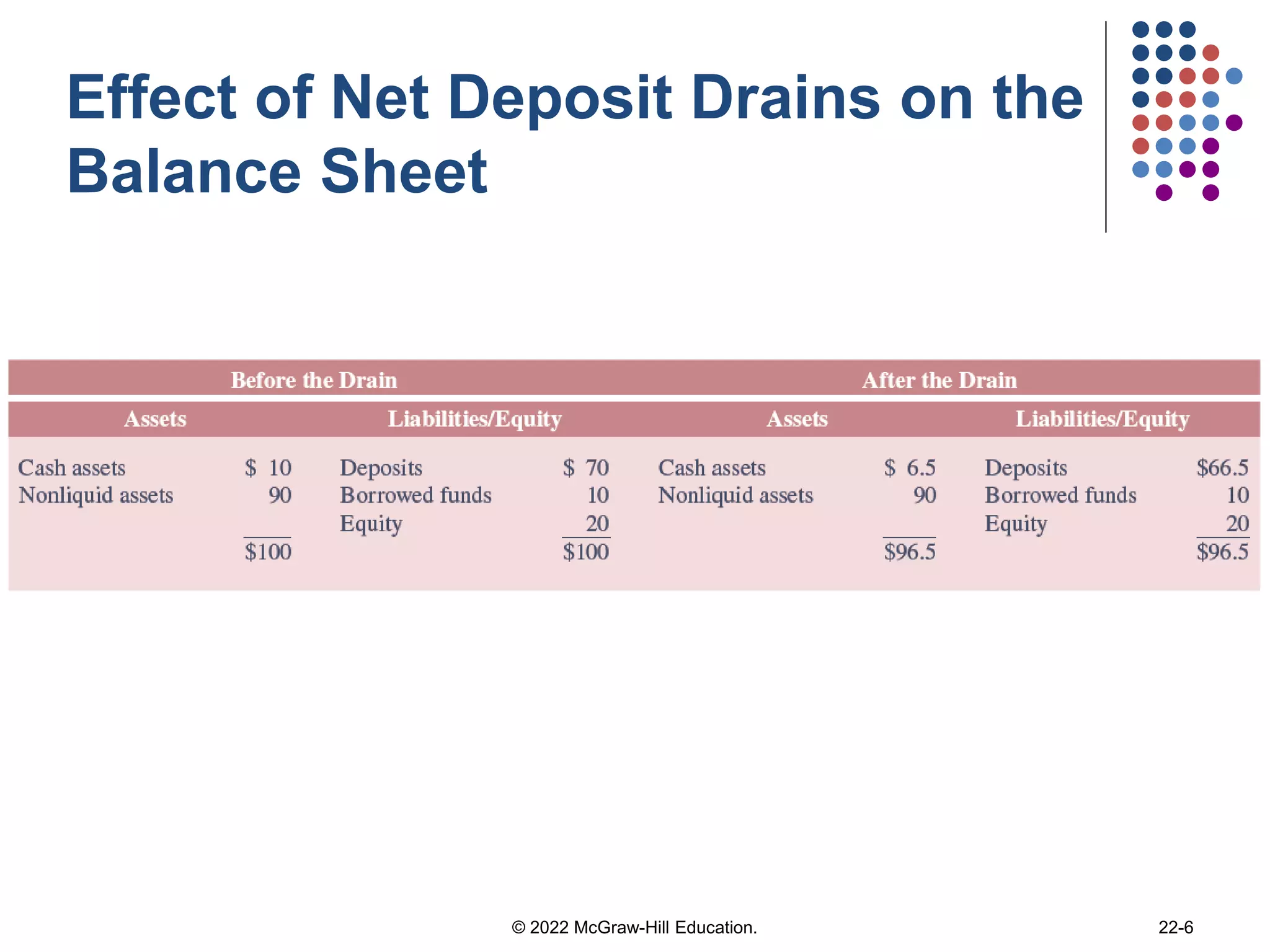
Effect of Net Deposit Drains on the
Balance Sheet
© 2022 McGraw-Hill Education. 22-6
Liquidity Risk and
Depository Institutions (DIs)
(Continued)
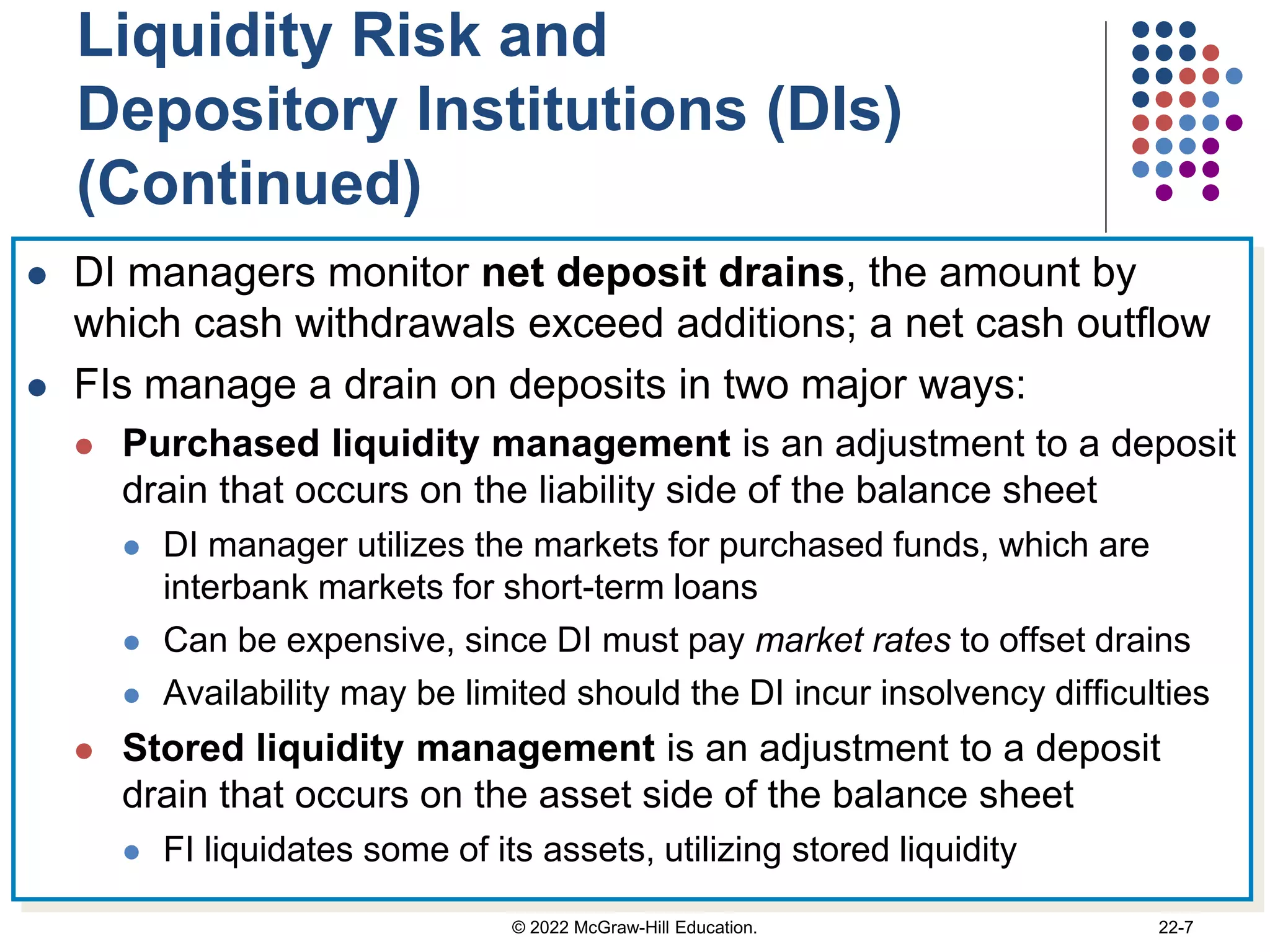
 DI managers monitor net deposit drains, the amount by
which cash withdrawals exceed additions; a net cash outflow
 FIs manage a drain on deposits in two major ways:
 Purchased liquidity management is an adjustment to a deposit
drain that occurs on the liability side of the balance sheet
 DI manager utilizes the markets for purchased funds, which are
interbank markets for short-term loans
 Can be expensive, since DI must pay market rates to offset drains
 Availability may be limited should the DI incur insolvency difficulties
 Stored liquidity management is an adjustment to a deposit
drain that occurs on the asset side of the balance sheet
 FI liquidates some of its assets, utilizing stored liquidity
© 2022 McGraw-Hill Education. 22-7
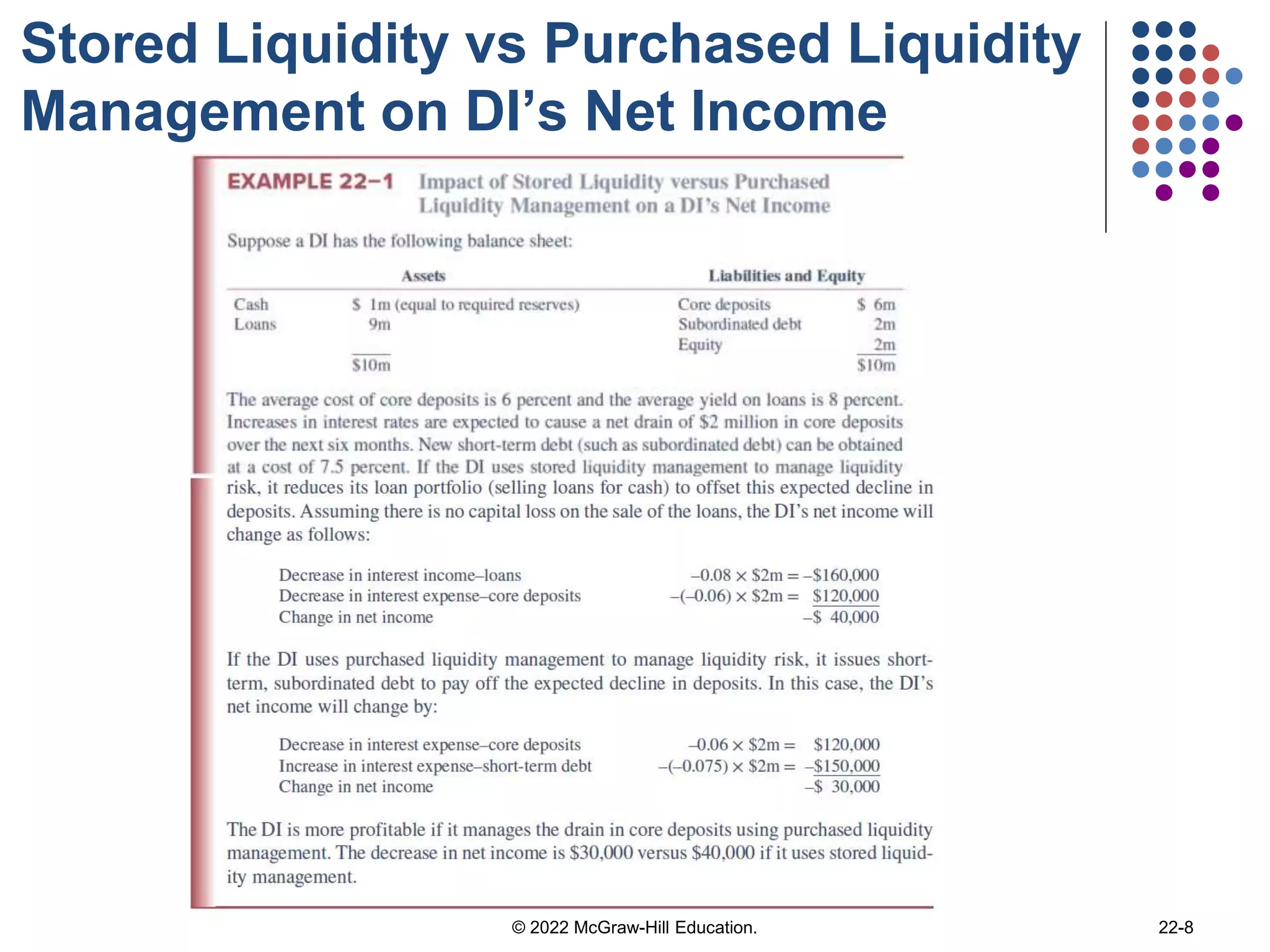
Stored Liquidity vs Purchased Liquidity
Management on DI’s Net Income
© 2022 McGraw-Hill Education. 22-8
Liquidity Risk and
Depository Institutions (DIs)
(Concluded)
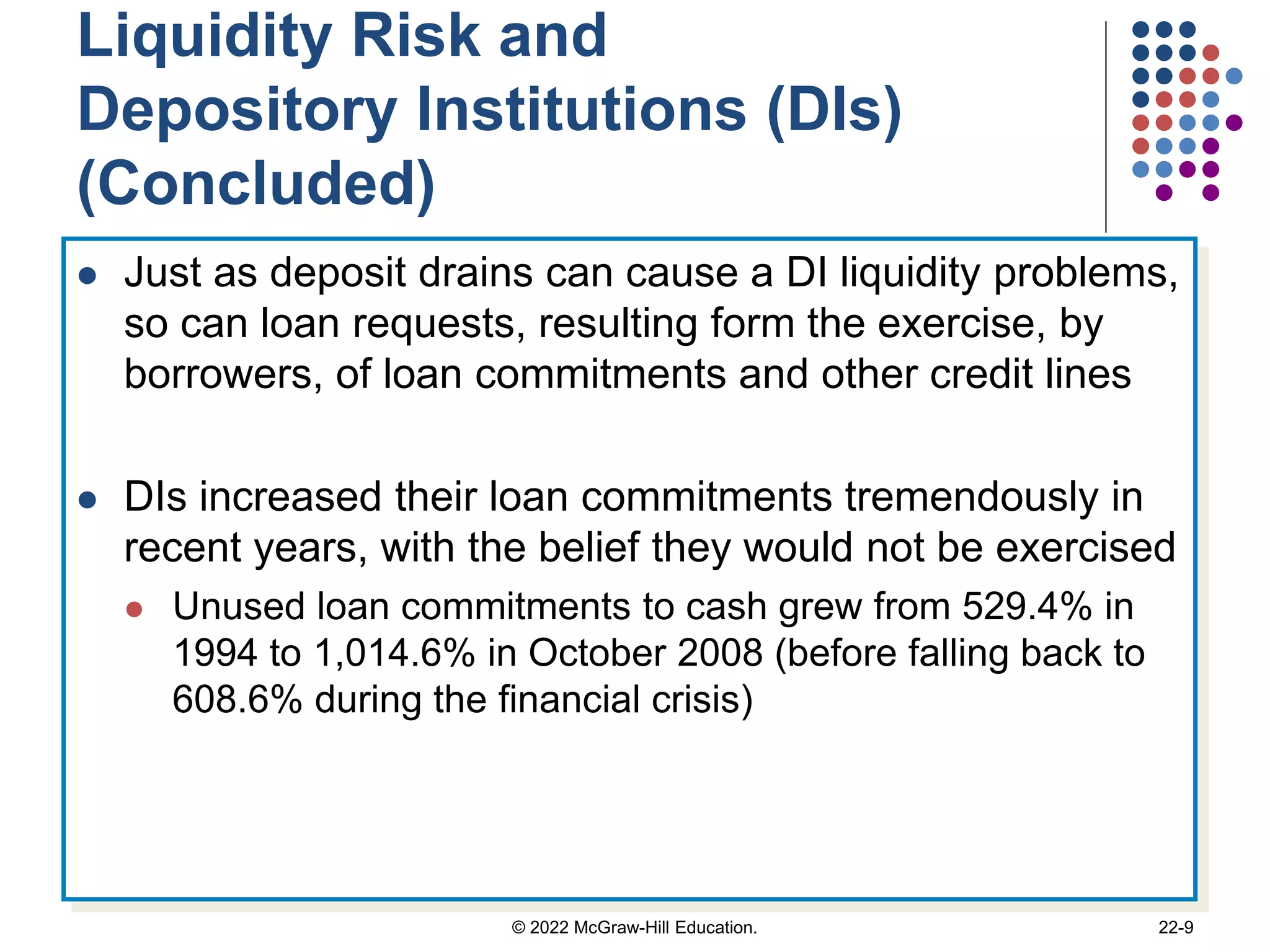
 Just as deposit drains can cause a DI liquidity problems,
so can loan requests, resulting form the exercise, by
borrowers, of loan commitments and other credit lines
 DIs increased their loan commitments tremendously in
recent years, with the belief they would not be exercised
 Unused loan commitments to cash grew from 529.4% in
1994 to 1,014.6% in October 2008 (before falling back to
608.6% during the financial crisis)
© 2022 McGraw-Hill Education. 22-9
Financing Gap and the Financing
Requirement
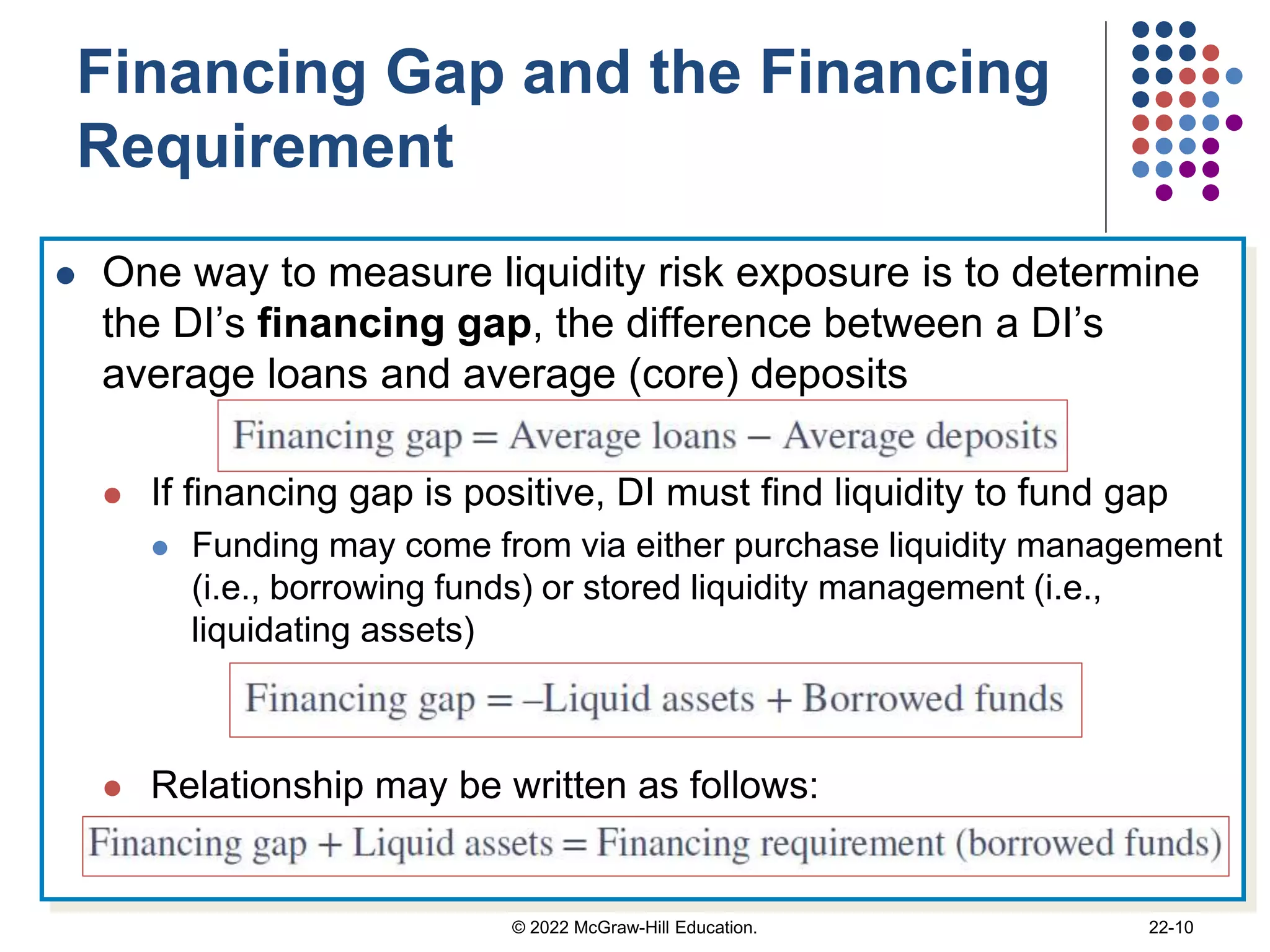
 One way to measure liquidity risk exposure is to determine
the DI’s financing gap, the difference between a DI’s
average loans and average (core) deposits
 If financing gap is positive, DI must find liquidity to fund gap
 Funding may come from via either purchase liquidity management
(i.e., borrowing funds) or stored liquidity management (i.e.,
liquidating assets)
 Relationship may be written as follows:
© 2022 McGraw-Hill Education. 22-10
Financing Gap and the Financing
Requirement (Continued)
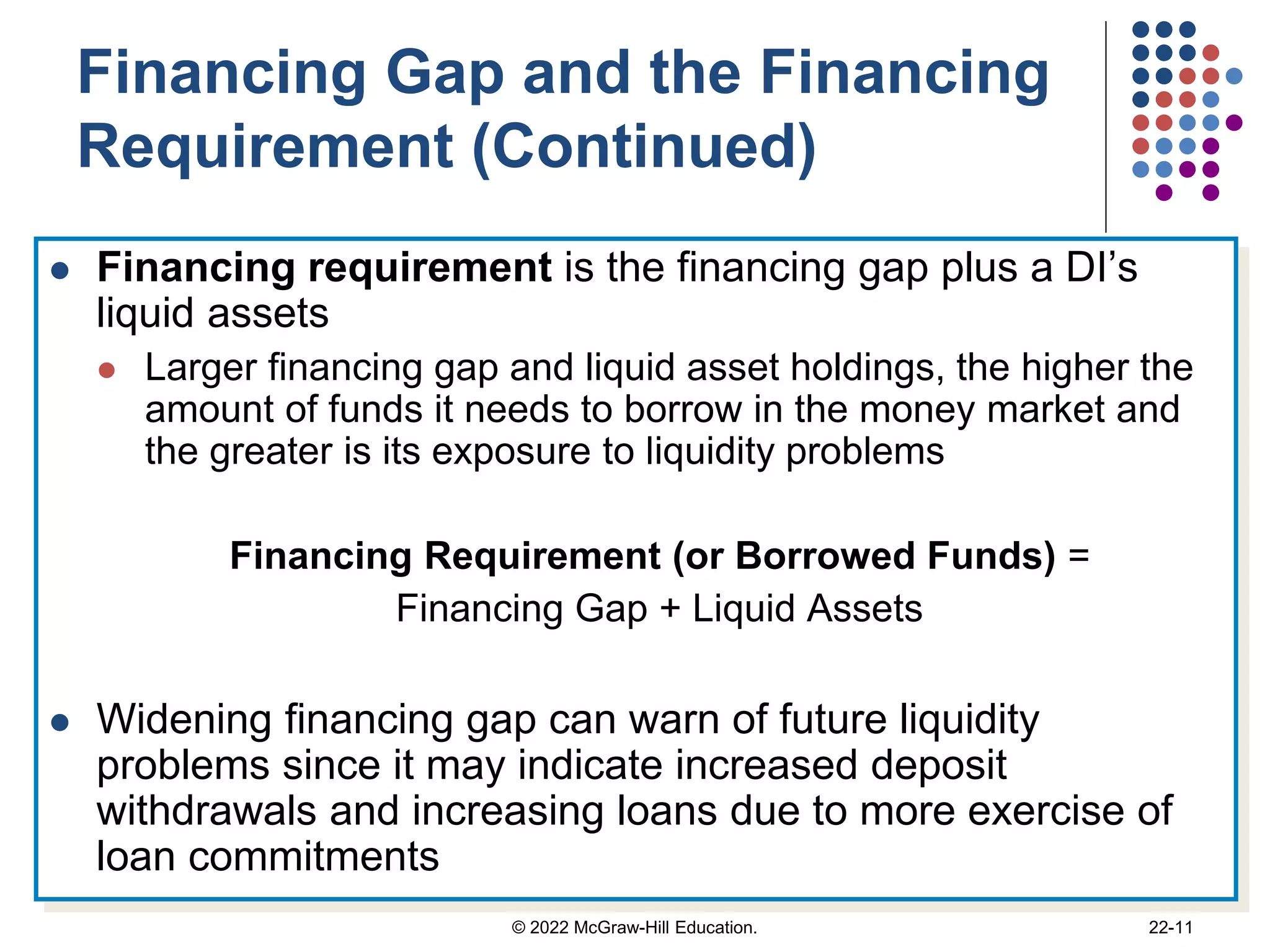
 Financing requirement is the financing gap plus a DI’s
liquid assets
 Larger financing gap and liquid asset holdings, the higher the
amount of funds it needs to borrow in the money market and
the greater is its exposure to liquidity problems
Financing Requirement (or Borrowed Funds) =
Financing Gap + Liquid Assets
 Widening financing gap can warn of future liquidity
problems since it may indicate increased deposit
withdrawals and increasing loans due to more exercise of
loan commitments
© 2022 McGraw-Hill Education. 22-11
Sources and Uses of Liquidity
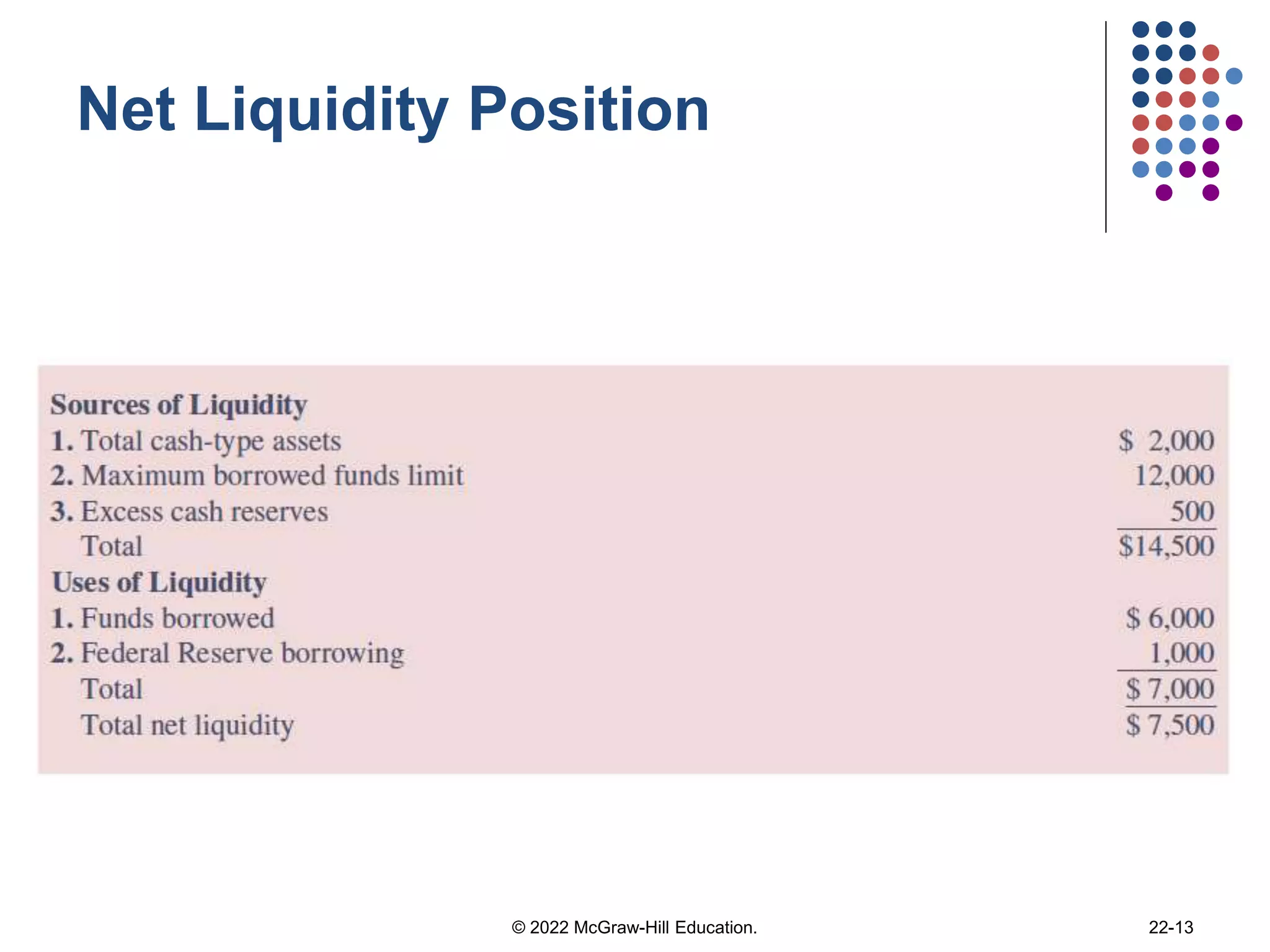
 Net liquidity statement lists sources and uses of liquidity,
and, thus, provides a measure of a DI’s net liquidity position
 Used by DI managers to measure DI’s daily liquidity position,
serving as the second method by which to measure liquidity
risk exposure
 DI can obtain liquid funds in three ways:
1. Sell its liquid assets, such as T-bills, immediately with little
price risk and low transaction costs
2. Borrow funds in the money/purchased funds market up to a
maximum amount
3. Use any excess cash reserves over and above the amount
held to meet regulatory imposed reserve requirements
 All DIs report historical sources and uses of liquidity in
annual and quarterly reports
© 2022 McGraw-Hill Education. 22-12
Net Liquidity Position
22-13
© 2022 McGraw-Hill Education.
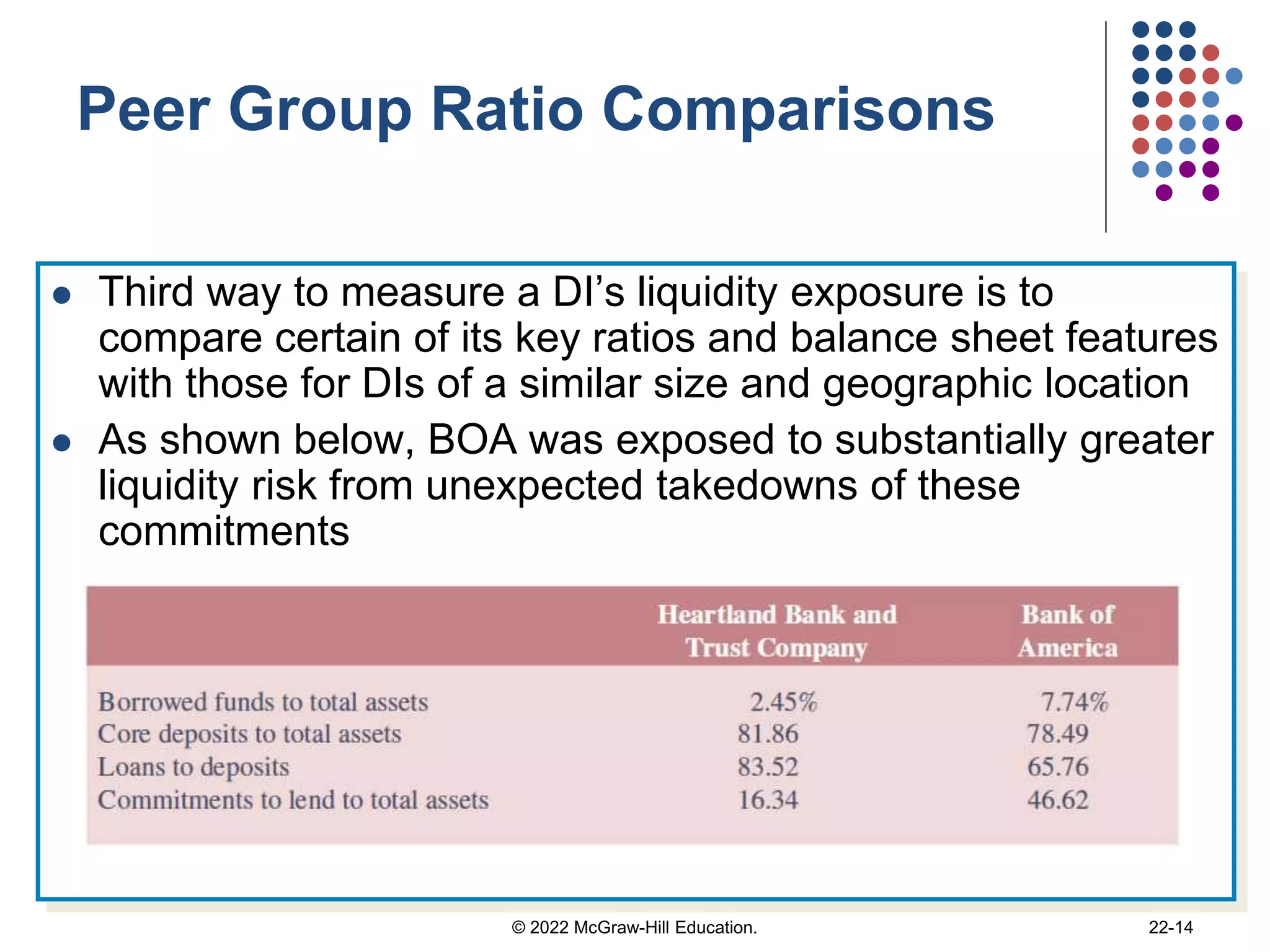
Peer Group Ratio Comparisons
 Third way to measure a DI’s liquidity exposure is to
compare certain of its key ratios and balance sheet features
with those for DIs of a similar size and geographic location
 As shown below, BOA was exposed to substantially greater
liquidity risk from unexpected takedowns of these
commitments
© 2022 McGraw-Hill Education. 22-14
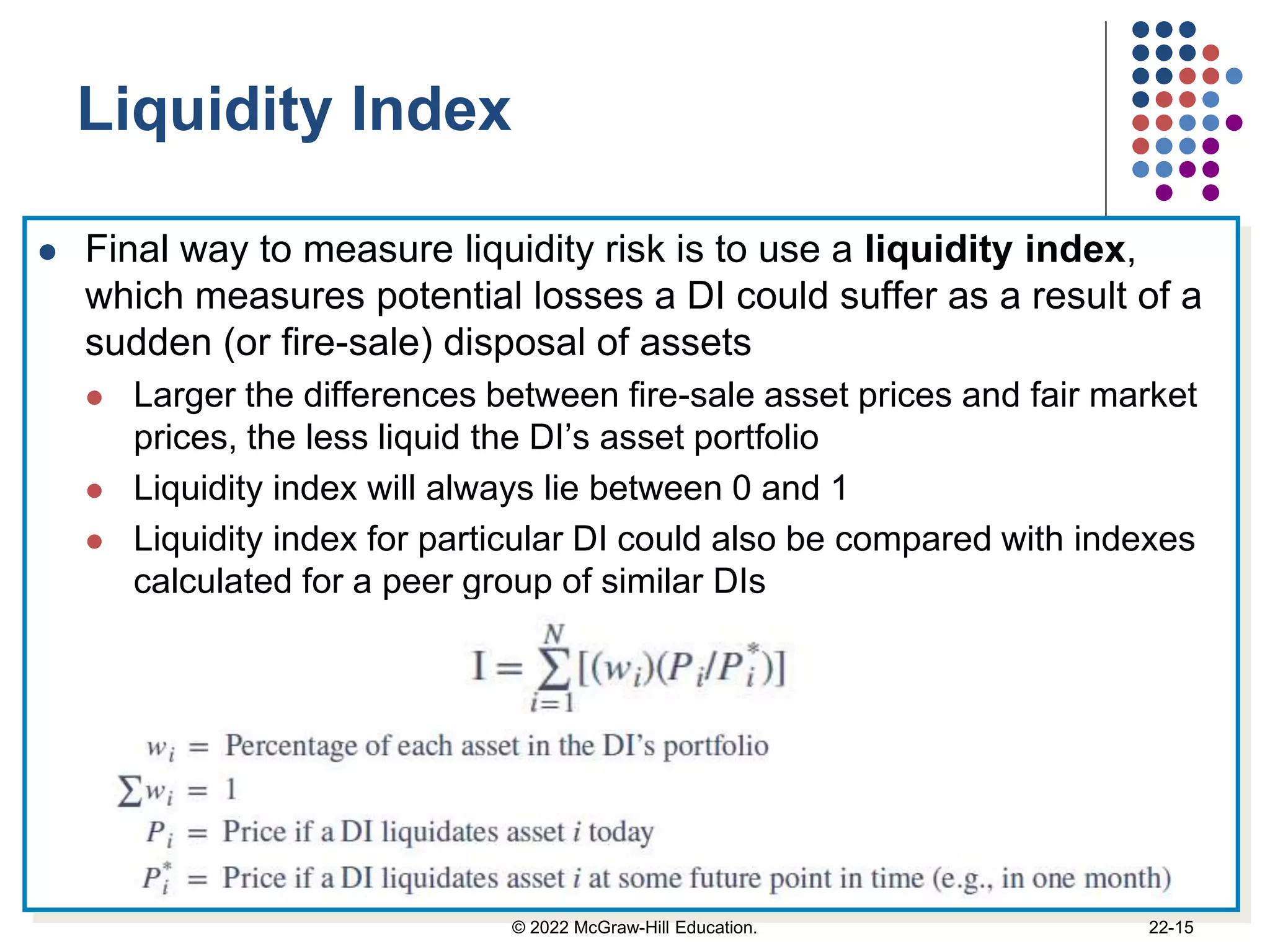
Liquidity Index
 Final way to measure liquidity risk is to use a liquidity index,
which measures potential losses a DI could suffer as a result of a
sudden (or fire-sale) disposal of assets
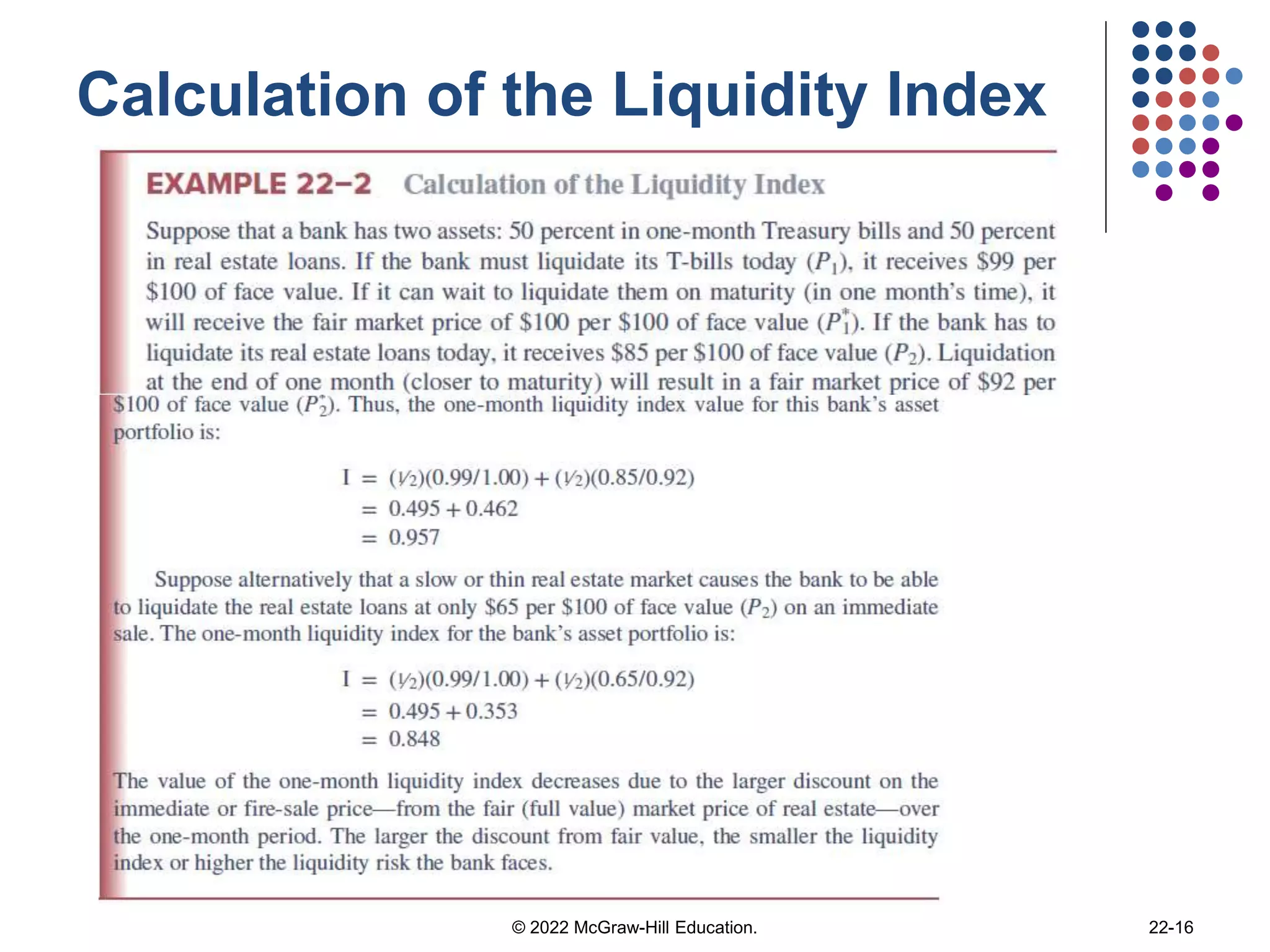
 Larger the differences between fire-sale asset prices and fair market
prices, the less liquid the DI’s asset portfolio
 Liquidity index will always lie between 0 and 1
 Liquidity index for particular DI could also be compared with indexes
calculated for a peer group of similar DIs
© 2022 McGraw-Hill Education. 22-15
Calculation of the Liquidity Index
22-16
© 2022 McGraw-Hill Education.
New Liquidity Risk Measures
Implemented by BIS
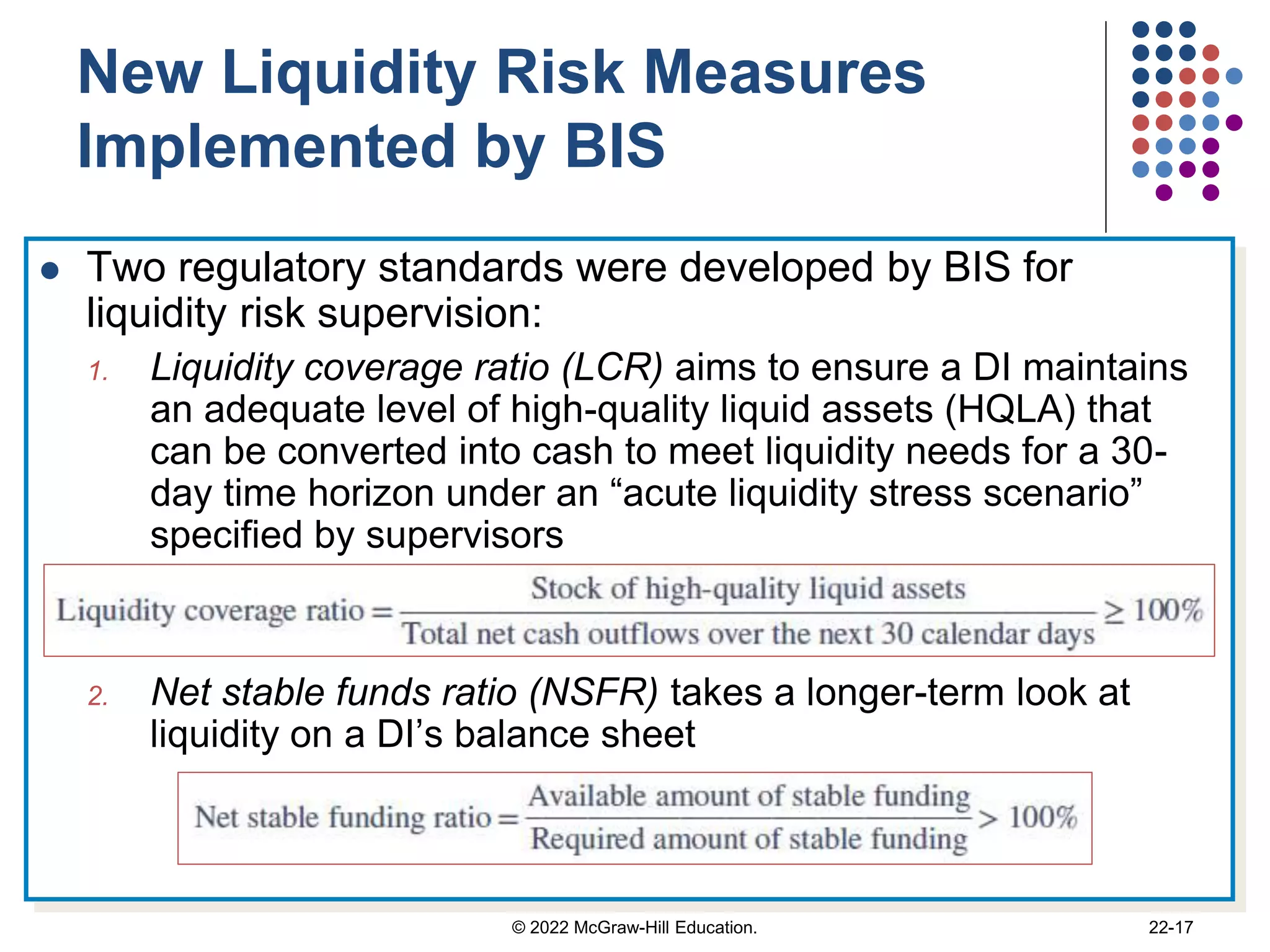
 Two regulatory standards were developed by BIS for
liquidity risk supervision:
1. Liquidity coverage ratio (LCR) aims to ensure a DI maintains
an adequate level of high-quality liquid assets (HQLA) that
can be converted into cash to meet liquidity needs for a 30-
day time horizon under an “acute liquidity stress scenario”
specified by supervisors
2. Net stable funds ratio (NSFR) takes a longer-term look at
liquidity on a DI’s balance sheet
© 2022 McGraw-Hill Education. 22-17
Liquidity Planning
 Liquidity planning allows managers to make important
borrowing priority decisions before liquidity problems arise
 Lowers costs of funds by determining an optimal funding mix
 Minimizes amount of excess reserves a DI needs to hold
 Liquidity plans have a number of components:
1. Delineation of managerial details and responsibilities
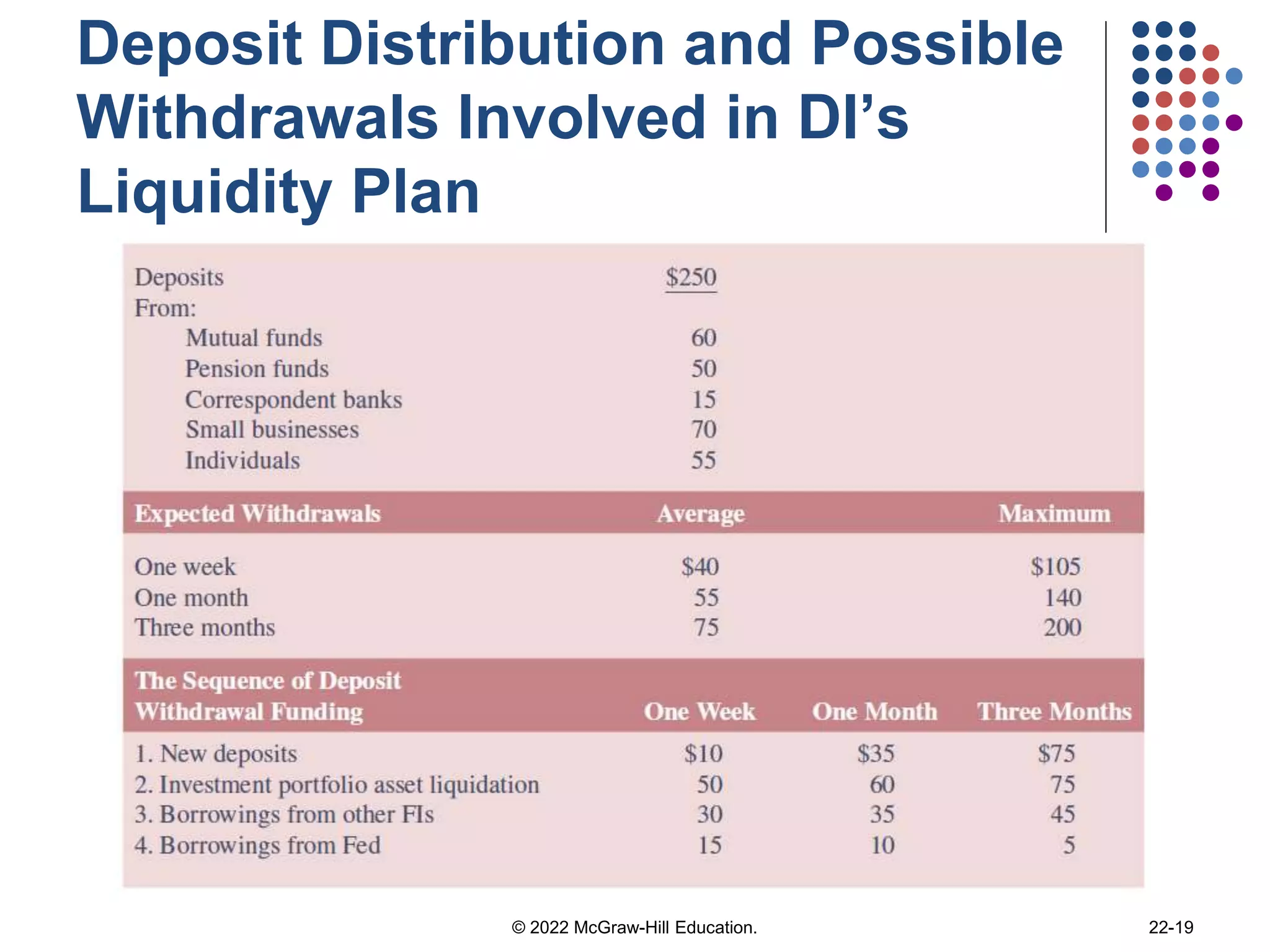
2. Detailed list of fund providers most likely to withdraw
funds and a pattern of fund withdrawals
3. Identification of the size of potential deposit and fund
withdrawals over various time horizons in the future
4. Internal limits on separate subsidiaries’ and branches’
borrowings as well as acceptable risk premiums to pay in
each market (fed funds, RPs, CDs, etc.)
© 2022 McGraw-Hill Education. 22-18
Deposit Distribution and Possible
Withdrawals Involved in DI’s
Liquidity Plan
22-19
© 2022 McGraw-Hill Education.
Liquidity Risk, Unexpected
Deposit Drains, and Bank Runs
 Major liquidity problems arise if deposit drains are
abnormally large and unexpected
 Abnormal deposit drains can occur for a number of reasons,
including the following:
 Concerns about a DI’s solvency relative to that of other DIs
 Failure of a related DI, leading to heightened depositor
concerns about the solvency of surviving DIs (i.e., a contagion
effect)
 Sudden changes in investor preferences regarding holding
nonbank financial assets (e.g., T-bills or mutual funds shares)
relative to DI deposits
 A bank run is a sudden and unexpected increase in deposit
withdrawals from a DI
© 2022 McGraw-Hill Education. 22-20
Deposit Drains and Bank Run
Liquidity Risk
 Demand deposits are first-come, first-served contracts in
the sense that a depositor’s place in line determines the
amount he or she will be able to withdraw from a DI
 Incentives for depositors to withdraw their funds at the first
sign of trouble creates a fundamental instability in the
banking system
 A bank panic is a systemic or contagious run on the deposits
of the banking industry as a whole
 Regulatory mechanisms are in place to ease banks’
liquidity problems and to deter bank runs and panics
1. Deposit insurance
2. Discount window
© 2022 McGraw-Hill Education. 22-21
Deposit Insurance
 FDIC was created in 1933 in the wake of the banking panics
of 1930-1933, when some 10,000 commercial banks failed
 Deposit insurance was first introduced in the U.S. in 1934
with coverage up to $2,500
 Coverage was increased to $100,000 in 1980 and to $250,000
in October 2008
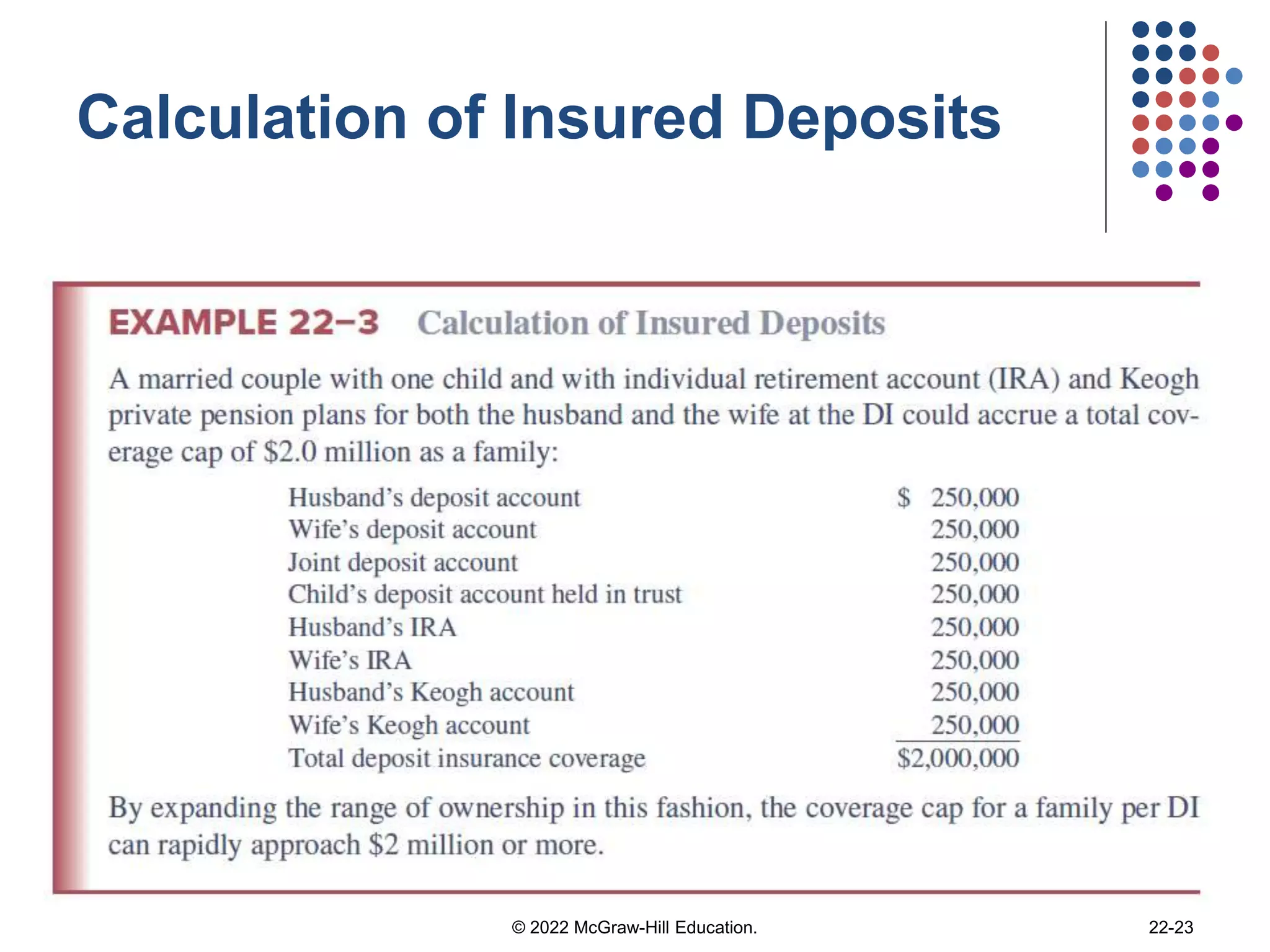
 Individuals can achieve many times the $250,000 coverage
cap on deposits by structuring their deposits in a particular
fashion
 Primary intention of deposit insurance is to deter DI runs
and panics, but a secondary and related objective has been
to protect the smaller, less informed saver against the
reduction in wealth that would occur if that person were last
in line were the DI to fail
© 2022 McGraw-Hill Education. 22-22
Calculation of Insured Deposits
22-23
© 2022 McGraw-Hill Education.
The Discount Window
 Federal Reserve also provides a “discount window”
lending facility, serving as a lender of last resort
 Interest rate at which securities are discounted is called
the discount rate and is set by the central bank
 While the discount window has traditionally been
available to DIs, in the spring of 2008 investment banks
gained access to the discount window through the
Primary Dealer Credit Facility (PDCF)
 After March 2008, several new broad-based lending
programs were implemented, providing funding to a wide
array of new parties, including U.S. money market mutual
funds, commercial paper issuers, insurance companies,
and others
© 2022 McGraw-Hill Education. 22-24
Liquidity Risk and Insurance
Companies
 Life insurance companies hold cash reserves and other
liquid assets for the following reasons:
 Meet policy payments
 Meet cancellation (surrender) payments
 Surrender value of a life insurance policy is amount that
insurance policyholder receives when cashing in a policy early
 Other working capital needs
 Property-casualty (P&C) insurance companies
 Claims against P&C insurers are relatively short-term and
unpredictable
 P&C insurance companies have a greater need for liquidity
than life insurance companies
© 2022 McGraw-Hill Education. 22-25
Guarantee Programs
 Both life insurance and property-casualty insurance
companies are regulated at the state level
 Unlike banks and thrifts, neither life nor P&C insurers have a federal
guarantee fund
 Beginning in the 1960s, most states began to sponsor state
guarantee funds for firms selling insurance in that state
 Differ from deposit insurance in several important ways:
 Programs are run and administered by the private insurance
companies themselves
 No permanent guarantee fund exists for the insurance industry,
with the sole exception of the state of New York
 Size of required contributions that surviving insurers make vary
widely from state to state
 Delay usually occurs before cash surrender values or other
payment obligations are received from the guarantee fund
© 2022 McGraw-Hill Education. 22-26
Liquidity Risk and Investment
Funds
 Investment funds, such as mutual funds and hedge funds,
sell shares as liabilities to investors and invest the
proceeds in assets such as bonds and equities
 Face similar liquidity problems as DIs when the number of
withdrawals rises to abnormally high or unexpected levels
 Fundamental difference in the way investment fund
contracts are valued compared to the valuation of DI deposit
contracts, thereby reducing the incentives for investment
fund shareholders to engage in deposit-like runs
© 2022 McGraw-Hill Education. 22-27

Saunders 8e ppt_chapter22

  • 1.
    Financial Institutions Course Code456413 by Dr. Muath Asmar An-Najah National University Faculty of Graduate Studies
  • 2.
    Chapter Twenty- Two Managing Liquidity Riskon the Balance Sheet Copyright © 2022 McGraw-Hill. All rights reserved. No reproduction or distribution without the prior written consent of McGraw-Hill.
  • 3.
    Liquidity Risk Management Unlike other risks, liquidity risk is a normal aspect of the everyday management of an FI  Banks must manage liquidity so they can pay out cash as deposit holders request withdrawals of their funds  At the extreme, liquidity risk can lead to insolvency  Some FIs are more exposed to liquidity risk than others  Depository institutions (DIs) are highly exposed  Mutual funds, hedge funds, pension funds, and property- casualty insurers have relatively low liquidity risk exposure  Financial crisis of 2008-2009 was, in part, due to liquidity risk  Central banks around the world had to pump short-term cash into strained markets to stem the post-2007 liquidity crisis © 2022 McGraw-Hill Education. 22-3
  • 4.
    Causes of LiquidityRisk  Liquidity risk arises for two reasons: 1. Liability-side reason occurs when FI’s liability holders, such as depositors or insurance policyholders, seek to cash in their financial claims immediately  FIs must meet withdrawals by borrowing additional funds or liquidating assets  Some assets may be liquidated only at fire-sale prices 2. Asset-side reason arises when FI needs to fund loans immediately  Loan commitment allows a customer to borrow funds from an FI on demand, and when a borrower draws on its loan commitment, the FI must fund the loan on the balance sheet immediately  FIs may meet this need by running down cash assets, selling off other liquid assets, or borrowing additional funds © 2022 McGraw-Hill Education. 22-4
  • 5.
    Liquidity Risk and DepositoryInstitutions (DIs)  DIs’ balance sheets typically have large amounts of short- term liabilities, such as demand deposits and other transaction accounts, that fund relatively long-term, illiquid assets (e.g., commercial loans and mortgages)  Demand deposit accounts and other transaction accounts are contracts that give holders the right to put their financial claims back to the DI on any given day and demand immediate repayment of the face value in cash  DIs know that normally only a small portion of demand deposits will be withdrawn on any given day  Most demand deposits act as core deposits—i.e., they are a stable and long-term funding source  Deposit withdrawals are normally, in part, offset by the inflow of new deposits © 2022 McGraw-Hill Education. 22-5
  • 6.
    Effect of NetDeposit Drains on the Balance Sheet © 2022 McGraw-Hill Education. 22-6
  • 7.
    Liquidity Risk and DepositoryInstitutions (DIs) (Continued)  DI managers monitor net deposit drains, the amount by which cash withdrawals exceed additions; a net cash outflow  FIs manage a drain on deposits in two major ways:  Purchased liquidity management is an adjustment to a deposit drain that occurs on the liability side of the balance sheet  DI manager utilizes the markets for purchased funds, which are interbank markets for short-term loans  Can be expensive, since DI must pay market rates to offset drains  Availability may be limited should the DI incur insolvency difficulties  Stored liquidity management is an adjustment to a deposit drain that occurs on the asset side of the balance sheet  FI liquidates some of its assets, utilizing stored liquidity © 2022 McGraw-Hill Education. 22-7
  • 8.
    Stored Liquidity vsPurchased Liquidity Management on DI’s Net Income © 2022 McGraw-Hill Education. 22-8
  • 9.
    Liquidity Risk and DepositoryInstitutions (DIs) (Concluded)  Just as deposit drains can cause a DI liquidity problems, so can loan requests, resulting form the exercise, by borrowers, of loan commitments and other credit lines  DIs increased their loan commitments tremendously in recent years, with the belief they would not be exercised  Unused loan commitments to cash grew from 529.4% in 1994 to 1,014.6% in October 2008 (before falling back to 608.6% during the financial crisis) © 2022 McGraw-Hill Education. 22-9
  • 10.
    Financing Gap andthe Financing Requirement  One way to measure liquidity risk exposure is to determine the DI’s financing gap, the difference between a DI’s average loans and average (core) deposits  If financing gap is positive, DI must find liquidity to fund gap  Funding may come from via either purchase liquidity management (i.e., borrowing funds) or stored liquidity management (i.e., liquidating assets)  Relationship may be written as follows: © 2022 McGraw-Hill Education. 22-10
  • 11.
    Financing Gap andthe Financing Requirement (Continued)  Financing requirement is the financing gap plus a DI’s liquid assets  Larger financing gap and liquid asset holdings, the higher the amount of funds it needs to borrow in the money market and the greater is its exposure to liquidity problems Financing Requirement (or Borrowed Funds) = Financing Gap + Liquid Assets  Widening financing gap can warn of future liquidity problems since it may indicate increased deposit withdrawals and increasing loans due to more exercise of loan commitments © 2022 McGraw-Hill Education. 22-11
  • 12.
    Sources and Usesof Liquidity  Net liquidity statement lists sources and uses of liquidity, and, thus, provides a measure of a DI’s net liquidity position  Used by DI managers to measure DI’s daily liquidity position, serving as the second method by which to measure liquidity risk exposure  DI can obtain liquid funds in three ways: 1. Sell its liquid assets, such as T-bills, immediately with little price risk and low transaction costs 2. Borrow funds in the money/purchased funds market up to a maximum amount 3. Use any excess cash reserves over and above the amount held to meet regulatory imposed reserve requirements  All DIs report historical sources and uses of liquidity in annual and quarterly reports © 2022 McGraw-Hill Education. 22-12
  • 13.
    Net Liquidity Position 22-13 ©2022 McGraw-Hill Education.
  • 14.
    Peer Group RatioComparisons  Third way to measure a DI’s liquidity exposure is to compare certain of its key ratios and balance sheet features with those for DIs of a similar size and geographic location  As shown below, BOA was exposed to substantially greater liquidity risk from unexpected takedowns of these commitments © 2022 McGraw-Hill Education. 22-14
  • 15.
    Liquidity Index  Finalway to measure liquidity risk is to use a liquidity index, which measures potential losses a DI could suffer as a result of a sudden (or fire-sale) disposal of assets  Larger the differences between fire-sale asset prices and fair market prices, the less liquid the DI’s asset portfolio  Liquidity index will always lie between 0 and 1  Liquidity index for particular DI could also be compared with indexes calculated for a peer group of similar DIs © 2022 McGraw-Hill Education. 22-15
  • 16.
    Calculation of theLiquidity Index 22-16 © 2022 McGraw-Hill Education.
  • 17.
    New Liquidity RiskMeasures Implemented by BIS  Two regulatory standards were developed by BIS for liquidity risk supervision: 1. Liquidity coverage ratio (LCR) aims to ensure a DI maintains an adequate level of high-quality liquid assets (HQLA) that can be converted into cash to meet liquidity needs for a 30- day time horizon under an “acute liquidity stress scenario” specified by supervisors 2. Net stable funds ratio (NSFR) takes a longer-term look at liquidity on a DI’s balance sheet © 2022 McGraw-Hill Education. 22-17
  • 18.
    Liquidity Planning  Liquidityplanning allows managers to make important borrowing priority decisions before liquidity problems arise  Lowers costs of funds by determining an optimal funding mix  Minimizes amount of excess reserves a DI needs to hold  Liquidity plans have a number of components: 1. Delineation of managerial details and responsibilities 2. Detailed list of fund providers most likely to withdraw funds and a pattern of fund withdrawals 3. Identification of the size of potential deposit and fund withdrawals over various time horizons in the future 4. Internal limits on separate subsidiaries’ and branches’ borrowings as well as acceptable risk premiums to pay in each market (fed funds, RPs, CDs, etc.) © 2022 McGraw-Hill Education. 22-18
  • 19.
    Deposit Distribution andPossible Withdrawals Involved in DI’s Liquidity Plan 22-19 © 2022 McGraw-Hill Education.
  • 20.
    Liquidity Risk, Unexpected DepositDrains, and Bank Runs  Major liquidity problems arise if deposit drains are abnormally large and unexpected  Abnormal deposit drains can occur for a number of reasons, including the following:  Concerns about a DI’s solvency relative to that of other DIs  Failure of a related DI, leading to heightened depositor concerns about the solvency of surviving DIs (i.e., a contagion effect)  Sudden changes in investor preferences regarding holding nonbank financial assets (e.g., T-bills or mutual funds shares) relative to DI deposits  A bank run is a sudden and unexpected increase in deposit withdrawals from a DI © 2022 McGraw-Hill Education. 22-20
  • 21.
    Deposit Drains andBank Run Liquidity Risk  Demand deposits are first-come, first-served contracts in the sense that a depositor’s place in line determines the amount he or she will be able to withdraw from a DI  Incentives for depositors to withdraw their funds at the first sign of trouble creates a fundamental instability in the banking system  A bank panic is a systemic or contagious run on the deposits of the banking industry as a whole  Regulatory mechanisms are in place to ease banks’ liquidity problems and to deter bank runs and panics 1. Deposit insurance 2. Discount window © 2022 McGraw-Hill Education. 22-21
  • 22.
    Deposit Insurance  FDICwas created in 1933 in the wake of the banking panics of 1930-1933, when some 10,000 commercial banks failed  Deposit insurance was first introduced in the U.S. in 1934 with coverage up to $2,500  Coverage was increased to $100,000 in 1980 and to $250,000 in October 2008  Individuals can achieve many times the $250,000 coverage cap on deposits by structuring their deposits in a particular fashion  Primary intention of deposit insurance is to deter DI runs and panics, but a secondary and related objective has been to protect the smaller, less informed saver against the reduction in wealth that would occur if that person were last in line were the DI to fail © 2022 McGraw-Hill Education. 22-22
  • 23.
    Calculation of InsuredDeposits 22-23 © 2022 McGraw-Hill Education.
  • 24.
    The Discount Window Federal Reserve also provides a “discount window” lending facility, serving as a lender of last resort  Interest rate at which securities are discounted is called the discount rate and is set by the central bank  While the discount window has traditionally been available to DIs, in the spring of 2008 investment banks gained access to the discount window through the Primary Dealer Credit Facility (PDCF)  After March 2008, several new broad-based lending programs were implemented, providing funding to a wide array of new parties, including U.S. money market mutual funds, commercial paper issuers, insurance companies, and others © 2022 McGraw-Hill Education. 22-24
  • 25.
    Liquidity Risk andInsurance Companies  Life insurance companies hold cash reserves and other liquid assets for the following reasons:  Meet policy payments  Meet cancellation (surrender) payments  Surrender value of a life insurance policy is amount that insurance policyholder receives when cashing in a policy early  Other working capital needs  Property-casualty (P&C) insurance companies  Claims against P&C insurers are relatively short-term and unpredictable  P&C insurance companies have a greater need for liquidity than life insurance companies © 2022 McGraw-Hill Education. 22-25
  • 26.
    Guarantee Programs  Bothlife insurance and property-casualty insurance companies are regulated at the state level  Unlike banks and thrifts, neither life nor P&C insurers have a federal guarantee fund  Beginning in the 1960s, most states began to sponsor state guarantee funds for firms selling insurance in that state  Differ from deposit insurance in several important ways:  Programs are run and administered by the private insurance companies themselves  No permanent guarantee fund exists for the insurance industry, with the sole exception of the state of New York  Size of required contributions that surviving insurers make vary widely from state to state  Delay usually occurs before cash surrender values or other payment obligations are received from the guarantee fund © 2022 McGraw-Hill Education. 22-26
  • 27.
    Liquidity Risk andInvestment Funds  Investment funds, such as mutual funds and hedge funds, sell shares as liabilities to investors and invest the proceeds in assets such as bonds and equities  Face similar liquidity problems as DIs when the number of withdrawals rises to abnormally high or unexpected levels  Fundamental difference in the way investment fund contracts are valued compared to the valuation of DI deposit contracts, thereby reducing the incentives for investment fund shareholders to engage in deposit-like runs © 2022 McGraw-Hill Education. 22-27