MOBILE COMPUTING
BY
SURENDRA PATIL 51
SUJATA RAVKHANDE 43
RAHUL VALU 40
GAUTAMI GAIKWAD 19
Presentation
on
WHAT IS MOBILE COMPUTING
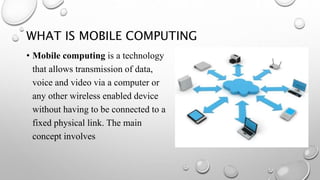
• Mobile computing is a technology
that allows transmission of data,
voice and video via a computer or
any other wireless enabled device
without having to be connected to a
fixed physical link. The main
concept involves
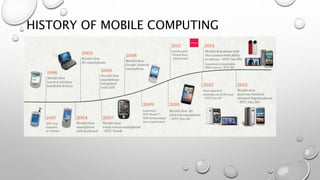
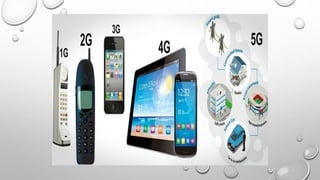
HISTORY OF MOBILE COMPUTING
USE OF MOBILE COMPUTING
• Transmission of news, road condition, traffic information, weather
information
• Personal communication using mobile phone
• Positioning via gps
• Local ad-hoc network with vehicles close by to prevent accident,
report traffic jams, guidance system,etc
• Vehicle data(ex. For busses, high speed train) can be transmitted in
advance for maintenance.
CHALLENGES OF MOBILE COMPUTING
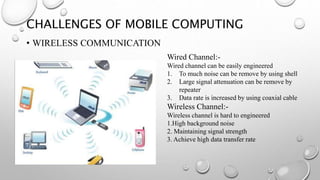
• WIRELESS COMMUNICATION
Wired Channel:-
Wired channel can be easily engineered
1. To much noise can be remove by using shell
2. Large signal attenuation can be remove by
repeater
3. Data rate is increased by using coaxial cable
Wireless Channel:-
Wireless channel is hard to engineered
1.High background noise
2. Maintaining signal strength
3. Achieve high data transfer rate
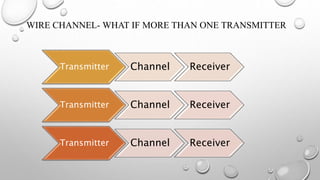
WIRE CHANNEL- WHAT IF MORE THAN ONE TRANSMITTER
Transmitter Channel Receiver
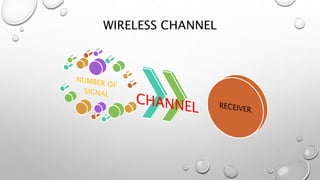
WIRELESS CHANNEL
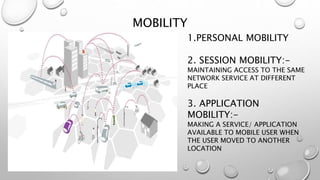
MOBILITY
1.PERSONAL MOBILITY
2. SESSION MOBILITY:-
MAINTAINING ACCESS TO THE SAME
NETWORK SERVICE AT DIFFERENT
PLACE
3. APPLICATION
MOBILITY:-
MAKING A SERVICE/ APPLICATION
AVAILABLE TO MOBILE USER WHEN
THE USER MOVED TO ANOTHER
LOCATION
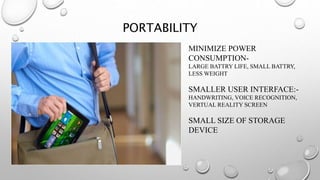
PORTABILITY
MINIMIZE POWER
CONSUMPTION-
LARGE BATTRY LIFE, SMALL BATTRY,
LESS WEIGHT
SMALLER USER INTERFACE:-
HANDWRITING, VOICE RECOGNITION,
VERTUAL REALITY SCREEN
SMALL SIZE OF STORAGE
DEVICE
Increase in productivity: Mobile devices can be used out in the field
of various companies, therefore reducing the time and cost for
clients and themselves.
Entertainment: Mobile devices can be used for entertainment
purposes, for personal and even for presentations to people and
client.
ADVANTAGES OF MOBILE
COMPUTING
• PORTABILITY: THIS WOULD BE ONE OF THE MAIN ADVANTAGES
OF MOBILE COMPUTING, YOU ARE NOT RESTRICTED TO ONE
LOCATION IN ORDER FOR YOU TO GET JOBS DONE OR EVEN
ACCESS EMAIL ON THE GO.
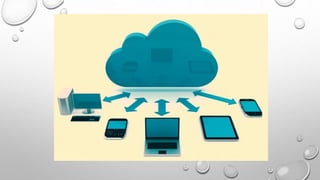
• CLOUD COMPUTING: THIS SERVICE IS AVAILABLE FOR SAVING
DOCUMENTS ON A ONLINE SERVER AND BEING ABLE TO
ACCESS THEM ANYTIME AND ANYWHERE WHEN YOU HAVE A
CONNECTION TO THE INTERNET AND CAN ACCESS THESE FILES
ON SEVERAL MOBILE DEVICES OR EVEN PCS AT HOME.
DISADVANTAGES OF MOBILE COMPUTING
• QUALITY OF CONNECTIVITY: AS ONE OF THE DISADVANTAGES,
MOBILE DEVICES WILL NEED EITHER WIFI CONNECTIVITY OR
MOBILE NETWORK CONNECTIVITY SUCH AS GPRS, 3G AND IN
SOME COUNTRIES EVEN 4G CONNECTIVITY THAT IS WHY THIS
IS A DISADVANTAGE BECAUSE IF YOU ARE NOT NEAR ANY OF
THESE CONNECTIONS YOUR ACCESS TO THE INTERNET IS VERY
LIMITED.
• SECURITY CONCERNS: MOBILE VPNS ARE UNSAFE TO CONNECT
TO, AND ALSO SYNCING DEVICES MIGHT ALSO LEAD TO
SECURITY CONCERNS. ACCESSING A WIFI NETWORK CAN ALSO
BE RISKY BECAUSE WPA AND WEP SECURITY CAN BE BYPASSED
EASILY.
• POWER CONSUMPTION: DUE TO THE USE OF BATTERIES IN
THESE DEVICES, THESE DO NOT TEND TO LAST LONG, IF IN A
SITUATION WHERE THERE IS NO SOURCE OF POWER FOR
CHARGING THEN THAT WILL CERTAINLY BE A LET DOWN.
EVOLUTION
Mobile computing is all about portable and small computers, which
includes PDAs (Personal Digital Assistants) like mobile phones,
palmtops, laptops etc. In this growing technological world, people
are much bound to work on computers and Internet. People are
attracted towards mobile devices because of their major features
such as-
Mobile computing can be defined as the ability to use technology
that is not physically connected to any static network. Nowadays,
most laptops and personal digital assistants(PDA) all have wireless
cards or Bluetooth interfaces built into them for very Good mobile
internet access. Mobile computing is “taking a computer and all
necessary files and software to the next Level
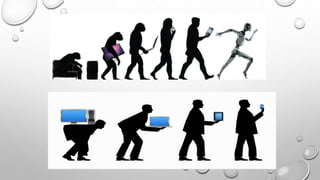
PORTABLE DEVICES
A portable computer (discontinued) is a general-purpose computer that can be
easily moved from place to place, but cannot be used while in transit, usually
because it requires some "setting-up" and an AC power source. The most
famous example is the Osborne 1. Portable computers are also called a
"transportable" or a "luggable" PC.
A personal digital assistant (PDA) (discontinued) is a small, usually pocket-
sized, computer with limited functionality. It is intended to supplement and to
synchronize with a desktop computer, giving access to contacts, address book,
notes, e-mail and other features.
• MOBILE COMPUTING DEVELOPING IN FOUR
DIMENSIONS
WARLESS DELIVERY TECHNOLOGY & SWITCHING
METHODS.
THIS CONCERNS THE FAST SPREADING DELIVERY
TECHNOLOGY OF CELLULAR , RADIO, SATELLITE
AND LAN COMMUNICATIONS WHICH ASSURE TO
PROVIDE INFORMATION TO MOBILE USERS
ANYWHERE ANY TIME.
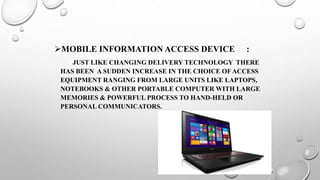
MOBILE INFORMATION ACCESS DEVICE :
JUST LIKE CHANGING DELIVERY TECHNOLOGY THERE
HAS BEEN A SUDDEN INCREASE IN THE CHOICE OFACCESS
EQUIPMENT RANGING FROM LARGE UNITS LIKE LAPTOPS,
NOTEBOOKS & OTHER PORTABLE COMPUTER WITH LARGE
MEMORIES & POWERFUL PROCESS TO HAND-HELD OR
PERSONAL COMMUNICATORS.
Mobile Data Inter – Networking Standards & Equipments :
Initially the voice oriented cellular systems were
designed only for voice calls & no data. Even then it has faced
hindrances like weak connections, frequent noise & moment
dropouts when users move from one cell tower another & face
physical barriers like bridge & tunnels. These same
distributions may occur for data calls ; also there are low
numbers frequencies available. In order to solve the problem ,
work has been undertaken in the areas digital cellular standard
which help in communications over cellular lines.
Mobile Computing Business Applications :
Mobility & portability have been responsible for
creating new class of applications & new markets which
combine persons computing and consumer electronics. Vehicle
dispatch and routing , inventory and package tracking & retail
point of sale are examples already existing vertical , niche
applications a mobile computing . Mail- enabled applications
and information or data services to mobile used are two
examples of organisational applications in use.
APPLICATION OF MOBILE COMPUTING
Vehicles
Emergencies
Business
Infotainment
Location Dependent Service
1. Follow-on services
2. Location Aware Services
3.Information Service
CONCLUSION
Today's computing has rapidly grown from being confined to a
single location. With mobile computing, people can work from the
comfort of any location they wish to as long as the connection and
the security concerns are properly factored. In the same light, the
presence of high speed connections has also promoted the use of
mobile computing.
Being an ever growing and emerging technology, mobile
computing will continue to be a core service in computing, and
Information and Communications Technology.
MIS

MIS

  • 1.
    MOBILE COMPUTING BY SURENDRA PATIL51 SUJATA RAVKHANDE 43 RAHUL VALU 40 GAUTAMI GAIKWAD 19 Presentation on
  • 2.
    WHAT IS MOBILECOMPUTING • Mobile computing is a technology that allows transmission of data, voice and video via a computer or any other wireless enabled device without having to be connected to a fixed physical link. The main concept involves
  • 3.
  • 4.
    USE OF MOBILECOMPUTING • Transmission of news, road condition, traffic information, weather information • Personal communication using mobile phone • Positioning via gps • Local ad-hoc network with vehicles close by to prevent accident, report traffic jams, guidance system,etc • Vehicle data(ex. For busses, high speed train) can be transmitted in advance for maintenance.
  • 5.
    CHALLENGES OF MOBILECOMPUTING • WIRELESS COMMUNICATION Wired Channel:- Wired channel can be easily engineered 1. To much noise can be remove by using shell 2. Large signal attenuation can be remove by repeater 3. Data rate is increased by using coaxial cable Wireless Channel:- Wireless channel is hard to engineered 1.High background noise 2. Maintaining signal strength 3. Achieve high data transfer rate
  • 6.
    WIRE CHANNEL- WHATIF MORE THAN ONE TRANSMITTER Transmitter Channel Receiver Transmitter Channel Receiver Transmitter Channel Receiver
  • 7.
  • 8.
    MOBILITY 1.PERSONAL MOBILITY 2. SESSIONMOBILITY:- MAINTAINING ACCESS TO THE SAME NETWORK SERVICE AT DIFFERENT PLACE 3. APPLICATION MOBILITY:- MAKING A SERVICE/ APPLICATION AVAILABLE TO MOBILE USER WHEN THE USER MOVED TO ANOTHER LOCATION
  • 9.
    PORTABILITY MINIMIZE POWER CONSUMPTION- LARGE BATTRYLIFE, SMALL BATTRY, LESS WEIGHT SMALLER USER INTERFACE:- HANDWRITING, VOICE RECOGNITION, VERTUAL REALITY SCREEN SMALL SIZE OF STORAGE DEVICE
  • 10.
    Increase in productivity:Mobile devices can be used out in the field of various companies, therefore reducing the time and cost for clients and themselves. Entertainment: Mobile devices can be used for entertainment purposes, for personal and even for presentations to people and client. ADVANTAGES OF MOBILE COMPUTING
  • 11.
    • PORTABILITY: THISWOULD BE ONE OF THE MAIN ADVANTAGES OF MOBILE COMPUTING, YOU ARE NOT RESTRICTED TO ONE LOCATION IN ORDER FOR YOU TO GET JOBS DONE OR EVEN ACCESS EMAIL ON THE GO. • CLOUD COMPUTING: THIS SERVICE IS AVAILABLE FOR SAVING DOCUMENTS ON A ONLINE SERVER AND BEING ABLE TO ACCESS THEM ANYTIME AND ANYWHERE WHEN YOU HAVE A CONNECTION TO THE INTERNET AND CAN ACCESS THESE FILES ON SEVERAL MOBILE DEVICES OR EVEN PCS AT HOME.
  • 13.
    DISADVANTAGES OF MOBILECOMPUTING • QUALITY OF CONNECTIVITY: AS ONE OF THE DISADVANTAGES, MOBILE DEVICES WILL NEED EITHER WIFI CONNECTIVITY OR MOBILE NETWORK CONNECTIVITY SUCH AS GPRS, 3G AND IN SOME COUNTRIES EVEN 4G CONNECTIVITY THAT IS WHY THIS IS A DISADVANTAGE BECAUSE IF YOU ARE NOT NEAR ANY OF THESE CONNECTIONS YOUR ACCESS TO THE INTERNET IS VERY LIMITED. • SECURITY CONCERNS: MOBILE VPNS ARE UNSAFE TO CONNECT TO, AND ALSO SYNCING DEVICES MIGHT ALSO LEAD TO SECURITY CONCERNS. ACCESSING A WIFI NETWORK CAN ALSO BE RISKY BECAUSE WPA AND WEP SECURITY CAN BE BYPASSED EASILY.
  • 14.
    • POWER CONSUMPTION:DUE TO THE USE OF BATTERIES IN THESE DEVICES, THESE DO NOT TEND TO LAST LONG, IF IN A SITUATION WHERE THERE IS NO SOURCE OF POWER FOR CHARGING THEN THAT WILL CERTAINLY BE A LET DOWN.
  • 15.
    EVOLUTION Mobile computing isall about portable and small computers, which includes PDAs (Personal Digital Assistants) like mobile phones, palmtops, laptops etc. In this growing technological world, people are much bound to work on computers and Internet. People are attracted towards mobile devices because of their major features such as- Mobile computing can be defined as the ability to use technology that is not physically connected to any static network. Nowadays, most laptops and personal digital assistants(PDA) all have wireless cards or Bluetooth interfaces built into them for very Good mobile internet access. Mobile computing is “taking a computer and all necessary files and software to the next Level
  • 16.
    PORTABLE DEVICES A portablecomputer (discontinued) is a general-purpose computer that can be easily moved from place to place, but cannot be used while in transit, usually because it requires some "setting-up" and an AC power source. The most famous example is the Osborne 1. Portable computers are also called a "transportable" or a "luggable" PC. A personal digital assistant (PDA) (discontinued) is a small, usually pocket- sized, computer with limited functionality. It is intended to supplement and to synchronize with a desktop computer, giving access to contacts, address book, notes, e-mail and other features.
  • 19.
    • MOBILE COMPUTINGDEVELOPING IN FOUR DIMENSIONS WARLESS DELIVERY TECHNOLOGY & SWITCHING METHODS. THIS CONCERNS THE FAST SPREADING DELIVERY TECHNOLOGY OF CELLULAR , RADIO, SATELLITE AND LAN COMMUNICATIONS WHICH ASSURE TO PROVIDE INFORMATION TO MOBILE USERS ANYWHERE ANY TIME.
  • 20.
    MOBILE INFORMATION ACCESSDEVICE : JUST LIKE CHANGING DELIVERY TECHNOLOGY THERE HAS BEEN A SUDDEN INCREASE IN THE CHOICE OFACCESS EQUIPMENT RANGING FROM LARGE UNITS LIKE LAPTOPS, NOTEBOOKS & OTHER PORTABLE COMPUTER WITH LARGE MEMORIES & POWERFUL PROCESS TO HAND-HELD OR PERSONAL COMMUNICATORS.
  • 21.
    Mobile Data Inter– Networking Standards & Equipments : Initially the voice oriented cellular systems were designed only for voice calls & no data. Even then it has faced hindrances like weak connections, frequent noise & moment dropouts when users move from one cell tower another & face physical barriers like bridge & tunnels. These same distributions may occur for data calls ; also there are low numbers frequencies available. In order to solve the problem , work has been undertaken in the areas digital cellular standard which help in communications over cellular lines.
  • 22.
    Mobile Computing BusinessApplications : Mobility & portability have been responsible for creating new class of applications & new markets which combine persons computing and consumer electronics. Vehicle dispatch and routing , inventory and package tracking & retail point of sale are examples already existing vertical , niche applications a mobile computing . Mail- enabled applications and information or data services to mobile used are two examples of organisational applications in use.
  • 23.
    APPLICATION OF MOBILECOMPUTING Vehicles Emergencies Business Infotainment Location Dependent Service 1. Follow-on services 2. Location Aware Services 3.Information Service
  • 24.
    CONCLUSION Today's computing hasrapidly grown from being confined to a single location. With mobile computing, people can work from the comfort of any location they wish to as long as the connection and the security concerns are properly factored. In the same light, the presence of high speed connections has also promoted the use of mobile computing. Being an ever growing and emerging technology, mobile computing will continue to be a core service in computing, and Information and Communications Technology.