MOBILE COMPUTING
DEPARTMENT OFCOMPUTER SCIENCE ENGINEERING
TRIDENT ACADEMY OF TECHNOLOGY ,BHUBANESWAR
Under The Supervision of :
Rani Dubey
Assistant professor, Dept of CSE
Presented by:
Subha laxmi Bal
Regd. No:2321289052
Computer Science Engineering
2.
Outline
What isMobile Computing?
History of Mobile Computing
Components
Features
Application of Mobile Computing
Advantages and Disadvantages
Challenges
Current trends Future trends
Conclusion
References
3.
What is MobileComputing ?
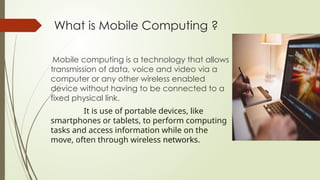
Mobile computing is a technology that allows
transmission of data, voice and video via a
computer or any other wireless enabled
device without having to be connected to a
fixed physical link.
It is use of portable devices, like
smartphones or tablets, to perform computing
tasks and access information while on the
move, often through wireless networks.
4.
HISTORY
.
Developments in mobiletechnology have led to many different types of
mobile computing . Though mobile computing technology has existed
since the 1980s, it was in the late 1990s and 2000s that advances in the
technology put it into the hands of numerous consumers
5.
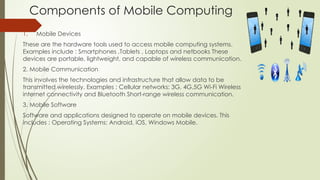
Components of MobileComputing
1. Mobile Devices
These are the hardware tools used to access mobile computing systems.
Examples include : Smartphones ,Tablets , Laptops and netbooks These
devices are portable, lightweight, and capable of wireless communication.
2. Mobile Communication
This involves the technologies and infrastructure that allow data to be
transmitted wirelessly. Examples : Cellular networks: 3G, 4G,5G Wi-Fi Wireless
internet connectivity and Bluetooth Short-range wireless communication.
3. Mobile Software
Software and applications designed to operate on mobile devices. This
includes : Operating Systems: Android, iOS, Windows Mobile.
6.
Features of MobileComputing
Portability : Devices can be easily carried anywhere laptops, smartphones,
tablets.
Connectivity: Constant access to the internet and networks through Wi-Fi,
4G/5G, or Bluetooth.
Remote Access: Ability to access files, applications, and systems from
anywhere.
Real-time Data Access :Users can send and receive information instantly..
GPS and Sensors:
Some mobile devices feature GPS for location tracking and other sensors like
accelerometers and compasses
7.
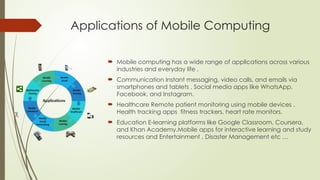
Applications of MobileComputing
Mobile computing has a wide range of applications across various
industries and everyday life .
Communication Instant messaging, video calls, and emails via
smartphones and tablets . Social media apps like WhatsApp,
Facebook, and Instagram.
Healthcare Remote patient monitoring using mobile devices .
Health tracking apps fitness trackers, heart rate monitors.
Education E-learning platforms like Google Classroom, Coursera,
and Khan Academy.Mobile apps for interactive learning and study
resources and Entertainment , Disaster Management etc …
8.
ADVANTAGES DISADVANTAGES
Mobile computingoffers
advantages like enhanced
productivity, flexibility, and
accessibility, enabling users to
access information and resources
anytime, anywhere, while also
streamlining business processes
and fostering collaboration.
Mobile computing, while
offering convenience and
connectivity, presents
disadvantages such
as security risks, limited
processing power, potential
distractions, and privacy
concerns, as well as
dependence on internet
connectivity.
9.
CHALLENGES IN MOBILECOMPUTING
Security Issues Risk of data theft, hacking, and
unauthorized access.
Battery Life Limited power supply can hinder long-term
use.
Data Privacy Sensitive user data can be exposed
through apps or third-party services.
Limited Processing Power Mobile devices have lower
computing power compared to desktops/laptops.
Device Compatibility Not all software/apps run the same
across different mobile devices or operating systems.
10.
Current trends Futuretrends
Widespread 4G/5G usage
faster internet access Cloud
based mobile apps –access
data from anywhere Mobile
payments digital wallets
and contactless transactions
Remote work and learning –
rise of collaboration apps.
App ecosystem growth
more specialized and
powerful apps
wider adoption of 5G and
upcoming 6G.Edge
computing – faster processing
near the source AI-powered
mobile apps – smart assistants,
automation IoT integration –
connected smart devices and
homes
AR/VR experiences –
immersive learning, shopping,
gaming
11.
CONCLUSION
Mobile computing hastransformed how we live, work, and communicate . It
offers anytime, anywhere access to data and services . Plays a key role in
sectors like business, healthcare, and education. Continuous advancements in
wireless tech and devices drive innovation
Mobile computing is not just the future — it's the present.
12.
References
Satyanarayanan ,M. (1996). "Fundamental Challenges in Mobile
Computing", ACM SIGOPS Operating Systems
Kumar, K., & Lu, Y. H. (2010). "Cloud computing for mobile users: Can
offloading computation save energy?“
Forman, G. H., & Zahorjan , J. (1994). "The challenges of mobile
computing." IEEE Computer
Books: "Mobile Computing" by Asoke K. Talukder, Roopa R. Yavagal
IEEE Xplore Digital Library – https://ieeexplore.ieee..org
Google Scholar – https://scholar.google.com