Mobile Computing
Definition A technology that allows transmission of data, via a computer, without having to be connected to a fixed physical link. ( Koudounas and Iqbal)
Introduction Emerging technology with intercross of many subjects. Human–computer interaction to be transported during normal usage. Hotspot in computing technology sector One of the four far-reaching implications technologies. New technology grwoing up with mobile communication, Internet, database, distributed computing...
Purpose Provide any clients at any time in any location with useful, accurate and timely information. Altering people's life style and working method drastically.
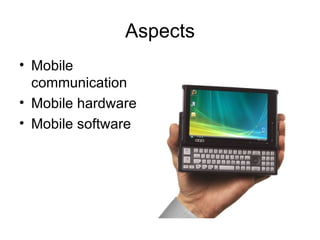
Aspects Mobile communication Mobile hardware  Mobile software
Mobile communication Communication between moving body, or moving body and fixed objects. Features: Mobility.  Complicated to propagate radio wave. Severe noise and interference.  Complex system and network configuration.
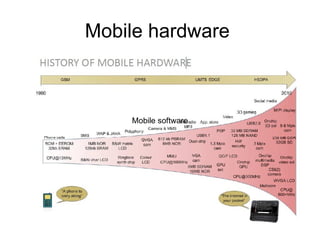
Mobile hardware  Mobile software
Mobile software Run on handheld computers, PDAs, EDAs,  smartphones and cellphones.  Popularity of these platforms has risen considerably since the first handheld computers invented in 1980s.
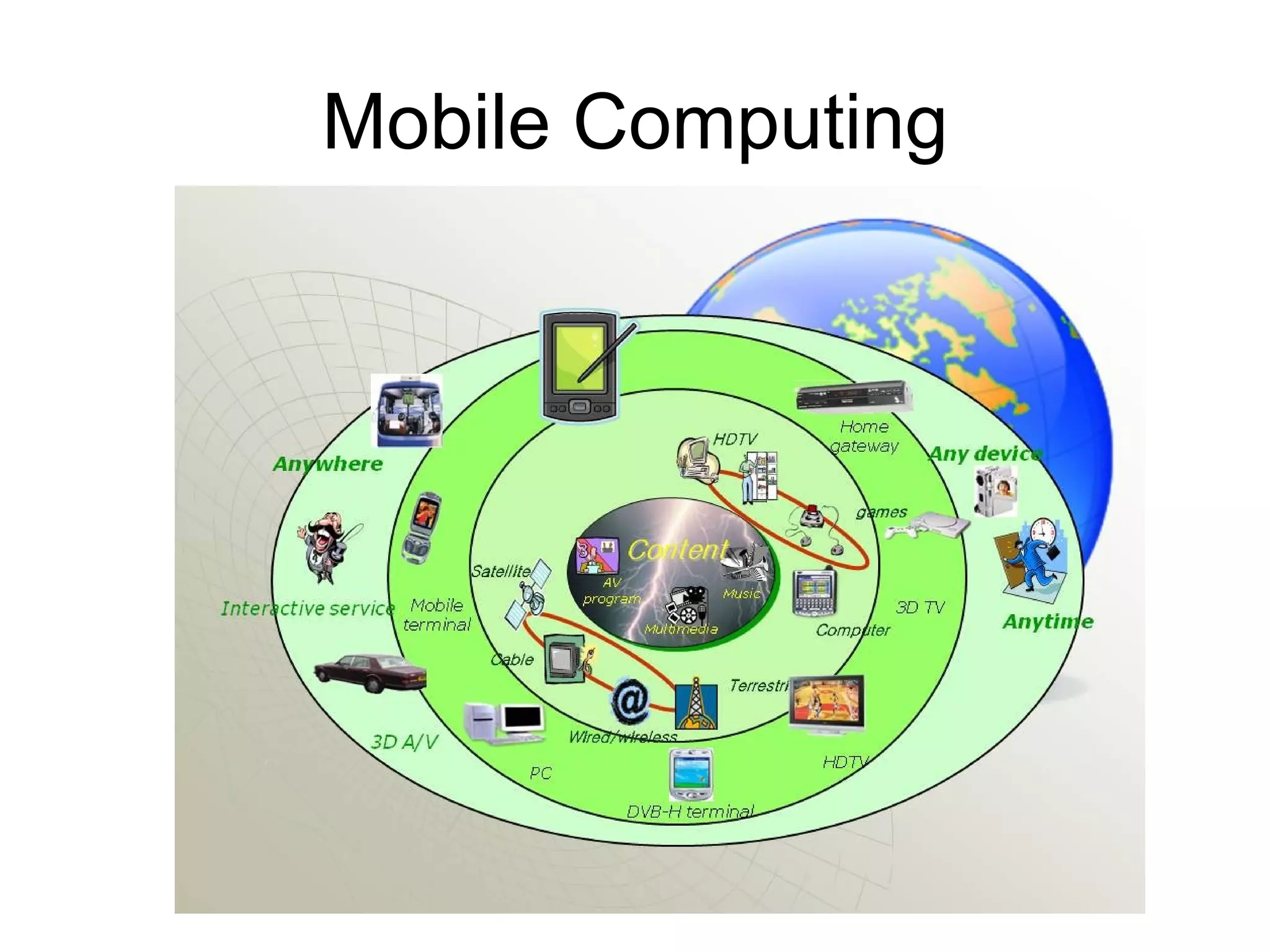
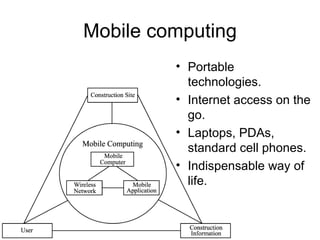
Mobile computing Portable technologies. Internet access on the go. Laptops, PDAs, standard cell phones.  Indispensable way of life.
WiFi Common, cheap Radio waves used to broadcast Internet signal from wireless router. Anyone can jump on if not encrypted.  Commonly used in public places to create hotspot. Hotspot must be located, stay put within broadcasting range.
Cellular broadband Cellular modem or AirCard used to connect to cell towers.  AirCard fits into PC Card or ExpressCard slot, delivering Internet access on the go. Needn’t remain stationary as signal remain strong. Cell phones and PDAs also use it.  Access considered premium service which increases cost.
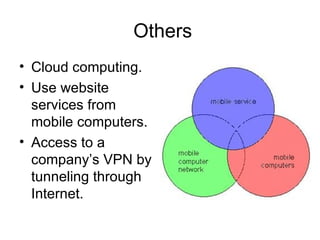
Others Cloud computing. Use website services from mobile computers.  Access to a company’s VPN by tunneling through Internet.
Importance Increasing business value. Staying connected.  Email to Facebook, Skype to socializing sites, cloud computing to VPNs,  No longer do without mobile computing anymore.
Future Wireless connect and pocket PC Balance between autonomy and interdependence David Krebs, analyst, VDC introduced how mobile computing involved in next 10 years http://www.youtube.com/watch?v=-MnX6zJzKIU&feature=player_embedded
Challenge and Suggestion 1. Constraints for Mobility   Mobile components are resource-poor relative to static elements. Mobility is essentially hazardous Mobile connection is highly flexible in performance and variability. Mobile computing is interdependent on energy source It requires us to rethink the traditional  approaches to information access.
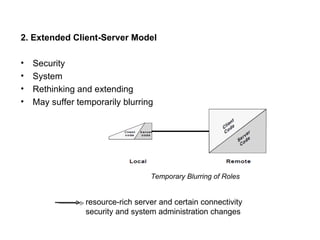
2. Extended Client-Server Model Security  System  Rethinking and extending  May suffer temporarily blurring Temporary Blurring of Roles resource-rich server and certain connectivity  security and system administration changes
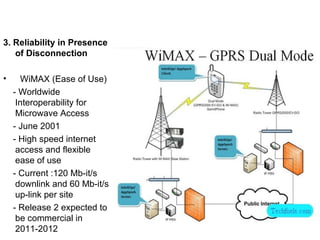
3. Reliability in Presence of Disconnection    WiMAX (Ease of Use) - Worldwide Interoperability for Microwave Access - June 2001  - High speed internet access and flexible ease of use - Current :120 Mb-it/s downlink and 60 Mb-it/s up-link per site  - Release 2 expected to be commercial in 2011-2012
4. Security and Privacy   Payment, E-agency, E-currency  Cyber-crime The way mobile security is developing as:       1.  Authentication Access to documents Handling of personal information Privacy safeguard 2.  Authorization Requires high supervision from servers to clients.  3.  Encryption Decryption
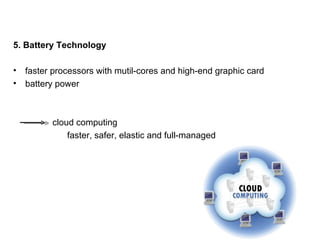
5. Battery Technology faster processors with mutil-cores and high-end graphic card  battery power  cloud computing faster, safer, elastic and full-managed

Mobile computing

  • 1.
  • 2.
    Definition A technologythat allows transmission of data, via a computer, without having to be connected to a fixed physical link. ( Koudounas and Iqbal)
  • 3.
    Introduction Emerging technologywith intercross of many subjects. Human–computer interaction to be transported during normal usage. Hotspot in computing technology sector One of the four far-reaching implications technologies. New technology grwoing up with mobile communication, Internet, database, distributed computing...
  • 4.
    Purpose Provide anyclients at any time in any location with useful, accurate and timely information. Altering people's life style and working method drastically.
  • 5.
    Aspects Mobile communicationMobile hardware Mobile software
  • 6.
    Mobile communication Communicationbetween moving body, or moving body and fixed objects. Features: Mobility. Complicated to propagate radio wave. Severe noise and interference. Complex system and network configuration.
  • 7.
    Mobile hardware Mobile software
  • 8.
    Mobile software Runon handheld computers, PDAs, EDAs, smartphones and cellphones. Popularity of these platforms has risen considerably since the first handheld computers invented in 1980s.
  • 9.
    Mobile computing Portabletechnologies. Internet access on the go. Laptops, PDAs, standard cell phones. Indispensable way of life.
  • 10.
    WiFi Common, cheapRadio waves used to broadcast Internet signal from wireless router. Anyone can jump on if not encrypted. Commonly used in public places to create hotspot. Hotspot must be located, stay put within broadcasting range.
  • 11.
    Cellular broadband Cellularmodem or AirCard used to connect to cell towers. AirCard fits into PC Card or ExpressCard slot, delivering Internet access on the go. Needn’t remain stationary as signal remain strong. Cell phones and PDAs also use it. Access considered premium service which increases cost.
  • 12.
    Others Cloud computing.Use website services from mobile computers. Access to a company’s VPN by tunneling through Internet.
  • 13.
    Importance Increasing businessvalue. Staying connected. Email to Facebook, Skype to socializing sites, cloud computing to VPNs, No longer do without mobile computing anymore.
  • 14.
    Future Wireless connectand pocket PC Balance between autonomy and interdependence David Krebs, analyst, VDC introduced how mobile computing involved in next 10 years http://www.youtube.com/watch?v=-MnX6zJzKIU&feature=player_embedded
  • 15.
    Challenge and Suggestion1. Constraints for Mobility   Mobile components are resource-poor relative to static elements. Mobility is essentially hazardous Mobile connection is highly flexible in performance and variability. Mobile computing is interdependent on energy source It requires us to rethink the traditional  approaches to information access.
  • 16.
    2. Extended Client-ServerModel Security System Rethinking and extending May suffer temporarily blurring Temporary Blurring of Roles resource-rich server and certain connectivity security and system administration changes
  • 17.
    3. Reliability inPresence of Disconnection   WiMAX (Ease of Use) - Worldwide Interoperability for Microwave Access - June 2001 - High speed internet access and flexible ease of use - Current :120 Mb-it/s downlink and 60 Mb-it/s up-link per site  - Release 2 expected to be commercial in 2011-2012
  • 18.
    4. Security andPrivacy   Payment, E-agency, E-currency Cyber-crime The way mobile security is developing as:      1.  Authentication Access to documents Handling of personal information Privacy safeguard 2.  Authorization Requires high supervision from servers to clients.  3.  Encryption Decryption
  • 19.
    5. Battery Technologyfaster processors with mutil-cores and high-end graphic card battery power cloud computing faster, safer, elastic and full-managed