MANAGEMENT INFORMATION SYSTEM
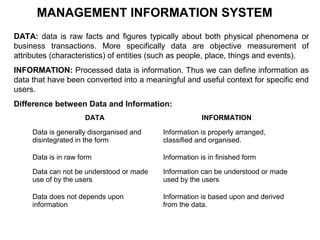
DATA: data is raw facts and figures typically about both physical phenomena or
business transactions. More specifically data are objective measurement of
attributes (characteristics) of entities (such as people, place, things and events).
INFORMATION: Processed data is information. Thus we can define information as
data that have been converted into a meaningful and useful context for specific end
users.
Difference between Data and Information:
                     DATA                             INFORMATION

     Data is generally disorganised and   Information is properly arranged,
     disintegrated in the form            classified and organised.

     Data is in raw form                  Information is in finished form

     Data can not be understood or made   Information can be understood or made
     use of by the users                  used by the users

     Data does not depends upon           Information is based upon and derived
     information                          from the data.
DATA   PROCESS   INFORMATION   DECISION

                   SPECIFIC               IMPLEMENTATION

                               ACTION
CLASSIFICATION OF INFORMATION SYSTEM


                         INFORMATION
                            SYSTEM


         OPERATION                          MANAGEMENT
          SUPPORT                            SUPPORT
           SYSTEM                             SYSTEM


T.P.S.     P.C.S.    E.C.S.        M.I.S.      D.S.S.    E.I.S.
T.P.S.- Transaction Process System
P.C.S.- Process Control System
E.C.S.- Enterprise Collaboration System
M.I.S.- Management Information System
D.S.S.- Decision Support System
E.I.S.- Executive Information System
Operation Support System
The information system which supports day to day operations at the lower level
   management such as cash management, credit management, billing, invoice, selling,
   purchasing, inventory management, salary and wage records, etc.
TPS (Transaction Processing System)
Transaction is a process where 2 or more parties are involved in order to exchange of 1
   commodity for exchange of other. There are 2 types of processing:
a) Batch Processing
b) Real Time Processing
                  Batch Processing                              Real Time Processing

   Processing does not happen then and there but   Processing happens then and there.
   after a stipulated period of time
   It is slow process                              It is fast process
   Provides obsolete and old information           Provides most updated information
   Cost effective/less costly because load is      Costly because good and advance quality of
   divided into batches                            processor is required to support the load
   Less possibility of errors eg. Depositing a     More prone to errors eg. When we get cash bill
   cheque in a bank manually                       after purchasing items.
P.C.S. (Process Control System)
System regulating any kind of process. PCS consists of that broad category
of information system in which any kind of production process which is
physical, chemical, biological, bio-chemical, production process related to
drugs, automobiles etc. In any of these process, production is controlled with
help of information system.
E.C.S. (Enterprise Collaboration System)
ECS is that category of information system which helps in collaboration and
coordination among the various stakeholders of business using the internet
platform such as intranet and extranet, where in the basic idea is to formulate
a cross functional, multi disciplinary team in order to share assets, resources
and take GD on virtual basis overcoming the barriers related to time, cost,
infrastructural and distance.
Some      ECS:      mobile     conferencing, video conferencing, audio
conferencing, WAP, electronic meeting system, GD, e-mail, voice mail,
extranet, e-mail, voice mail, FTP
MANAGEMENT SUPPORT SYSTEM
It supports critical decision taking at top level, middle level and top level
management. MSS is more specialized system.
D.S.S. (Decision Support System)
Decision means selecting the best alternative among different available
alternatives.

          Intelligence Phase              Identifying Problem

          Design Phase                    Develop Alternatives

          Choice Phase                     Selection of Best Alternative


                Herbert Simon approach to Decision Making

Problem can be faced at any stage of an organisation. In this phase in order to
understand the problem you are required to apply your brain, intelligence,
various statistical data, logical ability etc., designing various alternative which
can be developed for a single problem
MANAGEMENT INFORMATION SYSTEM
Provide information in the form of prescribed reports and displays to
support business decision making. Eg. Sales analysis, production
performance, and cost trend reporting system.


EXECUTIVE INFORMATION SYSTEM
Provide critical information from many sources tailored to
the information needs of executives. Eg. Systems for easy
access to analyses business performance, action of
competitors and economic developments to support
strategic planning.
PROCESS OF GENERATING INFORMATION
         Process of generating information begins with process of data
collection. There are several methods of data collection. The choice of method
has an impact on the quality of information. Some of the methods of data
collections are discussed as under:

Observation
It is a first hand knowledge by a person who is responsible for collecting data.
Example: Visit to the customer for assessing the customer complaints. A visit to
assess the accidental damage for insurance payment purpose. The main
advantage of first hand knowledge is less response bias. An accuracy of
observation will decide the response.

Experimentation
Conducting an experiment can collect the information on a specific parameter.
For example: conducting a control experiment can assess the impact of a new
fertilizer dose on the yield of a crop. Conducting a test market trial can assess
the impact of a new packaging of a product. The quality of information will be a
function of design of experiment.
Survey

         Under this method a part (sample) of population is covered on specific
aspects for the purpose of information collection, However, the quality of the
information depends on the instruments such as questionnaire used for
collecting the information, Examples of Survey are market surveys, opinion
polls, census etc.

Subjective Estimation
         In the absence of experiment, surveys, and first hand information,
expert opinion may be called to collect the information. The information may be
collected from more than one expert and in more than one round of collection
from the same expert. The multiple set of information/data can be
analyzed/processed to get the right information with minimum bias. Data
pertaining to future like alternate source of energy, the life style and food habits
of later half of 21st century are collected using subjective estimations. These
estimates are called subjective since no probability law is being used for
collecting the information.
Transaction Processing
Sources of data for this method are ledgers, payrolls, stock statements and
sales reports of an organization. The data collected from these sources will
require the processing to get meaningful information.

Publications
In this method, data are collected from secondary sources. The sources are
publication of financial institutions, industrial organization, universities,
consulting firm's etc. This method of data collection is less costly.

Government Agencies
Some of the state agencies in all countries publish reports about the basic
parameters of the economy and other facets of the society. For example:
Publications of Central Bank of a country, in case of India publications such as
RBI Annual Report, Report on Currency and Finance, Economic survey etc.
falls in this category. These reports are available to researchers, planners and
policy makers. In addition, these reports are also available to public. However,
this information may not be directly useful but one can make use of this
information. In fact all activities in an organization generate data.
Strategic Roles of Information System
A company has competitive advantage over other companies when it sustains
   marketability and greater market share. The area of specialisation is above
   any other company in the industry. i.e. you are ahead your competitors.
Who are you competitors?
1. Me tools
2. Substitutes
3. New entrants
Me tools: These are identical products from different companies. i.e. the have
  similar types product, similar technology and similar target area. Eg.
  Refrigerators from samsung and LG
Substitutes: replacement of products i.e. tea and coffee
New Entrants: who are now coming up with new product of the same category.
  i.e. LG producing electronics now entering in to FMCG
If any firm can overcome 5 forces of business the firm is able to achieve competitive
advantage in the market
Michael Porter’s 5 forces Model
                                          THREATS
                                            FROM
                                         ME TOOLS &
                                         SUBSTITUTE

               THREATS                                               INTERNAL
                FROM                                              RIVALRY AMONG
             NEW ENTRANTS                  FIRM’S                      FIRMS
                                        COMPETITIVE
                                         ADVANTAGE


                     BARGAINING POWER                 BARGAINING POWER
                       OF SUPPLIERS                     OF CUSTOMERS


Bargaining power of customer is due to high supply and low demand. Customer become
choosy.
Bargaining power of supplier is due to high demand and low supply. Eg. Maggi
STRATEGIES TO ACHIEVE COMPETITIVE ADVANTAGES
1. Cost Leadership
2. Innovation: New offer and never before
3. Differentiation: Unique product and features
4. Diversification
   Related Diversification- Johnson & Johnson
   Non Related Diversification-ITC
5. Strategic Alliances: Alliance means ASSOCIATION
   Mergers: A& B – AB company
   Acquisition/Takeover: A buys B
   Joint Ventures: A&B for project. Will separate after project completes
   Technology Collaboration: Technical Know how is provided by one company
   to another
ARTIFICIAL INTELLIGENCE
Artificial Intelligence is that branch of science which deals with computer in which the
goal is to develop computer which can think, see, hear, talk and feel or in other words
developed computer which can perform functions equivalent to human intelligence.
Artificial Intelligence is multi disciplinary because it has borrowed its principles from:
   •    Mathematics
   •    Operation research
   •    Statistics
   •    Psychology
   •    Engineering
   Application areas of Artificial Intelligence

                                      Artificial Intelligence


        Cognitive Science                                             Natural Interface
                                     Robotics Applications
          Applications                                                  Applications
Cognitive Sciences Applications
Something related to cognition i.e. mental ability to solve a problem using
reasoning, learning ability.
Cognitive Science. This area of artificial intelligence is based on research in biology,
neurology, psychology, mathematics, and many allied disciplines. It focuses on
researching how the human brain works and how humans think and learn. The results
of such research in human information processing are the basis for the development
of a variety of computer-based applications in artificial intelligence.
Applications in the cognitive science area of AI include the development of expert
systems and other knowledge-based systems that add a knowledge base and some
reasoning capability to information systems. Also included are adaptive learning
systems that can modify their behaviors based on information they acquire as they
operate. Chess-playing systems are primitive examples of such applications, though
many more applications are being implemented. Fuzzy logic systems can process data
that are incomplete or ambiguous, that is, fuzzy data. Thus, they can solve
unstructured problems with incomplete knowledge by developing approximate
inferences and answers, as humans do. Neural network software can learn by
processing sample problems and their solutions. As neural nets start to recognize
patterns, they can begin to program themselves to solve such problems on their own.
Genetic algorithm software uses Darwinian (survival of the fittest), randomizing, and
other mathematics functions to simulate evolutionary processes that can generate
increasingly better solutions to problems. And intelligent agents use expert system
and other AI technologies to serve as software surrogates for a variety of end user
applications.
ROBOTICS:
Al, engineering, and physiology are the basic disciplines of robotics. This technology
produces robot machines with computer intelligence and computer- controlled,
humanlike physical capabilities. This area thus includes applications designed to give
robots the powers of sight, or visual perception; touch, or tactile capabilities; or skill in
handling and manipulation; locomotion, or the physical ability to move over any terrain;
and navigation, or the intelligence to properly find one’s way to a destination.

NATURAL INTERFACES:
The development of natural interfaces is considered as a major area of Al applications
and is essential to the natural use of computers by humans. For example, the
development of natural languages and speech recognition are major thrusts of this area
of AI. Being able to talk to computers and robots in conversational human languages
and have them “understand” us as easily as we understand each other is a goal of AI
research. This involves research and development in linguistics, psychology, computer
science, and other disciplines. Other natural interface research applications include the
development of multisensory devices that use a variety of body movements to operate
computers. This is related to the emerging application area of virtual reality. Virtual
reality involves using multisensory human- computer interfaces that enable human users
to experience computer-simulated objects, spaces, activities, and “worlds” as if they
actually exist.
Expert System
        An expert system is a computer based application that
guides the performance of ill-structured tasks which usually
requires experience and expertise. Using an expert system,
a non-expert can achieve performance comparable to an
expert in that particular domain. Expert systems can be
considered as an instance of a DSS. The unique feature of
an expert system is the knowledge base, the data and
decision rules which represent the expertise.
        The concept of expert systems is based on the
assumption that an expert’s knowledge can be captured in
computer storage and then applied by others when the need
arises.
Components of Expert System
User Interface: the user interface allows the user to enter instructions
and information to the expert system and receive information from the
expert system.

Knowledge Base: the knowledge base contains the facts that describe
the problem area, and knowledge representation techniques that
describe how the facts fit together in a logical manner.

Inference Engine: the interface engine of an expert system takes the
rules that defines how the expert processes his factual knowledge and
interprets them as appropriate. Unlike a simple program, the steps are
not sequentially determined by the programmer, but follow from the
data input and the results obtained at earlier stages in the user system

Development Engine: the development engine is used to create the
expert system. The process essentially involves building the rule set.
There are two basic approaches: programming languages and expert
system shells.
System

•   A System is a set of individual components
    linked together achieve a common goal.
•   A group of interrelated components working
    together towards a common goal by
    accepting input thereby producing output in
    an organised transformation process.
•   A combination of a group of interrelate or
    interacting elements that form a unified
    whole.
System Stakeholders
   System stakeholder means any person
   who has an interest in an existing or
   proposed        information       system.
   Stakeholders may include technical and
   non- technical workers as well as internal
   and external workers.
1. System Owners: Any Information System can
   have one or more owners. Usually, system
   owners are the managers of the organisation.
   Hence, they view an information in terms of cost
   and benefits to solve problems and exploit
   opportunities.
2.   System Analyst: System analyst is a specialist who
     studies the problems and needs of an organisation to
     determine how people, data, process and information
     technology can best accomplish improvements for the
     business. The system analyst is a unique stakeholder
     because he serves as a facilitator, bridges the
     communication gaps that can naturally developed between
     the technical system designer and builder and non
     technical owners and users.
3.   System Designers: A technical experts is someone who
     translates system users, business requirements and
     constraints into a technical solutions. A system designer
     can be a database administrator, network architect, web
     architect, graphics artists, security experts and technology
     specialists.
4.   System Builders: System builder is a technical specialist who
     constructs information system and components based on the
     design specifications generated by the system designers.

5.   System Users: System user is a person who will use or is affected
     by an information system on a regular basis. They are the person
     who are involved in capturing, validating, entering and exchanging
     data and information. There are broadly two categories of system
     users:
a)   Internal System Users: Internal system users are clerical and
     service workers, technical and professional staff, supervisors,
     middle managers and top managers.
b)   External System Users: They are also known as remote user
     (a user who is located at a distant place but needs the information).
     Example of external user are customers, suppliers, partners,
     employees etc.
SDLC (System Development Life
           Cycle)
SDLC describe the various stages through
which    software     goes    during  its
development. Each SDLC stage consists
have well Defined activities and methods
to perform their job.
Phases of SDLC:
1. Problem Identification: The
   objective of problem identification
   phase is to understand the
   problem. This necessitates the
   need for preliminary investigation.
2. Preliminary Investigation: The
   main objective of preliminary
   investigation is to determine
   whether the request is valid and
   feasible.
3. Feasibility Study: Feasibility study involves seeing
   whether it is possible (feasible) to do the change in the
   system or build a new one, as per the outcome of
   preliminary investigation.
   Types of Feasibility study:
      Economical Feasibility: Study to see that whether it
      will be economically feasible to go ahead with the
      system development. If the benefits outweigh costs,
      then the decision is made to design and implement the
      new system.
      Technical Feasibility: It involves studying the system
      for checking that whether it will be technically feasible
      to develop and implement the system.
      Behavioral or Operational Feasibility: The study is
      done to see that weather the users staff, do will
      actually be the user of the system, and accept the new
      system. It is very important that the users are covered
      to use the new system.
4. System Analysis: System analysis is process of
   studying existing system and its environment.
   Interviews, outside observation and questionnaires
   are different tools used for analysis of the system.
5. System Design: System Design consists of
   design activities that produce system specification
   satisfying the functional requirements that were
   developed in the system analysis process. Cost
   and benefit analysis is also done during this
   phase.
System Design


User Interface         Data          Process
   Design             Design          Design
• Screen, Form,   Data Element    Program and
  Report, and     Structure       Procedure
  Dialog Design   Design          Design
6. Coding:     Coding the system involves writing
programs, the design made during the design period
are     converted     into    actual     programs.

7. Testing: Testing the system involves checking all the
modules developed, during the coding phase for their
proper functionality. Testing involves checking the
system for the result by comparing the result with the
intended                                         output.
Testing is the quality- control measure of software
development. Testing detects errors in all the phases of
software development, discovering requirements,
design and coding errors in software.
There are two types of testing techniques:
     Black Box Testing: Detects errors in the functional
     behavior of a program.
     White Box Testing: Detects errors in the internal
     structure of a program.

8.   Implementation: Implementation phase of SDLC
     involves implementation of the system developed at
     the user site. Implementation involves user training,
     site preparation and file conversion.
9.     Maintenance:        When the implementation or installation
       phase is completed and user staff is adjusted then the system
       evaluation and maintenance of hardware and software.
       There are three types of software maintenance:
     –     Corrective Maintenance: Corrective maintenance is
           concerned with the removal of errors discovered after
           delivery of software to the customer.
       For example, when the library management system was
       delivered, the customer found that the software was not
       displaying the names of all students who checked out books.
     –     Adaptive Maintenance: Adaptive Maintenance is
           concerned with changes in the software due to a change
           in the environment in which the software functions. For
           example, a banking system showing message starting that
           the memory is full, after the 1,000th entry.
       Perfective       Maintenance:        Perfective    Maintenance
       implements new functional system requirements generated
       by the customer. For example, after testing the banking
       system, the customer realizes that the system should also
       show the details of daily transactions being carried out.

Mis

  • 1.
    MANAGEMENT INFORMATION SYSTEM DATA:data is raw facts and figures typically about both physical phenomena or business transactions. More specifically data are objective measurement of attributes (characteristics) of entities (such as people, place, things and events). INFORMATION: Processed data is information. Thus we can define information as data that have been converted into a meaningful and useful context for specific end users. Difference between Data and Information: DATA INFORMATION Data is generally disorganised and Information is properly arranged, disintegrated in the form classified and organised. Data is in raw form Information is in finished form Data can not be understood or made Information can be understood or made use of by the users used by the users Data does not depends upon Information is based upon and derived information from the data.
  • 2.
    DATA PROCESS INFORMATION DECISION SPECIFIC IMPLEMENTATION ACTION
  • 3.
    CLASSIFICATION OF INFORMATIONSYSTEM INFORMATION SYSTEM OPERATION MANAGEMENT SUPPORT SUPPORT SYSTEM SYSTEM T.P.S. P.C.S. E.C.S. M.I.S. D.S.S. E.I.S.
  • 4.
    T.P.S.- Transaction ProcessSystem P.C.S.- Process Control System E.C.S.- Enterprise Collaboration System M.I.S.- Management Information System D.S.S.- Decision Support System E.I.S.- Executive Information System
  • 5.
    Operation Support System Theinformation system which supports day to day operations at the lower level management such as cash management, credit management, billing, invoice, selling, purchasing, inventory management, salary and wage records, etc. TPS (Transaction Processing System) Transaction is a process where 2 or more parties are involved in order to exchange of 1 commodity for exchange of other. There are 2 types of processing: a) Batch Processing b) Real Time Processing Batch Processing Real Time Processing Processing does not happen then and there but Processing happens then and there. after a stipulated period of time It is slow process It is fast process Provides obsolete and old information Provides most updated information Cost effective/less costly because load is Costly because good and advance quality of divided into batches processor is required to support the load Less possibility of errors eg. Depositing a More prone to errors eg. When we get cash bill cheque in a bank manually after purchasing items.
  • 6.
    P.C.S. (Process ControlSystem) System regulating any kind of process. PCS consists of that broad category of information system in which any kind of production process which is physical, chemical, biological, bio-chemical, production process related to drugs, automobiles etc. In any of these process, production is controlled with help of information system. E.C.S. (Enterprise Collaboration System) ECS is that category of information system which helps in collaboration and coordination among the various stakeholders of business using the internet platform such as intranet and extranet, where in the basic idea is to formulate a cross functional, multi disciplinary team in order to share assets, resources and take GD on virtual basis overcoming the barriers related to time, cost, infrastructural and distance. Some ECS: mobile conferencing, video conferencing, audio conferencing, WAP, electronic meeting system, GD, e-mail, voice mail, extranet, e-mail, voice mail, FTP
  • 7.
    MANAGEMENT SUPPORT SYSTEM Itsupports critical decision taking at top level, middle level and top level management. MSS is more specialized system. D.S.S. (Decision Support System) Decision means selecting the best alternative among different available alternatives. Intelligence Phase Identifying Problem Design Phase Develop Alternatives Choice Phase Selection of Best Alternative Herbert Simon approach to Decision Making Problem can be faced at any stage of an organisation. In this phase in order to understand the problem you are required to apply your brain, intelligence, various statistical data, logical ability etc., designing various alternative which can be developed for a single problem
  • 8.
    MANAGEMENT INFORMATION SYSTEM Provideinformation in the form of prescribed reports and displays to support business decision making. Eg. Sales analysis, production performance, and cost trend reporting system. EXECUTIVE INFORMATION SYSTEM Provide critical information from many sources tailored to the information needs of executives. Eg. Systems for easy access to analyses business performance, action of competitors and economic developments to support strategic planning.
  • 9.
    PROCESS OF GENERATINGINFORMATION Process of generating information begins with process of data collection. There are several methods of data collection. The choice of method has an impact on the quality of information. Some of the methods of data collections are discussed as under: Observation It is a first hand knowledge by a person who is responsible for collecting data. Example: Visit to the customer for assessing the customer complaints. A visit to assess the accidental damage for insurance payment purpose. The main advantage of first hand knowledge is less response bias. An accuracy of observation will decide the response. Experimentation Conducting an experiment can collect the information on a specific parameter. For example: conducting a control experiment can assess the impact of a new fertilizer dose on the yield of a crop. Conducting a test market trial can assess the impact of a new packaging of a product. The quality of information will be a function of design of experiment.
  • 10.
    Survey Under this method a part (sample) of population is covered on specific aspects for the purpose of information collection, However, the quality of the information depends on the instruments such as questionnaire used for collecting the information, Examples of Survey are market surveys, opinion polls, census etc. Subjective Estimation In the absence of experiment, surveys, and first hand information, expert opinion may be called to collect the information. The information may be collected from more than one expert and in more than one round of collection from the same expert. The multiple set of information/data can be analyzed/processed to get the right information with minimum bias. Data pertaining to future like alternate source of energy, the life style and food habits of later half of 21st century are collected using subjective estimations. These estimates are called subjective since no probability law is being used for collecting the information.
  • 11.
    Transaction Processing Sources ofdata for this method are ledgers, payrolls, stock statements and sales reports of an organization. The data collected from these sources will require the processing to get meaningful information. Publications In this method, data are collected from secondary sources. The sources are publication of financial institutions, industrial organization, universities, consulting firm's etc. This method of data collection is less costly. Government Agencies Some of the state agencies in all countries publish reports about the basic parameters of the economy and other facets of the society. For example: Publications of Central Bank of a country, in case of India publications such as RBI Annual Report, Report on Currency and Finance, Economic survey etc. falls in this category. These reports are available to researchers, planners and policy makers. In addition, these reports are also available to public. However, this information may not be directly useful but one can make use of this information. In fact all activities in an organization generate data.
  • 12.
    Strategic Roles ofInformation System A company has competitive advantage over other companies when it sustains marketability and greater market share. The area of specialisation is above any other company in the industry. i.e. you are ahead your competitors. Who are you competitors? 1. Me tools 2. Substitutes 3. New entrants Me tools: These are identical products from different companies. i.e. the have similar types product, similar technology and similar target area. Eg. Refrigerators from samsung and LG Substitutes: replacement of products i.e. tea and coffee New Entrants: who are now coming up with new product of the same category. i.e. LG producing electronics now entering in to FMCG
  • 13.
    If any firmcan overcome 5 forces of business the firm is able to achieve competitive advantage in the market Michael Porter’s 5 forces Model THREATS FROM ME TOOLS & SUBSTITUTE THREATS INTERNAL FROM RIVALRY AMONG NEW ENTRANTS FIRM’S FIRMS COMPETITIVE ADVANTAGE BARGAINING POWER BARGAINING POWER OF SUPPLIERS OF CUSTOMERS Bargaining power of customer is due to high supply and low demand. Customer become choosy. Bargaining power of supplier is due to high demand and low supply. Eg. Maggi
  • 14.
    STRATEGIES TO ACHIEVECOMPETITIVE ADVANTAGES 1. Cost Leadership 2. Innovation: New offer and never before 3. Differentiation: Unique product and features 4. Diversification Related Diversification- Johnson & Johnson Non Related Diversification-ITC 5. Strategic Alliances: Alliance means ASSOCIATION Mergers: A& B – AB company Acquisition/Takeover: A buys B Joint Ventures: A&B for project. Will separate after project completes Technology Collaboration: Technical Know how is provided by one company to another
  • 15.
    ARTIFICIAL INTELLIGENCE Artificial Intelligenceis that branch of science which deals with computer in which the goal is to develop computer which can think, see, hear, talk and feel or in other words developed computer which can perform functions equivalent to human intelligence. Artificial Intelligence is multi disciplinary because it has borrowed its principles from: • Mathematics • Operation research • Statistics • Psychology • Engineering Application areas of Artificial Intelligence Artificial Intelligence Cognitive Science Natural Interface Robotics Applications Applications Applications
  • 16.
    Cognitive Sciences Applications Somethingrelated to cognition i.e. mental ability to solve a problem using reasoning, learning ability. Cognitive Science. This area of artificial intelligence is based on research in biology, neurology, psychology, mathematics, and many allied disciplines. It focuses on researching how the human brain works and how humans think and learn. The results of such research in human information processing are the basis for the development of a variety of computer-based applications in artificial intelligence. Applications in the cognitive science area of AI include the development of expert systems and other knowledge-based systems that add a knowledge base and some reasoning capability to information systems. Also included are adaptive learning systems that can modify their behaviors based on information they acquire as they operate. Chess-playing systems are primitive examples of such applications, though many more applications are being implemented. Fuzzy logic systems can process data that are incomplete or ambiguous, that is, fuzzy data. Thus, they can solve unstructured problems with incomplete knowledge by developing approximate inferences and answers, as humans do. Neural network software can learn by processing sample problems and their solutions. As neural nets start to recognize patterns, they can begin to program themselves to solve such problems on their own. Genetic algorithm software uses Darwinian (survival of the fittest), randomizing, and other mathematics functions to simulate evolutionary processes that can generate increasingly better solutions to problems. And intelligent agents use expert system and other AI technologies to serve as software surrogates for a variety of end user applications.
  • 17.
    ROBOTICS: Al, engineering, andphysiology are the basic disciplines of robotics. This technology produces robot machines with computer intelligence and computer- controlled, humanlike physical capabilities. This area thus includes applications designed to give robots the powers of sight, or visual perception; touch, or tactile capabilities; or skill in handling and manipulation; locomotion, or the physical ability to move over any terrain; and navigation, or the intelligence to properly find one’s way to a destination. NATURAL INTERFACES: The development of natural interfaces is considered as a major area of Al applications and is essential to the natural use of computers by humans. For example, the development of natural languages and speech recognition are major thrusts of this area of AI. Being able to talk to computers and robots in conversational human languages and have them “understand” us as easily as we understand each other is a goal of AI research. This involves research and development in linguistics, psychology, computer science, and other disciplines. Other natural interface research applications include the development of multisensory devices that use a variety of body movements to operate computers. This is related to the emerging application area of virtual reality. Virtual reality involves using multisensory human- computer interfaces that enable human users to experience computer-simulated objects, spaces, activities, and “worlds” as if they actually exist.
  • 18.
    Expert System An expert system is a computer based application that guides the performance of ill-structured tasks which usually requires experience and expertise. Using an expert system, a non-expert can achieve performance comparable to an expert in that particular domain. Expert systems can be considered as an instance of a DSS. The unique feature of an expert system is the knowledge base, the data and decision rules which represent the expertise. The concept of expert systems is based on the assumption that an expert’s knowledge can be captured in computer storage and then applied by others when the need arises.
  • 19.
    Components of ExpertSystem User Interface: the user interface allows the user to enter instructions and information to the expert system and receive information from the expert system. Knowledge Base: the knowledge base contains the facts that describe the problem area, and knowledge representation techniques that describe how the facts fit together in a logical manner. Inference Engine: the interface engine of an expert system takes the rules that defines how the expert processes his factual knowledge and interprets them as appropriate. Unlike a simple program, the steps are not sequentially determined by the programmer, but follow from the data input and the results obtained at earlier stages in the user system Development Engine: the development engine is used to create the expert system. The process essentially involves building the rule set. There are two basic approaches: programming languages and expert system shells.
  • 20.
    System • A System is a set of individual components linked together achieve a common goal. • A group of interrelated components working together towards a common goal by accepting input thereby producing output in an organised transformation process. • A combination of a group of interrelate or interacting elements that form a unified whole.
  • 21.
    System Stakeholders System stakeholder means any person who has an interest in an existing or proposed information system. Stakeholders may include technical and non- technical workers as well as internal and external workers. 1. System Owners: Any Information System can have one or more owners. Usually, system owners are the managers of the organisation. Hence, they view an information in terms of cost and benefits to solve problems and exploit opportunities.
  • 22.
    2. System Analyst: System analyst is a specialist who studies the problems and needs of an organisation to determine how people, data, process and information technology can best accomplish improvements for the business. The system analyst is a unique stakeholder because he serves as a facilitator, bridges the communication gaps that can naturally developed between the technical system designer and builder and non technical owners and users. 3. System Designers: A technical experts is someone who translates system users, business requirements and constraints into a technical solutions. A system designer can be a database administrator, network architect, web architect, graphics artists, security experts and technology specialists.
  • 23.
    4. System Builders: System builder is a technical specialist who constructs information system and components based on the design specifications generated by the system designers. 5. System Users: System user is a person who will use or is affected by an information system on a regular basis. They are the person who are involved in capturing, validating, entering and exchanging data and information. There are broadly two categories of system users: a) Internal System Users: Internal system users are clerical and service workers, technical and professional staff, supervisors, middle managers and top managers. b) External System Users: They are also known as remote user (a user who is located at a distant place but needs the information). Example of external user are customers, suppliers, partners, employees etc.
  • 24.
    SDLC (System DevelopmentLife Cycle) SDLC describe the various stages through which software goes during its development. Each SDLC stage consists have well Defined activities and methods to perform their job.
  • 25.
    Phases of SDLC: 1.Problem Identification: The objective of problem identification phase is to understand the problem. This necessitates the need for preliminary investigation. 2. Preliminary Investigation: The main objective of preliminary investigation is to determine whether the request is valid and feasible.
  • 26.
    3. Feasibility Study:Feasibility study involves seeing whether it is possible (feasible) to do the change in the system or build a new one, as per the outcome of preliminary investigation. Types of Feasibility study: Economical Feasibility: Study to see that whether it will be economically feasible to go ahead with the system development. If the benefits outweigh costs, then the decision is made to design and implement the new system. Technical Feasibility: It involves studying the system for checking that whether it will be technically feasible to develop and implement the system. Behavioral or Operational Feasibility: The study is done to see that weather the users staff, do will actually be the user of the system, and accept the new system. It is very important that the users are covered to use the new system.
  • 27.
    4. System Analysis:System analysis is process of studying existing system and its environment. Interviews, outside observation and questionnaires are different tools used for analysis of the system. 5. System Design: System Design consists of design activities that produce system specification satisfying the functional requirements that were developed in the system analysis process. Cost and benefit analysis is also done during this phase.
  • 28.
    System Design User Interface Data Process Design Design Design • Screen, Form, Data Element Program and Report, and Structure Procedure Dialog Design Design Design
  • 29.
    6. Coding: Coding the system involves writing programs, the design made during the design period are converted into actual programs. 7. Testing: Testing the system involves checking all the modules developed, during the coding phase for their proper functionality. Testing involves checking the system for the result by comparing the result with the intended output. Testing is the quality- control measure of software development. Testing detects errors in all the phases of software development, discovering requirements, design and coding errors in software.
  • 30.
    There are twotypes of testing techniques: Black Box Testing: Detects errors in the functional behavior of a program. White Box Testing: Detects errors in the internal structure of a program. 8. Implementation: Implementation phase of SDLC involves implementation of the system developed at the user site. Implementation involves user training, site preparation and file conversion.
  • 31.
    9. Maintenance: When the implementation or installation phase is completed and user staff is adjusted then the system evaluation and maintenance of hardware and software. There are three types of software maintenance: – Corrective Maintenance: Corrective maintenance is concerned with the removal of errors discovered after delivery of software to the customer. For example, when the library management system was delivered, the customer found that the software was not displaying the names of all students who checked out books. – Adaptive Maintenance: Adaptive Maintenance is concerned with changes in the software due to a change in the environment in which the software functions. For example, a banking system showing message starting that the memory is full, after the 1,000th entry. Perfective Maintenance: Perfective Maintenance implements new functional system requirements generated by the customer. For example, after testing the banking system, the customer realizes that the system should also show the details of daily transactions being carried out.