Acute Myocardial Infarction
Presented By: Deepak Kapoor
Emergency Department
Columbia Asia Hospital-Ghazibad
What Is a Heart Attack?
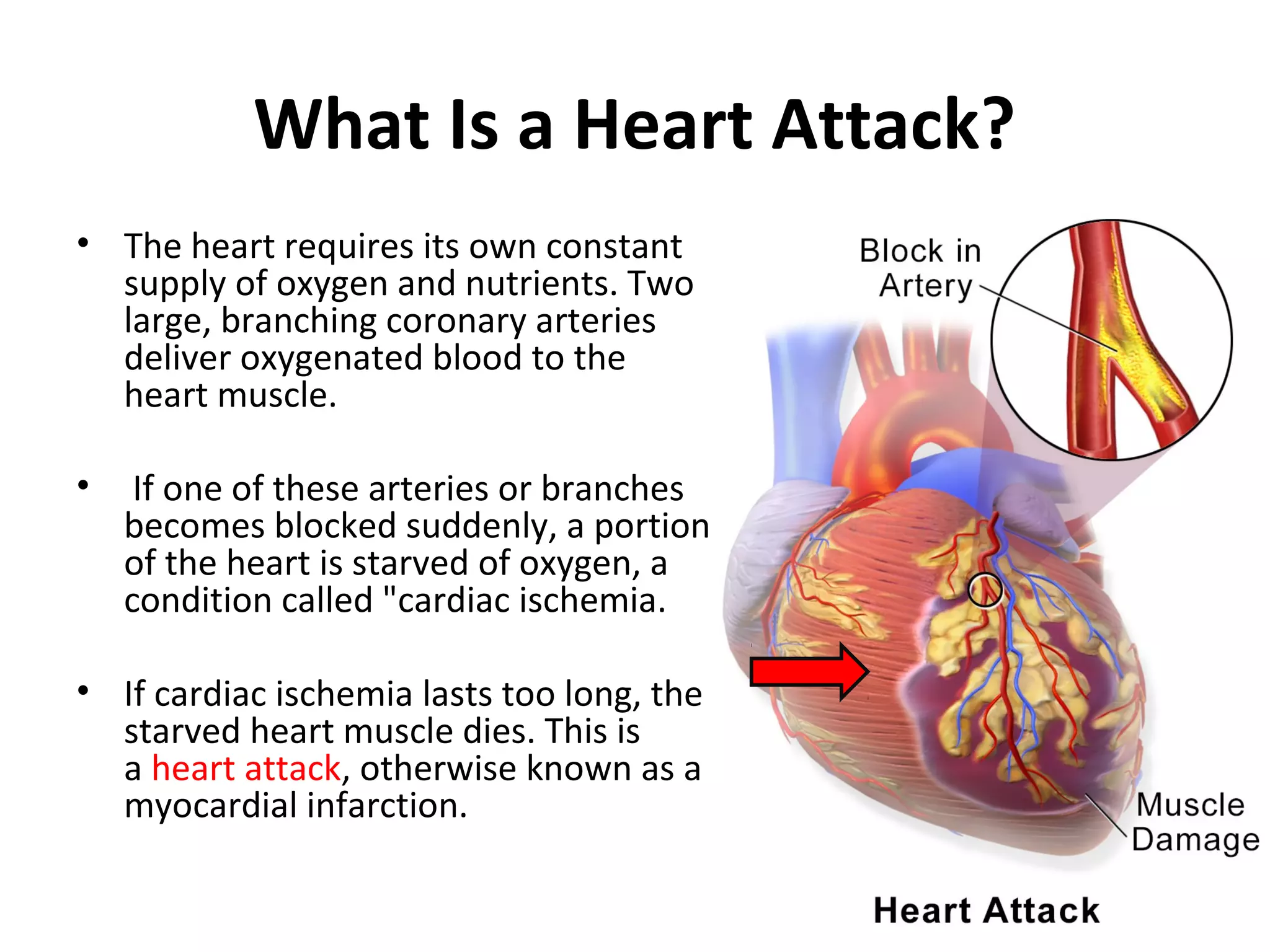
• The heart requires its own constant
supply of oxygen and nutrients. Two
large, branching coronary arteries
deliver oxygenated blood to the
heart muscle.
• If one of these arteries or branches
becomes blocked suddenly, a portion
of the heart is starved of oxygen, a
condition called "cardiac ischemia.
• If cardiac ischemia lasts too long, the
starved heart muscle dies. This is
a heart attack, otherwise known as a
myocardial infarction.
Let’s Understand AMI
Video
Signs and symptoms
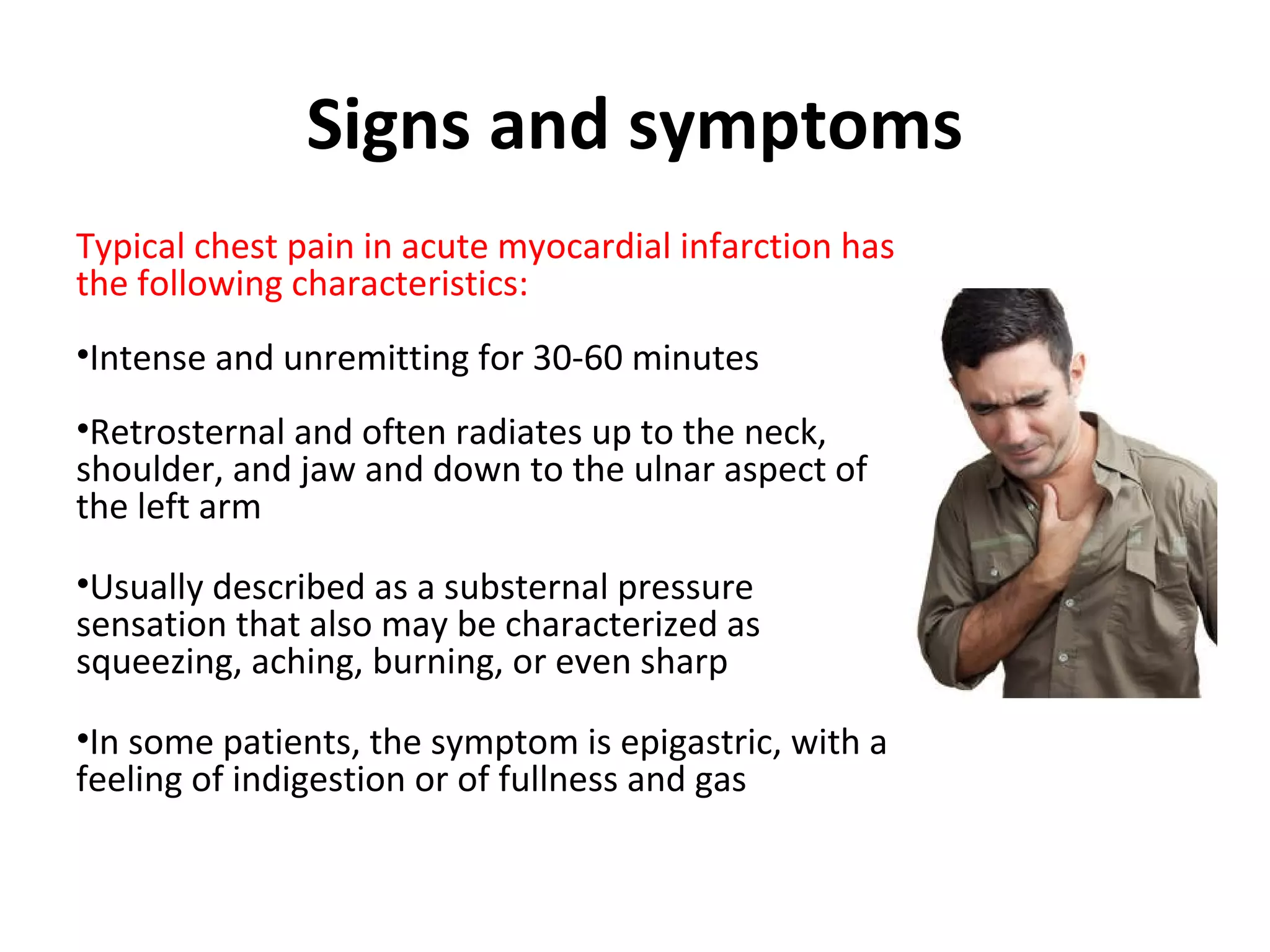
Typical chest pain in acute myocardial infarction has
the following characteristics:
•Intense and unremitting for 30-60 minutes
•Retrosternal and often radiates up to the neck,
shoulder, and jaw and down to the ulnar aspect of
the left arm
•Usually described as a substernal pressure
sensation that also may be characterized as
squeezing, aching, burning, or even sharp
•In some patients, the symptom is epigastric, with a
feeling of indigestion or of fullness and gas
Signs and symptoms
The patient’s vital signs may demonstrate the following in myocardial
infarction:
The patient’s heart rate is often increased secondary to sympatho-adrenal
discharge
The pulse may be irregular because of ventricular ectopy, In general, the patient's
blood pressure is initially elevated because of peripheral arterial vasoconstriction
resulting from an adrenergic response to pain and ventricular dysfunction
However, with right ventricular myocardial infarction or severe left ventricular
dysfunction, hypotension is seen
The respiratory rate may be increased in response to pulmonary congestion or
anxiety
Coughing, wheezing, and the production of frothy sputum may occur
Fever is usually present within 24-48 hours, Body temperature may occasionally
exceed 102°F
Causes/Risk Factors
Rupture of high-risk plaque in the coronary arteries is a primary
causative factor in the development of AMI.
Increasing age is considered the most significant risk factor for CAD.
Individuals aged older than 45 years have an eight times greater risk
for AMI (less than 10% of patients who have AMI are aged younger
than 45 years). The risk for mortality after AMI is higher for older
individuals
Cigarette smoking is a major risk factor for atherosclerosis and
hence AMI.
Dyslipidemia:Elevated serum levels of low-density lipoprotein
cholesterol (LDL-C) and non–high-density lipoprotein cholesterol
(HDL-C) (other triglyceride-rich lipoproteins) significantly increase
the risk of AMI
Hypertension
Diabetes mellitus
family history of ischemic heart disease (IHD) in a first-degree
relative have a higher risk for AMI
Diagnosis
Laboratory studies
Troponin levels: Troponin is a contractile protein that normally is not
found in serum; it is released only when myocardial necrosis occurs
Creatine kinase (CK) levels: CK-MB levels increase within 3-12 hours
of the onset of chest pain, reach peak values within 24 hours, and
return to baseline after 48-72 hours
Myoglobin levels: Myoglobin is released more rapidly from infarcted
myocardium than is troponin; urine myoglobin levels rise within 1-4
hours from the onset of chest pain
Complete blood count
Chemistry profile
Lipid profile
C-reactive protein and other inflammation markers
Diagnosis
Radiology Investigations
Electrocardiography
The ECG is the most important tool in the initial evaluation and
triage of patients in whom an acute coronary syndrome (ACS),
such as myocardial infarction, is suspected. It is confirmatory
of the diagnosis in approximately 80% of cases.
Cardiac imaging
For individuals with highly probable or confirmed ACS, a
coronary angiogram can be used to definitively diagnose or
rule out coronary artery disease.
Emergency Management of MI
Immediate management priorities
Intravenous access must be available for effective administration of
emergency drug
Keep your crash cart (including defibrillator) and intubation trolley
ready for emergency use.
Administration of oxygen
An ECG should be arranged rapidly.
Analgesia
Anti-emetics
Nitrates -- Nitrates reduce myocardial workload and hence
myocardial oxygen demand by reducing preload (venodilatation) and
afterload (reduced peripheral resistance and blood pressure).
Choice of Drugs
Aspirin-It can treat a heart attack and prevent blood clots when
patient has an abnormal heartbeat. Aspirin can have side effects:
diarrhea, a skin rash, itching, nausea, or stomach pain.
Clopidogrel -Clopidogrel is used alone or with aspirin.
Taking clopidogrel helps prevent blood clots from forming in your
arteries. Side Effects-diarrhea, skin rash, itching, nausea, or stomach
pain.
Sorbitrate- -This medication helps to widen blood vessels so blood
flows better. It is used to treat and prevent chest pain (angina).
Heparin – anticoagulant
Atorvas (atorvastatin) - It lowers the level of cholesterol and
triglycerides in the blood.
Naproxen(NSAIDs)- naproxen appears to have better cardiovascular
safety than diclofenac, ibuprofen
Nursing Interventions
Monitor/document characteristics of pain, noting verbal reports,
nonverbal cues (e.g., moaning, crying, restlessness, diaphoresis,
clutching chest, rapid breathing), and hemodynamic response
(BP/heart rate changes).
Obtain full description of pain from patient including location, intensity
(0–10), duration, characteristics (dull/crushing), and radiation. Assist
patient to quantify pain by comparing it to other experiences.
Review history of previous angina, anginal equivalent, or MI pain.
Discuss family history if pertinent.
Instruct patient to report pain immediately.Provide quiet environment,
calm activities, and comfort measures (e.g., dry/wrinkle-free linens,
backrub). Approach patient calmly and confidently.
Nursing Interventions
Assist/instruct in relaxation techniques, e.g., deep/slow breathing,
distraction behaviors, visualization, guided imagery.
Check vital signs before and after narcotic medication.
Administer supplemental oxygen by means of nasal cannula or face
mask, as indicated.
Administer medications as indicated:Antianginals, e.g., nitroglycerin
(Nitro-Bid, Nitrostat, Nitro-Dur), isosorbide denitrate (Isordil),
mononitrate (Imdur)Beta-blockers, e.g., atenolol (Tenormin),
pindolol(Visken), propranolol (Inderal), nadolol (Corgard), metoprolol
(Lopressor)
Analgesics, e.g., morphine, meperidine (Demerol)
Important Tips
•Hand Washing to prevent infection
•Do not touch oral medications
•Access IV line asap
•Collect Blood Samples
•Do not talk about the condition of patient in front of him
•Keep Crash Cart and Intubation ready
•Get in touch with cath lab team and keep informing them about
the status (if MI is diagnosed)
•Narcotics should be used as per hospital policy
•Keep a proper record of drug administrations and observe side
effects.
Thank You!

MI-Presentation

  • 1.
    Acute Myocardial Infarction PresentedBy: Deepak Kapoor Emergency Department Columbia Asia Hospital-Ghazibad
  • 2.
    What Is aHeart Attack? • The heart requires its own constant supply of oxygen and nutrients. Two large, branching coronary arteries deliver oxygenated blood to the heart muscle. • If one of these arteries or branches becomes blocked suddenly, a portion of the heart is starved of oxygen, a condition called "cardiac ischemia. • If cardiac ischemia lasts too long, the starved heart muscle dies. This is a heart attack, otherwise known as a myocardial infarction.
  • 3.
  • 4.
    Signs and symptoms Typicalchest pain in acute myocardial infarction has the following characteristics: •Intense and unremitting for 30-60 minutes •Retrosternal and often radiates up to the neck, shoulder, and jaw and down to the ulnar aspect of the left arm •Usually described as a substernal pressure sensation that also may be characterized as squeezing, aching, burning, or even sharp •In some patients, the symptom is epigastric, with a feeling of indigestion or of fullness and gas
  • 5.
    Signs and symptoms Thepatient’s vital signs may demonstrate the following in myocardial infarction: The patient’s heart rate is often increased secondary to sympatho-adrenal discharge The pulse may be irregular because of ventricular ectopy, In general, the patient's blood pressure is initially elevated because of peripheral arterial vasoconstriction resulting from an adrenergic response to pain and ventricular dysfunction However, with right ventricular myocardial infarction or severe left ventricular dysfunction, hypotension is seen The respiratory rate may be increased in response to pulmonary congestion or anxiety Coughing, wheezing, and the production of frothy sputum may occur Fever is usually present within 24-48 hours, Body temperature may occasionally exceed 102°F
  • 6.
    Causes/Risk Factors Rupture ofhigh-risk plaque in the coronary arteries is a primary causative factor in the development of AMI. Increasing age is considered the most significant risk factor for CAD. Individuals aged older than 45 years have an eight times greater risk for AMI (less than 10% of patients who have AMI are aged younger than 45 years). The risk for mortality after AMI is higher for older individuals Cigarette smoking is a major risk factor for atherosclerosis and hence AMI. Dyslipidemia:Elevated serum levels of low-density lipoprotein cholesterol (LDL-C) and non–high-density lipoprotein cholesterol (HDL-C) (other triglyceride-rich lipoproteins) significantly increase the risk of AMI Hypertension Diabetes mellitus family history of ischemic heart disease (IHD) in a first-degree relative have a higher risk for AMI
  • 7.
    Diagnosis Laboratory studies Troponin levels:Troponin is a contractile protein that normally is not found in serum; it is released only when myocardial necrosis occurs Creatine kinase (CK) levels: CK-MB levels increase within 3-12 hours of the onset of chest pain, reach peak values within 24 hours, and return to baseline after 48-72 hours Myoglobin levels: Myoglobin is released more rapidly from infarcted myocardium than is troponin; urine myoglobin levels rise within 1-4 hours from the onset of chest pain Complete blood count Chemistry profile Lipid profile C-reactive protein and other inflammation markers
  • 8.
    Diagnosis Radiology Investigations Electrocardiography The ECGis the most important tool in the initial evaluation and triage of patients in whom an acute coronary syndrome (ACS), such as myocardial infarction, is suspected. It is confirmatory of the diagnosis in approximately 80% of cases. Cardiac imaging For individuals with highly probable or confirmed ACS, a coronary angiogram can be used to definitively diagnose or rule out coronary artery disease.
  • 9.
    Emergency Management ofMI Immediate management priorities Intravenous access must be available for effective administration of emergency drug Keep your crash cart (including defibrillator) and intubation trolley ready for emergency use. Administration of oxygen An ECG should be arranged rapidly. Analgesia Anti-emetics Nitrates -- Nitrates reduce myocardial workload and hence myocardial oxygen demand by reducing preload (venodilatation) and afterload (reduced peripheral resistance and blood pressure).
  • 10.
    Choice of Drugs Aspirin-Itcan treat a heart attack and prevent blood clots when patient has an abnormal heartbeat. Aspirin can have side effects: diarrhea, a skin rash, itching, nausea, or stomach pain. Clopidogrel -Clopidogrel is used alone or with aspirin. Taking clopidogrel helps prevent blood clots from forming in your arteries. Side Effects-diarrhea, skin rash, itching, nausea, or stomach pain. Sorbitrate- -This medication helps to widen blood vessels so blood flows better. It is used to treat and prevent chest pain (angina). Heparin – anticoagulant Atorvas (atorvastatin) - It lowers the level of cholesterol and triglycerides in the blood. Naproxen(NSAIDs)- naproxen appears to have better cardiovascular safety than diclofenac, ibuprofen
  • 11.
    Nursing Interventions Monitor/document characteristicsof pain, noting verbal reports, nonverbal cues (e.g., moaning, crying, restlessness, diaphoresis, clutching chest, rapid breathing), and hemodynamic response (BP/heart rate changes). Obtain full description of pain from patient including location, intensity (0–10), duration, characteristics (dull/crushing), and radiation. Assist patient to quantify pain by comparing it to other experiences. Review history of previous angina, anginal equivalent, or MI pain. Discuss family history if pertinent. Instruct patient to report pain immediately.Provide quiet environment, calm activities, and comfort measures (e.g., dry/wrinkle-free linens, backrub). Approach patient calmly and confidently.
  • 12.
    Nursing Interventions Assist/instruct inrelaxation techniques, e.g., deep/slow breathing, distraction behaviors, visualization, guided imagery. Check vital signs before and after narcotic medication. Administer supplemental oxygen by means of nasal cannula or face mask, as indicated. Administer medications as indicated:Antianginals, e.g., nitroglycerin (Nitro-Bid, Nitrostat, Nitro-Dur), isosorbide denitrate (Isordil), mononitrate (Imdur)Beta-blockers, e.g., atenolol (Tenormin), pindolol(Visken), propranolol (Inderal), nadolol (Corgard), metoprolol (Lopressor) Analgesics, e.g., morphine, meperidine (Demerol)
  • 13.
    Important Tips •Hand Washingto prevent infection •Do not touch oral medications •Access IV line asap •Collect Blood Samples •Do not talk about the condition of patient in front of him •Keep Crash Cart and Intubation ready •Get in touch with cath lab team and keep informing them about the status (if MI is diagnosed) •Narcotics should be used as per hospital policy •Keep a proper record of drug administrations and observe side effects.
  • 14.

Editor's Notes

  • #13 http://nurseslabs.com/7-myocardial-infarction-heart-attack-nursing-care-plans/