Minor Project on Cooling of water
through Convection process
GUIDED BY: SUBMITTED BY:
MISS MAMTA VARMA AJAY VERMA (08)
PROFESSOR ME DEPT. ASHISH SAMUEL DASS (25)
BIST BHOPAL DEEPAK KUMAR (31)
DHEERENDRA PATEL (35)
YOGESH SAHU (121)
HEAT TRANSFER
 Heat transfer is the exchange of thermal energy between physical systems,
depending on the temperature and pressure by dissipating heat.
 Heat transfer always occurs from a region of high temperature to another
region of lower temperature.
 The fundamental modes of heat transfer are:
 Conduction
 Convection
 Radiation
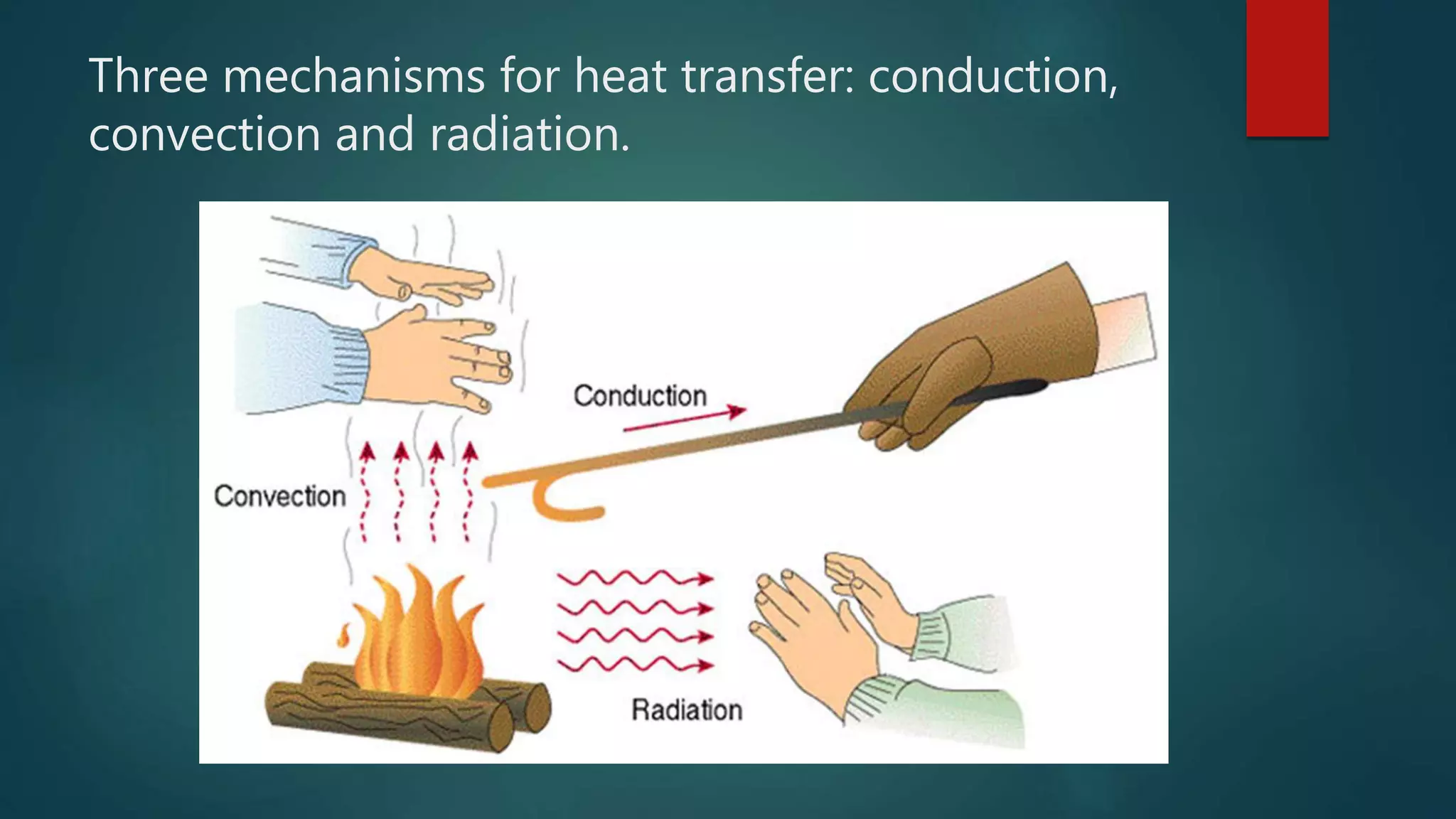
Three mechanisms for heat transfer: conduction,
convection and radiation.
CONDUCTION
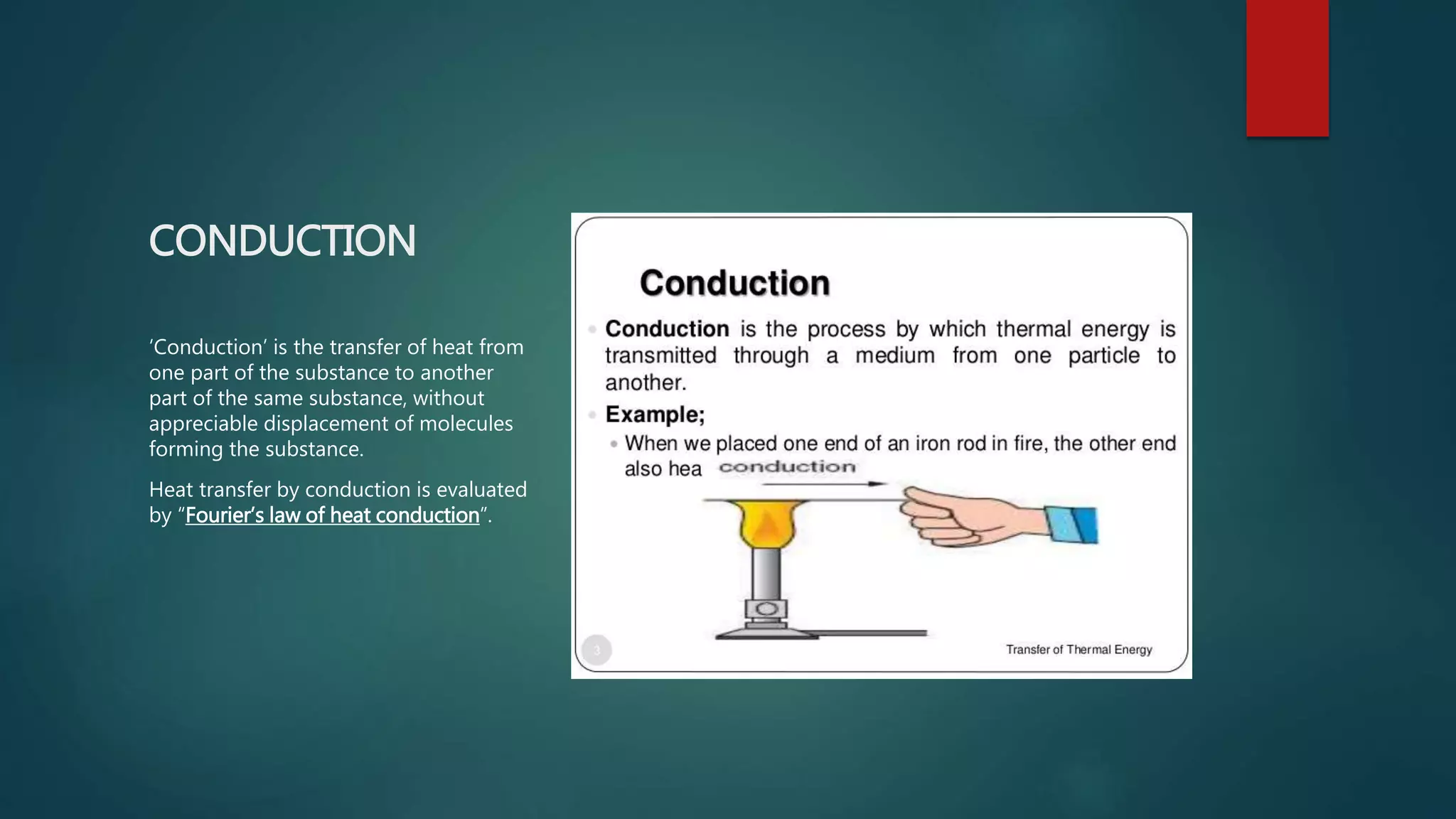
‘Conduction’ is the transfer of heat from
one part of the substance to another
part of the same substance, without
appreciable displacement of molecules
forming the substance.
Heat transfer by conduction is evaluated
by “Fourier’s law of heat conduction”.
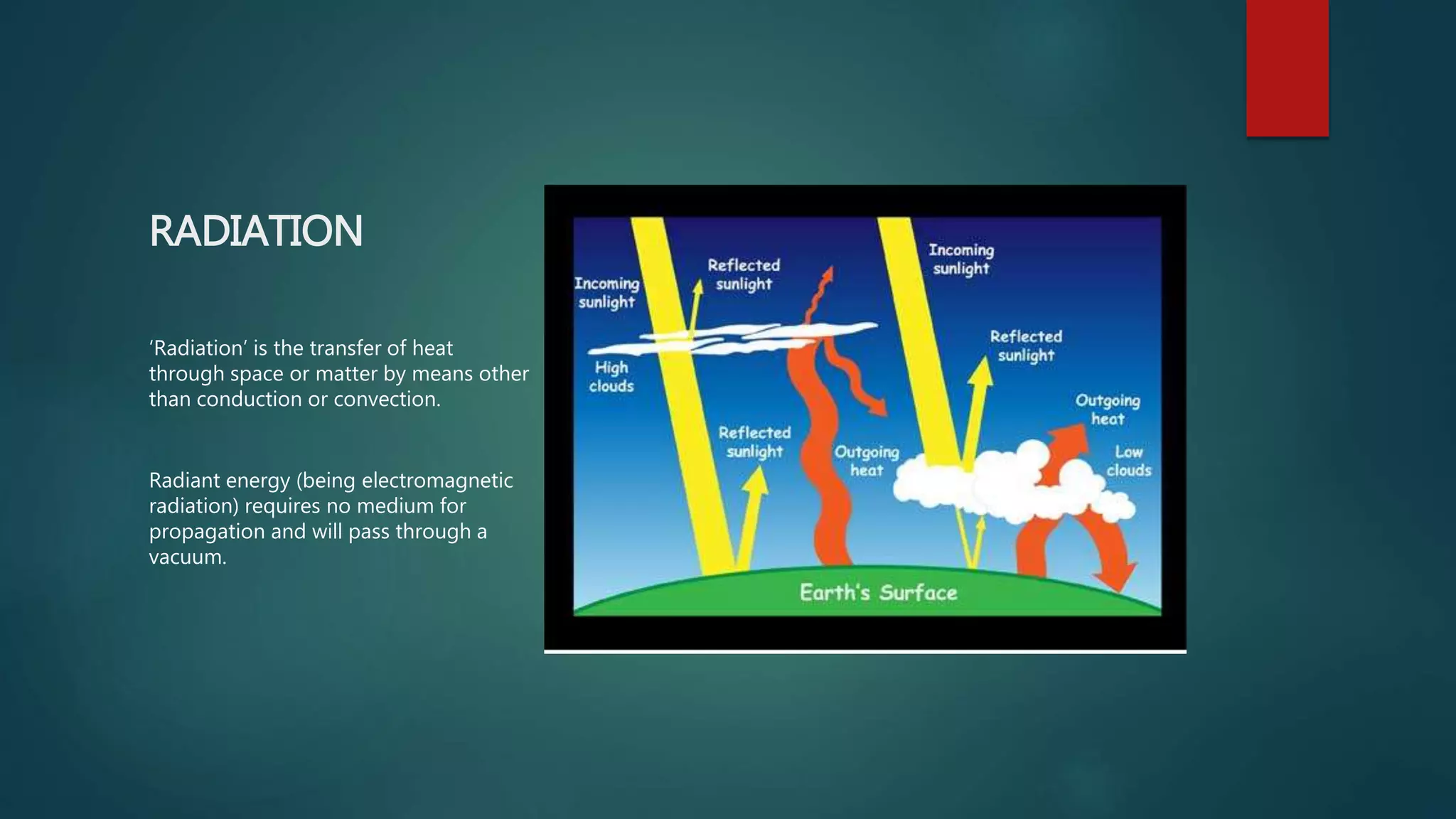
RADIATION
‘Radiation’ is the transfer of heat
through space or matter by means other
than conduction or convection.
Radiant energy (being electromagnetic
radiation) requires no medium for
propagation and will pass through a
vacuum.
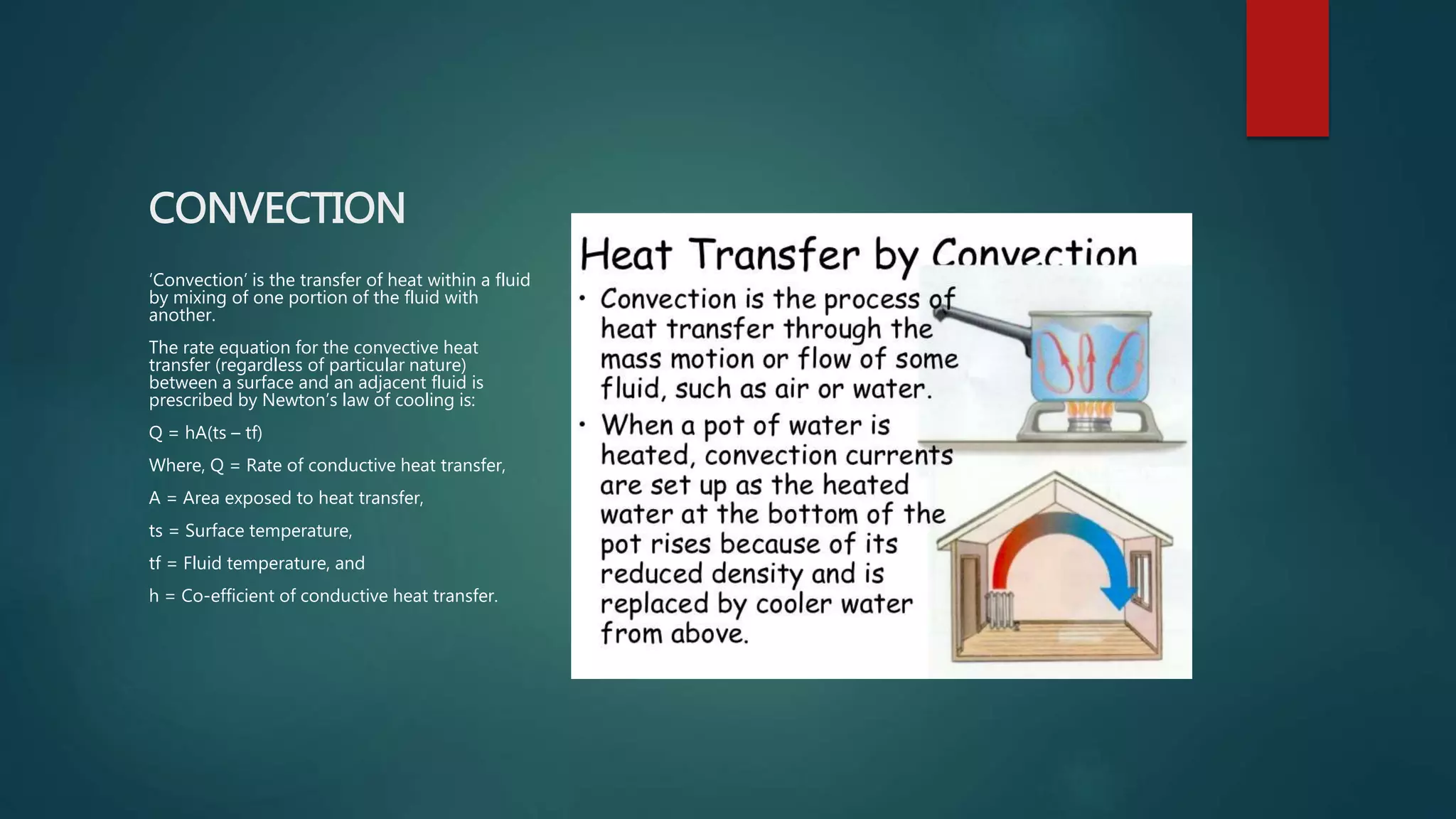
CONVECTION
‘Convection’ is the transfer of heat within a fluid
by mixing of one portion of the fluid with
another.
The rate equation for the convective heat
transfer (regardless of particular nature)
between a surface and an adjacent fluid is
prescribed by Newton’s law of cooling is:
Q = hA(ts – tf)
Where, Q = Rate of conductive heat transfer,
A = Area exposed to heat transfer,
ts = Surface temperature,
tf = Fluid temperature, and
h = Co-efficient of conductive heat transfer.
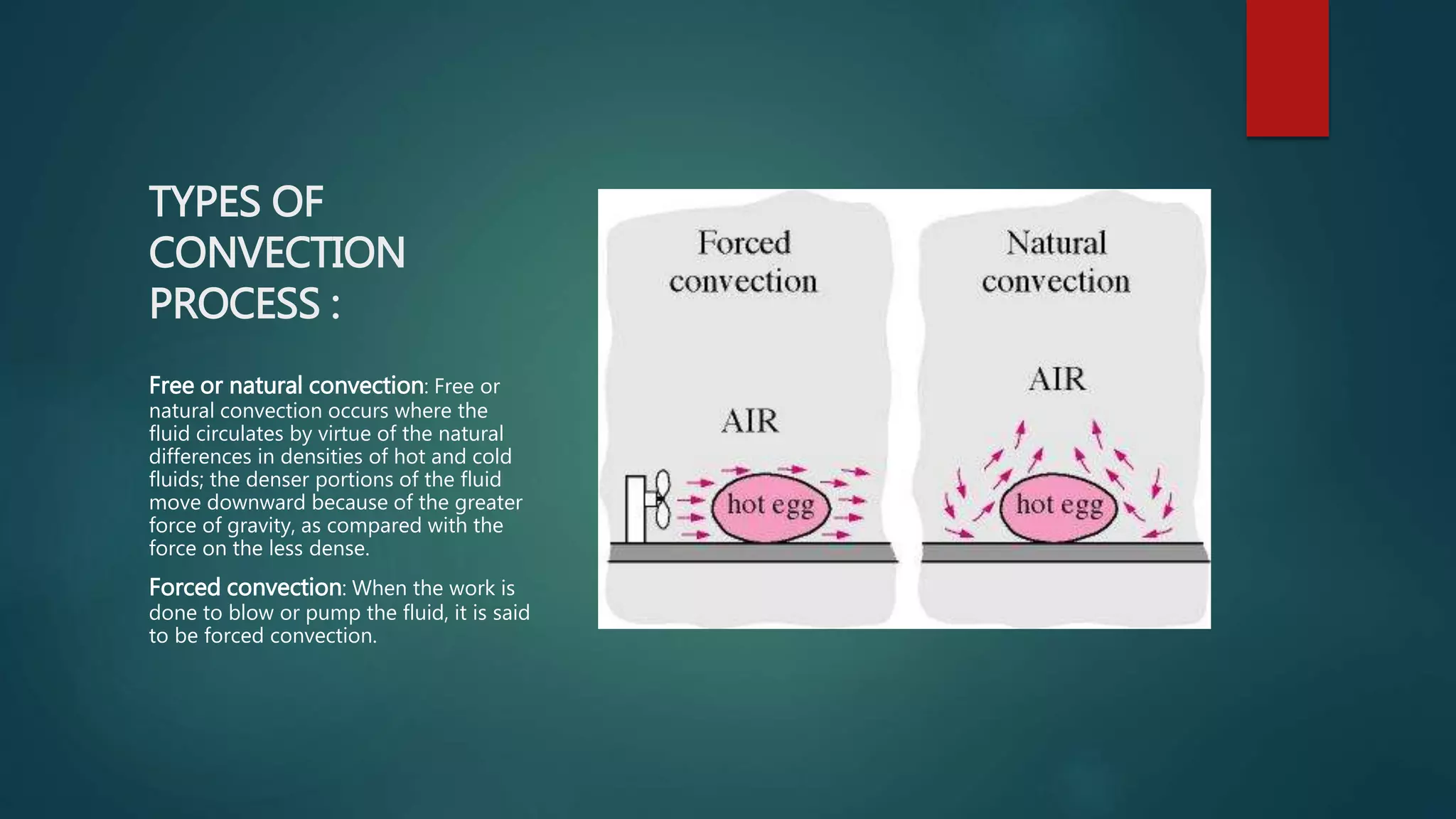
TYPES OF
CONVECTION
PROCESS :
Free or natural convection: Free or
natural convection occurs where the
fluid circulates by virtue of the natural
differences in densities of hot and cold
fluids; the denser portions of the fluid
move downward because of the greater
force of gravity, as compared with the
force on the less dense.
Forced convection: When the work is
done to blow or pump the fluid, it is said
to be forced convection.
HEAT EXCHANGER
 A ‘heat exchanger’ may be defined as an equipment which transfers the
energy from a hot fluid to a cold fluid, with maximum rate and minimum
investment and running costs.
 Examples of heat exchangers:
 (i) Intercoolers and preheaters; (ii) Condensers and boilers in steam plant
 TYPES :
 On the basis of relative direction of fluid motion –
i. Parallel flow
ii. Counter flow
 On the basis of design and constructional features –
I. Condensers
II. Evaporators
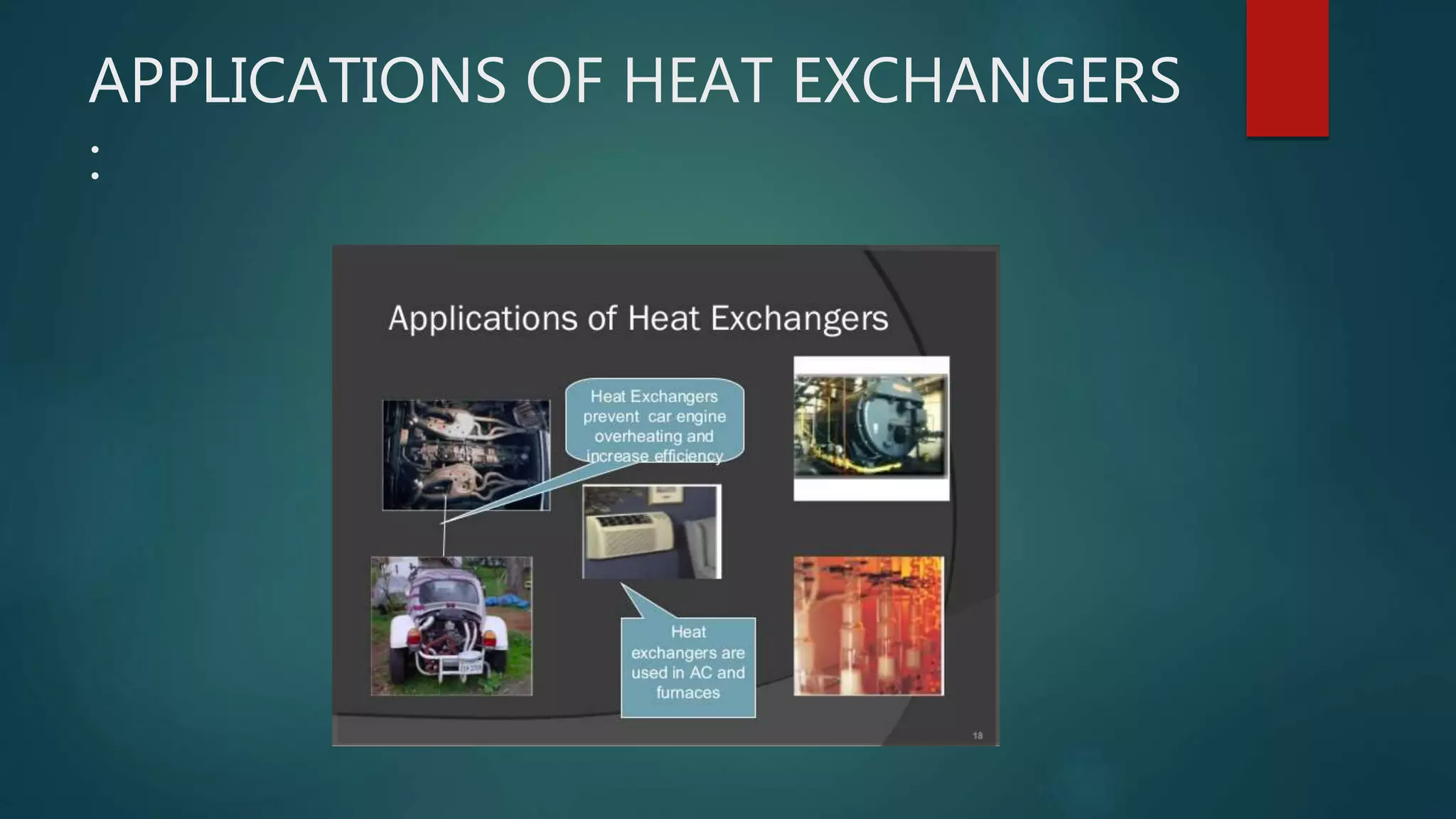
APPLICATIONS OF HEAT EXCHANGERS
:
Dual purpose equipment
 The dual purpose equipment serves two purposes namely:
 Act as cooler
 Supplies cold water for drinking purpose
 The basic working principle is forced convection. The hot water is forced
through the multiple tubes which losses it’s heat to the cold air flowing
over it. As a result, the cold water received in the storage tank can be used
for drinking purpose.
 It is inspired by the constructional features of shell and tube pass heat
exchanger.
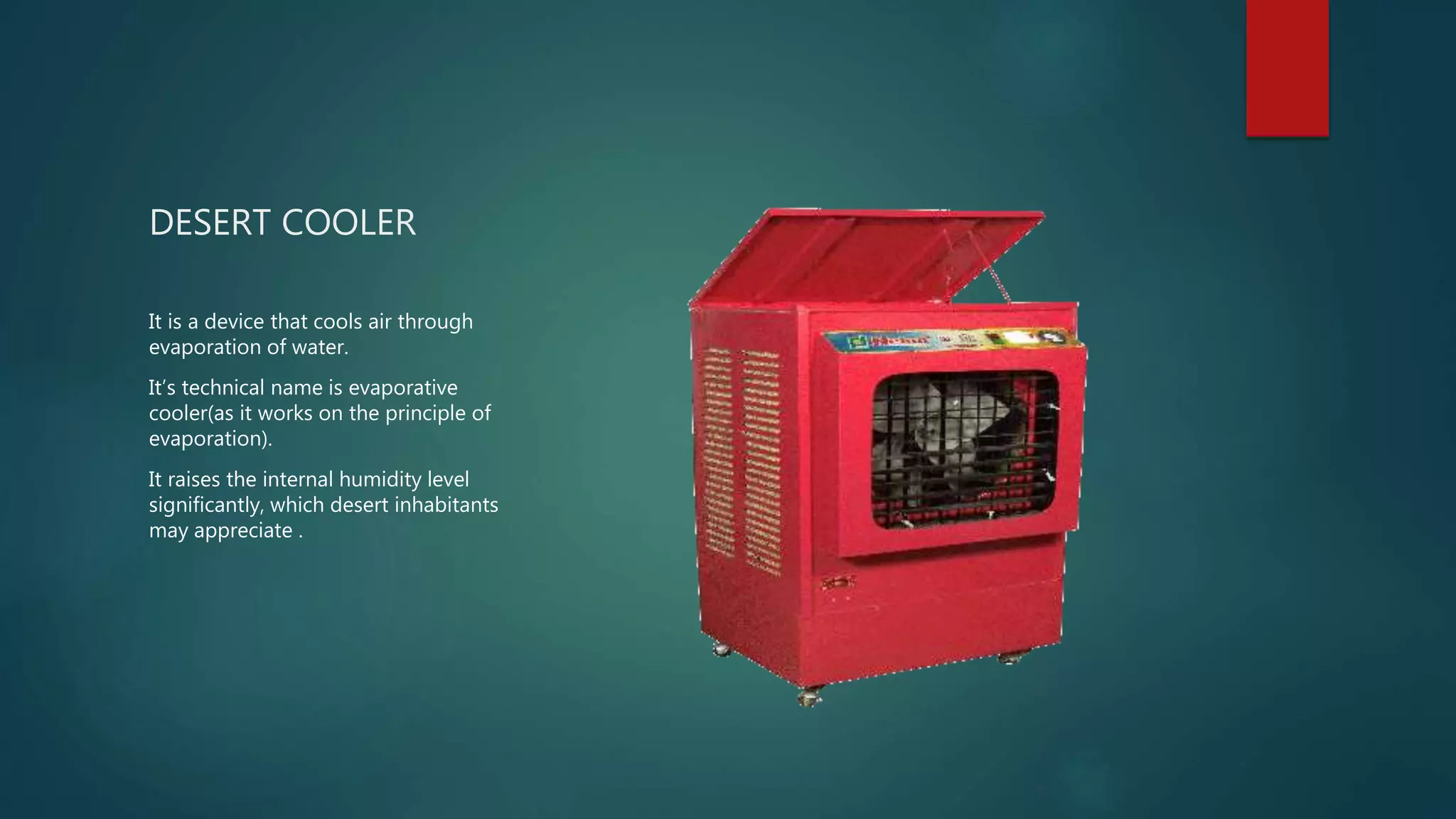
DESERT COOLER
It is a device that cools air through
evaporation of water.
It’s technical name is evaporative
cooler(as it works on the principle of
evaporation).
It raises the internal humidity level
significantly, which desert inhabitants
may appreciate .
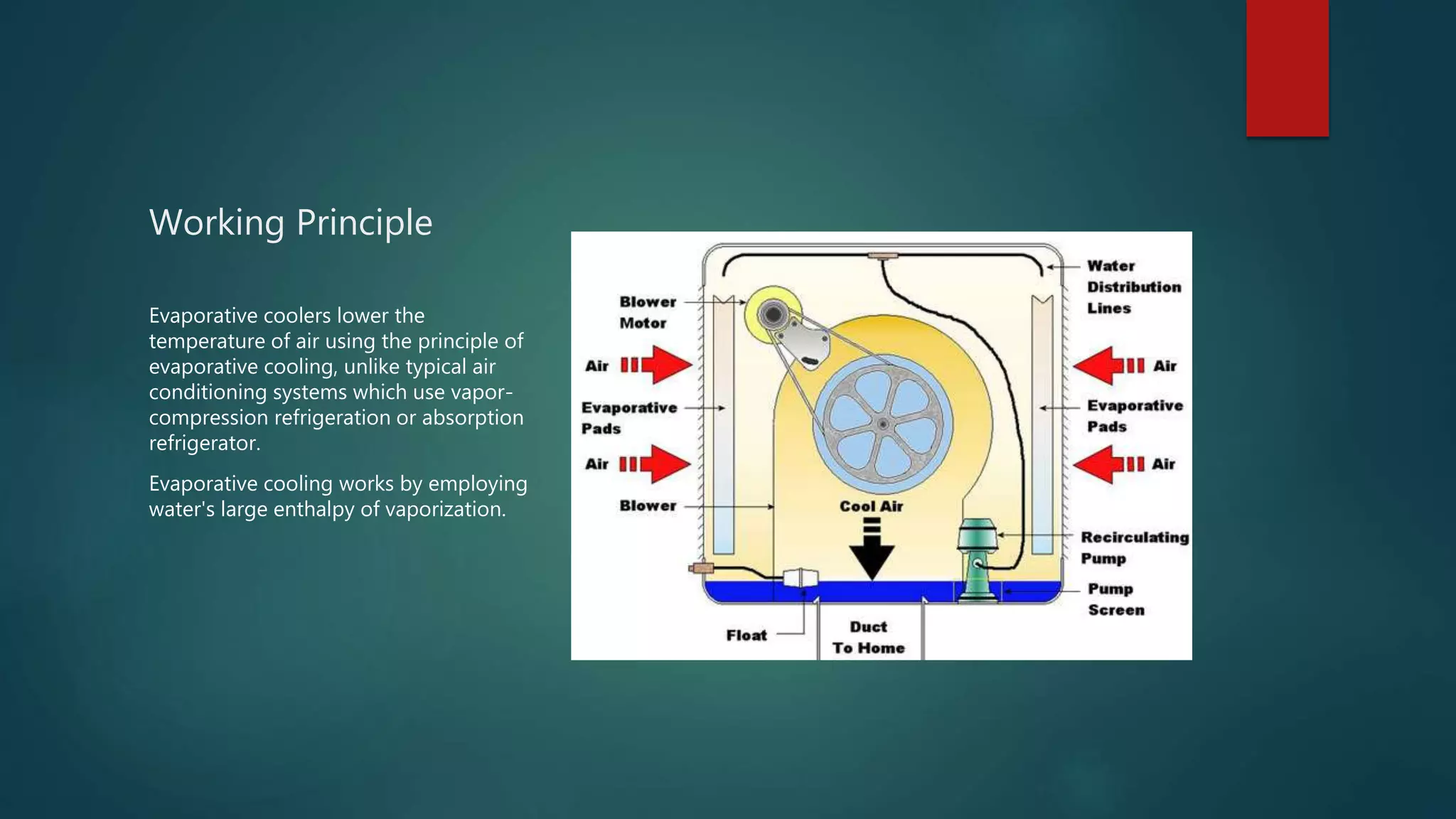
Working Principle
Evaporative coolers lower the
temperature of air using the principle of
evaporative cooling, unlike typical air
conditioning systems which use vapor-
compression refrigeration or absorption
refrigerator.
Evaporative cooling works by employing
water's large enthalpy of vaporization.
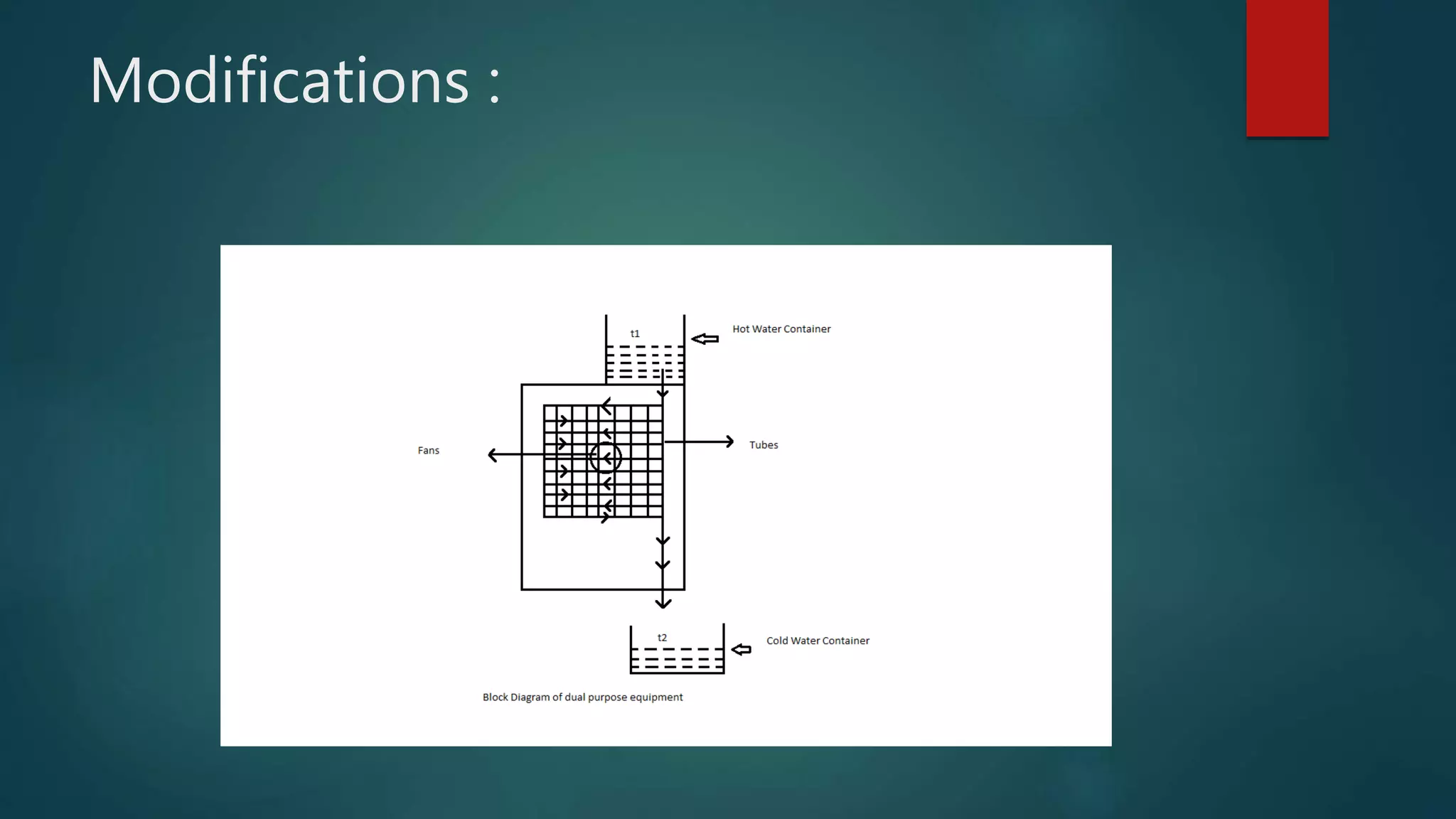
Modifications :
Working :
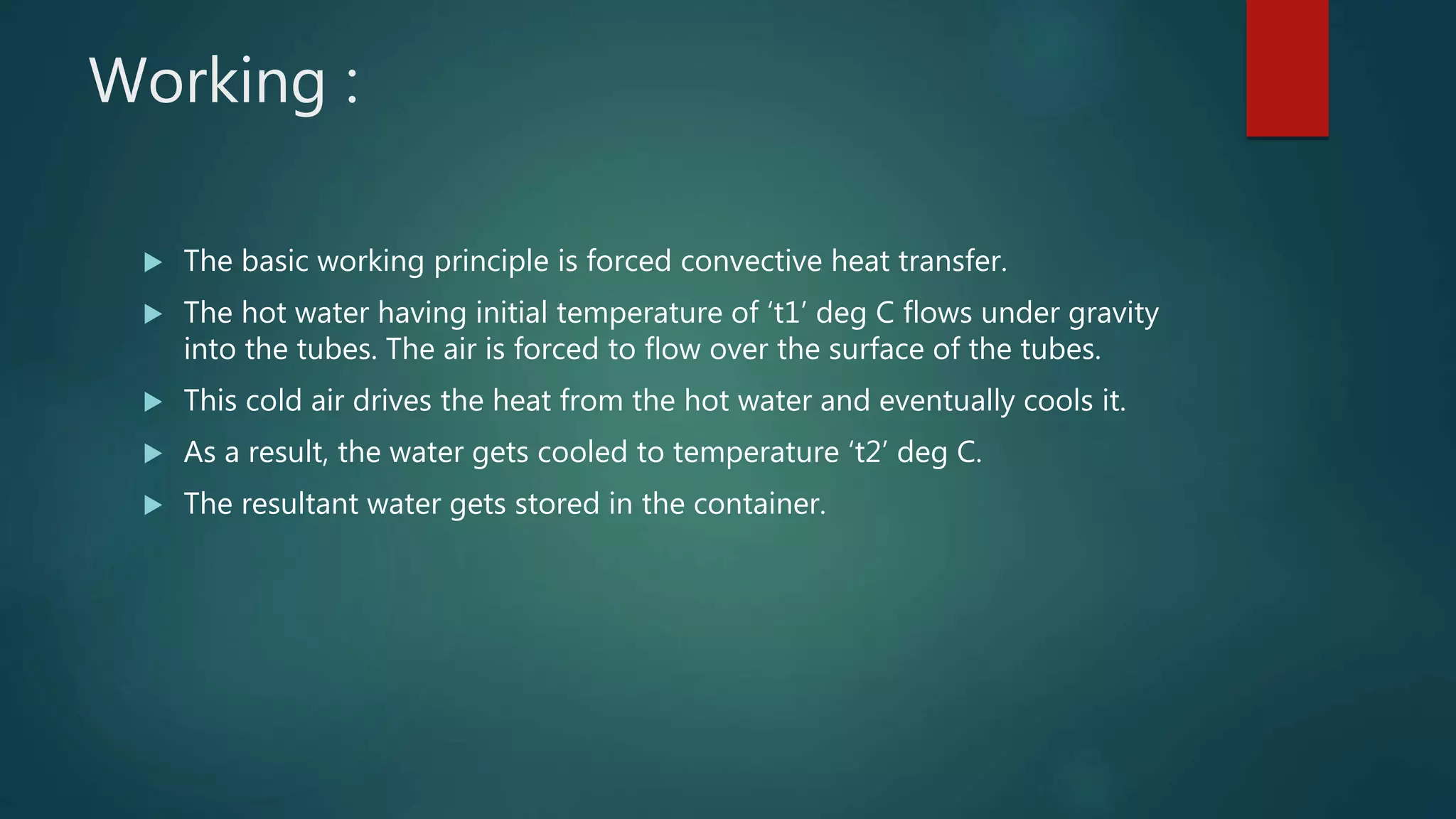
 The basic working principle is forced convective heat transfer.
 The hot water having initial temperature of ‘t1’ deg C flows under gravity
into the tubes. The air is forced to flow over the surface of the tubes.
 This cold air drives the heat from the hot water and eventually cools it.
 As a result, the water gets cooled to temperature ‘t2’ deg C.
 The resultant water gets stored in the container.
Construction:
 An Evaporative cooler whose body shall be made out of galvanized steel
sheet with Grade 350 minimum conforming to IS 277 : 1992 (According to
Bureau of Indian Standards).
 Heat Exchanger tubes following :
 A179 - A179/A179M-90a (1996) e1 - Specification for Seamless Cold-
Drawn Low-Carbon Steel Heat-Exchanger and Condenser Tubes
(According to ASTM International Standards).
 Two Containers of specific size for the following purposes:
 For storing hot water
 For storing cold water
Calculations :
Let,
q1 = Heat energy possessed by the hot water,
t1 = Temperature of hot water, deg C
q2 = Heat energy possessed by the cold water,
t2 = Temperature of the cold water, deg C
m = Mass of the water, g
C = Specific heat of water, J/gdegC
= 4.187 J/gdegC
Calculations(cont.) :
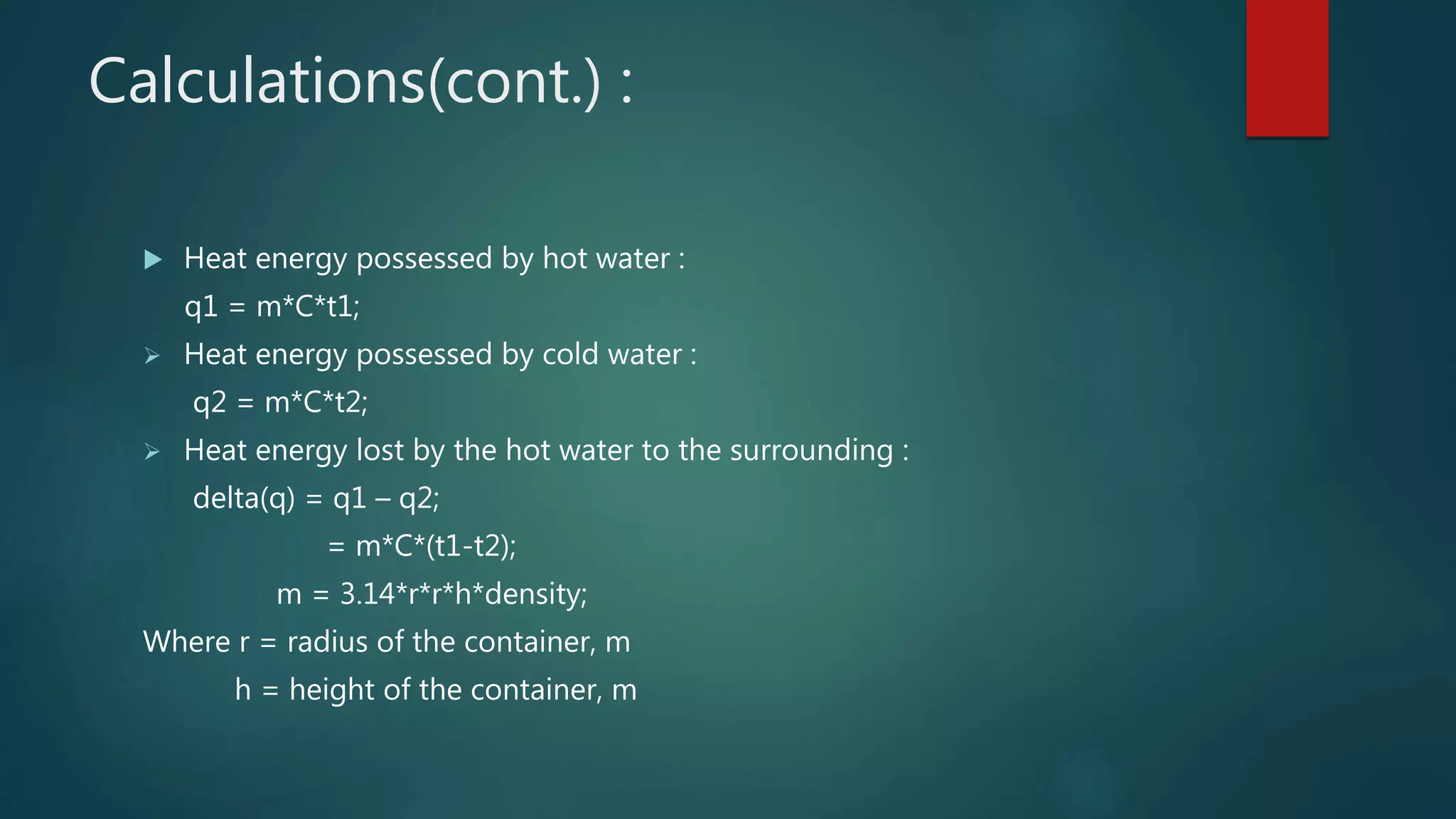
 Heat energy possessed by hot water :
q1 = m*C*t1;
 Heat energy possessed by cold water :
q2 = m*C*t2;
 Heat energy lost by the hot water to the surrounding :
delta(q) = q1 – q2;
= m*C*(t1-t2);
m = 3.14*r*r*h*density;
Where r = radius of the container, m
h = height of the container, m
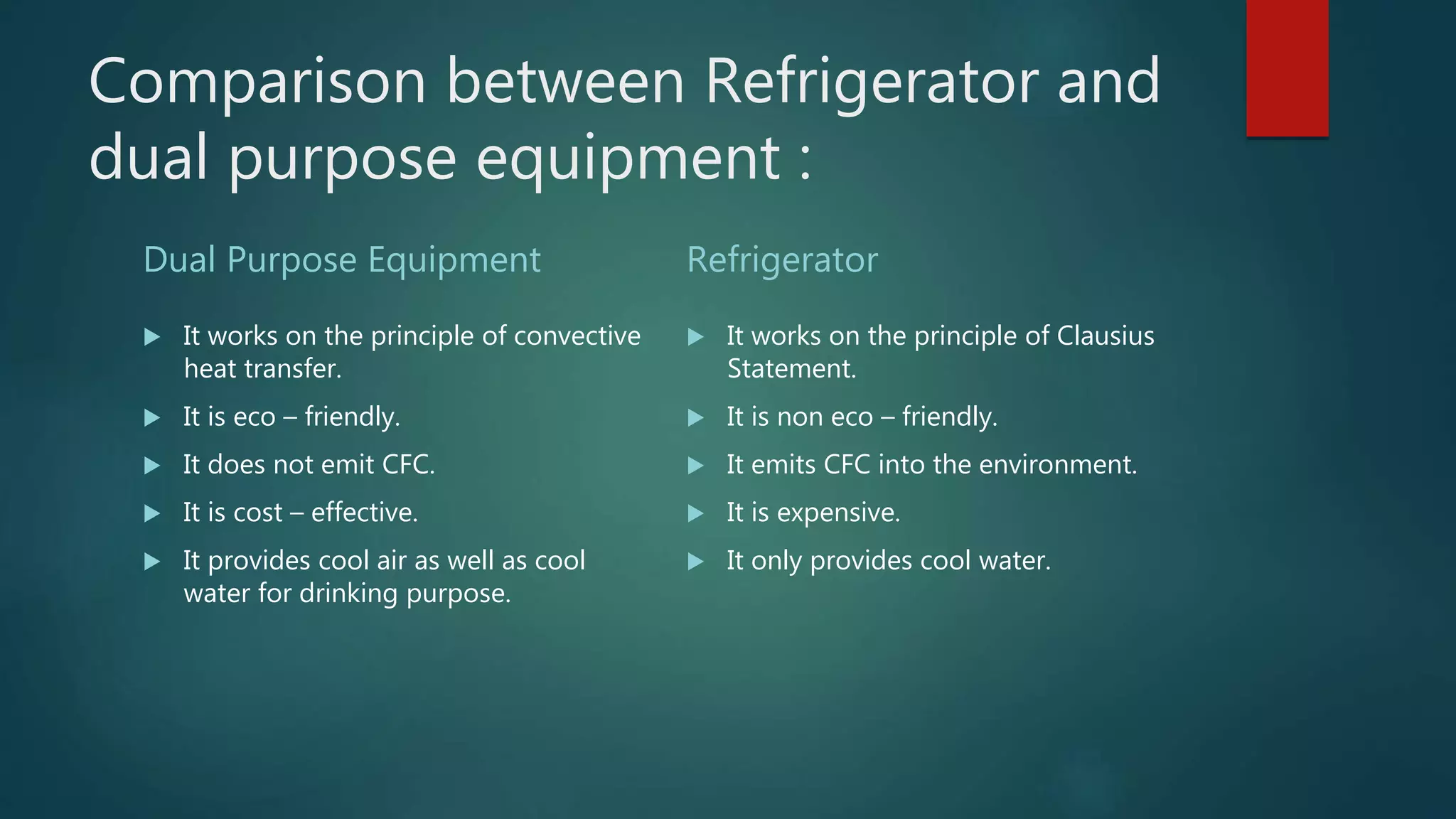
Comparison between Refrigerator and
dual purpose equipment :
Dual Purpose Equipment
 It works on the principle of convective
heat transfer.
 It is eco – friendly.
 It does not emit CFC.
 It is cost – effective.
 It provides cool air as well as cool
water for drinking purpose.
Refrigerator
 It works on the principle of Clausius
Statement.
 It is non eco – friendly.
 It emits CFC into the environment.
 It is expensive.
 It only provides cool water.
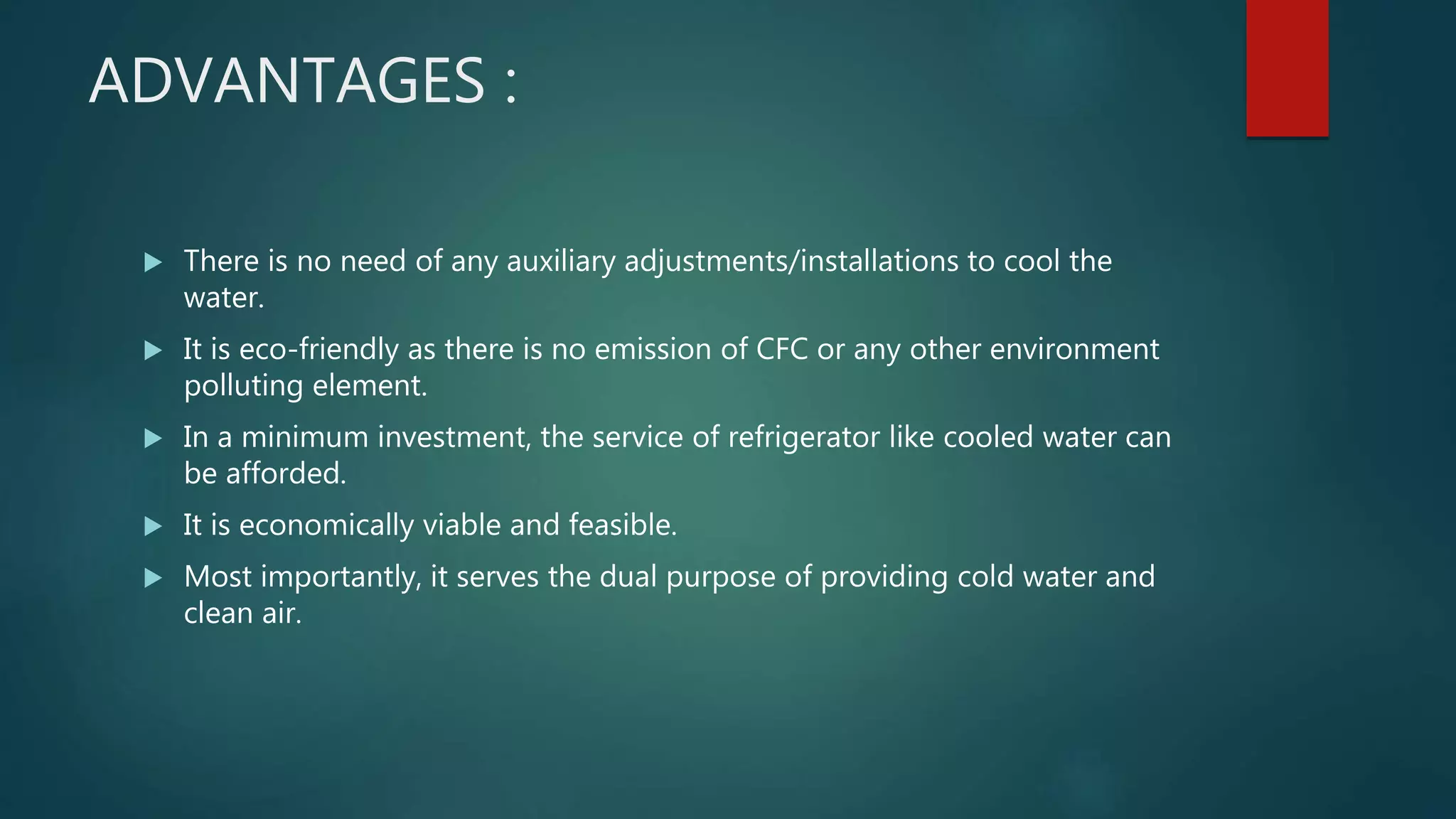
ADVANTAGES :
 There is no need of any auxiliary adjustments/installations to cool the
water.
 It is eco-friendly as there is no emission of CFC or any other environment
polluting element.
 In a minimum investment, the service of refrigerator like cooled water can
be afforded.
 It is economically viable and feasible.
 Most importantly, it serves the dual purpose of providing cold water and
clean air.
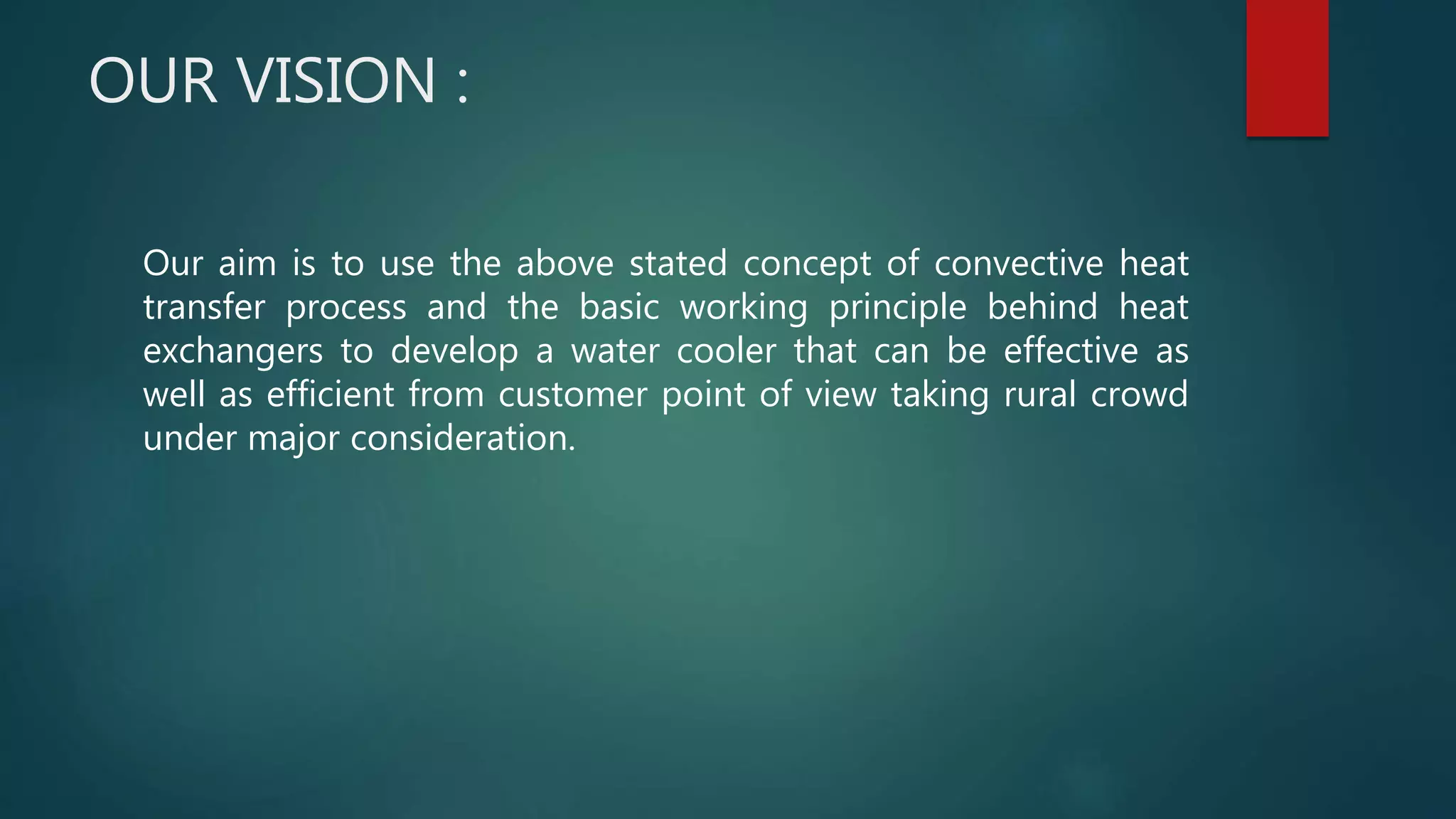
OUR VISION :
Our aim is to use the above stated concept of convective heat
transfer process and the basic working principle behind heat
exchangers to develop a water cooler that can be effective as
well as efficient from customer point of view taking rural crowd
under major consideration.

Minor Project on Cooling of water through Convection

  • 1.
    Minor Project onCooling of water through Convection process GUIDED BY: SUBMITTED BY: MISS MAMTA VARMA AJAY VERMA (08) PROFESSOR ME DEPT. ASHISH SAMUEL DASS (25) BIST BHOPAL DEEPAK KUMAR (31) DHEERENDRA PATEL (35) YOGESH SAHU (121)
  • 2.
    HEAT TRANSFER  Heattransfer is the exchange of thermal energy between physical systems, depending on the temperature and pressure by dissipating heat.  Heat transfer always occurs from a region of high temperature to another region of lower temperature.  The fundamental modes of heat transfer are:  Conduction  Convection  Radiation
  • 3.
    Three mechanisms forheat transfer: conduction, convection and radiation.
  • 4.
    CONDUCTION ‘Conduction’ is thetransfer of heat from one part of the substance to another part of the same substance, without appreciable displacement of molecules forming the substance. Heat transfer by conduction is evaluated by “Fourier’s law of heat conduction”.
  • 5.
    RADIATION ‘Radiation’ is thetransfer of heat through space or matter by means other than conduction or convection. Radiant energy (being electromagnetic radiation) requires no medium for propagation and will pass through a vacuum.
  • 6.
    CONVECTION ‘Convection’ is thetransfer of heat within a fluid by mixing of one portion of the fluid with another. The rate equation for the convective heat transfer (regardless of particular nature) between a surface and an adjacent fluid is prescribed by Newton’s law of cooling is: Q = hA(ts – tf) Where, Q = Rate of conductive heat transfer, A = Area exposed to heat transfer, ts = Surface temperature, tf = Fluid temperature, and h = Co-efficient of conductive heat transfer.
  • 7.
    TYPES OF CONVECTION PROCESS : Freeor natural convection: Free or natural convection occurs where the fluid circulates by virtue of the natural differences in densities of hot and cold fluids; the denser portions of the fluid move downward because of the greater force of gravity, as compared with the force on the less dense. Forced convection: When the work is done to blow or pump the fluid, it is said to be forced convection.
  • 8.
    HEAT EXCHANGER  A‘heat exchanger’ may be defined as an equipment which transfers the energy from a hot fluid to a cold fluid, with maximum rate and minimum investment and running costs.  Examples of heat exchangers:  (i) Intercoolers and preheaters; (ii) Condensers and boilers in steam plant  TYPES :  On the basis of relative direction of fluid motion – i. Parallel flow ii. Counter flow  On the basis of design and constructional features – I. Condensers II. Evaporators
  • 9.
  • 10.
    Dual purpose equipment The dual purpose equipment serves two purposes namely:  Act as cooler  Supplies cold water for drinking purpose  The basic working principle is forced convection. The hot water is forced through the multiple tubes which losses it’s heat to the cold air flowing over it. As a result, the cold water received in the storage tank can be used for drinking purpose.  It is inspired by the constructional features of shell and tube pass heat exchanger.
  • 11.
    DESERT COOLER It isa device that cools air through evaporation of water. It’s technical name is evaporative cooler(as it works on the principle of evaporation). It raises the internal humidity level significantly, which desert inhabitants may appreciate .
  • 12.
    Working Principle Evaporative coolerslower the temperature of air using the principle of evaporative cooling, unlike typical air conditioning systems which use vapor- compression refrigeration or absorption refrigerator. Evaporative cooling works by employing water's large enthalpy of vaporization.
  • 13.
  • 14.
    Working :  Thebasic working principle is forced convective heat transfer.  The hot water having initial temperature of ‘t1’ deg C flows under gravity into the tubes. The air is forced to flow over the surface of the tubes.  This cold air drives the heat from the hot water and eventually cools it.  As a result, the water gets cooled to temperature ‘t2’ deg C.  The resultant water gets stored in the container.
  • 15.
    Construction:  An Evaporativecooler whose body shall be made out of galvanized steel sheet with Grade 350 minimum conforming to IS 277 : 1992 (According to Bureau of Indian Standards).  Heat Exchanger tubes following :  A179 - A179/A179M-90a (1996) e1 - Specification for Seamless Cold- Drawn Low-Carbon Steel Heat-Exchanger and Condenser Tubes (According to ASTM International Standards).  Two Containers of specific size for the following purposes:  For storing hot water  For storing cold water
  • 16.
    Calculations : Let, q1 =Heat energy possessed by the hot water, t1 = Temperature of hot water, deg C q2 = Heat energy possessed by the cold water, t2 = Temperature of the cold water, deg C m = Mass of the water, g C = Specific heat of water, J/gdegC = 4.187 J/gdegC
  • 17.
    Calculations(cont.) :  Heatenergy possessed by hot water : q1 = m*C*t1;  Heat energy possessed by cold water : q2 = m*C*t2;  Heat energy lost by the hot water to the surrounding : delta(q) = q1 – q2; = m*C*(t1-t2); m = 3.14*r*r*h*density; Where r = radius of the container, m h = height of the container, m
  • 18.
    Comparison between Refrigeratorand dual purpose equipment : Dual Purpose Equipment  It works on the principle of convective heat transfer.  It is eco – friendly.  It does not emit CFC.  It is cost – effective.  It provides cool air as well as cool water for drinking purpose. Refrigerator  It works on the principle of Clausius Statement.  It is non eco – friendly.  It emits CFC into the environment.  It is expensive.  It only provides cool water.
  • 19.
    ADVANTAGES :  Thereis no need of any auxiliary adjustments/installations to cool the water.  It is eco-friendly as there is no emission of CFC or any other environment polluting element.  In a minimum investment, the service of refrigerator like cooled water can be afforded.  It is economically viable and feasible.  Most importantly, it serves the dual purpose of providing cold water and clean air.
  • 20.
    OUR VISION : Ouraim is to use the above stated concept of convective heat transfer process and the basic working principle behind heat exchangers to develop a water cooler that can be effective as well as efficient from customer point of view taking rural crowd under major consideration.