College of Food Processing
Technology and Bio-energy
PRESENTATION ON
ARTIFICIAL METHODS OF
REFRIGERATION
By, Kratika Khede(07-0221-2015)
Purvangi Patel(07-0230-2015)
4th sem 2 year.
vArtificial methods of
refrigeration:
 Refrigeration methods made by human beings rather than
occurring naturally are called Artificial methods of
refrigeration.
vTypes of Artificial methods of
refrigeration:
 Dry ice refrigeration
 Evaporative refrigeration
 Thermo-electric refrigeration
 Steam jet refrigeration
 Liquid gas refrigeration and
 Vortex tube system of refrigeration
1. Dry Ice
Refrigeration:
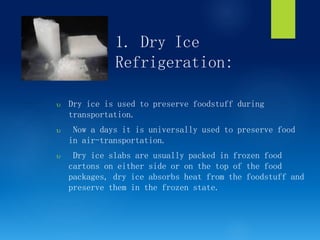
 Dry ice is used to preserve foodstuff during
transportation.
 Now a days it is universally used to preserve food
in air-transportation.
 Dry ice slabs are usually packed in frozen food
cartons on either side or on the top of the food
packages, dry ice absorbs heat from the foodstuff and
preserve them in the frozen state.
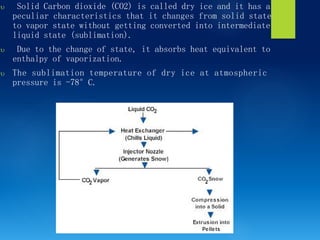
 Solid Carbon dioxide (CO2) is called dry ice and it has a
peculiar characteristics that it changes from solid state
to vapor state without getting converted into intermediate
liquid state (sublimation).
 Due to the change of state, it absorbs heat equivalent to
enthalpy of vaporization.
 The sublimation temperature of dry ice at atmospheric
pressure is -78°C.
3. Evaporative
Refrigeration:
 Evaporative refrigeration makes use of the principle that
when a liquid evaporates, it absorbs heat equivalent to its
latent heat of vaporization from the surroundings, thereby
cooling it.
 Cooling of water in the earthen pitcher – the water
coming out of the pores of the pitcher evaporates when it
comes in contact with dry air, thereby cooling the water in
the pitcher.
 When a drop of spirit is put on the palm of hand, it
evaporates producing cooling effect.
 Evaporation cooling may be defined as the adiabatic
transfer of heat from air to water.
 Evaporation cooling may be defined as the
adiabatic transfer of heat from air to water.
 It is utilized in cooling towers where condenser
water is cooled by spraying it from top and forcing
a current of air from below.
 Another application is evaporative type of
condensers. Yet another application is in desert
coolers or room coolers.
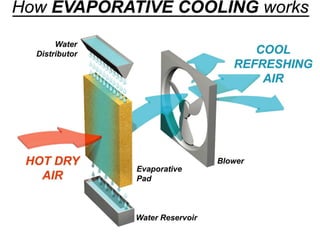
 Dry air is passed through wet pads. Due to
evaporation, air gets cooled.
 The principle is also utilized in making artificial
snow.
4.Thermo-electric
Refrigeration:
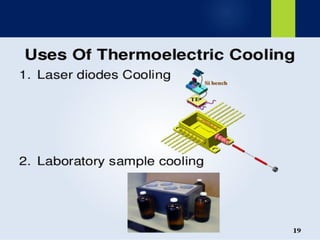
 Thermo-electric refrigeration type employs
Peltier’s effect. when two dissimilar metals are
joined on either ends and a direct current is
circulated through it, one joint gets cooled while the
other gets heated.
 Antimony (Sb) and Bismuth (Bi) are commonly used
metals as they are electro-chemically opposite in
their polarity.
 If the cold end is placed in a closed space, it gets
cooled.
 If the magnitude of current is increased and a series
of such strips are placed together a good cooling
effect can be produced.
5.Steam Jet
Refrigeration:
 The principle: Boiling point of water can be reduced by
reducing the pressure. At standard atmospheric pressure, the
boiling point of water is 100°C.
 If the atmospheric pressure is lowered, the boiling point is
considerably reduced. For example, at pressure of 6.5 cm of
water, the boiling point of water is considerably reduced to
5 cm of water, its boiling point reduces to 6°C.
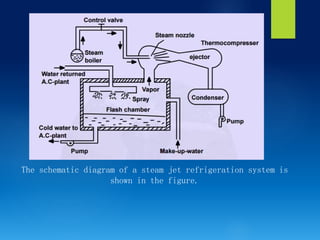
 The pressure reduction in the system is achieved by a steam
nozzle and ejector assembly.
 Due to the extremely high velocity of steam in ejector
assembly all the gases and vapors present in the flash
chamber are removed thereby creating partial vacuum. This
results in the reduction of the boiling point of water.
Ø Due to the evaporation of water at low temperature, the
remaining water in the flash chamber gets cooled which is
circulated to the refrigerated space and the warm water
received from it is sprayed in the flash chamber.
Ø A make-up water connection is provided in the flash
chamber to make good any water lost in evaporation.
Ø The steam is supplied to the nozzle from a boiler.
Ø The condenser condenses the steam and water vapour received
from flash chamber.
Ø The condensate from the condenser is taken back to the boiler.
The schematic diagram of a steam jet refrigeration system is
shown in the figure.
6. Liquid Gas
Refrigeration:
 Liquid gases which can be utilized for producing
refrigeration should be non-toxic. Due to this limitation only
nitrogen and liquid carbon dioxide can be utilized for the
purpose.
 Due to the evaporation of cooling gas, cooling is
accomplished.
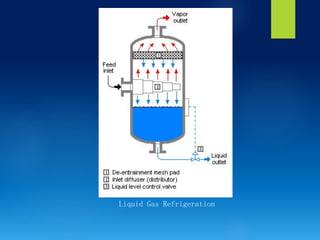
 Liquid gas is filled in a well insulated cylinder and its
quantity regulated by means of a valve.
 Liquid gas is sprayed in the refrigerated space. Due to its
evaporation, the temperature in the refrigerated space is
lowered. This method is used for cooling the vehicles
transporting food stuff. It may also be utilized for cold
storage’s.
Liquid Gas Refrigeration
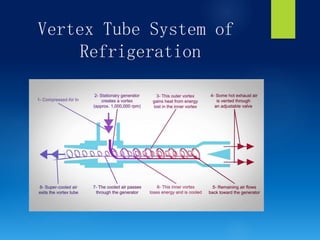
7. Vertex Tube System of
Refrigeration:
 Vertex tube is a simple straight piece of tube into
which compressed air flows tangentially and is so throttled
that the central core of the air steam can be separated from
peripheral flow.
 The central core of the air is separated either by uni-
flow or counter flow method. The central core of the air
steam in cold as compared to the hot gases at the periphery.
Vertex Tube System of
Refrigeration
Reference:
Arora Domkundwar , A Course in Refrigeration and
Air-conditioning , Gagan Kapur for Dhanpatrai & Co.
(P)ltd. ,2006, seventh Revised Edition
 THANK YOU for your kind attention.

Artifical method of Refrigeration

  • 1.
    College of FoodProcessing Technology and Bio-energy PRESENTATION ON ARTIFICIAL METHODS OF REFRIGERATION By, Kratika Khede(07-0221-2015) Purvangi Patel(07-0230-2015) 4th sem 2 year.
  • 2.
    vArtificial methods of refrigeration: Refrigeration methods made by human beings rather than occurring naturally are called Artificial methods of refrigeration. vTypes of Artificial methods of refrigeration:  Dry ice refrigeration  Evaporative refrigeration  Thermo-electric refrigeration  Steam jet refrigeration  Liquid gas refrigeration and  Vortex tube system of refrigeration
  • 3.
    1. Dry Ice Refrigeration: Dry ice is used to preserve foodstuff during transportation.  Now a days it is universally used to preserve food in air-transportation.  Dry ice slabs are usually packed in frozen food cartons on either side or on the top of the food packages, dry ice absorbs heat from the foodstuff and preserve them in the frozen state.
  • 4.
     Solid Carbondioxide (CO2) is called dry ice and it has a peculiar characteristics that it changes from solid state to vapor state without getting converted into intermediate liquid state (sublimation).  Due to the change of state, it absorbs heat equivalent to enthalpy of vaporization.  The sublimation temperature of dry ice at atmospheric pressure is -78°C.
  • 5.
    3. Evaporative Refrigeration:  Evaporativerefrigeration makes use of the principle that when a liquid evaporates, it absorbs heat equivalent to its latent heat of vaporization from the surroundings, thereby cooling it.  Cooling of water in the earthen pitcher – the water coming out of the pores of the pitcher evaporates when it comes in contact with dry air, thereby cooling the water in the pitcher.  When a drop of spirit is put on the palm of hand, it evaporates producing cooling effect.
  • 7.
     Evaporation coolingmay be defined as the adiabatic transfer of heat from air to water.  Evaporation cooling may be defined as the adiabatic transfer of heat from air to water.  It is utilized in cooling towers where condenser water is cooled by spraying it from top and forcing a current of air from below.  Another application is evaporative type of condensers. Yet another application is in desert coolers or room coolers.  Dry air is passed through wet pads. Due to evaporation, air gets cooled.  The principle is also utilized in making artificial snow.
  • 8.
    4.Thermo-electric Refrigeration:  Thermo-electric refrigerationtype employs Peltier’s effect. when two dissimilar metals are joined on either ends and a direct current is circulated through it, one joint gets cooled while the other gets heated.  Antimony (Sb) and Bismuth (Bi) are commonly used metals as they are electro-chemically opposite in their polarity.  If the cold end is placed in a closed space, it gets cooled.  If the magnitude of current is increased and a series of such strips are placed together a good cooling effect can be produced.
  • 10.
    5.Steam Jet Refrigeration:  Theprinciple: Boiling point of water can be reduced by reducing the pressure. At standard atmospheric pressure, the boiling point of water is 100°C.  If the atmospheric pressure is lowered, the boiling point is considerably reduced. For example, at pressure of 6.5 cm of water, the boiling point of water is considerably reduced to 5 cm of water, its boiling point reduces to 6°C.  The pressure reduction in the system is achieved by a steam nozzle and ejector assembly.  Due to the extremely high velocity of steam in ejector assembly all the gases and vapors present in the flash chamber are removed thereby creating partial vacuum. This results in the reduction of the boiling point of water.
  • 11.
    Ø Due tothe evaporation of water at low temperature, the remaining water in the flash chamber gets cooled which is circulated to the refrigerated space and the warm water received from it is sprayed in the flash chamber. Ø A make-up water connection is provided in the flash chamber to make good any water lost in evaporation. Ø The steam is supplied to the nozzle from a boiler. Ø The condenser condenses the steam and water vapour received from flash chamber. Ø The condensate from the condenser is taken back to the boiler.
  • 12.
    The schematic diagramof a steam jet refrigeration system is shown in the figure.
  • 13.
    6. Liquid Gas Refrigeration: Liquid gases which can be utilized for producing refrigeration should be non-toxic. Due to this limitation only nitrogen and liquid carbon dioxide can be utilized for the purpose.  Due to the evaporation of cooling gas, cooling is accomplished.  Liquid gas is filled in a well insulated cylinder and its quantity regulated by means of a valve.  Liquid gas is sprayed in the refrigerated space. Due to its evaporation, the temperature in the refrigerated space is lowered. This method is used for cooling the vehicles transporting food stuff. It may also be utilized for cold storage’s.
  • 14.
  • 15.
    7. Vertex TubeSystem of Refrigeration:  Vertex tube is a simple straight piece of tube into which compressed air flows tangentially and is so throttled that the central core of the air steam can be separated from peripheral flow.  The central core of the air is separated either by uni- flow or counter flow method. The central core of the air steam in cold as compared to the hot gases at the periphery.
  • 16.
    Vertex Tube Systemof Refrigeration
  • 17.
    Reference: Arora Domkundwar ,A Course in Refrigeration and Air-conditioning , Gagan Kapur for Dhanpatrai & Co. (P)ltd. ,2006, seventh Revised Edition
  • 18.
     THANK YOUfor your kind attention.