DESIGN AND ANALYSIS OF A
HYBRID COOLER
Guided By. Submitted By
Vikas Sahu
Prof. Harsh Jain
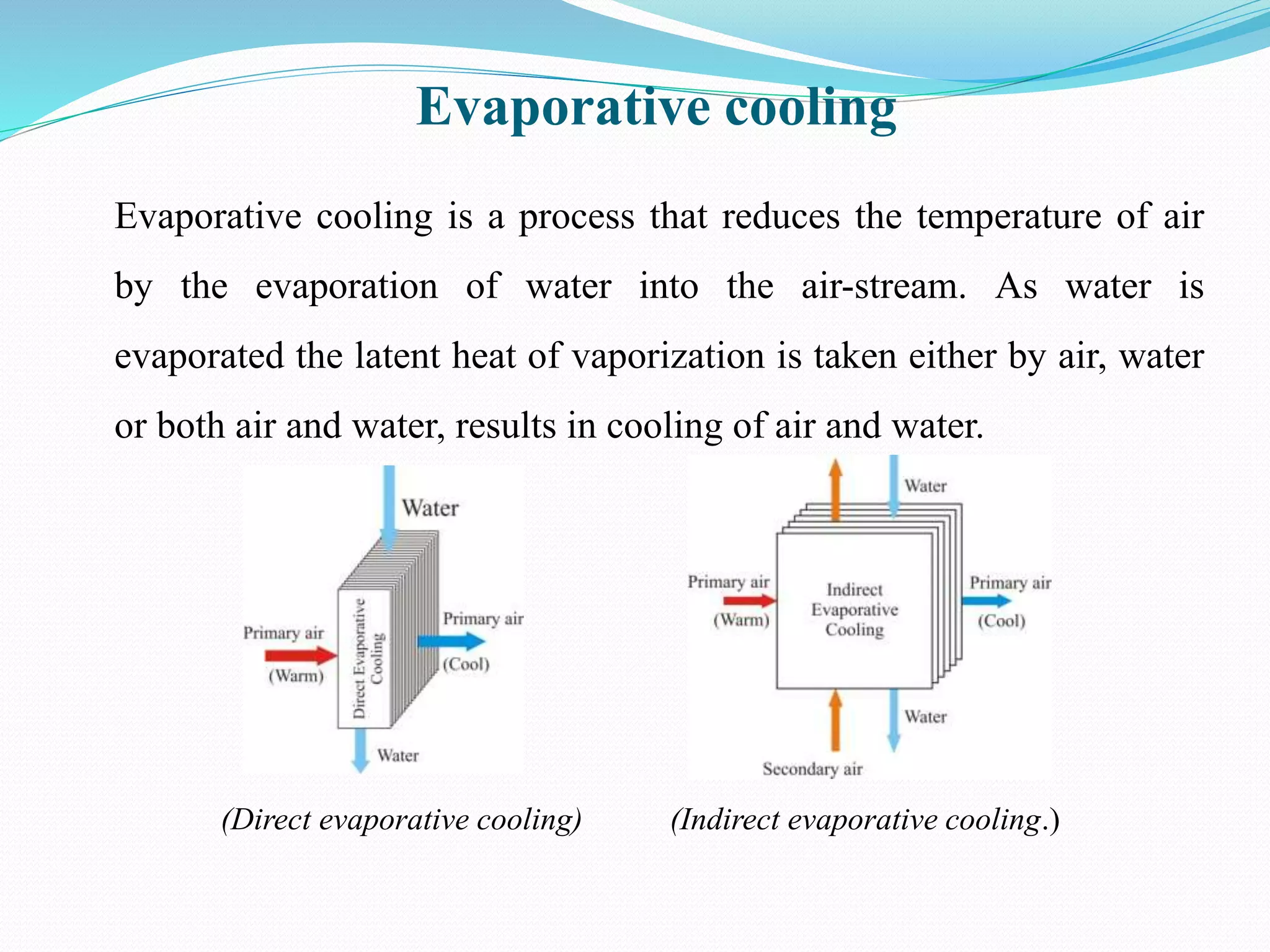
PRINCIPLE OF DESERT COOLER
 Desert coolers are based on the simple principle that when
unsaturated air comes in contact with water, the water
evaporates. In the process, the moisture content of air
increases, while its temperature decreases. The resulting cold
but moist air is used for providing cooling . Thus a desert
cooler is a simple device, which consists of an arrangement for
blowing dry and hot air over a wet surface and arrangement for
keeping the surface wet continuously. The cooler normally
consist of a blower and a pump.
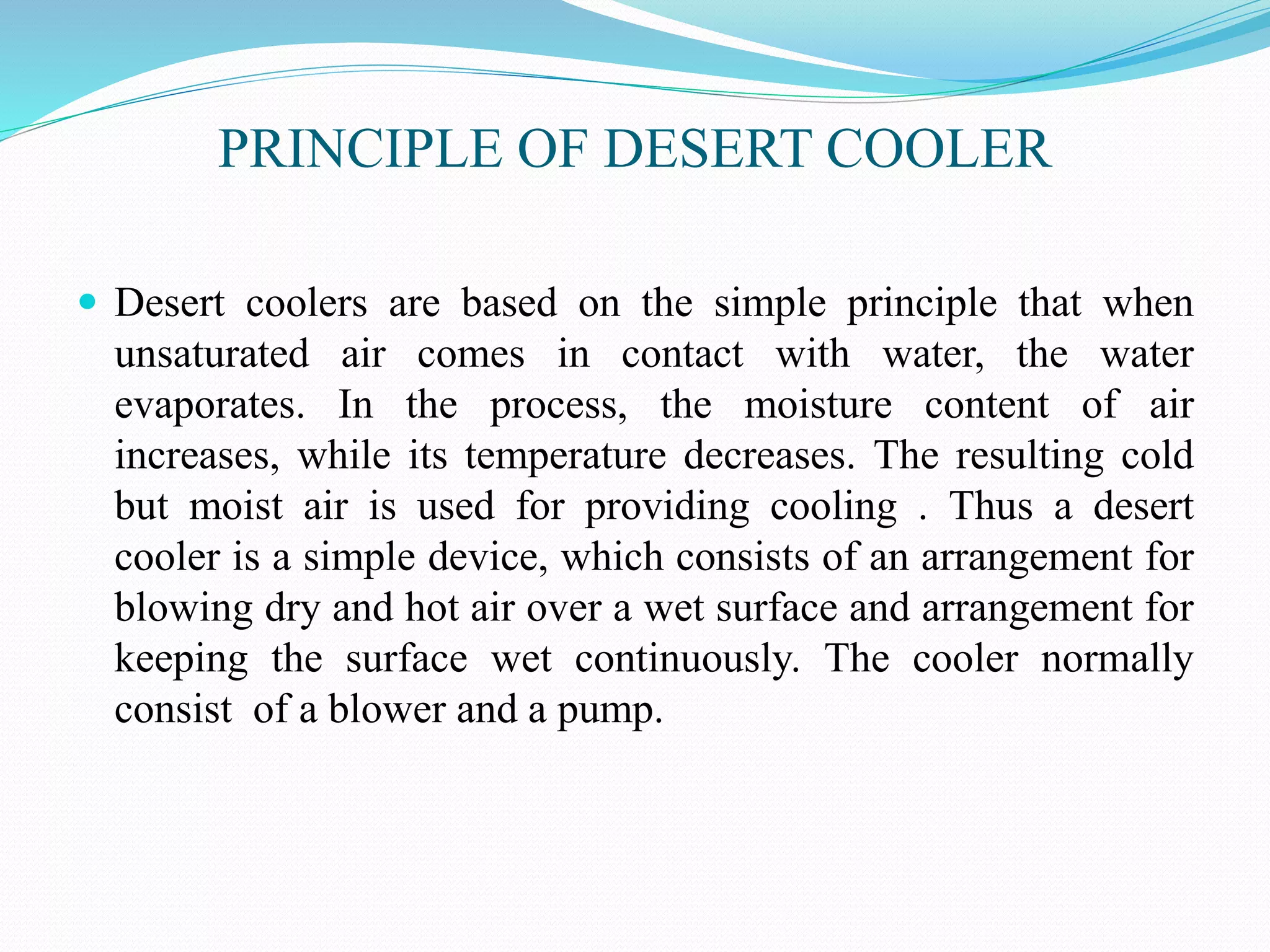
Evaporative cooling
Evaporative cooling is a process that reduces the temperature of air
by the evaporation of water into the air-stream. As water is
evaporated the latent heat of vaporization is taken either by air, water
or both air and water, results in cooling of air and water.
(Direct evaporative cooling) (Indirect evaporative cooling.)
PRINCIPLE OF DESERT COOLER
Desert cooler
METHODOLOGY
 Mathematical model.
 Fabrication of proposed design.
 Experimental validation of proposed mathematical model.
 Coefficient of performance(C.O.P) of proposed cooler.
EXPECTED OUTCOME
 A new design of desert cooler utilized for water cooling as well
as air conditioning, is being proposed which would be very
useful especially for hot and composite climates like Raipur
(CG).
 A substitute for CFC based air conditioners and refrigerators,
this device is based on principle of evaporation would be
environment friendly and will consume negligible amount of
electricity.
 It would be a cost effective and innovative design.
PARTS / EQUIPMENTS/DEVICE NEEDED
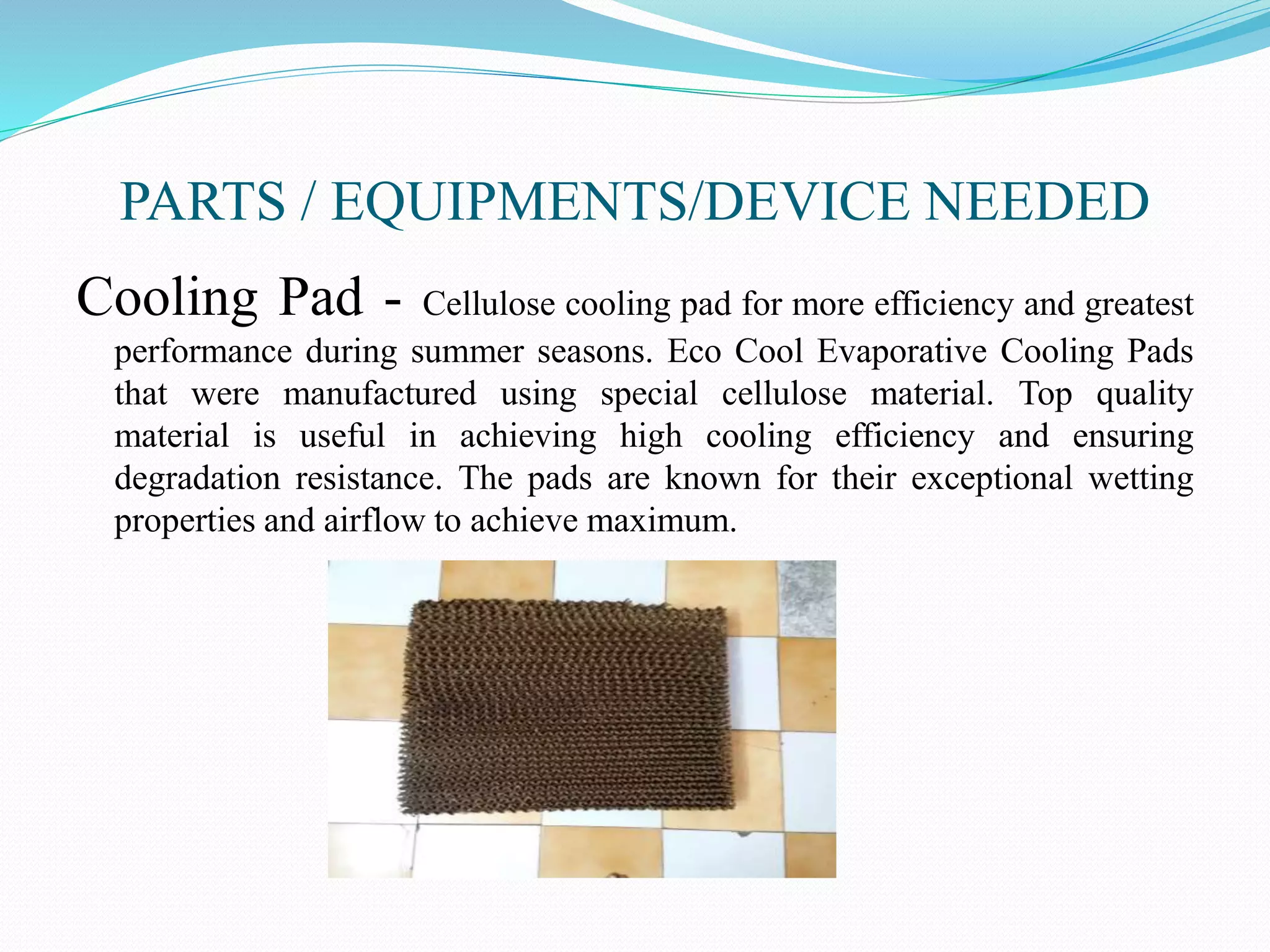
Cooling Pad - Cellulose cooling pad for more efficiency and greatest
performance during summer seasons. Eco Cool Evaporative Cooling Pads
that were manufactured using special cellulose material. Top quality
material is useful in achieving high cooling efficiency and ensuring
degradation resistance. The pads are known for their exceptional wetting
properties and airflow to achieve maximum.
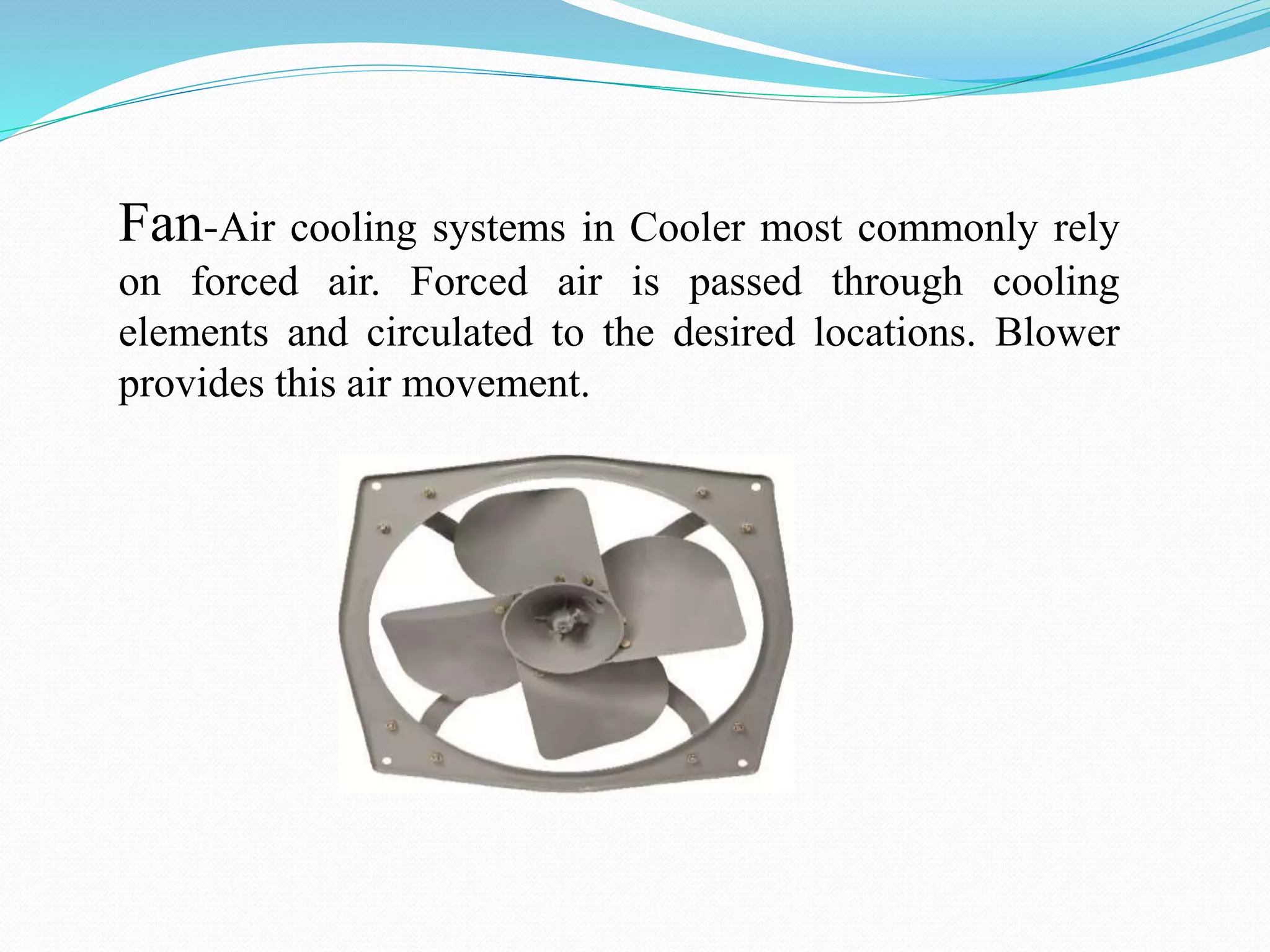
Fan-Air cooling systems in Cooler most commonly rely
on forced air. Forced air is passed through cooling
elements and circulated to the desired locations. Blower
provides this air movement.
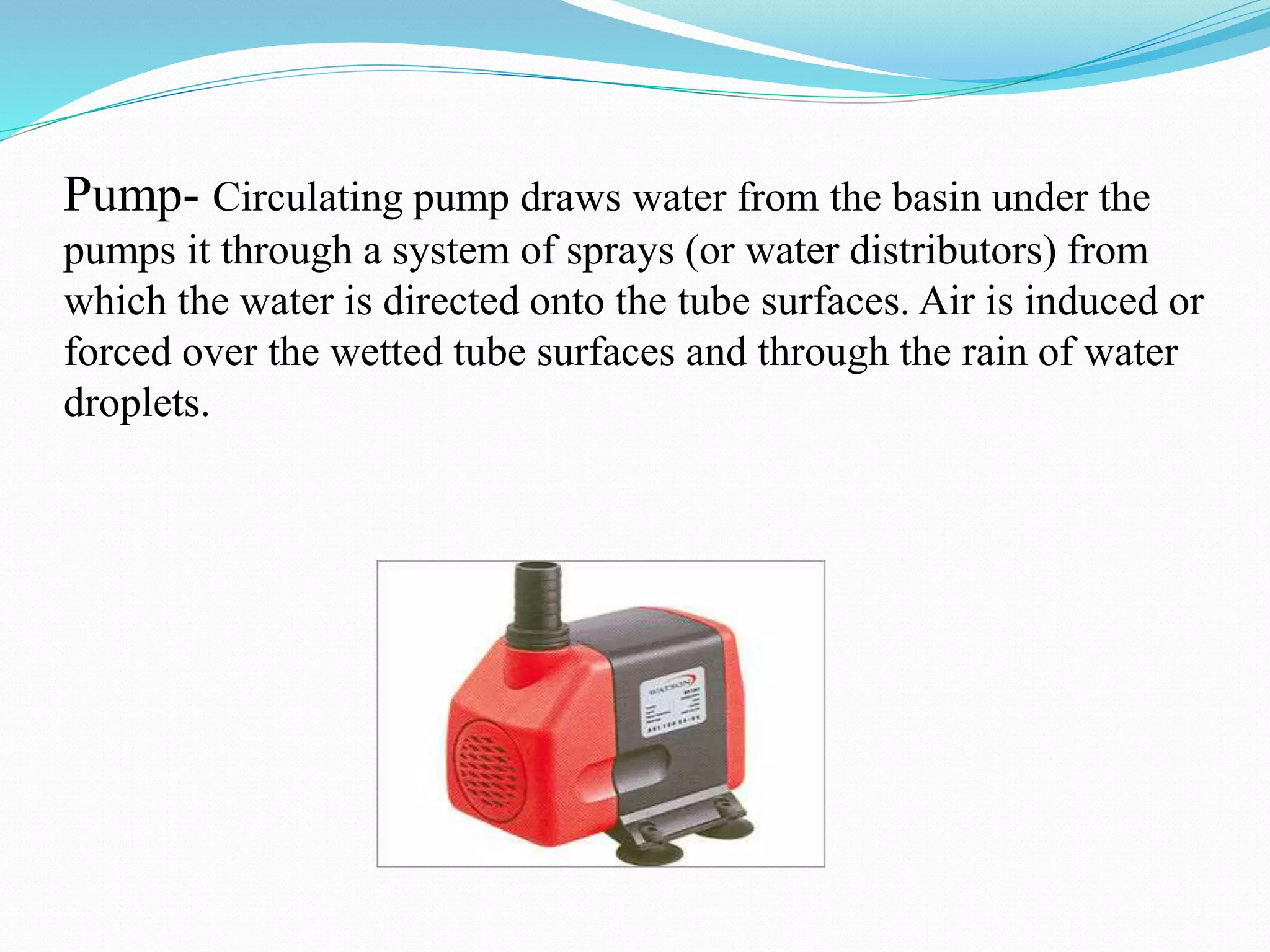
Pump- Circulating pump draws water from the basin under the
pumps it through a system of sprays (or water distributors) from
which the water is directed onto the tube surfaces. Air is induced or
forced over the wetted tube surfaces and through the rain of water
droplets.
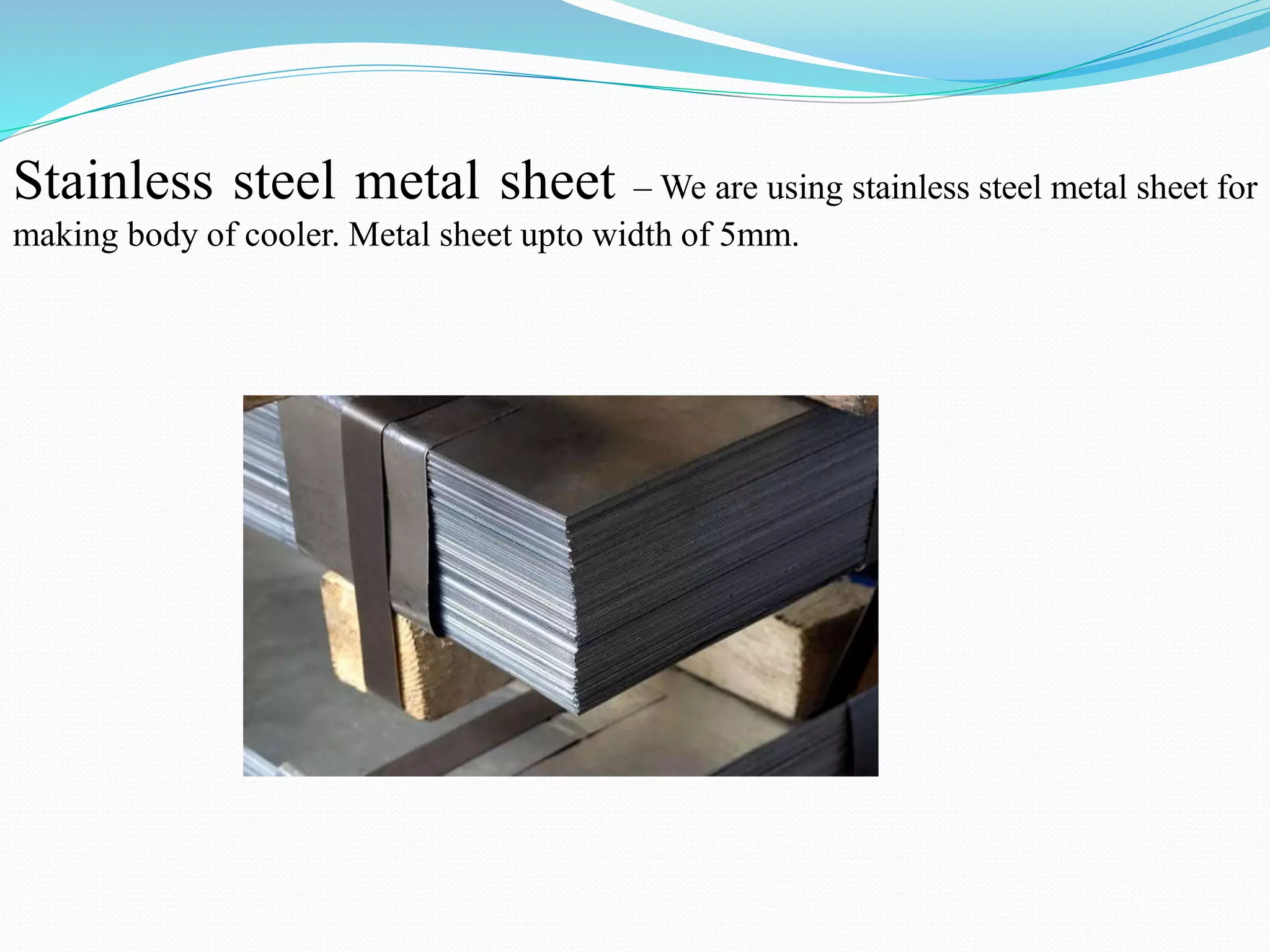
Stainless steel metal sheet – We are using stainless steel metal sheet for
making body of cooler. Metal sheet upto width of 5mm.
LITREATURE
The use of direct evaporative coolers (commonly known as desert
coolers) is very widespread in the third world countries, during hot
and dry weather. It consists of a cubical box of sheet metal or plastic
containing large vertical filter (Pads) an electric motor driven fan, a
water pump, a water distribution system, and a water sump (tank) at
the bottom, Fan draws in warm air from outside through wetted
media, air gets evaporated and thus cooled. The water pump lifts the
water from the sump through distribution system to the top of the
pads from where it trickles down by gravity back to water tank. The
cooled air is then delivered either directly into a room or into duct
distribution system, this is called as “Direct evaporative cooling” in
which the air comes in direct contact of water, the cooled and
humidified outside air flows to the room and removes heat.
Ideally, when water temperature is assumed to be at wet bulb temperature
of ambient air, the temperature of water remains constant neither raised nor
lowered evaporation results in cooling of air alone. But in desert coolers the
temperature of circulating water is considerably warmer than the wet bulb
temperature of air both air and water gets cooled. The process resembles in
cooling tower to cool warm water by evaporation.
It is suggested that in addition to cooling air, one can utilize the coolness
stored in the bottom tray (or tank) for medium temperature cooling; as an
example one can place a box in the tank to keep food cool or exchange heat with
the help of a coil placed in the tank or conditioned (cooled) tank water can be
utilized to enhance the distillate output of solar still. The present work explores
this option and in the process makes further progress in modelling of such
coolers, in particular by inclusion of the variation of the temperature of flowing
water along the direction of flow; the expressions for the corresponding
parameters also become different.
The present knowledge of evaporative cooling is based on theoretical and
experimental work on heat and mass transfer in wet porous pads with cross
flow of air and water and performance of devices based on evaporative
cooling, previous work limits up to the modeling based on the exit air
temperature, effectiveness and efficiency of desert cooler
All previous analysis discussed, correspond to the steady state and
neglect the variation of the temperature of water along the direction of flow; the
temperature of water has been assumed to be the wet bulb temperature,
throughout the pad. Unlike previous research works in this chapter the variation
of the temperature of water along the direction of flow has been taken into
account. The time variation of the temperature of water in the tank has also
been investigated. The effect of addition of heat to the water in the bottom tank
(for purpose of cooling) has also been studied. An expression for the average
temperature of cool air, flowing out of the pad has also been derived .The
theoretical results have been compared with the results of experiments
conducted by the authors. To validate mathematical model theoretical and
experimental time variation of tank water temperature is plotted.
REFRENCES
[1] J.R. Watt., Evaporative Air conditioning hand book, 2nd Edn. Chapman and
Hall, New York , (1986).
[2] M.L Mathur, B.P Jain., Performance of a portable cooler; Desert cooler.,
J.Inst. Engr. India 59,241-245, (1979).
[3] M.L Mathur, B.P Jain., Experimental study of performance of portable air
washer type Air cooler, Journal of Institute of Engineers India 63, 38-40,
(1982).
[4] R.L Sawhney, S.P Singh, N.K Bansal, M.S Sodha., Optimization of an
evaporative cooler for space cooling., Int. J. Housing Sc. and its Applns.11,
225-231, (1987).
[5] S.P Singh, R.L Sawhney, N.K Bansal, M.S Sodha., Sizing of an
evaporative cooler for thermal comfort inside a room, Int. J. Housing Sc.
and its Applns.11, 141-148, (1987).
[6] M.S Sodha, J. Kaur, R.L Sawhney,R. Kamal., Thermal performance of a
building coupled to an evaporative cooling tower; Parametric studies., Int.J.
Energy Research15, 1-10. (1991a).
[7] B. Ringavkuli, S. Kumar., An experimental study of a novel dew point
evaporative cooling system, Energy and Buildings 42 (5), 637-644, (2010).
[8] J.A Dowdy,N.S Karabash., Experimental determination of heat and mass
transfer coefficients in rigid impregnated cellulose evaporative media, ASHRAE
Trans. 93 Part 2 , 382-395, (1987).
[9] J.R Camargo,J.R Ebinuma,C.D., A mathematical model for direct and
indirect evaporative cooling air conditioning systems, Proceedings of the 9th
Brazilian Congress of Thermal Engineering and Sciences (2002).
[10] J.M Wu, Huang, H Zhang, Theoretical analysis on heat and mass
transfer in a direct evaporative cooler, Applied Thermal Engineering 29, 980-
984, (2009a).
[11] J.M Wu, Huang,H Zhang., Numerical investigation on the heat and
mass transfer in a direct evaporative cooler, Applied Thermal
Engineering 29, 195-201,( 2009b).
[12] M.S Sodha, S.P Singh,S.P, R.L Sawhney., Evolution of design
pattern for direct evaporative coolers, Building and Environment 30 ,
287-291, (1985)
[13] P.J.Erens andA.A.Dreyer.,.Modelling of indirect evaporative air
coolers., International Journal of Heat and Mass Transfer 36, (1993)
[14] T.R.Tulsidasani, R.L.Sawhney, S.P. Singh and M.S.Sodha., Recent
Researches on an indirect Evaporative Cooler-I: Optimization of COP
of an indirect Evaporative Cooler (IEC)., International Journal of
Energy Research, 21, 1099-1108, (1997).
[15] Dr. Aneesh Somwanshi., Recent Researches in Performance of
Direct Evaporative Cooler ( Desert cooler) for Climate of Raipur
(Chhattisgarh).
THANK YOU

New microsoft office power point presentation

  • 1.
    DESIGN AND ANALYSISOF A HYBRID COOLER Guided By. Submitted By Vikas Sahu Prof. Harsh Jain
  • 2.
    PRINCIPLE OF DESERTCOOLER  Desert coolers are based on the simple principle that when unsaturated air comes in contact with water, the water evaporates. In the process, the moisture content of air increases, while its temperature decreases. The resulting cold but moist air is used for providing cooling . Thus a desert cooler is a simple device, which consists of an arrangement for blowing dry and hot air over a wet surface and arrangement for keeping the surface wet continuously. The cooler normally consist of a blower and a pump.
  • 3.
    Evaporative cooling Evaporative coolingis a process that reduces the temperature of air by the evaporation of water into the air-stream. As water is evaporated the latent heat of vaporization is taken either by air, water or both air and water, results in cooling of air and water. (Direct evaporative cooling) (Indirect evaporative cooling.)
  • 4.
    PRINCIPLE OF DESERTCOOLER Desert cooler
  • 5.
    METHODOLOGY  Mathematical model. Fabrication of proposed design.  Experimental validation of proposed mathematical model.  Coefficient of performance(C.O.P) of proposed cooler.
  • 6.
    EXPECTED OUTCOME  Anew design of desert cooler utilized for water cooling as well as air conditioning, is being proposed which would be very useful especially for hot and composite climates like Raipur (CG).  A substitute for CFC based air conditioners and refrigerators, this device is based on principle of evaporation would be environment friendly and will consume negligible amount of electricity.  It would be a cost effective and innovative design.
  • 7.
    PARTS / EQUIPMENTS/DEVICENEEDED Cooling Pad - Cellulose cooling pad for more efficiency and greatest performance during summer seasons. Eco Cool Evaporative Cooling Pads that were manufactured using special cellulose material. Top quality material is useful in achieving high cooling efficiency and ensuring degradation resistance. The pads are known for their exceptional wetting properties and airflow to achieve maximum.
  • 8.
    Fan-Air cooling systemsin Cooler most commonly rely on forced air. Forced air is passed through cooling elements and circulated to the desired locations. Blower provides this air movement.
  • 9.
    Pump- Circulating pumpdraws water from the basin under the pumps it through a system of sprays (or water distributors) from which the water is directed onto the tube surfaces. Air is induced or forced over the wetted tube surfaces and through the rain of water droplets.
  • 10.
    Stainless steel metalsheet – We are using stainless steel metal sheet for making body of cooler. Metal sheet upto width of 5mm.
  • 11.
    LITREATURE The use ofdirect evaporative coolers (commonly known as desert coolers) is very widespread in the third world countries, during hot and dry weather. It consists of a cubical box of sheet metal or plastic containing large vertical filter (Pads) an electric motor driven fan, a water pump, a water distribution system, and a water sump (tank) at the bottom, Fan draws in warm air from outside through wetted media, air gets evaporated and thus cooled. The water pump lifts the water from the sump through distribution system to the top of the pads from where it trickles down by gravity back to water tank. The cooled air is then delivered either directly into a room or into duct distribution system, this is called as “Direct evaporative cooling” in which the air comes in direct contact of water, the cooled and humidified outside air flows to the room and removes heat.
  • 12.
    Ideally, when watertemperature is assumed to be at wet bulb temperature of ambient air, the temperature of water remains constant neither raised nor lowered evaporation results in cooling of air alone. But in desert coolers the temperature of circulating water is considerably warmer than the wet bulb temperature of air both air and water gets cooled. The process resembles in cooling tower to cool warm water by evaporation. It is suggested that in addition to cooling air, one can utilize the coolness stored in the bottom tray (or tank) for medium temperature cooling; as an example one can place a box in the tank to keep food cool or exchange heat with the help of a coil placed in the tank or conditioned (cooled) tank water can be utilized to enhance the distillate output of solar still. The present work explores this option and in the process makes further progress in modelling of such coolers, in particular by inclusion of the variation of the temperature of flowing water along the direction of flow; the expressions for the corresponding parameters also become different.
  • 13.
    The present knowledgeof evaporative cooling is based on theoretical and experimental work on heat and mass transfer in wet porous pads with cross flow of air and water and performance of devices based on evaporative cooling, previous work limits up to the modeling based on the exit air temperature, effectiveness and efficiency of desert cooler All previous analysis discussed, correspond to the steady state and neglect the variation of the temperature of water along the direction of flow; the temperature of water has been assumed to be the wet bulb temperature, throughout the pad. Unlike previous research works in this chapter the variation of the temperature of water along the direction of flow has been taken into account. The time variation of the temperature of water in the tank has also been investigated. The effect of addition of heat to the water in the bottom tank (for purpose of cooling) has also been studied. An expression for the average temperature of cool air, flowing out of the pad has also been derived .The theoretical results have been compared with the results of experiments conducted by the authors. To validate mathematical model theoretical and experimental time variation of tank water temperature is plotted.
  • 14.
    REFRENCES [1] J.R. Watt.,Evaporative Air conditioning hand book, 2nd Edn. Chapman and Hall, New York , (1986). [2] M.L Mathur, B.P Jain., Performance of a portable cooler; Desert cooler., J.Inst. Engr. India 59,241-245, (1979). [3] M.L Mathur, B.P Jain., Experimental study of performance of portable air washer type Air cooler, Journal of Institute of Engineers India 63, 38-40, (1982). [4] R.L Sawhney, S.P Singh, N.K Bansal, M.S Sodha., Optimization of an evaporative cooler for space cooling., Int. J. Housing Sc. and its Applns.11, 225-231, (1987). [5] S.P Singh, R.L Sawhney, N.K Bansal, M.S Sodha., Sizing of an evaporative cooler for thermal comfort inside a room, Int. J. Housing Sc. and its Applns.11, 141-148, (1987).
  • 15.
    [6] M.S Sodha,J. Kaur, R.L Sawhney,R. Kamal., Thermal performance of a building coupled to an evaporative cooling tower; Parametric studies., Int.J. Energy Research15, 1-10. (1991a). [7] B. Ringavkuli, S. Kumar., An experimental study of a novel dew point evaporative cooling system, Energy and Buildings 42 (5), 637-644, (2010). [8] J.A Dowdy,N.S Karabash., Experimental determination of heat and mass transfer coefficients in rigid impregnated cellulose evaporative media, ASHRAE Trans. 93 Part 2 , 382-395, (1987). [9] J.R Camargo,J.R Ebinuma,C.D., A mathematical model for direct and indirect evaporative cooling air conditioning systems, Proceedings of the 9th Brazilian Congress of Thermal Engineering and Sciences (2002). [10] J.M Wu, Huang, H Zhang, Theoretical analysis on heat and mass transfer in a direct evaporative cooler, Applied Thermal Engineering 29, 980- 984, (2009a).
  • 16.
    [11] J.M Wu,Huang,H Zhang., Numerical investigation on the heat and mass transfer in a direct evaporative cooler, Applied Thermal Engineering 29, 195-201,( 2009b). [12] M.S Sodha, S.P Singh,S.P, R.L Sawhney., Evolution of design pattern for direct evaporative coolers, Building and Environment 30 , 287-291, (1985) [13] P.J.Erens andA.A.Dreyer.,.Modelling of indirect evaporative air coolers., International Journal of Heat and Mass Transfer 36, (1993) [14] T.R.Tulsidasani, R.L.Sawhney, S.P. Singh and M.S.Sodha., Recent Researches on an indirect Evaporative Cooler-I: Optimization of COP of an indirect Evaporative Cooler (IEC)., International Journal of Energy Research, 21, 1099-1108, (1997). [15] Dr. Aneesh Somwanshi., Recent Researches in Performance of Direct Evaporative Cooler ( Desert cooler) for Climate of Raipur (Chhattisgarh).
  • 17.