Chapter 2 introduced multiagent environments, in which each agent needs to consider the
actions of other agents and how they affect its own welfare. The unpredictability of these
other agents can introduce contingencies into the agent’s problem-solving process, as discussed
in Chapter 4. In this chapter we cover competitive environments, in which the agents’
goals are in conflict, giving rise to adversarial search problems—often known as games.
Mathematical game theory, a branch of economics, views any multiagent environment
as a game, provided that the impact of each agent on the others is “significant,” regardless
of whether the agents are cooperative or competitive.
1
In AI, the most common games are
of a rather specialized kind—what game theorists call deterministic, turn-taking, two-player,
zero-sum games of perfect information (such as chess). In our terminology, this means
deterministic, fully observable environments in which two agents act alternately and in which
the utility values at the end of the game are always equal and opposite. For example, if one
player wins a game of chess, the other player necessarily loses. It is this opposition between
the agents’ utility functions that makes the situation adversarial.
Games have engaged the intellectual faculties of humans—sometimes to an alarming
degree—for as long as civilization has existed. For AI researchers, the abstract nature of
games makes them an appealing subject for study. The state of a game is easy to represent,
and agents are usually restricted to a small number of actions whose outcomes are defined by
precise rules. Physical games, such as croquet and ice hockey, have much more complicated
descriptions, a much larger range of possible actions, and rather imprecise rules defining
the legality of actions. With the exception of robot soccer, these physical games have not
attracted much interest in the AI community.

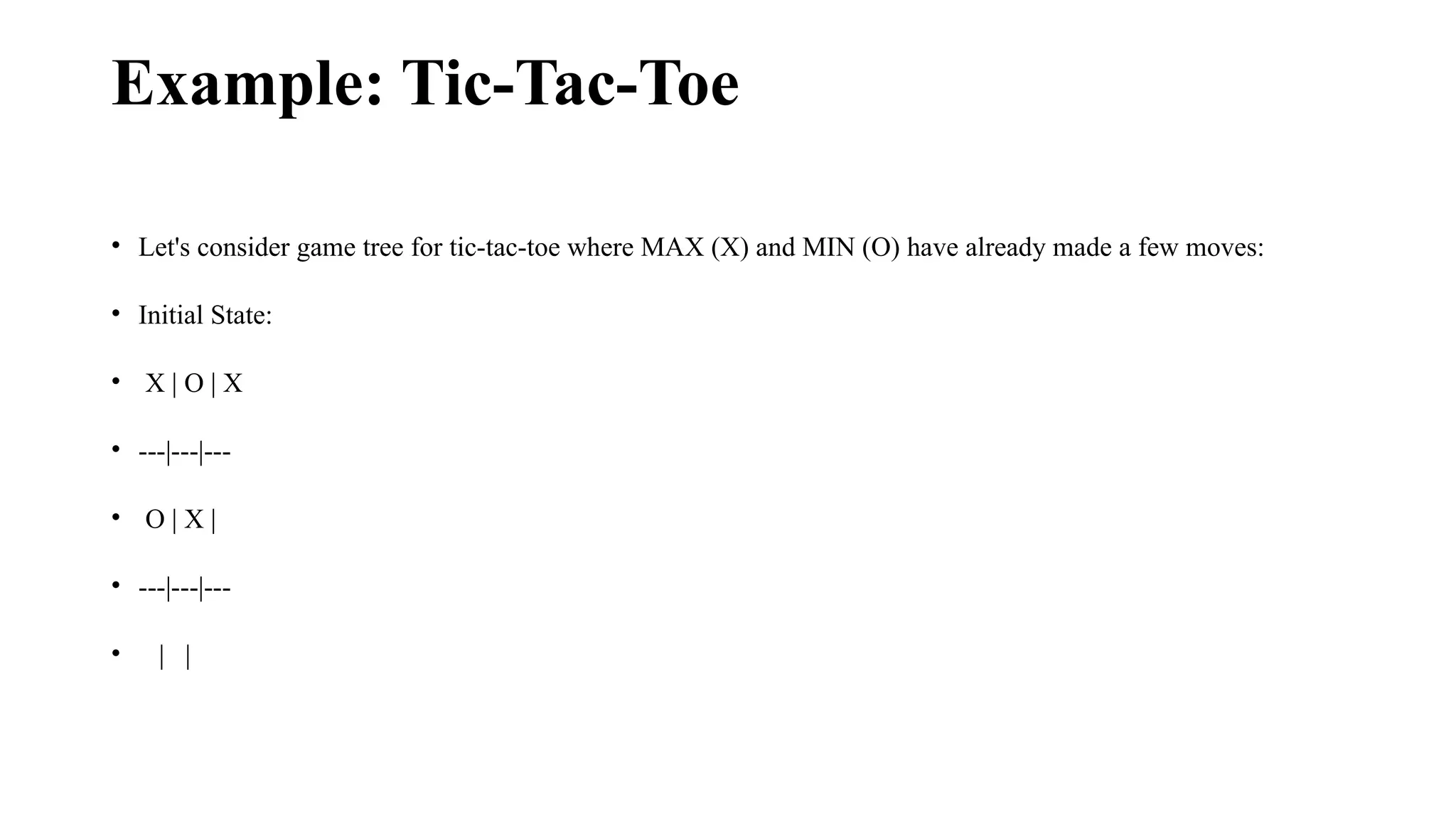
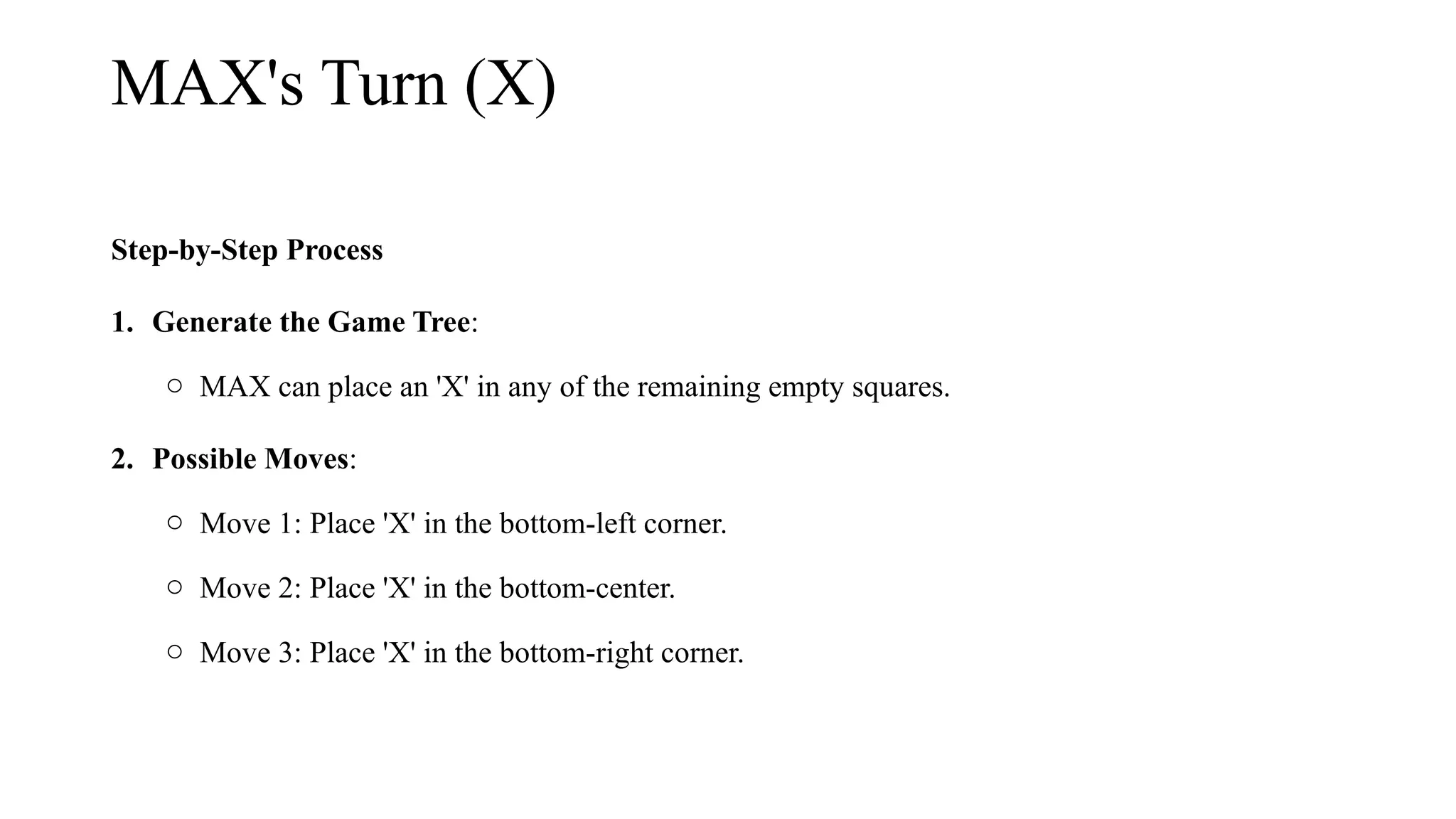
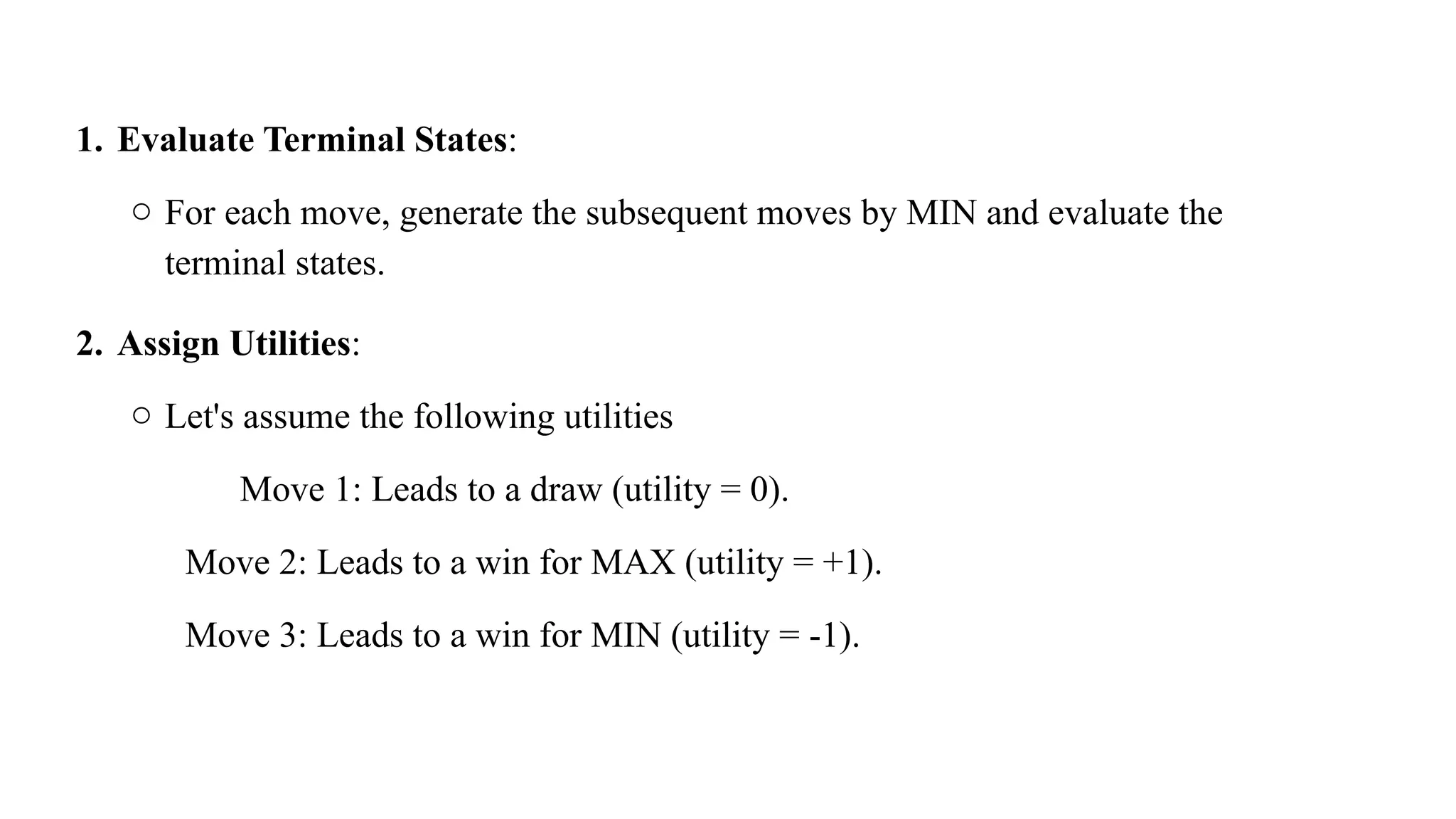
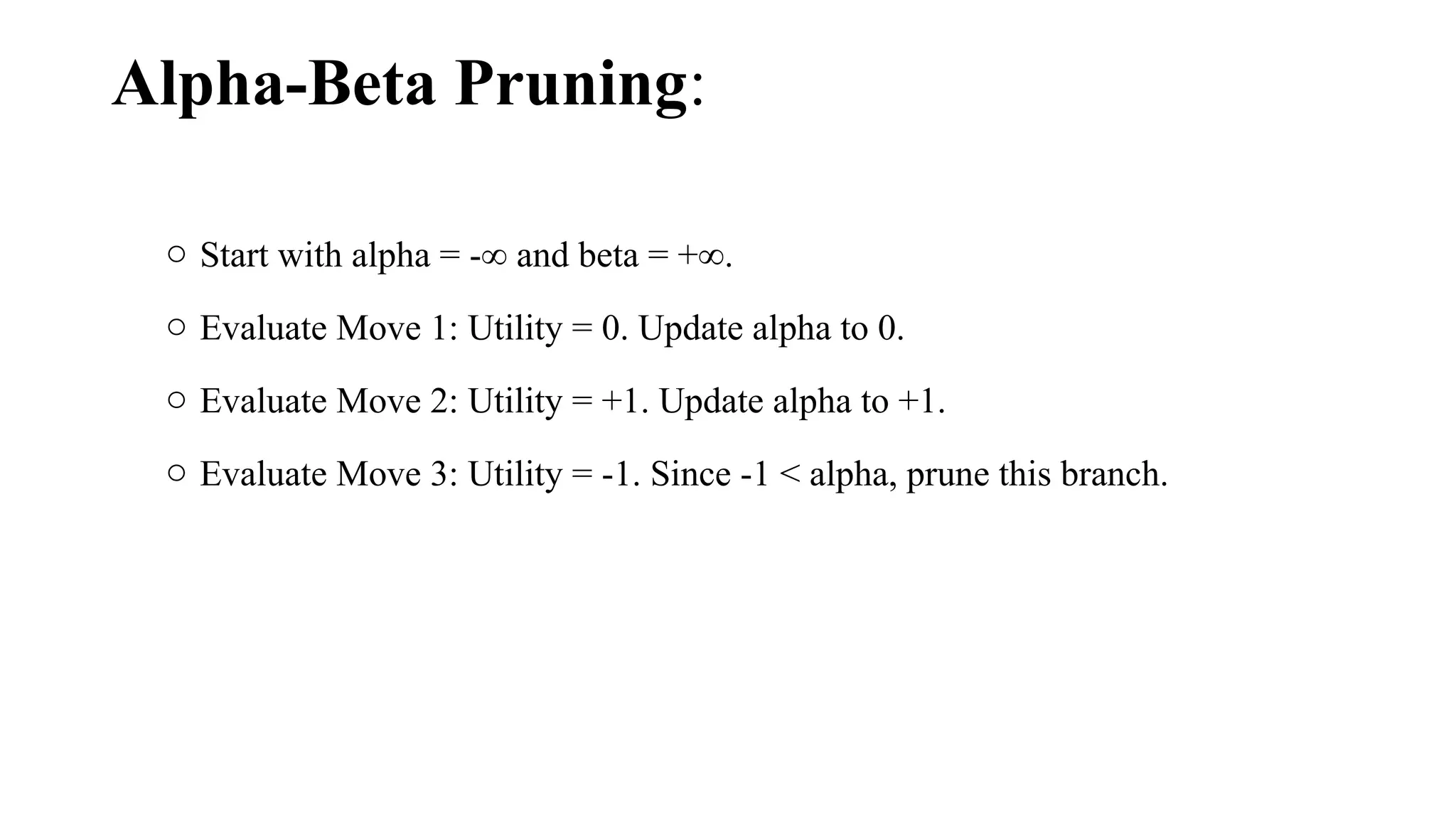
![• Game Tree with Alpha-Beta Pruning:
Initial State
/ |
Move 1 Move 2 Move 3
(0) (+1) (-1) [Pruned]
MAX's Optimal Move: Move 2 (utility = +1)](https://image.slidesharecdn.com/adversialsearch-250919052535-1f61aa37/75/Adversial-Search-and-its-applications-in-Artificial-intelligence-19-2048.jpg)