WIRE ROPE
MM Matrix Integrity (M) Sdn Bhd
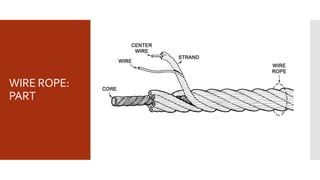
WIRE ROPE:
PART
WIRE ROPE:
PART (Core)
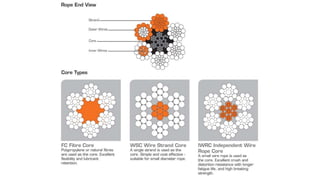
 The core of a wire rope runs through the center of the rope and supports the
strands and helps to maintain their relative position under loading and
bending stresses.
 Cores can be made from a number of different materials including natural or
synthetic fibers and steel
 Type of core: - Fiber center (FC): -natural (NFC)
-synthetic (SFC)
- Steel core (WC): -arranged as a wire strand (WSC)
-arranged as an independent wire rope (IWRC)
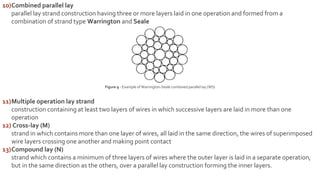
10)Combined parallel lay
parallel lay strand construction having three or more layers laid in one operation and formed from a
combination of strand type Warrington and Seale
11)Multiple operation lay strand
construction containing at least two layers of wires in which successive layers are laid in more than one
operation
12) Cross-lay (M)
strand in which contains more than one layer of wires, all laid in the same direction, the wires of superimposed
wire layers crossing one another and making point contact
13)Compound lay (N)
strand which contains a minimum of three layers of wires where the outer layer is laid in a separate operation,
but in the same direction as the others, over a parallel lay construction forming the inner layers.
Figure 9 - Example of Warrington-Seale combined parallel lay (WS)
NOMENCLATURE
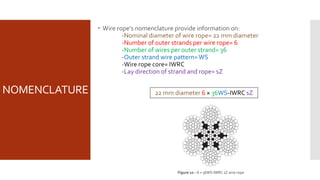
 Wire rope’s nomenclature provide information on:
-Nominal diameter of wire rope= 22 mm diameter
-Number of outer strands per wire rope= 6
-Number of wires per outer strand= 36
-Outer strand wire pattern=WS
-Wire rope core= IWRC
-Lay direction of strand and rope= sZ
22 mm diameter 6 × 36WS-IWRC sZ
Figure 10 – 6 × 36WS-IWRC sZ wire rope
NOMINAL
DIAMETER
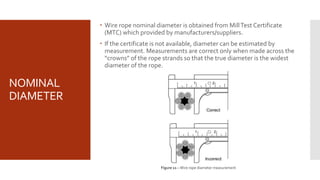
 Wire rope nominal diameter is obtained from MillTest Certificate
(MTC) which provided by manufacturers/suppliers.
 If the certificate is not available, diameter can be estimated by
measurement. Measurements are correct only when made across the
“crowns” of the rope strands so that the true diameter is the widest
diameter of the rope.
Figure 11 – Wire rope diameter measurement
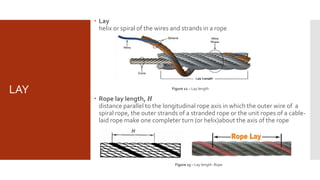
LAY
 Lay
helix or spiral of the wires and strands in a rope
 Rope lay length, 𝑯
distance parallel to the longitudinal rope axis in which the outer wire of a
spiral rope, the outer strands of a stranded rope or the unit ropes of a cable-
laid rope make one completer turn (or helix)about the axis of the rope
Figure 13 – Lay length- Rope
Figure 12 – Lay length
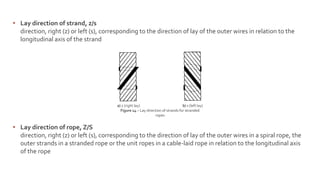
• Lay direction of strand, z/s
direction, right (z) or left (s), corresponding to the direction of lay of the outer wires in relation to the
longitudinal axis of the strand
• Lay direction of rope, Z/S
direction, right (z) or left (s), corresponding to the direction of lay of the outer wires in a spiral rope, the
outer strands in a stranded rope or the unit ropes in a cable-laid rope in relation to the longitudinal axis
of the rope
a) z (right lay) b) s (left lay)
Figure 14 – Lay direction of strands for stranded
ropes
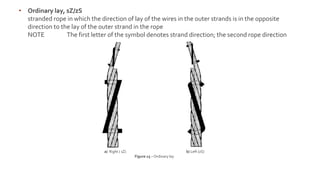
• Ordinary lay, sZ/zS
stranded rope in which the direction of lay of the wires in the outer strands is in the opposite
direction to the lay of the outer strand in the rope
NOTE The first letter of the symbol denotes strand direction; the second rope direction
a) Right ( sZ) b) Left (zS)
Figure 15 – Ordinary lay
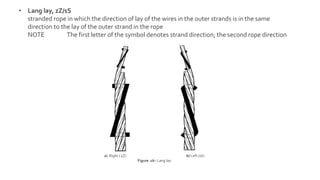
• Lang lay, zZ/sS
stranded rope in which the direction of lay of the wires in the outer strands is in the same
direction to the lay of the outer strand in the rope
NOTE The first letter of the symbol denotes strand direction; the second rope direction
a) Right ( zZ) b) Left (sS)
Figure 16– Lang lay

WIRE ROPE.pptx

  • 1.
    WIRE ROPE MM MatrixIntegrity (M) Sdn Bhd
  • 2.
  • 4.
    WIRE ROPE: PART (Core) The core of a wire rope runs through the center of the rope and supports the strands and helps to maintain their relative position under loading and bending stresses.  Cores can be made from a number of different materials including natural or synthetic fibers and steel  Type of core: - Fiber center (FC): -natural (NFC) -synthetic (SFC) - Steel core (WC): -arranged as a wire strand (WSC) -arranged as an independent wire rope (IWRC)
  • 6.
    10)Combined parallel lay parallellay strand construction having three or more layers laid in one operation and formed from a combination of strand type Warrington and Seale 11)Multiple operation lay strand construction containing at least two layers of wires in which successive layers are laid in more than one operation 12) Cross-lay (M) strand in which contains more than one layer of wires, all laid in the same direction, the wires of superimposed wire layers crossing one another and making point contact 13)Compound lay (N) strand which contains a minimum of three layers of wires where the outer layer is laid in a separate operation, but in the same direction as the others, over a parallel lay construction forming the inner layers. Figure 9 - Example of Warrington-Seale combined parallel lay (WS)
  • 8.
    NOMENCLATURE  Wire rope’snomenclature provide information on: -Nominal diameter of wire rope= 22 mm diameter -Number of outer strands per wire rope= 6 -Number of wires per outer strand= 36 -Outer strand wire pattern=WS -Wire rope core= IWRC -Lay direction of strand and rope= sZ 22 mm diameter 6 × 36WS-IWRC sZ Figure 10 – 6 × 36WS-IWRC sZ wire rope
  • 10.
    NOMINAL DIAMETER  Wire ropenominal diameter is obtained from MillTest Certificate (MTC) which provided by manufacturers/suppliers.  If the certificate is not available, diameter can be estimated by measurement. Measurements are correct only when made across the “crowns” of the rope strands so that the true diameter is the widest diameter of the rope. Figure 11 – Wire rope diameter measurement
  • 11.
    LAY  Lay helix orspiral of the wires and strands in a rope  Rope lay length, 𝑯 distance parallel to the longitudinal rope axis in which the outer wire of a spiral rope, the outer strands of a stranded rope or the unit ropes of a cable- laid rope make one completer turn (or helix)about the axis of the rope Figure 13 – Lay length- Rope Figure 12 – Lay length
  • 13.
    • Lay directionof strand, z/s direction, right (z) or left (s), corresponding to the direction of lay of the outer wires in relation to the longitudinal axis of the strand • Lay direction of rope, Z/S direction, right (z) or left (s), corresponding to the direction of lay of the outer wires in a spiral rope, the outer strands in a stranded rope or the unit ropes in a cable-laid rope in relation to the longitudinal axis of the rope a) z (right lay) b) s (left lay) Figure 14 – Lay direction of strands for stranded ropes
  • 14.
    • Ordinary lay,sZ/zS stranded rope in which the direction of lay of the wires in the outer strands is in the opposite direction to the lay of the outer strand in the rope NOTE The first letter of the symbol denotes strand direction; the second rope direction a) Right ( sZ) b) Left (zS) Figure 15 – Ordinary lay
  • 15.
    • Lang lay,zZ/sS stranded rope in which the direction of lay of the wires in the outer strands is in the same direction to the lay of the outer strand in the rope NOTE The first letter of the symbol denotes strand direction; the second rope direction a) Right ( zZ) b) Left (sS) Figure 16– Lang lay