Minimax Algorithm
PRESENTED BY: SULAIMAN M. KARIM
STUDENT NO: 4013031617
E-MAIL: SULAIMAN_MUSARIA@YAHOO.COM
Introduction
 Minimax is one of the oldest heuristic in IT.
 In 1950, the first chess programs were written by
C.Shannon & A.Tuting based on this algorithm.
 IBM’s Deep blue supercomputer defeats the chess
grandmaster kasparov in 1997.
-In two players games with perfect information,
the minimax algorithm can determine the best
move for a player by evaluating (enumerating)
the entire game tree.
-Player 1 is called Max. : Maximizes result.
-Player 2 is called Min.
Minimizes opponent’s
result.
Two persons games
Properties of minimax
 It is complete (if the tree is finite).
 It is Optimal (against an optimal
opponent).
 d=depth of the tree .
 b=legal moves.
1-Time complexity : bᵈ .
2-Space complexity : b*d .
MinMax Algorithm types
1. Game theory.
2. Combinatorial game theory.
3. Minimax for individual decisions.
4. Maximin in philosophy.
Minimax steps
The minimax algorithm consists of 5
steps:-
1-Generate the whole game tree.
2-Apply the utility function to leaf
nodes to get their values.
3-Use the utility of nodes at level N to
determine the utility of nodes at level
N-1 in the search tree.
Minimax steps
4-Continue backing up values
towards the root , layer at a time.
5-Eventually the backed values
reach the top of the tree , at that
point Max chooses the move that
leads to the highest value .
MinMax Algorithm code
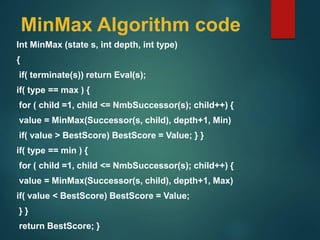
Int MinMax (state s, int depth, int type)
{
if( terminate(s)) return Eval(s);
if( type == max ) {
for ( child =1, child <= NmbSuccessor(s); child++) {
value = MinMax(Successor(s, child), depth+1, Min)
if( value > BestScore) BestScore = Value; } }
if( type == min ) {
for ( child =1, child <= NmbSuccessor(s); child++) {
value = MinMax(Successor(s, child), depth+1, Max)
if( value < BestScore) BestScore = Value;
} }
return BestScore; }
Game theory
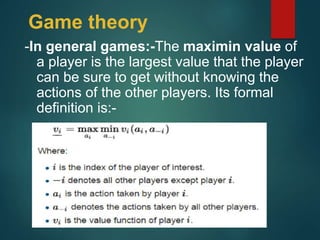
-In general games:-The maximin value of
a player is the largest value that the player
can be sure to get without knowing the
actions of the other players. Its formal
definition is:-
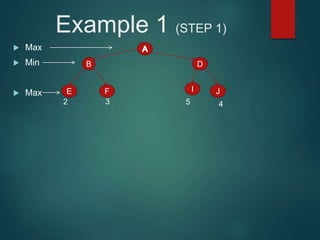
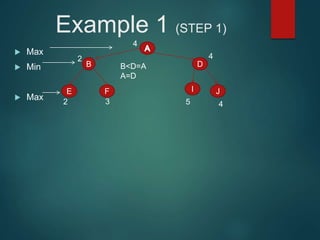
Example 1 (STEP 1)
 Max
 Min
 Max
B D
E F I J
52 3 4
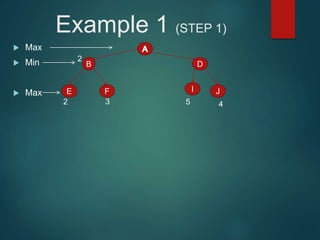
Example 1 (STEP 1)
 Max
 Min
 Max
B D
E F I J
52 3 4
2
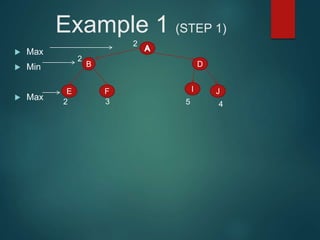
Example 1 (STEP 1)
 Max
 Min
 Max
B D
E F I J
52 3 4
2
2
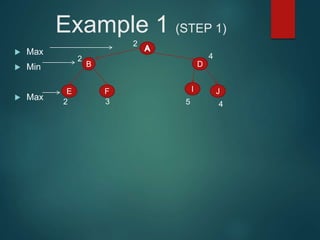
Example 1 (STEP 1)
 Max
 Min
 Max
B D
E F I J
52 3 4
2
2
4
Example 1 (STEP 1)
 Max
 Min
 Max
B D
E F I J
5
B<D=A
A=D
3 4
2
4
4
2
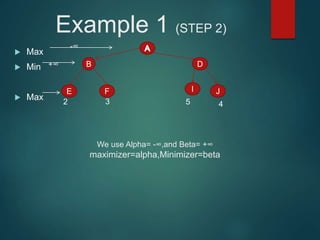
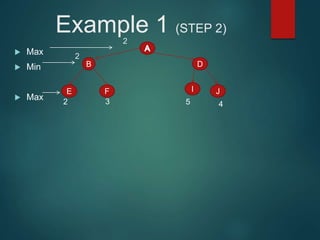
Example 1 (STEP 2)
 Max
 Min
 Max
B D
E F I J
53 42
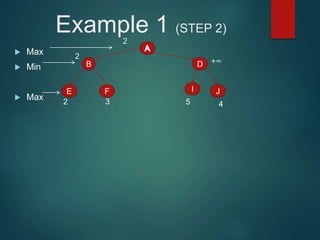
We use Alpha= -∞,and Beta= +∞
maximizer=alpha,Minimizer=beta
+∞
-∞
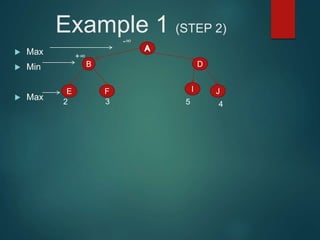
Example 1 (STEP 2)
 Max
 Min
 Max
B D
E F I J
53 42
+∞
-∞
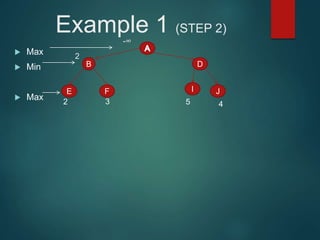
Example 1 (STEP 2)
 Max
 Min
 Max
B D
E F I J
53 42
2
-∞
Example 1 (STEP 2)
 Max
 Min
 Max
B D
E F I J
53 42
2
2
Example 1 (STEP 2)
 Max
 Min
 Max
B D
E F I J
53 42
2
2
+∞
Example 1 (STEP 2)
 Max
 Min
 Max
B D
E F I J
53 42
2
2
4
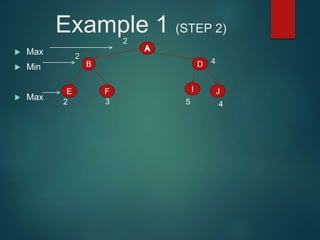
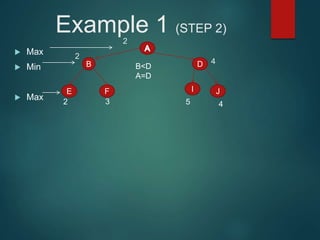
Example 1 (STEP 2)
 Max
 Min
 Max
B D
E F I J
53 42
2
2
4
B<D
A=D
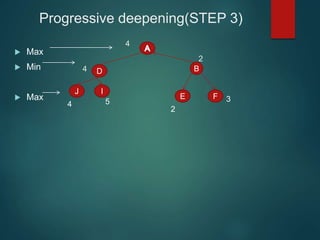
Progressive deepening(STEP 3)
 Max
 Min
 Max
BD
E F
IJ
354
2
2
4
4
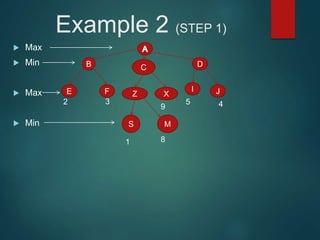
Example 2 (STEP 1)
 Max
 Min
 Max
 Min
B D
E F I J
52 3 4
C
Z X
MS
81
9
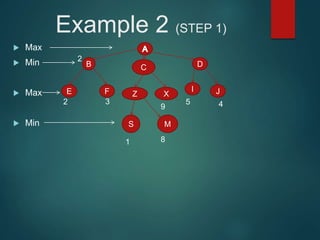
Example 2 (STEP 1)
 Max
 Min
 Max
 Min
B D
E F I J
52 3 4
C
Z X
MS
81
9
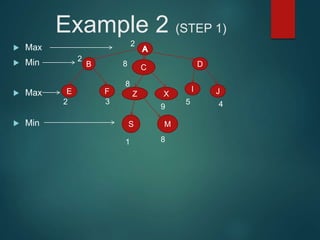
2
Example 2 (STEP 1)
 Max
 Min
 Max
 Min
B D
E F I J
52 3 4
C
Z X
MS
81
9
2
2
8
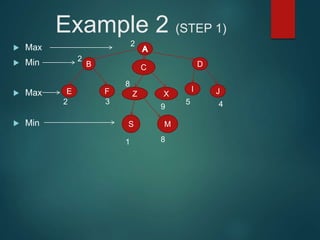
Example 2 (STEP 1)
 Max
 Min
 Max
 Min
B D
E F I J
52 3 4
C
Z X
MS
81
9
2
2
8
8
Example 2 (STEP 1)
 Max
 Min
 Max
 Min
B D
E F I J
52 3 4
C
Z X
MS
81
9
2
8
8
8
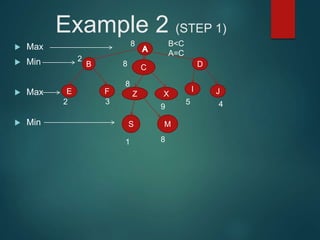
B<C
A=C
Example 2 (STEP 1)
 Max
 Min
 Max
 Min
B D
E F I J
52 3 4
C
Z X
MS
81
9
2
8
8
8
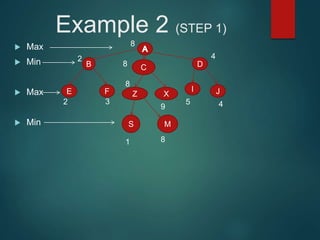
4
Example 2 (STEP 1)
 Max
 Min
 Max
 Min
B D
E F I J
52 3 4
C
Z X
MS
81
9
2
8
8
8
4
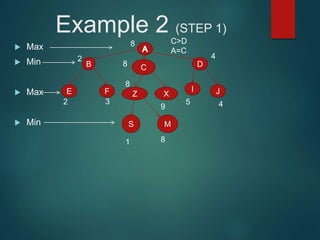
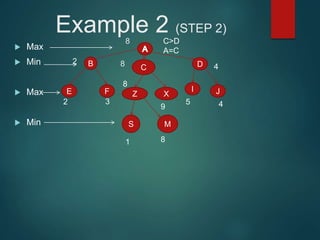
C>D
A=C
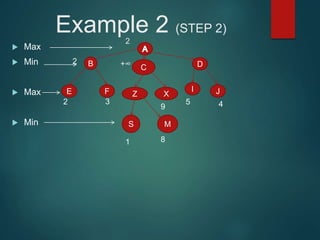
Example 2 (STEP 2)
 Max
 Min
 Max
 Min
B D
E F I J
52 3 4
C
Z X
MS
81
9
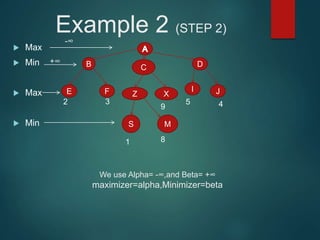
We use Alpha= -∞,and Beta= +∞
maximizer=alpha,Minimizer=beta
+∞
-∞
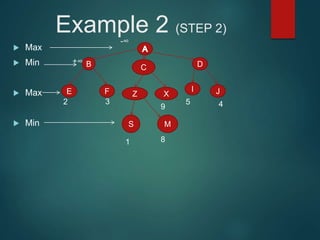
Example 2 (STEP 2)
 Max
 Min
 Max
 Min
B D
E F I J
52 3 4
C
Z X
MS
81
9
+∞
-∞
Example 2 (STEP 2)
 Max
 Min
 Max
 Min
B D
E F I J
52 3 4
C
Z X
MS
81
9
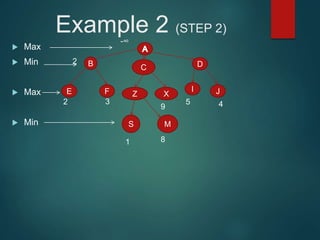
2
-∞
Example 2 (STEP 2)
 Max
 Min
 Max
 Min
B D
E F I J
52 3 4
C
Z X
MS
81
9
2
2
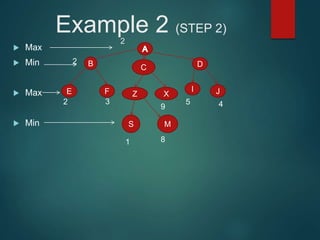
Example 2 (STEP 2)
 Max
 Min
 Max
 Min
B D
E F I J
52 3 4
C
Z X
MS
81
9
2
2
+∞
Example 2 (STEP 2)
 Max
 Min
 Max
 Min
B D
E F I J
52 3 4
C
Z X
MS
81
9
2
2
+∞
8
Example 2 (STEP 2)
 Max
 Min
 Max
 Min
B D
E F I J
52 3 4
C
Z X
MS
81
9
2
2
8
8
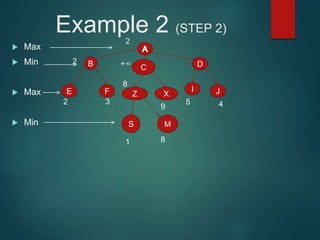
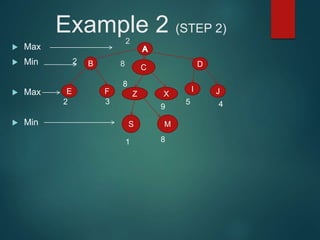
Example 2 (STEP 2)
 Max
 Min
 Max
 Min
B D
E F I J
52 3 4
C
Z X
MS
81
9
2
8
8
8
B<C
A=C
Example 2 (STEP 2)
 Max
 Min
 Max
 Min
B D
E F I J
52 3 4
C
Z X
MS
81
9
2
8
8
8
∞+
Example 2 (STEP 2)
 Max
 Min
 Max
 Min
B D
E F I J
52 3 4
C
Z X
MS
81
9
2
8
8
8
4
Example 2 (STEP 2)
 Max
 Min
 Max
 Min
B D
E F I J
52 3 4
C
Z X
MS
81
9
2
8
8
8
C>D
A=C
4
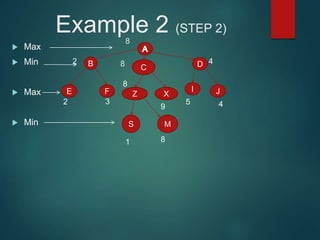
Example 2 (STEP 2)
 Max
 Min
 Max
 Min
B D
E F I J
52 3 4
C
Z X
MS
81
9
2
8
8
8
4
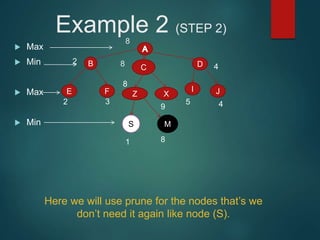
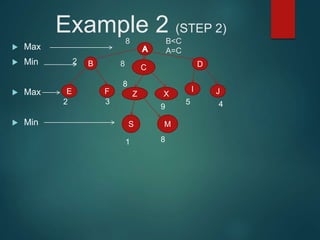
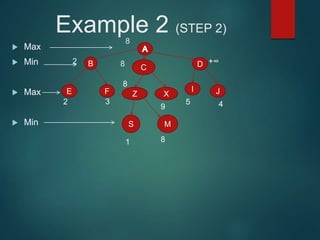
Here we will use prune for the nodes that’s we
don’t need it again like node (S).
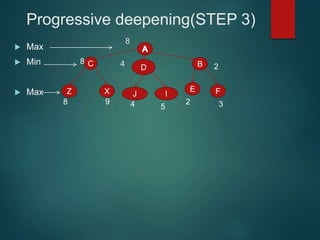
Progressive deepening(STEP 3)
 Max
 Min
 Max
C B
Z X E F
28 9 3
D
J I
5
8
8
4
4
2
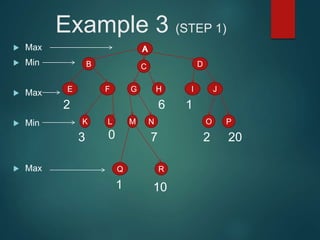
Example 3 (STEP 1)
 Max
 Min
 Max
 Min
 Max
B C D
E F G H I J
K L M N O P
Q R
1 10
202703
12 6
Example 3(STEP 1)
 Max
 Min
 Max
 Min
 Max
B C D
E F G H I J
K L M N O P
Q R
1 10
202703
12 6
2
2
3
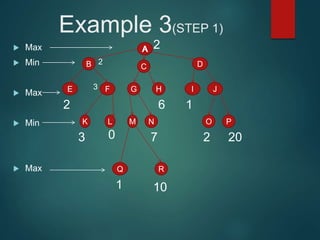
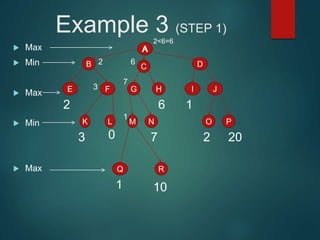
Example 3 (STEP 1)
 Max
 Min
 Max
 Min
 Max
B C D
E F G H I J
K L M N O P
Q R
1 10
202703
12 6
2
2<6=6
1
7
6
3
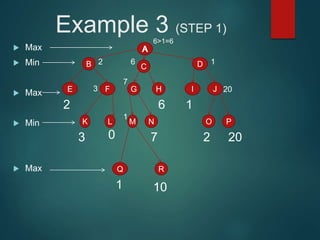
Example 3 (STEP 1)
 Max
 Min
 Max
 Min
 Max
B C D
E F G H I J
K L M N O P
Q R
1 10
202703
12 6
2
6>1=6
1
7
6
20
1
3
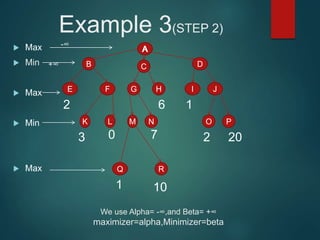
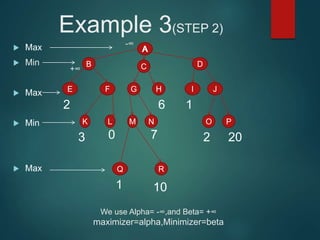
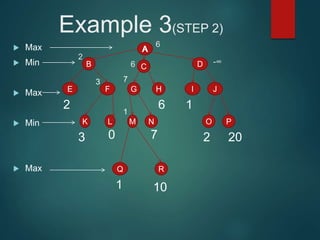
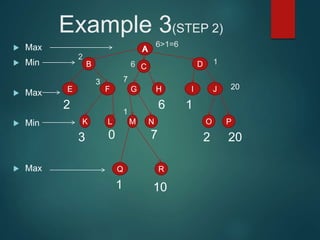
Example 3(STEP 2)
 Max
 Min
 Max
 Min
 Max
B C D
E F G H I J
K L M N O P
Q R
1 10
202703
12 6
We use Alpha= -∞,and Beta= +∞
maximizer=alpha,Minimizer=beta
+∞
-∞
Example 3(STEP 2)
 Max
 Min
 Max
 Min
 Max
B C D
E F G H I J
K L M N O P
Q R
1 10
202703
12 6
We use Alpha= -∞,and Beta= +∞
maximizer=alpha,Minimizer=beta
+∞
-∞
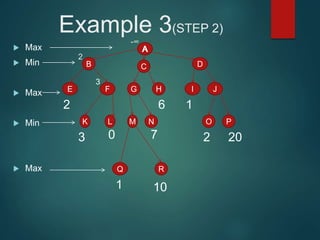
Example 3(STEP 2)
 Max
 Min
 Max
 Min
 Max
B C D
E F G H I J
K L M N O P
Q R
1 10
202703
12 6
2
-∞
3
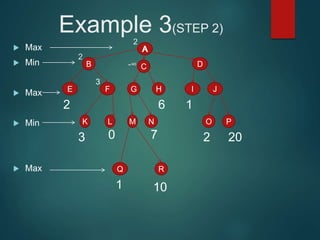
Example 3(STEP 2)
 Max
 Min
 Max
 Min
 Max
B C D
E F G H I J
K L M N O P
Q R
1 10
202703
12 6
2
2
3
-∞
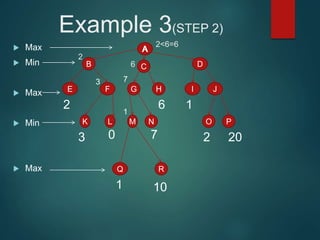
Example 3(STEP 2)
 Max
 Min
 Max
 Min
 Max
B C D
E F G H I J
K L M N O P
Q R
1 10
202703
12 6
2
2<6=6
3
6
1
7
Example 3(STEP 2)
 Max
 Min
 Max
 Min
 Max
B C D
E F G H I J
K L M N O P
Q R
1 10
202703
12 6
2
6
3
6
1
7
-∞
Example 3(STEP 2)
 Max
 Min
 Max
 Min
 Max
B C D
E F G H I J
K L M N O P
Q R
1 10
202703
12 6
2
6>1=6
3
6
1
7
1
20
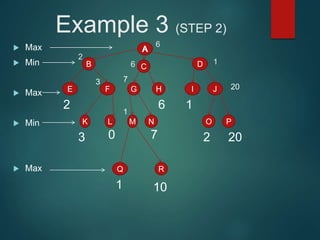
Example 3 (STEP 2)
 Max
 Min
 Max
 Min
 Max
B C D
E F G H I J
K L M N O P
Q R
1 10
202703
12 6
2
6
3
6
1
7
1
20
Example 3 (STEP 2)
 Max
 Min
 Max
 Min
 Max
B C D
E F G H I J
K L M N O P
Q R
1 10
202703
12 6
2
6
3
6
1
7
1
20
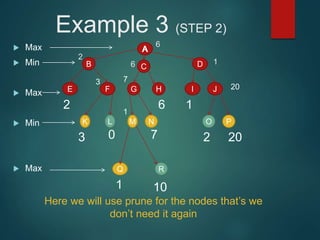
Here we will use prune for the nodes that’s we
don’t need it again
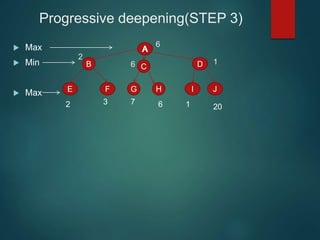
Progressive deepening(STEP 3)
 Max
 Min
 Max
B C D
E F G H I J
2
6
3
6
7
1
2012 6
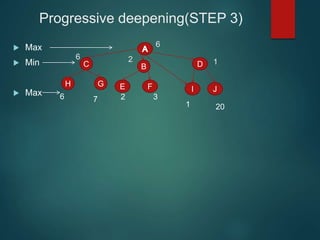
Progressive deepening(STEP 3)
 Max
 Min
 Max
BC D
E FGH
I J
2
6
3
6
7
1
201
26

Minimax Algorithm

  • 1.
    Minimax Algorithm PRESENTED BY:SULAIMAN M. KARIM STUDENT NO: 4013031617 E-MAIL: SULAIMAN_MUSARIA@YAHOO.COM
  • 2.
    Introduction  Minimax isone of the oldest heuristic in IT.  In 1950, the first chess programs were written by C.Shannon & A.Tuting based on this algorithm.  IBM’s Deep blue supercomputer defeats the chess grandmaster kasparov in 1997.
  • 3.
    -In two playersgames with perfect information, the minimax algorithm can determine the best move for a player by evaluating (enumerating) the entire game tree. -Player 1 is called Max. : Maximizes result. -Player 2 is called Min. Minimizes opponent’s result. Two persons games
  • 4.
    Properties of minimax It is complete (if the tree is finite).  It is Optimal (against an optimal opponent).  d=depth of the tree .  b=legal moves. 1-Time complexity : bᵈ . 2-Space complexity : b*d .
  • 5.
    MinMax Algorithm types 1.Game theory. 2. Combinatorial game theory. 3. Minimax for individual decisions. 4. Maximin in philosophy.
  • 6.
    Minimax steps The minimaxalgorithm consists of 5 steps:- 1-Generate the whole game tree. 2-Apply the utility function to leaf nodes to get their values. 3-Use the utility of nodes at level N to determine the utility of nodes at level N-1 in the search tree.
  • 7.
    Minimax steps 4-Continue backingup values towards the root , layer at a time. 5-Eventually the backed values reach the top of the tree , at that point Max chooses the move that leads to the highest value .
  • 8.
    MinMax Algorithm code IntMinMax (state s, int depth, int type) { if( terminate(s)) return Eval(s); if( type == max ) { for ( child =1, child <= NmbSuccessor(s); child++) { value = MinMax(Successor(s, child), depth+1, Min) if( value > BestScore) BestScore = Value; } } if( type == min ) { for ( child =1, child <= NmbSuccessor(s); child++) { value = MinMax(Successor(s, child), depth+1, Max) if( value < BestScore) BestScore = Value; } } return BestScore; }
  • 9.
    Game theory -In generalgames:-The maximin value of a player is the largest value that the player can be sure to get without knowing the actions of the other players. Its formal definition is:-
  • 10.
    Example 1 (STEP1)  Max  Min  Max B D E F I J 52 3 4
  • 11.
    Example 1 (STEP1)  Max  Min  Max B D E F I J 52 3 4 2
  • 12.
    Example 1 (STEP1)  Max  Min  Max B D E F I J 52 3 4 2 2
  • 13.
    Example 1 (STEP1)  Max  Min  Max B D E F I J 52 3 4 2 2 4
  • 14.
    Example 1 (STEP1)  Max  Min  Max B D E F I J 5 B<D=A A=D 3 4 2 4 4 2
  • 15.
    Example 1 (STEP2)  Max  Min  Max B D E F I J 53 42 We use Alpha= -∞,and Beta= +∞ maximizer=alpha,Minimizer=beta +∞ -∞
  • 16.
    Example 1 (STEP2)  Max  Min  Max B D E F I J 53 42 +∞ -∞
  • 17.
    Example 1 (STEP2)  Max  Min  Max B D E F I J 53 42 2 -∞
  • 18.
    Example 1 (STEP2)  Max  Min  Max B D E F I J 53 42 2 2
  • 19.
    Example 1 (STEP2)  Max  Min  Max B D E F I J 53 42 2 2 +∞
  • 20.
    Example 1 (STEP2)  Max  Min  Max B D E F I J 53 42 2 2 4
  • 21.
    Example 1 (STEP2)  Max  Min  Max B D E F I J 53 42 2 2 4 B<D A=D
  • 22.
    Progressive deepening(STEP 3) Max  Min  Max BD E F IJ 354 2 2 4 4
  • 23.
    Example 2 (STEP1)  Max  Min  Max  Min B D E F I J 52 3 4 C Z X MS 81 9
  • 24.
    Example 2 (STEP1)  Max  Min  Max  Min B D E F I J 52 3 4 C Z X MS 81 9 2
  • 25.
    Example 2 (STEP1)  Max  Min  Max  Min B D E F I J 52 3 4 C Z X MS 81 9 2 2 8
  • 26.
    Example 2 (STEP1)  Max  Min  Max  Min B D E F I J 52 3 4 C Z X MS 81 9 2 2 8 8
  • 27.
    Example 2 (STEP1)  Max  Min  Max  Min B D E F I J 52 3 4 C Z X MS 81 9 2 8 8 8 B<C A=C
  • 28.
    Example 2 (STEP1)  Max  Min  Max  Min B D E F I J 52 3 4 C Z X MS 81 9 2 8 8 8 4
  • 29.
    Example 2 (STEP1)  Max  Min  Max  Min B D E F I J 52 3 4 C Z X MS 81 9 2 8 8 8 4 C>D A=C
  • 30.
    Example 2 (STEP2)  Max  Min  Max  Min B D E F I J 52 3 4 C Z X MS 81 9 We use Alpha= -∞,and Beta= +∞ maximizer=alpha,Minimizer=beta +∞ -∞
  • 31.
    Example 2 (STEP2)  Max  Min  Max  Min B D E F I J 52 3 4 C Z X MS 81 9 +∞ -∞
  • 32.
    Example 2 (STEP2)  Max  Min  Max  Min B D E F I J 52 3 4 C Z X MS 81 9 2 -∞
  • 33.
    Example 2 (STEP2)  Max  Min  Max  Min B D E F I J 52 3 4 C Z X MS 81 9 2 2
  • 34.
    Example 2 (STEP2)  Max  Min  Max  Min B D E F I J 52 3 4 C Z X MS 81 9 2 2 +∞
  • 35.
    Example 2 (STEP2)  Max  Min  Max  Min B D E F I J 52 3 4 C Z X MS 81 9 2 2 +∞ 8
  • 36.
    Example 2 (STEP2)  Max  Min  Max  Min B D E F I J 52 3 4 C Z X MS 81 9 2 2 8 8
  • 37.
    Example 2 (STEP2)  Max  Min  Max  Min B D E F I J 52 3 4 C Z X MS 81 9 2 8 8 8 B<C A=C
  • 38.
    Example 2 (STEP2)  Max  Min  Max  Min B D E F I J 52 3 4 C Z X MS 81 9 2 8 8 8 ∞+
  • 39.
    Example 2 (STEP2)  Max  Min  Max  Min B D E F I J 52 3 4 C Z X MS 81 9 2 8 8 8 4
  • 40.
    Example 2 (STEP2)  Max  Min  Max  Min B D E F I J 52 3 4 C Z X MS 81 9 2 8 8 8 C>D A=C 4
  • 41.
    Example 2 (STEP2)  Max  Min  Max  Min B D E F I J 52 3 4 C Z X MS 81 9 2 8 8 8 4 Here we will use prune for the nodes that’s we don’t need it again like node (S).
  • 42.
    Progressive deepening(STEP 3) Max  Min  Max C B Z X E F 28 9 3 D J I 5 8 8 4 4 2
  • 43.
    Example 3 (STEP1)  Max  Min  Max  Min  Max B C D E F G H I J K L M N O P Q R 1 10 202703 12 6
  • 44.
    Example 3(STEP 1) Max  Min  Max  Min  Max B C D E F G H I J K L M N O P Q R 1 10 202703 12 6 2 2 3
  • 45.
    Example 3 (STEP1)  Max  Min  Max  Min  Max B C D E F G H I J K L M N O P Q R 1 10 202703 12 6 2 2<6=6 1 7 6 3
  • 46.
    Example 3 (STEP1)  Max  Min  Max  Min  Max B C D E F G H I J K L M N O P Q R 1 10 202703 12 6 2 6>1=6 1 7 6 20 1 3
  • 47.
    Example 3(STEP 2) Max  Min  Max  Min  Max B C D E F G H I J K L M N O P Q R 1 10 202703 12 6 We use Alpha= -∞,and Beta= +∞ maximizer=alpha,Minimizer=beta +∞ -∞
  • 48.
    Example 3(STEP 2) Max  Min  Max  Min  Max B C D E F G H I J K L M N O P Q R 1 10 202703 12 6 We use Alpha= -∞,and Beta= +∞ maximizer=alpha,Minimizer=beta +∞ -∞
  • 49.
    Example 3(STEP 2) Max  Min  Max  Min  Max B C D E F G H I J K L M N O P Q R 1 10 202703 12 6 2 -∞ 3
  • 50.
    Example 3(STEP 2) Max  Min  Max  Min  Max B C D E F G H I J K L M N O P Q R 1 10 202703 12 6 2 2 3 -∞
  • 51.
    Example 3(STEP 2) Max  Min  Max  Min  Max B C D E F G H I J K L M N O P Q R 1 10 202703 12 6 2 2<6=6 3 6 1 7
  • 52.
    Example 3(STEP 2) Max  Min  Max  Min  Max B C D E F G H I J K L M N O P Q R 1 10 202703 12 6 2 6 3 6 1 7 -∞
  • 53.
    Example 3(STEP 2) Max  Min  Max  Min  Max B C D E F G H I J K L M N O P Q R 1 10 202703 12 6 2 6>1=6 3 6 1 7 1 20
  • 54.
    Example 3 (STEP2)  Max  Min  Max  Min  Max B C D E F G H I J K L M N O P Q R 1 10 202703 12 6 2 6 3 6 1 7 1 20
  • 55.
    Example 3 (STEP2)  Max  Min  Max  Min  Max B C D E F G H I J K L M N O P Q R 1 10 202703 12 6 2 6 3 6 1 7 1 20 Here we will use prune for the nodes that’s we don’t need it again
  • 56.
    Progressive deepening(STEP 3) Max  Min  Max B C D E F G H I J 2 6 3 6 7 1 2012 6
  • 57.
    Progressive deepening(STEP 3) Max  Min  Max BC D E FGH I J 2 6 3 6 7 1 201 26