
A MINI LITERATURE REVIEW


 REHABILITATION OF LOGGING GAPS AT PRA-ANUM FOREST RESERVE IN
                            GHANA


ASIGBAASE MICHAEL


Table of Contents .......................................................................................................................................... ii


                                                                            i
List of Tables ................................................................................................................................................ iii
Sections
1.1 General Introduction ............................................................................................................................... 1
1.2 The problem of Deforestation ................................................................................................................. 2
1.3 Logging in Natural Forests ..................................................................................................................... 2
1.4 Impact of Logging on Forest and Forest Conditions .............................................................................. 3
1.5 Forest Rehabilitation ............................................................................................................................... 4
   1.5.1 Enrichment Plantings ....................................................................................................................... 5
1.6 Choice of Tree Species for Rehabilitation .............................................................................................. 5
1.7 Native Tree Species ................................................................................................................................ 7
1.8 Growth Requirement of the Indigenous Species ..................................................................................... 7
   1.8.1 Water ................................................................................................................................................ 8
   1.8.2 Light ................................................................................................................................................. 8
   1.8.3 Soil Characteristics .......................................................................................................................... 9
   1.8.4 Spacing/Stand Stocking ................................................................................................................... 9
1.9 Conclusion .............................................................................................................................................. 9
REFERENCES ........................................................................................................................................... 10


List of Tables


                                                                             ii
1. Table 1: Logging Impact on Forest                         3
2. Table 2: Competition Potential of Species                 6
3. Table 3: Perceived Potential Benefits of Native Species   6


                              1.0 Literature Review


                                         iii
1.1 General Introduction

A forest is defined by the Secretariat of the Convention on Biological Diversity (2010) as a
community or association of trees and animals dominated by trees which are capable of
generating forest products. These ecosystems produce valuable materials such as lumber,
paper pulp, and domestic livestock that is important in human culture. They also play vital
roles in regulating climate, controlling water runoff, providing wildlife habitat, purifying the
air and a host of other ecological services. In addition, these terrestrial biomasses have
cultural, historic and scenic values and hence are usually protected (Lamb and Gilmour,
2003; Secretariat of the Convention on Biological Diversity, 2010). However, forest is one of
the most heavily disturbed resources by human activity. This work, therefore, is a review of
literature on logging damage and the rehabilitation of forest after logging. It will focus on the
rehabilitation of logging gaps using native species.


1.2 The Problem of Deforestation

For the past two decades, Central and West Africa recorded the highest deforestation rates;
annual rate change of 0.6% from 1990-2000 and 0.5% for 2000-2005 (FAO, 2006). Ghana
was one West African country where deforestation was highest (Benhin and Barbier, 2001).
Therefore, precise figures describing the current total forest cover and deforestation are
difficult to give (Hansen et al., 2009), though FAO, 2006 reported 24% of total land cover as
Ghana’s forest cover in 2005.

The forests of Ghana are grouped into off-reserves and on-reserves. The Forestry
Commission manages the on-reserve areas. There are 266 forest reserves in Ghana, out of
this, 216 occur in the high forest zone which is the timber production zone (Damnyag et al.,
2011). However, most of these reserves were already degraded in the mid 1990s as a result of
over-harvesting (over-logging) for timber, forest fires, and farming (Hawthorne and Abu-
Juam, 1995). The situation, currently, may even be worse, because in 2006, the annual
allowable cut had increased from 1 million m3 in 1989 to 2 million m3 (Blackett and
Gardette, 2008), without an equivalent replanting of trees (Damnyag et al., 2011). In Ghana,
timber is extracted from the forest through selective logging (Palo and Yirdaw, 1996),
involving periodic entries into a given area of a forest for the removal of selected commercial
timber trees using heavy extraction machines such as bull dozers, skidders and sometimes
tractors, which cause much damage to the residual forest. The method allows the removal of


                                               2
only the current commercial trees while retaining those with potential commercial value for
future use. This method of harvesting (selective logging) is one of the leading causes of
Ghana’s forest loss through degradation and deforestation (Palo and Yirdaw, 1996).
Therefore, the government of Ghana over the years have been concerned about the extent of
forest degradation in the country (Damnyag et al., 2011). Rehabilitation measures, including
tree planting is one tactical effort being made to combat deforestation and to achieve
sustainable management (Damnyag et al., 2011). The 1994 Government policy therefore
recommends that degraded forest reserves should be put under reforestation and/or
rehabilitation (Ministry of Lands and Forestry, 1994).

1.3 Logging in Natural Forests

Logging is described by Stoddard and Stoddard (1987), as ‘the process of harvesting and
hauling rough forest products from stump areas to the points of processing or sale’. Felling
and extraction of trees are the main activities during logging. The major aspect of logging
that may contribute to degradation and eventually to deforestation is that besides damage
done due to felling some parts of the forests are cleared to construct tracks, roads, landings
and loading bays. Though logging affects the forest (Lamb and Gilmour, 2003), with proper
management, it can be useful as matured trees have to be removed so that young trees can
grow to replace them. This however is not always the case, since it is dependent on proper
management.

Tree felling creates gaps in the forest canopy. This poses a serious threat to sustainability if
no silvicultural intervention appropriate for easing the recovery of logged areas is carried out
(Asabere, 1987). The cumulative effect of these gaps together with skidding, road
construction, and loading bay operations can be very serious. The impact, however, varies
with logging intensity, frequency and spatial extent. The physical impact of logging
operations, however, creates a structurally heterogeneous residual forest consisting of
different micro-sites such as log landings, logging roads, logging gaps, loading bays and skid
trails (Stoddard and Stoddard, 1987; Demir et al., 2005).

1.4 Impact of Logging on Forest and Forest Conditions

The two main anthropogenic impacts on the tropical rain forests are deforestation and logging
(Johns, 1997). Stoddard and Stoddard (1987) stated that harvesting timber from forested areas
has both direct and indirect environmental effects. The level of impact as it relates to these


                                               3
are, however, dependent on factors such as logging intensity, forest structure, terrain
condition, harvesting methods and skill of machine operators (Johns, 1997 ; Stoddard and
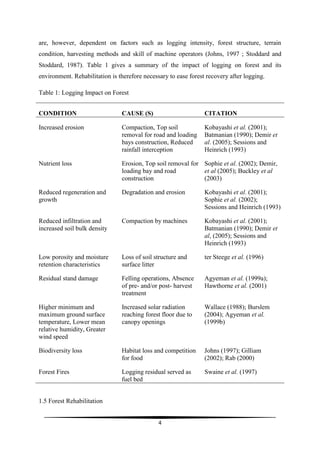
Stoddard, 1987). Table 1 gives a summary of the impact of logging on forest and its
environment. Rehabilitation is therefore necessary to ease forest recovery after logging.

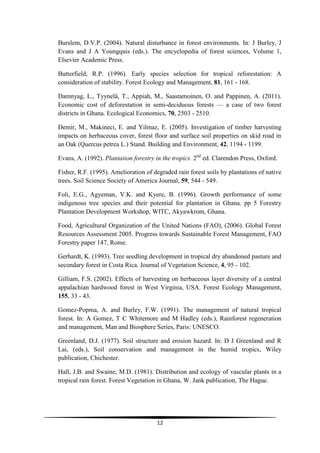
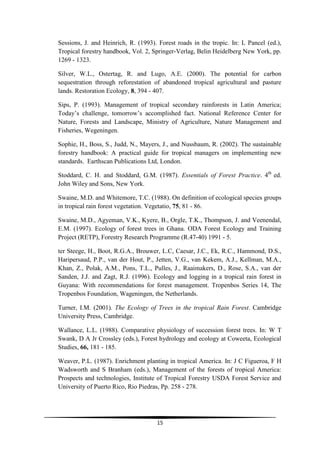
Table 1: Logging Impact on Forest


CONDITION                       CAUSE (S)                        CITATION

Increased erosion               Compaction, Top soil             Kobayashi et al. (2001);
                                removal for road and loading     Batmanian (1990); Demir et
                                bays construction, Reduced       al. (2005); Sessions and
                                rainfall interception            Heinrich (1993)

Nutrient loss                   Erosion, Top soil removal for Sophie et al. (2002); Demir,
                                loading bay and road          et al (2005); Buckley et al
                                construction                  (2003)

Reduced regeneration and        Degradation and erosion          Kobayashi et al. (2001);
growth                                                           Sophie et al. (2002);
                                                                 Sessions and Heinrich (1993)

Reduced infiltration and        Compaction by machines           Kobayashi et al. (2001);
increased soil bulk density                                      Batmanian (1990); Demir et
                                                                 al, (2005); Sessions and
                                                                 Heinrich (1993)

Low porosity and moisture       Loss of soil structure and       ter Steege et al. (1996)
retention characteristics       surface litter

Residual stand damage           Felling operations, Absence      Agyeman et al. (1999a);
                                of pre- and/or post- harvest     Hawthorne et al. (2001)
                                treatment

Higher minimum and              Increased solar radiation        Wallace (1988); Burslem
maximum ground surface          reaching forest floor due to     (2004); Agyeman et al.
temperature, Lower mean         canopy openings                  (1999b)
relative humidity, Greater
wind speed

Biodiversity loss               Habitat loss and competition     Johns (1997); Gilliam
                                for food                         (2002); Rab (2000)

Forest Fires                    Logging residual served as       Swaine et al. (1997)
                                fuel bed


1.5 Forest Rehabilitation


                                               4
Gomez-Pompa and Burley (1991) observed that the natural regeneration process can be
‘assisted’ or ‘directed’ to increase representation of any particular species. Forest
rehabilitation is the human intervention to counter forest degradation processes e.g.,
promotion of the recovery process in large gaps or conversion of shrub forest to high storey
plantation forest (Kobayashi et al., 2001). Forest rehabilitation therefore promotes measures
that maximise forest functions especially after logging to satisfy human aims. It involves re-
establishment of a more intact canopy that is found in undisturbed forest (Kobayashi et al.,
2001). Replanting of commercial species has been a widespread means of supplementing
inadequate natural regeneration and can be employed in rehabilitation projects after logging
(Johns, 1997). For example, during the 1960s, areas of the West Mengo Forest Reserve,
Uganda, which had been heavily damaged by logging and charcoal burning, were replanted
with selected timber species, including exotic hardwoods and it resulted in a considerable
improvement in timber increment (Johns, 1997). The seedlings are planted in natural forest
gaps along regularly placed lines, or on heavily damaged open areas such as roads and
loading areas (Johns, 1997). This implies that rehabilitation or enrichment planting may be
costly and difficult to implement.

1.5.1 Enrichment Plantings

Enrichment can conserve the soil and the forest environment, protect potential crop trees, and
produce additional wood or other forest products, leaf-fodder and fruits (Pancel, 1993). Some
forests are damaged by heavy logging and harsh conditions such as low nutrient status, high
irradiance, invasion of grasses and low soil moisture due to high evaporation are prevalent at
the gaps (Wallace, 1988; Burslem, 2004; Agyeman et al., 1999b). This poses problems to
regeneration and the growth of young trees because germination and growth is dependent on
such conditions as soil moisture content, invasive species, soil nutrient level and light
(Gerhardt, 1993; Nepstad et al., 1990; Honu and Dang, 2000; Anning and Yeboah-Gyan,
2007). Sometimes commercially attractive timbers may be lost because they were not
represented in any advanced growth (i.e. saplings and trees smaller than the felling limit) or
because the advanced growth was damaged by the logging operation hence enrichment
planting has been suggested to assist natural regeneration (Weaver, 1987; Kopelainen et al.,
1995; Sips, 1993).

Enrichment planting is a way to enhance commercial productivity whiles maintaining the
sites as essentially natural as in natural forests (Weaver, 1987; Aide et al., 2000; International


                                                5
Tropical Timber Organization, 2002; Lamprecht, 1990). Planting fast growing and
commercially attractive species can speed up the forest recovery rate and enhance the
capacity of the forest to maintain commercial or social productivity by promoting the growth
of economically desired species (Kobayashi et al., 2001). Enrichment planting also conserves
any residual advanced growth or natural regeneration of timber trees and this in effect will
maintain much of the residual biodiversity that is still present in the forest (Kobayashi et al.,
2001). However, since species suitability may vary with certain sites, the choice of native
species for rehabilitation should be carefully considered.

1.6 Choice of Tree Species for Rehabilitation

The decisive factors in choosing tree species for rehabilitation are usually both ecological and
economic in nature (Pancel, 1993). Almost all the energy in the tropical forest ecosystem
originates from solar radiation and trees differ in their tolerance to shade and light to such
degrees that, ecologically, they are put them into two main classes: pioneer species and non-
pioneer species (Swaine and Whitemore, 1988). The pioneer species are light demanders and
fail to establish in deep forest shade. Examples are Fromager (Ceiba pentandra), Iroko
(Milicia excelsa) and Framire (Terminalia ivorensis). These species are good for
rehabilitation projects since they are able to grow in gaps (Longman and Jeniks, 1992).

The non-pioneer species are further grouped into non pioneer light demanders and non-
pioneer shade demanders. In moderate gaps, the non-pioneer light demanders such as
Entandrophragma species, Khaya species, Bete (Mansonia altissima) and Ako (Antiaris
toxicaria) perform appreciably better than the non-pioneer shade demanders (Longman and
Jeniks, 1992). This implies that these species may be extremely difficult to plant where gaps
are large such as loading bays since they require some shading. Therefore, for effective
growth they should be established under some shade. The choice of species for rehabilitation
projects after logging should therefore be carefully considered and the appropriate species
should be used.

Some species can better compete in logging gaps than others (Longman and Jeniks, 1992). If
species whose competition potential is not known are considered for planting, it is advisable
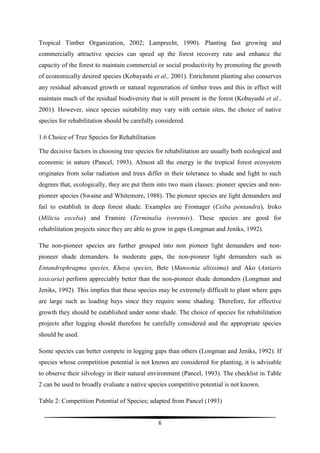
to observe their silvology in their natural environment (Pancel, 1993). The checklist in Table
2 can be used to broadly evaluate a native species competitive potential is not known.

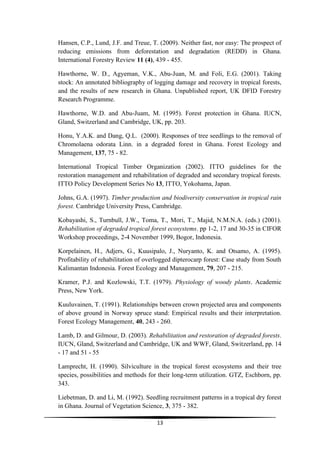
Table 2: Competition Potential of Species; adapted from Pancel (1993)


                                                6
Characteristics                                     Competition Behaviour
Pioneer Species                                     Rapid initial growth, competes successfully
                                                    with weeds and climbers
Opportunist Species                                 Moderately tolerant to competition
Light Demanders                                     Sensitive to competition from weeds and
                                                    climbers
Shadow-tolerant                                     May not be necessary or desirable to remove
                                                    the indigenous forest growth
Occurs in association with grasses                  Tolerates allelopathetic effects of grasses


1.7 Native Tree Species

A native tree species is one that grows naturally in the country concerned, though not
necessarily in all parts and certainly not suited to all sites (Evans, 1992). In comparison to the
tree species in the temperate regions, many tropical tree species possess natural properties
which make them practically useful. Such properties include natural durability, mechanical
stability and decorative appearance (Hall and Swaine, 1981). Therefore, cultivation of
indigenous timber species has both economic and ecological advantages over exotic species
which yield a high profit after a few years and are not slow growing as earlier thought (Foli et
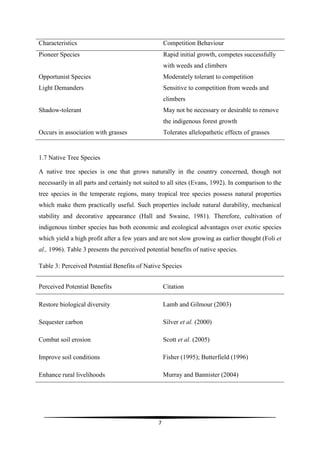
al., 1996). Table 3 presents the perceived potential benefits of native species.

Table 3: Perceived Potential Benefits of Native Species


Perceived Potential Benefits                        Citation

Restore biological diversity                        Lamb and Gilmour (2003)

Sequester carbon                                    Silver et al. (2000)

Combat soil erosion                                 Scott et al. (2005)

Improve soil conditions                             Fisher (1995); Butterfield (1996)

Enhance rural livelihoods                           Murray and Bannister (2004)


                                                7
However, limited availability of information on native species has resulted in few of them
being actually used in forest restoration programs. Understanding the growth characteristics
of forest trees will enhance their usage in rehabilitation programs.

1.8 Growth Requirement of the Indigenous Species

The growth of planted species is dependent on:

       environmental site conditions (soil, temperature, precipitation, distribution of
       precipitation and light) (Blatchford, 1978; Pancel, 1993);
       stocking of the stand (Pancel, 1993);
       silvicultural treatment (weeding, soil working, climber cutting, thinning) (Pancel,
       1993 ), and,
       endogenous growth characteristics of the species (Johns, 1997; Assman, 1970;
       Blatchford, 1978).

1.8.1 Water

The supply of water is justifiably considered to be the key factor in tree growth and plays an
important role in determining the success of plantations, especially in the tropics (Longman
and Jeniks, 1992). Rainfall is the primary source of water and can be a limiting factor to tree
growth. For instance, according to Swaine et al. (1997), for adequate growth, M. altissima
requires a high rainfall of 2032 mm yr-1. Species like Cynometra anata and Tarrieta utilis
cannot tolerate the dry season drought. The use of these species for rehabilitation should be
restricted to the Evergreen Forest Zone where the seasonal drought is about four months
(Swaine et al., 1997).

In seasonally dry forest, growth is probably reduced owing to water shortage during the dry
season, unless the trees can tap water deep in the soil. At La Selva, Costa Rica, a detailed
study of growth patterns on a day-to-day basis by Turner (2001) showed an annual
periodicity in growth in most of species on well-drained soils. Most species showed reduced
growth in the mild dry season at La Selva. Similarly, during a severe drought in 1983 on
Barro Colorado Island, there was considerably higher mortality among trees than normal,
with large-diameter stems suffering the greatest increase in mortality (Turner, 2001). The
case is not different in Ghana, the significant seasonal drought occurring each year in the
drier forest types, notably the Moist and Dry Semi-deciduous Forest types, have been found
to halt the growth of the trees. On the other hand, trees, which tolerate long drought periods,

                                                8
example Terminalia mollis (ongo), Khaya senegalensis, and Afzelia africana can survive in
these areas (Swaine et al., 1997).

1.8.2 Light

Though tree species, ecologically, has been grouped into pioneer species and non-pioneer
species, tree species growth is greatly influenced by light levels even within the same group.
Turner (2001) observed that shading results in most forest trees growing at rates well below
their potential maximum. Also, studies in a deciduous dry forest in Mexico resulted in
increased growth when light was increased (Rincon and Huante, 1993). Therefore differences
in growth response to light conditions exist among species and affect the composition of
forest stand (Hall and Swaine, 1981). Liebetman and Li (1992) found out that seedling
density was higher in well-shaded areas than exposed, open sites in a dry forest in Ghana.
This may be due to the fact that light may be excessive in gaps in dry seasons therefore
creating higher desiccation hence increasing seedling mortality in large gaps. Therefore,
species such as M. altissima will prefer moderate shade for the initial stages and subsequently
become a light demander requiring overhead light.

1.8.3 Soil Characteristics

An interaction of several soil factors influence the growth of trees because changes in one
factor may bring about corresponding changes in the other factors. For instance, soil
compaction increases bulk density or strength of the soil, commonly called its mechanical
impedances, and reduces its conductivity, permeability and diffusivity to water and air
(Greenland, 1997). Soil characteristics such as texture, bulk density, compaction, moisture,
penetration, thickness of the A horizon, organic matter and nutrient content can therefore
promote or retard the establishment and growth of forest trees (Kramer and Kozlowski,
1979). However, Evans (1992) notes that luxuriance and richness of much tropical forests
does not primarily depend on fertile soil but on efficient recycling of nutrients in the
ecosystem.

1.8.4 Spacing/Stand Stocking

Stand stocking and spacing are inversely related (Kuuluvainen, 1991). Relatively wide
spacing of individual trees and their resultant crown development affect the rate of diameter
growth and the quality of the lumber or their products they yield (Nketia, 2002; Nkyi, 2007).


                                              9
Crowding of trees in dense stands however has slightly stimulating effects on the height
growth which may exceed that of open grown trees.


1.9 Conclusion
The current rapid deforestation rates, the dominance of non-commercial pioneers in logging
gaps, lack of adequate regeneration for most commercial species, and current projections of
dramatic declines in the volume of future harvests calls for rehabilitation. Rehabilitation of
logged areas, loading bays, skid trails and road verges as well as landings is the most urgent
matter requiring enrichment plantings. With proper planning, site and species selection and
management, logging gaps can be rehabilitated after logging. This will ease forest function
recovery through early canopy closer.


                                             10
REFERENCES

    Agyeman, V.K., Abu-Juan, M. and Hawthorne, W. D. (1999a). Towards better forest
    harvesting, a summary of the findings of the research project: impact of harvesting on
    forest mortality and regeneration in the high forest zone of Ghana. Forestry Research
    Programme, Project R6716, Funded by the U.K., DFID, P.p 18.

    Agyeman, V.K., Swaine, M.D. and Thompson, J. (1999b). A comparison of gap
    microclimates in two forest types in Ghana. Ghana Journal of Forestry, 7, 51 - 69.

    Aide, T.M., Zimmerman, J.K., Pascarella, J.B., Rivera, L. and Marcano-Vega, H.
    (2000). Forest regeneration in a chronosequence of tropical abandoned pastures:
    Implications for restoration ecology. Restoration Ecology, 8, 328 - 338.

    Anning, A.K. and Yeboah-Gyan, K. (2007). Diversity and distribution of invasive
    weeds in Ashanti region, Ghana. African Journal of Ecology, 45, 355 - 366.

    Asabere, P. (1987). Attempts at sustainable yield management in the tropical high
    forests of Ghana. In: F Mergen and J R Vincent (eds.) Natural management of tropical
    moist forests: silviculture and management prospects of sustainable utilization, Yale
    University press, New Haven, CT, pp. 47 - 49.

    Assman E. (1970). The principles of forest yield study. Pergamon Press, Oxford.

    Batmanian, G.J. (1990). Reforestation of degraded pastures in Brazilian Amazon:
    effect of site preparation on phosphorous availability in the soil. PhD thesis,
    University of Georgia, Athens, GA.

    Benhin, J.K.A. and Barbier, E.B. (2001). The effects of adjustment in Ghana of the
    structural program on deforestation. Agricultural and Resource Economics Review,
    30, 66 - 80.

    Blackett, H. and Gardette, E. (2008). Cross-border flows of timber and wood products
    in West Africa. Final Report, HTSPE Ltd, European Commission, Contract
    Reference: 2007/146818.

    Blatchford, O.N. (ed.) (1978). A summary of methods of establishing, maintaining
    and harvesting forest crops with advice on planning and other management
    considerations for owners, agents and foresters. Forestry Commission Bulletin No. 14,
    pp. 1.

    Buckley, D.S., Crow, T.R., Nauertz, E.A. and Schulz, K.E. (2003). Influence of skid
    trails and haul roads on understory plant richness and composition in managed forest
    landscapes in Upper Michigan, USA. Forest Ecology and Management, 175, 509 -
    520.


                                          11
Burslem, D.V.P. (2004). Natural disturbance in forest environments. In: J Burley, J
Evans and J A Youngquis (eds.). The encyclopedia of forest sciences, Volume 1,
Elsevier Academic Press.

Butterfield, R.P. (1996). Early species selection for tropical reforestation: A
consideration of stability. Forest Ecology and Management, 81, 161 - 168.

Damnyag, L., Tyynelä, T., Appiah, M., Saastamoinen, O. and Pappinen, A. (2011).
Economic cost of deforestation in semi-deciduous forests — a case of two forest
districts in Ghana. Ecological Economics, 70, 2503 - 2510.

Demir, M., Makineci, E. and Yilmaz, E. (2005). Investigation of timber harvesting
impacts on herbaceous cover, forest floor and surface soil properties on skid road in
an Oak (Quercus petrea L.) Stand. Building and Environment, 42, 1194 - 1199.

Evans, A. (1992). Plantation forestry in the tropics. 2nd ed. Clarendon Press, Oxford.

Fisher, R.F. (1995). Amelioration of degraded rain forest soils by plantations of native
trees. Soil Science Society of America Journal, 59, 544 - 549.

Foli, E.G., Agyeman, V.K. and Kyere, B. (1996). Growth performance of some
indigenous tree species and their potential for plantation in Ghana. pp 5 Forestry
Plantation Development Workshop, WITC, Akyawkrom, Ghana.

Food, Agricultural Organization of the United Nations (FAO), (2006). Global Forest
Resources Assessment 2005. Progress towards Sustainable Forest Management, FAO
Forestry paper 147, Rome.

Gerhardt, K. (1993). Tree seedling development in tropical dry abandoned pasture and
secondary forest in Costa Rica. Journal of Vegetation Science, 4, 95 - 102.

Gilliam, F.S. (2002). Effects of harvesting on herbaceous layer diversity of a central
appalachian hardwood forest in West Virginia, USA. Forest Ecology Management,
155, 33 - 43.

Gomez-Popma, A. and Burley, F.W. (1991). The management of natural tropical
forest. In: A Gomez, T C Whitemore and M Hadley (eds.), Rainforest regeneration
and management, Man and Biosphere Series, Paris: UNESCO.

Greenland, D.J. (1977). Soil structure and erosion hazard. In: D J Greenland and R
Lai, (eds.), Soil conservation and management in the humid tropics, Wiley
publication, Chichester.

Hall, J.B. and Swaine, M.D. (1981). Distribution and ecology of vascular plants in a
tropical rain forest. Forest Vegetation in Ghana, W. Jank publication, The Hague.


                                      12
Hansen, C.P., Lund, J.F. and Treue, T. (2009). Neither fast, nor easy: The prospect of
reducing emissions from deforestation and degradation (REDD) in Ghana.
International Forestry Review 11 (4), 439 - 455.

Hawthorne, W. D., Agyeman, V.K., Abu-Juan, M. and Foli, E.G. (2001). Taking
stock: An annotated bibliography of logging damage and recovery in tropical forests,
and the results of new research in Ghana. Unpublished report, UK DFID Forestry
Research Programme.

Hawthorne, W.D. and Abu-Juam, M. (1995). Forest protection in Ghana. IUCN,
Gland, Switzerland and Cambridge, UK, pp. 203.

Honu, Y.A.K. and Dang, Q.L. (2000). Responses of tree seedlings to the removal of
Chromolaena odorata Linn. in a degraded forest in Ghana. Forest Ecology and
Management, 137, 75 - 82.

International Tropical Timber Organization (2002). ITTO guidelines for the
restoration management and rehabilitation of degraded and secondary tropical forests.
ITTO Policy Development Series No 13, ITTO, Yokohama, Japan.

Johns, G.A. (1997). Timber production and biodiversity conservation in tropical rain
forest. Cambridge University Press, Cambridge.

Kobayashi, S., Turnbull, J.W., Toma, T., Mori, T., Majid, N.M.N.A. (eds.) (2001).
Rehabilitation of degraded tropical forest ecosystems. pp 1-2, 17 and 30-35 in CIFOR
Workshop proceedings, 2-4 November 1999, Bogor, Indonesia.

Korpelainen, H., Adjers, G., Kuusipalo, J., Nuryanto, K. and Otsamo, A. (1995).
Profitability of rehabilitation of overlogged dipterocarp forest: Case study from South
Kalimantan Indonesia. Forest Ecology and Management, 79, 207 - 215.

Kramer, P.J. and Kozlowski, T.T. (1979). Physiology of woody plants. Academic
Press, New York.

Kuuluvainen, T. (1991). Relationships between crown projected area and components
of above ground in Norway spruce stand: Empirical results and their interpretation.
Forest Ecology Management, 40, 243 - 260.

Lamb, D. and Gilmour, D. (2003). Rehabilitation and restoration of degraded forests.
IUCN, Gland, Switzerland and Cambridge, UK and WWF, Gland, Switzerland, pp. 14
- 17 and 51 - 55

Lamprecht, H. (1990). Silviculture in the tropical forest ecosystems and their tree
species, possibilities and methods for their long-term utilization. GTZ, Eschborn, pp.
343.

Liebetman, D. and Li, M. (1992). Seedling recruitment patterns in a tropical dry forest
in Ghana. Journal of Vegetation Science, 3, 375 - 382.

                                      13
Longman, K.A. and Jeniks, J. (1992). Tropical forest and its environment. 2nd ed.
Longman Scientific and Technical, London.

Ministry of Lands and Forestry (1994). Forest and Wildlife Policy. Republic of
Ghana, 24th November 1994, Ministry of Lands and Forestry, Accra- Ghana.

Murray, G.F. and Bannister, M.E. (2004). Peasants, agroforesters, and
anthropologists: a 20 year venture in income-generating trees and hedgerows in Haiti.
Agroforestry Systems, 61, 383 - 397.

Nepstad, D.C., Hula, C., and Serrao, E.A. (1990). Surmounting barriers to forest
regeneration in abandoned, highly degraded pastures: a case study from Paragominas,
Para, Brazil, In: A Anderson (ed.), Alternatives to deforestation: steps towards
sustainable uses of Amazonian Forests, Columbia University Press, New York, 215 -
229.

Nketia, K.S. (2002). Pruning of tree shrubs and conifers. Faber and Faber, London.

Nkyi, A. (2007). Introduction to tropical forest measurements. Asare Patrick Printing
Press, Ghana.

Palo, M., and Yirdaw, E. (1996). Deforestation and sustainable forestry challenges in
Ghana. In: M Palo and G Mery (eds.), Sustainable forestry challenges for developing
countries, Kluwer Academic Publishers, The Netherlands, pp. 343 - 357.

Pancel, L. (ed.) (1993). Tropical forestry handbook. Vol. 1. Springer-Verlag, Belin
Heidelberg New York, Pp. 648 - 649, 665, 715, 757 - 781.

Popma, J. and Bongers, F. (1988). The effect of canopy openings on growth and
morphology of seedlings of rain forest species. Oecologia, P.p 75, and 625 -632.

Rab, M.A. (2000). Recovery of soil physical properties from compaction and soil
profile disturbance caused by logging of native forest in Victorian Central Highlands,
Australia. Forest Ecology Management, 191, 329 - 40.

Rincon, E. and Huante, P. (1993). Growth responses of tropical deciduous tree
seedlings to contrasting light conditions. Trees, 7, 202 - 207.

Scott, D.F., Bruijnzeel, L.A. and Mackensen, J. (2005). The hydrological and soil
impacts of forestation in the tropics. In: M Bonell and L A Bruijnzeel (eds.), Forests,
water and people in the humid tropics: Past, present and future hydrological research
for integrated land and water management. University Press/UNESCO, Cambridge
Pp. 622 - 651.

Secretariat of the Convention on Biological Diversity (2010). Sustainable Forest
Management, Biodiversity and Livelihoods: A Good Practice Guide. Convention on
Biological Diversity, IUCN, Montreal, 57.


                                      14
Sessions, J. and Heinrich, R. (1993). Forest roads in the tropic. In: L Pancel (ed.),
Tropical forestry handbook, Vol. 2, Springer-Verlag, Belin Heidelberg New York, pp.
1269 - 1323.

Silver, W.L., Ostertag, R. and Lugo, A.E. (2000). The potential for carbon
sequestration through reforestation of abandoned tropical agricultural and pasture
lands. Restoration Ecology, 8, 394 - 407.

Sips, P. (1993). Management of tropical secondary rainforests in Latin America;
Today’s challenge, tomorrow’s accomplished fact. National Reference Center for
Nature, Forests and Landscape, Ministry of Agriculture, Nature Management and
Fisheries, Wegeningen.

Sophie, H., Boss, S., Judd, N., Mayers, J., and Nussbaum, R. (2002). The sustainable
forestry handbook: A practical guide for tropical managers on implementing new
standards. Earthscan Publications Ltd, London.

Stoddard, C. H. and Stoddard, G.M. (1987). Essentials of Forest Practice. 4th ed.
John Wiley and Sons, New York.

Swaine, M.D. and Whitemore, T.C. (1988). On definition of ecological species groups
in tropical rain forest vegetation. Vegetatio, 75, 81 - 86.

Swaine, M.D., Agyeman, V.K., Kyere, B., Orgle, T.K., Thompson, J. and Veenendal,
E.M. (1997). Ecology of forest trees in Ghana. ODA Forest Ecology and Training
Project (RETP), Forestry Research Programme (R.47-40) 1991 - 5.

ter Steege, H., Boot, R.G.A., Brouwer, L.C, Caesar, J.C., Ek, R.C., Hammond, D.S.,
Haripersaud, P.P., van der Hout, P., Jetten, V.G., van Kekem, A.J., Kellman, M.A.,
Khan, Z., Polak, A.M., Pons, T.L., Pulles, J., Raaimakers, D., Rose, S.A., van der
Sanden, J.J. and Zagt, R.J. (1996). Ecology and logging in a tropical rain forest in
Guyana: With recommendations for forest management. Tropenbos Series 14, The
Tropenbos Foundation, Wageningen, the Netherlands.

Turner, I.M. (2001). The Ecology of Trees in the tropical Rain Forest. Cambridge
University Press, Cambridge.

Wallance, L.L. (1988). Comparative physiology of succession forest trees. In: W T
Swank, D A Jr Crossley (eds.), Forest hydrology and ecology at Coweeta, Ecological
Studies, 66, 181 - 185.

Weaver, P.L. (1987). Enrichment planting in tropical America. In: J C Figueroa, F H
Wadsworth and S Branham (eds.), Management of the forests of tropical America:
Prospects and technologies, Institute of Tropical Forestry USDA Forest Service and
University of Puerto Rico, Rio Piedras, Pp. 258 - 278.


                                     15

Mini literature review exercise

  • 1.
    A MINI LITERATUREREVIEW REHABILITATION OF LOGGING GAPS AT PRA-ANUM FOREST RESERVE IN GHANA ASIGBAASE MICHAEL Table of Contents .......................................................................................................................................... ii i
  • 2.
    List of Tables................................................................................................................................................ iii Sections 1.1 General Introduction ............................................................................................................................... 1 1.2 The problem of Deforestation ................................................................................................................. 2 1.3 Logging in Natural Forests ..................................................................................................................... 2 1.4 Impact of Logging on Forest and Forest Conditions .............................................................................. 3 1.5 Forest Rehabilitation ............................................................................................................................... 4 1.5.1 Enrichment Plantings ....................................................................................................................... 5 1.6 Choice of Tree Species for Rehabilitation .............................................................................................. 5 1.7 Native Tree Species ................................................................................................................................ 7 1.8 Growth Requirement of the Indigenous Species ..................................................................................... 7 1.8.1 Water ................................................................................................................................................ 8 1.8.2 Light ................................................................................................................................................. 8 1.8.3 Soil Characteristics .......................................................................................................................... 9 1.8.4 Spacing/Stand Stocking ................................................................................................................... 9 1.9 Conclusion .............................................................................................................................................. 9 REFERENCES ........................................................................................................................................... 10 List of Tables ii
  • 3.
    1. Table 1:Logging Impact on Forest 3 2. Table 2: Competition Potential of Species 6 3. Table 3: Perceived Potential Benefits of Native Species 6 1.0 Literature Review iii
  • 4.
    1.1 General Introduction Aforest is defined by the Secretariat of the Convention on Biological Diversity (2010) as a community or association of trees and animals dominated by trees which are capable of generating forest products. These ecosystems produce valuable materials such as lumber, paper pulp, and domestic livestock that is important in human culture. They also play vital roles in regulating climate, controlling water runoff, providing wildlife habitat, purifying the air and a host of other ecological services. In addition, these terrestrial biomasses have cultural, historic and scenic values and hence are usually protected (Lamb and Gilmour, 2003; Secretariat of the Convention on Biological Diversity, 2010). However, forest is one of the most heavily disturbed resources by human activity. This work, therefore, is a review of literature on logging damage and the rehabilitation of forest after logging. It will focus on the rehabilitation of logging gaps using native species. 1.2 The Problem of Deforestation For the past two decades, Central and West Africa recorded the highest deforestation rates; annual rate change of 0.6% from 1990-2000 and 0.5% for 2000-2005 (FAO, 2006). Ghana was one West African country where deforestation was highest (Benhin and Barbier, 2001). Therefore, precise figures describing the current total forest cover and deforestation are difficult to give (Hansen et al., 2009), though FAO, 2006 reported 24% of total land cover as Ghana’s forest cover in 2005. The forests of Ghana are grouped into off-reserves and on-reserves. The Forestry Commission manages the on-reserve areas. There are 266 forest reserves in Ghana, out of this, 216 occur in the high forest zone which is the timber production zone (Damnyag et al., 2011). However, most of these reserves were already degraded in the mid 1990s as a result of over-harvesting (over-logging) for timber, forest fires, and farming (Hawthorne and Abu- Juam, 1995). The situation, currently, may even be worse, because in 2006, the annual allowable cut had increased from 1 million m3 in 1989 to 2 million m3 (Blackett and Gardette, 2008), without an equivalent replanting of trees (Damnyag et al., 2011). In Ghana, timber is extracted from the forest through selective logging (Palo and Yirdaw, 1996), involving periodic entries into a given area of a forest for the removal of selected commercial timber trees using heavy extraction machines such as bull dozers, skidders and sometimes tractors, which cause much damage to the residual forest. The method allows the removal of 2
  • 5.
    only the currentcommercial trees while retaining those with potential commercial value for future use. This method of harvesting (selective logging) is one of the leading causes of Ghana’s forest loss through degradation and deforestation (Palo and Yirdaw, 1996). Therefore, the government of Ghana over the years have been concerned about the extent of forest degradation in the country (Damnyag et al., 2011). Rehabilitation measures, including tree planting is one tactical effort being made to combat deforestation and to achieve sustainable management (Damnyag et al., 2011). The 1994 Government policy therefore recommends that degraded forest reserves should be put under reforestation and/or rehabilitation (Ministry of Lands and Forestry, 1994). 1.3 Logging in Natural Forests Logging is described by Stoddard and Stoddard (1987), as ‘the process of harvesting and hauling rough forest products from stump areas to the points of processing or sale’. Felling and extraction of trees are the main activities during logging. The major aspect of logging that may contribute to degradation and eventually to deforestation is that besides damage done due to felling some parts of the forests are cleared to construct tracks, roads, landings and loading bays. Though logging affects the forest (Lamb and Gilmour, 2003), with proper management, it can be useful as matured trees have to be removed so that young trees can grow to replace them. This however is not always the case, since it is dependent on proper management. Tree felling creates gaps in the forest canopy. This poses a serious threat to sustainability if no silvicultural intervention appropriate for easing the recovery of logged areas is carried out (Asabere, 1987). The cumulative effect of these gaps together with skidding, road construction, and loading bay operations can be very serious. The impact, however, varies with logging intensity, frequency and spatial extent. The physical impact of logging operations, however, creates a structurally heterogeneous residual forest consisting of different micro-sites such as log landings, logging roads, logging gaps, loading bays and skid trails (Stoddard and Stoddard, 1987; Demir et al., 2005). 1.4 Impact of Logging on Forest and Forest Conditions The two main anthropogenic impacts on the tropical rain forests are deforestation and logging (Johns, 1997). Stoddard and Stoddard (1987) stated that harvesting timber from forested areas has both direct and indirect environmental effects. The level of impact as it relates to these 3
  • 6.
    are, however, dependenton factors such as logging intensity, forest structure, terrain condition, harvesting methods and skill of machine operators (Johns, 1997 ; Stoddard and Stoddard, 1987). Table 1 gives a summary of the impact of logging on forest and its environment. Rehabilitation is therefore necessary to ease forest recovery after logging. Table 1: Logging Impact on Forest CONDITION CAUSE (S) CITATION Increased erosion Compaction, Top soil Kobayashi et al. (2001); removal for road and loading Batmanian (1990); Demir et bays construction, Reduced al. (2005); Sessions and rainfall interception Heinrich (1993) Nutrient loss Erosion, Top soil removal for Sophie et al. (2002); Demir, loading bay and road et al (2005); Buckley et al construction (2003) Reduced regeneration and Degradation and erosion Kobayashi et al. (2001); growth Sophie et al. (2002); Sessions and Heinrich (1993) Reduced infiltration and Compaction by machines Kobayashi et al. (2001); increased soil bulk density Batmanian (1990); Demir et al, (2005); Sessions and Heinrich (1993) Low porosity and moisture Loss of soil structure and ter Steege et al. (1996) retention characteristics surface litter Residual stand damage Felling operations, Absence Agyeman et al. (1999a); of pre- and/or post- harvest Hawthorne et al. (2001) treatment Higher minimum and Increased solar radiation Wallace (1988); Burslem maximum ground surface reaching forest floor due to (2004); Agyeman et al. temperature, Lower mean canopy openings (1999b) relative humidity, Greater wind speed Biodiversity loss Habitat loss and competition Johns (1997); Gilliam for food (2002); Rab (2000) Forest Fires Logging residual served as Swaine et al. (1997) fuel bed 1.5 Forest Rehabilitation 4
  • 7.
    Gomez-Pompa and Burley(1991) observed that the natural regeneration process can be ‘assisted’ or ‘directed’ to increase representation of any particular species. Forest rehabilitation is the human intervention to counter forest degradation processes e.g., promotion of the recovery process in large gaps or conversion of shrub forest to high storey plantation forest (Kobayashi et al., 2001). Forest rehabilitation therefore promotes measures that maximise forest functions especially after logging to satisfy human aims. It involves re- establishment of a more intact canopy that is found in undisturbed forest (Kobayashi et al., 2001). Replanting of commercial species has been a widespread means of supplementing inadequate natural regeneration and can be employed in rehabilitation projects after logging (Johns, 1997). For example, during the 1960s, areas of the West Mengo Forest Reserve, Uganda, which had been heavily damaged by logging and charcoal burning, were replanted with selected timber species, including exotic hardwoods and it resulted in a considerable improvement in timber increment (Johns, 1997). The seedlings are planted in natural forest gaps along regularly placed lines, or on heavily damaged open areas such as roads and loading areas (Johns, 1997). This implies that rehabilitation or enrichment planting may be costly and difficult to implement. 1.5.1 Enrichment Plantings Enrichment can conserve the soil and the forest environment, protect potential crop trees, and produce additional wood or other forest products, leaf-fodder and fruits (Pancel, 1993). Some forests are damaged by heavy logging and harsh conditions such as low nutrient status, high irradiance, invasion of grasses and low soil moisture due to high evaporation are prevalent at the gaps (Wallace, 1988; Burslem, 2004; Agyeman et al., 1999b). This poses problems to regeneration and the growth of young trees because germination and growth is dependent on such conditions as soil moisture content, invasive species, soil nutrient level and light (Gerhardt, 1993; Nepstad et al., 1990; Honu and Dang, 2000; Anning and Yeboah-Gyan, 2007). Sometimes commercially attractive timbers may be lost because they were not represented in any advanced growth (i.e. saplings and trees smaller than the felling limit) or because the advanced growth was damaged by the logging operation hence enrichment planting has been suggested to assist natural regeneration (Weaver, 1987; Kopelainen et al., 1995; Sips, 1993). Enrichment planting is a way to enhance commercial productivity whiles maintaining the sites as essentially natural as in natural forests (Weaver, 1987; Aide et al., 2000; International 5
  • 8.
    Tropical Timber Organization,2002; Lamprecht, 1990). Planting fast growing and commercially attractive species can speed up the forest recovery rate and enhance the capacity of the forest to maintain commercial or social productivity by promoting the growth of economically desired species (Kobayashi et al., 2001). Enrichment planting also conserves any residual advanced growth or natural regeneration of timber trees and this in effect will maintain much of the residual biodiversity that is still present in the forest (Kobayashi et al., 2001). However, since species suitability may vary with certain sites, the choice of native species for rehabilitation should be carefully considered. 1.6 Choice of Tree Species for Rehabilitation The decisive factors in choosing tree species for rehabilitation are usually both ecological and economic in nature (Pancel, 1993). Almost all the energy in the tropical forest ecosystem originates from solar radiation and trees differ in their tolerance to shade and light to such degrees that, ecologically, they are put them into two main classes: pioneer species and non- pioneer species (Swaine and Whitemore, 1988). The pioneer species are light demanders and fail to establish in deep forest shade. Examples are Fromager (Ceiba pentandra), Iroko (Milicia excelsa) and Framire (Terminalia ivorensis). These species are good for rehabilitation projects since they are able to grow in gaps (Longman and Jeniks, 1992). The non-pioneer species are further grouped into non pioneer light demanders and non- pioneer shade demanders. In moderate gaps, the non-pioneer light demanders such as Entandrophragma species, Khaya species, Bete (Mansonia altissima) and Ako (Antiaris toxicaria) perform appreciably better than the non-pioneer shade demanders (Longman and Jeniks, 1992). This implies that these species may be extremely difficult to plant where gaps are large such as loading bays since they require some shading. Therefore, for effective growth they should be established under some shade. The choice of species for rehabilitation projects after logging should therefore be carefully considered and the appropriate species should be used. Some species can better compete in logging gaps than others (Longman and Jeniks, 1992). If species whose competition potential is not known are considered for planting, it is advisable to observe their silvology in their natural environment (Pancel, 1993). The checklist in Table 2 can be used to broadly evaluate a native species competitive potential is not known. Table 2: Competition Potential of Species; adapted from Pancel (1993) 6
  • 9.
    Characteristics Competition Behaviour Pioneer Species Rapid initial growth, competes successfully with weeds and climbers Opportunist Species Moderately tolerant to competition Light Demanders Sensitive to competition from weeds and climbers Shadow-tolerant May not be necessary or desirable to remove the indigenous forest growth Occurs in association with grasses Tolerates allelopathetic effects of grasses 1.7 Native Tree Species A native tree species is one that grows naturally in the country concerned, though not necessarily in all parts and certainly not suited to all sites (Evans, 1992). In comparison to the tree species in the temperate regions, many tropical tree species possess natural properties which make them practically useful. Such properties include natural durability, mechanical stability and decorative appearance (Hall and Swaine, 1981). Therefore, cultivation of indigenous timber species has both economic and ecological advantages over exotic species which yield a high profit after a few years and are not slow growing as earlier thought (Foli et al., 1996). Table 3 presents the perceived potential benefits of native species. Table 3: Perceived Potential Benefits of Native Species Perceived Potential Benefits Citation Restore biological diversity Lamb and Gilmour (2003) Sequester carbon Silver et al. (2000) Combat soil erosion Scott et al. (2005) Improve soil conditions Fisher (1995); Butterfield (1996) Enhance rural livelihoods Murray and Bannister (2004) 7
  • 10.
    However, limited availabilityof information on native species has resulted in few of them being actually used in forest restoration programs. Understanding the growth characteristics of forest trees will enhance their usage in rehabilitation programs. 1.8 Growth Requirement of the Indigenous Species The growth of planted species is dependent on: environmental site conditions (soil, temperature, precipitation, distribution of precipitation and light) (Blatchford, 1978; Pancel, 1993); stocking of the stand (Pancel, 1993); silvicultural treatment (weeding, soil working, climber cutting, thinning) (Pancel, 1993 ), and, endogenous growth characteristics of the species (Johns, 1997; Assman, 1970; Blatchford, 1978). 1.8.1 Water The supply of water is justifiably considered to be the key factor in tree growth and plays an important role in determining the success of plantations, especially in the tropics (Longman and Jeniks, 1992). Rainfall is the primary source of water and can be a limiting factor to tree growth. For instance, according to Swaine et al. (1997), for adequate growth, M. altissima requires a high rainfall of 2032 mm yr-1. Species like Cynometra anata and Tarrieta utilis cannot tolerate the dry season drought. The use of these species for rehabilitation should be restricted to the Evergreen Forest Zone where the seasonal drought is about four months (Swaine et al., 1997). In seasonally dry forest, growth is probably reduced owing to water shortage during the dry season, unless the trees can tap water deep in the soil. At La Selva, Costa Rica, a detailed study of growth patterns on a day-to-day basis by Turner (2001) showed an annual periodicity in growth in most of species on well-drained soils. Most species showed reduced growth in the mild dry season at La Selva. Similarly, during a severe drought in 1983 on Barro Colorado Island, there was considerably higher mortality among trees than normal, with large-diameter stems suffering the greatest increase in mortality (Turner, 2001). The case is not different in Ghana, the significant seasonal drought occurring each year in the drier forest types, notably the Moist and Dry Semi-deciduous Forest types, have been found to halt the growth of the trees. On the other hand, trees, which tolerate long drought periods, 8
  • 11.
    example Terminalia mollis(ongo), Khaya senegalensis, and Afzelia africana can survive in these areas (Swaine et al., 1997). 1.8.2 Light Though tree species, ecologically, has been grouped into pioneer species and non-pioneer species, tree species growth is greatly influenced by light levels even within the same group. Turner (2001) observed that shading results in most forest trees growing at rates well below their potential maximum. Also, studies in a deciduous dry forest in Mexico resulted in increased growth when light was increased (Rincon and Huante, 1993). Therefore differences in growth response to light conditions exist among species and affect the composition of forest stand (Hall and Swaine, 1981). Liebetman and Li (1992) found out that seedling density was higher in well-shaded areas than exposed, open sites in a dry forest in Ghana. This may be due to the fact that light may be excessive in gaps in dry seasons therefore creating higher desiccation hence increasing seedling mortality in large gaps. Therefore, species such as M. altissima will prefer moderate shade for the initial stages and subsequently become a light demander requiring overhead light. 1.8.3 Soil Characteristics An interaction of several soil factors influence the growth of trees because changes in one factor may bring about corresponding changes in the other factors. For instance, soil compaction increases bulk density or strength of the soil, commonly called its mechanical impedances, and reduces its conductivity, permeability and diffusivity to water and air (Greenland, 1997). Soil characteristics such as texture, bulk density, compaction, moisture, penetration, thickness of the A horizon, organic matter and nutrient content can therefore promote or retard the establishment and growth of forest trees (Kramer and Kozlowski, 1979). However, Evans (1992) notes that luxuriance and richness of much tropical forests does not primarily depend on fertile soil but on efficient recycling of nutrients in the ecosystem. 1.8.4 Spacing/Stand Stocking Stand stocking and spacing are inversely related (Kuuluvainen, 1991). Relatively wide spacing of individual trees and their resultant crown development affect the rate of diameter growth and the quality of the lumber or their products they yield (Nketia, 2002; Nkyi, 2007). 9
  • 12.
    Crowding of treesin dense stands however has slightly stimulating effects on the height growth which may exceed that of open grown trees. 1.9 Conclusion The current rapid deforestation rates, the dominance of non-commercial pioneers in logging gaps, lack of adequate regeneration for most commercial species, and current projections of dramatic declines in the volume of future harvests calls for rehabilitation. Rehabilitation of logged areas, loading bays, skid trails and road verges as well as landings is the most urgent matter requiring enrichment plantings. With proper planning, site and species selection and management, logging gaps can be rehabilitated after logging. This will ease forest function recovery through early canopy closer. 10
  • 13.
    REFERENCES Agyeman, V.K., Abu-Juan, M. and Hawthorne, W. D. (1999a). Towards better forest harvesting, a summary of the findings of the research project: impact of harvesting on forest mortality and regeneration in the high forest zone of Ghana. Forestry Research Programme, Project R6716, Funded by the U.K., DFID, P.p 18. Agyeman, V.K., Swaine, M.D. and Thompson, J. (1999b). A comparison of gap microclimates in two forest types in Ghana. Ghana Journal of Forestry, 7, 51 - 69. Aide, T.M., Zimmerman, J.K., Pascarella, J.B., Rivera, L. and Marcano-Vega, H. (2000). Forest regeneration in a chronosequence of tropical abandoned pastures: Implications for restoration ecology. Restoration Ecology, 8, 328 - 338. Anning, A.K. and Yeboah-Gyan, K. (2007). Diversity and distribution of invasive weeds in Ashanti region, Ghana. African Journal of Ecology, 45, 355 - 366. Asabere, P. (1987). Attempts at sustainable yield management in the tropical high forests of Ghana. In: F Mergen and J R Vincent (eds.) Natural management of tropical moist forests: silviculture and management prospects of sustainable utilization, Yale University press, New Haven, CT, pp. 47 - 49. Assman E. (1970). The principles of forest yield study. Pergamon Press, Oxford. Batmanian, G.J. (1990). Reforestation of degraded pastures in Brazilian Amazon: effect of site preparation on phosphorous availability in the soil. PhD thesis, University of Georgia, Athens, GA. Benhin, J.K.A. and Barbier, E.B. (2001). The effects of adjustment in Ghana of the structural program on deforestation. Agricultural and Resource Economics Review, 30, 66 - 80. Blackett, H. and Gardette, E. (2008). Cross-border flows of timber and wood products in West Africa. Final Report, HTSPE Ltd, European Commission, Contract Reference: 2007/146818. Blatchford, O.N. (ed.) (1978). A summary of methods of establishing, maintaining and harvesting forest crops with advice on planning and other management considerations for owners, agents and foresters. Forestry Commission Bulletin No. 14, pp. 1. Buckley, D.S., Crow, T.R., Nauertz, E.A. and Schulz, K.E. (2003). Influence of skid trails and haul roads on understory plant richness and composition in managed forest landscapes in Upper Michigan, USA. Forest Ecology and Management, 175, 509 - 520. 11
  • 14.
    Burslem, D.V.P. (2004).Natural disturbance in forest environments. In: J Burley, J Evans and J A Youngquis (eds.). The encyclopedia of forest sciences, Volume 1, Elsevier Academic Press. Butterfield, R.P. (1996). Early species selection for tropical reforestation: A consideration of stability. Forest Ecology and Management, 81, 161 - 168. Damnyag, L., Tyynelä, T., Appiah, M., Saastamoinen, O. and Pappinen, A. (2011). Economic cost of deforestation in semi-deciduous forests — a case of two forest districts in Ghana. Ecological Economics, 70, 2503 - 2510. Demir, M., Makineci, E. and Yilmaz, E. (2005). Investigation of timber harvesting impacts on herbaceous cover, forest floor and surface soil properties on skid road in an Oak (Quercus petrea L.) Stand. Building and Environment, 42, 1194 - 1199. Evans, A. (1992). Plantation forestry in the tropics. 2nd ed. Clarendon Press, Oxford. Fisher, R.F. (1995). Amelioration of degraded rain forest soils by plantations of native trees. Soil Science Society of America Journal, 59, 544 - 549. Foli, E.G., Agyeman, V.K. and Kyere, B. (1996). Growth performance of some indigenous tree species and their potential for plantation in Ghana. pp 5 Forestry Plantation Development Workshop, WITC, Akyawkrom, Ghana. Food, Agricultural Organization of the United Nations (FAO), (2006). Global Forest Resources Assessment 2005. Progress towards Sustainable Forest Management, FAO Forestry paper 147, Rome. Gerhardt, K. (1993). Tree seedling development in tropical dry abandoned pasture and secondary forest in Costa Rica. Journal of Vegetation Science, 4, 95 - 102. Gilliam, F.S. (2002). Effects of harvesting on herbaceous layer diversity of a central appalachian hardwood forest in West Virginia, USA. Forest Ecology Management, 155, 33 - 43. Gomez-Popma, A. and Burley, F.W. (1991). The management of natural tropical forest. In: A Gomez, T C Whitemore and M Hadley (eds.), Rainforest regeneration and management, Man and Biosphere Series, Paris: UNESCO. Greenland, D.J. (1977). Soil structure and erosion hazard. In: D J Greenland and R Lai, (eds.), Soil conservation and management in the humid tropics, Wiley publication, Chichester. Hall, J.B. and Swaine, M.D. (1981). Distribution and ecology of vascular plants in a tropical rain forest. Forest Vegetation in Ghana, W. Jank publication, The Hague. 12
  • 15.
    Hansen, C.P., Lund,J.F. and Treue, T. (2009). Neither fast, nor easy: The prospect of reducing emissions from deforestation and degradation (REDD) in Ghana. International Forestry Review 11 (4), 439 - 455. Hawthorne, W. D., Agyeman, V.K., Abu-Juan, M. and Foli, E.G. (2001). Taking stock: An annotated bibliography of logging damage and recovery in tropical forests, and the results of new research in Ghana. Unpublished report, UK DFID Forestry Research Programme. Hawthorne, W.D. and Abu-Juam, M. (1995). Forest protection in Ghana. IUCN, Gland, Switzerland and Cambridge, UK, pp. 203. Honu, Y.A.K. and Dang, Q.L. (2000). Responses of tree seedlings to the removal of Chromolaena odorata Linn. in a degraded forest in Ghana. Forest Ecology and Management, 137, 75 - 82. International Tropical Timber Organization (2002). ITTO guidelines for the restoration management and rehabilitation of degraded and secondary tropical forests. ITTO Policy Development Series No 13, ITTO, Yokohama, Japan. Johns, G.A. (1997). Timber production and biodiversity conservation in tropical rain forest. Cambridge University Press, Cambridge. Kobayashi, S., Turnbull, J.W., Toma, T., Mori, T., Majid, N.M.N.A. (eds.) (2001). Rehabilitation of degraded tropical forest ecosystems. pp 1-2, 17 and 30-35 in CIFOR Workshop proceedings, 2-4 November 1999, Bogor, Indonesia. Korpelainen, H., Adjers, G., Kuusipalo, J., Nuryanto, K. and Otsamo, A. (1995). Profitability of rehabilitation of overlogged dipterocarp forest: Case study from South Kalimantan Indonesia. Forest Ecology and Management, 79, 207 - 215. Kramer, P.J. and Kozlowski, T.T. (1979). Physiology of woody plants. Academic Press, New York. Kuuluvainen, T. (1991). Relationships between crown projected area and components of above ground in Norway spruce stand: Empirical results and their interpretation. Forest Ecology Management, 40, 243 - 260. Lamb, D. and Gilmour, D. (2003). Rehabilitation and restoration of degraded forests. IUCN, Gland, Switzerland and Cambridge, UK and WWF, Gland, Switzerland, pp. 14 - 17 and 51 - 55 Lamprecht, H. (1990). Silviculture in the tropical forest ecosystems and their tree species, possibilities and methods for their long-term utilization. GTZ, Eschborn, pp. 343. Liebetman, D. and Li, M. (1992). Seedling recruitment patterns in a tropical dry forest in Ghana. Journal of Vegetation Science, 3, 375 - 382. 13
  • 16.
    Longman, K.A. andJeniks, J. (1992). Tropical forest and its environment. 2nd ed. Longman Scientific and Technical, London. Ministry of Lands and Forestry (1994). Forest and Wildlife Policy. Republic of Ghana, 24th November 1994, Ministry of Lands and Forestry, Accra- Ghana. Murray, G.F. and Bannister, M.E. (2004). Peasants, agroforesters, and anthropologists: a 20 year venture in income-generating trees and hedgerows in Haiti. Agroforestry Systems, 61, 383 - 397. Nepstad, D.C., Hula, C., and Serrao, E.A. (1990). Surmounting barriers to forest regeneration in abandoned, highly degraded pastures: a case study from Paragominas, Para, Brazil, In: A Anderson (ed.), Alternatives to deforestation: steps towards sustainable uses of Amazonian Forests, Columbia University Press, New York, 215 - 229. Nketia, K.S. (2002). Pruning of tree shrubs and conifers. Faber and Faber, London. Nkyi, A. (2007). Introduction to tropical forest measurements. Asare Patrick Printing Press, Ghana. Palo, M., and Yirdaw, E. (1996). Deforestation and sustainable forestry challenges in Ghana. In: M Palo and G Mery (eds.), Sustainable forestry challenges for developing countries, Kluwer Academic Publishers, The Netherlands, pp. 343 - 357. Pancel, L. (ed.) (1993). Tropical forestry handbook. Vol. 1. Springer-Verlag, Belin Heidelberg New York, Pp. 648 - 649, 665, 715, 757 - 781. Popma, J. and Bongers, F. (1988). The effect of canopy openings on growth and morphology of seedlings of rain forest species. Oecologia, P.p 75, and 625 -632. Rab, M.A. (2000). Recovery of soil physical properties from compaction and soil profile disturbance caused by logging of native forest in Victorian Central Highlands, Australia. Forest Ecology Management, 191, 329 - 40. Rincon, E. and Huante, P. (1993). Growth responses of tropical deciduous tree seedlings to contrasting light conditions. Trees, 7, 202 - 207. Scott, D.F., Bruijnzeel, L.A. and Mackensen, J. (2005). The hydrological and soil impacts of forestation in the tropics. In: M Bonell and L A Bruijnzeel (eds.), Forests, water and people in the humid tropics: Past, present and future hydrological research for integrated land and water management. University Press/UNESCO, Cambridge Pp. 622 - 651. Secretariat of the Convention on Biological Diversity (2010). Sustainable Forest Management, Biodiversity and Livelihoods: A Good Practice Guide. Convention on Biological Diversity, IUCN, Montreal, 57. 14
  • 17.
    Sessions, J. andHeinrich, R. (1993). Forest roads in the tropic. In: L Pancel (ed.), Tropical forestry handbook, Vol. 2, Springer-Verlag, Belin Heidelberg New York, pp. 1269 - 1323. Silver, W.L., Ostertag, R. and Lugo, A.E. (2000). The potential for carbon sequestration through reforestation of abandoned tropical agricultural and pasture lands. Restoration Ecology, 8, 394 - 407. Sips, P. (1993). Management of tropical secondary rainforests in Latin America; Today’s challenge, tomorrow’s accomplished fact. National Reference Center for Nature, Forests and Landscape, Ministry of Agriculture, Nature Management and Fisheries, Wegeningen. Sophie, H., Boss, S., Judd, N., Mayers, J., and Nussbaum, R. (2002). The sustainable forestry handbook: A practical guide for tropical managers on implementing new standards. Earthscan Publications Ltd, London. Stoddard, C. H. and Stoddard, G.M. (1987). Essentials of Forest Practice. 4th ed. John Wiley and Sons, New York. Swaine, M.D. and Whitemore, T.C. (1988). On definition of ecological species groups in tropical rain forest vegetation. Vegetatio, 75, 81 - 86. Swaine, M.D., Agyeman, V.K., Kyere, B., Orgle, T.K., Thompson, J. and Veenendal, E.M. (1997). Ecology of forest trees in Ghana. ODA Forest Ecology and Training Project (RETP), Forestry Research Programme (R.47-40) 1991 - 5. ter Steege, H., Boot, R.G.A., Brouwer, L.C, Caesar, J.C., Ek, R.C., Hammond, D.S., Haripersaud, P.P., van der Hout, P., Jetten, V.G., van Kekem, A.J., Kellman, M.A., Khan, Z., Polak, A.M., Pons, T.L., Pulles, J., Raaimakers, D., Rose, S.A., van der Sanden, J.J. and Zagt, R.J. (1996). Ecology and logging in a tropical rain forest in Guyana: With recommendations for forest management. Tropenbos Series 14, The Tropenbos Foundation, Wageningen, the Netherlands. Turner, I.M. (2001). The Ecology of Trees in the tropical Rain Forest. Cambridge University Press, Cambridge. Wallance, L.L. (1988). Comparative physiology of succession forest trees. In: W T Swank, D A Jr Crossley (eds.), Forest hydrology and ecology at Coweeta, Ecological Studies, 66, 181 - 185. Weaver, P.L. (1987). Enrichment planting in tropical America. In: J C Figueroa, F H Wadsworth and S Branham (eds.), Management of the forests of tropical America: Prospects and technologies, Institute of Tropical Forestry USDA Forest Service and University of Puerto Rico, Rio Piedras, Pp. 258 - 278. 15