Innovations in the Design and Detection of Polymer Lab-on-a-chip Microfluidic DevicesPresented By: Aaron Ritthaler
OutlineBackgroundIntroductionExperimentsResultsConclusionsReferencesQuestions
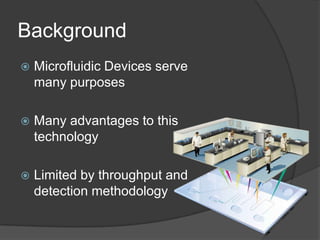
BackgroundMicrofluidic Devices serve many purposesMany advantages to this technologyLimited by throughput and detection methodology
Literature ReviewsHigh-throughput Lens-Free Imaging and Characterization of a Heterogeneous Cell Solution Polymer Lab-on-a-Chip System with Electrical Detection
High-throughput Lens-Free Imaging and Characterization of a Heterogeneous Cell Solution Goal: Replace Flow Cytometry with microfluidic detection deviceBuilt off of previous work (LUCAS)Focus on decision algorithm
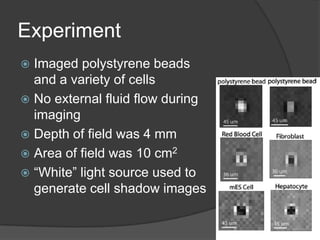
ExperimentImaged polystyrene beads and a variety of cellsNo external fluid flow during imagingDepth of field was 4 mmArea of field was 10 cm2“White” light source used to generate cell shadow images
ResultsAlgorithm is limited by detection of overlapping cells and plane gapsProven detection and separate characterization of three micro particlesMethods developed to characterize undetectable cells
Polymer Lab-on-a-Chip System with Electrical DetectionGoal: Present new materials and methods for Lab-on-a-chip devicesSupports the use of PEEK for fabricationDemonstrates CCD (C4D) detection methodDeveloped “MinCE”
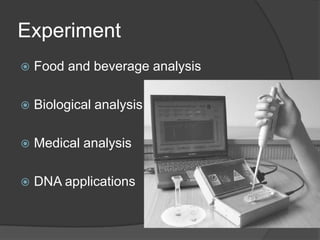
ExperimentFood and beverage analysisBiological analysisMedical analysisDNA applications
ResultsSuccessful in all experiments as a “proof of concept”Demonstrated advantages to using PEEKProven use of CCD for DNA analysis
ConclusionNew material and detection methodsExpanded applications for devicesResearch shows promise for breaking limitations
ReferencesTing-Wei Su, SungkyuSeo, Anthony Erlinger, AydoganOzcan, "High-Throughput Lensfree Imaging and Characterization of a Heterogeneous Cell Solution On a Chip", Biotechnology and Bioengineering 102 (2009) 856-868Holger Muhlberger, Wonhee Hwang, Andreas E. Guber, Volker Saile, Werner Hoffmann, "Polymer Lab-on-a-Chip System with Electrical Detection", IEEE Sensors Journal, 8 (2008) 572-579
Questions?

Minerick Final Presentation April 23rd 2010

  • 1.
    Innovations in theDesign and Detection of Polymer Lab-on-a-chip Microfluidic DevicesPresented By: Aaron Ritthaler
  • 2.
  • 3.
    BackgroundMicrofluidic Devices servemany purposesMany advantages to this technologyLimited by throughput and detection methodology
  • 4.
    Literature ReviewsHigh-throughput Lens-FreeImaging and Characterization of a Heterogeneous Cell Solution Polymer Lab-on-a-Chip System with Electrical Detection
  • 5.
    High-throughput Lens-Free Imagingand Characterization of a Heterogeneous Cell Solution Goal: Replace Flow Cytometry with microfluidic detection deviceBuilt off of previous work (LUCAS)Focus on decision algorithm
  • 6.
    ExperimentImaged polystyrene beadsand a variety of cellsNo external fluid flow during imagingDepth of field was 4 mmArea of field was 10 cm2“White” light source used to generate cell shadow images
  • 7.
    ResultsAlgorithm is limitedby detection of overlapping cells and plane gapsProven detection and separate characterization of three micro particlesMethods developed to characterize undetectable cells
  • 8.
    Polymer Lab-on-a-Chip Systemwith Electrical DetectionGoal: Present new materials and methods for Lab-on-a-chip devicesSupports the use of PEEK for fabricationDemonstrates CCD (C4D) detection methodDeveloped “MinCE”
  • 9.
    ExperimentFood and beverageanalysisBiological analysisMedical analysisDNA applications
  • 10.
    ResultsSuccessful in allexperiments as a “proof of concept”Demonstrated advantages to using PEEKProven use of CCD for DNA analysis
  • 11.
    ConclusionNew material anddetection methodsExpanded applications for devicesResearch shows promise for breaking limitations
  • 12.
    ReferencesTing-Wei Su, SungkyuSeo,Anthony Erlinger, AydoganOzcan, "High-Throughput Lensfree Imaging and Characterization of a Heterogeneous Cell Solution On a Chip", Biotechnology and Bioengineering 102 (2009) 856-868Holger Muhlberger, Wonhee Hwang, Andreas E. Guber, Volker Saile, Werner Hoffmann, "Polymer Lab-on-a-Chip System with Electrical Detection", IEEE Sensors Journal, 8 (2008) 572-579
  • 13.

Editor's Notes

  • #4 Purposes:-Point-of-care Medical Applications-Cell characterization-Disease Detection-Biological SeparationAdvantages:-Cost effective in a large variety of circumstances-Can operate with minimal support (all on-chip)-High surface-area-to-volume ration (catalysis)Limitations:-Field of View problems for detection-Usually require fluorescence-Decision Algorithms could be improved
  • #6 The proposed detection method was faster and cheaper than flow cytometry for characterizing micro particles.LUCAS = Lensless, Ultra-wide Cell Monitoring Array platform based on Shadow Imaging
  • #8 Equation was developed for characterizing overlapping cells, which wasn’t a problem below 50,000 cells/second flow. Plane gaps between cells were required to be 100 micrometer or greater.Proven for both Homogeneous mixtures of different sizes and heterogeneous mixtures.Methods developed include: Surface Chemistry, Dielectric Micro Bead, and Fluorescent particle labeling
  • #9 PEEK = Polyether Ether Ketone. Throughout the paper, they talk about the advantages and disadvantages of using PEEK, including the development of a new bonding process to overcome disadvantages. C4D = Capacitively Coupled Contactless Conductivity Measurements, which uses a signaling and detection electrode.MinCE = Completely Minimized Capillary Electrophoresis Device encompassing entire experimental apparatus in hand-held form.
  • #10 Food and Beverage – Characterized organic acids in wine and saccharides in fruit juices.Biological Analysis – Detection of 13 amino acids in acidic media.Medical Analysis – Detection of Lithium levels in blood, which Li+ is used as a treatment for manic-depressives.DNA Applications – Two separate DNA fragments were detected in electrophoresis gel medium.
  • #12 The use of PEEK, higher through-put designs, complex detection algorithms, and electrical detection methods opens the door for expanded applications. Applications include: DNA detection, Biological Analysis, Point-of-care Medical Analysis, and Food/Beverage Analysis to name a few.The literature shows that researchers are overstepping the limiting factors of microdevices. Expanded through-put and more complex detection methods are developing to create the next generation of microdevices.