Gopika M G
S6 Int MSc Chemistry
Amrita School of Arts and Sciences,
Amritapuri Campus
1. What are fats?
2. Occurrence and Composition of fats
3. Extraction
4. Role of dietary fats in diet
5. Important functions of fats in food
6. Structure of fats
7. Composition of fats
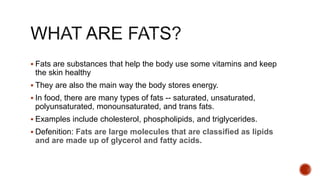
 Fats are substances that help the body use some vitamins and keep
the skin healthy
 They are also the main way the body stores energy.
 In food, there are many types of fats -- saturated, unsaturated,
polyunsaturated, monounsaturated, and trans fats.
 Examples include cholesterol, phospholipids, and triglycerides.
 Defenition: Fats are large molecules that are classified as lipids
and are made up of glycerol and fatty acids.
 Fats are the main constituents of the storage fat cells in animals and
plants.
 They are one of the important food reserves of the organism.
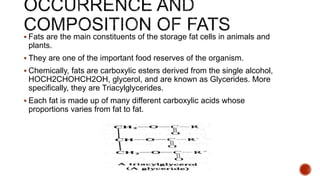
 Chemically, fats are carboxylic esters derived from the single alcohol,
HOCH2CHOHCH2OH, glycerol, and are known as Glycerides. More
specifically, they are Triacylglycerides.
 Each fat is made up of many different carboxylic acids whose
proportions varies from fat to fat.
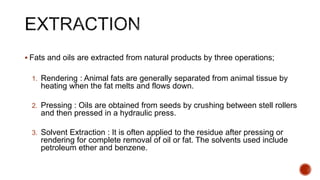
 Fats and oils are extracted from natural products by three operations;
1. Rendering : Animal fats are generally separated from animal tissue by
heating when the fat melts and flows down.
2. Pressing : Oils are obtained from seeds by crushing between stell rollers
and then pressed in a hydraulic press.
3. Solvent Extraction : It is often applied to the residue after pressing or
rendering for complete removal of oil or fat. The solvents used include
petroleum ether and benzene.
 Fats that we get from food are vital to good health.
 They provide energy and essential fatty acids for healthy Skin and
important hormone – like substances.
 They also help to absorb fat soluble vitamins like A,D,E and K
 They are not just calorie powerhouse, but also serve many Chemical,
Physical and Nutritional function in the food we eat.
1. Fats can alter the food’s appearance by creating a glossy or moist
visual texture.
2. They are an important component in most emulsions.
3. They have unique ability to absorb and preserve flavours.
4. Fats provide one of the most efficient modes of heat transfer during
cooking.
5. The type of fat used in a particular product often determines the
melting point of the final product.
6. Fat is an effective method of delivering calories when needed,
especially for delivering fat soluble vitamins like A,D,E,and K.
 Fats are classified as lipids, or a group of compounds which are substances
made up of two or more elements that do not dissolve in water.
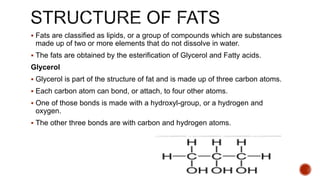
 The fats are obtained by the esterification of Glycerol and Fatty acids.
Glycerol
 Glycerol is part of the structure of fat and is made up of three carbon atoms.
 Each carbon atom can bond, or attach, to four other atoms.
 One of those bonds is made with a hydroxyl-group, or a hydrogen and
oxygen.
 The other three bonds are with carbon and hydrogen atoms.
Fatty Acids
 They are made up of individual components called fatty acids.
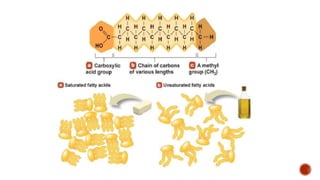
 They are chains made of carbon and hydrogen atoms that have a
carboxyl group at one end and a methyl group at the other.
 Carboxyl groups contain one carbon atom, one hydrogen atoms, and
two oxygen atoms, and methyl groups include one carbon atom and
three hydrogen atoms.
 The carbon atoms in the fatty acid molecules are linked by single or
double bonds.
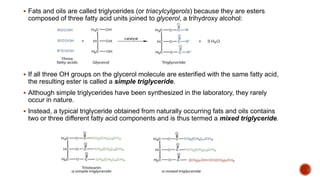
 Fats and oils are called triglycerides (or triacylcylgerols) because they are esters
composed of three fatty acid units joined to glycerol, a trihydroxy alcohol:
 If all three OH groups on the glycerol molecule are esterified with the same fatty acid,
the resulting ester is called a simple triglyceride.
 Although simple triglycerides have been synthesized in the laboratory, they rarely
occur in nature.
 Instead, a typical triglyceride obtained from naturally occurring fats and oils contains
two or three different fatty acid components and is thus termed a mixed triglyceride.
 The main components of edible fats and oils are triglycerides.
 The minor components include mono- and diglycerides, free fatty acids,
phosphatides, sterols, fat-soluble vitamins, tocopherols, pigments,
waxes, and fatty alcohols.
 Animal fats contain smaller amounts of minor components.
Triglyceride
 A triglyceride is called a fat if it is a solid at 25°C;
it is called an oil if it is a liquid at that temperature.
 These differences in melting points reflect differences in the degree of unsaturation
and number of carbon atoms in the constituent fatty acids.
 Triglycerides obtained from animal sources are usually solids, while those of plant
origin are generally oils. Therefore, we commonly speak of animal fats and vegetable
oils.
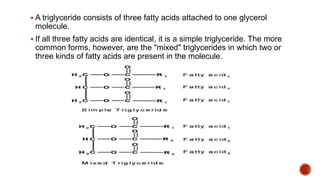
 A triglyceride consists of three fatty acids attached to one glycerol
molecule.
 If all three fatty acids are identical, it is a simple triglyceride. The more
common forms, however, are the "mixed" triglycerides in which two or
three kinds of fatty acids are present in the molecule.
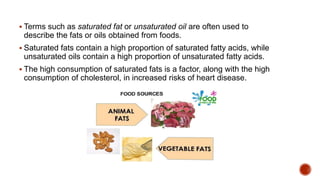
 Terms such as saturated fat or unsaturated oil are often used to
describe the fats or oils obtained from foods.
 Saturated fats contain a high proportion of saturated fatty acids, while
unsaturated oils contain a high proportion of unsaturated fatty acids.
 The high consumption of saturated fats is a factor, along with the high
consumption of cholesterol, in increased risks of heart disease.
1. Mono- and Diglycerides: Mono- and diglycerides are mono- and diesters of
fatty acids and glycerol. They are used frequently in foods as emulsifiers.
2. Free Fatty Acids: As the name suggests, free fatty acids are the unattached
fatty acids present in a fat. Some unrefined oils may contain as much as several
percent free fatty acids.
3. Phosphatides: Phosphatides, also known as phospholipids, consist of an
alcohol (usually glycerol) combined with fatty acids, and a phosphate ester.
4. Sterols: Sterols are found in both animal fats and vegetable oils, but there are
substantial biological differences.
5. Tocopherols and Tocotrienols: Tocopherols and tocotrienols are important
minor constituents of most vegetable fats.
6. Pigments: Carotenoids are yellow to deep red color materials that occur
naturally in fats and oils.
7. Fatty Alcohols: Long chain alcohols are of little importance in most edible
fats.
 Unsactuated fatty acids form two different shapes.
1. Organic Chemistry, Morrison & Boyd.
2. LibreTexts:
https://chem.libretexts.org/Bookshelves/Introductory_Chemistry/Book%3A_The_Ba
sics_of_GOB_Chemistry_(Ball_et_al.)/17%3A_Lipids/17.2%3A_Fats_and_Oils
3. Institute of Shortening and Edible Oils:
http://iseo.org/FFO/page2.html
Fats - Structure and Composition

Fats - Structure and Composition

  • 1.
    Gopika M G S6Int MSc Chemistry Amrita School of Arts and Sciences, Amritapuri Campus
  • 2.
    1. What arefats? 2. Occurrence and Composition of fats 3. Extraction 4. Role of dietary fats in diet 5. Important functions of fats in food 6. Structure of fats 7. Composition of fats
  • 3.
     Fats aresubstances that help the body use some vitamins and keep the skin healthy  They are also the main way the body stores energy.  In food, there are many types of fats -- saturated, unsaturated, polyunsaturated, monounsaturated, and trans fats.  Examples include cholesterol, phospholipids, and triglycerides.  Defenition: Fats are large molecules that are classified as lipids and are made up of glycerol and fatty acids.
  • 5.
     Fats arethe main constituents of the storage fat cells in animals and plants.  They are one of the important food reserves of the organism.  Chemically, fats are carboxylic esters derived from the single alcohol, HOCH2CHOHCH2OH, glycerol, and are known as Glycerides. More specifically, they are Triacylglycerides.  Each fat is made up of many different carboxylic acids whose proportions varies from fat to fat.
  • 6.
     Fats andoils are extracted from natural products by three operations; 1. Rendering : Animal fats are generally separated from animal tissue by heating when the fat melts and flows down. 2. Pressing : Oils are obtained from seeds by crushing between stell rollers and then pressed in a hydraulic press. 3. Solvent Extraction : It is often applied to the residue after pressing or rendering for complete removal of oil or fat. The solvents used include petroleum ether and benzene.
  • 8.
     Fats thatwe get from food are vital to good health.  They provide energy and essential fatty acids for healthy Skin and important hormone – like substances.  They also help to absorb fat soluble vitamins like A,D,E and K  They are not just calorie powerhouse, but also serve many Chemical, Physical and Nutritional function in the food we eat.
  • 9.
    1. Fats canalter the food’s appearance by creating a glossy or moist visual texture. 2. They are an important component in most emulsions. 3. They have unique ability to absorb and preserve flavours. 4. Fats provide one of the most efficient modes of heat transfer during cooking. 5. The type of fat used in a particular product often determines the melting point of the final product. 6. Fat is an effective method of delivering calories when needed, especially for delivering fat soluble vitamins like A,D,E,and K.
  • 10.
     Fats areclassified as lipids, or a group of compounds which are substances made up of two or more elements that do not dissolve in water.  The fats are obtained by the esterification of Glycerol and Fatty acids. Glycerol  Glycerol is part of the structure of fat and is made up of three carbon atoms.  Each carbon atom can bond, or attach, to four other atoms.  One of those bonds is made with a hydroxyl-group, or a hydrogen and oxygen.  The other three bonds are with carbon and hydrogen atoms.
  • 11.
    Fatty Acids  Theyare made up of individual components called fatty acids.  They are chains made of carbon and hydrogen atoms that have a carboxyl group at one end and a methyl group at the other.  Carboxyl groups contain one carbon atom, one hydrogen atoms, and two oxygen atoms, and methyl groups include one carbon atom and three hydrogen atoms.  The carbon atoms in the fatty acid molecules are linked by single or double bonds.
  • 12.
     Fats andoils are called triglycerides (or triacylcylgerols) because they are esters composed of three fatty acid units joined to glycerol, a trihydroxy alcohol:  If all three OH groups on the glycerol molecule are esterified with the same fatty acid, the resulting ester is called a simple triglyceride.  Although simple triglycerides have been synthesized in the laboratory, they rarely occur in nature.  Instead, a typical triglyceride obtained from naturally occurring fats and oils contains two or three different fatty acid components and is thus termed a mixed triglyceride.
  • 13.
     The maincomponents of edible fats and oils are triglycerides.  The minor components include mono- and diglycerides, free fatty acids, phosphatides, sterols, fat-soluble vitamins, tocopherols, pigments, waxes, and fatty alcohols.  Animal fats contain smaller amounts of minor components.
  • 14.
    Triglyceride  A triglycerideis called a fat if it is a solid at 25°C; it is called an oil if it is a liquid at that temperature.  These differences in melting points reflect differences in the degree of unsaturation and number of carbon atoms in the constituent fatty acids.  Triglycerides obtained from animal sources are usually solids, while those of plant origin are generally oils. Therefore, we commonly speak of animal fats and vegetable oils.
  • 15.
     A triglycerideconsists of three fatty acids attached to one glycerol molecule.  If all three fatty acids are identical, it is a simple triglyceride. The more common forms, however, are the "mixed" triglycerides in which two or three kinds of fatty acids are present in the molecule.
  • 16.
     Terms suchas saturated fat or unsaturated oil are often used to describe the fats or oils obtained from foods.  Saturated fats contain a high proportion of saturated fatty acids, while unsaturated oils contain a high proportion of unsaturated fatty acids.  The high consumption of saturated fats is a factor, along with the high consumption of cholesterol, in increased risks of heart disease.
  • 18.
    1. Mono- andDiglycerides: Mono- and diglycerides are mono- and diesters of fatty acids and glycerol. They are used frequently in foods as emulsifiers. 2. Free Fatty Acids: As the name suggests, free fatty acids are the unattached fatty acids present in a fat. Some unrefined oils may contain as much as several percent free fatty acids. 3. Phosphatides: Phosphatides, also known as phospholipids, consist of an alcohol (usually glycerol) combined with fatty acids, and a phosphate ester. 4. Sterols: Sterols are found in both animal fats and vegetable oils, but there are substantial biological differences. 5. Tocopherols and Tocotrienols: Tocopherols and tocotrienols are important minor constituents of most vegetable fats. 6. Pigments: Carotenoids are yellow to deep red color materials that occur naturally in fats and oils. 7. Fatty Alcohols: Long chain alcohols are of little importance in most edible fats.
  • 19.
     Unsactuated fattyacids form two different shapes.
  • 20.
    1. Organic Chemistry,Morrison & Boyd. 2. LibreTexts: https://chem.libretexts.org/Bookshelves/Introductory_Chemistry/Book%3A_The_Ba sics_of_GOB_Chemistry_(Ball_et_al.)/17%3A_Lipids/17.2%3A_Fats_and_Oils 3. Institute of Shortening and Edible Oils: http://iseo.org/FFO/page2.html