The NI Food Strategy Framework aims to be
a cross government unifying framework,
with
• a shared long term vision,
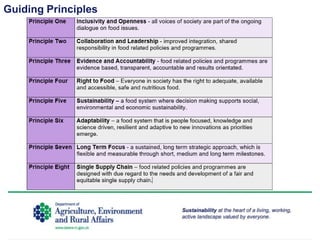
• set of 8 principles and
• 6 priority areas
to guide long term food decision making.
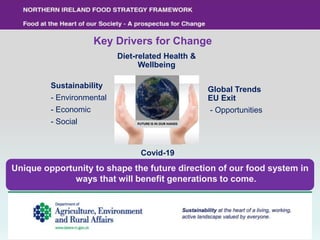
Key Drivers for Change
Diet-related Health &
Wellbeing
Global Trends
EU Exit
- Opportunities
Sustainability
- Environmental
- Economic
- Social
Covid-19
Unique opportunity to shape the future direction of our food system in
ways that will benefit generations to come.
The Journey So Far ……..
Summer 2019 DAERA began to explore with the DfE, and
other NI Departments and interested parties, the merits,
scope and content of a possible Food Strategy
Framework to:
• develop strategic alignment across NI Departments
and help shape a future food system for Northern
Ireland.
• provide a structure within which government, industry,
voluntary and community organisations can operate.
• allow autonomy with guidance on the direction of
travel, but the flexibility to adapt to changing global
trends, policy mandates, and marketplace needs.
Development of a draft Vision by officials from across all government
departments.
Vision
“A transformed food system that protects
natural resources for future generations, is
economically and environmentally
sustainable and provides safe, nourishing,
accessible food to people, who make
informed healthy choices”.
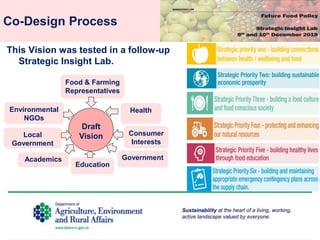
Co-Design Process
Draft
Vision
Environmental
NGOs
Food & Farming
Representatives
Academics
Health
Education
Consumer
Interests
Local
Government
This Vision was tested in a follow-up
Strategic Insight Lab.
Government
OVERVIEW – PHASE ONE – March 2022
• Start of the journey.
• Framework to build future policy decisions around food.
• Food Systems Approach
• Executive approval in principle for the Food Framework approach
• Seeking your views - Is this the right approach?
• Consultation period – closes on 19 November 2021
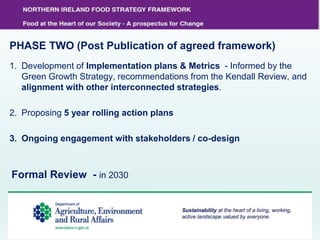
PHASE TWO (Post Publication of agreed framework)
1. Development of Implementation plans & Metrics - Informed by the
Green Growth Strategy, recommendations from the Kendall Review, and
alignment with other interconnected strategies.
2. Proposing 5 year rolling action plans
3. Ongoing engagement with stakeholders / co-design
Formal Review - in 2030
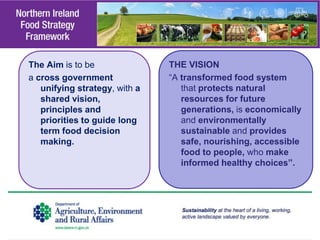
The Aim is to be
a cross government
unifying strategy, with a
shared vision,
principles and
priorities to guide long
term food decision
making.
THE VISION
“A transformed food system
that protects natural
resources for future
generations, is economically
and environmentally
sustainable and provides
safe, nourishing, accessible
food to people, who make
informed healthy choices”.
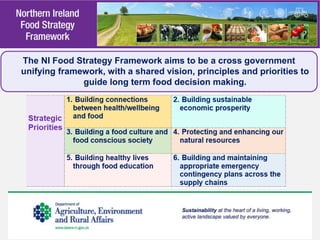
The NI Food Strategy Framework aims to be a cross government
unifying framework, with a shared vision, principles and priorities to
guide long term food decision making.
Guiding Principles
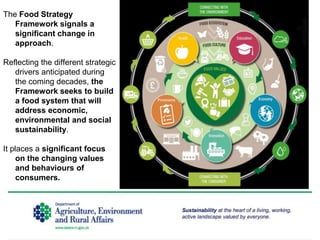
The Food Strategy
Framework signals a
significant change in
approach.
Reflecting the different strategic
drivers anticipated during
the coming decades, the
Framework seeks to build
a food system that will
address economic,
environmental and social
sustainability.
It places a significant focus
on the changing values
and behaviours of
consumers.
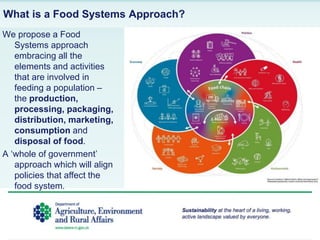
What is a Food Systems Approach?
We propose a Food
Systems approach
embracing all the
elements and activities
that are involved in
feeding a population –
the production,
processing, packaging,
distribution, marketing,
consumption and
disposal of food.
A ‘whole of government’
approach which will align
policies that affect the
food system.
This new approach on food is part of wider policy development
agenda underway on strategic issues such as Circular Economy,
Climate, Environment, Farming, Health, Education, Skills &
Science.
Food cuts across the policy responsibilities of a number of NI
Ministers, Agriculture, Environment and Rural Affairs, Economy,
Communities, Health, Education, Finance and Justice.
Although led by DAERA, the proposed Food Strategy Framework has
been developed in collaboration with the other NI Departments,
the Food Standards Agency NI, Invest NI, and key stakeholders.
It will ensure coherence across food policies that affect all our lives
and help to improve economic, environmental, health and social
outcomes for Northern Ireland.
LINKS WITH OTHER STRATEGIES
DAERA, on behalf of the NI Executive, are
developing a Green Growth Strategy and
associated Climate Action Plan which will be the
initial route map to climate action, green jobs and
a clean environment.
The Executive has agreed in principle to the cross-
departmental approach under Green Growth.
Within DAERA, a ‘sister’ strategy on agriculture is dealing with
• increased productivity,
• environmental sustainability,
• improved resilience, and
• supply chain integration.
The new agriculture strategy will be closely linked to the Food Framework
through the supply chain pillar.
Northern Ireland Food Strategy Framework - Strategic
Priorities
The proposed Framework highlights six strategic priorities to achieve the
Vision.
• Five were identified from the work with NI Departments and key external
stakeholders.
• A sixth was added to take account of experience of the COVID-19
pandemic.
These six priorities will provide a focus and direction to NI Departments for
future policy interventions on food.
Strategic priority one will build on the connections between
health, wellbeing and food, with a focus on making healthy,
nutritious and sustainable food the ‘food of choice’, and
• ensuring food is produced to the highest quality, safety
and ethical standards.
• enhance collaboration around policy agendas such as
obesity, nutritional standards, food poverty, and the
principles of One Health (which recognises that the health
of humans, animals and ecosystems are interconnected).
What would success look like?
A society where everyone has access to safe and nutritious food,
where food insecurity and dietary related diseases are in decline,
resulting in improved societal health and wellbeing.
Key
Partners
Department
of Health,
Department
of
Communities,
Department
of Justice,
DAERA,
Food
Standards
Agency
Strategic priority two will build on the connections between the
economy, environment and food, with a focus on innovation.
• It will enhance collaboration around policy agendas such as circular
economy and economic development, innovation, skills and
education, rural communities, and tourism.
What would success look like?
• A sustainable food system which is populated by successful,
adaptable businesses with increased levels of productivity,
circularity and innovation, which are competitive and able to
maximise opportunities both in NI and on the global stage.
• The NI agri-food sector is a major source of economic prosperity
recognised for its quality, safety and knowledge driven
approach, and for fairness and transparency in the supply
chain.
Key
Partners
Department
for
Economy,
DAERA,
DoJ,
Invest NI,
Tourism NI,
Food
Standards
Agency,
Local
Councils
Strategic priority three will build on the connections between the
economy, environment, and food, with a focus on creating a
healthy food culture, reconnecting people with knowledge of
where their food comes from, building a food citizenship
movement and promoting our quality produce.
• It will enhance collaboration around policy agendas such as
economic prosperity, environment, rural communities, and
tourism.
What would success look like?
Northern Ireland will have a culture of civic pride as the home of
good food, where the social value of food is nurtured and
celebrated. The food sector will be more resilient as a result of
increased local, national and international demand encouraged by
co-ordinated NI agri-food market awareness and promotion.
Key
Partners
Department
for Economy,
Department
of
Communities,
DAERA,
Tourism NI,
Invest NI,
Food
Standards
Agency,
Local
Councils.
Strategic priority four will build on the connections between
agricultural primary production, environment, and food,
enhancing collaboration around policy agendas such as future
agriculture support, environment, biodiversity and land use,
reduction in food waste, carbon reduction and Green Growth.
What would success look like?
Northern Ireland will become a low carbon society where natural
resources deployed in food production are responsibly
managed and associated environmental costs/benefits are
appropriately valued and reflected across the food supply
chain. There will be a strong emphasis on circular economy,
nature friendly farming practices, and opportunities to create
profitable and shorter supply chains, minimise food waste,
and redistribute surplus where possible.
Key
Partners
Department
for
Economy,
DAERA,
Invest NI.
Strategic priority five will build on the connections between health,
education, farming, environment, and food. It will enhance
collaboration around policy agendas such as food in
schools, obesity, healthy eating, and nutritional standards.
What will success look like?
• School food education will create a strong foundation for a
healthy lifelong relationship with food, encouraging and
supporting children to eat well, understand where and how
their food is produced and processed, and how food choices
impact on their health and the environment.
• In addition, this priority focuses on education throughout life
to also improve adult education in healthy foods and
nutrition.
Key
Partners
Department
of
Education,
Department
of Health,
Education
Authority,
DAERA,
Food
Standards
Agency.
Strategic priority six will build on the connections between food
supply security, food poverty, safety and integrity of food
and protection of the food system economy.
What will success look like?
The Northern Ireland food system (industry, Government, voluntary
and community sectors) will proactively manage risk along the
entire food chain. It will include accessibility to food by people
who live here, the safety and integrity of food, and protection of
the food system economy.
This priority will aim to ensure that emergency contingency plans
will be ready to operate in any future crisis to ensure a
continued supply of safe food for all the people of Northern
Ireland.
Key
partners
Department
of
Communities,
Department
of Health,
Food
Standards
Agency,
DAERA,
Department
for Economy,
Invest NI
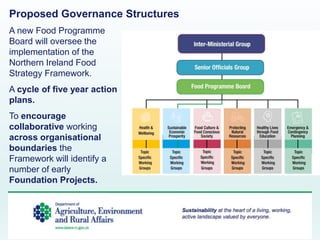
Proposed Governance Structures
A new Food Programme
Board will oversee the
implementation of the
Northern Ireland Food
Strategy Framework.
A cycle of five year action
plans.
To encourage
collaborative working
across organisational
boundaries the
Framework will identify a
number of early
Foundation Projects.
Pilot Implementation Projects
Foundation Project - a cross departmental task force will
investigate the opportunity to increase the amount of
food sourced locally by government
Another potential early Project will explore how to
encourage children in schools to eat more fruit and
vegetables, including seasonal local produce. This
Project will seek to promote health, socio-economic,
environmental and education objectives. It will aim to
help to connect children with where their food comes
from and encourage them to make healthy eating
choices.
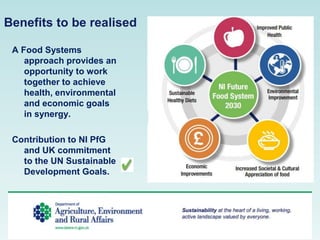
Benefits to be realised
A Food Systems
approach provides an
opportunity to work
together to achieve
health, environmental
and economic goals
in synergy.
Contribution to NI PfG
and UK commitment
to the UN Sustainable
Development Goals.
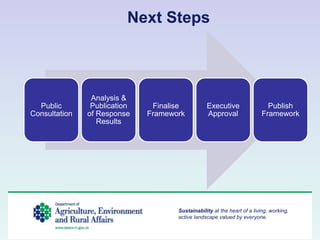
Next Steps
Sustainability at the heart of a living, working,
active landscape valued by everyone.
Public
Consultation
Analysis &
Publication
of Response
Results
Finalise
Framework
Executive
Approval
Publish
Framework

Food Strategy Framework Presentation - Information Sessions.PPTX

  • 2.
    The NI FoodStrategy Framework aims to be a cross government unifying framework, with • a shared long term vision, • set of 8 principles and • 6 priority areas to guide long term food decision making.
  • 3.
    Key Drivers forChange Diet-related Health & Wellbeing Global Trends EU Exit - Opportunities Sustainability - Environmental - Economic - Social Covid-19 Unique opportunity to shape the future direction of our food system in ways that will benefit generations to come.
  • 4.
    The Journey SoFar …….. Summer 2019 DAERA began to explore with the DfE, and other NI Departments and interested parties, the merits, scope and content of a possible Food Strategy Framework to: • develop strategic alignment across NI Departments and help shape a future food system for Northern Ireland. • provide a structure within which government, industry, voluntary and community organisations can operate. • allow autonomy with guidance on the direction of travel, but the flexibility to adapt to changing global trends, policy mandates, and marketplace needs. Development of a draft Vision by officials from across all government departments.
  • 5.
    Vision “A transformed foodsystem that protects natural resources for future generations, is economically and environmentally sustainable and provides safe, nourishing, accessible food to people, who make informed healthy choices”.
  • 6.
    Co-Design Process Draft Vision Environmental NGOs Food &Farming Representatives Academics Health Education Consumer Interests Local Government This Vision was tested in a follow-up Strategic Insight Lab. Government
  • 7.
    OVERVIEW – PHASEONE – March 2022 • Start of the journey. • Framework to build future policy decisions around food. • Food Systems Approach • Executive approval in principle for the Food Framework approach • Seeking your views - Is this the right approach? • Consultation period – closes on 19 November 2021
  • 8.
    PHASE TWO (PostPublication of agreed framework) 1. Development of Implementation plans & Metrics - Informed by the Green Growth Strategy, recommendations from the Kendall Review, and alignment with other interconnected strategies. 2. Proposing 5 year rolling action plans 3. Ongoing engagement with stakeholders / co-design Formal Review - in 2030
  • 9.
    The Aim isto be a cross government unifying strategy, with a shared vision, principles and priorities to guide long term food decision making. THE VISION “A transformed food system that protects natural resources for future generations, is economically and environmentally sustainable and provides safe, nourishing, accessible food to people, who make informed healthy choices”.
  • 10.
    The NI FoodStrategy Framework aims to be a cross government unifying framework, with a shared vision, principles and priorities to guide long term food decision making.
  • 11.
  • 12.
    The Food Strategy Frameworksignals a significant change in approach. Reflecting the different strategic drivers anticipated during the coming decades, the Framework seeks to build a food system that will address economic, environmental and social sustainability. It places a significant focus on the changing values and behaviours of consumers.
  • 13.
    What is aFood Systems Approach? We propose a Food Systems approach embracing all the elements and activities that are involved in feeding a population – the production, processing, packaging, distribution, marketing, consumption and disposal of food. A ‘whole of government’ approach which will align policies that affect the food system.
  • 14.
    This new approachon food is part of wider policy development agenda underway on strategic issues such as Circular Economy, Climate, Environment, Farming, Health, Education, Skills & Science. Food cuts across the policy responsibilities of a number of NI Ministers, Agriculture, Environment and Rural Affairs, Economy, Communities, Health, Education, Finance and Justice. Although led by DAERA, the proposed Food Strategy Framework has been developed in collaboration with the other NI Departments, the Food Standards Agency NI, Invest NI, and key stakeholders. It will ensure coherence across food policies that affect all our lives and help to improve economic, environmental, health and social outcomes for Northern Ireland.
  • 15.
    LINKS WITH OTHERSTRATEGIES DAERA, on behalf of the NI Executive, are developing a Green Growth Strategy and associated Climate Action Plan which will be the initial route map to climate action, green jobs and a clean environment. The Executive has agreed in principle to the cross- departmental approach under Green Growth. Within DAERA, a ‘sister’ strategy on agriculture is dealing with • increased productivity, • environmental sustainability, • improved resilience, and • supply chain integration. The new agriculture strategy will be closely linked to the Food Framework through the supply chain pillar.
  • 16.
    Northern Ireland FoodStrategy Framework - Strategic Priorities The proposed Framework highlights six strategic priorities to achieve the Vision. • Five were identified from the work with NI Departments and key external stakeholders. • A sixth was added to take account of experience of the COVID-19 pandemic. These six priorities will provide a focus and direction to NI Departments for future policy interventions on food.
  • 17.
    Strategic priority onewill build on the connections between health, wellbeing and food, with a focus on making healthy, nutritious and sustainable food the ‘food of choice’, and • ensuring food is produced to the highest quality, safety and ethical standards. • enhance collaboration around policy agendas such as obesity, nutritional standards, food poverty, and the principles of One Health (which recognises that the health of humans, animals and ecosystems are interconnected). What would success look like? A society where everyone has access to safe and nutritious food, where food insecurity and dietary related diseases are in decline, resulting in improved societal health and wellbeing. Key Partners Department of Health, Department of Communities, Department of Justice, DAERA, Food Standards Agency
  • 18.
    Strategic priority twowill build on the connections between the economy, environment and food, with a focus on innovation. • It will enhance collaboration around policy agendas such as circular economy and economic development, innovation, skills and education, rural communities, and tourism. What would success look like? • A sustainable food system which is populated by successful, adaptable businesses with increased levels of productivity, circularity and innovation, which are competitive and able to maximise opportunities both in NI and on the global stage. • The NI agri-food sector is a major source of economic prosperity recognised for its quality, safety and knowledge driven approach, and for fairness and transparency in the supply chain. Key Partners Department for Economy, DAERA, DoJ, Invest NI, Tourism NI, Food Standards Agency, Local Councils
  • 19.
    Strategic priority threewill build on the connections between the economy, environment, and food, with a focus on creating a healthy food culture, reconnecting people with knowledge of where their food comes from, building a food citizenship movement and promoting our quality produce. • It will enhance collaboration around policy agendas such as economic prosperity, environment, rural communities, and tourism. What would success look like? Northern Ireland will have a culture of civic pride as the home of good food, where the social value of food is nurtured and celebrated. The food sector will be more resilient as a result of increased local, national and international demand encouraged by co-ordinated NI agri-food market awareness and promotion. Key Partners Department for Economy, Department of Communities, DAERA, Tourism NI, Invest NI, Food Standards Agency, Local Councils.
  • 20.
    Strategic priority fourwill build on the connections between agricultural primary production, environment, and food, enhancing collaboration around policy agendas such as future agriculture support, environment, biodiversity and land use, reduction in food waste, carbon reduction and Green Growth. What would success look like? Northern Ireland will become a low carbon society where natural resources deployed in food production are responsibly managed and associated environmental costs/benefits are appropriately valued and reflected across the food supply chain. There will be a strong emphasis on circular economy, nature friendly farming practices, and opportunities to create profitable and shorter supply chains, minimise food waste, and redistribute surplus where possible. Key Partners Department for Economy, DAERA, Invest NI.
  • 21.
    Strategic priority fivewill build on the connections between health, education, farming, environment, and food. It will enhance collaboration around policy agendas such as food in schools, obesity, healthy eating, and nutritional standards. What will success look like? • School food education will create a strong foundation for a healthy lifelong relationship with food, encouraging and supporting children to eat well, understand where and how their food is produced and processed, and how food choices impact on their health and the environment. • In addition, this priority focuses on education throughout life to also improve adult education in healthy foods and nutrition. Key Partners Department of Education, Department of Health, Education Authority, DAERA, Food Standards Agency.
  • 22.
    Strategic priority sixwill build on the connections between food supply security, food poverty, safety and integrity of food and protection of the food system economy. What will success look like? The Northern Ireland food system (industry, Government, voluntary and community sectors) will proactively manage risk along the entire food chain. It will include accessibility to food by people who live here, the safety and integrity of food, and protection of the food system economy. This priority will aim to ensure that emergency contingency plans will be ready to operate in any future crisis to ensure a continued supply of safe food for all the people of Northern Ireland. Key partners Department of Communities, Department of Health, Food Standards Agency, DAERA, Department for Economy, Invest NI
  • 23.
    Proposed Governance Structures Anew Food Programme Board will oversee the implementation of the Northern Ireland Food Strategy Framework. A cycle of five year action plans. To encourage collaborative working across organisational boundaries the Framework will identify a number of early Foundation Projects.
  • 24.
    Pilot Implementation Projects FoundationProject - a cross departmental task force will investigate the opportunity to increase the amount of food sourced locally by government Another potential early Project will explore how to encourage children in schools to eat more fruit and vegetables, including seasonal local produce. This Project will seek to promote health, socio-economic, environmental and education objectives. It will aim to help to connect children with where their food comes from and encourage them to make healthy eating choices.
  • 25.
    Benefits to berealised A Food Systems approach provides an opportunity to work together to achieve health, environmental and economic goals in synergy. Contribution to NI PfG and UK commitment to the UN Sustainable Development Goals.
  • 26.
    Next Steps Sustainability atthe heart of a living, working, active landscape valued by everyone. Public Consultation Analysis & Publication of Response Results Finalise Framework Executive Approval Publish Framework

Editor's Notes

  • #18 Could you put something about One Health? Wonder should we focus on the aspiration piece in the consultation document – “Strategic priority one will build on the connections between health, wellbeing and food, with a focus on making healthy, nutritious and sustainable food the ‘food of choice’, and ensuring food is produced to the highest quality, safety and ethical standards. It will enhance collaboration around policy agendas such as obesity, nutritional standards, food poverty, and the principles of One Health (which recognises that the health of humans, animals and ecosystems are interconnected).
  • #19 Again maybe the aspiration - Northern Ireland will have a sustainable food system which is populated by successful, adaptable businesses with increased levels of productivity, circularity and innovation, which are competitive and able to maximise opportunities both in the NI marketplace and on the global stage. The NI agri-food sector is a major source of economic prosperity recognised for its quality, safety and knowledge driven approach, and for fairness and transparency in the supply chain.
  • #20 Northern Ireland will have a culture of civic pride as the home of good food, where the social value of food is nurtured and celebrated. The food sector will be more resilient as a result of increased local, national and international demand encouraged by co-ordinated NI agri-food market awareness and promotion.
  • #21 Northern Ireland will become a low carbon society where natural resources deployed in food production are responsibly managed and associated environmental costs/benefits are appropriately valued and reflected across the food supply chain. There will be a strong emphasis on circular economy, nature friendly farming practices, and opportunities to create profitable and shorter supply chains, minimise food waste, and redistribute surplus where possible.
  • #22 School food education will create a strong foundation for a healthy lifelong relationship with food, encouraging and supporting children to eat well, understand where and how their food is produced and processed, and how food choices impact on their health and the environment. In addition, this priority focuses on education throughout life to also improve adult education in healthy foods and nutrition. There are particular links to strategic priorities one and three.
  • #23 This priority will aim to ensure that emergency contingency plans will be ready to operate in any future crisis to ensure a continued supply of safe food for all the people of Northern Ireland. There is a significant role for industry to maintain robust contingency plans to deal with disruptions to food supplies. Government has a role in co-ordinating the response to crises affecting food systems. It will encourage partnerships with industry and the voluntary and community sector to mitigate risks to consumers. The lessons learnt from previous pandemics/ disease outbreaks will inform the plans for dealing with future emergencies.