DEVICETECHNOLOGY
Ms.T.K.Anusuya
Assistant Professor
Department of Computer Science
Bon Secours College forWomen,Thanjavur
DeviceTechnology
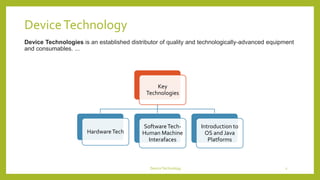
Device Technologies is an established distributor of quality and technologically-advanced equipment
and consumables. ...
DeviceTechnology 2
Key
Technologies
HardwareTech
SoftwareTech-
Human Machine
Interafaces
Introduction to
OS and Java
Platforms
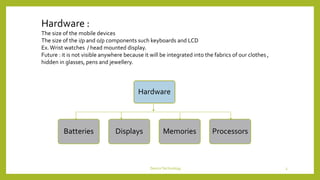
Hardware :
The size of the mobile devices
The size of the i/p and o/p components such keyboards and LCD
Ex.Wrist watches / head mounted display.
Future : it is not visible anywhere because it will be integrated into the fabrics of our clothes ,
hidden in glasses, pens and jewellery.
Hardware
Batteries Displays Memories Processors
DeviceTechnology 3
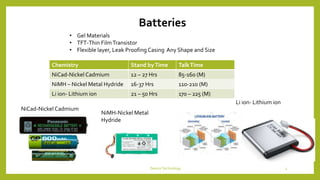
Chemistry Stand byTime TalkTime
NiCad-Nickel Cadmium 12 – 27 Hrs 85-160 (M)
NiMH – Nickel Metal Hydride 16-37 Hrs 110-210 (M)
Li ion- Lithium ion 21 – 50 Hrs 170 – 225 (M)
Batteries
• Gel Materials
• TFT-Thin FilmTransistor
• Flexible layer, Leak Proofing Casing Any Shape and Size
NiMH-Nickel Metal
Hydride
NiCad-Nickel Cadmium
Li ion- Lithium ion
DeviceTechnology 4
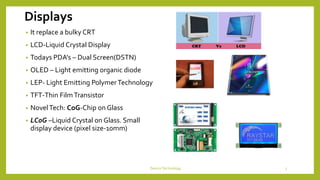
Displays
• It replace a bulky CRT
• LCD-Liquid Crystal Display
• Todays PDA’s – Dual Screen(DSTN)
• OLED – Light emitting organic diode
• LEP- Light Emitting PolymerTechnology
• TFT-Thin FilmTransistor
• NovelTech: CoG-Chip on Glass
• LCoG –Liquid Crystal on Glass. Small
display device (pixel size-10mm)
DeviceTechnology 5
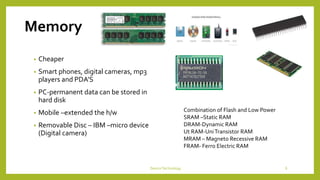
Memory
• Cheaper
• Smart phones, digital cameras, mp3
players and PDA’S
• PC-permanent data can be stored in
hard disk
• Mobile –extended the h/w
• Removable Disc – IBM –micro device
(Digital camera)
DeviceTechnology 6
Combination of Flash and Low Power
SRAM –Static RAM
DRAM-Dynamic RAM
Ut RAM-UniTransistor RAM
MRAM – Magneto Recessive RAM
FRAM- Ferro Electric RAM
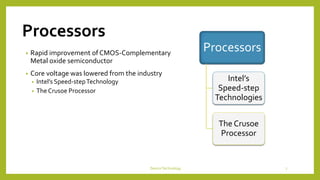
Processors
• Rapid improvement of CMOS-Complementary
Metal oxide semiconductor
• Core voltage was lowered from the industry
• Intel’s Speed-stepTechnology
• The Crusoe Processor
DeviceTechnology 7
Processors
Intel’s
Speed-step
Technologies
The Crusoe
Processor
Processors
• Intel’s Speed StepTechnology
• Power Management
• Internal Clk frequencies and core voltage
changes in power supply.
• Newer Design – Switching point(on/off)
• Power Saving
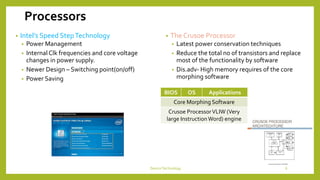
• The Crusoe Processor
• Latest power conservation techniques
• Reduce the total no of transistors and replace
most of the functionality by software
• Dis.adv- High memory requires of the core
morphing software
DeviceTechnology 8
BIOS OS Applications
Core Morphing Software
Crusoe ProcessorVLIW (Very
large InstructionWord) engine
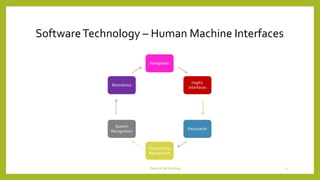
SoftwareTechnology – Human Machine Interfaces
Navigation
Haptic
interfaces
Keyboards
Handwriting
Recognition
Speech
Recognition
Biometrics
DeviceTechnology 9
Human Machine Interfaces
DeviceTechnology 10
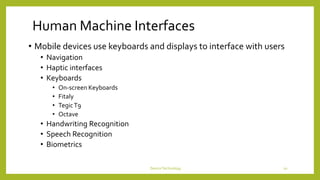
• Mobile devices use keyboards and displays to interface with users
• Navigation
• Haptic interfaces
• Keyboards
• On-screen Keyboards
• Fitaly
• TegicT9
• Octave
• Handwriting Recognition
• Speech Recognition
• Biometrics
Navigation
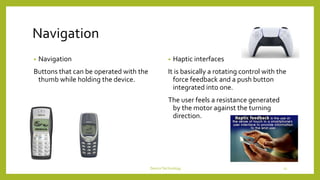
• Navigation
Buttons that can be operated with the
thumb while holding the device.
• Haptic interfaces
It is basically a rotating control with the
force feedback and a push button
integrated into one.
The user feels a resistance generated
by the motor against the turning
direction.
DeviceTechnology 11
Keyboards (input technologies)
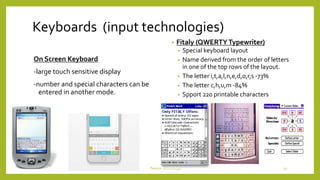
On Screen Keyboard
-large touch sensitive display
-number and special characters can be
entered in another mode.
• Fitaly (QWERTYTypewriter)
• Special keyboard layout
• Name derived from the order of letters
in one of the top rows of the layout.
• The letter i,t,a,l,n,e,d,o,r,s -73%
• The letter c,h,u,m -84%
• Spport 220 printable characters
DeviceTechnology 12
Keyboards
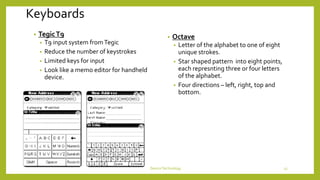
• TegicT9
• T9 input system fromTegic
• Reduce the number of keystrokes
• Limited keys for input
• Look like a memo editor for handheld
device.
• Octave
• Letter of the alphabet to one of eight
unique strokes.
• Star shaped pattern into eight points,
each represnting three or four letters
of the alphabet.
• Four directions – left, right, top and
bottom.
DeviceTechnology 13
Handwriting Recognition
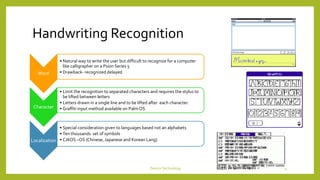
Word
• Natural way to write the user but difficult to recognize for a computer
like calligrapher on a Psion Series 5
• Drawback- recognized delayed
Character
• Limit the recognition to separated characters and requires the stylus to
be lifted between letters
• Letters drawn in a single line and to be lifted after each character.
• Graffiti input method available on Palm OS
Localization
• Special consideration given to languages based not an alphabets
• Ten thousands set of symbols
• CJKOS –OS (Chinese, Japanese and Korean Lang)
DeviceTechnology 14
Speech Recognition
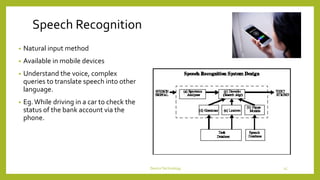
• Natural input method
• Available in mobile devices
• Understand the voice, complex
queries to translate speech into other
language.
• Eg.While driving in a car to check the
status of the bank account via the
phone.
DeviceTechnology 15
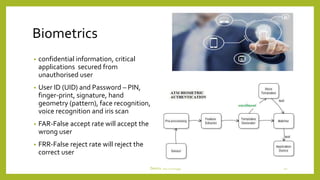
Biometrics
• confidential information, critical
applications secured from
unauthorised user
• User ID (UID) and Password – PIN,
finger-print, signature, hand
geometry (pattern), face recognition,
voice recognition and iris scan
• FAR-False accept rate will accept the
wrong user
• FRR-False reject rate will reject the
correct user
DeviceTechnology 16
Operating Systems
• The major differences of OS for pervasive computing from the user’s point of view
are human machine interface and the speed with which a task can be performed.
• Deploy various chips- ARM,MIPS, Motorola, SH3/4,Transmeta and multiple OS –
Palm OS, EPOC andWindows CE
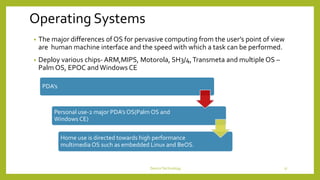
DeviceTechnology 17
PDA’s
Personal use-2 major PDA’s OS(Palm OS and
Windows CE)
Home use is directed towards high performance
multimedia OS such as embedded Linux and BeOS.
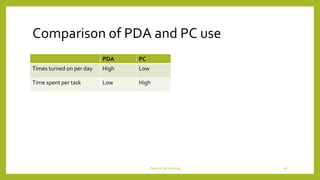
Comparison of PDA and PC use
PDA PC
Times turned on per day High Low
Time spent per task Low High
DeviceTechnology 18
Operating System
• Palm OS
• Designed specially for PDA’s –
Handspring, Sony, IBM and others.
• Limited features – lower memory and
longer battery life.
• Implemented on 16bit motorola
DragonballCPU
• support -256 color
• Palm OS features:
• User management-single user OS
• Task Management – single application
can run at a time and also ability to use
multitasking.
• Power management – different
modes(Sleep, running ) to save power
• OS Size – 1.4 MB
• User interface – Built in date
• Memory Management-OS small and fast
. 1. Dynamic heap 2. Storage
DeviceTechnology 19
Operating System
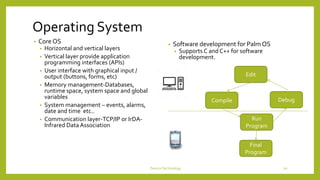
• Core OS
• Horizontal and vertical layers
• Vertical layer provide application
programming interfaces (APIs)
• User interface with graphical input /
output (buttons, forms, etc)
• Memory management-Databases,
runtime space, system space and global
variables
• System management – events, alarms,
date and time etc..
• Communication layer-TCP/IP or IrDA-
Infrared Data Association
• Software development for Palm OS
• Supports C and C++ for software
development.
DeviceTechnology 20
Edit
DebugCompile
Run
Program
Final
Program
EPOC
• Originally created by Psion,
Motorola, Panasonic, Ericsson and
Nokia in 1998
• Specially designed for phones (16 bit
and 32 bit)
• Supports Unicode and display 256
colours
DeviceTechnology 21
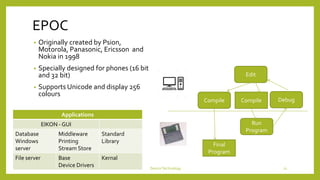
Applications
EIKON - GUI
Database
Windows
server
Middleware
Printing
Stream Store
Standard
Library
File server Base
Device Drivers
Kernal
Edit
DebugCompile
Run
Program
Final
Program
Edit
Compile
Windows CE (Embedded Compact)
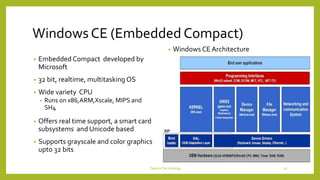
• Embedded Compact developed by
Microsoft
• 32 bit, realtime, multitasking OS
• Wide variety CPU
• Runs on x86,ARM,Xscale, MIPS and
SH4
• Offers real time support, a smart card
subsystems and Unicode based
• Supports grayscale and color graphics
upto 32 bits
• Windows CE Architecture
DeviceTechnology 22
QNX Neutrino
DeviceTechnology 23
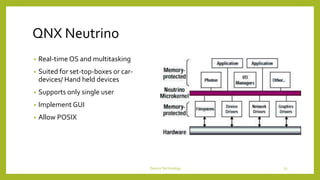
• Real-time OS and multitasking
• Suited for set-top-boxes or car-
devices/ Hand held devices
• Supports only single user
• Implement GUI
• Allow POSIX
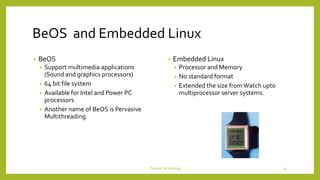
BeOS and Embedded Linux
• BeOS
• Support multimedia applications
(Sound and graphics processors)
• 64 bit file system
• Available for Intel and Power PC
processors
• Another name of BeOS is Pervasive
Multithreading.
• Embedded Linux
• Processor and Memory
• No standard format
• Extended the size fromWatch upto
multiprocessor server systems.
DeviceTechnology 24
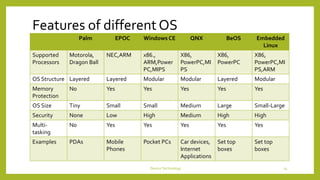
Features of different OS
Palm EPOC Windows CE QNX BeOS Embedded
Linux
Supported
Processors
Motorola,
Dragon Ball
NEC,ARM x86.,
ARM,Power
PC,MIPS
X86,
PowerPC,MI
PS
X86,
PowerPC
X86,
PowerPC,MI
PS,ARM
OS Structure Layered Layered Modular Modular Layered Modular
Memory
Protection
No Yes Yes Yes Yes Yes
OS Size Tiny Small Small Medium Large Small-Large
Security None Low High Medium High High
Multi-
tasking
No Yes Yes Yes Yes Yes
Examples PDAs Mobile
Phones
Pocket PCs Car devices,
Internet
Applications
Set top
boxes
Set top
boxes
DeviceTechnology 25
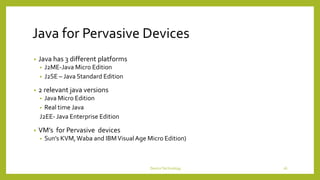
Java for Pervasive Devices
• Java has 3 different platforms
• J2ME-Java Micro Edition
• J2SE – Java Standard Edition
• 2 relevant java versions
• Java Micro Edition
• Real time Java
J2EE- Java Enterprise Edition
• VM’s for Pervasive devices
• Sun’s KVM,Waba and IBMVisualAge Micro Edition)
DeviceTechnology 26
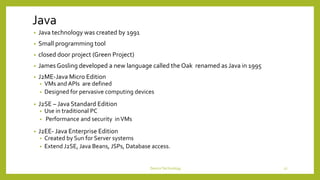
Java
• Java technology was created by 1991
• Small programming tool
• closed door project (Green Project)
• James Gosling developed a new language called the Oak renamed as Java in 1995
• J2ME-Java Micro Edition
• VMs and APIs are defined
• Designed for pervasive computing devices
• J2SE – Java Standard Edition
• Use in traditional PC
• Performance and security inVMs
• J2EE- Java Enterprise Edition
• Created by Sun for Server systems
• Extend J2SE, Java Beans, JSPs, Database access.
DeviceTechnology 27
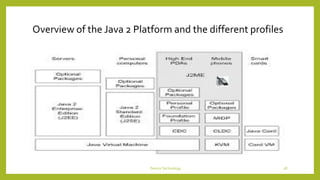
Overview of the Java 2 Platform and the different profiles
DeviceTechnology 28
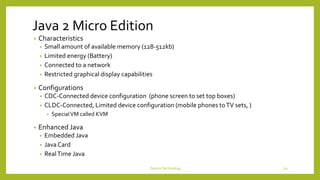
Java 2 Micro Edition
• Characteristics
• Small amount of available memory (128-512kb)
• Limited energy (Battery)
• Connected to a network
• Restricted graphical display capabilities
• Configurations
• CDC-Connected device configuration (phone screen to set top boxes)
• CLDC-Connected, Limited device configuration (mobile phones toTV sets, )
• SpecialVM called KVM
• Enhanced Java
• Embedded Java
• JavaCard
• RealTime Java
DeviceTechnology 29
Real-time Java and its features
• It is not suitable for real-time applications
• JCP-Java Community Process
• RTSJ- Real-time specification for Java
• Features
• Predictable execution speed
• Customizable schedulers
• Advanced memory management
• Access to physical memory
• Object and thread synchronization
• Asynchronous event handling
DeviceTechnology 30
JavaVirtual Machines for pervasive devices
• Sun’s KVM implements the J2ME standard
• Use device library
• IDE for Java on Pervasive devices includesVM the IBMVisual Age Micro Edition
• Sun KVM
• 512 KB memory and the JavaCardVM
• 32-64 KB memory
DeviceTechnology 31
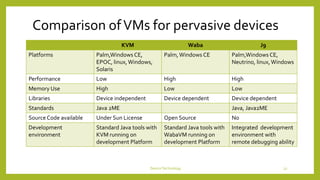
Comparison ofVMs for pervasive devices
KVM Waba J9
Platforms Palm,Windows CE,
EPOC, linux,Windows,
Solaris
Palm,Windows CE Palm,Windows CE,
Neutrino, linux,Windows
Performance Low High High
Memory Use High Low Low
Libraries Device independent Device dependent Device dependent
Standards Java 2ME Java, Java2ME
Source Code available Under Sun License Open Source No
Development
environment
Standard Java tools with
KVM running on
development Platform
Standard Java tools with
WabaVM running on
development Platform
Integrated development
environment with
remote debugging ability
DeviceTechnology 32
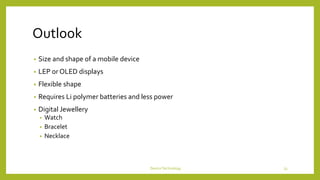
Outlook
• Size and shape of a mobile device
• LEP or OLED displays
• Flexible shape
• Requires Li polymer batteries and less power
• Digital Jewellery
• Watch
• Bracelet
• Necklace
DeviceTechnology 33
Summary
• KeyTechnologies
• Hardware
• Software(Human Machine interfaces
• Bio-metrices
• Operating Systems
• Java for pervasive device
• Outlook
DeviceTechnology 34
DeviceTechnology 35

Chap3 Device Technology

  • 1.
    DEVICETECHNOLOGY Ms.T.K.Anusuya Assistant Professor Department ofComputer Science Bon Secours College forWomen,Thanjavur
  • 2.
    DeviceTechnology Device Technologies isan established distributor of quality and technologically-advanced equipment and consumables. ... DeviceTechnology 2 Key Technologies HardwareTech SoftwareTech- Human Machine Interafaces Introduction to OS and Java Platforms
  • 3.
    Hardware : The sizeof the mobile devices The size of the i/p and o/p components such keyboards and LCD Ex.Wrist watches / head mounted display. Future : it is not visible anywhere because it will be integrated into the fabrics of our clothes , hidden in glasses, pens and jewellery. Hardware Batteries Displays Memories Processors DeviceTechnology 3
  • 4.
    Chemistry Stand byTimeTalkTime NiCad-Nickel Cadmium 12 – 27 Hrs 85-160 (M) NiMH – Nickel Metal Hydride 16-37 Hrs 110-210 (M) Li ion- Lithium ion 21 – 50 Hrs 170 – 225 (M) Batteries • Gel Materials • TFT-Thin FilmTransistor • Flexible layer, Leak Proofing Casing Any Shape and Size NiMH-Nickel Metal Hydride NiCad-Nickel Cadmium Li ion- Lithium ion DeviceTechnology 4
  • 5.
    Displays • It replacea bulky CRT • LCD-Liquid Crystal Display • Todays PDA’s – Dual Screen(DSTN) • OLED – Light emitting organic diode • LEP- Light Emitting PolymerTechnology • TFT-Thin FilmTransistor • NovelTech: CoG-Chip on Glass • LCoG –Liquid Crystal on Glass. Small display device (pixel size-10mm) DeviceTechnology 5
  • 6.
    Memory • Cheaper • Smartphones, digital cameras, mp3 players and PDA’S • PC-permanent data can be stored in hard disk • Mobile –extended the h/w • Removable Disc – IBM –micro device (Digital camera) DeviceTechnology 6 Combination of Flash and Low Power SRAM –Static RAM DRAM-Dynamic RAM Ut RAM-UniTransistor RAM MRAM – Magneto Recessive RAM FRAM- Ferro Electric RAM
  • 7.
    Processors • Rapid improvementof CMOS-Complementary Metal oxide semiconductor • Core voltage was lowered from the industry • Intel’s Speed-stepTechnology • The Crusoe Processor DeviceTechnology 7 Processors Intel’s Speed-step Technologies The Crusoe Processor
  • 8.
    Processors • Intel’s SpeedStepTechnology • Power Management • Internal Clk frequencies and core voltage changes in power supply. • Newer Design – Switching point(on/off) • Power Saving • The Crusoe Processor • Latest power conservation techniques • Reduce the total no of transistors and replace most of the functionality by software • Dis.adv- High memory requires of the core morphing software DeviceTechnology 8 BIOS OS Applications Core Morphing Software Crusoe ProcessorVLIW (Very large InstructionWord) engine
  • 9.
    SoftwareTechnology – HumanMachine Interfaces Navigation Haptic interfaces Keyboards Handwriting Recognition Speech Recognition Biometrics DeviceTechnology 9
  • 10.
    Human Machine Interfaces DeviceTechnology10 • Mobile devices use keyboards and displays to interface with users • Navigation • Haptic interfaces • Keyboards • On-screen Keyboards • Fitaly • TegicT9 • Octave • Handwriting Recognition • Speech Recognition • Biometrics
  • 11.
    Navigation • Navigation Buttons thatcan be operated with the thumb while holding the device. • Haptic interfaces It is basically a rotating control with the force feedback and a push button integrated into one. The user feels a resistance generated by the motor against the turning direction. DeviceTechnology 11
  • 12.
    Keyboards (input technologies) OnScreen Keyboard -large touch sensitive display -number and special characters can be entered in another mode. • Fitaly (QWERTYTypewriter) • Special keyboard layout • Name derived from the order of letters in one of the top rows of the layout. • The letter i,t,a,l,n,e,d,o,r,s -73% • The letter c,h,u,m -84% • Spport 220 printable characters DeviceTechnology 12
  • 13.
    Keyboards • TegicT9 • T9input system fromTegic • Reduce the number of keystrokes • Limited keys for input • Look like a memo editor for handheld device. • Octave • Letter of the alphabet to one of eight unique strokes. • Star shaped pattern into eight points, each represnting three or four letters of the alphabet. • Four directions – left, right, top and bottom. DeviceTechnology 13
  • 14.
    Handwriting Recognition Word • Naturalway to write the user but difficult to recognize for a computer like calligrapher on a Psion Series 5 • Drawback- recognized delayed Character • Limit the recognition to separated characters and requires the stylus to be lifted between letters • Letters drawn in a single line and to be lifted after each character. • Graffiti input method available on Palm OS Localization • Special consideration given to languages based not an alphabets • Ten thousands set of symbols • CJKOS –OS (Chinese, Japanese and Korean Lang) DeviceTechnology 14
  • 15.
    Speech Recognition • Naturalinput method • Available in mobile devices • Understand the voice, complex queries to translate speech into other language. • Eg.While driving in a car to check the status of the bank account via the phone. DeviceTechnology 15
  • 16.
    Biometrics • confidential information,critical applications secured from unauthorised user • User ID (UID) and Password – PIN, finger-print, signature, hand geometry (pattern), face recognition, voice recognition and iris scan • FAR-False accept rate will accept the wrong user • FRR-False reject rate will reject the correct user DeviceTechnology 16
  • 17.
    Operating Systems • Themajor differences of OS for pervasive computing from the user’s point of view are human machine interface and the speed with which a task can be performed. • Deploy various chips- ARM,MIPS, Motorola, SH3/4,Transmeta and multiple OS – Palm OS, EPOC andWindows CE DeviceTechnology 17 PDA’s Personal use-2 major PDA’s OS(Palm OS and Windows CE) Home use is directed towards high performance multimedia OS such as embedded Linux and BeOS.
  • 18.
    Comparison of PDAand PC use PDA PC Times turned on per day High Low Time spent per task Low High DeviceTechnology 18
  • 19.
    Operating System • PalmOS • Designed specially for PDA’s – Handspring, Sony, IBM and others. • Limited features – lower memory and longer battery life. • Implemented on 16bit motorola DragonballCPU • support -256 color • Palm OS features: • User management-single user OS • Task Management – single application can run at a time and also ability to use multitasking. • Power management – different modes(Sleep, running ) to save power • OS Size – 1.4 MB • User interface – Built in date • Memory Management-OS small and fast . 1. Dynamic heap 2. Storage DeviceTechnology 19
  • 20.
    Operating System • CoreOS • Horizontal and vertical layers • Vertical layer provide application programming interfaces (APIs) • User interface with graphical input / output (buttons, forms, etc) • Memory management-Databases, runtime space, system space and global variables • System management – events, alarms, date and time etc.. • Communication layer-TCP/IP or IrDA- Infrared Data Association • Software development for Palm OS • Supports C and C++ for software development. DeviceTechnology 20 Edit DebugCompile Run Program Final Program
  • 21.
    EPOC • Originally createdby Psion, Motorola, Panasonic, Ericsson and Nokia in 1998 • Specially designed for phones (16 bit and 32 bit) • Supports Unicode and display 256 colours DeviceTechnology 21 Applications EIKON - GUI Database Windows server Middleware Printing Stream Store Standard Library File server Base Device Drivers Kernal Edit DebugCompile Run Program Final Program Edit Compile
  • 22.
    Windows CE (EmbeddedCompact) • Embedded Compact developed by Microsoft • 32 bit, realtime, multitasking OS • Wide variety CPU • Runs on x86,ARM,Xscale, MIPS and SH4 • Offers real time support, a smart card subsystems and Unicode based • Supports grayscale and color graphics upto 32 bits • Windows CE Architecture DeviceTechnology 22
  • 23.
    QNX Neutrino DeviceTechnology 23 •Real-time OS and multitasking • Suited for set-top-boxes or car- devices/ Hand held devices • Supports only single user • Implement GUI • Allow POSIX
  • 24.
    BeOS and EmbeddedLinux • BeOS • Support multimedia applications (Sound and graphics processors) • 64 bit file system • Available for Intel and Power PC processors • Another name of BeOS is Pervasive Multithreading. • Embedded Linux • Processor and Memory • No standard format • Extended the size fromWatch upto multiprocessor server systems. DeviceTechnology 24
  • 25.
    Features of differentOS Palm EPOC Windows CE QNX BeOS Embedded Linux Supported Processors Motorola, Dragon Ball NEC,ARM x86., ARM,Power PC,MIPS X86, PowerPC,MI PS X86, PowerPC X86, PowerPC,MI PS,ARM OS Structure Layered Layered Modular Modular Layered Modular Memory Protection No Yes Yes Yes Yes Yes OS Size Tiny Small Small Medium Large Small-Large Security None Low High Medium High High Multi- tasking No Yes Yes Yes Yes Yes Examples PDAs Mobile Phones Pocket PCs Car devices, Internet Applications Set top boxes Set top boxes DeviceTechnology 25
  • 26.
    Java for PervasiveDevices • Java has 3 different platforms • J2ME-Java Micro Edition • J2SE – Java Standard Edition • 2 relevant java versions • Java Micro Edition • Real time Java J2EE- Java Enterprise Edition • VM’s for Pervasive devices • Sun’s KVM,Waba and IBMVisualAge Micro Edition) DeviceTechnology 26
  • 27.
    Java • Java technologywas created by 1991 • Small programming tool • closed door project (Green Project) • James Gosling developed a new language called the Oak renamed as Java in 1995 • J2ME-Java Micro Edition • VMs and APIs are defined • Designed for pervasive computing devices • J2SE – Java Standard Edition • Use in traditional PC • Performance and security inVMs • J2EE- Java Enterprise Edition • Created by Sun for Server systems • Extend J2SE, Java Beans, JSPs, Database access. DeviceTechnology 27
  • 28.
    Overview of theJava 2 Platform and the different profiles DeviceTechnology 28
  • 29.
    Java 2 MicroEdition • Characteristics • Small amount of available memory (128-512kb) • Limited energy (Battery) • Connected to a network • Restricted graphical display capabilities • Configurations • CDC-Connected device configuration (phone screen to set top boxes) • CLDC-Connected, Limited device configuration (mobile phones toTV sets, ) • SpecialVM called KVM • Enhanced Java • Embedded Java • JavaCard • RealTime Java DeviceTechnology 29
  • 30.
    Real-time Java andits features • It is not suitable for real-time applications • JCP-Java Community Process • RTSJ- Real-time specification for Java • Features • Predictable execution speed • Customizable schedulers • Advanced memory management • Access to physical memory • Object and thread synchronization • Asynchronous event handling DeviceTechnology 30
  • 31.
    JavaVirtual Machines forpervasive devices • Sun’s KVM implements the J2ME standard • Use device library • IDE for Java on Pervasive devices includesVM the IBMVisual Age Micro Edition • Sun KVM • 512 KB memory and the JavaCardVM • 32-64 KB memory DeviceTechnology 31
  • 32.
    Comparison ofVMs forpervasive devices KVM Waba J9 Platforms Palm,Windows CE, EPOC, linux,Windows, Solaris Palm,Windows CE Palm,Windows CE, Neutrino, linux,Windows Performance Low High High Memory Use High Low Low Libraries Device independent Device dependent Device dependent Standards Java 2ME Java, Java2ME Source Code available Under Sun License Open Source No Development environment Standard Java tools with KVM running on development Platform Standard Java tools with WabaVM running on development Platform Integrated development environment with remote debugging ability DeviceTechnology 32
  • 33.
    Outlook • Size andshape of a mobile device • LEP or OLED displays • Flexible shape • Requires Li polymer batteries and less power • Digital Jewellery • Watch • Bracelet • Necklace DeviceTechnology 33
  • 34.
    Summary • KeyTechnologies • Hardware •Software(Human Machine interfaces • Bio-metrices • Operating Systems • Java for pervasive device • Outlook DeviceTechnology 34
  • 35.