PHYSIOLOGY
PRESENTATION :
TOPIC : MID BRAIN

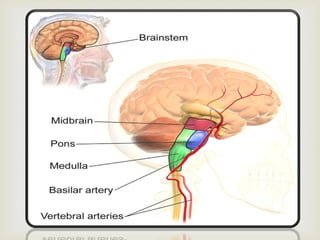
The midbrain is a part of the central
nervous system, located below
the CEREBRAL CORTEX and at the
topmost part of the BRAIN STEM. This
small but important structure plays a
crucial role in processing visual and
auditory signals.
MID BRAIN


Midbrain functions involves movement of
body and head, as it provides passage for
downward pathways for the cerebral cortex.
It is a channel for the spinal cord transmitting
stimuli (sensory) from the head and body to
the direct brain.
 in motor movement, particularly movements
of the eye, and in auditory and visual
processing.
FUNCTIONS

Without the function of the midbrain, we
wouldn’t be able to respond to threats or
even move. eg if you accidentally touch
your hand to a hot stove, your midbrain is
what lets you jerk your hand back. The
midbrain is what controls your motor
movement and reflexes, letting you
respond appropriately to situations like
that
FUNCTION CONTINUED

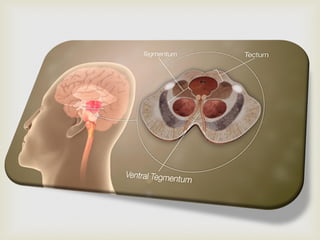
 When viewed in cross-
section, the midbrain can
be divided into three
portions:
 Tectum (posterior)
 Tegmentum
 Cerebral peduncles
(anterior)
Divisions


Sitting posteriorly, the tectum (Latin
for "roof" or "covering") is composed of
the tectal plate and superior and
inferior colliculi. The tectum is unique
to the midbrain and does not have a
counterpart in the rest of the brainstem.
Tectum

Nerve cells within the superior colliculi
process vision signals from the retina of the
eye before channeling them on to
the occipital lobe located at the back of the
head.
The inferior colliculi is responsible for
processing auditory (hearing) signals before
they are channeled through the thalamus and
eventually to the primary auditory cortex in
the temporal lobe
TECTUM FUNCTION

 The tegmentum is the phylogenetically-old part of
the brainstem and runs through the pons and
medulla oblongata .
 he tegmentum is involved in many unconscious
homeostatic and reflexive pathways, and is the
motor center that relays inhibitory signals to the
thalamus and basal nuclei to prevent unwanted
body movement.
Tegmentum

Tegmentum also responsible for :
Tegmentum. Reticular formation: This
highly diverse and integrative area
contains a network of nuclei responsible
for many vital functions
including arousal, consciousness, sleep-
wake cycles, coordination of certain
movements, and cardiovascular control.

Cerebral peduncles: Anterior to the tegmentum
are the cerebral peduncles which are composed
of the large ascending and descending tracts that
run to and from the cerebrum
These cerebral peduncles are the main highway
for signals that need to be transported from the
cortex to other parts of the central nervous
system (CNS), and are especially important for
body coordination.
Cerebral Peduncles

The cerebral peduncles contain part of the
substantia nigrae, which (like the ventral
tegmental area) contain large collections of
dopamine-producing neurons.
Periaqueductal gray (PAG) matter: This area
plays a primary role in
processing pain signals, autonomic function,
and behavioral responses to fear and anxiety.
Cerebral peduncles include :

THANK YOU

Mid Brain

  • 1.
  • 2.
     The midbrain isa part of the central nervous system, located below the CEREBRAL CORTEX and at the topmost part of the BRAIN STEM. This small but important structure plays a crucial role in processing visual and auditory signals. MID BRAIN
  • 3.
  • 4.
     Midbrain functions involvesmovement of body and head, as it provides passage for downward pathways for the cerebral cortex. It is a channel for the spinal cord transmitting stimuli (sensory) from the head and body to the direct brain.  in motor movement, particularly movements of the eye, and in auditory and visual processing. FUNCTIONS
  • 5.
     Without the functionof the midbrain, we wouldn’t be able to respond to threats or even move. eg if you accidentally touch your hand to a hot stove, your midbrain is what lets you jerk your hand back. The midbrain is what controls your motor movement and reflexes, letting you respond appropriately to situations like that FUNCTION CONTINUED
  • 6.
      When viewedin cross- section, the midbrain can be divided into three portions:  Tectum (posterior)  Tegmentum  Cerebral peduncles (anterior) Divisions
  • 7.
  • 8.
     Sitting posteriorly, thetectum (Latin for "roof" or "covering") is composed of the tectal plate and superior and inferior colliculi. The tectum is unique to the midbrain and does not have a counterpart in the rest of the brainstem. Tectum
  • 9.
     Nerve cells withinthe superior colliculi process vision signals from the retina of the eye before channeling them on to the occipital lobe located at the back of the head. The inferior colliculi is responsible for processing auditory (hearing) signals before they are channeled through the thalamus and eventually to the primary auditory cortex in the temporal lobe TECTUM FUNCTION
  • 10.
      The tegmentumis the phylogenetically-old part of the brainstem and runs through the pons and medulla oblongata .  he tegmentum is involved in many unconscious homeostatic and reflexive pathways, and is the motor center that relays inhibitory signals to the thalamus and basal nuclei to prevent unwanted body movement. Tegmentum
  • 11.
     Tegmentum also responsiblefor : Tegmentum. Reticular formation: This highly diverse and integrative area contains a network of nuclei responsible for many vital functions including arousal, consciousness, sleep- wake cycles, coordination of certain movements, and cardiovascular control.
  • 12.
     Cerebral peduncles: Anteriorto the tegmentum are the cerebral peduncles which are composed of the large ascending and descending tracts that run to and from the cerebrum These cerebral peduncles are the main highway for signals that need to be transported from the cortex to other parts of the central nervous system (CNS), and are especially important for body coordination. Cerebral Peduncles
  • 13.
     The cerebral pedunclescontain part of the substantia nigrae, which (like the ventral tegmental area) contain large collections of dopamine-producing neurons. Periaqueductal gray (PAG) matter: This area plays a primary role in processing pain signals, autonomic function, and behavioral responses to fear and anxiety. Cerebral peduncles include :
  • 14.